





Toads are a diverse group of amphibians found across nearly every continent, thriving in environments from deserts to alpine meadows. With their warty skin, sturdy bodies, and remarkable adaptability, toads play a vital role in ecosystems as both predators and prey. This guide introduces 25 fascinating types of toads from around the world—ranging from the familiar American Toad to the rare and localized Black Toad of California. Each species is described in detail, including identification traits, natural habitats, behaviors, and unique adaptations. Whether you’re a nature enthusiast, student, or curious observer, this comprehensive list offers a closer look at the rich variety within the toad family.
1. American Toad

The American Toad (Anaxyrus americanus) is one of the most common toad species in North America, found in a variety of habitats from forests and fields to suburban gardens. Its adaptability, distinctive call, and bumpy skin make it easy to recognize.
Identification
- Bumpy, warty skin with brown, gray, or reddish coloration
- Large parotoid glands behind the eyes
- Usually has 1–2 warts in each dark spot on the back
- Belly is light with dark speckles
- Horizontal pupils with golden irises
Habitat and Range
American Toads inhabit much of the eastern United States and parts of Canada. They prefer moist environments near woodlands, gardens, and wetlands but are also frequently found in backyards and grassy areas.
Behavior
These toads are mostly nocturnal and feed on insects, worms, and other invertebrates. During the day, they stay hidden under leaves, logs, or in shallow burrows. In winter, they hibernate underground.
Breeding and Lifecycle
American Toads breed in spring in shallow ponds or ditches. Males produce a long trilling call to attract females. Females lay long strings of eggs, which hatch into tadpoles in a few days and transform into toadlets in several weeks.
2. Fowler’s Toad
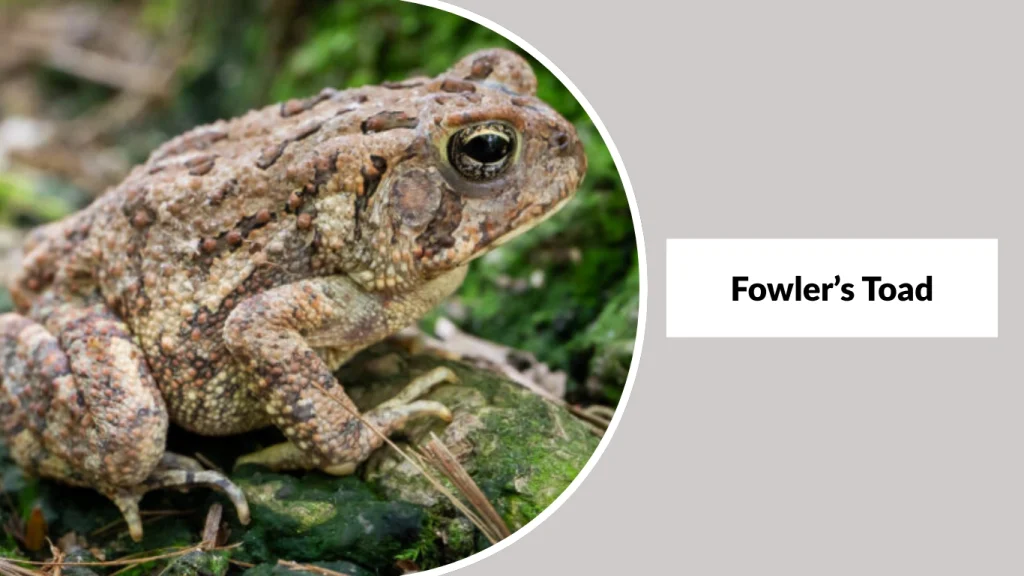
Fowler’s Toad (Anaxyrus fowleri) is a medium-sized toad commonly found in sandy or open habitats across the eastern United States. It closely resembles the American Toad but can be distinguished by its breeding call and wart pattern.
Identification
- Gray, brown, or tan body with darker blotches
- Each dark dorsal spot contains 3 or more warts
- Pale belly with minimal or no dark spotting
- Cranial crests may touch or nearly touch parotoid glands
- Call is a short, nasal “waaaah” sound
Habitat and Range
They inhabit coastal plains, fields, and open woodlands, especially where sandy or loose soil is available for burrowing.
Behavior
Fowler’s Toads are nocturnal insectivores, emerging at night to hunt. During the day, they remain under cover or partially buried. They can secrete a mild toxin as a defense.
Breeding and Lifecycle
Breeding occurs in shallow, temporary pools in late spring to summer. Eggs are laid in gelatinous strings, and development from tadpole to toadlet takes several weeks depending on temperature and water conditions.
3. Cane Toad
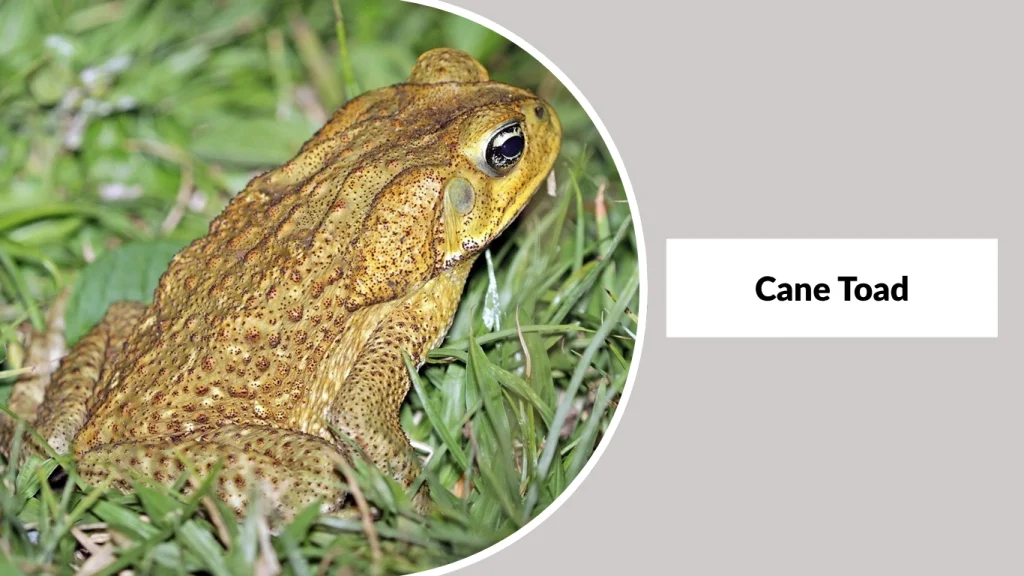
The Cane Toad (Rhinella marina), also known as the Marine Toad or Giant Neotropical Toad, is a large, invasive species known for its potent toxin. Originally from Central and South America, it has been introduced to other regions, often with ecological consequences.
Identification
- Very large body, can grow over 6 inches (15 cm)
- Dry, warty skin with a tan, brown, or grayish color
- Large triangular parotoid glands behind the eyes
- Horizontal pupils and robust limbs
- Toxic milky secretions from skin glands
Habitat and Range
Native to Central and South America, it has been introduced to Australia, the Caribbean, and parts of Asia. It prefers disturbed areas, urban environments, and grasslands.
Behavior
Highly adaptable and active at night, Cane Toads feed on a wide range of prey, including insects, small mammals, and even pet food. They are notorious for their environmental impact in areas where they are invasive.
Breeding and Lifecycle
They breed year-round in warm climates, laying thousands of eggs in water. Tadpoles develop quickly, and the species’ high reproductive rate contributes to its spread.
4. Colorado River Toad
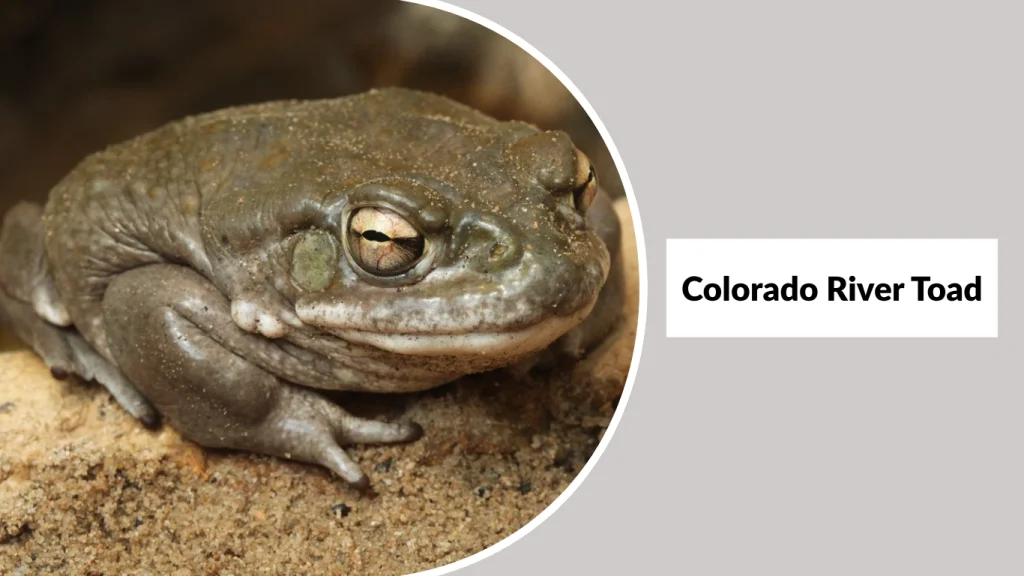
The Colorado River Toad (Incilius alvarius), also known as the Sonoran Desert Toad, is a large, toxic amphibian native to the southwestern United States and northwestern Mexico. It is known for secreting a powerful hallucinogenic substance.
Identification
- Olive green or dull brown coloration
- Smooth skin with few warts
- Large size, often exceeding 7 inches (18 cm)
- Creamy white underside
- Prominent parotoid glands and large tympanum (eardrum)
Habitat and Range
This species inhabits arid and semi-arid regions, particularly in the Sonoran Desert. It prefers areas near water sources like streams and irrigation ditches.
Behavior
Primarily nocturnal, it emerges during monsoon rains to feed on insects and small vertebrates. It secretes toxins as a defense, which can be dangerous to predators and pets.
Breeding and Lifecycle
Breeding is triggered by summer rains. Eggs are laid in strings in temporary pools. Tadpoles develop rapidly before the water dries up.
5. Great Plains Toad

The Great Plains Toad (Anaxyrus cognatus) is a medium to large toad known for its loud, prolonged call and distinctive dorsal pattern. It is native to central North America.
Identification
- Light brown to olive color with dark, symmetrical blotches
- Each blotch contains multiple small warts
- Light stripe running down the back
- Prominent cranial crests
- Large parotoid glands
Habitat and Range
It inhabits prairies, grasslands, and agricultural fields, especially in areas with loose, sandy soil for burrowing.
Behavior
These toads are most active at night and after heavy rains. They remain underground during dry periods, emerging to feed and breed when conditions are moist.
Breeding and Lifecycle
They breed in temporary rain-filled pools in spring and summer. Males produce a high-pitched trill. Eggs hatch quickly, and metamorphosis occurs within several weeks.
6. Western Toad
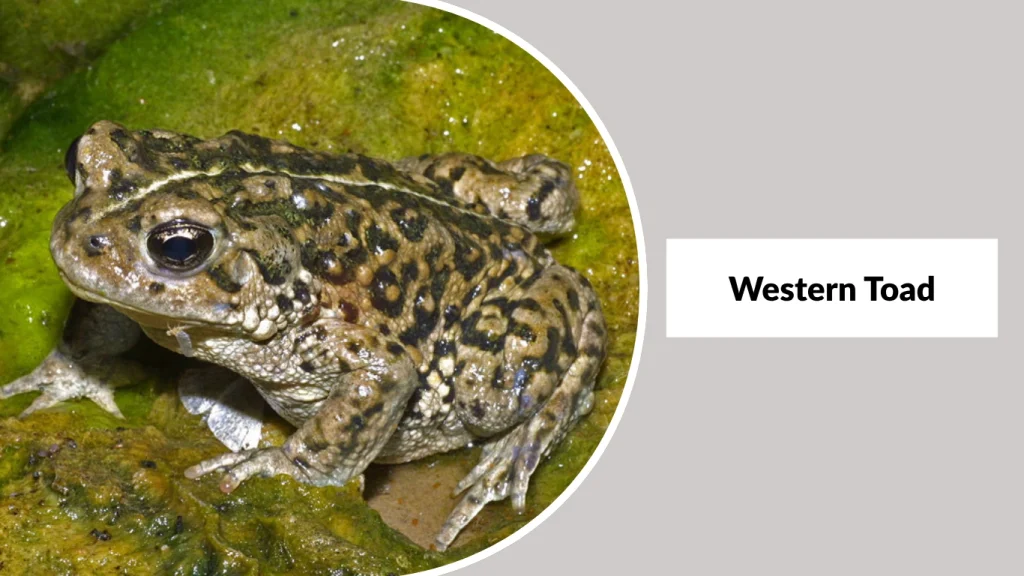
The Western Toad (Anaxyrus boreas) is a widespread species found throughout western North America. It is known for its prominent white or light-colored dorsal stripe and relatively smooth, bumpy skin compared to other toads.
Identification
- Olive, gray, or brownish body with a distinct light-colored dorsal stripe
- Warty skin with dark blotches
- Parotoid glands are oval and located behind the eyes
- No cranial crests
- Typically 2–5 inches in length
Habitat and Range
Western Toads range from Alaska to Baja California and eastward to the Rocky Mountains. They occupy diverse habitats such as mountain meadows, forests, grasslands, and desert fringes. They are especially common near ponds, streams, or marshes where breeding occurs.
Behavior
Western Toads are both nocturnal and diurnal depending on temperature and humidity. They forage for insects and small invertebrates and often travel considerable distances between feeding and breeding sites. During the winter, they hibernate in rodent burrows or other protected spots below the frost line.
Breeding and Lifecycle
Breeding takes place in spring or early summer. Males gather at shallow water bodies and produce a short, chirping call to attract females. Eggs are laid in long strings that float among aquatic vegetation. Tadpoles are social and form large schools before transforming into toadlets in late summer. Juveniles may disperse far from their birthplace.
7. Sonoran Desert Toad
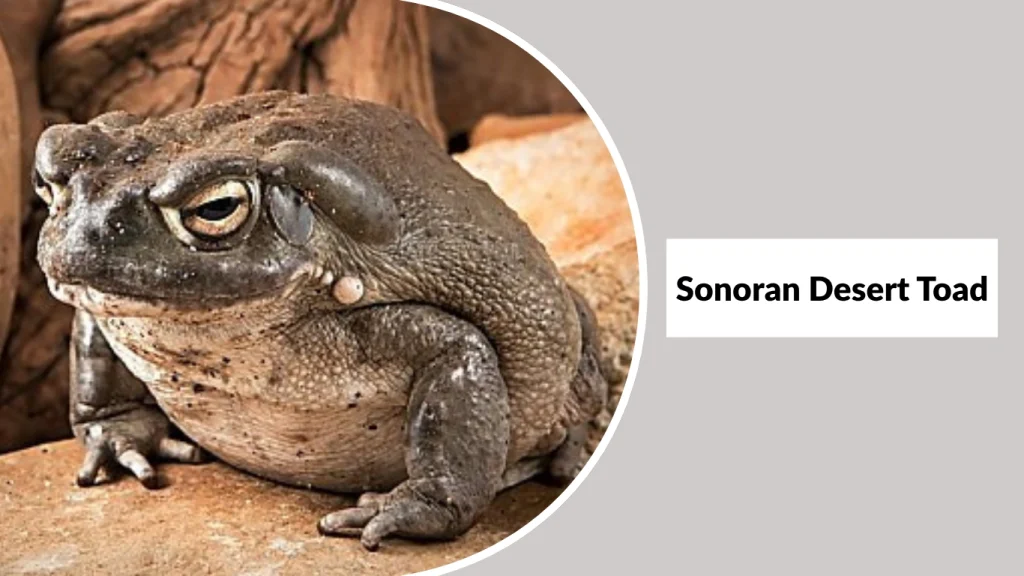
The Sonoran Desert Toad (Incilius alvarius), also known as the Colorado River Toad, is one of the largest native toads in the United States and is especially noted for its powerful toxin, which has gained attention for its psychoactive properties.
Identification
- Large and robust body, reaching up to 7.5 inches (19 cm)
- Smooth, leathery skin with few warts
- Dark green to olive brown coloration
- Large, oval parotoid glands and pronounced tympanic membranes
- Cream-colored underbelly and pale-colored glands on legs
Habitat and Range
This species is native to the Sonoran Desert region of Arizona, New Mexico, and northwestern Mexico. It thrives in desert scrub, grasslands, and mesquite lowlands, especially in areas with temporary pools or irrigation ditches.
Behavior
Sonoran Desert Toads are nocturnal and spend most of the year underground in self-dug burrows or rodent holes. They emerge during summer monsoon rains to feed and breed. Their skin secretes a potent toxin that can sicken or even kill predators—including domestic animals. In humans, the toxin contains 5-MeO-DMT, a powerful hallucinogen.
Breeding and Lifecycle
Breeding is explosive and synchronized with monsoon rains. Males call with a low-pitched trill while floating in shallow pools. Females lay strings of thousands of eggs, which hatch in a few days. Tadpoles grow rapidly, metamorphosing within 3–6 weeks. Due to the desert environment, timing is critical to ensure survival before pools evaporate.
8. Red-spotted Toad

The Red-spotted Toad (Anaxyrus punctatus) is a small, slender toad known for its smooth texture and reddish-orange wart-like spots that contrast beautifully with its light gray or tan body. Native to the southwestern U.S. and parts of Mexico, this desert-adapted toad is active primarily during rainy periods.
Identification
- Small body, typically 1.5 to 3 inches (3.8–7.5 cm) long
- Gray to light brown coloration with numerous red or orange warts
- Smooth, flattened appearance with relatively long limbs
- Oval parotoid glands that do not touch the eye
- Vertical pupils
Habitat and Range
The Red-spotted Toad ranges across the arid and semi-arid regions of the southwestern U.S., including California, Arizona, New Mexico, Texas, and extending into northern Mexico. It thrives in rocky canyons, desert washes, and sandy arroyos, where it finds refuge under rocks or in crevices.
During the dry season, it may aestivate underground to escape the intense heat and lack of moisture. This toad is highly adapted to desert life, often residing far from permanent water sources.
Behavior
This species is nocturnal and most active during or after desert rainstorms. It feeds on ants, beetles, moths, and other small invertebrates. Thanks to its agility and long limbs, it moves with quick hops and can even climb small rock surfaces—an uncommon behavior among toads.
The Red-spotted Toad’s call is a high-pitched musical trill lasting up to 10 seconds, often mistaken for insect sounds. Unlike other toads, it rarely excretes toxins unless directly threatened.
Breeding and Lifecycle
Breeding occurs in temporary rain-filled pools or slow-moving desert streams. Males gather in large numbers after heavy rains, forming choruses. The female lays several strings of eggs, which hatch within a few days. Tadpoles develop quickly—sometimes in as little as 6 to 8 days—taking advantage of the short-lived water sources. Metamorphosis into toadlets is equally rapid, allowing survival before the desert pools evaporate.
9. Southern Toad
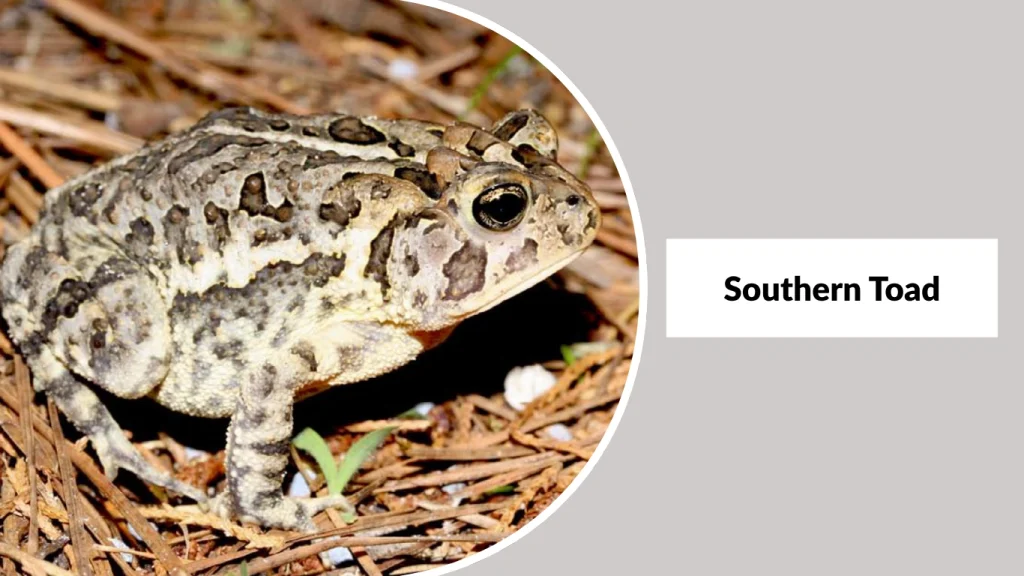
The Southern Toad (Anaxyrus terrestris) is a robust and vocal amphibian native to the southeastern United States. Its prominent cranial crests and earthy coloring help it blend into leaf litter and sandy soils. This toad is especially noted for its long trill and high population density in suburban lawns and pine forests.
Identification
- Medium-sized toad, 2 to 4 inches (5 to 10 cm) in length
- Reddish-brown to gray coloration with darker blotches and warts
- Two pronounced cranial crests that form “horns” above the eyes
- Large parotoid glands located behind each eye
- Pale underbelly with scattered darker specks
Habitat and Range
Found throughout the southeastern U.S., from North Carolina down to Florida and west to eastern Louisiana, the Southern Toad favors sandy woodlands, pine barrens, gardens, and coastal dunes. It is highly tolerant of disturbed habitats and frequently encountered in suburban yards and parks.
Behavior
Southern Toads are primarily nocturnal. They emerge at night to hunt insects, worms, and spiders. During the day, they hide under logs, leaf litter, or in self-dug burrows. Their skin secretions are mildly toxic and serve as a defense against predators such as raccoons, snakes, and birds.
Breeding and Lifecycle
Breeding usually occurs between March and September, depending on rainfall and temperature. Males gather at the edges of shallow ponds, ditches, or slow-moving streams, calling to attract females. After mating, females lay long strings containing thousands of eggs.
10. Woodhouse’s Toad
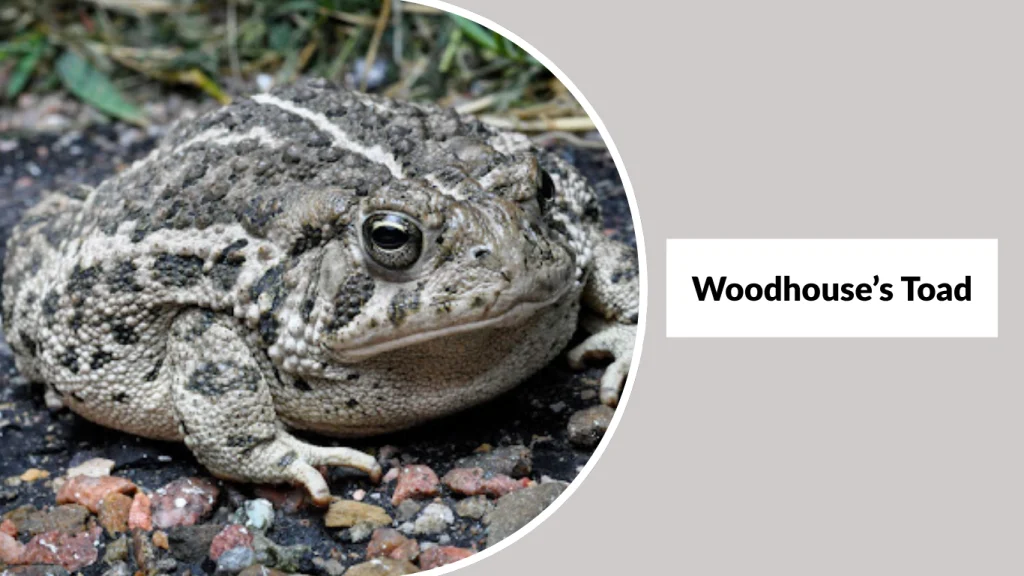
Woodhouse’s Toad (Anaxyrus woodhousii) is a hardy and adaptable species found across much of the central and southwestern United States. Known for its loud sheep-like call and tolerance to urban environments, this toad is frequently encountered near lights at night, where insects gather.
Identification
- Medium to large size: 2.5 to 4 inches (6.3 to 10 cm) long
- Gray, brown, or olive coloration with dark blotches and scattered warts
- Pale mid-dorsal stripe running down the back
- Large, oblong parotoid glands touching or overlapping the cranial crests
- Pale or white belly, sometimes with dark speckling
Habitat and Range
Woodhouse’s Toad is found from the Dakotas and Nebraska southward through Texas and New Mexico, extending west into Utah, Arizona, and parts of California. It occupies a variety of habitats: open grasslands, desert edges, floodplains, woodlands, and human-developed areas like golf courses and irrigated fields
Behavior
This species is most active at night and is commonly seen on roads or patios during warm evenings. It preys on beetles, ants, moths, and other invertebrates. It often positions itself under lights to ambush prey.
When threatened, it inflates its body to appear larger and may secrete a mild toxin from its skin. Though not harmful to humans in small amounts, this secretion can irritate pets if ingested.
Breeding and Lifecycle
Breeding occurs in spring and summer after rainfall. Males congregate in ponds, ditches, and slow-flowing streams to call. Females lay thousands of eggs in long strings. Tadpoles hatch within a few days and typically complete metamorphosis in 4 to 8 weeks.
11. Yosemite Toad

The Yosemite Toad (Anaxyrus canorus) is a high-elevation amphibian native to the Sierra Nevada mountains of California. It is known for its distinct sexual dimorphism: females are colorful with blotches, while males are more uniformly colored. This species is considered threatened due to habitat loss and climate change.
Identification
- Small to medium size: 1.5 to 2.8 inches (3.8–7.1 cm)
- Females: bright yellow to greenish with dark spots
- Males: duller in color, often solid yellow-green or gray
- Short, rounded snout and smooth skin for a toad
- No cranial crests; parotoid glands are small and oval
Habitat and Range
Yosemite Toads are endemic to the Sierra Nevada mountains in California, typically found at elevations between 6,000 and 11,000 feet. They inhabit alpine meadows, coniferous forests, and moist montane grasslands.
These toads rely heavily on wet meadows and snowmelt pools for breeding. Due to their reliance on specific high-altitude habitats, they are highly sensitive to changes in hydrology and temperature.
Behavior
They are diurnal—active during the day, which is rare among toads. Yosemite Toads feed on insects and other small invertebrates found in meadow vegetation.
Outside the breeding season, they remain close to moist refuges under logs, in burrows, or beneath alpine grasses. Hibernation occurs during the long Sierra winters, typically beginning in late summer or fall and lasting through early spring.
Breeding and Lifecycle
Breeding is triggered by the melting of snow in spring or early summer. Males gather at shallow meadow pools and produce a low-pitched, pulsing call. Females lay eggs in gelatinous strands, which develop slowly in cold mountain waters.
12. Arroyo Toad

The Arroyo Toad (Anaxyrus californicus) is a small, cryptic species native to southern California and northwestern Baja California. This toad prefers semi-arid scrub and woodland environments near sandy streams. Due to habitat fragmentation, it is listed as endangered in the United States.
Identification
- Small size: 2 to 3 inches (5–7.5 cm)
- Pale gray, tan, or olive coloring with dark green or brown patches
- Weak or absent dorsal stripe
- Warty skin and parotoid glands that are oval and widely spaced
- Pale underbelly with no dark spotting
Habitat and Range
This species is highly habitat-specific, favoring shallow, sandy-bottomed streams with adjacent floodplains and sparse vegetation. It occurs from Monterey County south through coastal California and into Baja. Preferred habitats include riparian corridors in oak woodland, chaparral, and sage scrub ecosystems.
Behavior
Arroyo Toads are nocturnal and spend much of the year buried in loose sand or beneath vegetation, emerging during the breeding season or after rains. They feed on ants, beetles, and other small invertebrates.
Unlike many toads, they are poor climbers and walkers. When disturbed, they often remain motionless, blending into the substrate. Their call is a high-pitched musical trill, but populations are now scattered, making choruses rare.
Breeding and Lifecycle
Breeding occurs between March and July, usually following spring rains. Males congregate in slow-moving, sandy pools along streams. Females deposit eggs in long, double-stranded rows along submerged sandbars.
Tadpoles hatch quickly and remain in shallow water until metamorphosis, which may take up to 6 weeks. Juvenile toads stay close to moist soils in riparian zones. Because the species is so specialized, altered water flow or erosion can easily disrupt its entire reproductive cycle.
13. Green Toad
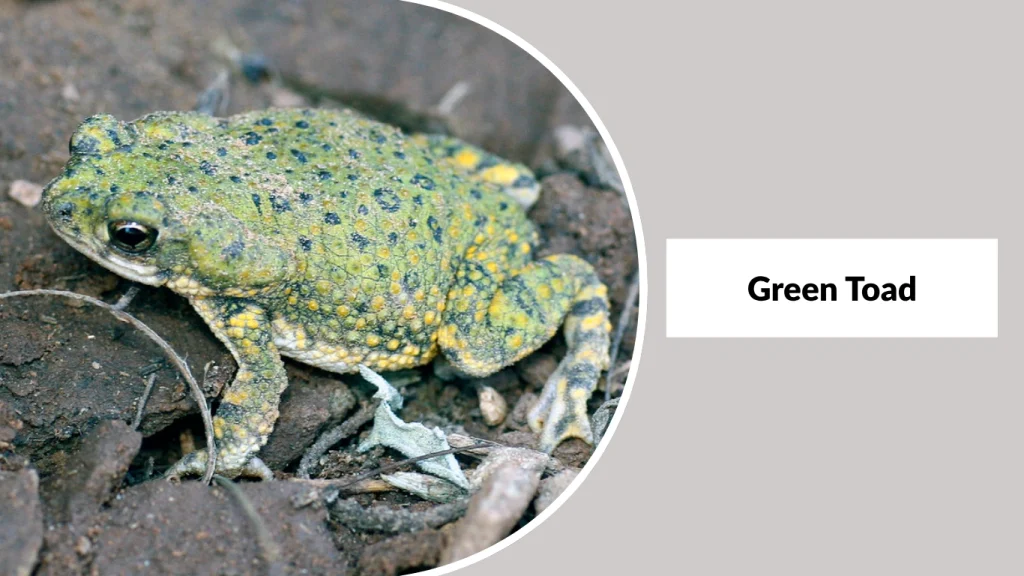
The Green Toad (Anaxyrus debilis) is one of the smallest and most vividly colored toads in North America. Found primarily in arid and semi-arid regions of the southwestern U.S. and northern Mexico, it is well adapted to desert conditions and thrives after summer rains.
Identification
- Very small size: 1.25 to 2 inches (3.2–5 cm)
- Bright green or yellow-green body with black reticulated markings
- Smooth to slightly warty skin
- Small, oval parotoid glands and round pupils
- Belly is pale and unspotted
Habitat and Range
Green Toads inhabit desert grasslands, scrublands, and rocky flats across western Texas, New Mexico, Arizona, and northern Mexico. They prefer open terrain with sandy or loamy soils that allow easy burrowing.
This toad is strongly associated with summer monsoon rains and spends much of the year underground, entering a state of dormancy during dry periods.
Behavior
Highly secretive for most of the year, Green Toads emerge suddenly after heavy rains to feed and breed. They are primarily insectivorous, consuming ants, termites, and beetles. Their activity is strictly nocturnal, and they may only be above ground for a few days each year.
The Green Toad’s call is a high-pitched, sharp trill lasting about 1–2 seconds, often heard in desert washes during monsoon season. They are not aggressive and rarely secrete toxins unless handled roughly.
Breeding and Lifecycle
Breeding takes place immediately following summer rain events, typically from June to August. Males call from shallow, temporary pools to attract females. Egg strings are deposited overnight and hatch within a few days.
Because these toads often breed in puddles that may dry rapidly, tadpole development is exceptionally fast, sometimes completing metamorphosis in under 10 days. Juveniles disperse quickly and seek out microhabitats with residual moisture before the desert dries out again.
14. Gulf Coast Toad
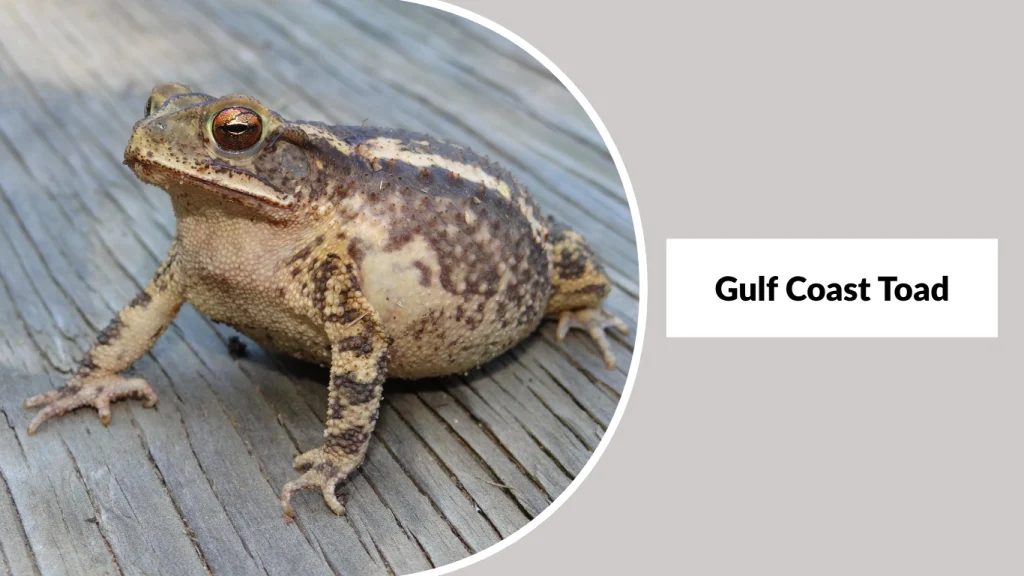
The Gulf Coast Toad (Incilius nebulifer) is a common amphibian of the southeastern United States and eastern Mexico, easily recognized by its broad, flattened body and bold, contrasting stripe. It thrives in both natural wetlands and human-altered habitats.
Identification
- Medium to large size: 2 to 4.5 inches (5–11.5 cm)
- Dark brown to black body with a prominent white or yellow dorsal stripe
- Rough, warty skin with dark blotches on limbs
- Large parotoid glands and visible cranial crests
- Pale underbelly, sometimes with dark speckling
Habitat and Range
This species is native to the Gulf Coast region—from Mississippi to Texas and down into eastern Mexico. It thrives in marshes, swamps, ditches, fields, and even urban backyards. It often inhabits lowland areas prone to temporary flooding.
Gulf Coast Toads are tolerant of disturbed areas and are frequently seen near homes, streetlights, and agricultural zones. Their adaptability has allowed them to expand their range over time.
Behavior
Primarily nocturnal, Gulf Coast Toads feed on a wide variety of insects and other invertebrates. They are known for their resistance to mild droughts and can often be found under stones, logs, or buried in leaf litter.
These toads may secrete a strong-smelling toxin from their skin when threatened, which can deter many predators. They also exhibit a common defense behavior—remaining still and blending into their surroundings.
Breeding and Lifecycle
They breed in any available standing water, including puddles, ditches, and cattle tanks. Breeding occurs opportunistically throughout the warm season, especially after rains.
Females lay long strands of eggs, which hatch in a few days. Tadpoles develop quickly and complete metamorphosis within 3–6 weeks. Newly emerged toadlets disperse widely, often colonizing nearby lawns and gardens.
15. Natterjack Toad

The Natterjack Toad (Epidalea calamita) is a European species known for its loud, rasping call and preference for sandy heathlands and coastal dunes. It is one of the few toads in Europe with a truly terrestrial breeding strategy and is of conservation concern in many regions.
Identification
- Small to medium size: 2 to 3 inches (5–7.5 cm)
- Light olive or sandy brown coloration with darker blotches
- Bright yellow dorsal stripe running from head to vent
- Short legs and a stocky build, giving it a distinctive waddling gait
- Smooth to moderately warty skin; pale underside
Habitat and Range
Native to western and central Europe, the Natterjack Toad is found in coastal dunes, heathlands, sandy grasslands, and lowland moors. Its range includes parts of the UK, Ireland, France, Spain, and Germany.
It prefers open, unshaded habitats with shallow temporary pools for breeding. Habitat loss and fragmentation have caused sharp declines in many areas, prompting conservation actions including managed breeding ponds and restricted grazing.
Behavior
This toad is mostly nocturnal, emerging at dusk to forage for beetles, spiders, and ants. Unlike many toads, it moves by running or walking rather than hopping, aided by its short limbs.
Males are highly vocal and gather in large choruses during breeding season. Their call, a loud and metallic “ratchet-like” rasp, can carry over long distances—especially in the open landscapes they favor.
Breeding and Lifecycle
Breeding begins in spring and extends into summer, depending on local climate. Males call from the edges of shallow, sun-warmed pools, which may dry quickly.
Females lay eggs in strings, typically producing hundreds to a few thousand per clutch. Because the pools are short-lived, tadpoles develop rapidly, often metamorphosing in as little as three weeks.
16. Eastern Spadefoot Toad

The Eastern Spadefoot Toad (Scaphiopus holbrookii) is a secretive, burrowing amphibian native to the eastern and southeastern United States. It is named for the hard, black spade on each hind foot, which it uses to dig backward into loose soil.
Identification
- Medium-sized: 1.75 to 3 inches (4.4–7.6 cm)
- Smooth, moist skin that’s brown or gray with irregular yellowish lines
- Vertical, cat-like pupils (unusual among toads)
- No prominent parotoid glands or cranial crests
- Hard, sickle-shaped black spade on each hind foot
Habitat and Range
This toad inhabits sandy or loose soils in pine forests, coastal plains, open fields, and dry uplands from New England south to Florida and west into the Mississippi Valley. It favors environments where it can burrow easily.
Despite its wide range, it is rarely seen because it spends most of its life underground. It emerges primarily during heavy rains, often after long periods of drought.
Behavior
Eastern Spadefoots are fossorial, spending most of their lives several inches below ground. When disturbed, they can rapidly burrow backward into soil using their spade-like feet.
They are nocturnal and insectivorous, feeding on beetles, ants, crickets, and earthworms. Their defense includes producing a musky secretion when handled.
Breeding and Lifecycle
This species breeds in ephemeral pools formed by rainstorms. Males gather in shallow water and call in groups. Females lay eggs in jelly-like strands, which hatch within 48 hours.
Tadpoles grow rapidly and can metamorphose in as little as two weeks—an adaptation to the short-lived nature of their breeding pools. Newly emerged toadlets are vulnerable to desiccation and must quickly find shelter..
17. Western Spadefoot Toad

The Western Spadefoot Toad (Spea hammondii) is a small, desert-adapted amphibian found in California and northern Baja California. Its ability to remain dormant underground for most of the year allows it to survive in some of the driest parts of its range.
Identification
- Small size: 1.5 to 2.5 inches (3.8–6.3 cm)
- Light gray to olive or brown body with irregular green or black spots
- Smooth to slightly rough skin with fewer warts than true toads
- Cat-like vertical pupils and no cranial crests
- Pale spade on each hind foot used for digging
Habitat and Range
This species is endemic to California, occurring in grasslands, coastal sage scrub, and oak woodlands, typically below 5,000 feet in elevation. It requires loose, friable soils for burrowing and ephemeral pools for breeding.
The toad’s range overlaps with urban and agricultural areas, making it vulnerable to habitat fragmentation, road mortality, and pesticide use.
Behavior
Western Spadefoots are highly secretive and fossorial. They spend most of the year underground in self-dug burrows, emerging only after heavy rains—sometimes just a few nights a year.
Their diet consists of ants, beetles, termites, and other small arthropods. They secrete a mild, peanut-scented skin toxin when threatened, which can cause allergic reactions in some people.
Breeding and Lifecycle
Breeding is highly synchronized with rainfall. When triggered by precipitation, males gather in shallow, temporary pools and call to attract females. Eggs are laid in gelatinous strings attached to submerged vegetation or debris.
Tadpoles grow rapidly, metamorphosing in as little as 8–14 days depending on water temperature. This rapid development allows them to survive in pools that may evaporate quickly.
18. African Common Toad

The African Common Toad (Sclerophrys regularis), also known as the African Toad or Egyptian Toad, is a widespread and adaptable species found throughout sub-Saharan Africa. It plays an important role in pest control but also faces threats from habitat loss and pollution in urban environments.
Identification
- Medium to large size: 2.5 to 5 inches (6–13 cm)
- Dull brown, gray, or olive with darker blotches or mottling
- Rough, warty skin with noticeable parotoid glands behind the eyes
- Cranial crests often present above the eyes
- Belly is pale with variable dark speckling
Habitat and Range
This species is broadly distributed across sub-Saharan Africa, from Senegal and Sudan to Angola and South Africa. It occupies a wide range of habitats including savannas, grasslands, forests, agricultural land, and urban areas.
African Common Toads are highly adaptable to human-altered environments and are frequently found in gardens, near homes, and around streetlights where insects congregate. They favor moist areas for breeding but can tolerate seasonal dryness through burrowing and dormancy.
Behavior
Nocturnal by nature, African Common Toads emerge at dusk to forage on a diverse diet of insects, worms, snails, and other invertebrates. During the day, they hide under rocks, logs, leaf litter, or in burrows.
When threatened, they puff up their bodies, secrete a milky toxin from their parotoid glands, and may emit low defensive vocalizations. Though harmless to humans in small contact, the toxins can irritate pets or predators.
Breeding and Lifecycle
Breeding usually occurs during the rainy season, when males gather around ponds, puddles, or ditches and produce a low-pitched, guttural trill. Females lay thousands of eggs in gelatinous strings, typically anchored to submerged vegetation.
Eggs hatch within a few days, and the tadpoles are black and social, often seen in swarms. Metamorphosis takes place within 4–6 weeks, depending on water temperature and availability.
19. European Green Toad
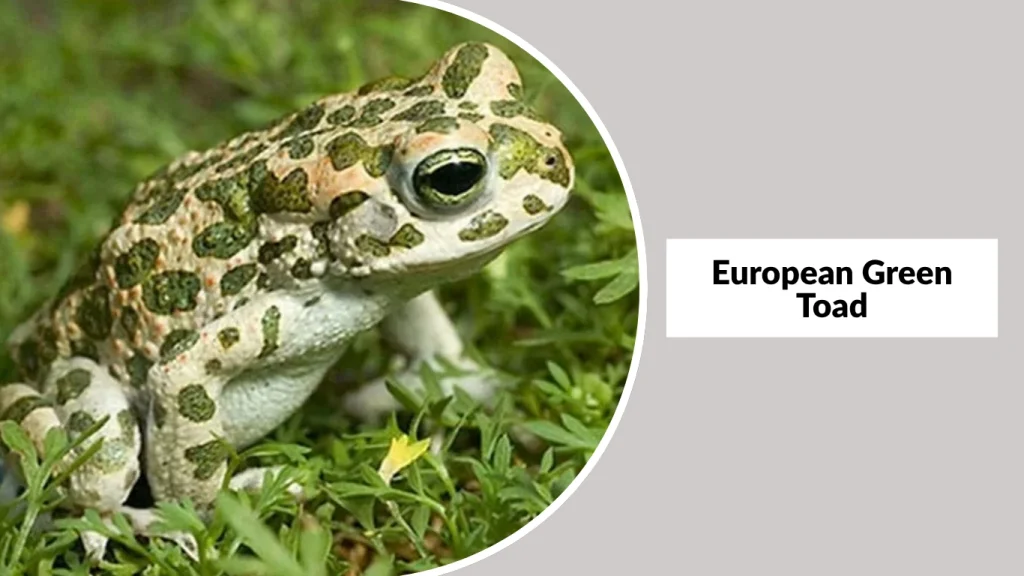
The European Green Toad (Bufotes viridis) is a visually striking species with bright green patterns across a pale background. Native to central and southern Europe and parts of Asia, this toad is tolerant of dry climates and urban environments but is declining in many regions due to habitat changes.
Identification
- Medium-sized: 2.5 to 4 inches (6–10 cm)
- Pale gray to cream-colored body with irregular bright green patches
- Skin is dry and bumpy with scattered warts
- No prominent cranial crests; parotoid glands are oval and moderately sized
- Underside is pale and unspotted
Habitat and Range
This species ranges from France and Germany eastward to Kazakhstan and southward into Greece, Turkey, and parts of the Middle East. It inhabits open woodlands, steppe, scrublands, agricultural fields, and urban parks.
European Green Toads are highly tolerant of disturbed habitats and are frequently found near buildings, in gardens, and around temporary water sources. They can survive in semi-arid environments, provided seasonal water is available for breeding.
Behavior
They are mostly nocturnal, emerging at night to forage for insects, spiders, and worms. They prefer open terrain and are known for their agile movements and tolerance to dry conditions.
This toad can secrete mild toxins as a defense, but it rarely poses a threat to humans or pets. During droughts or cold seasons, it may burrow underground or find refuge beneath stones and debris.
Breeding and Lifecycle
Breeding occurs from early spring to midsummer, triggered by warm rains. Males gather in shallow, warm ponds and ditches to call. Females lay long strings of eggs, which hatch within a week.
Tadpoles are dark and small but grow rapidly, transforming into juvenile toads within 4–6 weeks. The species is known for hybridizing with related species in overlapping zones, creating hybrid offspring in some areas.
20. Asiatic Toad

The Asiatic Toad (Bufo gargarizans), also called the Chinese Common Toad, is a robust amphibian native to East Asia. It holds ecological, medical, and cultural significance, as it is used in traditional Chinese medicine and is a familiar sight in rural and suburban landscapes.
Identification
- Medium to large size: 2.7 to 5 inches (7–13 cm)
- Brown to dark gray body with raised warts and ridges
- Large parotoid glands producing potent secretions
- Irregular dark blotches on the back and limbs
- Belly is pale with dark marbling; cranial crests are prominent
Habitat and Range
The Asiatic Toad is widespread in China, the Korean Peninsula, and parts of Russia and Mongolia. It inhabits forests, fields, gardens, rice paddies, and low mountain areas. It is often found near streams, irrigation channels, and other moist environments.
It tolerates moderate levels of human disturbance and is commonly seen in villages and farmlands, especially during the rainy season.
Behavior
This toad is mainly nocturnal but may be active on overcast or rainy days. It feeds on a broad diet including insects, spiders, slugs, and even small vertebrates. Its defensive toxin, known as “chan su” in traditional medicine, is extracted from skin glands and has cardiotoxic properties.
Breeding and Lifecycle
Breeding occurs during spring and early summer in shallow water bodies such as ditches, ponds, and flooded fields. Males arrive first and produce long, rhythmic calls to attract females. Mating takes place in water, and females lay egg strings that may contain thousands of eggs.
21. Panamanian Golden Toad

The Panamanian Golden Toad (Atelopus zeteki), also known as Zetek’s Golden Frog, is a critically endangered and iconic amphibian endemic to Panama. Its vibrant yellow-gold coloration and symbolic status have made it a national treasure, though it now survives mostly in captive breeding programs.
Identification
- Small size: 1.5 to 2.5 inches (3.8–6.3 cm)
- Males are bright yellow to golden-orange; females are larger with more olive or spotted coloring
- Smooth, glossy skin with slender limbs and a pointed snout
- No visible tympanum (eardrum), a unique trait among toads
- Long limbs with partially webbed toes
Habitat and Range
Historically, it was found in mid-elevation cloud forests along the Cordillera Central in western-central Panama, particularly near fast-flowing mountain streams. Its habitat included mossy forest floors, wet leaves, and stream banks.
The species requires cool, humid conditions with constant access to clean, flowing water for breeding. Its limited range made it especially vulnerable to disease and climate variation.
Behavior
Panamanian Golden Toads are diurnal, unlike many toads, and often seen perched on mossy rocks or walking slowly through damp foliage. They communicate through a combination of soft calls and hand-waving gestures called “semaphoring,” used to attract mates or signal rivals in the noise of fast-moving streams.
Breeding and Lifecycle
Breeding typically occurred during the rainy season, from July to September. Males would guard small territories along stream edges and call to females with soft, high-pitched trills. After mating, females laid eggs in clear, shallow pools attached to submerged rocks or plants.
22. Balearic Green Toad

The Balearic Green Toad (Bufotes balearicus) is a species endemic to the Balearic Islands and parts of southern Italy. Closely related to the European Green Toad, it is known for its attractive green markings and resilience in Mediterranean climates.
Identification
- Medium-sized: 2.5 to 4 inches (6–10 cm)
- Creamy or light tan background with large, irregular green blotches
- Smooth to moderately warty skin
- Oval parotoid glands and horizontal pupils
- Pale belly, often unspotted
Habitat and Range
Originally endemic to the Italian Peninsula and some nearby islands, the Balearic Green Toad has been introduced to the Balearic Islands (Mallorca, Menorca, Ibiza, and Formentera), where it has become widespread.
It prefers dry shrublands, coastal areas, olive groves, and cultivated lands. The species is tolerant of disturbed environments and breeds in man-made water bodies, such as irrigation canals and livestock troughs.
Behavior
Nocturnal and secretive during the day, Balearic Green Toads shelter under stones, walls, or vegetation. At night, they emerge to hunt insects, worms, and small arthropods.
When threatened, they inflate their bodies and release a foul-smelling toxin from their skin glands. Their coloration provides camouflage among dry leaves and rocky terrain, aiding in predator avoidance.
Breeding and Lifecycle
Breeding begins with the arrival of spring rains, typically from March to May. Males call from shallow pools, often in groups. Females lay eggs in long strings that cling to submerged vegetation or debris.
Tadpoles are small, dark, and often form loose aggregations. Development takes about 4–6 weeks, with metamorphosis timed to coincide with declining water levels.
23. Smooth-sided Toad
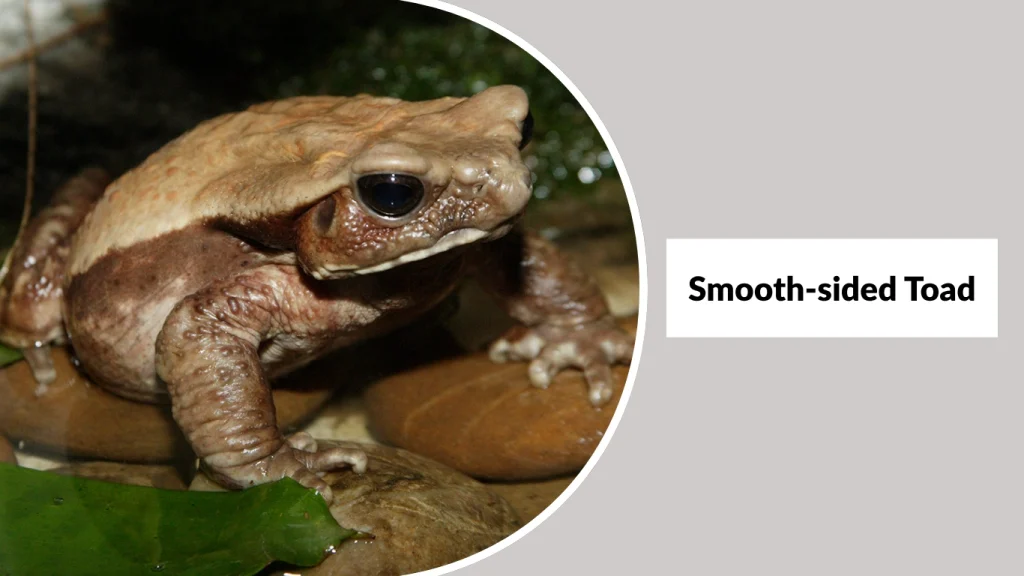
The Smooth-sided Toad (Rhaebo guttatus) is one of the largest toads in South America, known for its shiny skin and powerful toxins. It inhabits tropical rainforests and is often encountered along riverbanks and forest edges.
Identification
- Large body: 4 to 7 inches (10–18 cm)
- Smooth, leathery skin with few visible warts
- Color varies from reddish-brown to olive; underside is pale with dark mottling
- Large parotoid glands that curve downward behind the eyes
- Stout limbs and thick-set body
Habitat and Range
Native to northern South America, the Smooth-sided Toad is found in the Amazon Basin, including Brazil, Colombia, Ecuador, Peru, and Venezuela. It prefers humid lowland forests, especially areas near streams and swampy terrain.
This species is largely terrestrial and rarely ventures far from water. It is active during the rainy season and retreats to cover in the dry months.
Behavior
Nocturnal and solitary, it feeds on insects, spiders, centipedes, and even small vertebrates. It is a sit-and-wait predator, remaining still and ambushing passing prey.
Its skin glands secrete bufotoxins, which are potent enough to deter large predators. Indigenous groups have reportedly used its secretions for medicinal or ritual purposes, though with caution due to their toxicity.
Breeding and Lifecycle
Little is documented about its precise breeding habits in the wild, but it is believed to breed during the rainy season, when pools and temporary wetlands form.
Eggs are laid in aquatic environments, and tadpoles develop over several weeks before transforming. Due to its reclusive nature and difficult terrain, detailed studies of its reproduction are limited..
24. Yellow-bellied Toad

The Yellow-bellied Toad (Bombina variegata) is a small and striking amphibian native to central and southeastern Europe. Its bright, warning-colored belly and flattened body are key characteristics, and it thrives in mountain meadows, forest edges, and disturbed habitats.
Identification
- Small size: 1.4 to 2.2 inches (3.5–5.5 cm)
- Dorsal side is gray, brown, or olive with a warty texture
- Ventral side is vibrant yellow with irregular black blotches
- Pupils are heart- or triangular-shaped
- Body is flat with short limbs and no visible parotoid glands
Habitat and Range
Yellow-bellied Toads are distributed across the Alps, Carpathians, Dinaric Alps, and Balkans, extending from France and Germany through Austria, Hungary, Romania, and the western Balkans.
They inhabit shallow puddles, ruts, livestock ponds, and forest pools—especially in limestone-rich terrain. The species is well adapted to temporary water sources and can even be found in tire ruts and roadside ditches.
Behavior
This toad is diurnal and often basks in shallow water. When threatened, it exhibits an “unken reflex”—arching its back and limbs to display its vividly colored belly as a warning to predators.
Its skin secretes a bitter toxin that discourages ingestion. While not dangerous to humans, the secretion can cause mild irritation if handled improperly.
Breeding and Lifecycle
Breeding occurs from late spring to summer, often multiple times if conditions are favorable. Males call from shallow pools to attract females. Mating occurs in water, and females lay small clusters of eggs (usually fewer than 30 at a time) attached to submerged plants or debris.
25. Black Toad

The Black Toad (Anaxyrus exsul), also known as the Deep Springs Toad, is a rare and geographically restricted species found only in a small area of eastern California. It is known for its dark coloration, musical call, and extreme habitat specificity.
Identification
- Small size: 1.5 to 2 inches (3.8–5 cm)
- Uniform black to dark brown skin with lighter flecking or mottling
- Body is slender and slightly flattened
- Small parotoid glands and short limbs
- Pale belly with minimal pattern
Habitat and Range
The Black Toad is endemic to Deep Springs Valley in Inyo County, California. Its entire known population resides in a few spring-fed wetlands and irrigation ditches at elevations above 5,000 feet.
This species is extremely habitat-specific, relying on permanent water in an arid, high-desert basin. It occupies grassy marshes, shallow spring pools, and narrow irrigation channels used by livestock.
Behavior
Black Toads are active during the day and night but prefer cooler temperatures. They are typically found basking near water, perched on grasses or muddy banks. Their diet includes ants, beetles, spiders, and other small invertebrates.
When threatened, they retreat into water or dense vegetation. They are not known for strong skin toxins, and their defense relies more on camouflage and escape.
Breeding and Lifecycle
Breeding occurs from March through May in spring-fed pools and ditches. Males call from vegetated shallows. Females lay small strings of eggs attached to submerged grass or algae.
Eggs hatch within a week, and tadpoles develop over the course of 5–7 weeks. Metamorphosis is timed to match stable water levels, which are maintained by year-round springs.