




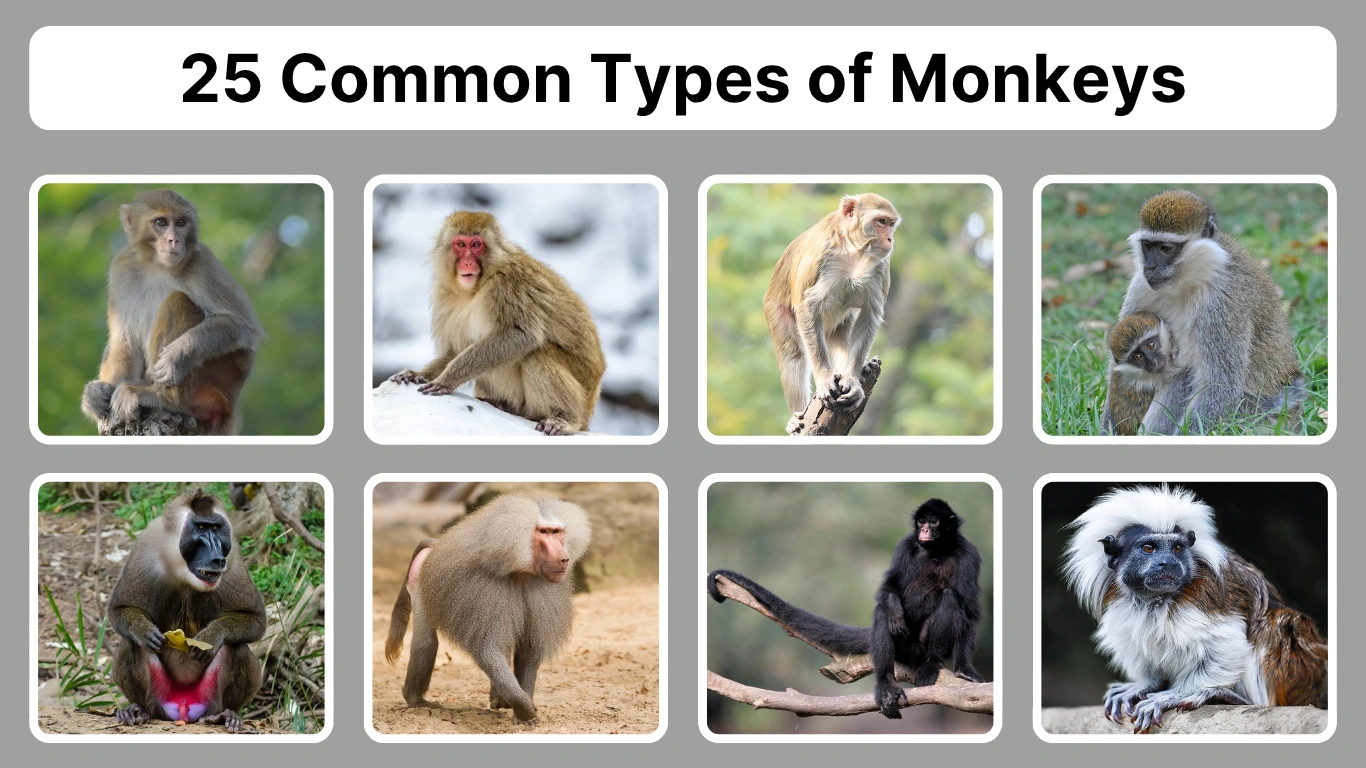
Monkeys are among the most diverse and fascinating animals on Earth, found in a wide range of environments—from the snowy mountains of Japan to the rainforests of South America and the savannas of Africa. With over 300 species classified into Old World and New World monkeys, each type has its own unique features, behaviors, diets, and habitats.
In this guide, you’ll discover 25 of the most well-known and widely recognized monkey species from around the world. Each section highlights how to identify them, where they live, what they eat, and how they behave in the wild. Whether you’re a wildlife enthusiast, a student, or just curious about primates, this list will offer valuable insights into the rich variety of monkey species that inhabit our planet.
1. Rhesus Macaque

The Rhesus Macaque (Macaca mulatta) is one of the most widespread and well-known monkey species in the world. Native to Asia, this adaptable primate is often found near human settlements and is widely used in scientific research due to its close genetic relationship to humans.
Identification
- Size: 17–25 inches in body length (excluding tail)
- Tail: 8–10 inches long
- Color: Light brown, grayish, or reddish-brown fur with a pink face
- Weight: Males: 14–17 pounds; Females: 8–12 pounds
- Face: Bare, expressive face without fur
Natural Habitat and Range
Rhesus Macaques are found across a wide region, including northern India, Nepal, Bangladesh, Pakistan, China, and parts of Southeast Asia. They thrive in diverse environments such as forests, grasslands, mountains, and urban areas. Their ability to live near humans has allowed them to expand even into cities and temples.
Diet and Feeding Habits
These monkeys are omnivorous and opportunistic feeders. Their diet includes fruits, seeds, roots, small animals, insects, and human-provided food like bread, rice, and snacks. They are known to raid crops and scavenge in towns and markets.
Behavior and Social Structure
Rhesus Macaques are highly social and live in large troops led by dominant males and females. They communicate through vocal calls, facial expressions, and body postures. Grooming is a key part of social bonding. They are diurnal and spend most of their time on the ground but can climb well when needed.
Intelligence and Human Interaction
These monkeys are highly intelligent, capable of learning tasks, solving problems, and using tools. Because of their similarity to humans, they are extensively used in biomedical research. In urban areas, they are both worshipped and considered pests, depending on cultural and regional contexts.
2. Japanese Macaque (Snow Monkey)
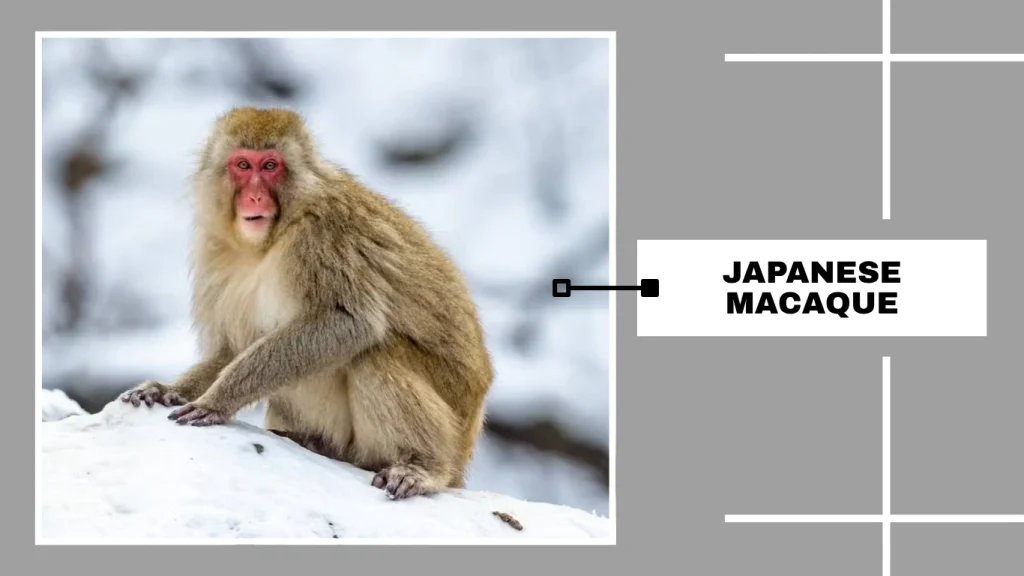
The Japanese Macaque (Macaca fuscata), commonly known as the Snow Monkey, is native to Japan and is famous for surviving in some of the coldest climates of any non-human primate. These monkeys are often seen soaking in natural hot springs during winter.
Identification
- Size: 20–24 inches in body length
- Tail: Short, about 3 inches
- Color: Thick gray-brown fur with a pinkish-red face
- Weight: Males: 25–40 pounds; Females: 15–25 pounds
- Face: Bare and pink, with expressive features
Natural Habitat and Range
Japanese Macaques inhabit a range of environments, from subtropical forests to snow-covered mountainous regions in Japan, including Honshu, Shikoku, and Kyushu islands. They live in both deciduous and evergreen forests, often in mountainous terrain.
Diet and Feeding Habits
They are omnivores with a seasonal diet that includes fruits, seeds, leaves, insects, bark, and even fish or soil minerals. Their adaptability helps them survive in cold months by foraging under snow and using geothermal hot springs.
Behavior and Social Structure
Japanese Macaques live in troops with complex social hierarchies. Females typically remain in their natal group, while males migrate. They are known for their intelligence and have been observed washing food, using hot springs, and even forming cultural habits unique to each troop.
3. Barbary Macaque

The Barbary Macaque (Macaca sylvanus) is the only monkey species native to North Africa and the only wild monkey found in Europe (Gibraltar). It’s a tailless species, often mistaken for an ape due to its build.
Identification
- Size: 21–30 inches in body length
- Tail: None (tailless)
- Color: Light brown to grayish fur with a pale underside
- Weight: Males: 30–40 pounds; Females: 20–30 pounds
- Face: Pinkish, fur-free, and expressive
Natural Habitat and Range
Barbary Macaques are native to the mountainous forests of Algeria and Morocco, especially the Atlas Mountains. A small, introduced population lives in Gibraltar, where they are a well-known tourist attraction.
Diet and Feeding Habits
Their diet includes fruits, leaves, roots, seeds, insects, and occasionally snails or small vertebrates. In Gibraltar, they are known to feed on food scraps and handouts from humans, which has led to behavior changes.
Behavior and Social Structure
Barbary Macaques are social animals that live in mixed-sex troops. Unusually, males play an active role in caring for infants, often carrying and grooming them. They communicate through vocalizations, facial gestures, and grooming. Despite their friendliness in Gibraltar, they are a threatened species in the wild due to habitat loss and illegal pet trade.
4. Bonnet Macaque

The Bonnet Macaque (Macaca radiata) is a social and adaptable monkey species native to southern India. Named for the “bonnet” of hair radiating from the crown of its head, this species is commonly seen near temples, roads, and cities.
Identification
- Size: 15–25 inches in body length
- Tail: Long and slender, often longer than the body
- Color: Light gray to golden brown fur with a pale underside
- Weight: Males: 15–22 pounds; Females: 8–15 pounds
- Face: Pinkish, rounded, with hair parted at the top like a cap
Natural Habitat and Range
Bonnet Macaques are found throughout southern India, including Tamil Nadu, Karnataka, Kerala, and Andhra Pradesh. They live in dry forests, riverbanks, urban parks, and temples, thriving in close proximity to humans.
Diet and Feeding Habits
They are omnivores, eating fruits, grains, leaves, seeds, insects, and food from human settlements. They’re known for scavenging and stealing food, especially in markets and pilgrim sites.
Behavior and Social Structure
These monkeys live in large troops led by dominant males. Grooming and vocal communication are essential to their social interactions. They are diurnal and often seen on roadsides, rooftops, and temple complexes. Their tolerance of humans has made them common but sometimes problematic in urban settings.
5. Crab-eating Macaque (Long-tailed Macaque)

The Crab-eating Macaque (Macaca fascicularis), also known as the Long-tailed Macaque, is a widespread Southeast Asian monkey found in forests, mangroves, and even cities. Its long tail and cheek pouches make it easy to recognize.
Identification
- Size: 16–22 inches in body length
- Tail: Very long—often longer than the body
- Color: Brown to grayish fur with a lighter belly and pinkish face
- Weight: Males: 10–18 pounds; Females: 6–12 pounds
- Face: Slender with expressive eyes and pronounced cheek pouches
Natural Habitat and Range
These monkeys are native to Southeast Asia, including Thailand, Indonesia, the Philippines, and Malaysia. They inhabit lowland rainforests, coastal mangroves, temples, and urban areas near humans and water bodies.
Diet and Feeding Habits
Despite the name, crab-eating macaques eat a wide range of food: fruits, leaves, seeds, insects, crabs, shellfish, and human leftovers. They are skilled foragers, known to wash food and crack open shells.
Behavior and Social Structure
They live in hierarchical troops with dominant males and multiple females. Highly intelligent and curious, they are often involved in conflicts with humans due to crop raiding and food theft. They are also widely used in medical and psychological research because of their adaptability and complex behavior.
6. Vervet Monkey

The Vervet Monkey (Chlorocebus pygerythrus) is a small, agile Old World monkey native to sub-Saharan Africa. Recognizable by its black face and hands, this species is known for its complex social behavior and alarm calls specific to predators.
Identification
- Size: 16–22 inches in body length
- Tail: Long and semi-prehensile, longer than the body
- Color: Grayish-green fur with a white belly and black face
- Weight: Males: 8–12 pounds; Females: 6–10 pounds
- Face: Hairless black face with white fringe
Natural Habitat and Range
Vervet Monkeys are found throughout eastern and southern Africa, in savannas, woodlands, riverbanks, and even urban gardens and farms. They are highly adaptable and often coexist near human settlements.
Diet and Feeding Habits
They are omnivorous, feeding on fruits, leaves, flowers, seeds, insects, bird eggs, and crops. In urban areas, they frequently raid gardens, garbage, and kitchens for food.
Behavior and Social Structure
Vervets live in large, hierarchical troops and communicate with a wide range of vocalizations, including predator-specific alarm calls for snakes, eagles, and leopards. They are playful, intelligent, and known for teaching behaviors across generations.
7. Grivet Monkey

The Grivet Monkey (Chlorocebus aethiops) is a close relative of the Vervet Monkey and is native to northeastern Africa. With its striking white whiskers and greenish-tinged coat, the grivet is often found near rivers and savanna woodlands.
Identification
- Size: 18–26 inches in body length
- Tail: Long and curved, often matching body length
- Color: Yellow-greenish fur with white cheeks and whiskers, and a black face
- Weight: Males: 10–14 pounds; Females: 6–10 pounds
- Face: Black skin surrounded by white fur
Natural Habitat and Range
Grivets are found in Sudan, Ethiopia, Eritrea, and surrounding regions. They prefer areas near water—such as riverine forests and savannas—but have adapted well to cultivated lands and villages.
Diet and Feeding Habits
They are omnivores, eating fruits, flowers, seeds, acacia pods, roots, small vertebrates, and insects. They forage in trees and on the ground and will exploit human crops when accessible.
Behavior and Social Structure
Grivet Monkeys are social, diurnal animals that live in multi-male, multi-female troops. They use a range of calls, facial expressions, and grooming to maintain social bonds. Their agility, curiosity, and adaptability make them successful in both wild and human-altered environments.
8. Green Monkey
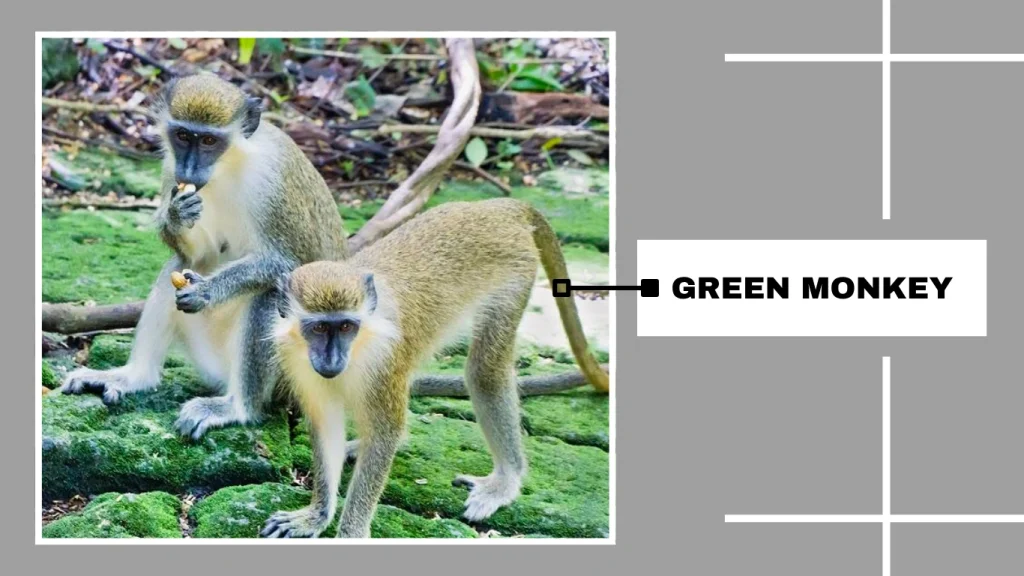
The Green Monkey (Chlorocebus sabaeus) is a member of the same genus as the vervet and grivet monkeys, known for its golden-green fur and expressive black face. Native to West Africa, it has also been introduced to Caribbean islands like Saint Kitts and Barbados.
Identification
- Size: 17–24 inches in body length
- Tail: Long and slender, usually longer than the body
- Color: Golden-green fur with a pale belly and black face surrounded by light whiskers
- Weight: Males: 10–13 pounds; Females: 6–10 pounds
- Face: Smooth black skin with expressive eyes and pale fringe
Natural Habitat and Range
Green Monkeys are native to West Africa but now also inhabit parts of the Caribbean due to historical introductions. They live in savannas, forests, mangroves, and human-altered landscapes like farms and towns.
Diet and Feeding Habits
They are omnivorous, feeding on fruits, leaves, flowers, seeds, insects, small reptiles, and even human food waste. They are known to raid gardens and plantations, often seen as agricultural pests.
Behavior and Social Structure
Green Monkeys live in troops of up to 50 individuals, with strong social hierarchies. They communicate through vocalizations, facial signals, and grooming. Males leave their natal group upon maturity, while females remain. They are curious, alert, and well-adapted to human presence.
9. Patas Monkey

The Patas Monkey (Erythrocebus patas) is the fastest running monkey, adapted for life on the African savanna. With its long limbs and reddish coat, it resembles a small ground-dwelling primate more than an arboreal one.
Identification
- Size: 24–34 inches in body length
- Tail: Long and straight, nearly matching body length
- Color: Reddish or rust-colored back with white belly and limbs
- Weight: Males: 24–30 pounds; Females: 10–15 pounds
- Face: Black face with white mustache and brow ridge
Natural Habitat and Range
Patas Monkeys inhabit dry savannas and semi-arid regions across West and East Africa. They prefer open grasslands and avoid dense forests, making them one of the most terrestrial monkey species.
Diet and Feeding Habits
They feed on seeds, acacia gum, insects, tubers, bird eggs, and small animals. They are opportunistic foragers, often searching for food on the ground and rarely climbing trees unless threatened.
Behavior and Social Structure
Patas Monkeys live in female-led troops with one adult male per group, except during mating season when multiple males may compete. They rely on speed to escape predators—reaching up to 35 mph—and have a unique sentinel system where one monkey stands guard while others feed.
10. Mandrill

The Mandrill (Mandrillus sphinx) is one of the most colorful and powerful monkey species in the world. Native to Central Africa, it’s known for its vibrant facial features, massive size, and strong social structure. Though often mistaken for baboons, mandrills are more closely related to drills.
Identification
- Size: 25–37 inches in body length
- Tail: Short, stubby tail
- Color: Olive green to dark brown body; males have vivid red and blue facial markings and colorful rumps
- Weight: Males: 50–70 pounds (can exceed 100 pounds); Females: 25–35 pounds
- Face: Brightly colored snout with elongated muzzle and pronounced ridges
Natural Habitat and Range
Mandrills inhabit tropical rainforests, dense secondary forests, and gallery forests of Cameroon, Gabon, Equatorial Guinea, and Congo. They are terrestrial but sleep in trees at night.
Diet and Feeding Habits
Mandrills are omnivorous. Their diet includes fruits, seeds, fungi, roots, insects, small mammals, and eggs. They forage on the forest floor and use their powerful hands and jaws to access tough food sources.
Behavior and Social Structure
Mandrills live in large troops called “hordes,” which can number over 200 individuals. Males are significantly larger and more vividly colored, especially during mating season. They communicate using facial expressions, grunts, and postures. Despite their intimidating appearance, they are usually shy in the wild.
11. Drill
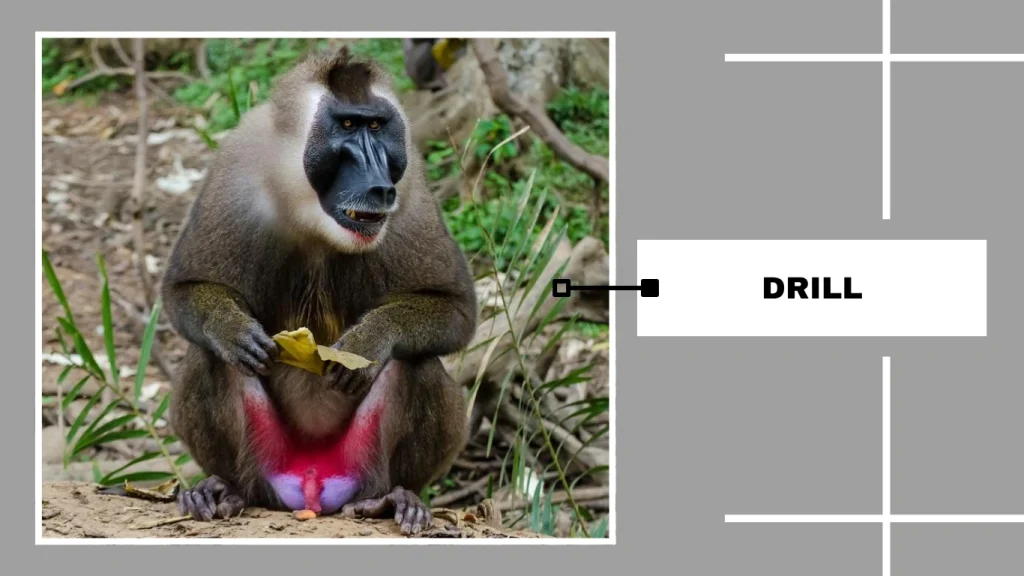
The Drill (Mandrillus leucophaeus) is a close relative of the mandrill but less flamboyant in appearance. It is one of the most endangered primates in Africa, found only in a few regions of Nigeria, Cameroon, and Bioko Island.
Identification
- Size: 22–30 inches in body length
- Tail: Very short
- Color: Black face with ridged muzzle; brown-gray body with a white chin “beard”
- Weight: Males: 60–100 pounds; Females: 25–40 pounds
- Face: Deep-set eyes, dark skin with subtle bluish tones and red lower lip
Natural Habitat and Range
Drills live in humid lowland forests, montane forests, and riverine areas. Their range is highly restricted to parts of West Central Africa, making habitat protection crucial for their survival.
Diet and Feeding Habits
They feed on fruits, leaves, seeds, insects, fungi, and small animals. Like mandrills, they forage on the ground and use cheek pouches to store food while moving.
Behavior and Social Structure
Drills form smaller groups than mandrills, usually with 20–30 individuals. Males are dominant, and females form the social core. They communicate with low grunts, facial gestures, and body postures. Due to poaching and deforestation, their population is in sharp decline and urgently in need of conservation.
12. Olive Baboon

The Olive Baboon (Papio anubis) is the most widespread species of baboon, ranging across 25 countries in Africa. Named for its olive-colored coat, this powerful and intelligent monkey lives in a variety of environments and is known for its adaptability.
Identification
- Size: 20–34 inches in body length (males significantly larger)
- Tail: Long and bent, carried in a characteristic arc
- Color: Greenish-gray or olive fur with a dog-like face
- Weight: Males: 50–80 pounds; Females: 25–40 pounds
- Face: Long, hairless black face with prominent brows
Natural Habitat and Range
Olive Baboons occupy savannas, grasslands, forests, and mountainous regions from Mali and Ethiopia to Tanzania. They are extremely adaptable and often live near farms or urban edges.
Diet and Feeding Habits
These omnivores eat fruits, leaves, roots, insects, small animals, and even birds. They are opportunistic and known to raid crops and scavenge near human settlements when available.
Behavior and Social Structure
Olive Baboons live in large troops with complex social hierarchies. Females form stable matrilineal lines, while males compete for dominance. They display a wide range of behaviors—grooming, vocalizing, facial expressions—that reveal high cognitive abilities and social intelligence.
13. Yellow Baboon

The Yellow Baboon (Papio cynocephalus) is a slender, long-limbed baboon species found in East Africa. It is lighter in build and fur color compared to other baboons, and is known for its speed and adaptability.
Identification
- Size: 20–30 inches in body length
- Tail: Long and carried in a characteristic downward-then-upward arc
- Color: Golden-yellow fur with a white underside and black face
- Weight: Males: 50–65 pounds; Females: 25–35 pounds
- Face: Narrow, dog-like black face with high cheekbones
Natural Habitat and Range
Yellow Baboons are found in savannas, grasslands, woodlands, and semi-arid areas of Kenya, Tanzania, and parts of Mozambique and Zambia. They prefer open spaces but also climb trees for sleeping and safety.
Diet and Feeding Habits
They eat fruits, grasses, seeds, insects, and small animals. They are expert foragers and dig for roots and tubers during dry seasons. In populated areas, they may also feed on garbage and crops.
Behavior and Social Structure
Yellow Baboons live in multi-male, multi-female troops ranging from 10 to over 100 individuals. Social bonds are formed through grooming, and troop life is dominated by a linear hierarchy. Males often transfer between troops, while females stay in their natal groups.
14. Hamadryas Baboon

The Hamadryas Baboon (Papio hamadryas) is a unique and visually striking baboon species native to the Horn of Africa and the southwestern tip of the Arabian Peninsula. Revered in ancient Egyptian culture, it stands out with its silver-white mane and strict social order.
Identification
- Size: 24–30 inches in body length
- Tail: Long with a tuft at the end
- Color: Males have silver-gray coats and a large mane; females are brown
- Weight: Males: 40–55 pounds; Females: 20–30 pounds
- Face: Bright red or pink hairless face and rump, particularly in males
Natural Habitat and Range
Hamadryas Baboons inhabit arid regions, rocky hills, and cliffs in Ethiopia, Somalia, Djibouti, Eritrea, and Yemen. They roost on cliffs at night and travel to open areas during the day to forage.
Diet and Feeding Habits
They eat grasses, roots, fruits, seeds, and insects. In dry areas, they dig for edible roots and bulbs, showing excellent survival skills in sparse environments.
Behavior and Social Structure
Hamadryas society is unusually structured into harems led by a dominant male who controls several females. These units form larger clans and bands that travel together. Males are extremely protective and herd their females closely, resulting in one of the most rigid social systems among monkeys.
15. Squirrel Monkey
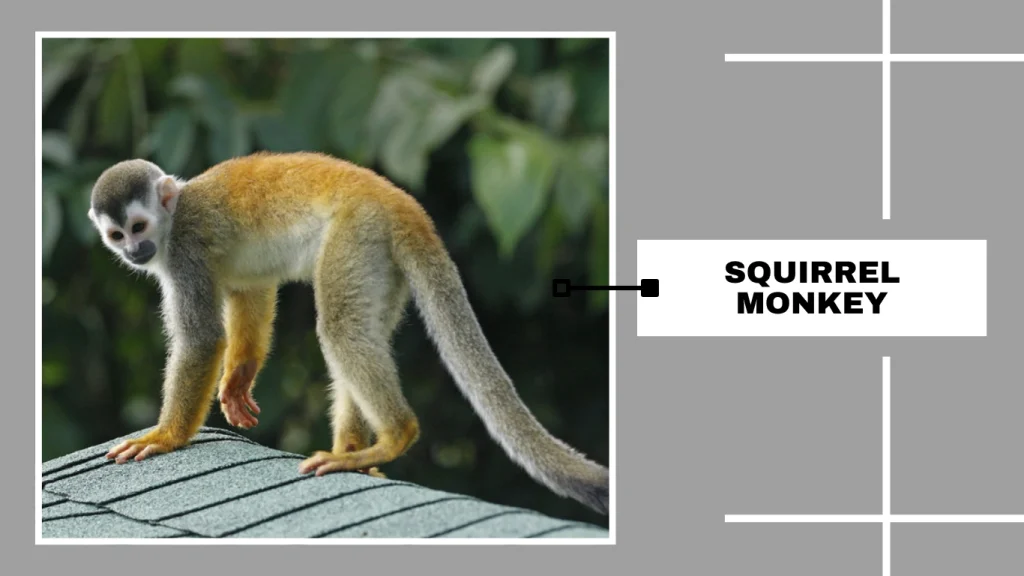
The Squirrel Monkey (genus Saimiri) is a small, agile New World monkey with a large brain-to-body size ratio and an expressive face. Native to Central and South America, it’s often seen in rainforests moving quickly through the canopy in large groups.
Identification
- Size: 9–14 inches in body length
- Tail: Long and non-prehensile, often longer than the body
- Color: Yellowish-orange limbs, white face with black muzzle and cap
- Weight: 1.5–2.5 pounds
- Face: Pale with a black mouth, nose, and eye outline—often described as “mask-like”
Natural Habitat and Range
Squirrel Monkeys live in tropical rainforests, often along riverbanks and forest edges. They are found in countries like Brazil, Colombia, Ecuador, and Peru, where they spend most of their time in the upper canopy.
Diet and Feeding Habits
They eat fruits, insects, flowers, leaves, bird eggs, and small vertebrates. Highly energetic, they forage in bursts, using both their hands and feet while navigating branches with incredible speed.
Behavior and Social Structure
Squirrel Monkeys live in large groups, sometimes exceeding 30–50 individuals. They use chirps, whistles, and body language to communicate. Known for their curiosity and agility, they are frequently studied in behavioral research and are common in zoos and wildlife parks due to their playful nature.
18. Spider Monkey

The Spider Monkey (genus Ateles) is a long-limbed, highly agile New World monkey known for its incredible brachiation skills and powerful prehensile tail. It is one of the largest monkeys in the Americas and plays a key role in forest ecology.
Identification
- Size: 14–26 inches in body length
- Tail: Long, muscular, and fully prehensile—often used like a fifth limb
- Color: Varies by species; commonly black, brown, or reddish with lighter underparts
- Weight: 15–20 pounds
- Face: Hairless black face with close-set eyes and a narrow jaw
Natural Habitat and Range
Spider Monkeys inhabit tropical rainforests in Central and South America, including countries like Brazil, Colombia, Mexico, and Peru. They prefer high canopy layers and are rarely seen on the ground.
Diet and Feeding Habits
Primarily frugivorous, they feed on a wide variety of ripe fruits, along with leaves, seeds, flowers, and sometimes insects. They play a major role in seed dispersal throughout the forest.
Behavior and Social Structure
Spider Monkeys live in fission–fusion societies of 15–30 individuals. They are among the most acrobatic monkeys, using their tails and limbs to swing rapidly through trees. They communicate with loud calls, whinnies, and even barks, and are highly intelligent and emotionally expressive.
19. Woolly Monkey

The Woolly Monkey (genus Lagothrix) is a large-bodied New World monkey with thick, soft fur and a calm, gentle disposition. These monkeys are social, slow-moving, and well-adapted to high-altitude cloud forests.
Identification
- Size: 16–24 inches in body length
- Tail: Long, thick, and fully prehensile with a sensitive underside
- Color: Dense gray, brown, or black fur with paler belly
- Weight: 13–24 pounds
- Face: Rounded with a short muzzle and prominent eyes
Natural Habitat and Range
Woolly Monkeys are found in the Amazon Basin and Andean cloud forests of Colombia, Ecuador, Peru, and Brazil. They prefer humid, high-elevation forests with rich canopy cover.
Diet and Feeding Habits
They eat mostly fruits, supplemented with leaves, seeds, and occasional insects. Their slow, deliberate foraging style allows them to consume large quantities of soft, ripe fruit each day.
Behavior and Social Structure
Woolly Monkeys live in cohesive groups of 10–25 individuals, with strong bonds and cooperative behaviors. They are quieter than many other monkeys and use soft vocalizations, body contact, and facial expressions for communication. Unfortunately, they are vulnerable to deforestation and hunting, making them a conservation priority.
20. Tamarin Monkey

Tamarins (genus Saguinus) are small, energetic New World monkeys known for their unique facial hair and social nature. Found in Central and South America, they are often characterized by their mustaches, manes, or tufts depending on the species.
Identification
- Size: 7–12 inches in body length
- Tail: Long and non-prehensile, often longer than the body
- Color: Varies by species; can include black, brown, white, or reddish fur with facial hair patterns
- Weight: 0.5–1.1 pounds
- Face: Small, expressive face with characteristic tufts or mustaches
Natural Habitat and Range
Tamarins inhabit tropical rainforests, including lowland and secondary forests in countries like Brazil, Colombia, Peru, and Bolivia. They are arboreal, spending most of their time in the middle to upper canopy.
Diet and Feeding Habits
They are omnivores, eating fruits, flowers, nectar, insects, spiders, small reptiles, and bird eggs. Some species also feed on plant exudates like sap or gum.
Behavior and Social Structure
Tamarins live in groups of 3 to 9 individuals and often display cooperative care of offspring. They are fast, vocal, and highly alert, using high-pitched calls to communicate and warn others of danger. Their small size and agility help them evade predators in dense foliage.
21. Marmoset

Marmosets (family Callitrichidae) are tiny, squirrel-like monkeys native to South America. Known for their claw-like nails and rapid movements, they are among the smallest primates in the world.
Identification
- Size: 5–9 inches in body length
- Tail: Long and non-prehensile, often ringed or furry
- Color: Varies by species—commonly gray, black, or brown with tufts or crests
- Weight: 0.3–1 pound
- Face: Small face with large eyes and noticeable ear tufts in some species
Natural Habitat and Range
Marmosets live in tropical forests of Brazil and surrounding countries, especially in the Amazon Basin. They prefer dense, tree-rich environments and rarely descend to the ground.
Diet and Feeding Habits
They feed on insects, fruit, gum, nectar, and small vertebrates. Specialized lower teeth help some species gouge trees to extract sap—a major food source.
Behavior and Social Structure
Marmosets live in family groups with strong social bonds. They exhibit cooperative parenting and vocal communication. Quick and nervous in movement, they are constantly alert and are often seen leaping between branches in search of food.
22. Dusky Leaf Monkey
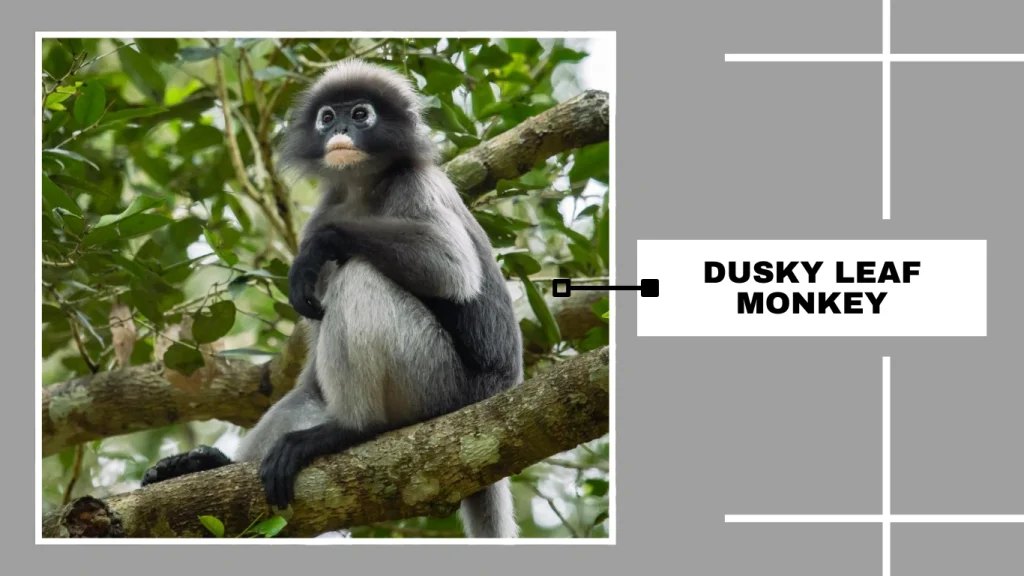
The Dusky Leaf Monkey (Trachypithecus obscurus), also known as the spectacled langur, is a gentle, tree-dwelling primate native to Southeast Asia. It’s named for its grayish fur and white eye circles that give it a “spectacled” appearance.
Identification
- Size: 16–24 inches in body length
- Tail: Long, slender, often up to 33 inches
- Color: Dark gray to black fur with white patches around the eyes and mouth
- Weight: 12–18 pounds
- Face: Small, dark face with round, pale eye rings resembling glasses
Natural Habitat and Range
Found in Malaysia, Thailand, and parts of Myanmar, Dusky Leaf Monkeys inhabit coastal forests, mangroves, and highland rainforests. They prefer treetops and rarely come to the ground.
Diet and Feeding Habits
They are primarily folivores, feeding on young leaves, fruits, flowers, and shoots. Their complex stomachs help ferment tough vegetation, similar to cows.
Behavior and Social Structure
Dusky Leaf Monkeys live in small troops led by a dominant male and several females. They are calm and shy compared to other monkeys. Communication includes soft cooing, squeaks, and body signals. Infants are born bright orange and gradually darken with age.
23. Proboscis Monkey

The Proboscis Monkey (Nasalis larvatus) is one of the most unusual-looking monkeys, famous for its large, bulbous nose and pot-bellied appearance. Native only to Borneo, it is also an excellent swimmer.
Identification
- Size: 26–30 inches in body length
- Tail: Long and thin, almost equal to body length
- Color: Reddish-brown back, gray limbs, and white underbelly
- Weight: Males: 35–50 pounds; Females: 20–25 pounds
- Face: Long face with an enlarged nose in males, believed to amplify vocalizations
Natural Habitat and Range
Proboscis Monkeys live in mangrove forests, swampy lowlands, and riverine forests of Borneo. They’re frequently seen near water and are strong swimmers, often diving into rivers to escape predators.
Diet and Feeding Habits
They primarily eat leaves, seeds, and unripe fruits. Their stomachs are multi-chambered and designed to ferment fibrous plant material, making them slow but efficient digesters.
Behavior and Social Structure
They live in harem groups (one male with several females) or bachelor groups. Males make loud honking calls to warn off rivals or alert the group. Despite their awkward appearance, they move gracefully through the trees and swim expertly. The species is endangered due to deforestation and habitat loss.
24. Golden Snub-nosed Monkey
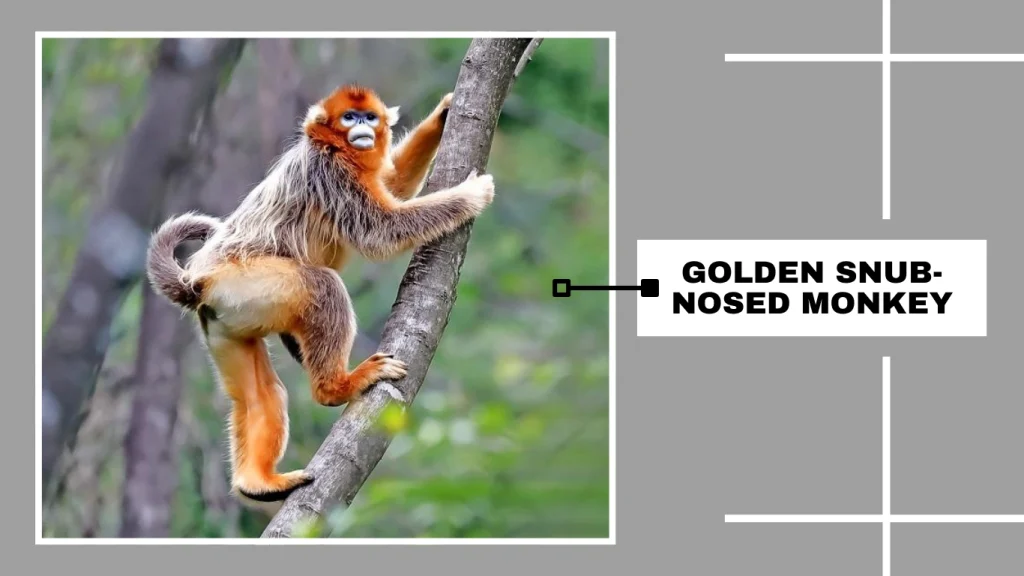
The Golden Snub-nosed Monkey (Rhinopithecus roxellana) is a striking and rare primate native to the mountainous forests of central and southwestern China. It is well-known for its vibrant fur and upturned, flat nose, which is thought to help it survive in cold climates.
Identification
- Size: 20–26 inches in body length
- Tail: Long and bushy, nearly equal to body length
- Color: Bright golden-orange to reddish fur, with pale blue face and black shoulders
- Weight: Males: 35–45 pounds; Females: 20–25 pounds
- Face: Hairless and sky blue, with a distinctive snub nose
Natural Habitat and Range
This species lives in temperate mountain forests of central China, particularly in the provinces of Sichuan, Gansu, and Hubei. They inhabit elevations of up to 13,000 feet and experience snowy, cold winters.
Diet and Feeding Habits
Golden Snub-nosed Monkeys feed on a variety of plant materials, including lichens, young leaves, fruits, bark, flowers, and seeds. In winter, lichens make up the bulk of their diet due to limited resources.
Behavior and Social Structure
They live in large, multilevel groups that can number over 100 individuals. These groups are structured into smaller family units. Their communication includes high-pitched calls and body postures. The species is endangered, facing threats from logging and habitat fragmentation.
25. Pygmy Marmoset

The Pygmy Marmoset (Cebuella pygmaea) is the world’s smallest monkey and one of the smallest primates overall. Native to the rainforests of the western Amazon Basin, it is famous for its tiny size and fast, squirrel-like movements.
Identification
- Size: 4.5–6 inches in body length
- Tail: Long and banded, often up to 9 inches
- Color: Golden-brown or grayish with mottled fur and ringed tail
- Weight: 3.5–4.5 ounces
- Face: Tiny face with large eyes and a blunt nose
Natural Habitat and Range
Pygmy Marmosets are found in the Amazon regions of Brazil, Peru, Colombia, Ecuador, and Bolivia. They prefer dense, lowland tropical forests near rivers and swamps.
Diet and Feeding Habits
They feed mostly on tree sap and gum, which they access by gnawing holes in bark using specialized incisors. Their diet also includes insects, nectar, and small fruits.
Behavior and Social Structure
Pygmy Marmosets live in small family groups of 2–9 members. They are highly agile, able to leap long distances between branches. They use high-frequency vocalizations to stay in contact and defend territories. Their small size and unique diet make them especially vulnerable to habitat loss and illegal pet trade.