



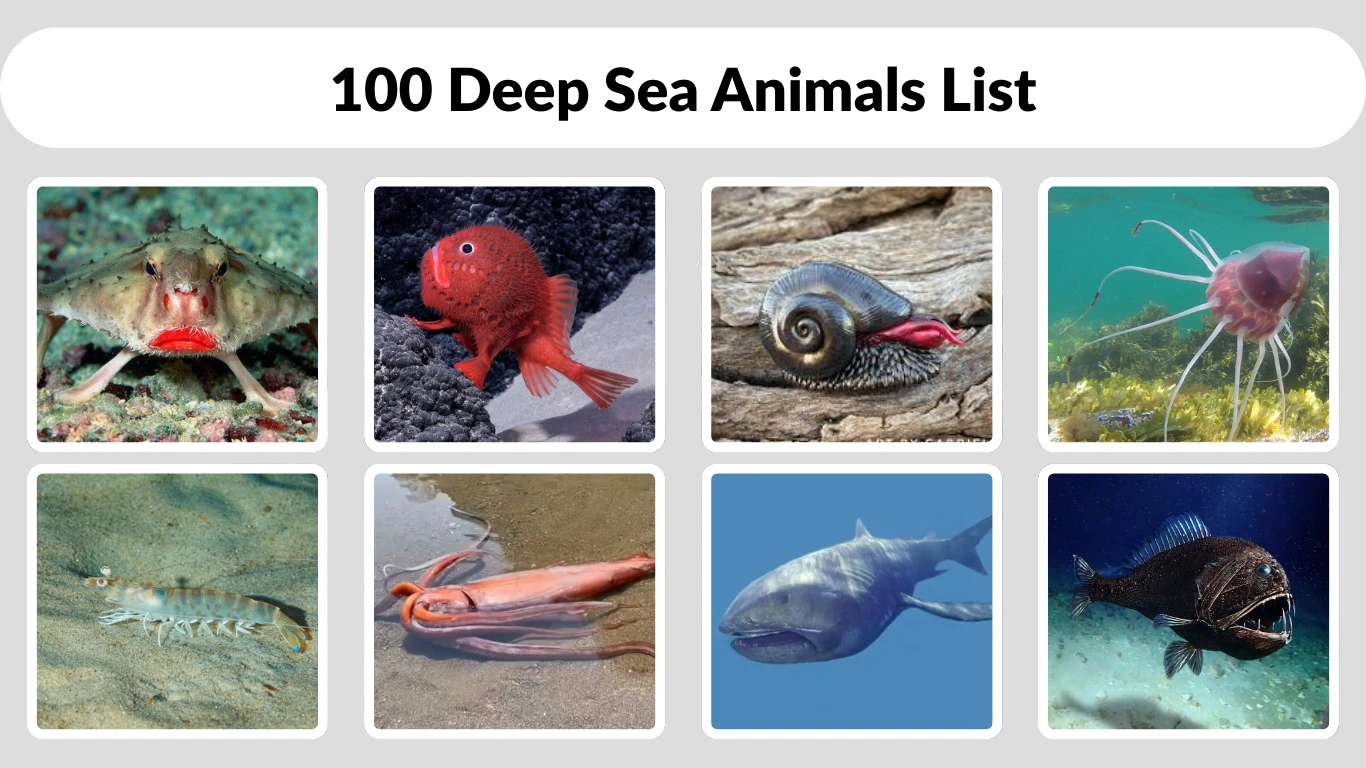
The deep ocean is one of the least explored environments on Earth, yet it is home to some of the strangest and most fascinating animals ever discovered. Far below sunlight, where pressure is crushing and temperatures are near freezing, deep-sea creatures have evolved incredible adaptations to survive. From glowing fish and giant squids to bone-eating worms and glass sponges, each animal plays a unique role in this hidden ecosystem. This guide organizes 100 deep-sea animals into clear groups to make understanding deep-ocean life easier.
Group 1: Deep-Sea Fish
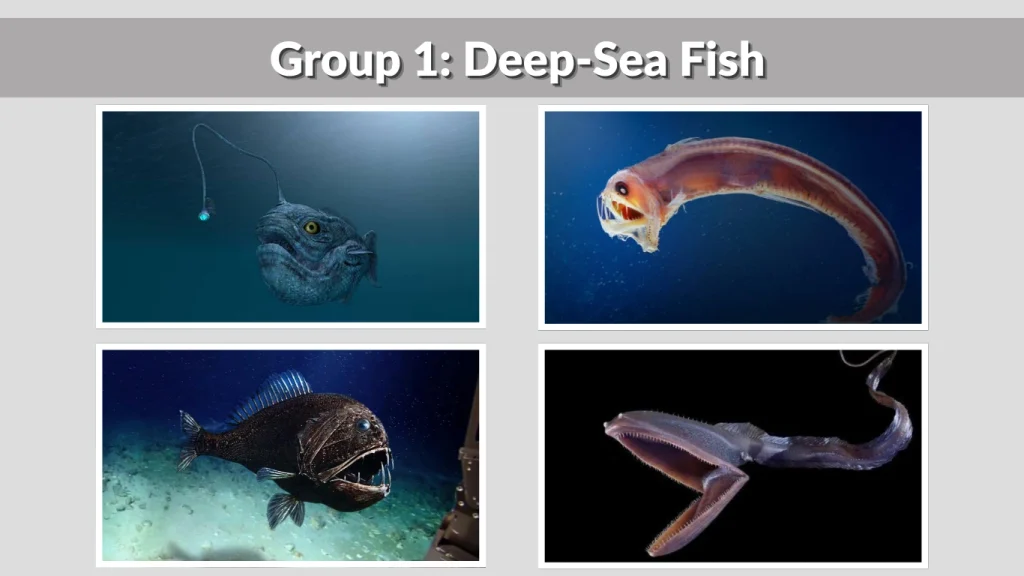
Deep-sea fish are some of the most mysterious creatures on Earth. Living thousands of meters below the ocean’s surface, they survive in total darkness, extreme pressure, and near-freezing temperatures. To adapt, many deep-sea fish have developed unusual features such as bioluminescent lights, oversized mouths, transparent heads, and needle-sharp teeth. These fish play an important role in deep-ocean ecosystems, acting as both predators and scavengers. Below are ten of the most well-known deep-sea fish, each showing a different type of survival strategy found in the depths of the ocean.
1. Anglerfish
Anglerfish are famous for the glowing “fishing rod” on their head, called a lure, which attracts prey in complete darkness. When curious fish approach the light, the anglerfish snaps them up with its huge mouth and long teeth.
2. Viperfish
The viperfish has one of the most frightening appearances in the deep sea. It has extremely long, needle-like teeth and a hinged lower jaw. A glowing organ near its mouth helps lure prey close enough to strike.
3. Fangtooth
Despite being small, the fangtooth has the largest teeth relative to body size of any fish. It lives at great depths and feeds on crustaceans and smaller fish, using its powerful jaws to grip slippery prey.
4. Gulper Eel
Also called the pelican eel, this fish has an enormous mouth and expandable stomach. It can swallow prey larger than itself and often feeds on shrimp, squid, and small fish drifting through the deep ocean.
5. Barreleye Fish
The barreleye fish has a transparent head and tubular eyes that point upward, allowing it to spot prey silhouetted against faint light from above. It can rotate its eyes forward when feeding.
6. Dragonfish
Dragonfish are bioluminescent predators with long bodies and sharp teeth. Some species can produce red light, which is invisible to most other deep-sea animals, giving them a secret “flashlight” to hunt prey.
7. Hatchetfish
Hatchetfish are named for their thin, blade-shaped bodies. They have reflective sides and light-producing organs that help them blend in with faint surface light, making them harder for predators to spot.
8. Frilled Shark
The frilled shark looks like a living fossil. It has an eel-like body and rows of trident-shaped teeth. It hunts squid and fish in deep waters, using sudden lunges to capture prey.
9. Goblin Shark
Known as a “living fossil,” the goblin shark has a long snout and a jaw that can shoot forward to grab prey. It feeds on deep-sea fish and crustaceans along the ocean floor.
10. Blobfish
The blobfish lives at extreme depths where pressure is very high. Its soft, jelly-like body is perfectly suited to deep water, allowing it to float just above the seafloor and feed on small animals.
Group 2: Deep-Sea Sharks & Rays
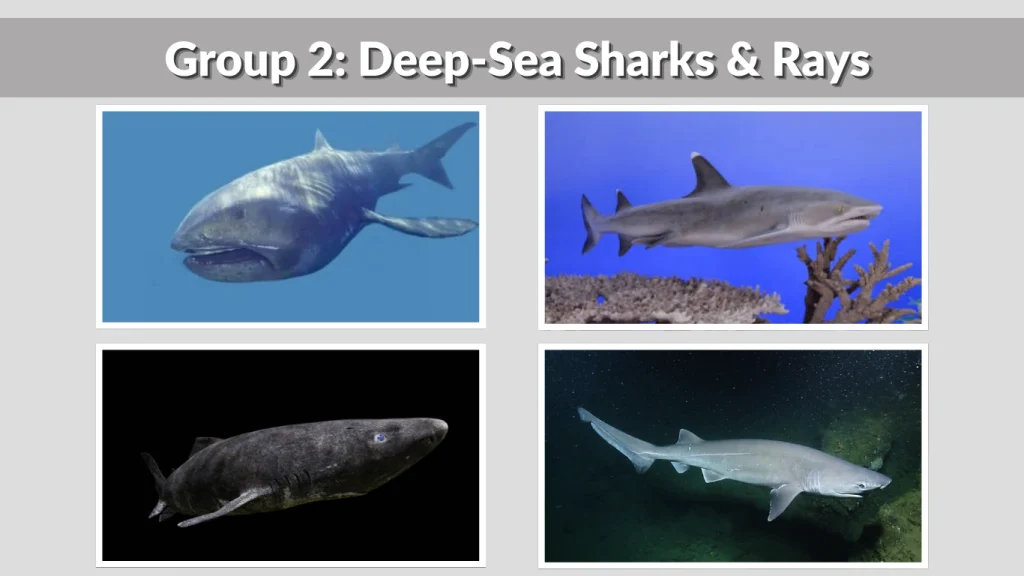
Deep-sea sharks and rays are ancient predators that inhabit the darker layers of the ocean, often ranging from 200 meters to several thousand meters deep. Unlike fast-swimming surface sharks, most deep-sea species move slowly and conserve energy, as food is scarce in the deep ocean. They are specially adapted with sensitive electroreceptors, large oil-rich livers for buoyancy, and highly developed senses that allow them to detect weak movements and electrical signals from hidden prey. Many of these sharks and rays feed on deep-sea fish, squid, and bottom-dwelling animals, helping regulate populations in the deep-ocean ecosystem.
11. Megamouth Shark
The megamouth shark is a rare deep-sea filter feeder. It has a huge mouth lined with glowing tissue that may help attract plankton and small organisms, which it filters from the water while swimming slowly.
12. Cookiecutter Shark
This small but aggressive shark is famous for biting round chunks of flesh from larger animals. It uses suction-like lips and sharp lower teeth to carve out “cookie-shaped” wounds on fish, whales, and even submarines.
13. Sleeper Shark
Sleeper sharks are large, sluggish predators found in very deep and cold waters. They feed on fish, squid, and even marine mammals, often scavenging carcasses that sink to the ocean floor.
14. Sixgill Shark
The sixgill shark is considered one of the most primitive living sharks. It has six gill slits instead of five and spends much of its life in deep waters, rising closer to the surface at night to hunt.
15. Seven-Gill Shark
Similar to the sixgill, this shark has seven gill slits and a powerful body. It is an active hunter that preys on fish, rays, and smaller sharks in deep and coastal waters.
16. Ghost Shark
Also known as chimaeras, ghost sharks are not true sharks but close relatives. They have smooth skin, long tails, and large eyes adapted for darkness, feeding mainly on mollusks and crustaceans.
17. Deep-Sea Skate
Deep-sea skates are flat, ray-like fish that glide over the seafloor. They feed on worms, crustaceans, and small fish, using their flattened bodies to ambush prey.
18. Spiny Dogfish
The spiny dogfish is a small deep-water shark with venomous spines in front of its dorsal fins. It forms large groups and feeds on fish, jellyfish, and invertebrates.
19. Portuguese Dogfish
This deep-sea shark has large green eyes and a slender body. It lives at great depths and feeds mainly on fish and squid, using its sensitive senses to locate prey.
20. Bigeye Thresher
The bigeye thresher shark is adapted to deep water with enormous eyes that gather light. It uses its long tail to stun prey before feeding, often hunting in dim, deep environments.
Deep-sea cephalopods are among the most intelligent and strange-looking animals of the ocean depths. This group includes squids and octopuses that live far below sunlight, where pressure is extreme and food is unpredictable. To survive, they have developed soft, flexible bodies, advanced nervous systems, excellent camouflage abilities, and, in many species, bioluminescence. Some deep-sea cephalopods grow to enormous sizes, while others remain ghostly and transparent. They are active predators, feeding on fish, crustaceans, and even other cephalopods, and they themselves are important prey for deep-sea sharks and whales.
Group 3: Deep-Sea Cephalopods
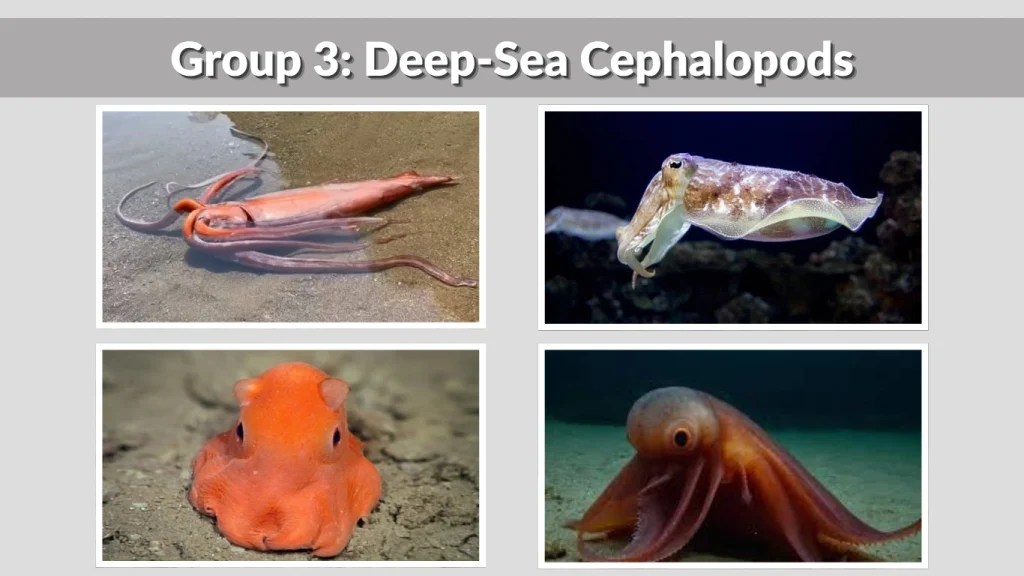
Deep-sea cephalopods are among the most intelligent and strange-looking animals of the ocean depths. This group includes squids and octopuses that live far below sunlight, where pressure is extreme and food is unpredictable. To survive, they have developed soft, flexible bodies, advanced nervous systems, excellent camouflage abilities, and, in many species, bioluminescence. Some deep-sea cephalopods grow to enormous sizes, while others remain ghostly and transparent. They are active predators, feeding on fish, crustaceans, and even other cephalopods, and they themselves are important prey for deep-sea sharks and whales.
21. Giant Squid
The giant squid is one of the largest invertebrates on Earth. It has long feeding tentacles with powerful suckers that grab prey such as deep-sea fish and other squids. Its huge eyes help it detect movement in near-total darkness.
22. Colossal Squid
Heavier and more robust than the giant squid, the colossal squid has rotating hooks on its tentacles. It lives in very deep, cold waters and is a major prey species of sperm whales.
23. Dumbo Octopus
Named for its ear-like fins, the dumbo octopus “flies” through the water using gentle fin movements. It feeds on worms, crustaceans, and small snails found on the deep-sea floor.
24. Vampire Squid
Despite its name, the vampire squid does not suck blood. It lives in oxygen-poor zones and feeds mainly on drifting organic particles, using its cloak-like webbing and light-producing organs for defense.
25. Glass Octopus
This rare octopus is almost completely transparent. Its see-through body helps it avoid predators, while its large eyes allow it to spot faint shapes in deep water.
26. Blanket Octopus
The blanket octopus is known for the dramatic webbing between its arms. Females are much larger than males and use their flowing “blanket” both for display and defense.
27. Bigfin Squid
Bigfin squids have extremely long, thin arms that trail behind them. They move slowly near the deep-sea floor and may use their arms to sense or trap small prey.
28. Flapjack Octopus
Also called the pancake octopus, this species has a rounded body and short arms. It often floats just above the seafloor, feeding on small invertebrates.
29. Deep-Sea Bobtail Squid
These small squids have light organs that help them blend in with faint light from above. They feed on tiny fish and crustaceans.
30. Seven-Arm Octopus
The seven-arm octopus appears to have seven arms because one is hidden and modified for reproduction in males. It lives in deep waters and feeds on crustaceans and small fish.
Group 4: Deep-Sea Crustaceans
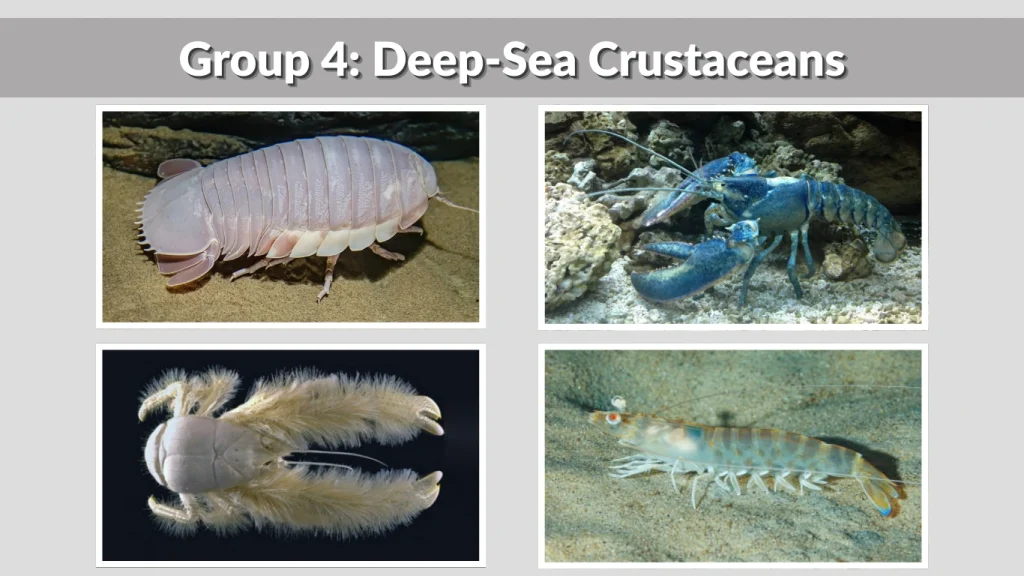
Deep-sea crustaceans are some of the toughest animals in the ocean. Living in freezing temperatures, crushing pressure, and complete darkness, they have evolved hard shells, slow metabolisms, and highly sensitive antennae to locate food. Many species are scavengers that feed on dead animals sinking from above, while others live near hydrothermal vents, where they depend on bacteria-based food webs instead of sunlight. From giant isopods to ghostly shrimps and vent crabs, these crustaceans play a major role in recycling nutrients and supporting deep-sea ecosystems.
31. Giant Isopod
Giant isopods look like oversized pill bugs and can grow over 30 centimeters long. They crawl along the deep seafloor feeding on dead fish, whales, and other organic matter.
32. Deep-Sea Lobster
Deep-sea lobsters live far below the continental shelf. They are slow-moving scavengers and predators that feed on worms, mollusks, and smaller crustaceans.
33. Yeti Crab
Yeti crabs are famous for their hairy claws. These hairs grow bacteria that the crab farms and eats, especially around hydrothermal vents where sunlight does not reach.
34. Blind Shrimp
Many deep-sea shrimps lack functional eyes. Instead, they rely on chemical sensors and long antennae to detect food and navigate the dark environment.
35. Deep-Sea Amphipod
These small, shrimp-like scavengers swarm around carcasses that fall to the ocean floor. Some species can survive extreme pressure and even feed on whale bones.
36. Hydrothermal Vent Crab
These crabs live near superheated vent openings. They feed on bacteria and small animals that thrive in chemically rich vent waters.
37. Deep-Sea Squat Lobster
Squat lobsters resemble small lobsters with long claws. Many species live near cold seeps and vents, feeding on bacteria, detritus, and tiny animals.
38. Giant Sea Spider
Although not true spiders, these long-legged arthropods live in deep water and use a straw-like mouth to suck nutrients from soft-bodied animals.
39. Deep-Sea Hermit Crab
Deep-sea hermit crabs use empty shells or even sponges for protection. They scavenge along the seabed, feeding on organic debris and small animals.
40. Pelagic Red Crab
These bright red crabs migrate between deep and mid-water zones. Their color appears black in deep water, helping them remain hidden from predators.
Group 5: Deep-Sea Jellyfish & Relatives
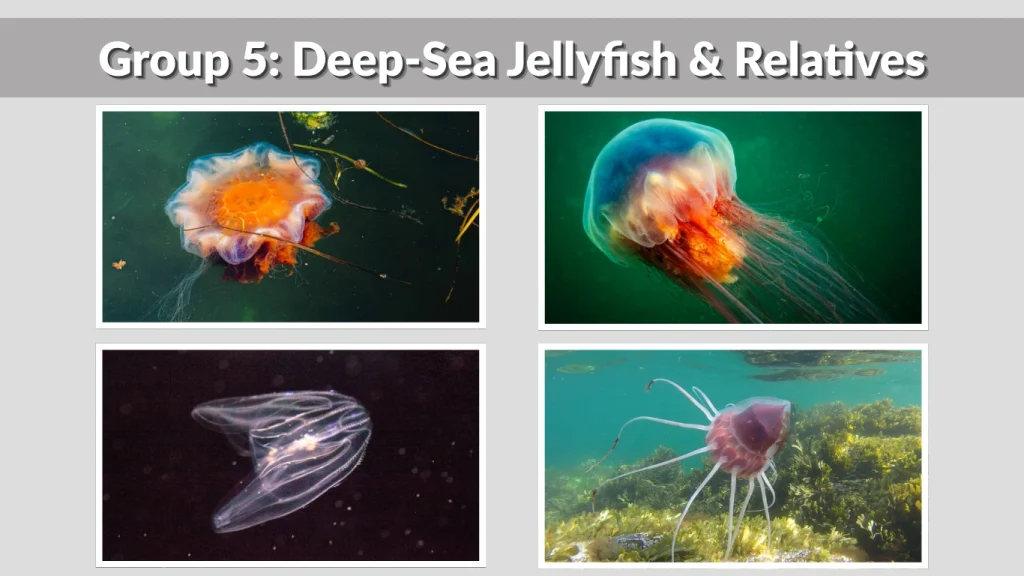
Deep-sea jellyfish and their relatives are some of the most delicate yet visually striking creatures in the ocean. Drifting through dark waters, they rely on gelatinous bodies, long trailing tentacles, and bioluminescence to survive. Many species glow in shades of blue, red, or purple, using light to confuse predators, attract prey, or communicate. Unlike fast-swimming fish, these animals float with deep currents, capturing small fish, plankton, and crustaceans with stinging cells. They form an important link in deep-sea food webs, transferring energy from tiny drifting organisms to larger predators.
41. Atolla Jellyfish
The Atolla jellyfish is known for its deep red color and bright blue bioluminescent flashes. When threatened, it produces a glowing display that may attract larger predators to scare away attackers.
42. Lion’s Mane Jellyfish
Although often seen near the surface, some populations live in very deep waters. This species has long, hair-like tentacles and feeds on fish, plankton, and other jellyfish.
43. Deep-Sea Comb Jelly
Comb jellies are not true jellyfish but are related gelatinous animals. They move using rows of shimmering cilia and feed on plankton and tiny crustaceans.
44. Phantom Jellyfish
This rare, ghostly jellyfish has long ribbon-like arms that can extend several meters. It drifts slowly and captures prey from the surrounding water.
45. Helmet Jellyfish
Helmet jellyfish are powerful swimmers with thick bells. They feed on other jellyfish and siphonophores, making them top predators among gelatinous animals.
46. Bloody-Belly Comb Jelly
This deep-red comb jelly has a dark stomach that hides glowing prey inside its body, helping it remain invisible in deep water.
47. Narcomedusa
Narcomedusae are unusual jellyfish that can attach themselves to other jellyfish and steal their prey. Some even carry parasitic young.
48. Deep-Sea Siphonophore
Siphonophores are long, colony-like animals made of many specialized parts. Some grow longer than blue whales and glow beautifully in the dark ocean.
49. Stygiomedusa
Sometimes called the giant phantom jellyfish, Stygiomedusa has a massive bell and thick oral arms instead of thin tentacles, feeding on drifting prey.
50. Crystal Jelly
Crystal jellies are mostly transparent and produce faint blue light. Their fragile bodies make them almost invisible in deep water, protecting them from predators.
Group 6: Deep-Sea Worms

Deep-sea worms are among the most important animals on the ocean floor. Although they often go unnoticed, they play a huge role in breaking down organic material, recycling nutrients, and supporting entire ecosystems. Some live buried in deep-sea mud, while others thrive near hydrothermal vents where toxic chemicals pour from the Earth’s crust. Many deep-sea worms lack eyes and jaws, relying instead on chemical sensing, symbiotic bacteria, or specialized feeding structures. Their unusual bodies and survival strategies make them some of the most remarkable invertebrates in the deep ocean.
51. Pompeii Worm
The Pompeii worm is considered one of the most heat-tolerant animals on Earth. It lives on hydrothermal vent chimneys, where temperatures can shift from near freezing to extremely hot within centimeters.
52. Giant Tube Worm
Giant tube worms can grow over two meters long. They have no mouth or stomach and instead rely on symbiotic bacteria inside their bodies to convert chemicals from vent water into food.
53. Bone-Eating Worm
Also called Osedax, this worm feeds on whale bones on the deep seafloor. It releases acids to dissolve bone and uses bacteria to extract nutrients.
54. Ice Worm
Some deep-sea ice worms live in extremely cold environments and feed on microorganisms trapped in icy or sediment-rich habitats.
55. Scale Worm
Scale worms are covered in overlapping plates that protect them from predators. Many species live in deep waters, crawling along the seafloor in search of small prey.
56. Deep-Sea Bristle Worm
These segmented worms have tiny bristles along their bodies that help them move and sense their surroundings. They are active scavengers and predators.
57. Hydrothermal Vent Worm
These worms live close to vent openings, feeding on bacteria and organic debris in chemically rich water.
58. Spoon Worm
Spoon worms use a long, flexible proboscis to gather organic particles from the seafloor and transport food to their mouths.
59. Beard Worm
Beard worms, also known as pogonophorans, live in deep tubes and rely on internal bacteria to produce nutrients from sulfur compounds.
60. Riftia Worm
Riftia pachyptila is a famous vent tube worm with a bright red plume. It absorbs chemicals from the water and supplies them to its symbiotic bacteria for food production.
Group 7: Deep-Sea Mollusks (Non-Cephalopods)
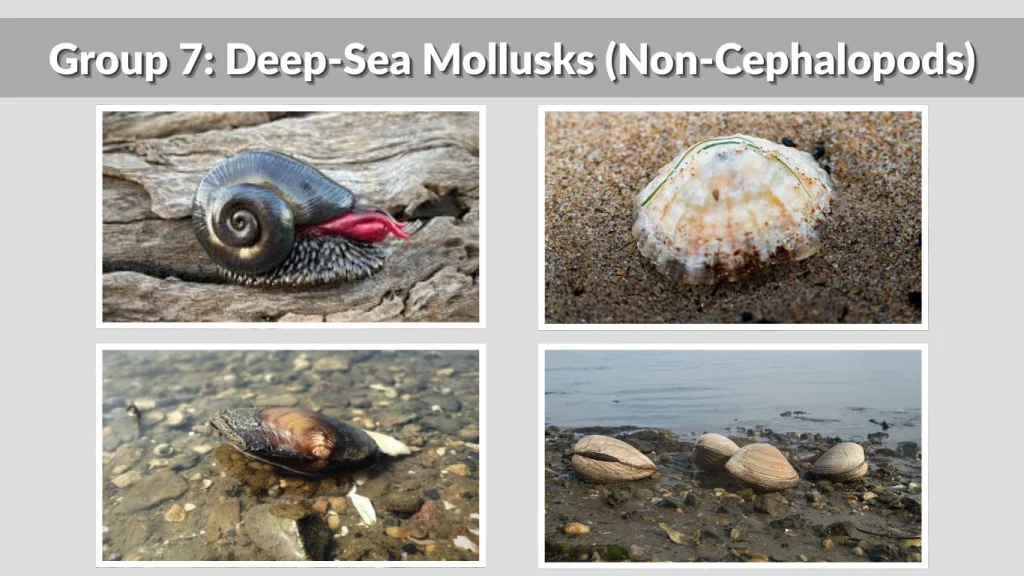
Deep-sea mollusks include snails, clams, mussels, chitons, and sea slugs that live far below the sunlit zone. Unlike squids and octopuses, these mollusks are slow-moving bottom dwellers that rely on strong shells, chemical sensing, and unique feeding methods. Many species thrive near hydrothermal vents and cold seeps, where they depend on symbiotic bacteria rather than plants for energy. Their shells are often thin and fragile because calcium is scarce in deep water, while some species have developed metal-rich armor or translucent bodies to survive extreme conditions.
61. Scaly-Foot Snail
This remarkable snail is the only known animal with a shell partly made of iron compounds. It lives near hydrothermal vents and hosts bacteria that help provide nutrition.
62. Deep-Sea Limpet
Deep-sea limpets cling tightly to rocks and vent structures. They scrape bacteria and organic films from hard surfaces using their rough, tongue-like radula.
63. Vent Mussel
Vent mussels live in dense beds around hydrothermal vents. They house bacteria inside their tissues that convert chemicals like methane and hydrogen sulfide into food.
64. Deep-Sea Clam
Many deep-sea clams are found at cold seeps and vents. They rely on symbiotic bacteria and can survive for decades in nutrient-poor environments.
65. Vampire Snail
The so-called vampire snail feeds on microorganisms and organic debris. It is adapted to deep, dark habitats with a slow metabolism and delicate shell.
66. Cold-Seep Mussel
Cold-seep mussels form large colonies where methane leaks from the seafloor. Their internal bacteria process methane into usable energy.
67. Deep-Sea Chiton
Chitons have eight overlapping shell plates that allow flexibility and protection. Deep-sea species crawl along rocky bottoms, feeding on algae-like bacterial mats.
68. Deep-Sea Whelk
These predatory snails hunt worms and small animals. They use a long siphon to detect chemical traces of food in the water.
69. Glass Scallop
Glass scallops have thin, translucent shells. They can clap their shells together to swim short distances when disturbed.
70. Deep-Sea Slug
Deep-sea sea slugs often lack hard shells and rely on chemical defenses and camouflage. They feed on sponges, bacteria, and small invertebrates.
Group 8: Deep-Sea Echinoderms
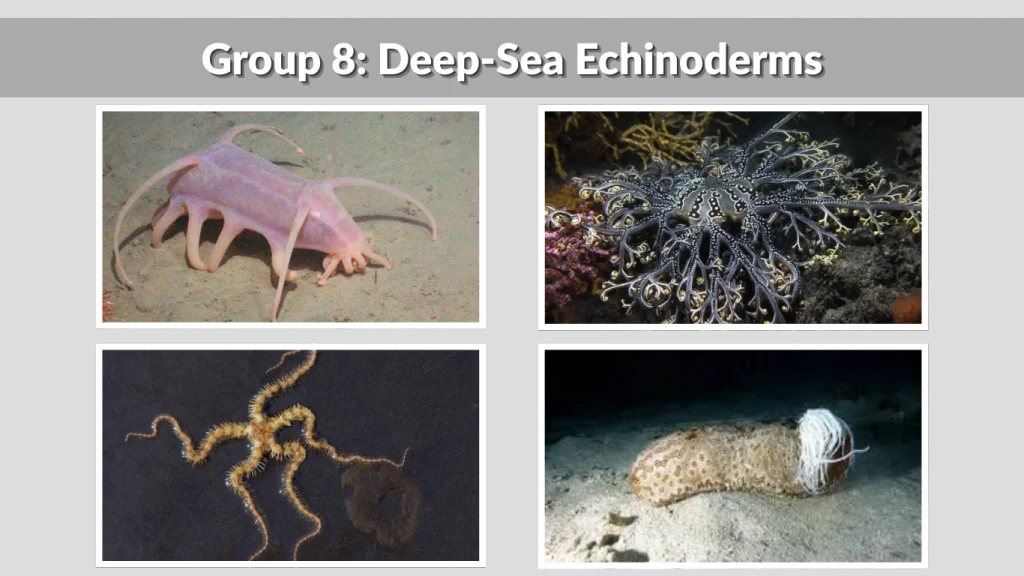
Deep-sea echinoderms include sea stars, sea cucumbers, sea urchins, brittle stars, and feather stars that dominate much of the ocean floor. They are especially successful in deep environments because they can survive on very little food, often feeding on organic particles that slowly sink from above. Many species have soft, expandable bodies, long arms, or unusual shapes that help them move across soft mud and capture drifting food. These animals play a major role in cleaning the seafloor, recycling nutrients, and maintaining balance in deep-sea ecosystems.
71. Sea Pig
Sea pigs are a type of deep-sea sea cucumber with short, tube-like legs. They walk slowly across the ocean floor, feeding on decaying organic matter in the mud.
72. Basket Star
Basket stars have highly branched arms that form a net-like structure. They climb onto rocks and corals to catch drifting plankton with their curled arms.
73. Brittle Star
Brittle stars have long, flexible arms and a small central disk. They move quickly over the seafloor and feed on detritus and tiny organisms.
74. Deep-Sea Sea Cucumber
These soft-bodied animals vacuum the sediment, digesting organic material and leaving behind cleaner sand.
75. Feather Star
Feather stars use many feathery arms to filter plankton from the water. Some deep-sea species anchor themselves to rocks, while others can swim.
76. Deep-Sea Urchin
Deep-sea sea urchins have long spines that protect them and help them move across soft sediments. They feed on organic debris and microorganisms.
77. Brisingid Starfish
Brisingid starfish have many long arms and live in deep water. They raise their arms into the current to capture plankton and small animals.
78. Cushion Star
Cushion stars have thick, inflated bodies and short arms. Deep-sea species move slowly and feed on organic matter and small invertebrates.
79. Deep-Sea Sand Dollar
These flattened echinoderms burrow into soft sediment. They feed on fine particles of organic material.
80. Mud Star
Mud stars live buried in soft seafloor sediments. They extend their arms above the mud to gather food from passing currents.
Group 9: Deep-Sea Invertebrates
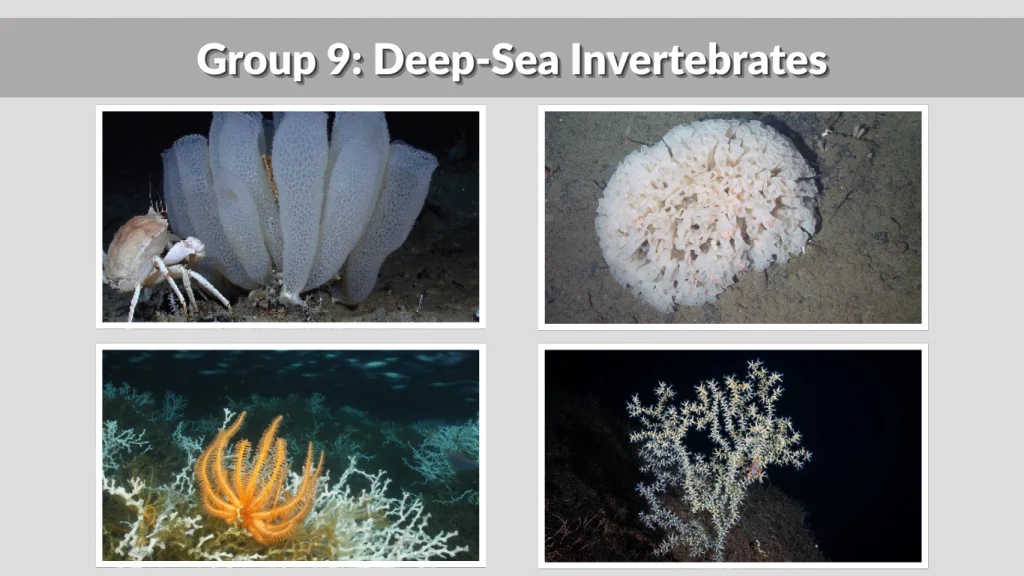
Beyond fish, worms, and mollusks, the deep sea is filled with many other invertebrates that form the foundation of deep-ocean ecosystems. These include sponges, corals, anemones, and single-celled giants that build structures, filter seawater, and provide shelter for countless animals. Many deep-sea invertebrates grow very slowly and can live for hundreds or even thousands of years. They often rely on filtering tiny food particles from the water or capturing drifting prey with tentacles. These organisms help create deep-sea habitats, making life possible in one of the harshest environments on Earth.
81. Venus Flower Basket
This beautiful glass sponge has a delicate, lattice-like skeleton made of silica. It filters microscopic food from seawater and often houses small shrimp inside its structure.
82. Glass Sponge
Glass sponges form reefs in some deep-sea regions. Their rigid, glassy skeletons provide homes for many small animals and help stabilize the seafloor.
83. Deep-Sea Coral
Unlike shallow corals, deep-sea corals do not rely on sunlight. They capture plankton from the water and can form massive reefs over centuries.
84. Black Coral
Black corals are slow-growing and long-lived animals that provide important habitats for fish and invertebrates in deep waters.
85. Sea Lily
Sea lilies are stalked echinoderms related to feather stars. They anchor to the seafloor and filter plankton from passing currents.
86. Xenophyophore
Xenophyophores are giant single-celled organisms that live on the deep seafloor. They trap particles and provide shelter for smaller animals.
87. Deep-Sea Anemone
These soft-bodied animals attach to rocks and vents, using stinging tentacles to capture small fish and drifting prey.
88. Giant Foraminiferan
These are large, shell-building single-celled organisms that play an important role in deep-sea sediment formation.
89. Hydrothermal Vent Barnacle
Vent barnacles live near superheated vent water. They filter food from chemically rich currents and often grow in dense clusters.
90. Deep-Sea Bryozoan
Bryozoans are tiny colonial animals that build branching or crust-like structures on rocks and corals, filtering microscopic food from the water.
Group 10: Deep-Sea Predators & Oddities

The deep sea is home to some of the strangest and most specialized animals on the planet. Many do not fit neatly into one group and are often called “oddities” because of their unusual bodies, hunting methods, and behaviors. These animals have evolved extreme adaptations such as expandable stomachs, tripod-like fins, telescopic eyes, and transparent bodies to survive where food is scarce and darkness is constant. As top predators or highly specialized feeders, they play an important role in controlling populations and maintaining balance in deep-ocean ecosystems.
91. Chimaera
Also known as ghost fish, chimaeras are relatives of sharks with long tapering tails and large eyes. They feed on hard-shelled animals such as crabs and mollusks on the deep seafloor.
92. Deep-Sea Tripod Fish
The tripod fish rests on elongated fin rays that act like stilts. It faces into the current and waits for small fish and crustaceans to drift within reach.
93. Coffinfish
Coffinfish are round, bottom-dwelling fish related to anglerfish. They walk on modified fins and use a small lure to attract prey.
94. Deep-Sea Batfish
Batfish crawl along the seafloor rather than swimming well. They have flattened bodies and use a lure on their snout to draw in prey.
95. Pelican Eel
The pelican eel has an enormous, stretchy mouth that can open wide to trap prey. It also has a glowing tail tip that may help lure animals closer.
96. Telescopefish
Telescopefish have large, upward-facing eyes that collect faint light from above, helping them spot silhouettes of prey.
97. Loosejaw Fish
Loosejaw fish possess a hinged, skinless jaw and needle-like teeth. Their mouths can open extremely wide, allowing them to snatch fast-moving prey.
98. Pacific Blackdragon
This dragonfish species produces both blue and red light. The red light acts like a private spotlight that most deep-sea animals cannot see.
99. Deep-Sea Lizardfish
These ambush predators lie in wait on the seafloor, lunging suddenly at passing fish and crustaceans.
100. Big Red Jellyfish
One of the largest deep-sea jellyfish, this species drifts through dark waters, capturing prey with long arms instead of thin tentacles.