
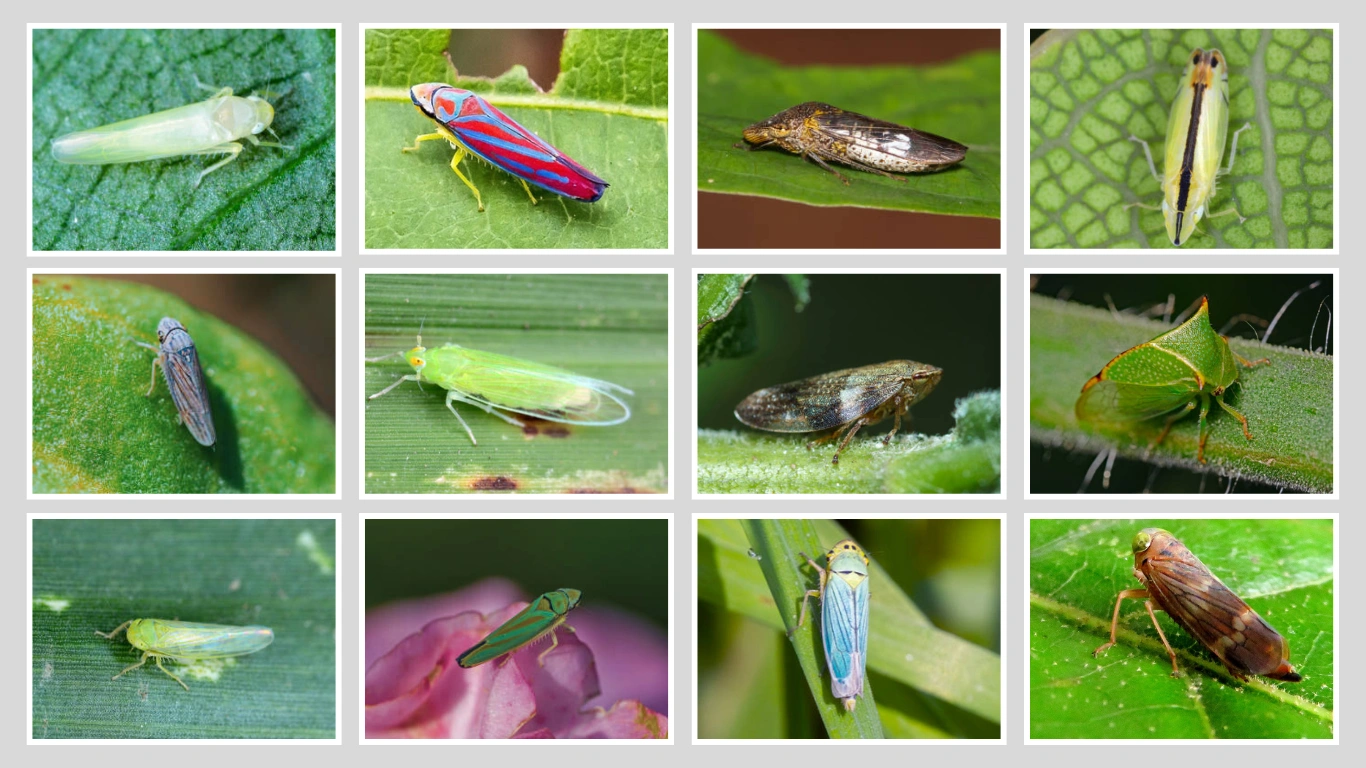
Leafhoppers are small, sap-sucking insects found worldwide, many of which pose serious threats to crops and ornamental plants. This guide explores 20 notable types of leafhoppers, from the Potato Leafhopper to the Spotted Leafhopper, including how to identify them, where they live, the damage they cause, and how to control them effectively.
1. Potato Leafhopper (Empoasca fabae)

The Potato Leafhopper is a tiny, wedge-shaped insect known for its destructive feeding on a wide range of crops, including potatoes, beans, alfalfa, and apples. It causes a distinctive yellowing and curling of leaves known as “hopperburn.” Despite its small size, it poses a significant agricultural threat due to its mobility and rapid reproduction.
Identification
- Small, about 1/8 inch (3 mm) long
- Pale green body
- Wedge-shaped and slender
- Six white spots on the pronotum (just behind the head)
- Rapid sideways or backward hopping when disturbed
Habitat and Distribution
Potato leafhoppers are primarily found in North America, especially in eastern and central United States. They do not survive winter in northern regions, instead migrating north each spring. These insects prefer deciduous trees, leguminous crops, and herbaceous plants in farms, gardens, and wild vegetation.
Feeding and Plant Damage
Potato leafhoppers feed by inserting their needle-like mouthparts into plant tissue and sucking sap. While feeding, they inject toxic saliva that causes hopperburn—a yellowing and browning of leaf tips and edges, followed by leaf curling. This disrupts photosynthesis and stunts plant growth, leading to reduced yields in crops like alfalfa, beans, and potatoes.
Control and Management
- Crop rotation and avoiding planting near overwintering sites
- Use row covers early in the season to exclude adults
- Insecticidal soaps or neem oil can help in early stages
- Natural predators, such as lady beetles and lacewings, offer biological control
- In severe infestations, systemic insecticides may be needed under agricultural guidance
2. Grapevine Leafhopper (Erythroneura elegantula)
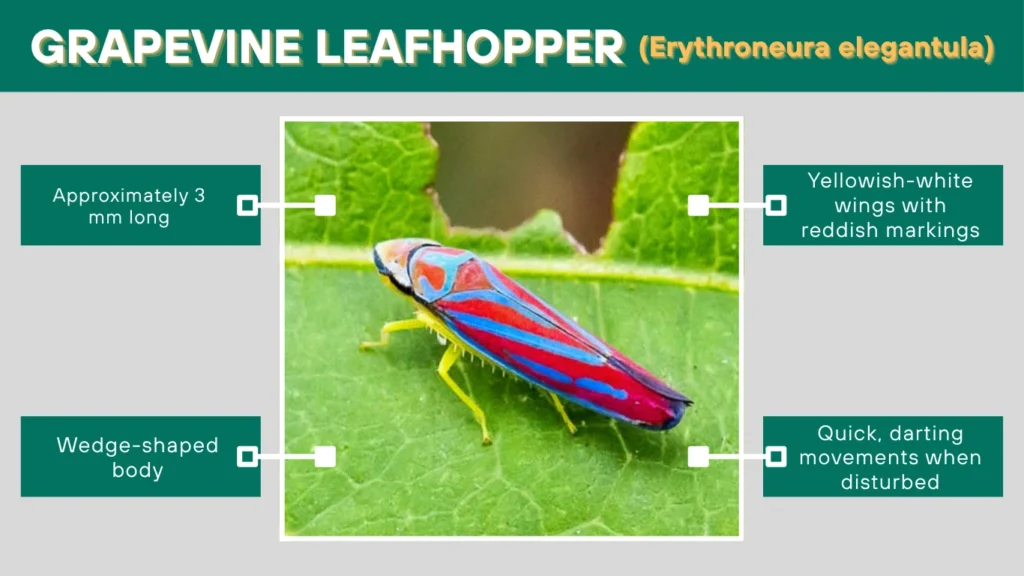
The Grapevine Leafhopper is a small but highly damaging pest of grapevines, especially in vineyards of California and the western U.S. Its feeding weakens vines, reduces fruit quality, and encourages the growth of mold due to honeydew deposits.
Identification
- Approximately 3 mm long
- Yellowish-white wings with reddish markings
- Wedge-shaped body
- Quick, darting movements when disturbed
- Often found on the underside of grape leaves
Habitat and Distribution
Primarily found in North American vineyards, especially California, this species thrives in temperate, dry climates. It resides on the underside of grapevine leaves, preferring cultivated grape varieties over wild types.
Feeding and Plant Damage
They feed on leaf sap, leaving behind white or yellow stippling. Heavy infestations lead to leaf curling, premature leaf drop, and reduced sugar levels in grapes. Their feeding also results in honeydew, which promotes sooty mold.
Control and Management
- Promote beneficial predators like Anagrus wasps
- Use reflective mulches or sticky traps early in the season
- Maintain canopy thinning for better air circulation
- Use targeted insecticides only when thresholds are exceeded
3. Glassy-winged Sharpshooter (Homalodisca vitripennis)

The Glassy-winged Sharpshooter is a large leafhopper known for its role in spreading Xylella fastidiosa, a bacterium that causes diseases like Pierce’s disease in grapes. Its wide host range and powerful flying ability make it a serious threat to agriculture.
Identification
- Large, about 12–14 mm long
- Dark brown body with translucent wings
- Reddish eyes
- Pale speckles on head and thorax
- Emits watery excreta when feeding
Habitat and Distribution
Native to the southeastern United States, but now invasive in California, Mexico, and parts of the Pacific. It inhabits a broad range of host plants, including citrus, grapevines, oleander, and ornamental trees.
Feeding and Plant Damage
Feeds on xylem fluid, requiring it to ingest large amounts of sap. While not directly toxic, its vectoring of bacterial pathogens causes severe plant diseases. This disrupts water flow and eventually leads to plant death in vulnerable species.
Control and Management
- Employ biological controls like parasitic wasps (Gonatocerus spp.)
- Avoid planting high-risk hosts together
- Monitor with yellow sticky traps
- Use insecticides in high-risk agricultural zones with vector monitoring
4. Two-spotted Leafhopper (Sophonia rufofascia)

The Two-spotted Leafhopper is an invasive pest originally from Asia, now established in Hawaii and parts of California. It feeds on a wide range of crops and ornamental plants, transmitting plant pathogens and causing leaf deformation.
Identification
- About 4–5 mm in length
- Pale yellow-green body
- Two distinct black spots behind the eyes
- Red stripe across the face
- Very active, hops or flies when disturbed
Habitat and Distribution
First found in Hawaii, this species now affects areas in California and the Pacific Islands. It thrives in tropical and subtropical climates, infesting gardens, nurseries, and orchards.
Feeding and Plant Damage
The insect feeds on sap from leaves and stems, resulting in leaf curling, yellowing, and necrosis. It also transmits Xylella fastidiosa, making it a vector for serious plant diseases in citrus, grapes, and coffee.
Control and Management
- Monitor using sticky traps and visual inspection
- Prune infested areas to limit spread
- Apply horticultural oils or insecticidal soap early
- Introduce parasitoid wasps in integrated pest management (IPM) programs
5. Beet Leafhopper (Circulifer tenellus)
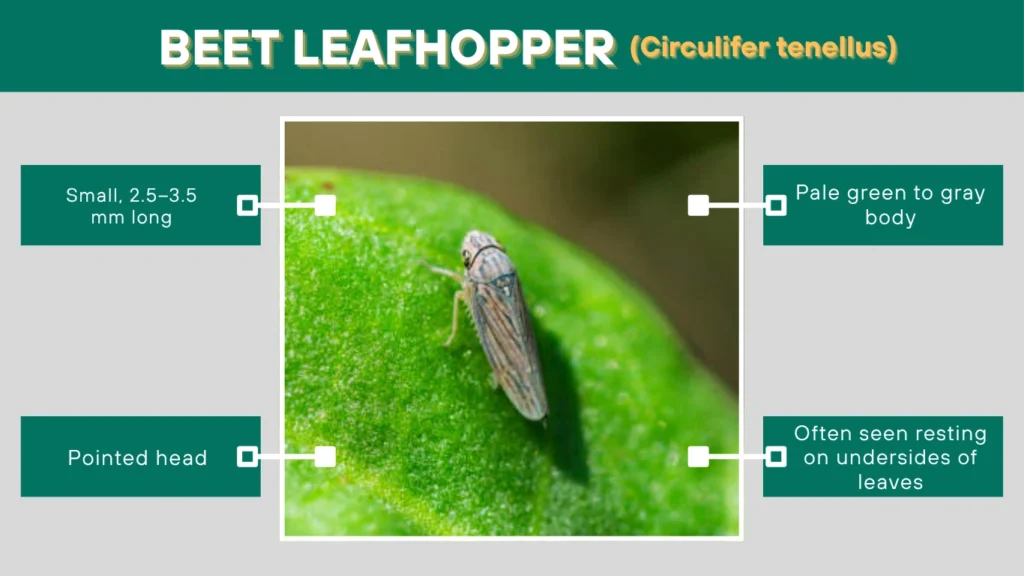
The Beet Leafhopper is a tiny but economically important pest, especially in sugar beet farming. It is a known vector of the curly top virus, affecting over 300 plant species including tomatoes, peppers, and spinach.
Identification
- Small, 2.5–3.5 mm long
- Pale green to gray body
- Pointed head
- Often seen resting on undersides of leaves
- Quick, erratic flight pattern when disturbed
Habitat and Distribution
Found across the western United States and Mexico, particularly in semi-arid regions. It often migrates from weedy areas to cultivated crops during warmer months.
Feeding and Plant Damage
Though direct feeding causes minimal damage, its real threat lies in transmitting viruses. Infected plants exhibit stunted growth, yellowing, and twisted leaves, severely impacting crop yield and quality.
Control and Management
- Remove nearby weedy host plants like Russian thistle
- Use resistant crop varieties when available
- Apply systemic insecticides in high-risk zones
- Monitor and manage populations in spring migration corridors
6. Green Leafhopper (Cicadella viridis)

The Green Leafhopper is a widespread species found in wetlands, grasslands, and agricultural fields. Known for its vivid color, it primarily feeds on grasses and legumes, occasionally transmitting plant diseases.
Identification
- Bright green body
- Approximately 5–7 mm long
- Slender, elongated shape
- Transparent wings held roof-like over the body
- Often spotted resting on grasses
Habitat and Distribution
Common in Europe, Asia, and North America, especially in moist meadows, wetlands, and agricultural fields. It prefers grasses, legumes, and herbaceous plants, and is most active in warm seasons.
Feeding and Plant Damage
Feeds on phloem sap, which weakens plants over time. Although not a major pest in small numbers, it can become problematic in large populations by spreading phytoplasma diseases in clovers and crops.
Control and Management
- Maintain field hygiene by mowing weeds and grasses
- Promote natural predators like spiders and lacewings
- Use light traps to monitor populations
- Apply selective insecticides during outbreaks
7. Rice Green Leafhopper (Nephotettix virescens)
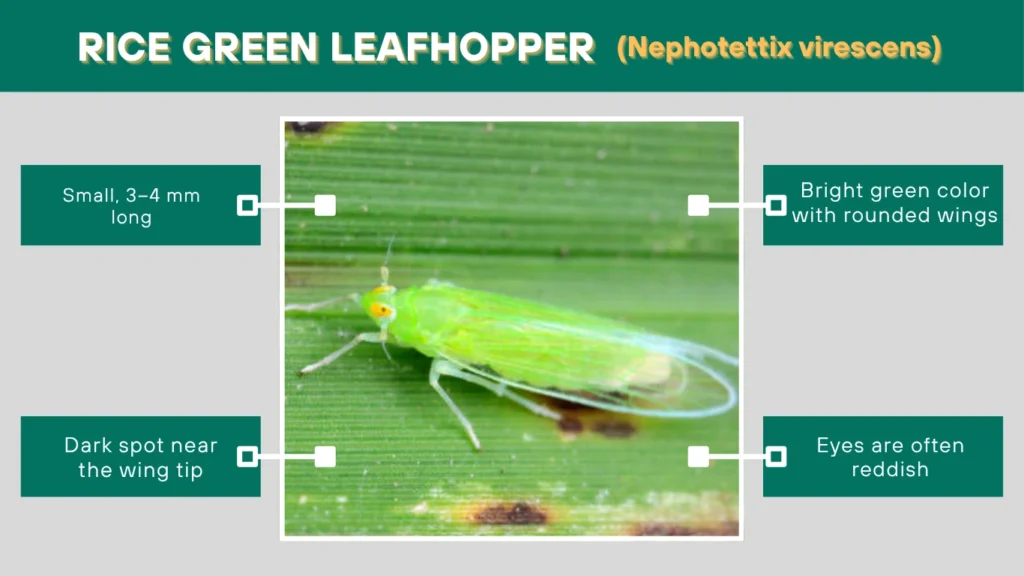
A major rice pest in Asia, the Rice Green Leafhopper causes both direct feeding damage and disease transmission. It spreads rice tungro virus, which severely reduces crop yield.
Identification
- Small, 3–4 mm long
- Bright green color with rounded wings
- Dark spot near the wing tip
- Eyes are often reddish
- Moves quickly and hops when disturbed
Habitat and Distribution
Widespread in Southeast Asia, India, China, and other rice-growing regions. Commonly found in paddy fields, especially in the early vegetative stages of rice crops.
Feeding and Plant Damage
It sucks sap from vascular tissue, causing yellowing, stunting, and plant wilting. More dangerously, it acts as a vector for rice tungro virus, which can destroy entire fields if unmanaged.
Control and Management
- Synchronous planting to limit population build-up
- Grow resistant rice varieties
- Introduce biological agents like spiders and mirid bugs
- Use insecticides carefully in IPM programs
8. Alder Spittlebug Leafhopper (Oncopsis alni)
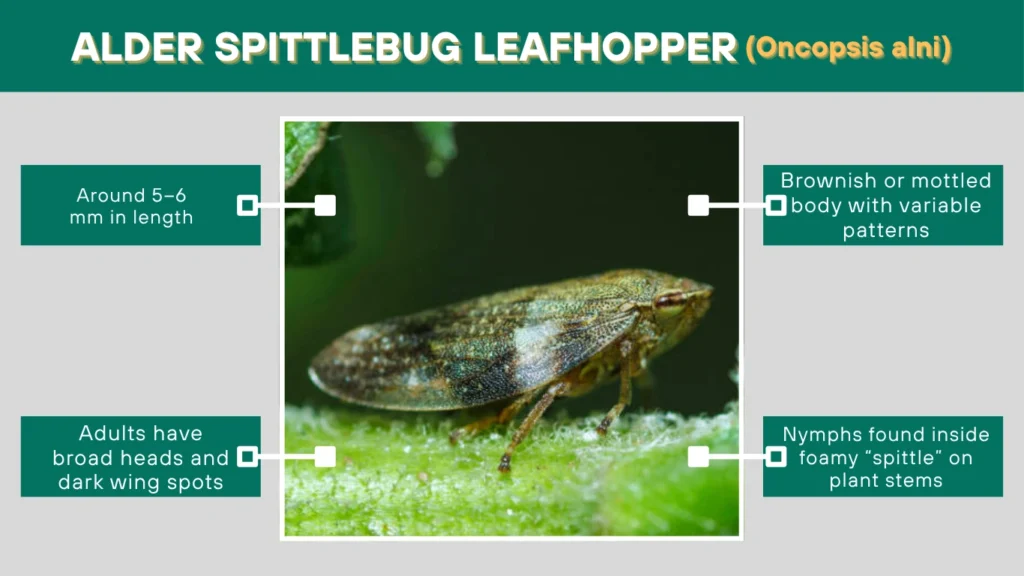
This species is often associated with alder trees and is known for its nymphs, which produce frothy spittle masses for protection. While not a major pest, its presence can indicate ecosystem imbalances in forested regions.
Identification
- Around 5–6 mm in length
- Brownish or mottled body with variable patterns
- Adults have broad heads and dark wing spots
- Nymphs found inside foamy “spittle” on plant stems
- Short, wide body with strong hind legs
Habitat and Distribution
Widespread across Europe and parts of Asia, especially in temperate forest zones with abundant alder trees. Found in hedgerows, riverbanks, and woodlands, often in moist environments.
Feeding and Plant Damage
Feeds on the xylem sap of alder and related trees. Damage is generally minor, causing localized sap loss and possibly contributing to disease spread in weakened plants. Nymphs are more noticeable due to their spittle masses.
Control and Management
- Usually not treated due to low economic damage
- Maintain tree health to reduce attractiveness
- Remove spittle masses manually if needed
- Encourage natural predators like birds and spiders
9. Buffalo Treehopper (Stictocephala bisonia)
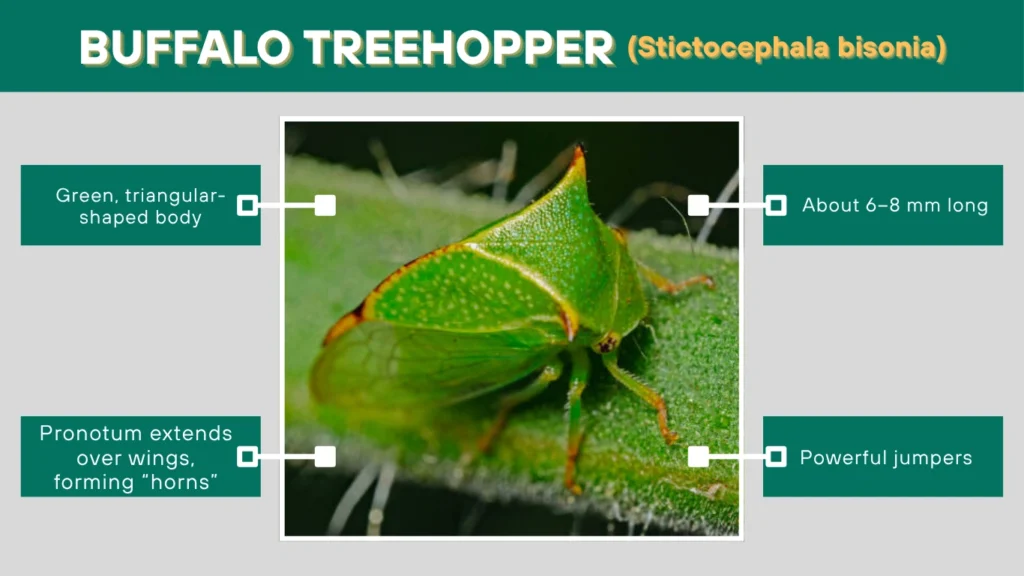
The Buffalo Treehopper is a unique-looking insect that resembles a miniature buffalo due to its horn-like thorax. While technically a treehopper (family Membracidae), it behaves like a leafhopper and feeds on sap from woody plants.
Identification
- Green, triangular-shaped body
- About 6–8 mm long
- Pronotum extends over wings, forming “horns”
- Powerful jumpers
- Resembles a miniature buffalo from the side
Habitat and Distribution
Native to North America but introduced to Europe. Found in orchards, gardens, and forested areas, especially where woody shrubs and trees like apple, elm, and willow are present.
Feeding and Plant Damage
Feeds on woody stems and petioles, occasionally causing girdling wounds. Females lay eggs in slits cut into twigs, which can weaken branches or introduce fungal infections. Can affect fruit trees in large populations.
Control and Management
- Prune and destroy egg-laden twigs
- Use tree wraps or bands to reduce egg-laying
- Apply horticultural oils in dormant season
- Encourage beneficial insects such as predatory wasps
10. Maize Leafhopper (Dalbulus maidis)

The Maize Leafhopper is a key vector of multiple maize diseases in the Americas. It transmits pathogens like maize rayado fino virus (MRFV) and Spiroplasma kunkelii, which cause significant crop loss in warm regions.
Identification
- Small, slender, about 3–4 mm long
- Pale yellow to light green color
- Transparent wings with faint veins
- Red eyes in some individuals
- Often seen near the base of corn leaves
Habitat and Distribution
Found primarily in Central and South America, as well as southern U.S. states. It thrives in warm, tropical, and subtropical maize-growing regions, especially where crops are grown year-round.
Feeding and Plant Damage
Feeds on phloem sap of young corn plants, weakening them and stunting growth. The most serious damage comes from its ability to transmit multiple diseases, which cause leaf striping, curling, and poor ear formation.
Control and Management
- Plant resistant maize hybrids
- Avoid overlapping crop cycles to break pest cycles
- Monitor and remove infected plants early
- Use insecticides as part of integrated pest management (IPM)
11. Rose Leafhopper (Edwardsiana rosae)

The Rose Leafhopper is a pest commonly found in gardens and nurseries. It primarily affects rose bushes but also feeds on other ornamental and fruit plants, leading to aesthetic and health issues.
Identification
- Approximately 3 mm long
- Pale yellow or whitish body
- Wedge-shaped with clear wings
- Found on the underside of rose leaves
- Leaves behind white spots where it feeds
Habitat and Distribution
Widespread across Europe, North America, and parts of Asia, especially in gardens, greenhouses, and landscaped areas. Prefers roses, but also affects apple, pear, and ornamental shrubs.
Feeding and Plant Damage
Sucks sap from the underside of leaves, causing white speckling or stippling. Heavy infestations can lead to leaf yellowing, premature drop, and reduced flowering, especially in rose cultivars.
Control and Management
- Regularly inspect and prune affected leaves
- Use strong water sprays to dislodge them
- Apply insecticidal soaps or horticultural oils
- Encourage ladybugs and lacewings as natural predators
12. Blue-green Sharpshooter (Graphocephala atropunctata)

The Blue-green Sharpshooter is a vibrant and active leafhopper known primarily for its role in spreading Pierce’s disease in grapevines. Despite its small size, its impact on vineyards can be severe.
Identification
- About 6–8 mm long
- Metallic blue-green body with red streaks
- Transparent wings folded over the back
- Black speckles near the wing base
- Very fast, flies or jumps when disturbed
Habitat and Distribution
Found in California and parts of the Pacific Coast, this species prefers riparian zones, ornamental plants, and vineyards. It thrives in moist environments with ample plant diversity.
Feeding and Plant Damage
Feeds on xylem sap, transmitting Xylella fastidiosa, the bacterium responsible for Pierce’s disease. Infected grapevines show leaf scorch, reduced fruit production, and eventually vine death.
Control and Management
- Remove or trim riparian vegetation near vineyards
- Use insecticide-treated barriers or reflective mulch
- Monitor with yellow sticky traps
- Introduce parasitoids or egg predators as part of IPM
13. Citrus Leafhopper (Scaphytopius spp.)
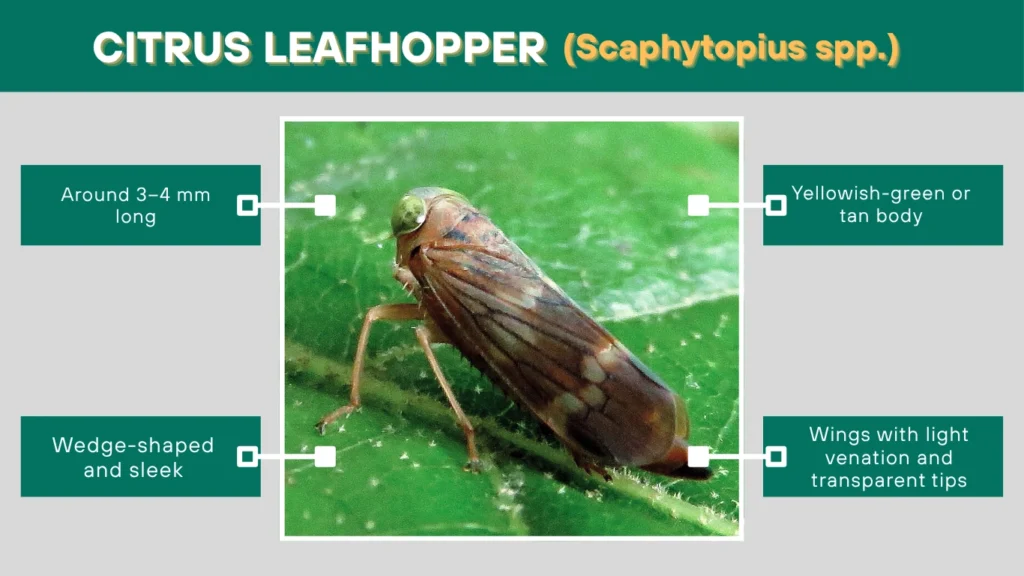
Citrus Leafhoppers are a group of leafhoppers that infest citrus trees and other fruit-bearing plants. Though small, they can spread citrus stubborn disease and other bacterial pathogens.
Identification
- Around 3–4 mm long
- Yellowish-green or tan body
- Wedge-shaped and sleek
- Wings with light venation and transparent tips
- Active flyers, rest on young leaves or stems
Habitat and Distribution
Found across North America, especially in southern U.S. citrus-growing areas like Florida, Texas, and California. These leafhoppers are seen on citrus, peach, plum, and occasionally grape.
Feeding and Plant Damage
They suck sap from young citrus shoots, causing leaf curling, stippling, and overall tree decline. Most damage results from their ability to transmit citrus stubborn phytoplasma, which affects fruit shape and yields.
Control and Management
- Remove weed hosts and nearby alternate crops
- Promote healthy, vigorous tree growth
- Apply systemic insecticides if monitoring shows threshold levels
- Consider beneficial insect support to reduce populations
14. Tea Green Leafhopper (Empoasca vitis)
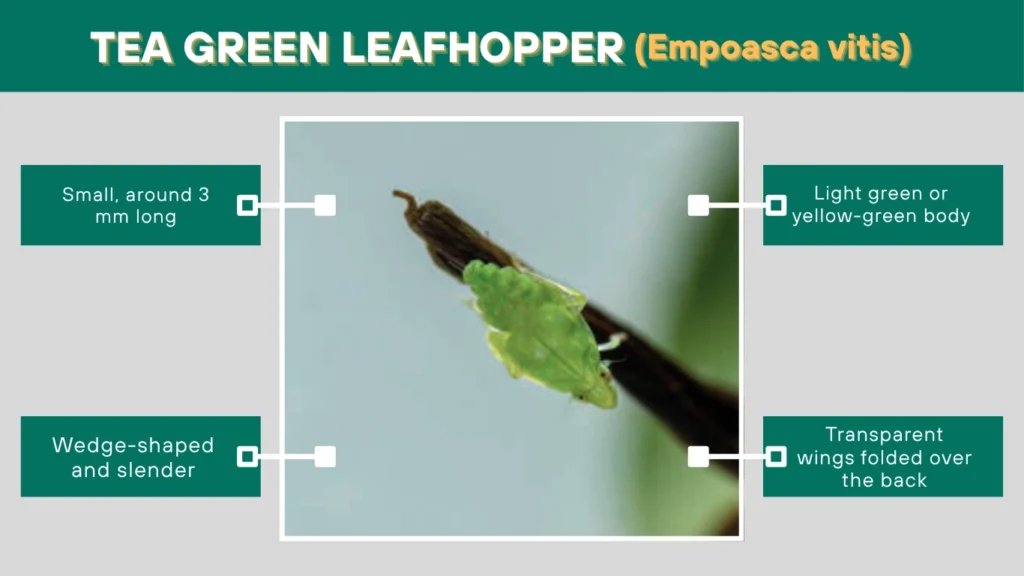
The Tea Green Leafhopper is a major pest in tea plantations across Asia. Its sap-feeding behavior leads to a condition known as “hopper burn,” which reduces tea quality and yield significantly.
Identification
- Small, around 3 mm long
- Light green or yellow-green body
- Wedge-shaped and slender
- Transparent wings folded over the back
- Often found in groups on young tea leaves
Habitat and Distribution
Widespread in China, Japan, India, and other tea-growing countries. Prefers humid, subtropical climates and infests the tender shoots and leaves of tea plants.
Feeding and Plant Damage
Feeds on the phloem sap of young leaves, leading to yellowing, curling, and browning at the tips, collectively known as “hopper burn.” Affected leaves become brittle and reduce the quality of processed tea.
Control and Management
- Maintain shade management and field hygiene
- Use light traps to monitor adult populations
- Apply botanical insecticides or neem extracts
- Introduce predators like spiders and mirid bugs in IPM systems
15. Eastern Grape Leafhopper (Erythroneura comes)

The Eastern Grape Leafhopper is a common pest in eastern U.S. vineyards. Though small, their feeding on grape leaves can cause visible damage and reduce the plant’s ability to photosynthesize effectively.
Identification
- Tiny, about 3 mm long
- Pale yellow body with reddish-brown markings
- Wings marked with distinctive zigzag patterns
- Often found on the underside of grape leaves
- Quick-moving when disturbed
Habitat and Distribution
Found in eastern and central United States, especially in grape-growing regions. Prefers cultivated vineyards, wild grapevines, and nearby wooded or weedy areas.
Feeding and Plant Damage
Feeds on the underside of grape leaves, removing sap and causing white stippling or leaf speckling. Heavy infestations may result in early leaf drop and reduced fruit sugar levels.
Control and Management
- Encourage beneficial wasps (Anagrus spp.) for egg parasitism
- Prune and manage canopy for good airflow and light
- Use insecticidal sprays when thresholds are met
- Regular scouting for early signs of infestation
16. Macrosteles Leafhopper (Macrosteles quadrilineatus)

Also known as the Aster Leafhopper, this species is a notorious vector of aster yellows phytoplasma, affecting over 300 plant species including vegetables, ornamentals, and grains.
Identification
- About 3.5 mm long
- Pale green to yellow body
- Four distinct black lines on the thorax
- Slender, wedge-shaped form
- Quick to jump or fly when disturbed
Habitat and Distribution
Found widely across North America, especially in Midwestern crop fields and gardens. It migrates long distances and thrives in temperate climates with access to aster family plants, carrots, lettuce, and celery.
Feeding and Plant Damage
Feeds on plant sap but primarily damages plants by transmitting aster yellows, which causes stunted growth, yellowing, bushy shoots, and abnormal flowers. It affects both crop yield and visual appeal of ornamentals.
Control and Management
- Remove weedy hosts around crops
- Use row covers for vulnerable plants
- Apply insecticides early in the season to prevent phytoplasma spread
- Monitor populations with sticky traps and scouting
17. Brown Leafhopper (Cofana spectra)
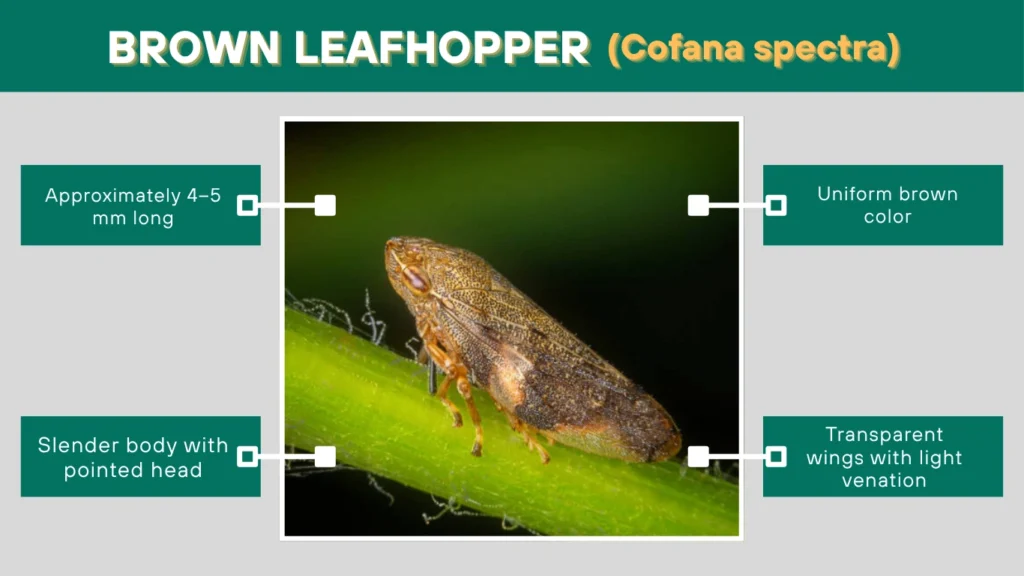
The Brown Leafhopper is a common rice pest in Asia. Though not as destructive as green rice hoppers, it can still impact yields through sap-feeding and virus transmission.
Identification
- Approximately 4–5 mm long
- Uniform brown color
- Slender body with pointed head
- Transparent wings with light venation
- Active hopper, often found in large numbers in rice paddies
Habitat and Distribution
Common in South and Southeast Asia, particularly in India, Bangladesh, and the Philippines. Found mostly in lowland rice fields, especially during early stages of crop growth.
Feeding and Plant Damage
Feeds on vascular sap, leading to yellowing leaves, wilting, and stunted growth. It can also transmit viral diseases, though less efficiently than other rice hoppers.
Control and Management
- Maintain field sanitation by removing stubble and weeds
- Use resistant rice varieties
- Introduce predators like frogs and spiders in wetland fields
- Apply biopesticides or low-impact insecticides in IPM frameworks
18. Yellow-striped Leafhopper (Paraphlepsius irroratus)

The Yellow-striped Leafhopper is a native North American species often found in gardens, crops, and meadows. Though not a major pest, it can transmit plant pathogens, especially to herbaceous plants.
Identification
- About 5–6 mm long
- Light brown or tan body
- Two faint yellow stripes running down the wings
- Wedge-shaped and slightly flattened body
- Found on leaves of herbaceous plants
Habitat and Distribution
Widespread in eastern and central North America, including fields, pastures, and vegetable gardens. It thrives in sunny, weedy areas, especially during the warmer months of late spring and summer.
Feeding and Plant Damage
Feeds on plant sap, causing stippling or yellowing in mild cases. In large numbers or with disease involvement, it may lead to stunted growth or pathogen transmission, especially to lettuce and carrot crops.
Control and Management
- Remove excessive weeds and grasses around crops
- Encourage natural enemies like parasitic wasps and spiders
- Monitor with visual checks and sweep nets
- Use organic sprays or selective insecticides when necessary
19. Japanese Leafhopper (Matsumuratettix hiroglyphicus)

This is a small but significant rice pest in Southeast Asia, known for transmitting rice ragged stunt virus and rice grassy stunt virus, which can destroy entire harvests if left unchecked.
Identification
- Small, about 3 mm long
- Light brown or pale gray with faint markings
- Flattened, elongated body
- Wings held roof-like over the back
- Moves quickly across rice foliage
Habitat and Distribution
Prevalent in Thailand, Vietnam, the Philippines, and other Southeast Asian rice-growing regions. Found in lowland paddies, especially during warm and humid growing seasons.
Feeding and Plant Damage
Direct feeding causes leaf yellowing, curling, and reduced tillering. More importantly, it is a known vector of two major rice viruses, resulting in irregular panicle development, poor grain filling, and up to 100% crop loss if uncontrolled.
Control and Management
- Synchronize planting to limit host availability
- Use virus-resistant rice strains
- Apply systemic insecticides during vulnerable crop stages
- Regular field monitoring and early action are essential
20. Spotted Leafhopper (Erythroneura variabilis)

The Spotted Leafhopper is a colorful, tiny insect primarily found in vineyards and orchards. Though small, its sap-sucking habit and virus-carrying ability can reduce fruit quality and affect overall plant health.
Identification
- Tiny, about 3 mm in length
- Yellowish-white body with distinct red or brown spots on the wings
- Wedge-shaped and compact form
- Clear wings with spotted patterns
- Typically seen on the underside of leaves, especially grapevines and fruit trees
Habitat and Distribution
Common in North America, especially in California, Oregon, and other fruit-producing regions. Prefers grapevines, apples, peaches, and other soft fruits, often found in both cultivated and wild areas.
Feeding and Plant Damage
Feeds on plant sap, leaving stippling (white or yellow spots) on the leaves. Heavy feeding can lead to leaf curling, premature leaf drop, and decreased photosynthesis, affecting fruit ripening and yield. Some species may also transmit plant pathogens.
Control and Management
- Implement canopy management in vineyards for better air circulation
- Encourage natural enemies like parasitic wasps
- Monitor populations using yellow sticky traps
- Apply selective insecticides when thresholds are exceeded
