
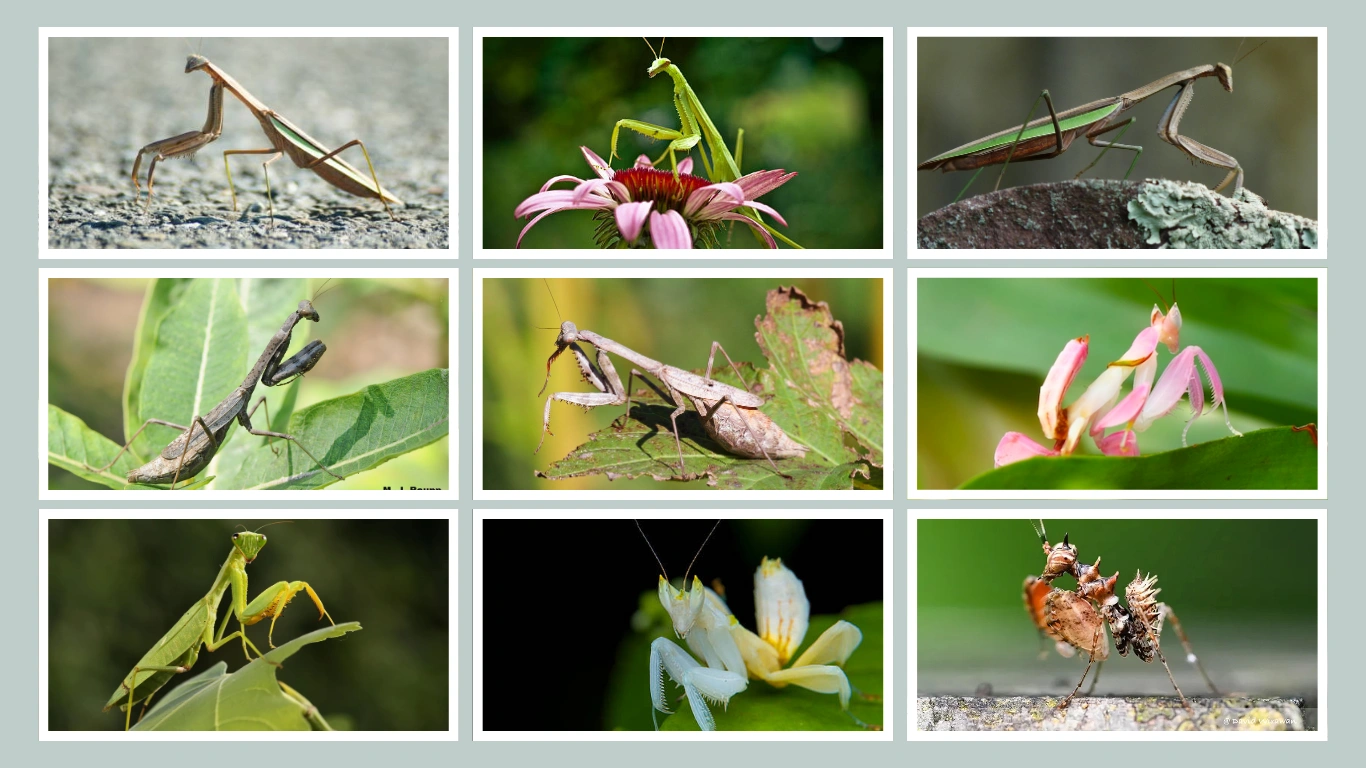
Praying mantises are some of the most fascinating insects in the world, known for their unique hunting style, folded “praying” forelegs, and excellent camouflage. With over 2,400 species globally, mantids come in a wide variety of colors, sizes, and forms—each uniquely adapted to its environment. In this guide, we’ve selected 23 of the most common and visually striking mantis types from around the world. From the petal-mimicking Orchid Mantis to the powerful Giant Rainforest Mantis, explore the diversity of these incredible insect predators, one species at a time.
1. Chinese Mantis (Tenodera sinensis)

The Chinese mantis is one of the largest and most commonly recognized praying mantis species in the world. Originally native to Asia, it has spread to North America and other parts of the world. This mantis is known for its long, slender body and excellent camouflage, making it an effective ambush predator. It often feeds on a wide variety of insects and sometimes even small vertebrates.
Identification
- Color: Brown, green, or a mix of both
- Size: 3 to 5 inches (7.5 to 12.5 cm)
- Body: Slender, with a green stripe along the edge of the wings
- Eyes: Bulging compound eyes, spaced wide apart
- Wings: Extend past the abdomen in adults
Habitat and Distribution
Chinese mantises are commonly found in gardens, meadows, and farmlands, especially in areas with tall grass and shrubs. In the U.S., they are widespread in the eastern and central states, often introduced as a form of natural pest control.
Behavior and Diet
This mantis is an ambush predator, staying still and striking rapidly at prey. It feeds on flies, crickets, grasshoppers, and even small frogs or hummingbirds in rare cases. They are solitary and can be territorial, sometimes showing cannibalistic behavior.
Life Cycle and Reproduction
The life cycle begins when females lay oothecae (egg cases) in late summer or fall. These cases can survive the winter and hatch in spring. A single ootheca can contain up to 200 nymphs, which molt several times before becoming adults in late summer.
2. European Mantis (Mantis religiosa)

The European mantis is a well-known species recognized for its distinctive green or brown coloring and the characteristic “praying” posture of its forelegs. Native to Europe, it has also been introduced to North America and other regions. This mantis is often admired for its elegant movements and effective hunting skills.
Identification
- Color: Green or light brown
- Size: 2 to 3 inches (5 to 7.5 cm)
- Forelegs: Marked with a distinctive black spot on the inner side
- Antennae: Thread-like, long and thin
- Wings: Fully developed in adults
Habitat and Distribution
The European mantis prefers dry, open habitats such as grasslands, gardens, and shrublands. It’s commonly found throughout southern Europe, but populations are also established in North America, particularly in warmer areas.
Behavior and Diet
This species is known for being a sit-and-wait predator, remaining motionless until prey comes within reach. It primarily feeds on flies, moths, and grasshoppers. Like many mantids, the female may exhibit sexual cannibalism after mating.
Life Cycle and Reproduction
Females lay oothecae on branches or other surfaces in late summer. These egg cases hatch in spring, releasing many tiny nymphs. The species undergoes incomplete metamorphosis, with several molts before reaching adulthood.
3. Carolina Mantis (Stagmomantis carolina)

The Carolina mantis is a native species to the United States and is frequently seen in gardens and wooded areas. It is the official state insect of South Carolina and is smaller than many other mantis species, making it ideal for home gardens as a natural pest controller.
Identification
- Color: Varies—gray, green, or brown
- Size: Males: ~2 inches (5 cm); Females: ~2.5 inches (6.4 cm)
- Wings: Males have longer wings than females
- Shape: Stout body, often with mottled or striped patterns
- Head: Triangular with large compound eyes
Habitat and Distribution
This mantis thrives in gardens, forests, and shrubs, especially in southern and eastern parts of the United States. It adapts well to various environments and is often encouraged by gardeners to help control pests.
Behavior and Diet
The Carolina mantis is an active hunter, moving from place to place rather than waiting for prey. It eats a variety of insects like mosquitoes, flies, caterpillars, and even other mantids. Males are more agile and fly readily, especially during mating season.
Life Cycle and Reproduction
Females deposit egg cases (oothecae) on flat surfaces or vegetation in the fall. These overwinter and hatch in the spring. The young nymphs go through multiple molts before reaching maturity by late summer.
4. Orchid Mantis (Hymenopus coronatus)
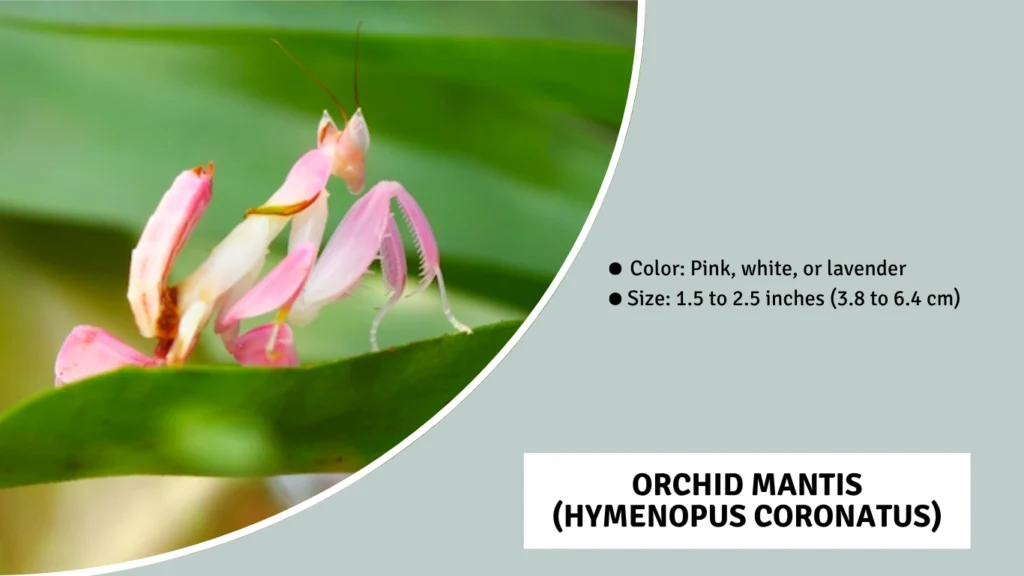
The Orchid mantis is one of the most visually stunning mantis species, perfectly adapted to mimic the appearance of orchid flowers. Native to the rainforests of Southeast Asia, this mantis uses its petal-like legs and vibrant coloring to ambush pollinating insects. It is especially admired in the exotic pet trade for its unique beauty.
Identification
- Color: Pink, white, or lavender
- Size: 1.5 to 2.5 inches (3.8 to 6.4 cm)
- Legs: Flattened, petal-shaped to resemble flower petals
- Body: Wide and leaf-like; juveniles are bright pink
- Camouflage: Exceptional mimicry of orchid flowers
Habitat and Distribution
Found primarily in Malaysia, Indonesia, and surrounding areas, the Orchid mantis prefers humid tropical forests where orchids and other flowers are common. It often rests on or near flowers to enhance its disguise.
Behavior and Diet
This mantis is an expert ambush predator, using its flower-like appearance to lure insects such as bees, butterflies, and flies. It waits motionless and strikes with lightning speed. Unlike other mantids, it often relies more on camouflage than movement.
Life Cycle and Reproduction
Females produce oothecae that hatch into nymphs after several weeks. The young mantids resemble tiny red ants and gradually transition into their floral disguise as they grow. They molt multiple times before becoming adults.
5. Ghost Mantis (Phyllocrania paradoxa)

The Ghost mantis is a leaf-mimicking mantis native to Africa and Madagascar. With a body shaped like a dry, curled leaf, it is one of the best examples of defensive mimicry in insects. Despite its intimidating appearance, it is relatively small and docile.
Identification
- Color: Brown, tan, or olive green
- Size: 1.5 to 2 inches (3.8 to 5 cm)
- Body: Flattened and twisted like a dead leaf
- Head: Elongated with a pointed crown
- Camouflage: Exceptional leaf mimicry with uneven edges
Habitat and Distribution
This mantis is found in dry forests, scrublands, and savannas of Sub-Saharan Africa and Madagascar. It prefers leaf-littered environments where it can blend into the background effortlessly.
Behavior and Diet
Ghost mantises are calm and slow-moving, using their camouflage to hide rather than chase prey. They feed on small flying insects and are particularly suited for captivity due to their tolerant nature and low activity level.
Life Cycle and Reproduction
Females lay small oothecae, and the nymphs that hatch resemble dark ants or sticks. They grow through several molts, developing their leafy appearance over time. The full life cycle takes several months, depending on temperature and humidity.
6. Dead Leaf Mantis (Deroplatys desiccata)
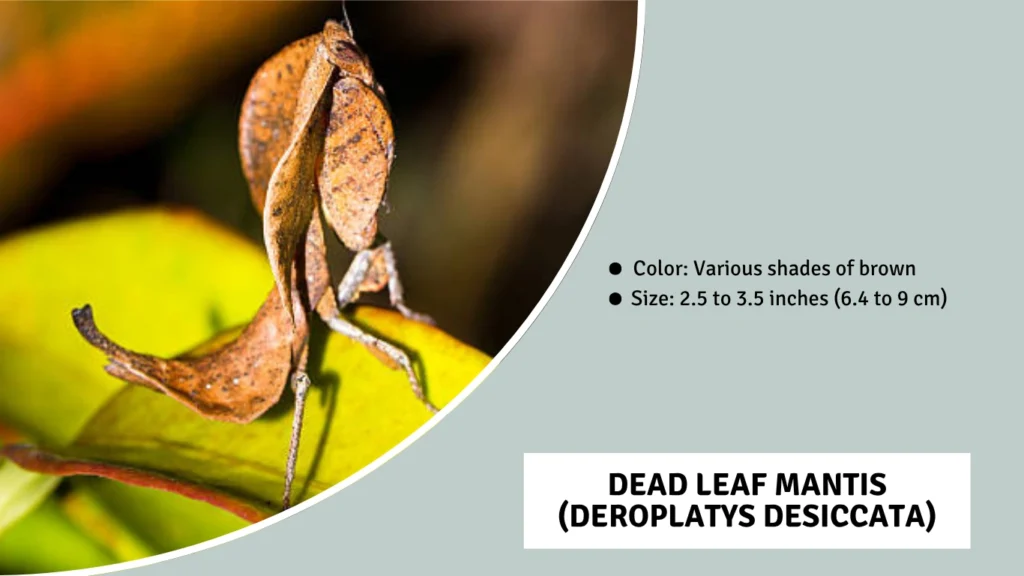
The Dead Leaf mantis is famous for its incredible resemblance to a dried, curled-up leaf. Native to Southeast Asia, this species uses its natural camouflage both to avoid predators and to sneak up on prey. It is one of the largest leaf-mimicking mantises and is popular among exotic insect keepers.
Identification
- Color: Various shades of brown, with some black mottling
- Size: 2.5 to 3.5 inches (6.4 to 9 cm)
- Wings: Leaf-veined and crinkled, mimicking dried leaves
- Pronotum: Large and flat, resembling a leaf stem
- Camouflage: Complete disguise as a dead leaf
Habitat and Distribution
Dead Leaf mantises are found in Malaysia, Indonesia, Borneo, and Sumatra, mainly in humid tropical forests with plenty of leaf litter. They remain still on the forest floor or among dead foliage.
Behavior and Diet
They are sit-and-wait predators, relying entirely on stillness and camouflage. They prey on flies, beetles, moths, and other small insects. When threatened, they display a dramatic defensive posture, fanning out their forelegs and wings to appear larger.
Life Cycle and Reproduction
Females lay oothecae on branches or leaves. The hatchlings go through 7 to 9 molts before becoming adults. Their transformation from nymphs to perfectly camouflaged mantids is gradual and striking.
7. African Mantis (Sphodromantis viridis)

The African mantis is a robust, active, and aggressive mantis species native to Sub-Saharan Africa. It is often seen in gardens and crops, where it plays an important role in controlling pest populations. Due to its size and hardiness, it is also a common pet mantis.
Identification
- Color: Bright green to brown
- Size: 3 to 4 inches (7.5 to 10 cm)
- Eyes: Large and well-spaced
- Body: Strong and muscular with wide forelegs
- Wings: Extend beyond the abdomen in adults
Habitat and Distribution
Widespread across Sub-Saharan Africa, the African mantis thrives in savannas, farms, gardens, and bushlands. It prefers warm climates and open areas with plenty of insect activity.
Behavior and Diet
Known for its aggressive hunting style, this mantis actively moves in search of prey. It feeds on flies, grasshoppers, butterflies, and even small vertebrates like frogs or lizards. Females are especially territorial and may attack other mantises.
Life Cycle and Reproduction
Females produce sturdy oothecae, which hatch in favorable conditions. Nymphs resemble miniature versions of adults and molt 6 to 9 times before reaching maturity. The life cycle is relatively fast in warm climates, allowing multiple generations per year.
8. Devil’s Flower Mantis (Idolomantis diabolica)
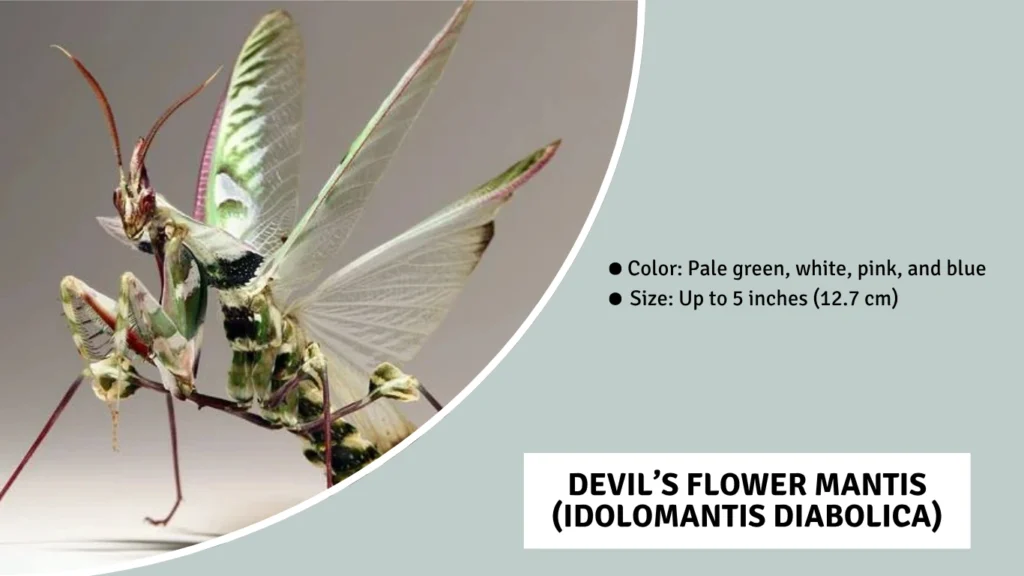
The Devil’s Flower mantis is one of the largest and most visually striking mantis species in the world. Known for its vibrant colors and dramatic threat displays, it resembles flower petals and is native to East Africa. Despite its name, it is not aggressive toward humans and is often kept by experienced insect keepers.
Identification
- Color: Pale green, white, pink, and blue
- Size: Up to 5 inches (12.7 cm)
- Legs: Large, flattened with colorful petal-like extensions
- Display: Bright inner legs used to startle predators
- Body: Slim with ornate thorax and elongated limbs
Habitat and Distribution
Native to Tanzania, Kenya, and Ethiopia, this mantis inhabits warm, semi-arid regions with flowering vegetation. It prefers high humidity and shaded areas.
Behavior and Diet
This species is a visual predator, blending into flowers to ambush pollinators like bees, moths, and butterflies. When threatened, it raises its body and fans out its legs in a bold display of colors to scare predators.
Life Cycle and Reproduction
The female lays large oothecae, which hatch in 6 to 8 weeks. Nymphs are brown and resemble dead twigs but develop into colorful adults after several molts. The entire development can take up to 6 months, depending on temperature and feeding.
9. Spiny Flower Mantis (Pseudocreobotra wahlbergii)

The Spiny Flower mantis is a small, vibrant mantis species known for the eye-like spiral marking on its wings and spiny body. Native to Africa, it mimics flowers and is often mistaken for petals by its prey. It is a favorite among mantis enthusiasts due to its manageable size and stunning appearance.
Identification
- Color: White with green, pink, or yellow accents
- Size: 1.5 inches (3.8 cm)
- Marking: Spiral “eye” pattern on the hind wings
- Thorax: Raised and covered with small spines
- Legs: Flattened, petal-like extensions
Habitat and Distribution
Found across central and southern Africa, particularly in flowering grasslands and gardens. It prefers warm, sunny environments where flowers are abundant.
Behavior and Diet
This mantis is a flower mimic, luring in pollinators like flies and bees. It uses its bright coloration as camouflage and also for defense. When startled, it flashes its spiral wings as a deimatic (startle) display to deter predators.
Life Cycle and Reproduction
Egg cases are laid on leaves or stems and hatch in warm conditions. Nymphs resemble tiny ants at first, then molt into ornate juveniles. The full life cycle lasts several months, depending on care and environmental conditions.
10. Shield Mantis (Choeradodis rhombicollis)
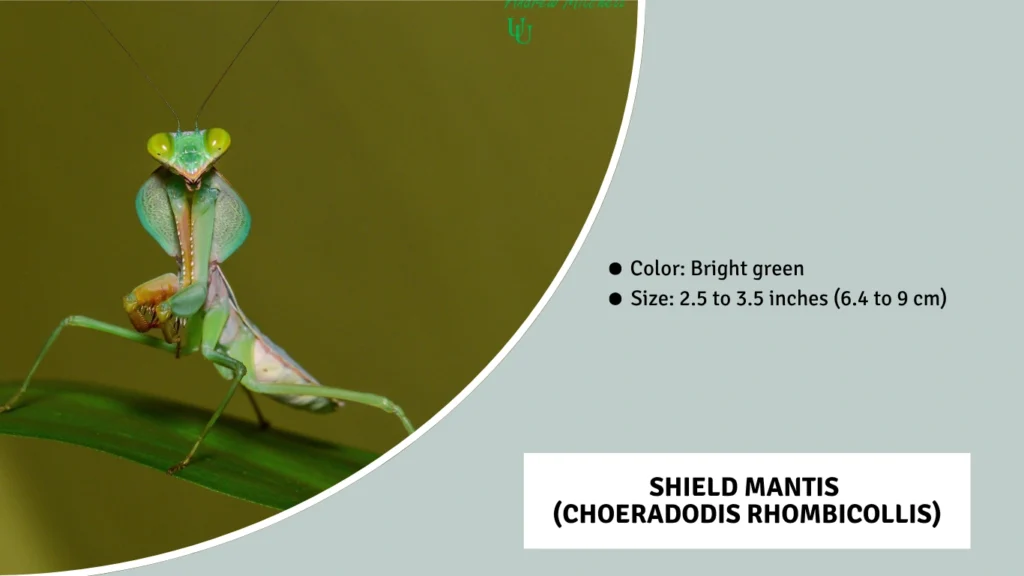
The Shield mantis, also known as the Leaf mantis, is famous for its extended, leaf-like thorax that helps it blend in with foliage. Native to Central and South America, it’s a master of camouflage and remains nearly invisible when resting on broad leaves.
Identification
- Color: Bright green
- Size: 2.5 to 3.5 inches (6.4 to 9 cm)
- Pronotum: Wide, flat, and leaf-shaped
- Wings: Veined like a real leaf
- Head: Triangular with large compound eyes
Habitat and Distribution
Shield mantises are found in tropical rainforests of Costa Rica, Panama, Colombia, and Brazil, where dense vegetation and large leaves dominate the landscape. They rest motionless on leaves during the day.
Behavior and Diet
They are ambush predators, relying entirely on their leaf disguise. Their diet consists mainly of flies, moths, and small beetles. If threatened, they spread their wings to reveal hidden eyespots, startling predators.
Life Cycle and Reproduction
The female produces oothecae on leaves or branches. The nymphs resemble miniature green leaves and gradually develop full camouflaging features as they molt. They go through 6–9 molts before becoming adults.
11. Malaysian Orchid Mantis (Hymenopus bicornis)

Closely related to the famous Hymenopus coronatus, the Malaysian Orchid mantis is slightly rarer and native to Southeast Asia. It features petal-shaped limbs and vibrant colors, giving it a strong resemblance to orchid blooms. It is an expert floral mimic used to trap unsuspecting pollinators.
Identification
- Color: Pink, white, with yellow hints
- Size: 2 to 2.5 inches (5 to 6.4 cm)
- Limbs: Broad, petal-shaped forelegs
- Thorax: Compact with flared lobes
- Eyes: Prominent and positioned wide apart
Habitat and Distribution
Found in Malaysia and surrounding regions, this mantis thrives in moist tropical rainforests where flowering plants are plentiful. It prefers shaded, humid areas near dense foliage.
Behavior and Diet
Using its flower mimicry, this mantis attracts insects like hoverflies, bees, and butterflies. It stays motionless among real flowers and strikes quickly at close-range prey. It’s also known to stalk small insects if needed.
Life Cycle and Reproduction
Females lay their oothecae on sturdy leaves or stems. The nymphs initially appear red or dark-colored to avoid predation, then turn pale as they grow. After several molts, they acquire the full floral disguise.
12. Boxer Mantis (Acromantis formosana)

The Boxer mantis gets its name from its curious behavior of holding up its forelegs in a way that resembles a boxing stance. This small mantis species is native to Asia and is admired for its energetic movements and unique posture during both hunting and defense.
Identification
- Color: Light brown to pale green
- Size: 1 to 1.5 inches (2.5 to 3.8 cm)
- Posture: Forelegs held upright like a boxer
- Wings: Short in females, longer in males
- Body: Slender and compact
Habitat and Distribution
This mantis is found in Taiwan, China, and parts of Southeast Asia, inhabiting shrubby vegetation and low tree branches in both forests and suburban gardens. It thrives in warm, humid climates.
Behavior and Diet
The Boxer mantis is a quick and curious hunter, often seen “dancing” side to side when observing its environment or prey. It feeds on small insects like fruit flies and gnats. Males are more active and flight-prone.
Life Cycle and Reproduction
The oothecae are small and usually attached to plant stems. Hatchlings are very tiny and delicate, requiring small prey. Nymphs molt multiple times, gradually gaining their adult colors and movements.
13. Giant Asian Mantis (Hierodula membranacea)

The Giant Asian mantis is one of the largest mantis species kept as a pet and widely distributed across Southeast Asia. Known for its robust size and hardy nature, it’s an efficient predator and can adapt to a range of environments.
Identification
- Color: Bright green, yellow-green, or brown
- Size: 4 to 5 inches (10 to 12.7 cm)
- Legs: Thick, with strong spines for gripping prey
- Wings: Fully developed, extending beyond the abdomen
- Eyes: Prominent, round, and widely spaced
Habitat and Distribution
Native to India, Thailand, Vietnam, and Indonesia, this mantis lives in tropical forests, rice fields, and gardens. It prefers places with tall plants for climbing and hunting.
Behavior and Diet
A powerful ambush predator, it feeds on flies, crickets, roaches, and even small vertebrates. It is also known to exhibit aggressive posturing when threatened, raising its body and spreading its forelegs.
Life Cycle and Reproduction
Females produce large oothecae that hatch in warm, humid conditions. The nymphs grow quickly, molting every few weeks. This species matures rapidly and can live for several months as an adult, depending on care and environment.
14. Budwing Mantis (Parasphendale affinis)

The Budwing mantis is a medium-sized African species known for its short wings and impressive strength, especially in females. Unlike many mantids, the females of this species are flightless due to their underdeveloped wings, which gives them a unique appearance among mantises.
Identification
- Color: Brown to reddish-brown
- Size: Females: 2.5–3 inches (6.4–7.6 cm); Males: Smaller
- Wings: Females have short, non-functional wings
- Body: Thick and heavily built
- Legs: Spiny, adapted for grasping strong prey
Habitat and Distribution
Native to eastern and central Africa, this mantis thrives in dry savannas, scrublands, and bushy environments. It prefers warm temperatures and moderate humidity.
Behavior and Diet
The Budwing mantis is a bold and active predator, capable of taking down relatively large prey like crickets, grasshoppers, and roaches. It relies more on strength than speed and can be quite territorial in captivity.
Life Cycle and Reproduction
Females produce durable oothecae, which hatch after several weeks in warm conditions. The nymphs are quick and hungry from the start, requiring regular feeding. Several molts lead to their thick, adult form.
15. Brunner’s Mantis (Brunneria borealis)

The Brunner’s mantis is a unique species for being parthenogenetic, meaning all individuals are female and reproduce without mating. This rare trait sets it apart in the mantis world. Native to the southern United States, it’s slender, stick-like, and perfectly camouflaged.
Identification
- Color: Pale green
- Size: Around 3 inches (7.6 cm)
- Body: Thin and elongated like a twig
- Wings: Present but rarely used for flight
- Legs: Long and delicate, mimicking grass blades
Habitat and Distribution
This mantis is found in Texas, Louisiana, Georgia, and surrounding states. It prefers grassy fields, shrubs, and woodland edges, where it blends into tall vegetation effortlessly.
Behavior and Diet
A quiet, passive hunter, the Brunner’s mantis feeds on small insects such as flies and gnats. It rarely shows aggression and moves slowly to avoid detection by both prey and predators.
Life Cycle and Reproduction
All known individuals are female. They lay oothecae that hatch without fertilization. This process, called parthenogenesis, allows populations to grow even in the absence of males. The life cycle is relatively slow but steady in warm climates.
16. Egyptian Pygmy Mantis (Miomantis paykullii)
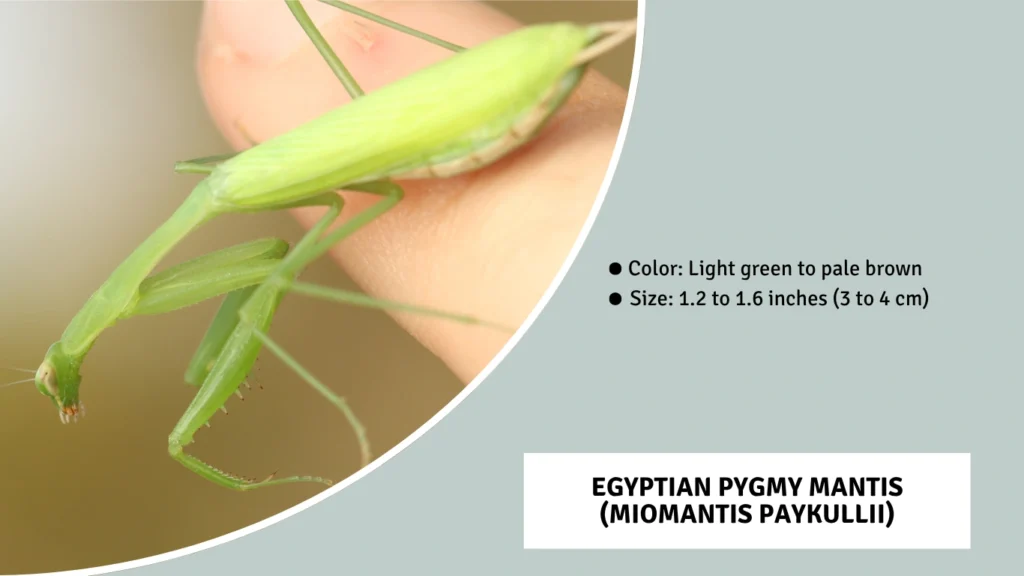
The Egyptian Pygmy mantis is a small, fast, and agile species native to parts of Africa and the Middle East. Despite its size, it’s a skilled hunter and is popular among mantis hobbyists for its energetic behavior and ease of care.
Identification
- Color: Light green to pale brown
- Size: 1.2 to 1.6 inches (3 to 4 cm)
- Body: Slender and short
- Wings: Transparent, extend just past the abdomen
- Eyes: Bulging, with a curious and alert expression
Habitat and Distribution
This species is found in North Africa, particularly Egypt, and parts of the Middle East, living in shrubs, gardens, and arid grasslands. It adapts well to both natural and urban environments.
Behavior and Diet
The Egyptian Pygmy mantis is a fast-moving hunter, preferring to chase rather than ambush. It feeds on small flies, moths, and gnats, and is particularly active in warm temperatures.
Life Cycle and Reproduction
Females lay small oothecae that hatch in favorable conditions. Nymphs are active from the start and molt frequently due to their rapid growth rate. They mature quickly and typically live a shorter lifespan than larger species.
17. Giant Shield Mantis (Rhombodera basalis)

The Giant Shield mantis is known for its large, broad thorax that resembles a flat shield, giving it a distinctive and armored appearance. Native to Southeast Asia, this mantis is one of the largest species within the Rhombodera genus and is favored for its impressive size and calm temperament.
Identification
- Color: Bright green, sometimes with bluish tones
- Size: 4 to 5 inches (10 to 12.7 cm)
- Pronotum: Wide and shield-like, extending past the head
- Wings: Fully developed, matching the body in color
- Body: Robust and powerful
Habitat and Distribution
Found throughout Thailand, Vietnam, and Malaysia, the Giant Shield mantis inhabits tropical forests and gardens, often resting on broad leaves or branches.
Behavior and Diet
This species is an ambush predator, staying still until prey approaches. It feeds on flies, crickets, moths, and occasionally small vertebrates. It’s known to tolerate handling well in captivity.
Life Cycle and Reproduction
Females produce large oothecae that hatch in warm, humid conditions. Nymphs resemble smaller versions of adults and grow rapidly through multiple molts. Males are thinner and more flight-capable than the stockier females.
18. Jeweled Flower Mantis (Creobroter gemmatus)

The Jeweled Flower mantis is a small, colorful mantis species known for its vibrant markings and active hunting style. Native to Asia, this mantis is admired for its stunning wing patterns that resemble tiny gemstones, hence the name “jeweled.”
Identification
- Color: Green or yellow with white and pink markings
- Size: 1 to 1.5 inches (2.5 to 3.8 cm)
- Wings: Decorative, with circular or oval eyespots
- Thorax: Short and smooth
- Eyes: Prominent, often with a curious look
Habitat and Distribution
Found in India, Sri Lanka, Nepal, and Southeast Asia, this species prefers flower-rich environments like gardens, grasslands, and tropical forests. It thrives in warm, humid climates with plenty of vegetation.
Behavior and Diet
Jeweled Flower mantises are active hunters, often walking or turning their heads to scan their surroundings. They prey on flies, mosquitoes, fruit flies, and other small flying insects. Their bright appearance helps them blend in among colorful flowers.
Life Cycle and Reproduction
Females lay oothecae on thin plant stems or leaves. Nymphs emerge with pale, ant-like coloration and gradually gain their jewel-toned wings as they molt. They reach adulthood in several weeks, depending on food and temperature.
19. Indian Flower Mantis (Creobroter pictipennis)

The Indian Flower mantis is closely related to the Jeweled Flower mantis and is known for its decorative wings and floral camouflage. It is a small, agile species that relies on both mimicry and speed to capture prey in flower-dense habitats.
Identification
- Color: Light green with patterns of yellow, pink, and white
- Size: Around 1.5 inches (3.8 cm)
- Wings: Brightly patterned, often with “eye spots”
- Legs: Thin with slight lobes to mimic flower parts
- Body: Compact and smooth
Habitat and Distribution
Native to India, Bangladesh, and Southeast Asia, this mantis lives in meadows, gardens, and forest edges, especially where flowering plants are abundant.
Behavior and Diet
This mantis is a flower mimic, ambushing pollinators like bees, butterflies, and gnats. It is quick to strike and often changes position to better match surrounding petals or leaves.
Life Cycle and Reproduction
Females attach their oothecae under leaves or flower stalks. The young nymphs resemble tiny brown ants and change color with each molt. Within a few months, they develop into their full patterned adult form.
20. African Twig Mantis (Popa spurca)

The African Twig mantis is a master of camouflage, mimicking dry twigs and sticks with incredible precision. Native to Africa, this slender species is well adapted to dry environments where it hides among branches and twigs to ambush prey.
Identification
- Color: Brown or grayish-brown
- Size: 2.5 to 3 inches (6.4 to 7.6 cm)
- Body: Long and narrow, with twig-like extensions
- Legs: Spiny and angular, resembling branch segments
- Head: Elongated with sharp angles
Habitat and Distribution
Found throughout central and southern Africa, especially in savannas, dry woodlands, and shrublands. It blends seamlessly with dry branches and twigs in its surroundings.
Behavior and Diet
This mantis is a sit-and-wait predator, using its appearance to remain undetected. It feeds on flies, small beetles, moths, and sometimes other mantids. It can stay motionless for hours, striking only when prey comes close.
Life Cycle and Reproduction
Females attach oothecae to thin branches or stems. Nymphs hatch in warmer months and go through several molts before becoming adults. Their twig-like form becomes more defined with each molt.
21. Feathered Mantis (Pseudempusa pinnapavonis)

The Feathered mantis is a rare and exotic-looking species with elaborate, feathery projections on its limbs and body. It is native to parts of South and Southeast Asia and is prized among collectors for its unusual and ornamental appearance.
Identification
- Color: Light brown, tan, or olive green
- Size: Around 3 inches (7.6 cm)
- Limbs: Adorned with feathery or brush-like extensions
- Body: Slender, with a ruffled appearance
- Wings: Long, textured, and fringed in some individuals
Habitat and Distribution
Found in India, Sri Lanka, and parts of Southeast Asia, the Feathered mantis inhabits tropical forests and dense vegetation, where its feathery appearance blends with leaf litter and foliage.
Behavior and Diet
It is a slow-moving predator, depending more on camouflage than speed. It hunts small flying insects, particularly moths and flies, and is known to sway gently to mimic vegetation.
Life Cycle and Reproduction
The ootheca is deposited on leaves or bark. Nymphs start small and plain, developing their feather-like appendages as they molt. The full life cycle takes several months and is best supported in humid, warm conditions.
22. Giant Rainforest Mantis (Hierodula majuscula)
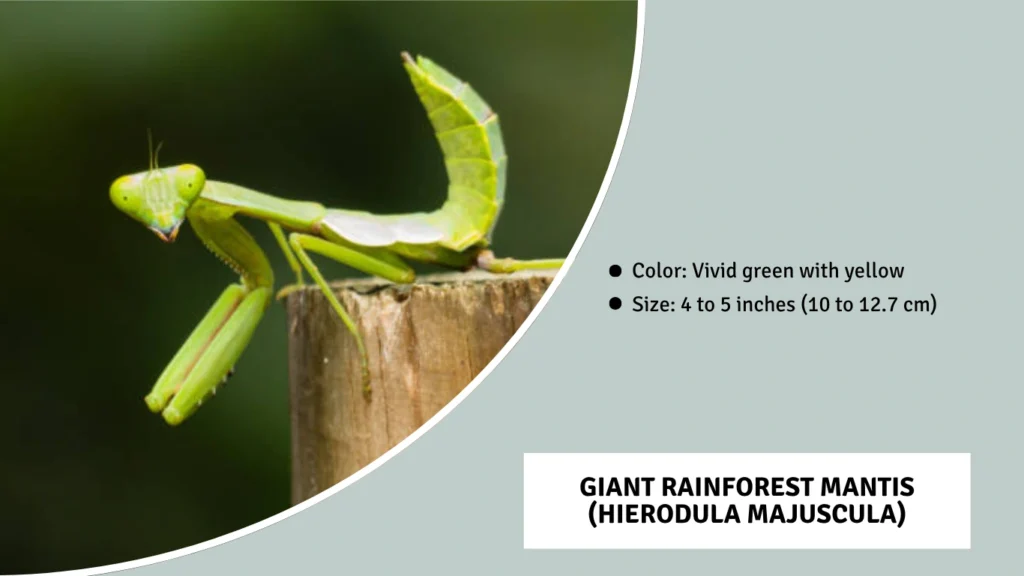
The Giant Rainforest mantis is one of the largest mantis species in Australia, known for its striking green body and powerful hunting ability. It plays an important role in the rainforest ecosystem by controlling insect populations and occasionally feeding on small vertebrates.
Identification
- Color: Vivid green with yellow or cream underwings
- Size: 4 to 5 inches (10 to 12.7 cm)
- Body: Thick, muscular, and elongated
- Wings: Large and fully functional
- Legs: Strong with sharp spines for grasping prey
Habitat and Distribution
This species is native to northeastern Australia, particularly in the rainforests of Queensland. It thrives in dense vegetation, tree canopies, and forest edges where prey is abundant.
Behavior and Diet
A dominant predator, the Giant Rainforest mantis preys on beetles, butterflies, spiders, and even small frogs or lizards. It uses both ambush and stalking strategies and displays defensive postures when threatened.
Life Cycle and Reproduction
Females lay large oothecae that are attached to tree bark or leaves. The eggs hatch into aggressive, fast-growing nymphs that molt several times before adulthood. The lifespan is about 10–12 months under natural conditions.
23. Arizona Unicorn Mantis (Phyllovates chlorophaea)
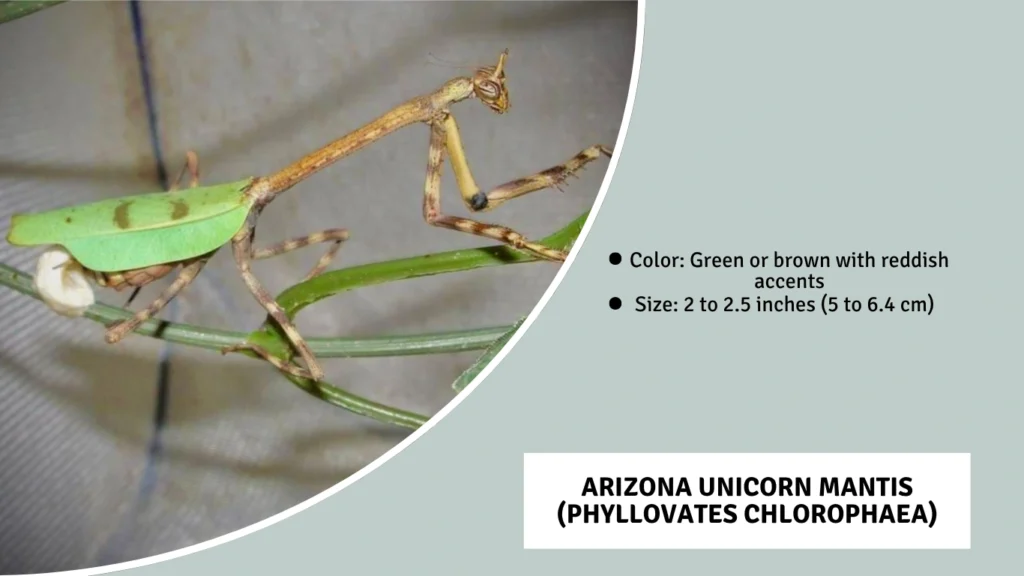
The Arizona Unicorn mantis is a unique North American species named for the horn-like projection on its head, giving it a “unicorn” appearance. It is well-adapted to desert and dry shrub environments in the southwestern United States.
Identification
- Color: Green or brown with reddish accents
- Size: 2 to 2.5 inches (5 to 6.4 cm)
- Head: Features a central horn-like structure
- Body: Slender with jagged leg extensions
- Wings: Clear with greenish veins
Habitat and Distribution
Found in Arizona, New Mexico, and northern Mexico, this mantis inhabits desert scrub, dry woodlands, and cactus groves, often hiding among twigs and low vegetation.
Behavior and Diet
It is an active and curious predator, feeding on moths, flies, beetles, and occasionally small spiders. The horn may help break up its outline, enhancing its camouflage.
Life Cycle and Reproduction
The female lays oothecae on twigs and cactus stems. Nymphs hatch in spring and go through multiple molts before reaching adult form. Males are agile and quick, while females are slightly more robust and less mobile.
