
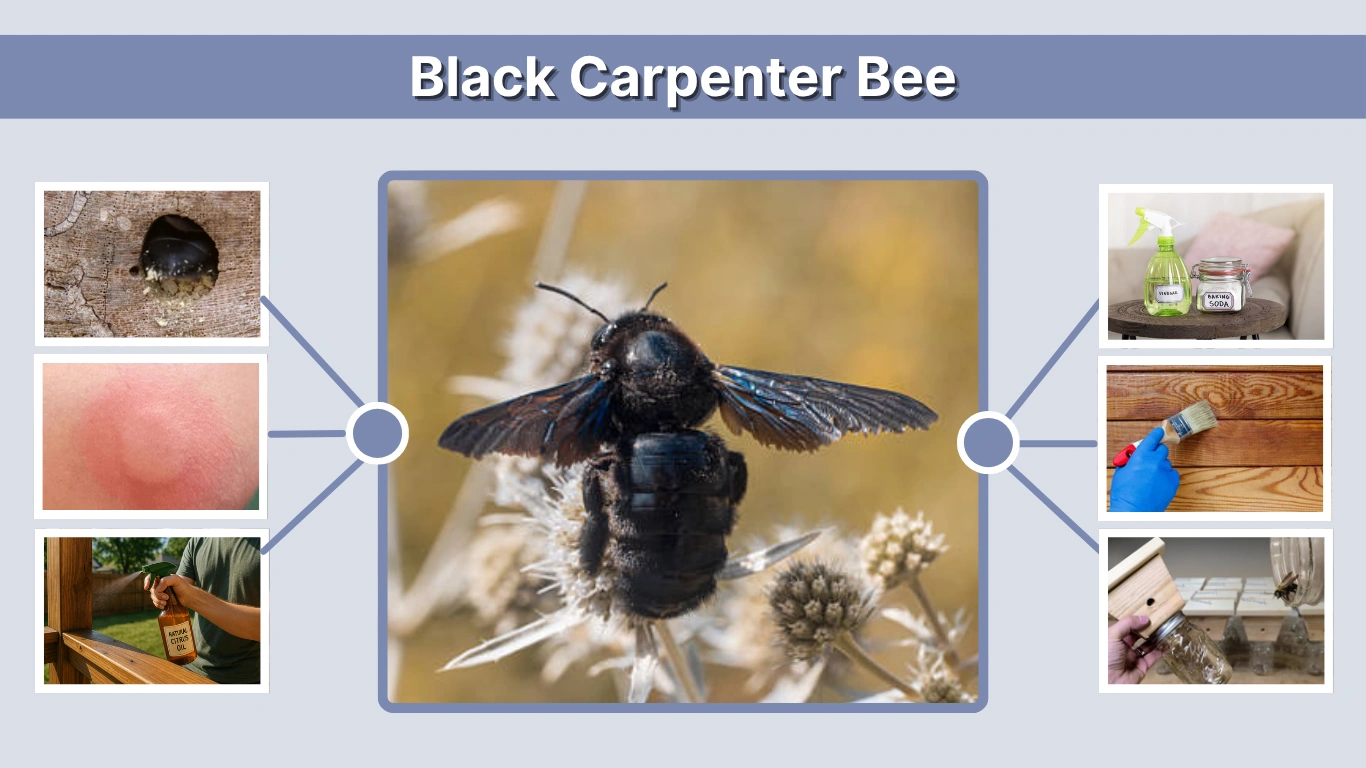
Black carpenter bees are large, glossy insects often confused with bumblebees because of their similar appearance. However, they are solitary wood-boring bees that prefer nesting in untreated or unpainted wood. Despite their intimidating look and loud buzzing, black carpenter bees are not aggressive and are essential pollinators in many regions around the world.
Appearance and Identification

Black carpenter bees are known for their distinctive shiny, all-black bodies that reflect shades of blue or purple in sunlight. Their body shape resembles that of bumblebees but lacks dense, fuzzy hair.
Key identification features include:
- Color: Deep black or metallic blue
- Size: Typically ½ to 1 inch in length
- Abdomen: Smooth and glossy rather than fuzzy
- Wings: Slightly iridescent, with a purplish hue in sunlight
- Facial markings: Males often have a pale yellow or white spot on the face, while females are solid black
These bees are strong fliers, producing a deep, droning sound when in flight. Their shiny exoskeleton helps distinguish them from bumblebees, which appear rounder and covered in yellow fuzz.
Species and Variants

Black Carpenter Bee (Xylocopa spp.)
This is the most widespread type found across many continents. The Xylocopa violacea, common in Europe and Asia, is known for its metallic black or blue body.
Giant Black Carpenter Bee
Found mainly in tropical Asia and Africa, this large species can reach over an inch in length. Its impressive size and deep coloration make it one of the most striking members of the carpenter bee family.
Black and Yellow Carpenter Bee
Native to North America, particularly the southern United States, this species combines a black abdomen with yellow thoracic hairs. They are often mistaken for bumblebees but can be recognized by their smooth, shiny abdomens.
These species vary slightly in coloration and size, but all share the same nesting behavior—boring into wood to create tunnels for reproduction.
Habitat and Location
Black carpenter bees thrive in warm climates and are distributed across multiple continents, including North America, Europe, Africa, and Asia. In the United States, they are especially common in:
- Florida – where humidity and wood availability attract large populations
- California and Texas – warm environments ideal for nesting
- Arizona – home to desert-adapted species that seek wooden structures for shelter
They are also seen in South Africa, Italy, France, Singapore, and Borneo, adapting to both tropical and temperate conditions.
Carpenter bees prefer untreated, unpainted, or weathered wood. Common nesting sites include fences, roof eaves, decks, beams, and garden furniture. They usually bore circular holes about ½ inch wide, creating tunnels where they lay eggs and store pollen for larvae.
Male vs. Female Characteristics
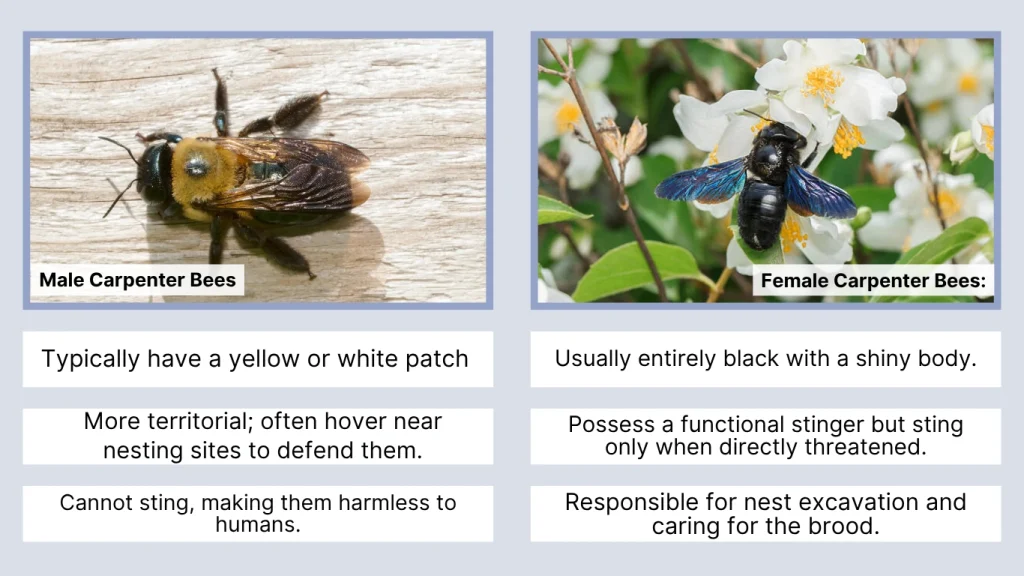
Carpenter bees exhibit distinct sexual differences in appearance and behavior:
- Male Carpenter Bees:
- Typically have a yellow or white patch on the front of the face.
- More territorial; often hover near nesting sites to defend them.
- Cannot sting, making them harmless to humans.
- Typically have a yellow or white patch on the front of the face.
- Female Carpenter Bees:
- Usually entirely black with a shiny body.
- Possess a functional stinger but sting only when directly threatened.
- Responsible for nest excavation and caring for the brood.
- Usually entirely black with a shiny body.
If you see a large black bee hovering around aggressively, it’s almost always a male guarding his territory rather than preparing to sting.
Behavior and Nesting Habits

Black carpenter bees are solitary insects, meaning each female constructs and occupies her own nest rather than forming colonies like honeybees. Their nesting process is fascinating and highly organized:
- The female drills a round entrance hole about ½ inch wide into wood.
- Inside, she creates a series of tunnels—called galleries—where she lays her eggs.
- Each cell is provisioned with pollen and nectar for the larvae.
- The female seals each section with chewed wood pulp to protect developing offspring.
Over time, these tunnels may be reused or expanded by new generations, which can weaken wooden structures if left untreated.
Carpenter bees are most active during spring and early summer, when females build nests and males patrol territories. They are important pollinators for flowers, fruit trees, and crops, despite their wood-boring behavior.
Sting and Danger

One of the most common questions is: Do black carpenter bees sting?
The answer depends on the gender. Male carpenter bees cannot sting, while females can, but they rarely do. Females only sting when handled roughly or directly threatened. Their sting is comparable to that of a wasp—painful but not medically dangerous.
These bees are not poisonous and do not pose a serious threat to humans or pets. Even though they look intimidating due to their size and buzzing flight, black carpenter bees are generally non-aggressive and will often fly close out of curiosity rather than hostility.
If stung, the treatment is simple:
- Wash the area with soap and water.
- Apply ice to reduce swelling.
- Use a mild antihistamine or hydrocortisone cream if irritation persists.
Severe allergic reactions are rare but should be treated by a medical professional immediately.
Carpenter Bee vs. Bumblebee

People frequently confuse carpenter bees with bumblebees because both are large and buzzing pollinators. However, they can be easily distinguished through a few physical and behavioral differences:
| Feature | Carpenter Bee | Bumblebee |
| Abdomen | Smooth, shiny, and black | Covered with dense, fuzzy hairs |
| Nesting site | Bores holes in wood | Builds colonies underground or in cavities |
| Social structure | Solitary | Highly social, with queens and workers |
| Aggression | Docile and non-aggressive | Defensive when protecting their hive |
Understanding these differences helps prevent unnecessary harm to carpenter bees, which play a vital role in pollination.
Spiritual and Symbolic Meaning
Across cultures, the black carpenter bee carries deep symbolic meaning. It often represents hard work, persistence, and creation, reflecting the bee’s industrious nature. In some beliefs, it also symbolizes transformation and new beginnings, as it reshapes wood to create life within
How to Get Rid of Black Carpenter Bees
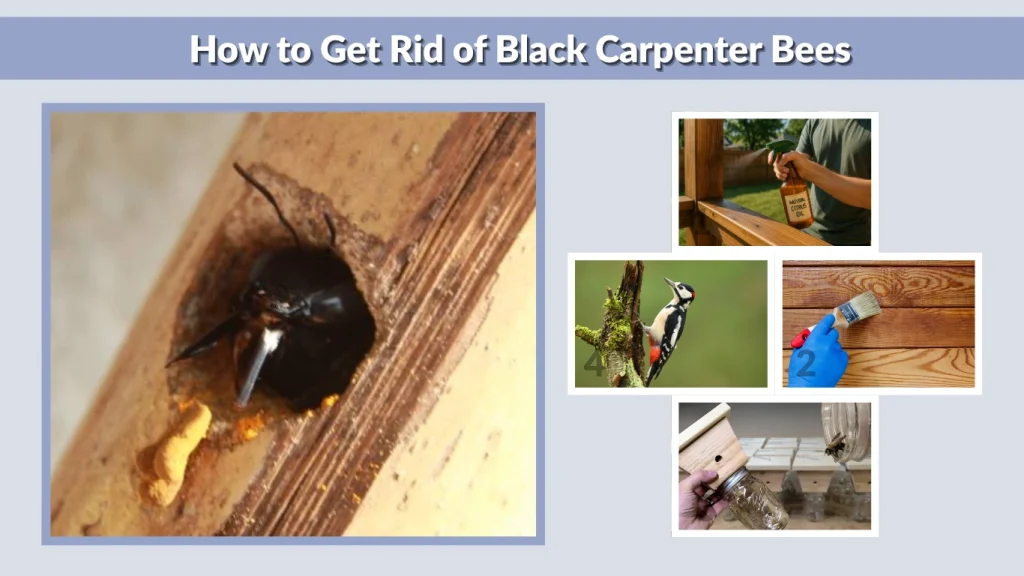
While black carpenter bees are beneficial pollinators, their habit of drilling holes into wood can cause damage over time. If left uncontrolled, repeated nesting weakens structures and leaves unsightly holes. Here are the most effective methods to remove or discourage them:
- Seal Existing Holes:
After confirming no bees are inside, fill nesting holes with wood putty or caulk. Sand and paint over the area to discourage re-entry. - Use Natural Repellents:
Carpenter bees dislike strong scents. Citrus oil, almond oil, and tea tree oil are effective deterrents. Spray these around eaves, decks, and exposed wood. - Carpenter Bee Foam Sprays:
For heavy infestations, use commercial foam sprays designed to reach deep tunnels. Follow up by sealing the holes to prevent reuse. - Paint or Treat Wood:
Bees prefer untreated wood. Painting or varnishing wooden structures significantly reduces nesting chances. - Install Decoy Nests:
Hanging artificial carpenter bee traps or decoy nests can divert females from damaging your property.
By maintaining treated surfaces and regularly inspecting wooden areas, you can prevent future infestations while allowing these bees to continue pollinating nearby plants.
Regional Species Highlights
Black carpenter bees adapt to diverse environments, and several regions have unique species worth noting:
- California: Home to Xylocopa varipuncta, known for its golden males and glossy black females. They nest in redwood and cedar structures.
- Florida: Populated by the Xylocopa micans, a metallic blue-black species that thrives in humid coastal areas.
- Texas and Arizona: These states host large carpenter bees that endure desert heat by nesting in shaded wood.
- South Africa: The Xylocopa caffra, often called the “valley carpenter bee,” features a dark blue sheen and is one of Africa’s largest bees.
- Borneo and Southeast Asia: Home to the giant black carpenter bee, which can reach up to 1.3 inches and is known for its thunderous buzz.
Each of these regional types plays a crucial role in local ecosystems, pollinating wildflowers, fruit trees, and crops that depend on large-bodied bees.
Nesting and Reproduction Cycle
Female carpenter bees start nesting in early spring, often returning to old holes to expand them. Each tunnel can extend up to a foot deep, divided into six to ten brood chambers.
Within each cell, a single egg is laid on a ball of pollen and nectar. After hatching, the larvae feed on the stored food until maturity, emerging as adult bees by late summer. Adults often overwinter in abandoned tunnels, reappearing the following spring to repeat the cycle.
This nesting habit explains why old wooden structures may show repeated holes over the years — bees recycle tunnels across generations.
Role in the Ecosystem
Although carpenter bees can be a nuisance, they are essential pollinators. Their strong bodies and ability to perform “buzz pollination” help release pollen from flowers that smaller insects cannot access.
They play a vital role in pollinating tomatoes, eggplants, peppers, and many wildflowers. Unlike honeybees, carpenter bees work alone, but their efficiency per flower is remarkably high. Protecting them, while managing nesting behavior responsibly, supports biodiversity and plant health.
Myths and Misconceptions
There are many misunderstandings surrounding black carpenter bees:
- Myth 1: “They eat wood.”
Carpenter bees do not eat wood; they only bore tunnels for nesting. - Myth 2: “All carpenter bees sting.”
Only females can sting, and they rarely do so unless provoked. - Myth 3: “They destroy homes quickly.”
Structural damage happens only after many generations of reuse, not instantly.
Understanding these facts helps balance pest control with conservation, allowing people to coexist with these valuable pollinators.
FAQs
What is the scientific name of the black carpenter bee?
The most recognized species include Xylocopa violacea in Europe and Asia, Xylocopa virginica in North America, and Xylocopa caffra in Africa. All belong to the Xylocopa genus, known for their wood-boring habits and shiny black exoskeletons.
Are black carpenter bees dangerous to humans?
Not at all. They are mostly harmless and avoid confrontation. Only females sting when roughly handled or trapped, and the sting causes temporary pain similar to a wasp’s, without lasting effects.
How big are black carpenter bees?
Their average size ranges from ½ to 1 inch, with females slightly larger. Some tropical species, like the giant black carpenter bee of Borneo, can exceed 1.3 inches, making them one of the world’s largest bees.
Do black carpenter bees produce honey?
No, they do not produce honey because they are solitary bees. Instead of forming colonies, each female cares for her own brood. However, they still play a major role in pollination similar to honeybees.
How can I prevent black carpenter bees from nesting?
Paint or varnish exposed wood, fill existing holes, and use natural deterrents like citrus or almond oil. Regular inspection and maintenance ensure these bees don’t return to reuse old tunnels in your property.
