
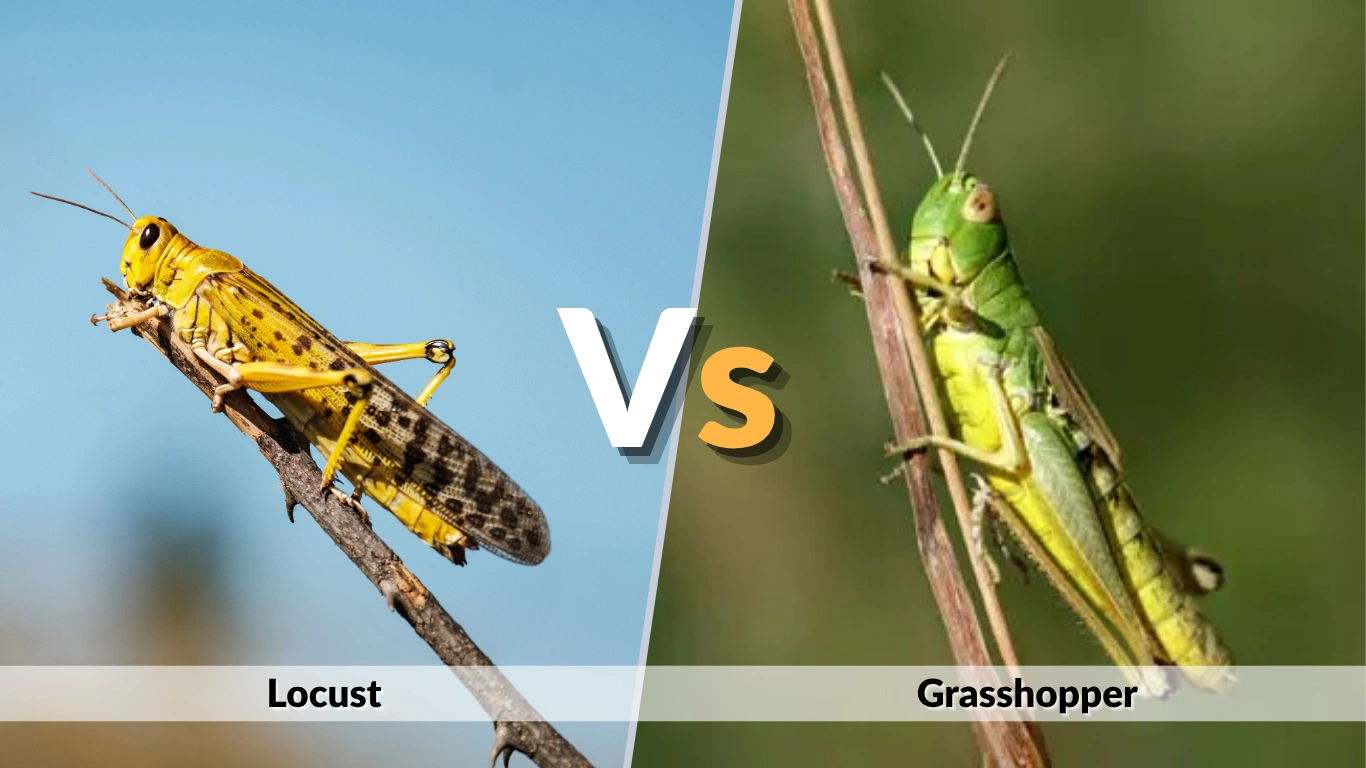
Locusts and grasshoppers are often mistaken for the same insect due to their similar appearance and anatomy. However, despite their shared lineage, they differ drastically in behavior, social patterns, and ecological impact. Grasshoppers are generally solitary, while locusts can switch to a swarming phase, forming massive groups that devastate crops and ecosystems worldwide. Understanding these distinctions helps explain why a grasshopper can sometimes transform into a locust under specific conditions.
Identification and Classification
What Are Grasshoppers?
Grasshoppers belong to the order Orthoptera and are known for their strong hind legs that allow them to leap great distances. Typically green or brown, they thrive in grassy areas, feeding on vegetation. Grasshoppers are solitary creatures, meaning they live and feed individually. They do not form large groups or migrate long distances, which limits their environmental impact compared to locusts.
What Are Locusts?
Locusts are actually a type of grasshopper belonging to the same order but capable of a unique transformation. When environmental conditions such as increased rainfall and vegetation occur, certain grasshopper species undergo a behavioral shift. This change, called the gregarious phase, triggers swarm formation. Locusts in this phase change color, reproduce rapidly, and migrate together in millions, often causing agricultural disasters.
Physical and Visual Differences

Size and Color Comparison
At first glance, locusts and grasshoppers look alike, but subtle differences set them apart. Locusts tend to be slightly larger, averaging 2–3 inches, whereas most grasshoppers range between 1–2 inches. Locusts in their swarming phase often turn bright yellow or orange, while grasshoppers usually remain green or brown for camouflage.
| Feature | Grasshopper | Locust |
| Average Size | 1–2 inches | 2–3 inches |
| Color | Green/Brown | Yellow/Orange during swarm |
| Behavior | Solitary | Gregarious (forms swarms) |
| Flight Distance | Short | Long-distance migratory |
| Environmental Impact | Low | High (crop destruction) |
Appearance in Different Regions
Regional variations also influence their appearance. For instance, the desert locust found in Africa and the Middle East displays brighter colors and longer wings, enabling wide migration. In contrast, species like the lubber grasshopper found in the U.S. are larger but slower, rarely forming swarms. The pallid-winged grasshopper blends into desert environments, making it visually distinct from typical green grasshoppers.
Behavioral and Environmental Differences
Swarming Behavior
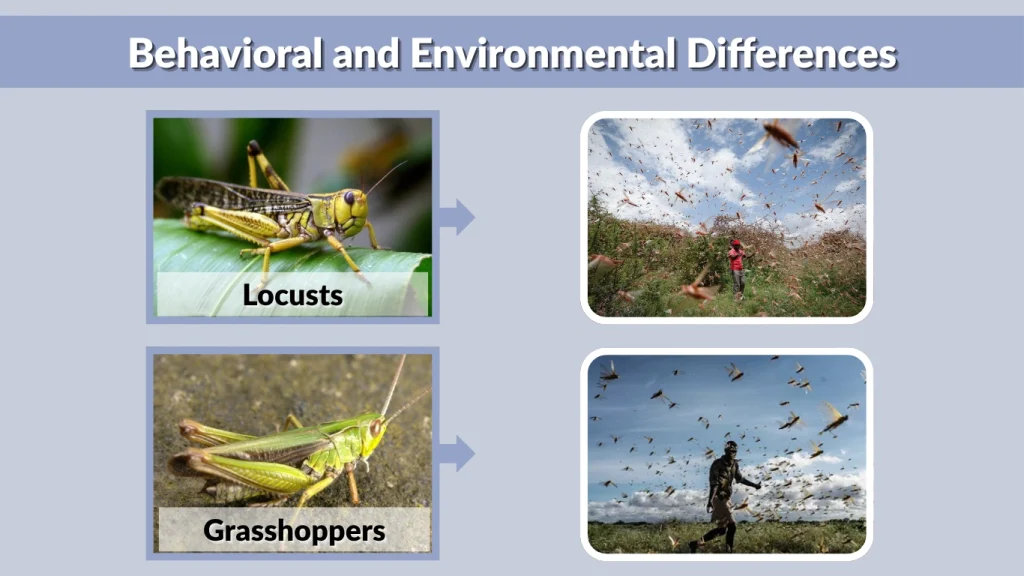
The defining feature of locusts is their ability to swarm. When population density increases, chemical signals such as serotonin trigger a transformation from solitary to gregarious behavior. Locusts then gather, synchronize their movements, and migrate collectively over vast distances, sometimes crossing continents. These swarms can cover hundreds of square miles and consume thousands of tons of crops per day, posing a severe threat to food security.
Grasshopper Lifestyle
Grasshoppers, by contrast, maintain a solitary lifestyle. They feed individually and seldom exhibit group migration. Their diet mainly consists of grasses and leafy plants. While grasshoppers can damage crops locally when populations rise, they rarely cause widespread destruction. Their feeding and movement remain confined to small areas, making them far less destructive than locusts.
Sound and Movement
Both locusts and grasshoppers produce sounds known as “stridulation.” Grasshoppers typically rub their hind legs against their wings to create chirping sounds used for attracting mates. Locusts, however, can generate louder buzzing noises, especially in swarms, through the rapid beating of wings. Their movement also differs — grasshoppers make quick, short jumps, whereas locusts can sustain long flights during migration.
Life Cycle and Reproduction
Similarities in Growth Stages
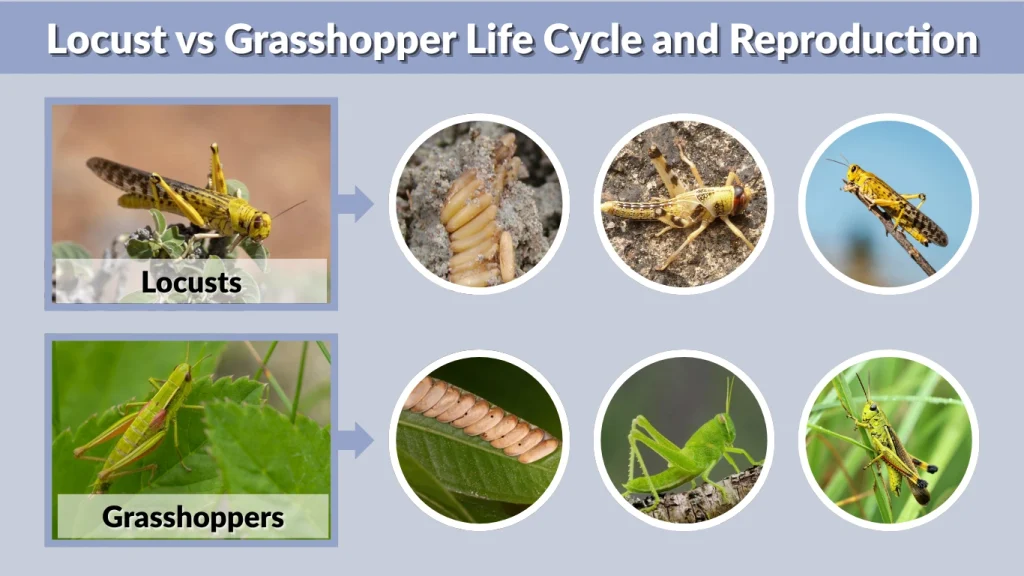
Both insects follow a three-stage life cycle: egg, nymph, and adult. Females lay eggs in soil, which hatch into wingless nymphs. These nymphs undergo multiple molts before reaching adulthood. Both species are herbivorous and depend heavily on vegetation during all stages of growth.
Locust Life Cycle
What sets locusts apart is the influence of their environment on reproduction. During favorable conditions — such as abundant vegetation after rainfall — locusts breed rapidly, laying eggs in clusters. As food becomes scarce, the crowded conditions push them into the swarming phase. Each swarm may contain billions of insects, spreading across hundreds of miles to find new feeding grounds. Their life cycle thus adapts dynamically to environmental stress, making them unpredictable and challenging to control.
Species and Regional Comparisons
Notable Variants
Locusts and grasshoppers come in numerous species adapted to different climates. The desert locust (Schistocerca gregaria) is one of the most destructive, capable of traveling up to 150 km per day. In the United States, species like the American grasshopper and differential grasshopper are more common and less destructive. Other variations, such as the Missouri grasshopper or Georgia pond grasshopper, thrive in warm, grassy regions.
Climate Influence
Weather and environmental changes have a major effect on locust behavior. Heavy rainfall and lush vegetation create favorable conditions for rapid breeding. When dry seasons follow, the crowding triggers locusts’ phase transformation. Grasshoppers, however, are less sensitive to such conditions and tend to maintain consistent behavior, living in smaller populations year-round.
Locust vs Grasshopper in Entomology
Scientific Classification
Both insects belong to the order Orthoptera and the suborder Caelifera, meaning they share much of their biological structure. The main difference lies not in anatomy but in behavior. Locusts are not a separate species; they are simply grasshoppers exhibiting gregarious behavior under environmental stress.
Entomological Perspective
Entomologists study locusts as a behavioral phase rather than a distinct classification. Research shows that the transformation from grasshopper to locust is reversible — when conditions improve, locusts can return to their solitary form. This insight has helped scientists better understand insect adaptability and population dynamics in ecosystems.
Grasshopper, Locust, and Other Insects

Grasshopper vs Cricket vs Locust
Grasshoppers and crickets are often confused because both can chirp and hop, yet they belong to slightly different groups. Crickets have long antennae and produce sound by rubbing their wings together, whereas grasshoppers use their legs and wings. Locusts differ from both because of their swarming capability and migratory instinct.
| Insect | Distinguishing Trait | Sound Source | Lifestyle |
| Grasshopper | Short antennae, green/brown body | Hind legs & wings | Solitary |
| Cricket | Long antennae, flat body | Wing friction | Nocturnal |
| Locust | Phase-changing grasshopper | Wing beats | Migratory swarms |
Katydid and Cicada Differences
The katydid resembles a grasshopper but has long antennae and a leaf-like body that helps it camouflage in trees. The cicada, often confused with a locust, is not related to either — it belongs to a different order (Hemiptera). Cicadas are known for their loud, buzzing calls made by vibrating abdominal membranes, unlike the leg-based stridulation of grasshoppers and locusts.
Human and Ecological Impact

Locust Swarms and Agriculture
Locust swarms are among the most destructive natural pests in human history. A single swarm can contain billions of insects, covering hundreds of square kilometers. They consume crops, grasslands, and forests, leaving famine and economic hardship in their wake. Governments and scientists employ advanced monitoring systems, drones, and satellite imaging to predict and control outbreaks before they escalate.
Grasshopper Role in Ecosystems
While grasshoppers can cause local crop damage, they play an essential ecological role. They help maintain plant diversity by feeding on dominant vegetation and serve as food for birds, reptiles, and small mammals. In balanced ecosystems, grasshoppers contribute to nutrient cycling and soil aeration through their feeding activity.
Identification Tips for Field Observation
How to Tell Them Apart Quickly
For anyone observing insects in the wild, certain clues make identification easier:
- Group Behavior: Locusts move in large, coordinated groups, while grasshoppers are found individually or in small numbers.
- Color: Locusts often turn yellow or orange during swarming; grasshoppers remain earthy green or brown.
- Wings and Flight: Locusts have longer wings suited for long flights; grasshoppers make shorter hops.
- Reaction to Crowding: Locusts become more active and social when crowded, while grasshoppers stay solitary.
These quick cues can help distinguish them even without scientific tools.
Visual Comparison Gallery (Optional for Article)
An engaging section can include labeled images or an infographic titled “Grasshopper vs Locust at a Glance.”
- Side view comparison: Body size, color tone, and wing span.
- Behavioral snapshot: A single grasshopper feeding vs. a dense locust swarm.
Such visuals reinforce learning and improve reader retention while boosting SEO engagement time.
FAQs
Are locusts just grasshoppers?
Yes. All locusts are grasshoppers, but not all grasshoppers become locusts. The term “locust” describes certain grasshopper species that switch to a swarming phase when population density and environmental conditions change, turning them from solitary insects into collective migratory pests.
Why do locusts form swarms while grasshoppers don’t?
Swarms occur when crowded conditions and abundant food trigger hormonal changes in specific grasshopper species. These changes cause them to seek company and move collectively. Ordinary grasshoppers lack this behavioral switch, so they remain solitary and localized throughout their life cycle.
Can grasshoppers turn into locusts?
In some species, yes. When stimulated by population density and favorable weather, solitary grasshoppers can transform into locusts through physical and behavioral changes. Their coloration brightens, their wings strengthen, and they begin moving in coordinated groups known as swarms.
Which insect is larger — a locust or a grasshopper?
Locusts are generally larger, ranging from 2 to 3 inches, while most grasshoppers measure between 1 and 2 inches. Their size advantage allows locusts to travel longer distances during migration and survive in harsher, more variable environments.
Do locusts and grasshoppers make the same sound?
Both produce sound, but in slightly different ways. Grasshoppers rub their legs against their wings to create a chirping noise, while locusts use wing beats that generate a louder, buzzing tone. During swarms, locust noise can be deafening due to millions of wings beating simultaneously.
