
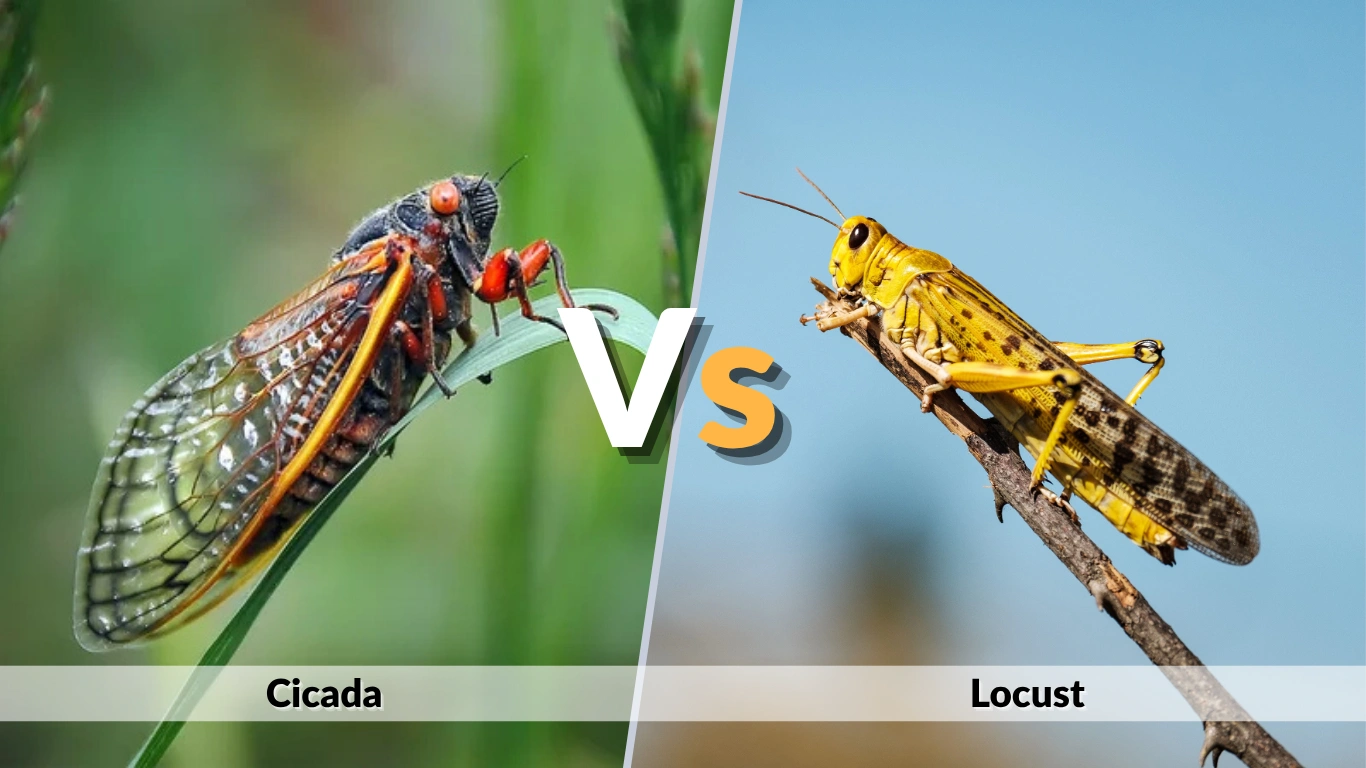
Every summer, the air fills with an unmistakable hum — the collective buzz of thousands of cicadas. To many people, that sound immediately brings one question to mind: are those locusts? This confusion has existed for centuries, especially in North America, where the emergence of periodical cicadas happens only once every 13 or 17 years. Early settlers mistook these mass emergences for biblical locust plagues, a mix-up that still causes misunderstanding today.
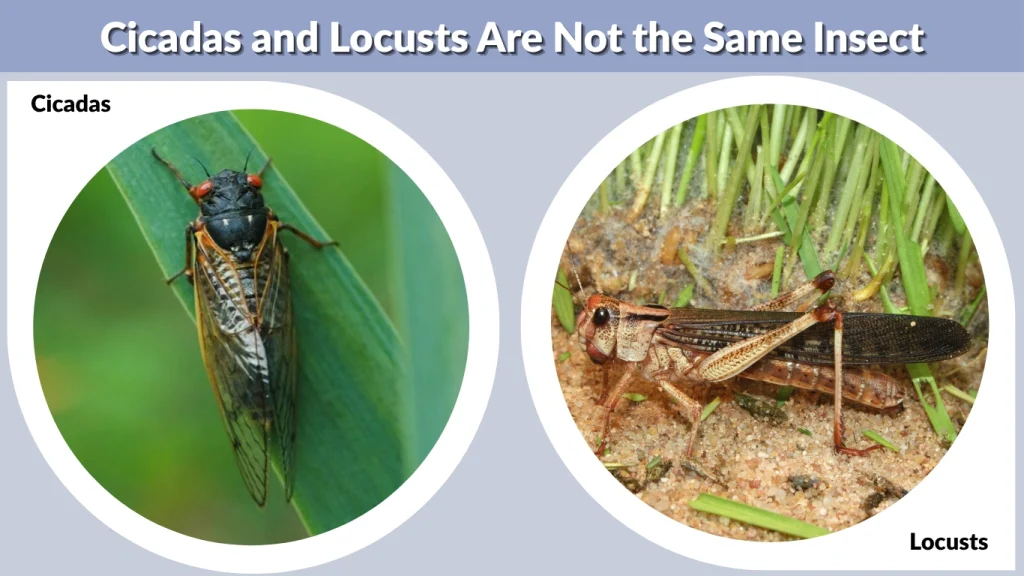
In reality, cicadas and locusts are two entirely different types of insects. They belong to different families, have distinct behaviors, and play very different roles in the environment. Cicadas are harmless singers that feed on tree sap, while locusts are grasshoppers capable of forming massive swarms that devastate crops. This article breaks down the key differences — in sound, appearance, life cycle, and impact — to help you finally tell these insects apart.
Cicadas and Locusts Are Not the Same Insect
Taxonomy and Classification
Cicadas and locusts may look and sound somewhat alike, but biologically, they come from completely separate branches of the insect world.
- Cicadas belong to the order Hemiptera, the same group as aphids and leafhoppers. They’re classified under the family Cicadidae and are considered true bugs, meaning they feed by piercing plants and sucking sap.
- Locusts, on the other hand, are a type of grasshopper from the order Orthoptera, family Acrididae. All locusts are grasshoppers, but not all grasshoppers are locusts — locusts are unique because they can change behavior and appearance when their populations explode, forming destructive swarms.
So while cicadas and locusts may share the same summer spotlight, they are no more related than butterflies are to beetles.
The Origin of the Confusion
The confusion goes back to colonial America. When early European settlers witnessed billions of red-eyed cicadas rising from the ground every 17 years, they compared the phenomenon to the biblical accounts of locust plagues. The name “17-year locust” stuck — even though cicadas do not swarm, eat crops, or migrate like true locusts.
This mislabeling continues today, often resurfacing when news outlets cover cicada emergences such as Brood X in the eastern United States. But scientifically speaking, cicadas are not locusts — they’re simply noisy but harmless insects celebrating their brief time above ground.
Physical Appearance and Body Structure
Cicada Features
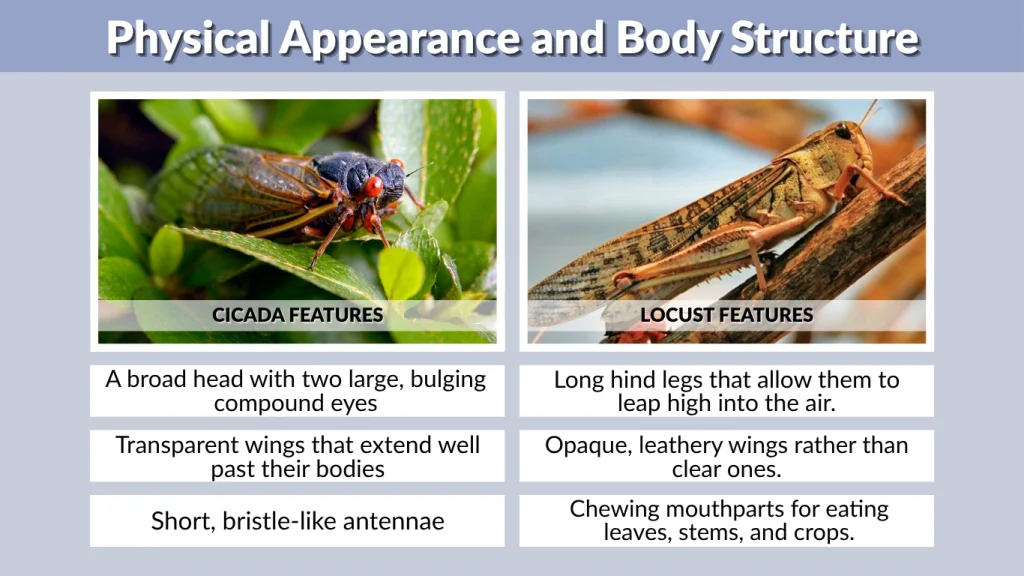
Cicadas are generally larger and stockier than locusts. They have:
- A broad head with two large, bulging compound eyes and three smaller simple eyes (ocelli).
- Transparent wings that extend well past their bodies, giving them a glass-like appearance.
- Short, bristle-like antennae and a straw-like mouthpart called a proboscis, used to drink sap from trees.
Their coloration ranges from green and brown in annual species to black with striking red eyes in periodical cicadas. When at rest, cicadas hold their wings tent-like over their bodies, unlike grasshoppers, whose wings fold flat.
Locust Features
Locusts are slimmer and built for jumping and flying long distances. They have:
- Long hind legs that allow them to leap high into the air.
- Opaque, leathery wings rather than clear ones.
- Chewing mouthparts for eating leaves, stems, and crops.
- Antennae that are longer and more flexible than a cicada’s.
Their earthy brown or green coloring helps them blend into grasslands, while their lightweight bodies allow them to travel in vast migrating swarms that can stretch for miles.
Shell and Molting Differences
Another common confusion comes from their molting shells.
- Cicadas leave behind empty brown shells (called exuviae) that cling to tree trunks, fences, or walls. These shells are easy to spot and often the first sign that cicadas have emerged.
- Locusts also molt, but their discarded skins are smaller, more fragile, and usually remain on the ground.
If you’ve ever seen a crisp, hollow insect shell gripping a tree — that’s definitely from a cicada, not a locust.
Sound and Communication
How Cicadas Make Sound
Cicadas are among the loudest insects in the world. Male cicadas produce their iconic buzzing by vibrating special structures called tymbals on the sides of their abdomen. Each vibration creates a rapid clicking sound that blends into a continuous hum. Some species can reach 100 decibels, loud enough to drown out conversation.
The purpose of the noise is simple: it’s a mating call. Each cicada species has a distinct song, and only the males sing. Females respond by flicking their wings, helping males locate them among the chorus. The sound is most intense on hot, sunny days and quiets down at night.
How Locusts Make Sound
Locusts, like grasshoppers, create sound in a completely different way. They rub their hind legs against their wings or bodies, a process known as stridulation. This produces a rough, rhythmic clicking or chirping sound, much softer than a cicada’s roar.
Locusts use their sounds for communication within swarms — signaling danger, coordinating movement, or attracting mates. While cicadas fill the air with constant buzzing, locust sounds are shorter and more intermittent.
Cicada Sound vs Locust Sound
Here’s a quick way to tell them apart:
- Cicadas: Continuous buzzing, droning, or humming — especially during the daytime.
- Locusts: Rhythmic chirps or crackling sounds, often heard in fields and grasslands.
In simple terms, if you hear an electric-sounding buzz echoing through the trees, that’s a cicada. If you hear a dry clicking noise from a field, it’s probably a locust or grasshopper.
Life Cycle Comparison
Cicada Life Cycle
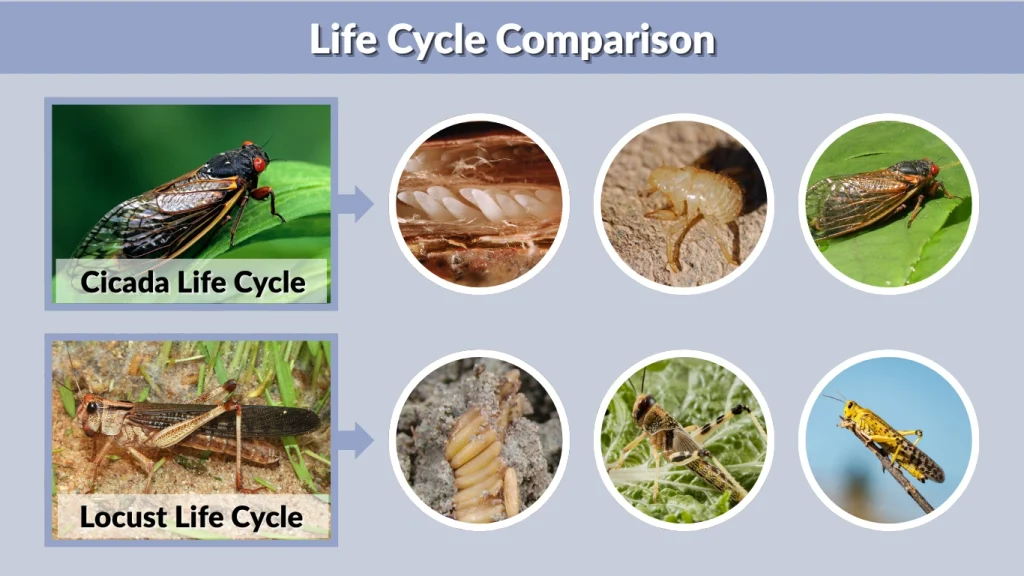
Cicadas have one of the most extraordinary life cycles in the insect world. After hatching, the young cicadas (called nymphs) drop from tree branches and burrow into the soil, where they feed on tree root sap. They remain underground for years — up to 17 years for periodical cicadas — before emerging as adults.
When the soil temperature reaches about 64°F (18°C), the nymphs dig to the surface, shed their shells, and begin their short adult lives. Adults live only 2 to 6 weeks, long enough to sing, mate, and lay eggs. Their emergence in huge numbers every few years overwhelms predators, ensuring that enough survive to reproduce — a phenomenon called predator satiation.
Locust Life Cycle
Locusts, in contrast, have a much shorter and simpler life cycle. They hatch from eggs laid in soil, grow through several nymphal stages (called hoppers), and reach adulthood within two to three months. When environmental conditions are favorable — such as after heavy rains — locust populations grow quickly.
Once they reach a certain density, a biological switch flips, and they transform from solitary grasshoppers into swarming locusts, capable of traveling hundreds of miles and consuming entire crops in their path.
The “17-Year Locust” Myth
One of the biggest reasons people confuse cicadas and locusts is the term “17-year locust.” This nickname dates back to the 1600s when European colonists in North America first experienced massive periodical cicada emergencies. To them, the sight of billions of insects rising from the ground, covering trees, and making an ear-splitting racket resembled the biblical stories of locust plagues.
However, this label is scientifically inaccurate. The so-called “17-year locusts” are actually periodical cicadas of the genus Magicicada. These insects spend most of their lives underground and emerge only once every 13 or 17 years, depending on the brood. Unlike real locusts, they don’t chew through crops or destroy vegetation. At most, their egg-laying activity can cause minor damage to small twigs and young trees.
While true locusts — such as the desert locust (Schistocerca gregaria) — have caused devastating famines throughout history, cicadas are harmless. The myth persists because both insects appear in overwhelming numbers, but their impact could not be more different.
Behavior, Habitat, and Ecology
Habitat and Range
Cicadas and locusts occupy entirely different worlds.
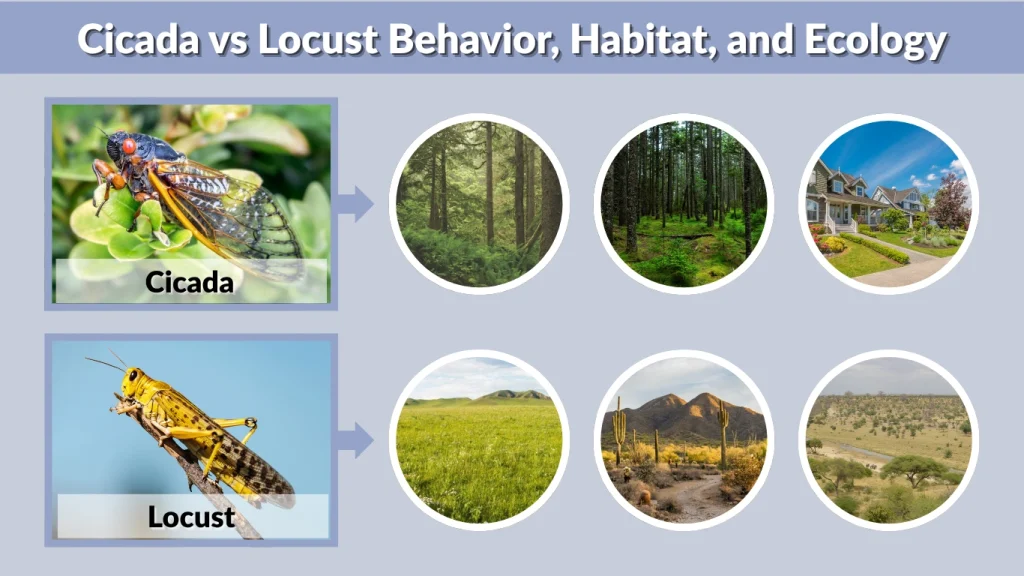
- Cicadas prefer forests, wooded areas, and suburban neighborhoods with plenty of trees. They spend their nymph years underground feeding on root sap, then climb trees to sing and mate. Cicadas are found across the globe, especially in North America, Australia, and parts of Asia.
- Locusts, in contrast, thrive in dry grasslands, deserts, and savannas. They are most common in Africa, the Middle East, and Asia, where seasonal rains trigger their population booms. Locusts prefer open fields and farmlands rather than wooded environments.
Feeding Behavior
Another major difference lies in their diet and mouthparts:
- Cicadas have a needle-like proboscis for piercing tree bark and sipping plant sap. They do not eat leaves, fruits, or crops.
- Locusts have powerful jaws that chew through vegetation. In large swarms, they can devour entire fields of grain, grass, and vegetables within hours.
While cicadas are passive feeders that cause minimal damage, locusts are among the most destructive agricultural pests on Earth.
Swarming vs Emerging
Cicadas and locusts both appear in large numbers, but their behavior is fundamentally different.
- Cicadas emerge, meaning billions may surface at once, but they remain relatively stationary — clinging to trees and plants while singing.
- Locusts swarm, forming dense clouds that can travel up to 100 miles a day. Swarming locusts behave like a single moving organism, darkening the sky as they migrate and feed.
So while both events can seem overwhelming, cicada emergencies are a natural celebration of life, while locust swarms are a destructive force of nature.
Cicadas vs Locusts vs Other Insects
Cicada vs Locust vs Grasshopper
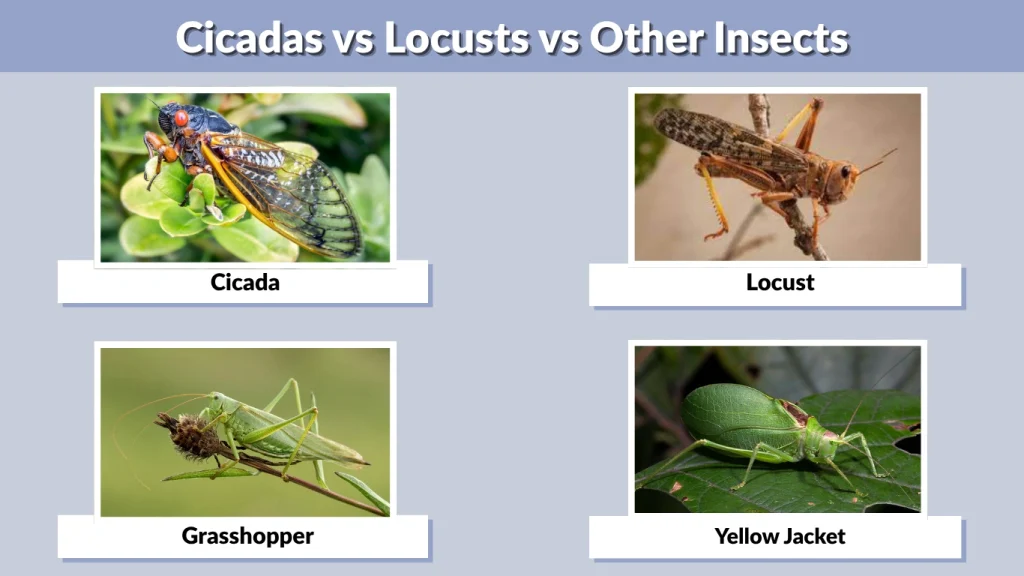
Locusts are actually a type of grasshopper, while cicadas are entirely separate. Grasshoppers and locusts share similar physical structures — long hind legs, chewing mouthparts, and short life cycles. The only real difference is behavior: locusts undergo a “phase change” when overcrowded, turning from solitary insects into swarming ones. Cicadas, on the other hand, never swarm or migrate.
Cicada vs Locust vs Katydid
Katydids, cicadas, and locusts are all known for their sounds, but the way they produce noise and when they sing are very different.
- Katydids resemble green leaves and produce gentle, rhythmic trills at night by rubbing their wings together.
- Cicadas have clear wings and create powerful buzzing songs during the day using tymbals.
- Locusts make dry clicking or chirping noises with their legs and wings, usually in the daytime.
Cricket vs Locust vs Cicada
Crickets are often mistaken for cicadas because of their nighttime chirping, but they are smaller and use wing rubbing (like katydids). Cicadas are diurnal — active in the heat of the day — and their sound is far louder. Locusts, meanwhile, produce short bursts of sound mostly while flying or resting.
Locusts vs Cicadas — At a Glance
| Feature | Cicada | Locust |
| Scientific Order | Hemiptera (Cicadidae) | Orthoptera (Acrididae) |
| Body Type | Stout, short legs | Slender, long jumping legs |
| Mouthparts | Piercing–sucking (sap) | Chewing (leaves, crops) |
| Sound Mechanism | Tymbal vibration | Stridulation (leg/wings) |
| Noise Level | Up to 100 dB (loud buzzing) | Softer clicking/whirring |
| Habitat | Trees, forests | Fields, deserts, grasslands |
| Lifespan | 2–17 years | 3–5 months |
| Swarming Behavior | No | Yes |
| Crop Impact | Harmless | Highly destructive |
| Visible Shells | Large, on trees | Small, on ground |
Why People Still Confuse Cicadas and Locusts
Historical Terminology
The term locust was used in the Bible to describe insect plagues, and early settlers borrowed it to name the overwhelming cicada emergencies they saw. The habit stuck, especially since the insects appeared in staggering numbers that reminded people of biblical stories.
Media and Cultural Confusion
Even today, many news outlets refer to periodical cicadas as “locusts,” particularly during large-scale events like Brood X in 2021 or 2024. Social media amplifies the error, spreading the false connection worldwide. Although the two insects look and behave differently, the myth persists because both inspire awe — one for its song, the other for its devastation.
Ecological Importance of Cicadas vs Locusts
Cicadas: Nature’s Gentle Gardeners
Cicadas are beneficial insects. Their underground burrowing aerates the soil, and when they die, their bodies decompose, enriching the earth with nutrients. They also serve as food for birds, mammals, and reptiles, forming an essential part of the food chain. Far from being pests, cicadas contribute to healthy forest ecosystems.
Locusts: Nature’s Troublemakers
Locusts also have an ecological purpose — controlling plant overgrowth and feeding other wildlife — but their potential for destruction is enormous. In large swarms, they can consume their own body weight in vegetation every day, stripping entire landscapes bare and triggering famines in vulnerable regions. Their behavior makes them one of agriculture’s oldest and most feared adversaries.
FAQs
Are cicadas and locusts the same insect?
No. Cicadas are true bugs that drink sap, while locusts are grasshoppers that chew leaves and crops.
Why are cicadas called 17-year locusts?
Because of a historical mix-up — settlers mistook the 17-year cicadas for biblical locust plagues.
Which insect makes the loud buzzing sound?
Cicadas. Locusts produce a much softer clicking or rustling noise.
Do cicadas destroy crops?
No. Cicadas are harmless to crops and trees; locusts are the real agricultural pests.
How long do cicadas and locusts live?
Cicadas live 2–17 years (mostly underground). Locusts live only a few months.
