

Swallowtail butterflies are some of the most eye-catching butterflies in the world. Known for their colorful wings and unique tails, they appear in many different forms across the globe.
In this article, you’ll explore 15 common types of swallowtail butterflies with simple descriptions and easy identification tips.
1. Eastern Tiger Swallowtail
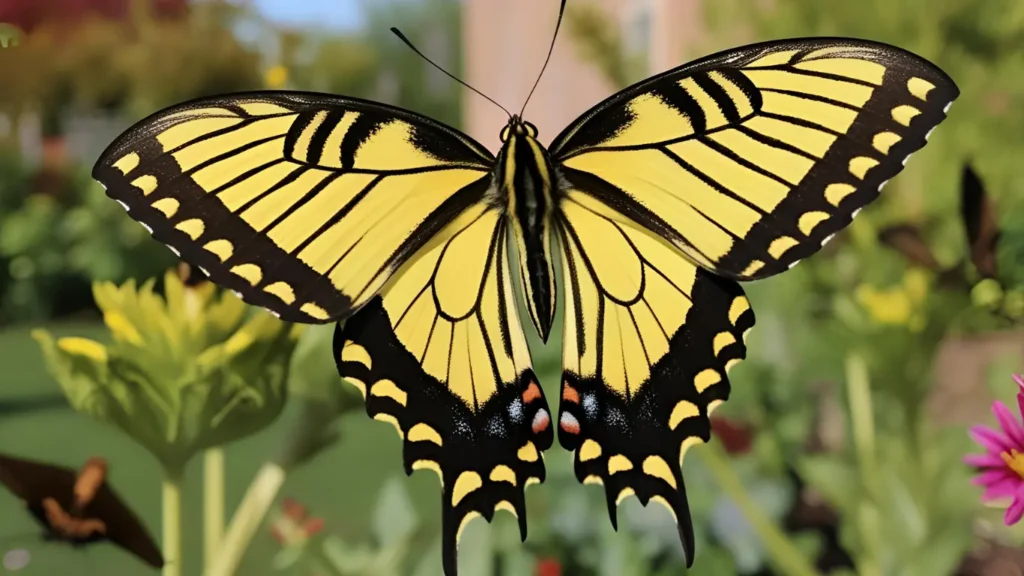
The Eastern Tiger Swallowtail is one of the most common and beautiful butterflies found in the eastern parts of North America. It’s known for its bright colors and large wings. People often see this butterfly in gardens, forests, and near rivers during spring and summer.
Appearance
This butterfly has yellow wings with black stripes that look like a tiger’s pattern. The back wings have short tails, like a swallow’s tail. Females can look different from males—some are yellow, and others are dark brown or black. The wingspan is between 3.5 and 5.5 inches.
Identification
- Yellow wings with black tiger-like stripes
- Hindwings have short, tail-like extensions
- Females may appear black with blue spots
- Males are always yellow
- Blue and orange spots on the hindwings (mostly in females)
Habitat & Range
The Eastern Tiger Swallowtail lives in many parts of eastern North America. You can find it in parks, woodlands, open fields, and near streams. It likes sunny places with lots of flowers.
Life Cycle
The butterfly starts as a small egg on a host plant. The caterpillar is green and has big fake eyes on its head to scare predators. After feeding for days, it becomes a pupa (chrysalis). Then it changes into a butterfly. This butterfly can have 2 or 3 generations each year.
Host Plants
The caterpillars feed on trees such as tulip tree, wild cherry, sweetbay magnolia, and ash.
Fun Fact
Some female Eastern Tiger Swallowtails are dark in color to look like another butterfly that birds don’t like to eat. This helps keep them safe.
2. Western Tiger Swallowtail

The Western Tiger Swallowtail is a bright and lively butterfly found mostly in the western parts of North America. It looks similar to the Eastern Tiger Swallowtail but lives in different areas and has some small differences in color and shape.
Appearance
This butterfly has yellow wings with bold black stripes. The hindwings have small tails that give the swallowtail look. The back wings also have a row of blue spots near the edges. Its wingspan ranges from 3 to 4 inches, slightly smaller than its eastern cousin.
Identification
- Bright yellow wings with black stripes
- Short tails on hindwings
- Blue spots on the back wings
- Black edging around the wings
- Seen mostly in western parts of North America
Habitat & Range
This butterfly lives near streams, canyons, gardens, and open woodlands. It prefers areas with trees and running water. You can find it in places like California, Oregon, Washington, and parts of Canada.
Life Cycle
The Western Tiger Swallowtail lays eggs on leaves of trees. The caterpillar is green and blends in well with leaves. After it eats enough, it forms a chrysalis and becomes a butterfly. It usually has two or more broods each year in warmer areas.
Host Plants
The caterpillars feed on cottonwood, willow, and aspen trees.
Fun Fact
The Western Tiger Swallowtail can often be seen flying high above the ground, gliding around tall trees and along riversides.
3. Pipevine Swallowtail

The Pipevine Swallowtail is a dark, shiny butterfly known for its deep blue and black wings. It gets its name from the pipevine plant, which its caterpillars eat. This butterfly is found mostly in the southern and eastern United States.
Appearance
This butterfly has black wings with shiny blue coloring on the back wings. The undersides of the wings have orange spots in a row. The wingspan is around 2.5 to 4 inches. The body is also dark with a bit of blue.
Identification
- Black wings with metallic blue shine
- Orange spots under hindwings
- No strong black stripes like tiger swallowtails
- Males are more shiny than females
- Smooth wing edges without tails in some cases
Habitat & Range
The Pipevine Swallowtail lives in open fields, gardens, forests, and near roadsides. It is most common in the southern U.S. but can also be found in parts of the east and midwest.
Life Cycle
The butterfly lays eggs on pipevine plants. The caterpillar is black with red spikes and feeds only on this plant. The plant makes the caterpillar taste bad to birds. After some time, it becomes a pupa and later an adult butterfly.
Host Plants
Only pipevine plants, especially native species like Aristolochia.
Fun Fact
Because it tastes bad to birds, many other butterflies try to look like the Pipevine Swallowtail for protection. This is called mimicry.
4. Black Swallowtail
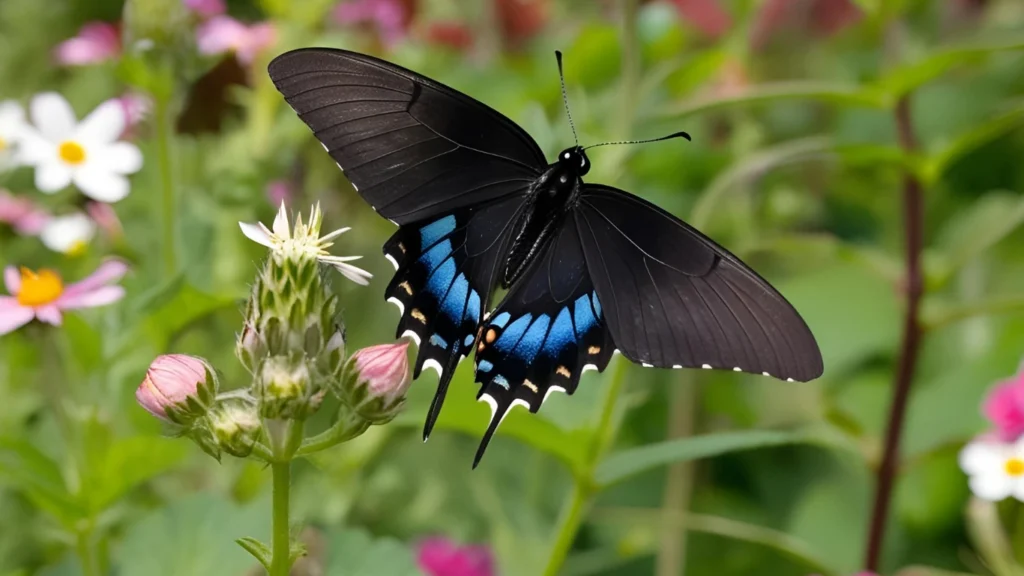
The Black Swallowtail is a common butterfly in North America. It is easy to recognize because of its black wings with colorful spots. It often visits gardens and open fields where it finds flowers and host plants.
Appearance
This butterfly has mostly black wings. Males have yellow spots across their wings, while females have more blue on the hindwings. The wingspan is around 3.5 to 4.5 inches. Both males and females have two orange eyespots on the back wings.
Identification
- Black wings with yellow or blue spots
- Orange eyespots on hindwings
- Males have more yellow, females more blue
- Short tail-like extensions on hindwings
- Found across the United States
Habitat & Range
The Black Swallowtail is found in gardens, meadows, fields, and near farms. It is common across most of the U.S., southern Canada, and into Central America.
Life Cycle
The butterfly lays eggs on host plants like parsley and dill. The caterpillar is green with black bands and yellow dots. It becomes a chrysalis and later turns into a butterfly. It can have two or three generations per year in warm places.
Host Plants
Parsley, dill, fennel, carrot, and Queen Anne’s lace.
Fun Fact
The Black Swallowtail caterpillar can stick out orange horns from its head when it feels threatened. These horns smell bad and help scare off predators.
5. Zebra Swallowtail
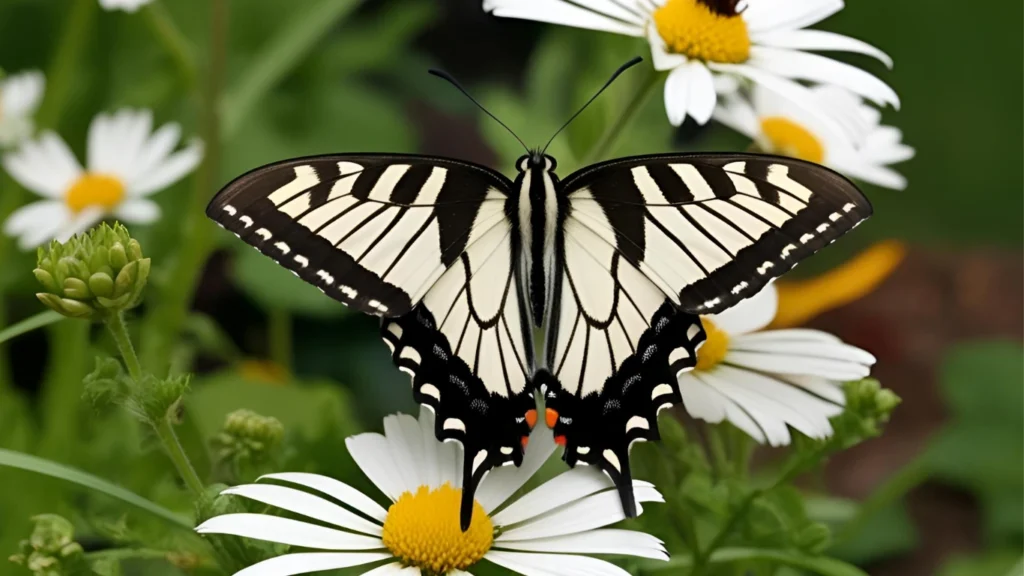
The Zebra Swallowtail is a striking butterfly with black and white stripes, just like a zebra. It is found in the eastern United States and is one of the more unique-looking swallowtails.
Appearance
This butterfly has white wings with bold black stripes. It also has long tails on its hindwings, even longer than most other swallowtails. In spring, it is smaller and paler, while summer forms are larger and brighter. Wingspan is about 2.5 to 4 inches.
Identification
- White wings with black zebra-like stripes
- Long tail extensions on hindwings
- Red and blue spots near the tail
- Summer form is larger and more colorful
- Seen mostly in the eastern U.S.
Habitat & Range
The Zebra Swallowtail lives in moist, wooded areas, especially near rivers. It is often seen near pawpaw trees, which the caterpillar feeds on.
Life Cycle
The female lays eggs on young pawpaw leaves. The caterpillars are green with yellow and black bands. After growing, they form a chrysalis and change into butterflies. There are usually two broods each year, sometimes more in warmer areas.
Host Plants
Only pawpaw trees (Asimina species).
Fun Fact
Because the caterpillar eats pawpaw leaves, it becomes toxic to predators. This helps protect both the caterpillar and the adult butterfly.
6. Spicebush Swallowtail

The Spicebush Swallowtail is a dark-colored butterfly with a shiny blue or green sheen. It is mostly found in the eastern United States and is named after the spicebush plant, one of its main host plants.
Appearance
This butterfly is mostly black. The hindwings of males have a bright blue-green color, while females show a deeper blue. The front wings have pale spots near the edges. Its wingspan is about 3 to 4 inches.
Identification
- Black wings with shiny blue or green hindwings
- Light spots on the edges of front wings
- Curved row of orange spots on the underside of hindwings
- Hindwing shape is more rounded than most swallowtails
- Mimics the Pipevine Swallowtail
Habitat & Range
The Spicebush Swallowtail is common in woodlands, gardens, and near streams. It lives in the eastern and southeastern parts of the United States.
Life Cycle
The female lays eggs on spicebush or sassafras leaves. The caterpillar is green with large false eyes that look like a snake’s face. It hides inside curled leaves during the day. After pupating, it becomes a butterfly. There can be two or more broods per year.
Host Plants
Spicebush and sassafras are the main host plants.
Fun Fact
The Spicebush Swallowtail caterpillar rolls leaves into a shelter using silk and hides inside during the day.
7. Giant Swallowtail

The Giant Swallowtail is the largest butterfly in North America. It is easy to spot because of its large wings and bright yellow markings. It is often seen in gardens and citrus groves.
Appearance
This butterfly has dark brown wings with a yellow band across both the front and back wings. The underside of the wings is mostly yellow with dark edges. It has long tails on the hindwings. Wingspan ranges from 4 to 6 inches.
Identification
- Large dark brown wings with yellow diagonal bands
- Yellow underside with brown borders
- Long hindwing tails
- Biggest butterfly in North America
- Slow and floating flight
Habitat & Range
Giant Swallowtails are found in the southern U.S., Mexico, Central America, and even parts of the Caribbean. They like gardens, citrus farms, and open woodlands.
Life Cycle
Eggs are laid on citrus plants. The caterpillar looks like bird droppings to avoid predators. It later becomes a chrysalis and then a butterfly. In warm areas, they can have several broods per year.
Host Plants
Citrus trees like orange, lemon, and lime, as well as wild lime and prickly ash.
Fun Fact
Because the caterpillar feeds on citrus plants, farmers sometimes consider it a pest, even though it turns into a beautiful butterfly.
8. Palamedes Swallowtail

The Palamedes Swallowtail is a large butterfly found mostly in the southeastern United States. It has dark wings with yellow and greenish markings and is often seen in swampy or wooded areas.
Appearance
This butterfly has dark brown wings with a row of creamy yellow spots along the edges. The hindwings have greenish-blue spots and long tails. Its wingspan ranges from 4 to 5 inches.
Identification
- Dark brown wings with yellow spot bands
- Greenish or bluish spots on hindwings
- Long hindwing tails
- Larger than most other swallowtails
- Seen mostly in the southeastern U.S.
Habitat & Range
The Palamedes Swallowtail lives in swamps, coastal woods, and near streams. It is mainly found in states like Florida, Georgia, Louisiana, and South Carolina.
Life Cycle
Eggs are laid on the leaves of swamp bay and redbay trees. The caterpillar is green with large fake eyes to scare off predators. After it finishes growing, it becomes a chrysalis and later emerges as a butterfly.
Host Plants
Swamp bay, redbay, and sassafras trees.
Fun Fact
The Palamedes Swallowtail is often confused with the Spicebush Swallowtail, but it is larger and has different spot patterns.
9. Polydamas Swallowtail
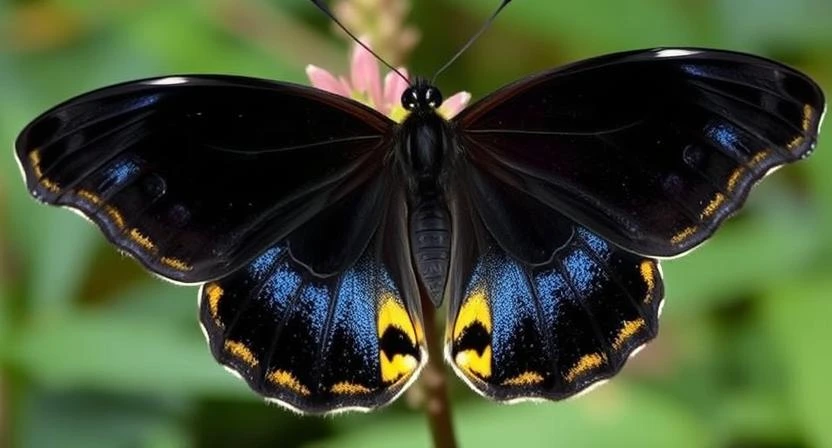
The Polydamas Swallowtail, also called the Gold Rim Swallowtail, is a unique member of the swallowtail family because it has no tails on its wings. It is mostly found in the southern U.S., Central America, and parts of South America.
Appearance
This butterfly has velvety black wings with a bright yellow or gold border around the edges. The wings do not have the typical tail extensions. The wingspan is about 3.5 to 4.5 inches.
Identification
- Black wings with wide gold or yellow border
- No tails on hindwings
- Underside has orange-red spots
- Males and females look similar
- Found in warmer regions like Florida and Texas
Habitat & Range
Polydamas Swallowtails live in tropical gardens, open fields, and along forest edges. They are often found in southern states and tropical areas.
Life Cycle
The female lays eggs on pipevine plants. The caterpillar is reddish-brown with black spikes. Like other swallowtails that feed on pipevine, it becomes poisonous to predators. After pupating, it turns into a butterfly.
Host Plants
Pipevine plants (Aristolochia species).
Fun Fact
Even though it has no tails, the Polydamas is still part of the swallowtail family. Its bold colors warn predators to stay away.
10. Two-tailed Swallowtail

The Two-tailed Swallowtail is a large and colorful butterfly found mostly in the western United States. It gets its name from the two small tails on each hindwing, which make it easy to tell apart from other swallowtails.
Appearance
This butterfly has bright yellow wings with bold black stripes. The hindwings have two thin tails on each side, and there are blue and orange spots near the tails. Its wingspan is large, usually between 4 to 6 inches.
Identification
- Yellow wings with black tiger-like stripes
- Two tails on each hindwing
- Blue and orange spots near tails
- Large wingspan
- Seen mostly in the western U.S.
Habitat & Range
The Two-tailed Swallowtail lives in mountains, canyons, and along streams in the western United States, especially in states like Arizona, New Mexico, and California. It prefers sunny and open spaces.
Life Cycle
Females lay eggs on ash, cherry, and other trees. The caterpillar is green and thick-bodied with yellow eye-like spots. After feeding, it forms a chrysalis and turns into a butterfly. It usually has one or two broods each year depending on the region.
Host Plants
Ash, cherry, sycamore, and other native trees.
Fun Fact
The Two-tailed Swallowtail is the state butterfly of Arizona.
11. Thoas Swallowtail
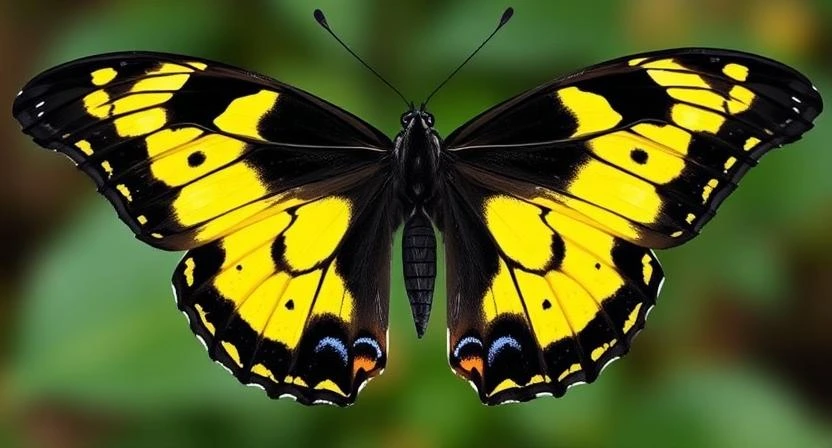
The Thoas Swallowtail is a large and fast-flying butterfly found mostly in Central and South America, but it also visits southern parts of the United States. It looks a lot like the Giant Swallowtail but has some differences in pattern.
Appearance
This butterfly has black wings with large yellow patches. The forewings have yellow spots that form bands, while the hindwings have tails and blue and red spots near the bottom. Wingspan ranges from 4 to 5.5 inches.
Identification
- Black wings with bold yellow patches
- Hindwings have long tails
- Red and blue spots on the underside
- Similar to the Giant Swallowtail
- Found in southern U.S. and tropical regions
Habitat & Range
Thoas Swallowtails live in tropical forests, gardens, and open fields. They are mostly found in Central and South America, but sometimes travel into southern Texas and Florida.
Life Cycle
Eggs are laid on citrus plants and other members of the citrus family. The caterpillars look like bird droppings to help them hide from predators. After pupating, they emerge as butterflies. They can have multiple broods in warmer regions.
Host Plants
Citrus trees, wild lime, and related plants.
Fun Fact
The Thoas Swallowtail is an excellent flier and can be seen flying quickly over long distances.
Ready for the next two?
12. Old World Swallowtail

The Old World Swallowtail is one of the most widespread butterflies in the world. It is found in Europe, Asia, and parts of North America. It is known for its bright colors and graceful flight.
Appearance
This butterfly has yellow wings with black veins and borders. The hindwings have blue patches and red eye spots near the tail. It has long, thin tails and a wingspan between 3 to 4 inches.
Identification
- Yellow wings with bold black markings
- Blue and red spots on hindwings
- Long tails on each hindwing
- Seen in Europe, Asia, and parts of North America
- Strong and elegant flight
Habitat & Range
Old World Swallowtails live in meadows, fields, gardens, and mountains. They are found from western Europe all the way to Japan and also in parts of Canada and Alaska.
Life Cycle
Females lay eggs on wild carrot and related plants. The caterpillar is green with black and orange bands. After feeding, it forms a chrysalis and later becomes a butterfly. There are one or two broods per year.
Host Plants
Wild carrot, fennel, parsley, and related plants.
Fun Fact
In the United Kingdom, the Old World Swallowtail is rare and mostly found in protected areas like the Norfolk Broads.
13. Great Mormon
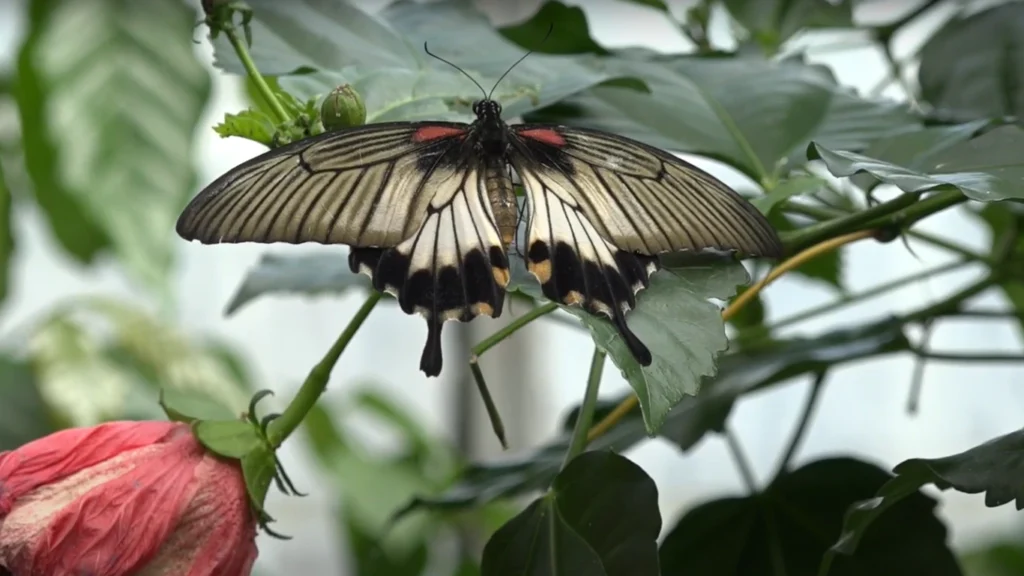
The Great Mormon is a large butterfly found in South and Southeast Asia. It has different forms depending on whether it’s male or female, and females come in many colors to mimic other butterflies.
Appearance
Males have black wings with a blue shine on the hindwings. Females can look very different—some are black with red or white markings, while others mimic poisonous butterflies. Wingspan is between 4 to 5.5 inches.
Identification
- Males are black with bluish hindwings
- Females vary in color and pattern
- No tails in males, tails in some female forms
- Large and fast-flying
- Found in India, Thailand, Indonesia, and nearby regions
Habitat & Range
The Great Mormon lives in forests, gardens, and near villages in tropical Asia. It prefers warm and humid areas with flowering plants.
Life Cycle
Eggs are laid on citrus plants. The caterpillar is green with white markings and hides by mimicking bird droppings when young. It later forms a green chrysalis and becomes an adult butterfly. Several generations can occur each year.
Host Plants
Citrus plants and other members of the Rutaceae family.
Fun Fact
The female Great Mormon is a master of disguise. It has many forms that look like different butterflies, helping it avoid predators.
14. Common Mormon
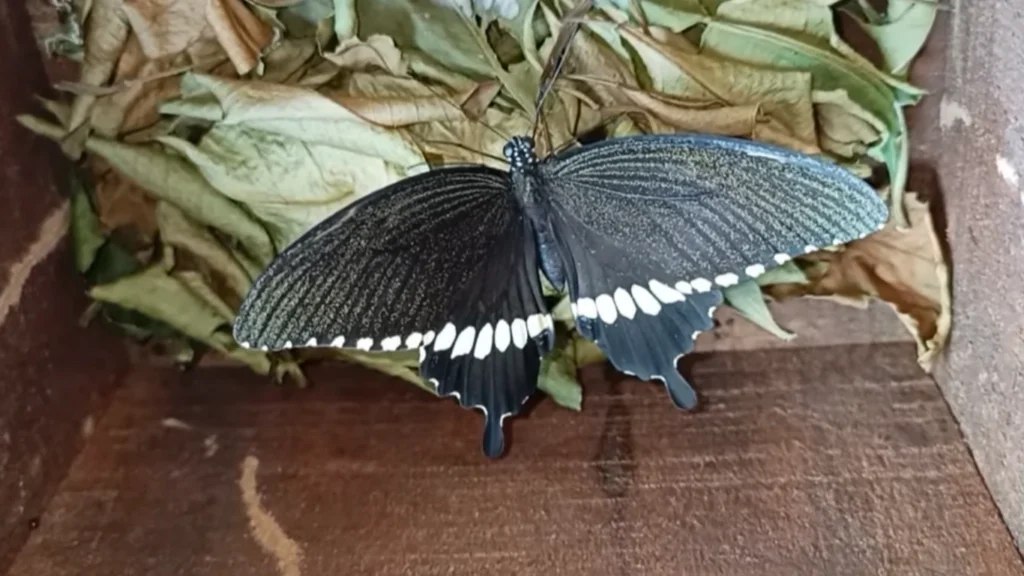
The Common Mormon is a widespread butterfly in South and Southeast Asia. It is closely related to the Great Mormon but slightly smaller. It is well-known for its female forms that mimic other butterflies to protect themselves from predators.
Appearance
Males are black with white spots on the hindwings. Females come in many forms—some look like the male, while others have red, white, and blue markings to copy poisonous butterflies. The wingspan is about 3 to 4 inches.
Identification
- Males: black wings with white spots on hindwings
- Females: multiple forms, some with red and white patterns
- Hindwings may have short tails
- Common in India, Sri Lanka, and Southeast Asia
- Fast and fluttery flight
Habitat & Range
Common Mormons are found in gardens, forests, and urban areas across India, Bangladesh, Thailand, and other Asian countries. They are often seen in flower-filled places.
Life Cycle
Eggs are laid on citrus plants. The young caterpillar looks like bird droppings, while older ones are green with white stripes. After forming a chrysalis, they become butterflies. They breed throughout the year in warm regions.
Host Plants
Citrus, curry leaf plant, and wild lime.
Fun Fact
This butterfly gets its name not from religion, but from its peaceful, common nature and ability to blend in with its surroundings.
15. Scarce Swallowtail

The Scarce Swallowtail is a beautiful butterfly with pale, creamy wings and long tails. Despite its name, it is not always scarce and is often seen across Europe and western Asia in spring and summer.
Appearance
It has pale white or cream-colored wings with thin black stripes. The hindwings have very long tails and small blue and orange spots. Wingspan ranges from 2.5 to 4 inches.
Identification
- Cream or white wings with black vertical stripes
- Long tails on hindwings
- Blue and orange eye spots on hindwings
- Delicate and elegant appearance
- Found in Europe and western Asia
Habitat & Range
Scarce Swallowtails live in warm, dry areas with lots of flowers and fruit trees. They are often seen in open fields, hillsides, and orchards.
Life Cycle
The female lays eggs on young leaves of fruit trees. The caterpillar is green and well-camouflaged. After feeding, it becomes a chrysalis and later hatches into a butterfly. Usually one or two broods occur per year.
Host Plants
Mostly wild cherry, apple, and hawthorn trees.
Fun Fact
Though once considered rare in some places, the Scarce Swallowtail is now more common in many parts of Europe thanks to conservation efforts.
