
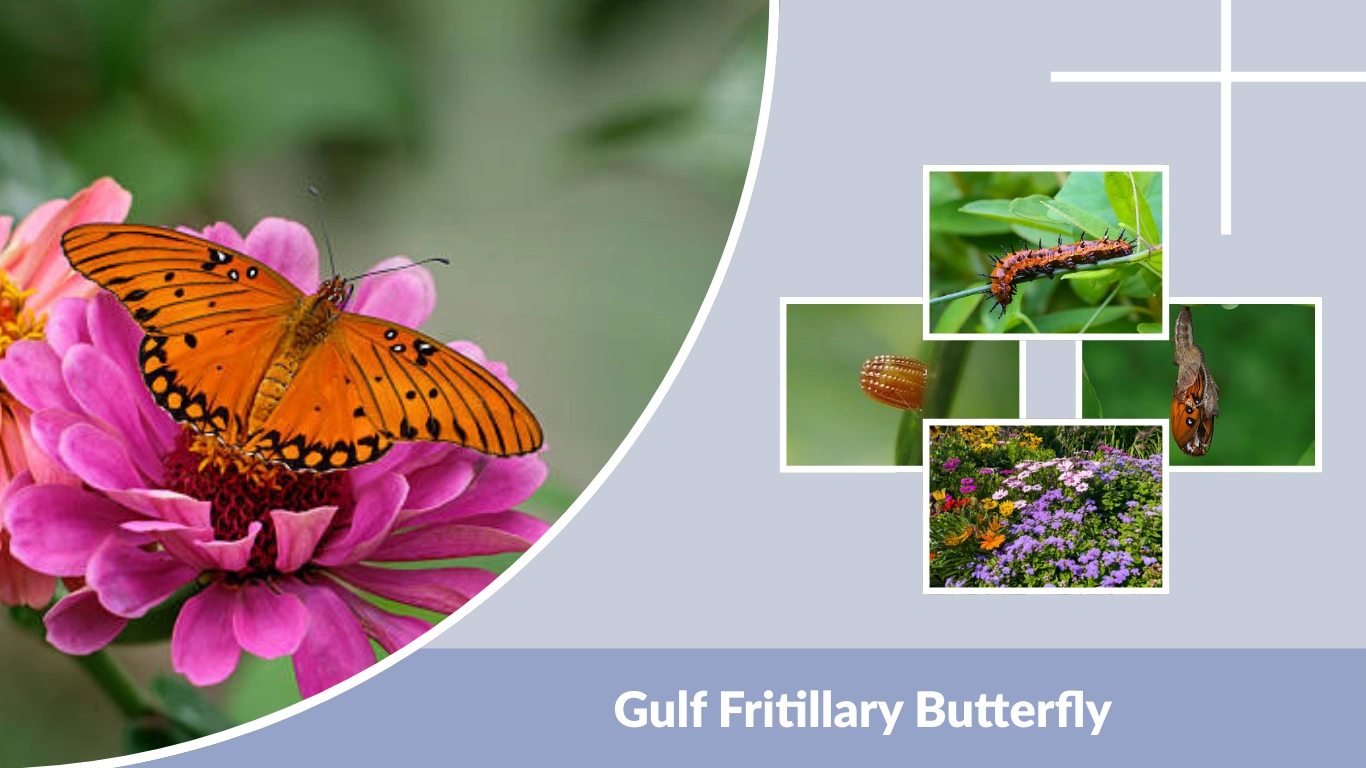
The gulf fritillary butterfly is a striking orange species commonly seen in warm regions of North America. Scientifically known as Agraulis vanillae, it belongs to the brush-footed butterfly family. This butterfly is especially associated with passionflower vines, which play a critical role in its life cycle. Because of its bright coloration and active flight, it is often mistaken for other orange butterflies, especially monarchs, though it is a distinct species with unique traits.
Identification & Key Characteristics
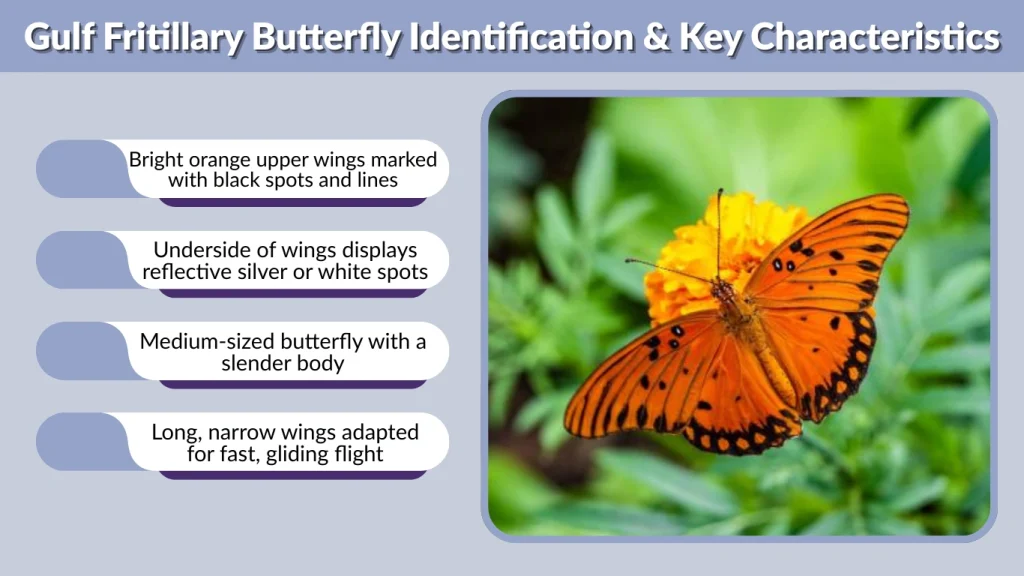
- Bright orange upper wings marked with black spots and lines
- Underside of wings displays reflective silver or white spots
- Medium-sized butterfly with a slender body
- Long, narrow wings adapted for fast, gliding flight
- Active and visible throughout most of the day
Male vs Female Gulf Fritillary
- Males usually have slightly slimmer bodies and brighter coloration
- Females are often larger with darker, bolder wing markings
- Male butterflies possess scent scales used during courtship
- Females tend to fly more slowly, especially when searching for host plants
Gulf Fritillary Caterpillar (Larva Stage)
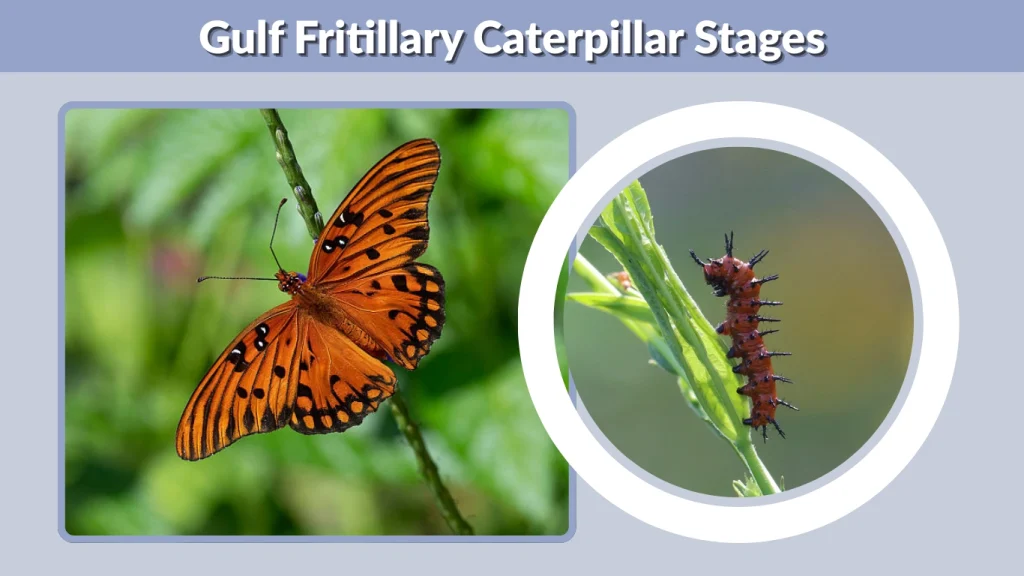
The gulf fritillary caterpillar is easily recognizable due to its bright orange body covered in black, branched spines. These spines may look threatening, but they are not capable of stinging. Caterpillars feed almost exclusively on passion vine leaves, absorbing toxic compounds from the plant that help protect them from predators. As they grow, caterpillars molt several times, increasing rapidly in size before entering the pupal stage.
Gulf Fritillary Caterpillar Stages
Early Instar Stages
Newly hatched caterpillars are small and pale in color. At this stage, they begin feeding immediately on tender passion vine leaves. Growth is rapid, and molting occurs frequently.
Mid-Stage Growth
As caterpillars mature, their orange coloration deepens and the black spines become more pronounced. Feeding increases significantly, and leaf consumption becomes noticeable on host plants.
Final Instar Stage
In the final stage, the caterpillar reaches full size and slows its feeding. It begins searching for a secure location to form a chrysalis, often away from the host plant.
Eggs, Chrysalis & Metamorphosis
Gulf Fritillary Eggs
Eggs are small, yellow, and laid singly on passion vine leaves or tendrils. Females may lay dozens of eggs over their lifespan, carefully selecting host plants that ensure caterpillar survival.
Chrysalis (Pupa) Stage
The chrysalis is brownish or gray with irregular shapes that resemble dried leaves. It hangs freely from a silk attachment and remains motionless for several days as metamorphosis occurs internally.
Adult Emergence
When development is complete, the adult butterfly emerges, pumps fluid into its wings, and prepares for flight within a few hours.
Life Cycle of Gulf Fritillary
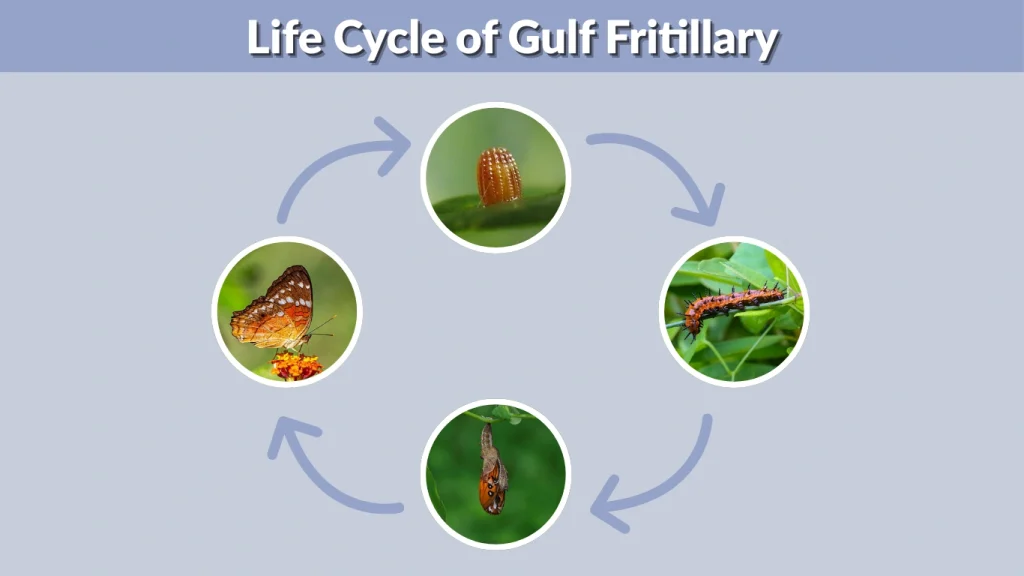
The gulf fritillary undergoes complete metamorphosis, progressing through egg, larva, pupa, and adult stages. Under warm conditions, this entire process can take less than a month. Multiple generations may occur each year in southern regions, while northern populations are more seasonal. Temperature, host plant availability, and daylight all influence development speed.
Host Plants & Caterpillar Food
- Passion vine (Passiflora) species are the primary host plants
- Both native and ornamental passionflowers are used
- Caterpillars feed exclusively on passion vine leaves
- Adult butterflies rely on nectar from flowering plants
Habitat & Range

Gulf fritillary butterflies thrive in warm, open habitats such as gardens, roadsides, fields, and forest edges. Their range includes the southern United States, Mexico, Central America, and parts of South America. In recent decades, they have expanded northward, aided by the widespread planting of passion vines in residential landscapes.
Migration & Seasonal Movement
Gulf fritillary butterflies do not migrate in the same way as monarchs, but they do exhibit seasonal movement. In warmer southern regions, they may remain active year-round if host plants are available. In cooler areas, adults expand northward during spring and summer, colonizing new habitats as passion vines become available. As temperatures drop, northern populations usually die off, while southern populations persist and produce the next generation.
Toxicity, Poison & Safety
Are Caterpillars Poisonous?
Gulf fritillary caterpillars are considered toxic to predators due to chemicals absorbed from passion vine leaves. These toxins make them unpalatable to birds and other animals, reducing predation. The bright orange and black coloration acts as a warning signal, advertising their chemical defenses.
Are They Dangerous to Humans or Pets?
Despite their toxic reputation, gulf fritillary caterpillars are not dangerous to humans or household pets. They do not bite, and casual contact does not cause poisoning. However, handling is discouraged, as some people may experience mild skin irritation from the spines.
Do Caterpillars Sting?
Gulf fritillary caterpillars do not sting. Their spines are soft and lack venom, serving only as a visual deterrent rather than a physical defense.
Predators & Natural Defenses
Although well-protected, gulf fritillaries still face predators. Birds, spiders, ants, and parasitic wasps may prey on eggs and young caterpillars. Their primary defense is chemical toxicity combined with warning coloration. Adult butterflies also benefit from fast, erratic flight, making them harder for predators to capture.
Gardening Impact & Control
In gardens, gulf fritillary caterpillars are often noticed when passion vines become heavily defoliated. While large numbers can temporarily strip leaves, the plants usually recover quickly. Gardeners who wish to support butterflies often tolerate caterpillar feeding or plant additional passion vines. Physical relocation of caterpillars is preferred over chemical control, which can harm beneficial insects.
Gulf Fritillary vs Monarch Butterfly
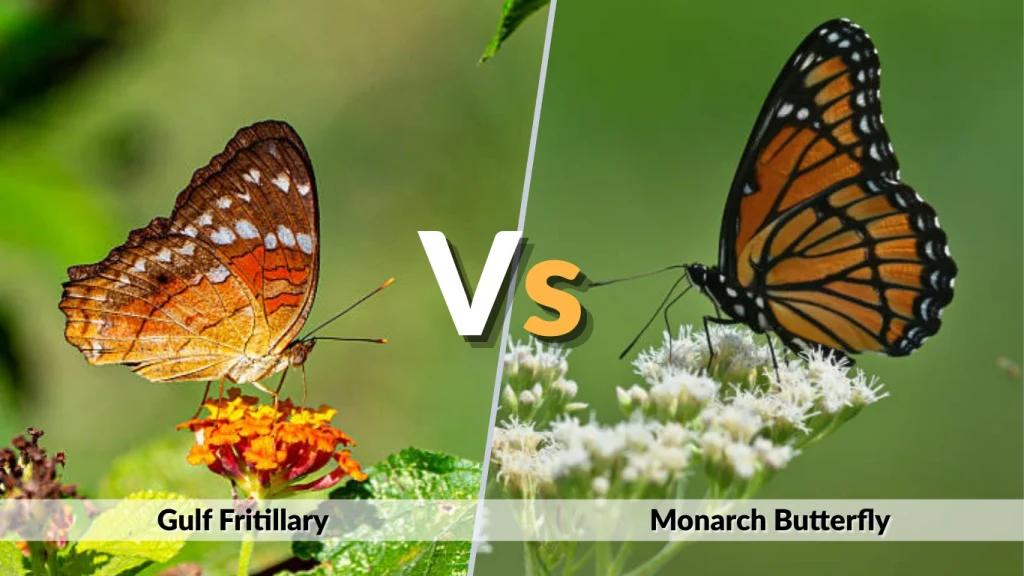
Although often confused, gulf fritillaries and monarch butterflies differ in several key ways. Monarchs rely on milkweed as host plants, while gulf fritillaries depend on passion vines. Monarchs undertake long-distance migrations, whereas gulf fritillaries spread seasonally without a fixed migration route. Visually, monarchs have thicker black wing veins, while gulf fritillaries display silver spots on the underside of their wings.
Meaning, Symbolism & Conservation
Gulf fritillary butterflies are often associated with transformation, resilience, and creativity due to their vivid colors and rapid life cycle. Spiritually, they are seen as symbols of personal growth and renewal. From a conservation standpoint, gulf fritillaries are not endangered and are considered stable across much of their range. Their success is closely tied to the availability of passionflower plants, highlighting the importance of native and butterfly-friendly gardening practices.
FAQs
Are gulf fritillary caterpillars poisonous?
Gulf fritillary caterpillars are toxic to predators because they absorb chemicals from passion vine leaves. These toxins make them taste unpleasant to birds and other animals. However, they are not considered poisonous to humans and are generally safe to observe without direct handling.
Do gulf fritillary caterpillars sting?
No, gulf fritillary caterpillars do not sting. Although they have long black spines that look sharp, these spines are soft and non-venomous. They serve as a visual warning to predators rather than a physical defense mechanism.
Will gulf fritillary caterpillars kill passion vine plants?
Gulf fritillary caterpillars can heavily defoliate passion vines, but they rarely kill healthy plants. Most passion vines recover quickly after caterpillars pupate. Planting extra vines or allowing natural regrowth is usually enough to support both the plant and the butterflies.
Do gulf fritillary butterflies migrate?
Gulf fritillary butterflies do not perform long-distance migrations like monarchs. Instead, they expand their range seasonally, moving northward in warmer months and retreating or dying off in colder regions while southern populations persist year-round.
How long does a gulf fritillary butterfly live?
The adult gulf fritillary butterfly typically lives between two and four weeks. Lifespan varies depending on temperature, food availability, and environmental conditions. In warm climates, multiple generations may occur throughout the year.
