

Tiger swallowtail caterpillars are among the most fascinating caterpillars found in North America. Known for their bright green bodies and large false eye spots, they often look more like tiny snakes than insects. These caterpillars are the juvenile stage of tiger swallowtail butterflies, a group famous for their bold yellow-and-black wings. Found in forests, parks, and home gardens, tiger swallowtail caterpillars play an important ecological role and offer a remarkable example of insect transformation.
What Is a Tiger Swallowtail Caterpillar?
A tiger swallowtail caterpillar is the larval stage of butterflies belonging to the Papilio glaucus species complex, which includes the eastern, western, and Canadian tiger swallowtails. During this stage, the insect’s main purpose is to eat, grow, and store energy for metamorphosis. Unlike adult butterflies that feed on nectar, caterpillars are leaf-eaters and spend most of their time on host trees and shrubs.
Tiger swallowtail caterpillars are especially well known because of their dramatic appearance changes. Young caterpillars resemble bird droppings, helping them avoid predators. As they grow, they turn bright green and develop large eye-like spots near the head, which can scare birds and small animals. This combination of camouflage and mimicry makes them one of the most visually interesting caterpillars in North America.
Identification of Tiger Swallowtail Caterpillar

Tiger swallowtail caterpillars are easy to recognize once you know their key features. Their appearance changes significantly as they mature, but several traits remain consistent.
- Bright green body in later stages
- Thick, soft body with visible segments
- Large yellow-and-black false eye spots behind the head
- Narrow black band or “saddle” across the middle
- Small true head tucked beneath the eye-spot area
- Orange, forked osmeterium that pops out when threatened
These caterpillars usually grow to about 2 — 2.5 inches long before pupating. When disturbed, they often rear back and extend the osmeterium, releasing a strong smell that helps repel ants, birds, and other predators.
Types of Tiger Swallowtail Caterpillars
Several closely related tiger swallowtail species exist across North America. Their caterpillars look similar but differ slightly in range, host plants, and seasonal behavior.
Eastern Tiger Swallowtail Caterpillar
The eastern tiger swallowtail caterpillar is the most widespread. It is found throughout the eastern United States and parts of southern Canada. Its caterpillars feed on trees such as wild cherry, tulip tree, ash, and birch. They develop the classic bright green body and bold eye spots that most people associate with tiger swallowtails.
Western Tiger Swallowtail Caterpillar
The western tiger swallowtail caterpillar occurs mainly in western North America. It often feeds on cottonwood, willow, and aspen. While very similar in appearance to the eastern form, it may show subtle differences in body tone and head shape. These caterpillars are commonly seen along rivers, forest edges, and mountain valleys.
Canadian Tiger Swallowtail Caterpillar
The Canadian tiger swallowtail caterpillar is adapted to cooler climates and is found in northern regions. It typically has a shorter active season and may complete only one generation per year. Host plants often include birch, cherry, and poplar. Its development is closely tied to temperature and seasonal timing.
Life Cycle of the Tiger Swallowtail
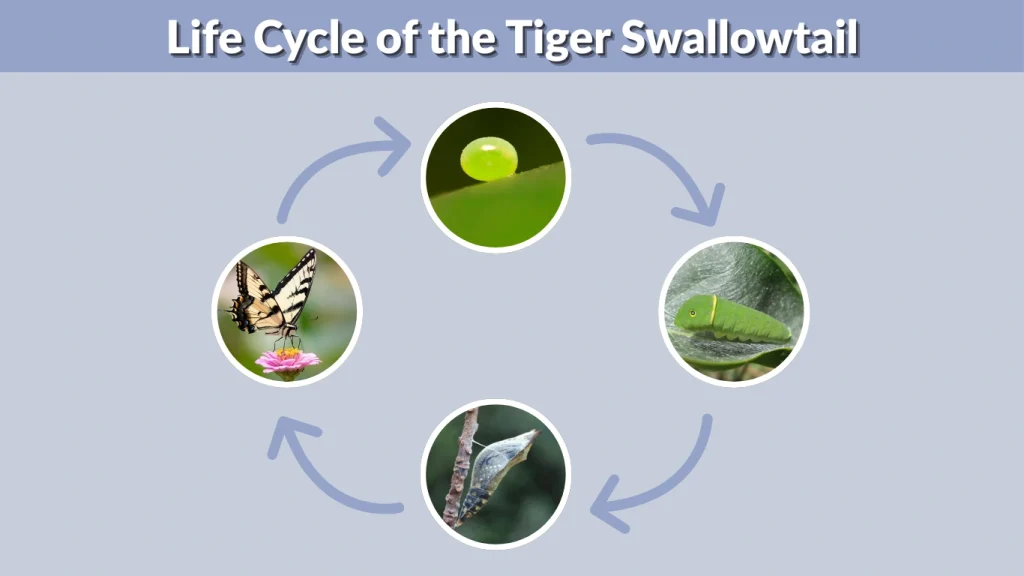
The tiger swallowtail undergoes complete metamorphosis, passing through several distinct life stages.
- The female butterfly lays small green eggs on the leaves of host plants
- Eggs hatch into tiny, dark caterpillars that resemble bird droppings
- The caterpillar grows through multiple molts, increasing rapidly in size
- A fully grown caterpillar forms a chrysalis attached to a stem or twig
- An adult butterfly emerges, ready to feed, mate, and repeat the cycle
Depending on climate, tiger swallowtails may have one to three generations per year. In colder regions, the chrysalis stage often overwinters before the butterfly emerges in spring.
Growth Stages of the Caterpillar
Tiger swallowtail caterpillars pass through several growth stages known as instars. Each stage brings changes in size, color, and behavior.
Early Instars
Newly hatched caterpillars are small, dark, and blotchy. Their bird-dropping appearance helps protect them from predators. During this stage, they feed lightly on leaf surfaces and often remain hidden along leaf edges or stems. Growth is rapid, and molting occurs every few days.
Late Instars
As they mature, the caterpillars turn bright green and develop their famous eye spots. They eat large amounts of foliage and become more visible on host plants. Late-stage caterpillars are thicker, slower-moving, and spend more time preparing for pupation.
What Do Tiger Swallowtail Caterpillars Eat?
Tiger swallowtail caterpillars are strict herbivores. They feed almost exclusively on the leaves of specific host trees and shrubs. Their strong jaws allow them to chew tough foliage, and a single caterpillar can consume many leaves before reaching full size. Diet not only fuels growth but also influences coloration, health, and successful metamorphosis.
Host Plants of Tiger Swallowtail Caterpillars

Tiger swallowtail caterpillars depend on specific host plants for survival. Female butterflies carefully choose these plants so their young have immediate access to food after hatching. These host trees are usually deciduous and provide the nutrients needed for fast growth and successful metamorphosis.
- Wild cherry
- Tulip tree (tulip poplar)
- Willow
- Birch
- Ash
- Poplar
- Magnolia
Caterpillars typically stay on a single host plant throughout their development. Heavy feeding may cause visible leaf damage, but healthy trees usually recover quickly.
Habitat and Natural Range
Tiger swallowtail caterpillars are native to much of North America. They are commonly found in woodlands, forest edges, riverbanks, and suburban landscapes where host plants are present. Because many of their preferred trees are used in landscaping, these caterpillars are frequently seen in parks and home gardens.
Their range stretches from southern Canada through most of the United States and into parts of northern Mexico. In warmer regions, multiple generations may occur each year, while northern populations usually produce only one. Seasonal timing strongly affects their growth rate and survival.
Behavior and Defense Mechanisms
Despite their soft bodies, tiger swallowtail caterpillars are well protected. Their bright green coloration helps them blend into leaves, making them difficult to detect. The large false eye spots near the head create the illusion of a small snake, which can startle birds and other predators.
One of their most effective defenses is the osmeterium, an orange, forked organ hidden behind the head. When threatened, the caterpillar extends it and releases a strong-smelling chemical that deters ants, spiders, and small predators. Combined with sudden head movements, this display often convinces attackers to retreat.
Chrysalis and Metamorphosis
When fully grown, the caterpillar stops feeding and searches for a secure location. It attaches itself to a twig, stem, or structure using silk and forms a chrysalis. The chrysalis may be green or brown, allowing it to blend in with surrounding vegetation.
Inside the chrysalis, the caterpillar’s body completely reorganizes. Over one to two weeks in warm seasons—or several months if overwintering—the insect transforms into a butterfly. When development is complete, the adult tiger swallowtail emerges, pumps fluid into its wings, and soon takes its first flight.
Tiger Swallowtail Caterpillar in Gardens
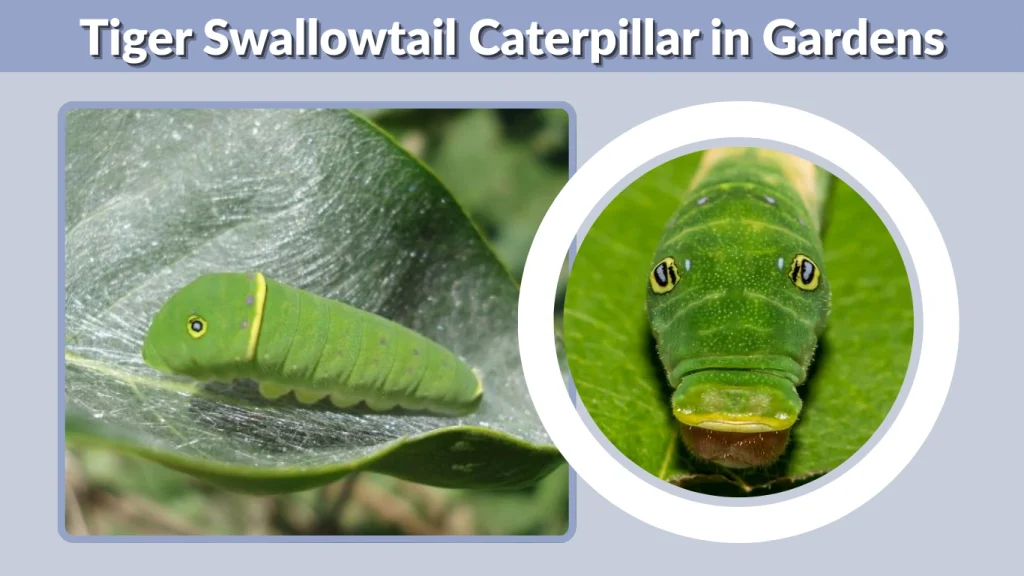
Tiger swallowtail caterpillars are valued in gardens because they eventually become important pollinators. Planting host trees such as tulip poplar, cherry, or willow can attract egg-laying butterflies and support local populations.
Although caterpillars may chew noticeable holes in leaves, they rarely cause serious harm to healthy trees. Many gardeners choose to tolerate or protect them, recognizing their role in supporting biodiversity. Raising caterpillars at home is also popular, as it allows close observation of metamorphosis while teaching respect for insect life cycles.
Predators, Parasites, and Survival Challenges
In nature, most tiger swallowtail caterpillars do not reach adulthood. Birds are their main predators, but spiders, ants, and predatory insects also feed on them. Parasitic wasps and flies may lay eggs inside caterpillars, eventually killing them before pupation.
Weather is another major threat. Heavy rain, extreme heat, and cold snaps can reduce survival rates. Human activities, especially pesticide use and habitat loss, also impact populations. Planting native trees and avoiding chemical sprays greatly improves their chances of survival.
Interesting Facts About Tiger Swallowtail Caterpillars
Tiger swallowtail caterpillars are famous for their snake-like appearance, but they also show impressive adaptability. They grow rapidly, molting several times in just a few weeks. Their eye spots are not true eyes but specialized markings designed to mislead predators.
Some populations complete multiple generations per year, while others rely on a single annual cycle. Their ability to overwinter as a chrysalis allows them to survive freezing temperatures and emerge precisely when host plants begin producing new leaves.
FAQs
What does a tiger swallowtail caterpillar look like?
Tiger swallowtail caterpillars are bright green in their later stages, with large yellow-and-black false eye spots near the head. They have soft, thick bodies and may show a dark band across the middle. Younger caterpillars are brown and white, resembling bird droppings.
Are tiger swallowtail caterpillars poisonous?
Tiger swallowtail caterpillars are not poisonous to humans. They do not sting, bite, or inject venom. Their main defense is the osmeterium, which releases a foul-smelling chemical to deter predators. This smell is harmless to people but unpleasant to many animals.
What plants do tiger swallowtail caterpillars eat?
They feed on the leaves of specific host trees, including wild cherry, tulip tree, willow, birch, ash, poplar, and magnolia. These plants provide the nutrients needed for fast growth and proper development into healthy butterflies.
How long does the caterpillar stage last?
The caterpillar stage usually lasts three to four weeks, depending on temperature and food quality. In warm climates, development is faster, while cooler regions may slow growth. After this stage, the caterpillar forms a chrysalis.
Can tiger swallowtail caterpillars be raised at home?
Yes, they can be raised at home if fresh host plant leaves are provided daily and the caterpillar is kept in a clean, ventilated container. Many people raise them for educational purposes and release the adult butterfly once it emerges.
