
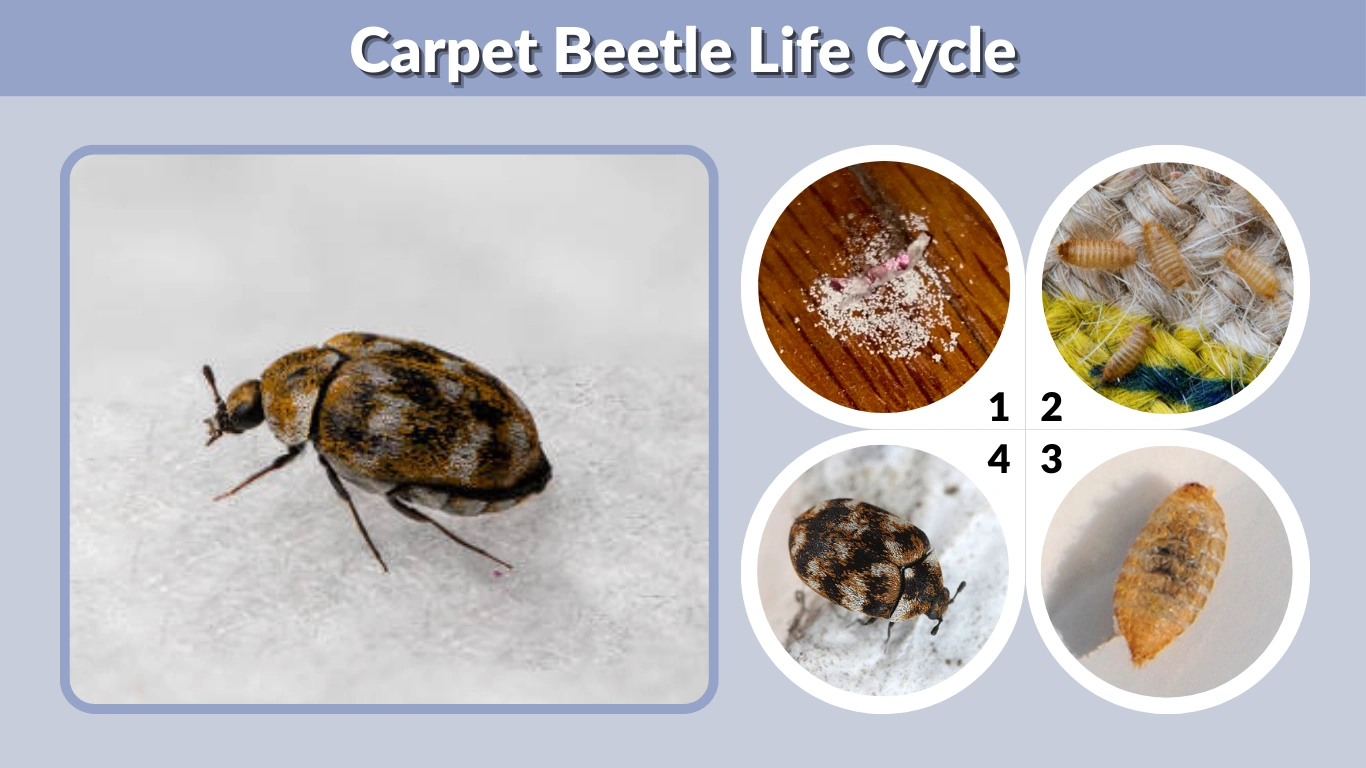
The carpet beetle life cycle explains why infestations often seem to appear suddenly and then keep returning even after cleaning. These small household pests develop through multiple hidden stages, with larvae doing most of the damage long before adults are noticed. Understanding how carpet beetles grow—from egg to adult—helps homeowners identify early warning signs, stop fabric destruction, and choose the right time to control them. This guide explores each life stage, behavior patterns, and why their life cycle makes them so persistent indoors.
Identification and Early Signs of Carpet Beetles

Short overview: Carpet beetles are often overlooked because different life stages hide in separate areas of the home. Spotting early signs can prevent serious fabric and furniture damage.
- Tiny white or cream eggs hidden in dark fibers
- Brown, hairy larvae crawling slowly on carpets or clothes
- Shed larval skins near baseboards and closets
- Small adult beetles near windows and light sources
- Irregular holes in wool, silk, feathers, or upholstery
What Is the Carpet Beetle Life Cycle?
Complete Metamorphosis Explained
Carpet beetles undergo complete metamorphosis, meaning they pass through four distinct stages: egg, larva, pupa, and adult. Each stage looks completely different and behaves differently. Eggs remain hidden, larvae feed aggressively, pupae stay inactive, and adults focus mainly on reproduction. Because multiple stages can exist at the same time, infestations often continue unnoticed for months.
Why the Life Cycle Matters for Control
Most damage is caused by larvae, not adult beetles. Treatments that only target visible beetles often fail because eggs and larvae remain hidden deep inside carpets, furniture, and wall cracks. Understanding where each stage lives helps target cleaning, monitoring, and control efforts more effectively.
Egg Stage: Where Infestations Begin

The carpet beetle life cycle begins when adult females lay tiny eggs in dark, undisturbed areas with access to natural fibers. Common egg-laying sites include carpet edges, air vents, stored clothing, furniture stuffing, and lint-filled corners. Eggs are extremely small and sticky, allowing them to cling to fabric and remain unnoticed.
Depending on temperature and humidity, eggs typically hatch within one to three weeks. Warm indoor environments speed up development, which is why carpet beetles thrive year-round inside homes. Because eggs are rarely seen, infestations usually go unnoticed until larvae begin feeding.
Larval Stage: The Most Destructive Phase

What Carpet Beetle Larvae Look Like
Carpet beetle larvae are small, elongated, and covered in stiff brown or tan hairs. Many people describe them as carrot-shaped or worm-like. Some species appear darker and longer, while others are shorter and banded. They move slowly and often curl when disturbed. Shed skins are frequently found near feeding sites.
What Carpet Beetle Larvae Eat
Larvae feed on materials rich in animal proteins. Their preferred food sources include wool, silk, fur, feathers, leather, pet hair, lint, and even dead insects. They also infest stored items such as blankets, rugs, clothing, taxidermy, and upholstered furniture. Unlike moths, they rarely damage synthetic fabrics unless blended with natural fibers.
Carpet Beetle Larvae Life Cycle Length
The larval stage is the longest part of the carpet beetle life cycle. Indoors, larvae may live for several months and in some cases more than a year. Growth speed depends on temperature, humidity, and food quality. In cool or dry conditions, larvae develop slowly, which is why infestations can persist long after adults disappear.
Pupal Stage: The Hidden Transformation

After completing their feeding phase, larvae move into protected areas to pupate. They often choose cracks, carpet backing, wall voids, furniture crevices, or storage boxes. During this stage, larvae stop feeding and transform into adults inside a pupal shell.
The pupal stage usually lasts one to three weeks. Because pupae are inactive and hidden, homeowners often believe the infestation is gone, only to see adult beetles emerge suddenly afterward.
Adult Carpet Beetles: Reproduction and Spread
Adult carpet beetles are small, oval-shaped insects that may be black, brown, or patterned depending on the species. Indoors, they are commonly seen on windowsills as they are attracted to light. Unlike larvae, adults do not damage fabrics. Instead, they feed on pollen and nectar outdoors and focus mainly on mating and laying eggs.
Once inside, females seek out suitable materials to deposit eggs, restarting the carpet beetle life cycle. Adults can enter through open windows, doors, or hitchhike on flowers, furniture, and clothing brought indoors.
Varied, Black, and Brown Carpet Beetle Life Cycles
Short overview: While all carpet beetles share the same four life stages, different species vary in appearance, preferred habitats, and development speed.
- Varied carpet beetle life cycle
- Black carpet beetle life cycle
- Brown carpet beetle life cycle
- Furniture carpet beetle life cycle
- Woolly bear carpet beetle life cycle
How Long Is the Carpet Beetle Life Cycle?

The full carpet beetle life cycle can range from about three months to more than a year. In warm, food-rich indoor environments, development happens faster, sometimes allowing a complete cycle within a single season. In cooler or drier conditions, larvae may remain active for many months before pupating. This long larval period is one of the main reasons infestations seem never-ending.
Temperature, humidity, and food availability all influence development speed. Homes with central heating, stored fabrics, and pet hair provide ideal conditions, allowing overlapping generations to exist at the same time. This means eggs, larvae, pupae, and adults may all be present simultaneously, making control more challenging.
Carpet Beetle Life Cycle in the UK
In the UK, carpet beetles typically follow a seasonal pattern outdoors, with adults appearing in spring and summer. However, indoor heating alters this natural cycle. Warm homes allow eggs to hatch throughout the year, and larvae may continue feeding even during winter months.
Because many UK homes rely on wool carpets, upholstered furniture, and stored clothing, indoor infestations can persist year-round. Seasonal surges often occur in late spring, when adult beetles fly indoors through open windows and lay new eggs, quietly restarting the cycle.
Carpet Beetle Life Cycle and “Bites”
Carpet beetles do not bite humans at any stage of their life cycle. However, many people report itchy red marks that resemble insect bites. These reactions are usually caused by contact with the tiny hairs found on carpet beetle larvae or their shed skins.
These hairs can trigger allergic skin reactions in sensitive individuals, leading to rashes that are sometimes called “carpet beetle dermatitis.” Unlike real bites from bed bugs or fleas, these marks do not come from feeding. Instead, they result from skin irritation after touching contaminated fabrics, carpets, or furniture.
Carpet Beetle Life Cycle Images and Visual Identification
Short overview: Visual identification helps determine which life stage is present and how severe an infestation may be.
- Egg and larva comparison images
- Larvae vs clothes moth larvae photos
- Pupae hidden in carpets and furniture
- Adult beetle appearance guide
- Close-ups of fabric and upholstery damage
Why Carpet Beetles Keep Coming Back
Many infestations return because the full carpet beetle life cycle is not interrupted. Eggs are often overlooked, larvae hide deep inside furniture, and pupae remain protected in cracks. Even if adult beetles are removed, surviving larvae can continue feeding and eventually transform into a new generation.
Another major reason is overlapping life stages. When eggs hatch at different times, treatments applied only once may kill active larvae but leave eggs untouched. Weeks later, new larvae emerge, giving the impression of a new infestation when it is actually the continuation of the same life cycle.
How to Interrupt the Carpet Beetle Life Cycle
Cleaning and Physical Removal
Thorough cleaning is the foundation of life cycle control. Frequent vacuuming of carpets, baseboards, vents, closets, and furniture seams removes eggs, larvae, and shed skins. Infested clothing and linens should be washed in hot water or heat-dried to kill hidden stages. Severely damaged items may need to be discarded to prevent reinfestation.
Environmental Control
Reducing food sources disrupts larval development. Storing fabrics in sealed containers, removing lint buildup, and lowering indoor humidity makes environments less favorable. Sealing cracks, repairing screens, and limiting access to outdoor insects also helps prevent adult beetles from laying new eggs.
Treatment Timing by Life Stage
Because eggs are resistant to many treatments, repeated control efforts are often necessary. Initial treatments target larvae, followed by follow-up cleaning and monitoring to catch newly hatched larvae before they mature. Breaking the cycle requires consistency over several weeks to months.
FAQs
What is the life cycle of a carpet beetle?
The carpet beetle life cycle includes four stages: egg, larva, pupa, and adult. Eggs hatch into larvae that feed on natural fibers for months. After pupating in hidden areas, adults emerge, mate, and lay new eggs, restarting the cycle indoors or outdoors.
How long does the carpet beetle life cycle take?
A complete life cycle can take as little as three months or extend beyond a year. The larval stage lasts the longest and is strongly influenced by temperature, humidity, and food availability, which is why infestations often persist for long periods.
Do all carpet beetles have the same life cycle?
All carpet beetle species follow the same four developmental stages, but the length and behavior vary. Varied, black, brown, furniture, and woolly bear carpet beetles differ slightly in growth speed, appearance, and preferred infestation sites.
Can carpet beetles bite during their life cycle?
Carpet beetles do not bite humans. Skin irritation associated with them is usually caused by larval hairs or shed skins that trigger allergic reactions. These rashes may look like bites but are not caused by feeding insects.
Why do carpet beetles return after treatment?
Reinfestations occur when eggs or hidden larvae survive. Because different life stages exist at the same time, single treatments rarely break the entire cycle. Consistent cleaning, monitoring, and repeated control measures are needed to fully eliminate them.
