
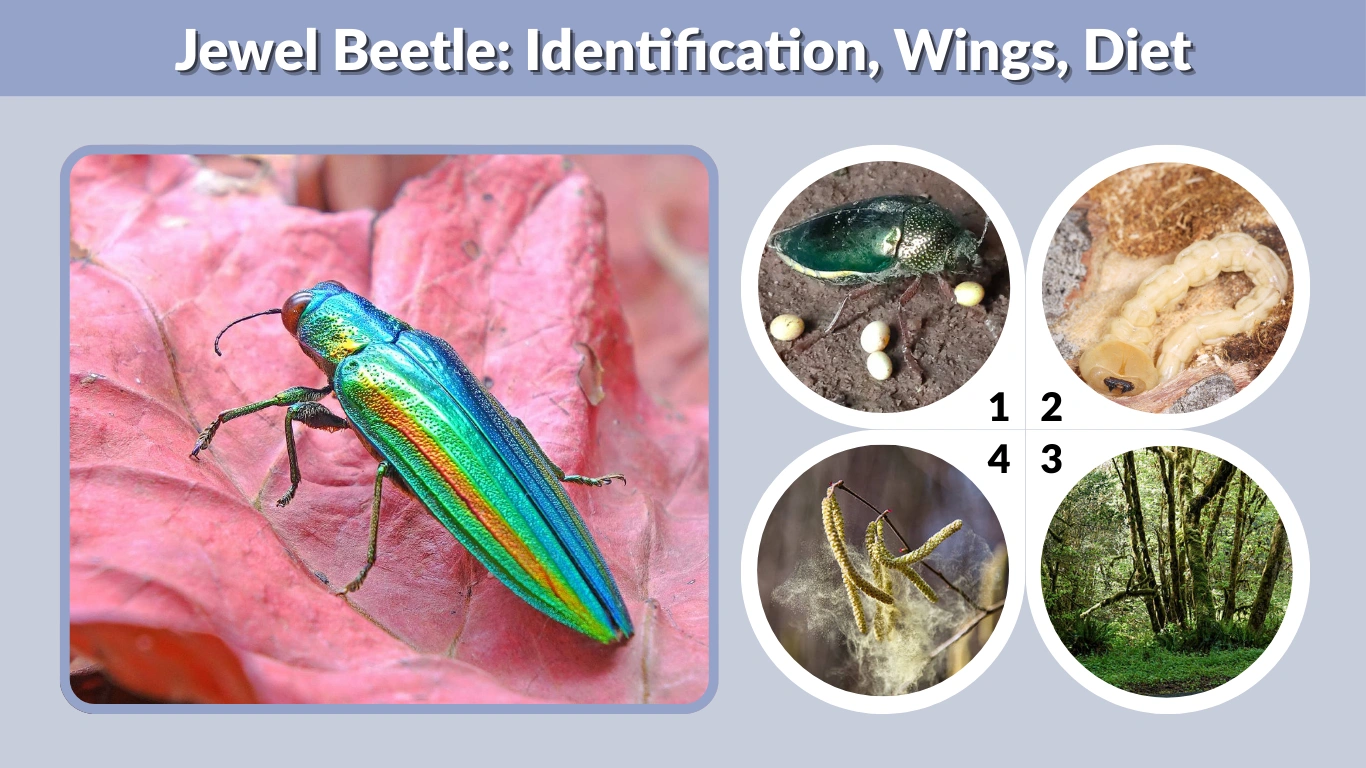
Jewel beetles are among the most beautiful insects in the world, known for their bright metallic colors and shiny bodies. They belong to the family Buprestidae, which includes more than 15,000 species found across many parts of the world. These beetles are often admired for their jewel-like appearance and unique structural colors. Jewel beetles live mainly in forests and wooded areas where trees are abundant. In this article, we will explore jewel beetle identification, wings, habitat, diet, and other fascinating aspects of their biology.
Jewel Beetle Identification
Physical Characteristics
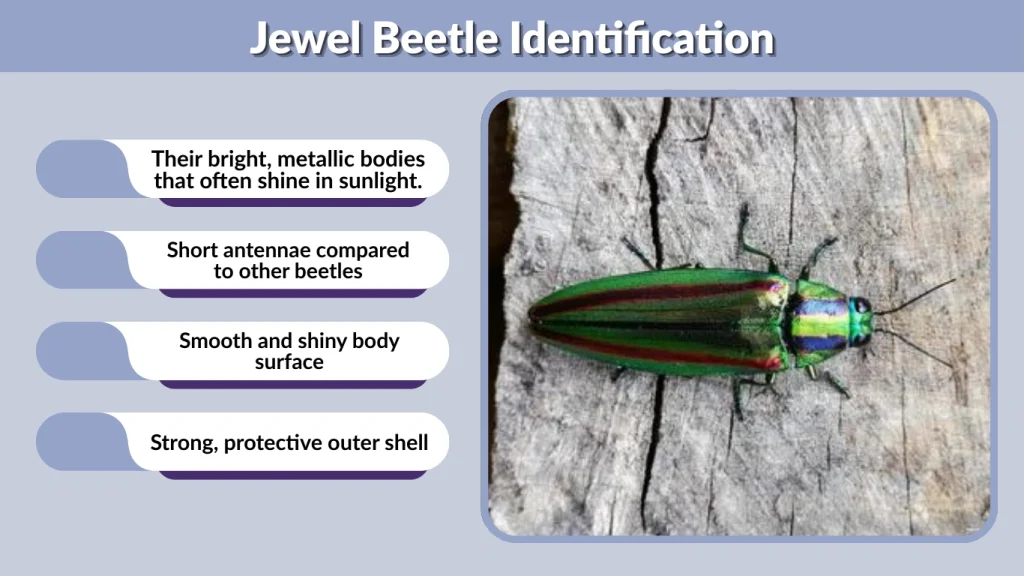
Jewel beetles are easily recognized by their bright, metallic bodies that often shine in sunlight. Their colors may include shades of green, blue, gold, copper, or even red. The body is usually elongated and slightly flattened, giving them a streamlined appearance. Many species have a bullet-shaped body that helps them move easily along tree bark.
These beetles vary in size depending on the species. Some jewel beetles are only a few millimeters long, while others can grow several centimeters in length. Despite this size variation, most species share the same glossy surface and colorful exoskeleton.
Key Identification Features
Several features make jewel beetles easy to identify. One of the most noticeable characteristics is their iridescent coloration, which often changes depending on the angle of the light. Unlike many insects that rely mainly on pigments, jewel beetles produce their colors through microscopic structures on their exoskeleton that reflect light.
Other identifying features include:
- Hard wing covers called elytra
- Short antennae compared to other beetles
- Smooth and shiny body surface
- Strong, protective outer shell
These characteristics help jewel beetles survive in their environment by protecting them from predators and environmental damage.
Common Jewel Beetle Species
There are thousands of jewel beetle species worldwide. Some of the most well-known examples include the emerald ash borer, which has become famous for damaging ash trees in North America. Another example is the golden jewel beetle, known for its brilliant golden-green coloration.
Species in the genera Buprestis and Chrysochroa are also well known for their striking metallic patterns and bright colors. Each species has its own unique coloration and habitat preference.
Jewel Beetle Wings
Structure of the Wings
Like most beetles, jewel beetles have two pairs of wings. The outer wings, called elytra, are hard and protective. These wing covers protect the delicate flight wings underneath and help shield the beetle’s body from physical damage.
The inner wings are thin and membranous. These wings are used for flying and are folded neatly beneath the elytra when the beetle is not in flight.
Metallic Color and Iridescence
One of the most fascinating features of jewel beetle wings is their brilliant metallic shine. This coloration is not produced only by pigments but also by the microscopic structure of their exoskeleton.
Tiny layers in the beetle’s outer surface reflect and scatter light, producing shimmering colors that appear to change when viewed from different angles. This phenomenon is called structural coloration. It is the same effect seen in butterfly wings and some bird feathers.
Function of the Wings
The wings of jewel beetles serve several important purposes. First, the elytra provide strong protection for the body and inner wings. This protective layer helps prevent damage while the beetle moves through rough tree bark and forest environments.
Second, the inner wings allow the beetle to fly. Flight helps jewel beetles search for food, find mates, and locate suitable trees for laying eggs. The ability to fly also helps them escape predators and move to new habitats.
Jewel Beetle Habitat
Natural Environments
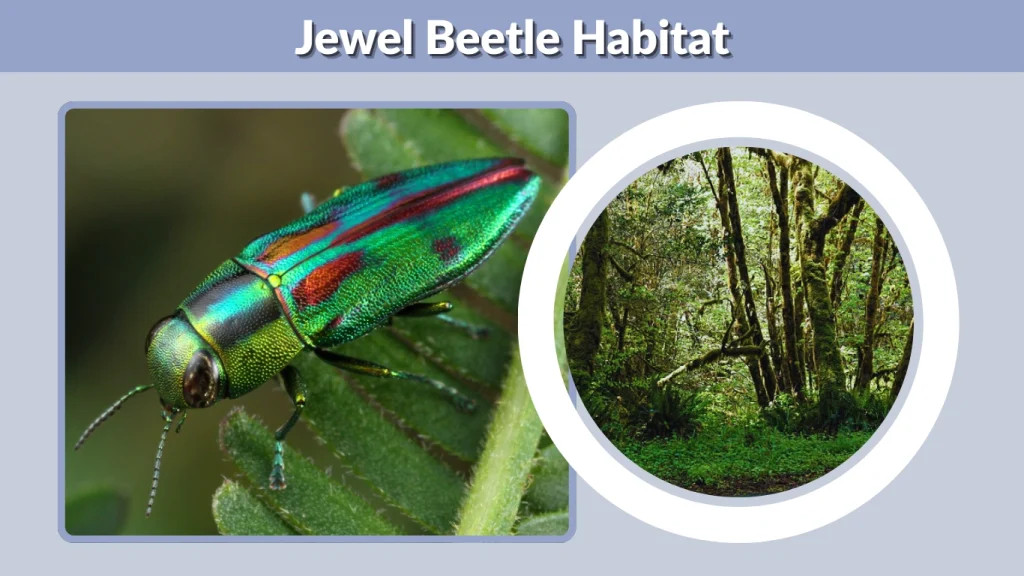
Jewel beetles are commonly found in forests and wooded regions where trees are plentiful. Many species prefer areas with dead or dying trees because these provide ideal places for their larvae to develop.
Tropical and subtropical forests are especially rich in jewel beetle species, but they can also be found in temperate regions. Some species are highly specialized and depend on particular types of trees.
Preferred Living Conditions
These beetles often live on sunlit tree trunks, branches, and logs. Warm sunlight helps increase their activity levels, which is why jewel beetles are frequently seen resting on exposed wood surfaces.
Dead wood and weakened trees are particularly important habitats because they provide both shelter and food sources for jewel beetle larvae.
Jewel Beetle Diet
Adult Diet
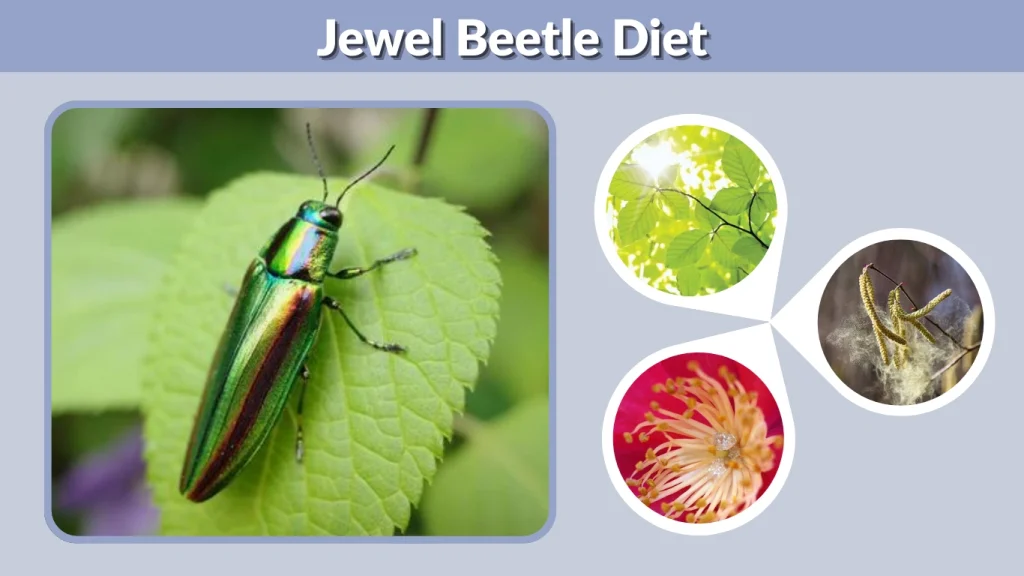
Adult jewel beetles mainly feed on plant-based materials. Their diet usually includes leaves, pollen, nectar, and sometimes the soft tissues of plants. Because of this feeding behavior, they are often found on flowers or on the leaves of trees and shrubs.
Some species prefer specific plants, while others feed on a wider variety of vegetation. By feeding on pollen and nectar, jewel beetles may also contribute slightly to pollination, although they are not considered major pollinators like bees.
Larval Diet
The larval stage of jewel beetles has a very different diet from that of the adults. Jewel beetle larvae are wood-borers, meaning they live inside tree trunks or branches and feed on the inner tissues of the wood.
After hatching, the larvae tunnel through the wood, creating narrow galleries as they feed. These tunnels allow the larvae to remain protected while they grow. Their feeding activity helps break down dead or dying wood in forest ecosystems.
Role in the Ecosystem
Jewel beetles play an important ecological role by helping to decompose wood. As larvae feed on tree tissues, they help break down plant material and return nutrients to the soil. This process supports the natural recycling of organic matter in forest environments.
However, some species can become pests when they attack healthy trees. The emerald ash borer, for example, has caused significant damage to ash tree populations in several regions.
Jewel Beetle Life Cycle
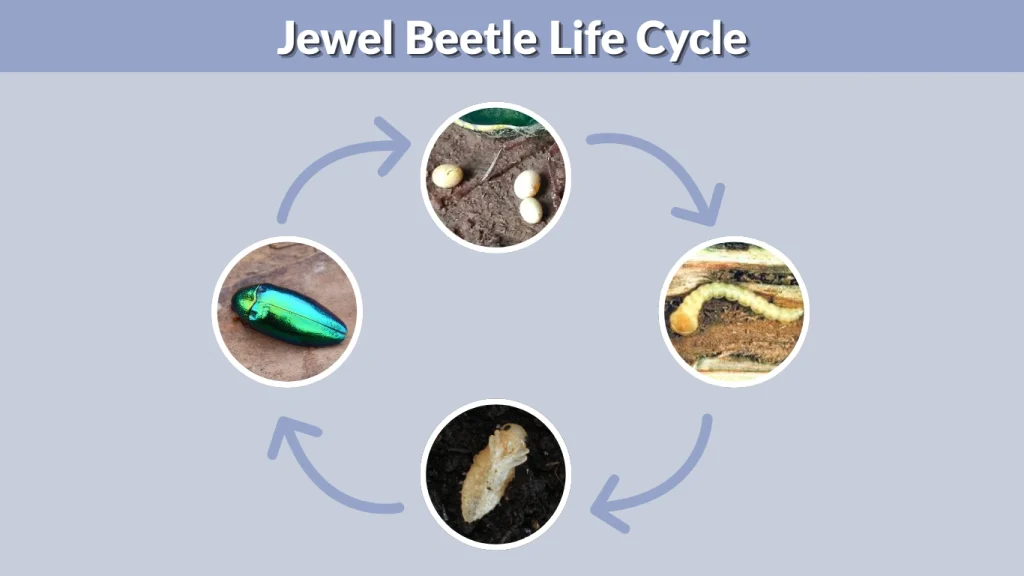
Egg Stage
The life cycle of a jewel beetle begins when a female lays eggs on the bark or in small cracks of a suitable tree. She carefully chooses trees that will provide enough food for the developing larvae.
The eggs are usually small and well hidden within the bark, which helps protect them from predators and environmental conditions. After a short period, the eggs hatch into larvae.
Larval Stage
The larval stage is the longest part of the jewel beetle’s life cycle. After hatching, the larvae immediately begin tunneling into the wood of the tree. Inside the wood, they feed continuously and create winding tunnels.
This stage can last several months or even several years depending on the species and environmental conditions. During this time, the larvae grow larger and store the energy needed for their transformation into adult beetles.
Pupal Stage
Once the larva has reached its full size, it forms a small chamber within the wood where it enters the pupal stage. During this stage, the insect undergoes a remarkable transformation as its body structure changes from a larva into an adult beetle.
The pupal stage usually lasts several weeks. When development is complete, the adult beetle is fully formed inside the chamber.
Adult Stage
After completing its transformation, the adult beetle emerges from the tree by chewing a small exit hole through the bark. Once outside, the beetle begins searching for food and mates.
Adult jewel beetles are most active in warm, sunny weather. After mating, females lay eggs on suitable trees, and the life cycle begins again.
Jewel Beetle Lifespan
Average Lifespan
The lifespan of jewel beetles varies depending on the species. Adult beetles typically live from a few weeks to several months. During this time, their main purpose is to reproduce and spread to new habitats.
However, the larval stage can last much longer. In some species, the larvae remain inside wood for one to several years before emerging as adults.
Factors That Affect Lifespan
Several factors influence how long jewel beetles live. Environmental conditions such as temperature, humidity, and food availability play a major role in their development.
Predators, parasites, and habitat conditions can also affect their survival. Birds, reptiles, and parasitic insects may prey on jewel beetles at different stages of their life cycle.
Interesting Jewel Beetle Facts
Jewel beetles are fascinating insects with many unique characteristics. Scientists have identified more than 15,000 species around the world, making them one of the largest beetle families.
Some jewel beetles are capable of detecting forest fires from great distances because they are attracted to freshly burned wood, which provides ideal breeding sites. Their shiny shells are so beautiful that in some cultures they have been used in decorative jewelry and artwork.
One of the most famous species, the emerald ash borer, has gained attention for its impact on ash tree populations. Despite this, most jewel beetles play beneficial roles in forest ecosystems by helping recycle nutrients and break down dead wood.
Conclusion
Jewel beetles are remarkable insects known for their bright metallic colors and unique biological features. From their distinctive identification characteristics to their specialized wings and wood-boring larvae, these beetles have adapted well to life in forest environments.
Their diet, habitat preferences, and life cycle all contribute to their important ecological role in breaking down plant material and maintaining healthy ecosystems. Although some species can become pests, jewel beetles remain one of the most visually striking and scientifically interesting groups of insects found in nature.
