
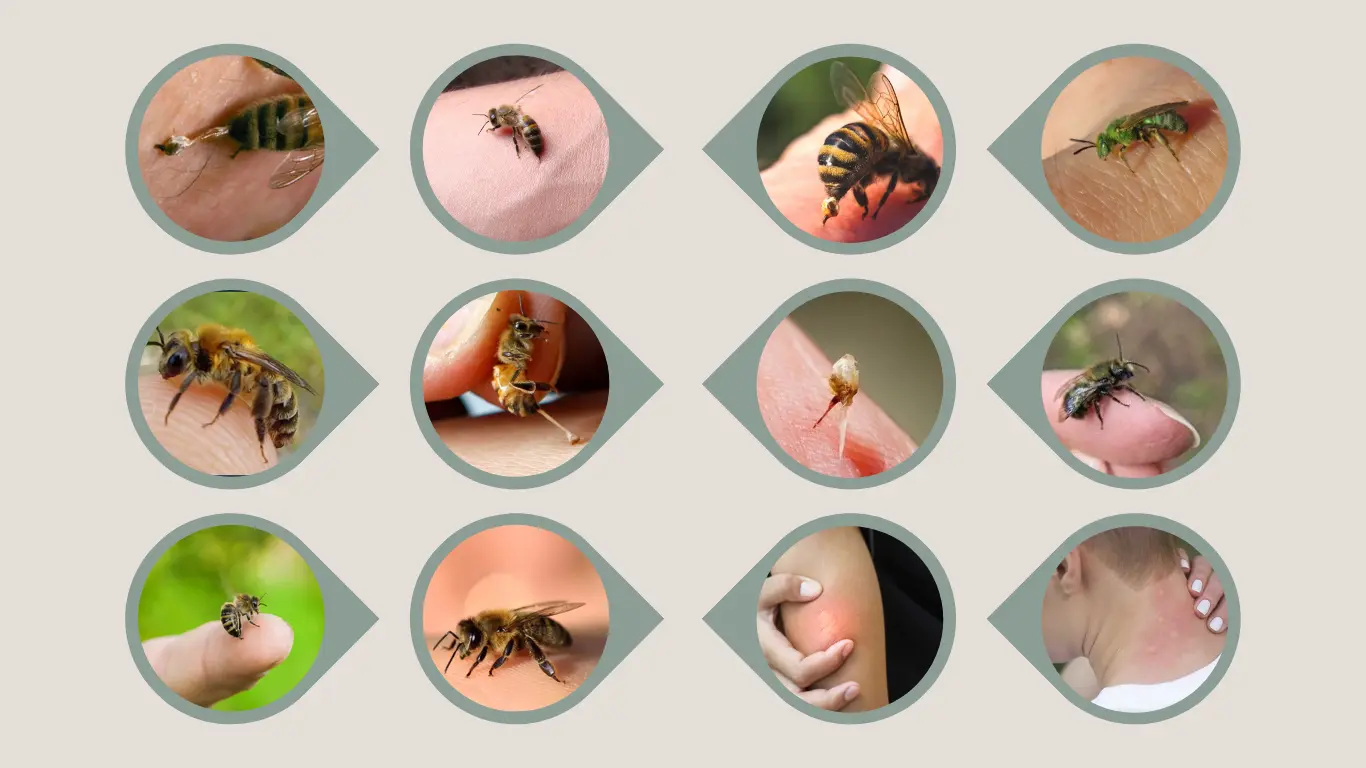
Not all bee stings are the same. Some cause mild pain, while others lead to serious reactions. This guide breaks down 17 types of bee stings—by bee species and how your body might respond—along with simple, effective treatment tips for each.
Honey Bee Sting Treatment

Identification
Honey bees (Apis mellifera) are common pollinators known for their golden-brown, fuzzy bodies. When they sting, they leave behind a barbed stinger, which continues to release venom even after detachment. This stinger remains embedded in the skin and is usually surrounded by a small white dot at the center of the sting site. Honey bees can sting only once, as they die shortly after.
Key Signs:
- A single sting with the stinger left in the skin
- Immediate sharp or burning pain
- Redness and swelling around the site
- Possible itching that starts within a few hours
Treatment Guide
Treating a honey bee sting quickly reduces the pain and prevents further venom absorption.
Step-by-step care:
- Remove the stinger immediately
- Scrape it off sideways using a credit card, fingernail, or dull knife.
- Avoid using tweezers or pinching, which may squeeze more venom into the skin.
- Scrape it off sideways using a credit card, fingernail, or dull knife.
- Wash the area
- Use soap and cool water to clean the sting site and prevent infection.
- Use soap and cool water to clean the sting site and prevent infection.
- Apply a cold compress
- Wrap ice in a cloth and hold it on the sting for 10–15 minutes.
- This reduces swelling and numbs the pain.
- Wrap ice in a cloth and hold it on the sting for 10–15 minutes.
- Relieve itching and swelling
- Use antihistamines like cetirizine or diphenhydramine (Benadryl).
- Apply hydrocortisone cream or calamine lotion to reduce irritation.
- Use antihistamines like cetirizine or diphenhydramine (Benadryl).
- Monitor for signs of allergy
- If you notice difficulty breathing, facial swelling, or dizziness, seek emergency medical help.
- If you notice difficulty breathing, facial swelling, or dizziness, seek emergency medical help.
Recovery Time:
Most people recover fully within a few hours to 2 days with no lasting effects.
Africanized Honey Bee Sting Treatment

Identification
Africanized honey bees, often called “killer bees,” look nearly identical to European honey bees but behave very differently. They are extremely aggressive and often attack in large numbers when they feel threatened. These bees have barbed stingers, just like regular honey bees, and also die after stinging.
Key Signs:
- Multiple stings in a short time
- Stingers left in the skin
- Chased or attacked by a swarm over a distance
- Rapid pain and swelling in many locations
Treatment Guide
Because the danger comes from venom overload, quick action is crucial.
Step-by-step care:
- Run away to safety immediately
- Get indoors or into a vehicle. Do not swat or jump into water (they may wait above).
- Get indoors or into a vehicle. Do not swat or jump into water (they may wait above).
- Remove all stingers quickly
- Use a credit card or dull edge to scrape them out—avoid squeezing.
- Use a credit card or dull edge to scrape them out—avoid squeezing.
- Call emergency services
- If stung more than 10–15 times, or if symptoms of allergic reaction begin (trouble breathing, dizziness), seek help immediately.
- If stung more than 10–15 times, or if symptoms of allergic reaction begin (trouble breathing, dizziness), seek help immediately.
- Cool the sting sites
- Apply ice packs to reduce pain and swelling.
- Apply ice packs to reduce pain and swelling.
- Take antihistamines
- For itching and swelling. Ibuprofen or acetaminophen can help reduce pain and inflammation.
- For itching and swelling. Ibuprofen or acetaminophen can help reduce pain and inflammation.
Recovery Time:
Mild cases resolve in 2–5 days. Multiple stings may require hospitalization.
Bumblebee Sting Treatment

Identification
Bumblebees are large, round, fuzzy bees with black and yellow markings. Unlike honey bees, they have a smooth stinger, which means they can sting multiple times. They are usually docile but will sting to defend their nest or if handled.
Key Signs:
- Multiple painful stings possible from one bee
- Deep, sharp burning sensation
- Swelling and redness in the affected area
- No stinger left behind (because it’s smooth)
Treatment Guide
Step-by-step care:
- Check for allergic symptoms
- Because bumblebee venom is strong, watch closely for signs of an allergic reaction—especially if multiple stings occur.
- Because bumblebee venom is strong, watch closely for signs of an allergic reaction—especially if multiple stings occur.
- Clean the sting area
- Wash with soap and water to prevent infection.
- Wash with soap and water to prevent infection.
- Apply a cold compress
- Use ice wrapped in cloth for 15–20 minutes every hour to reduce swelling.
- Use ice wrapped in cloth for 15–20 minutes every hour to reduce swelling.
- Use antihistamines or anti-inflammatory medications
- Cetirizine or diphenhydramine for itching. Ibuprofen can reduce pain and inflammation.
- Cetirizine or diphenhydramine for itching. Ibuprofen can reduce pain and inflammation.
- Elevate the area if swollen
- Especially useful for stings on arms or legs.
- Especially useful for stings on arms or legs.
Recovery Time:
Most symptoms subside in a few hours to two days. Swelling may last longer in sensitive individuals.
Carpenter Bee Sting Treatment

Identification
Carpenter bees resemble bumblebees but have a shiny, hairless black abdomen. They are solitary bees that bore into wood to create nests. Only female carpenter bees can sting, and even then, they usually only sting when directly provoked. Male carpenter bees cannot sting but may behave aggressively by hovering close.
Key Signs:
- Sting occurs when the bee is grabbed or pressed
- Usually a single, sharp sting
- No stinger left behind
- Mild swelling and redness
Treatment Guide
Step-by-step care:
- Clean the sting site
- Use mild soap and water to remove any dirt and reduce infection risk.
- Use mild soap and water to remove any dirt and reduce infection risk.
- Apply a cold compress
- Ice wrapped in a cloth will help reduce pain and swelling.
- Ice wrapped in a cloth will help reduce pain and swelling.
- Use topical treatments if needed
- Apply calamine lotion or hydrocortisone cream for itching.
- Apply calamine lotion or hydrocortisone cream for itching.
- Monitor symptoms
- Most stings do not escalate, but seek help if you experience allergic signs like swelling beyond the sting area, hives, or breathing issues.
- Most stings do not escalate, but seek help if you experience allergic signs like swelling beyond the sting area, hives, or breathing issues.
Recovery Time:
Pain and swelling typically go away within a few hours to one day.
Sweat Bee Sting Treatment
Identification
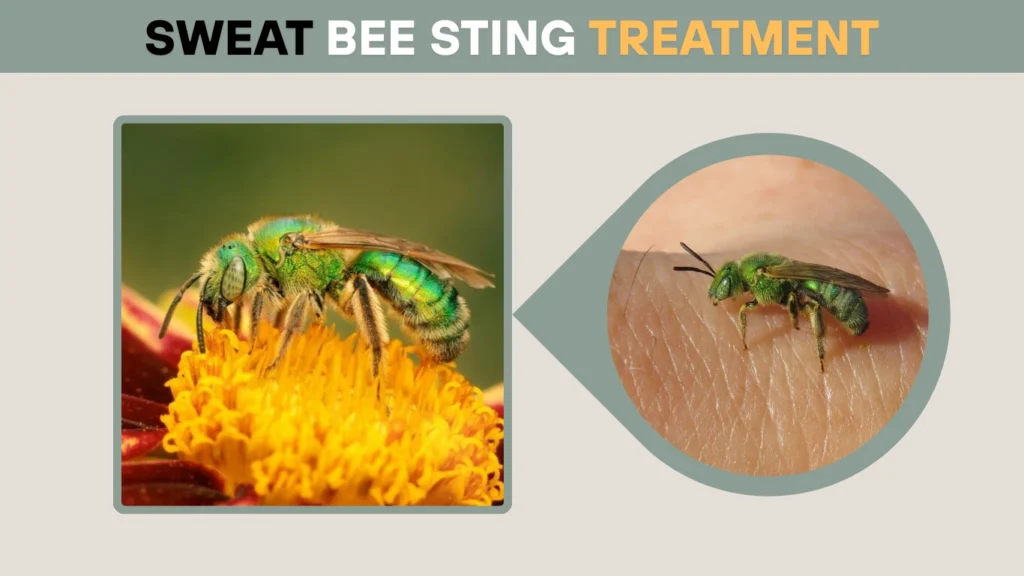
Sweat bees are small, metallic green or blue bees that are attracted to human sweat. They are solitary and non-aggressive but may sting when brushed off the skin. The sting is usually mild, and no stinger is left behind.
Key Signs:
- Slight pinch or burning sensation
- Small red bump or dot
- Itching that may begin shortly after the sting
- Often goes unnoticed until irritation starts
Treatment Guide
Step-by-step care:
- Wash the area thoroughly
- Use soap and water to keep the site clean.
- Use soap and water to keep the site clean.
- Apply cold compress
- Ice or a cool cloth helps reduce minor swelling or redness.
- Ice or a cool cloth helps reduce minor swelling or redness.
- Use anti-itch cream if needed
- Calamine lotion or antihistamines can reduce itching.
- Calamine lotion or antihistamines can reduce itching.
- Avoid scratching
- Scratching can introduce bacteria and cause infection.
- Scratching can introduce bacteria and cause infection.
Recovery Time:
Symptoms are very mild and usually disappear within a few hours.
Mining Bee Sting Treatment

Identification
Mining bees are solitary ground-nesting bees, often seen in early spring. They resemble small, fuzzy honey bees and typically nest in dry soil or lawns. They are non-aggressive, and stings are extremely rare. Only females can sting, and even then, only when directly handled.
Key Signs:
- Very mild or almost unnoticeable sting
- No stinger left behind
- Tiny red bump, slight irritation
- No aggressive behavior or multiple stings
Treatment Guide
Step-by-step care:
- Gently wash the area
- Use soap and lukewarm water to keep the sting site clean.
- Use soap and lukewarm water to keep the sting site clean.
- Apply a cool compress
- This helps with any slight swelling or warmth.
- This helps with any slight swelling or warmth.
- No medication usually required
- The sting often resolves on its own. Use anti-itch cream only if irritation occurs.
- The sting often resolves on its own. Use anti-itch cream only if irritation occurs.
- Observe for rare allergic signs
- While highly unlikely, monitor if it’s your first reaction to any bee sting.
- While highly unlikely, monitor if it’s your first reaction to any bee sting.
Recovery Time:
Symptoms (if any) typically disappear within a few hours or by the next day.
Leafcutter Bee Sting Treatment
Identification
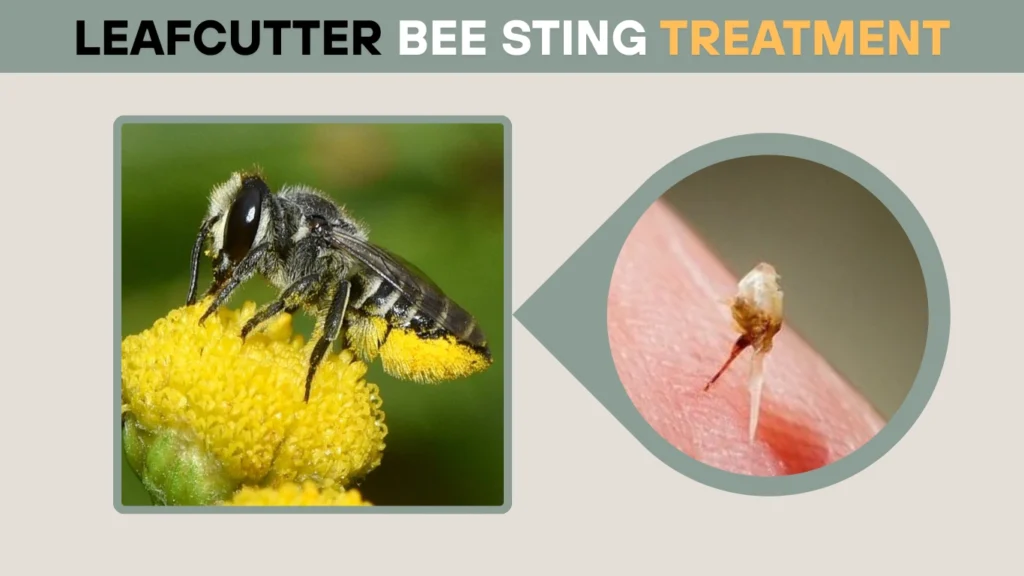
Leafcutter bees are known for cutting neat, circular pieces of leaves to build nests in wood or plant stems. They are solitary and rarely sting. Their stings are mild and occur only if the bee is pinched or trapped. These bees do not defend nests like honey bees.
Key Signs:
- Rare sting; usually only one
- Mild prick or burning sensation
- No stinger left in skin
- Minor redness or swelling
Treatment Guide
Step-by-step care:
- Clean the sting area
- Wash gently with soap and water to prevent irritation or infection.
- Wash gently with soap and water to prevent irritation or infection.
- Apply a cold compress
- Hold ice against the area to reduce any swelling or pain.
- Hold ice against the area to reduce any swelling or pain.
- Use mild skin cream if needed
- Hydrocortisone cream or aloe vera may ease itching or irritation.
- Hydrocortisone cream or aloe vera may ease itching or irritation.
- No further action needed
- Symptoms are self-limiting and not dangerous.
- Symptoms are self-limiting and not dangerous.
Recovery Time:
Usually resolves within a few hours to one day with or without treatment.
Mason Bee Sting Treatment

Identification
Mason bees are small, metallic blue or black solitary bees that nest in small cavities, cracks, or bee hotels. They are gentle and very unlikely to sting. Even when handled, they prefer to flee. Only females sting, and their sting is weak and nearly painless.
Key Signs:
- Sting is very rare
- If it occurs, it feels like a light prick or barely noticeable pinch
- No stinger left behind
- Minimal to no swelling or redness
Treatment Guide
Step-by-step care:
- Clean the area
- Use soap and water. The sting site is often so minor it may not need anything else.
- Use soap and water. The sting site is often so minor it may not need anything else.
- Cold compress if needed
- Apply ice only if there’s mild redness or irritation.
- Apply ice only if there’s mild redness or irritation.
- Skin relief cream (optional)
- Aloe vera or calamine lotion can be applied if itching develops.
- Aloe vera or calamine lotion can be applied if itching develops.
- No medication necessary
- Mason bee stings do not cause allergic reactions or systemic symptoms.
- Mason bee stings do not cause allergic reactions or systemic symptoms.
Recovery Time:
Most people recover in minutes to a few hours, often without realizing they were stung.
Cuckoo Bee Sting Treatment
Identification
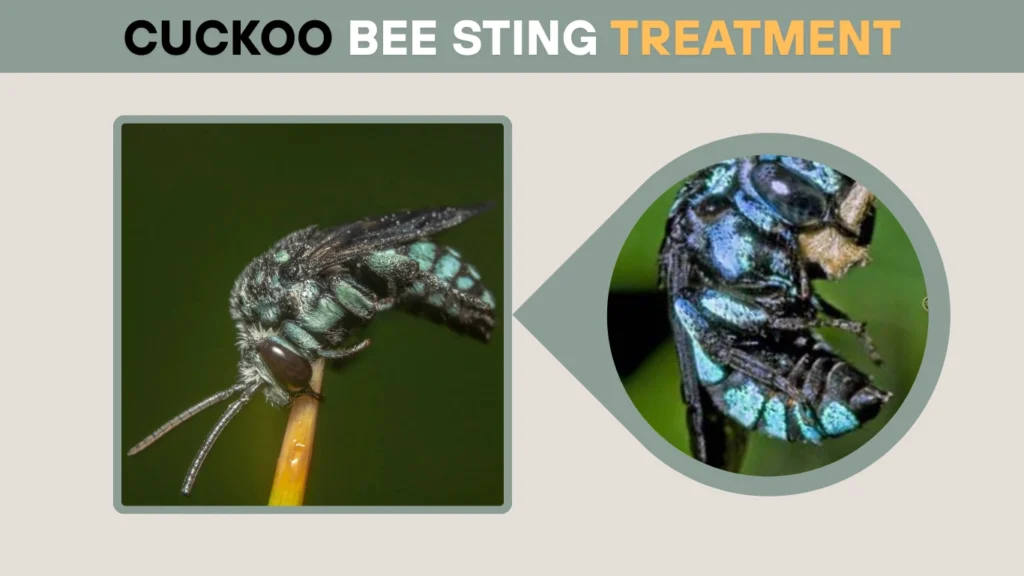
Cuckoo bees are parasitic bees that lay their eggs in the nests of other bees. Because they don’t build or protect nests, they are non-aggressive and sting only in extreme defense. Their stingers are smooth and flexible, allowing multiple stings, but incidents are extremely rare.
Key Signs:
- Sting only occurs with rough handling
- Sharp, quick sting with no stinger left behind
- Mild to moderate pain
- Small red bump or localized reaction
Treatment Guide
Step-by-step care:
- Wash the sting site
- Clean gently with soap and water to avoid infection.
- Clean gently with soap and water to avoid infection.
- Apply a cold compress
- Reduces discomfort and any minor swelling.
- Reduces discomfort and any minor swelling.
- Use topical relief if needed
- Hydrocortisone or antihistamine cream can ease itching.
- Hydrocortisone or antihistamine cream can ease itching.
- Monitor reaction
- No serious allergic responses are known, but always observe for unusual swelling.
- No serious allergic responses are known, but always observe for unusual swelling.
Recovery Time:
Mild symptoms typically disappear within a few hours to 1 day.
Long-Horned Bee Sting Treatment

Identification
Long-horned bees belong to the Eucerini tribe and are named for the males’ long antennae. They’re active pollinators often seen on sunflowers and summer wildflowers. Only females can sting, and even then, they do so rarely and only when physically threatened. The sting is mild and does not leave a stinger behind.
Key Signs:
- Mild sting if provoked
- No stinger present in skin
- Slight redness or swelling
- Itching or irritation may occur afterward
Treatment Guide
Step-by-step care:
- Clean the sting site
- Gently wash with soap and water to prevent infection.
- Gently wash with soap and water to prevent infection.
- Apply a cold compress
- Use for 10–15 minutes to ease swelling and pain.
- Use for 10–15 minutes to ease swelling and pain.
- Use topical anti-itch cream
- Calamine lotion or hydrocortisone may help with irritation.
- Calamine lotion or hydrocortisone may help with irritation.
- No serious symptoms expected
- These stings are very mild and rarely cause complications.
- These stings are very mild and rarely cause complications.
Recovery Time:
Recovery is usually complete within hours and rarely lasts more than a day.
Normal Bee Sting Reaction Treatment
Identification
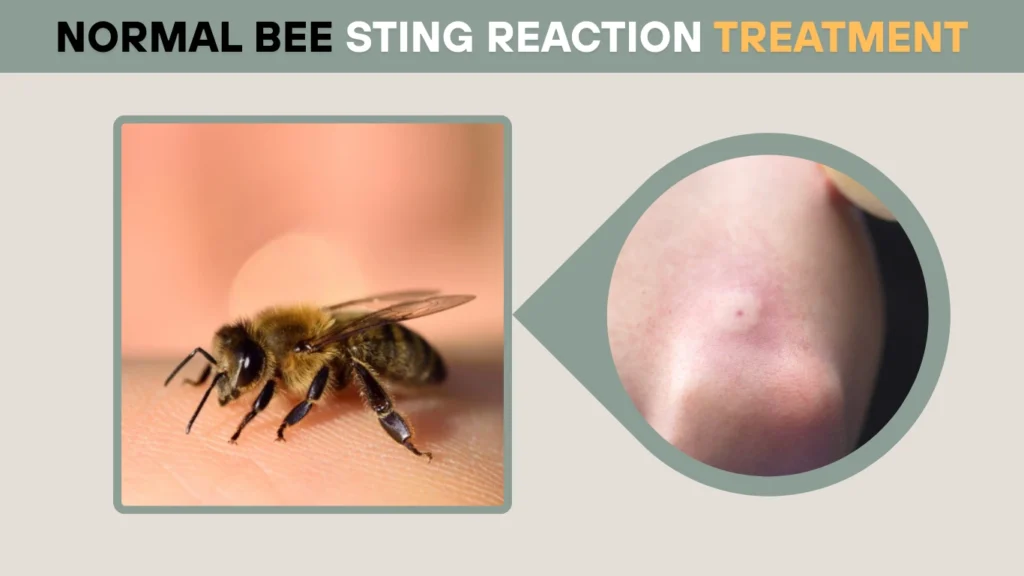
A normal reaction is the most common response to any bee sting. It includes mild pain, redness, slight swelling, and itching limited to the sting area. This is a non-allergic, localized reaction and doesn’t spread beyond the immediate site.
Key Signs:
- Sharp, immediate pain
- Redness and swelling around the sting
- A small white spot where the sting occurred
- No stinger in most cases (except with honey bees)
Treatment Guide
Step-by-step care:
- Remove the stinger (if present)
- Use a fingernail or credit card to scrape it out sideways. Do not pinch it.
- Use a fingernail or credit card to scrape it out sideways. Do not pinch it.
- Wash the sting area thoroughly
- Soap and water help prevent infection.
- Soap and water help prevent infection.
- Apply ice or a cold compress
- Reduces swelling and numbs pain.
- Reduces swelling and numbs pain.
- Use antihistamines or pain relievers
- Oral antihistamines (e.g., cetirizine) for itching.
- Ibuprofen or acetaminophen for pain.
- Oral antihistamines (e.g., cetirizine) for itching.
- Apply anti-itch or anti-inflammatory creams
- Hydrocortisone or calamine lotion can soothe the area.
- Hydrocortisone or calamine lotion can soothe the area.
Recovery Time:
Symptoms usually resolve in 1 to 2 days with basic care.
Large Local Reaction Bee Sting Treatment

Identification
A large local reaction (LLR) is a stronger-than-normal response that stays around the sting site but causes extended swelling and discomfort. It is not an allergy, though it may look alarming. Swelling usually begins within hours and can peak after 24–48 hours.
Key Signs:
- Swelling extending more than 4 inches beyond the sting
- Redness and warmth in a larger area (e.g., whole arm or leg)
- Itching and tightness in the skin
- No difficulty breathing or other systemic symptoms
Treatment Guide
Step-by-step care:
- Apply cold compresses
- Use ice wrapped in a cloth for 15–20 minutes every few hours to reduce swelling.
- Use ice wrapped in a cloth for 15–20 minutes every few hours to reduce swelling.
- Take oral antihistamines
- Medications like cetirizine or loratadine reduce the body’s response to venom.
- Medications like cetirizine or loratadine reduce the body’s response to venom.
- Use anti-inflammatory medication
- Ibuprofen or naproxen can help relieve pain and inflammation.
- Ibuprofen or naproxen can help relieve pain and inflammation.
- Elevate the affected limb
- Helps minimize swelling, especially if stung on a leg or arm.
- Helps minimize swelling, especially if stung on a leg or arm.
- Watch for signs of infection
- If swelling worsens after 2–3 days or redness spreads, consult a doctor.
- If swelling worsens after 2–3 days or redness spreads, consult a doctor.
Recovery Time:
LLR usually improves in 5 to 10 days, even without prescription medication.
Systemic Allergic Reaction (Anaphylaxis) Bee Sting Treatment
Identification
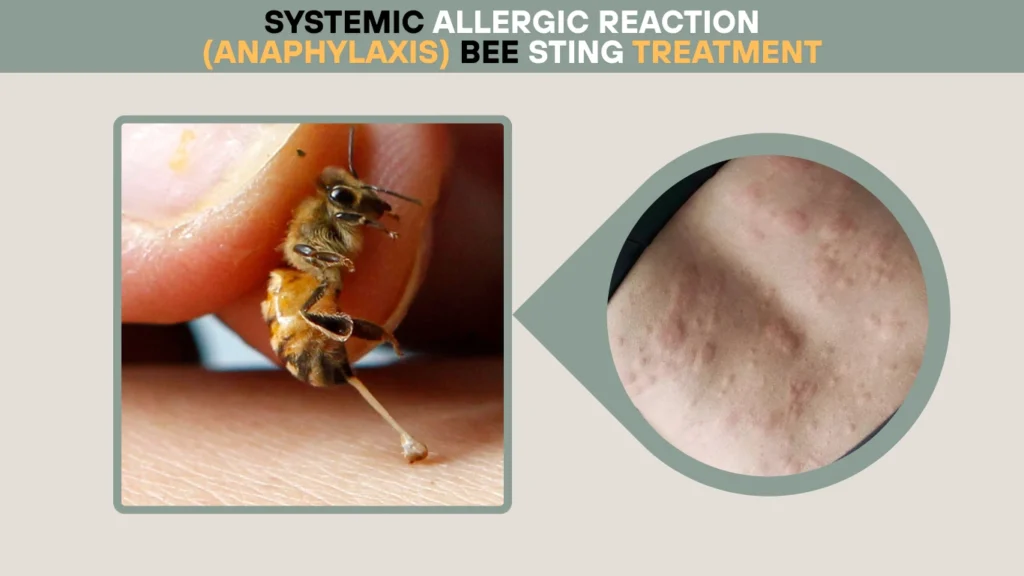
Anaphylaxis is a life-threatening allergic reaction that affects multiple systems in the body. It typically occurs within minutes of a sting and requires emergency treatment. It is more common in people with known bee sting allergies.
Key Signs:
- Difficulty breathing or wheezing
- Swelling of the face, lips, throat, or tongue
- Hives or widespread itching
- Dizziness, fainting, rapid heartbeat
- Nausea, vomiting, or abdominal pain
- Feeling of panic or impending doom
Treatment Guide
Step-by-step care:
- Call emergency services immediately
- Anaphylaxis can progress rapidly and must be treated by professionals.
- Anaphylaxis can progress rapidly and must be treated by professionals.
- Administer epinephrine (EpiPen)
- Inject into the outer thigh. If symptoms persist, a second dose may be required after 5–15 minutes.
- Inject into the outer thigh. If symptoms persist, a second dose may be required after 5–15 minutes.
- Keep the person lying down
- Elevate legs if possible and loosen tight clothing.
- Elevate legs if possible and loosen tight clothing.
- Monitor vital signs
- If trained, begin CPR if breathing or heartbeat stops.
- If trained, begin CPR if breathing or heartbeat stops.
- Seek follow-up care
- Even after symptoms subside, the person should go to the hospital for observation.
- Even after symptoms subside, the person should go to the hospital for observation.
Recovery Time:
With immediate treatment, most people recover fully. Long-term, they may need to carry an EpiPen and see an allergist.
Multiple Bee Stings Reaction Treatment
Identification
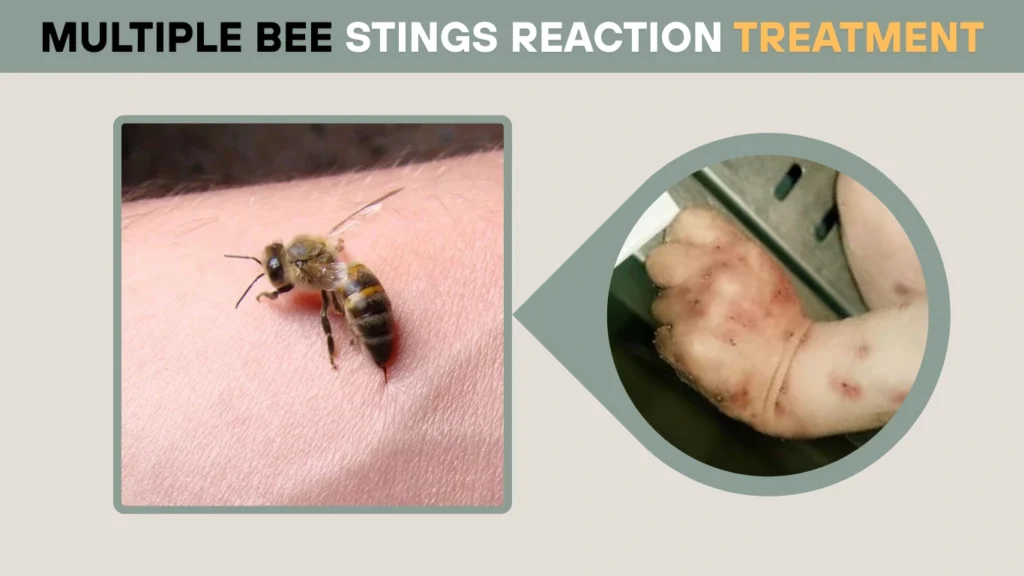
A multiple sting reaction occurs when a person is stung dozens or even hundreds of times, typically by aggressive bees like Africanized honey bees. Even without an allergy, the high amount of venom can cause toxic effects, especially in children, older adults, or people with health conditions.
Key Signs:
- Painful stings all over the body
- Widespread swelling and redness
- Fever, fatigue, nausea, or vomiting hours after the stings
- Dark urine or muscle weakness (signs of muscle breakdown)
- In severe cases: difficulty breathing, kidney stress, seizures
Treatment Guide
Step-by-step care:
- Get to safety immediately
- Run from the swarm and seek shelter indoors or in a car.
- Run from the swarm and seek shelter indoors or in a car.
- Call emergency services
- If stung more than 10 times (child) or 30–50 times (adult), seek help.
- If stung more than 10 times (child) or 30–50 times (adult), seek help.
- Remove all stingers quickly
- Scrape with a credit card or fingernail—do not pinch.
- Scrape with a credit card or fingernail—do not pinch.
- Lie down and stay calm
- Movement spreads venom more quickly through the bloodstream.
- Movement spreads venom more quickly through the bloodstream.
- Apply ice packs
- Reduces pain and swelling on individual sting sites.
- Reduces pain and swelling on individual sting sites.
- Hydrate well
- Drink fluids if conscious and stable (unless directed otherwise by a medical professional).
- Drink fluids if conscious and stable (unless directed otherwise by a medical professional).
Medical Treatment May Include:
- IV fluids
- Pain management
- Kidney and heart function monitoring
Recovery Time:
Mild cases resolve in a few days. Severe cases require hospitalization and recovery may take 1–2 weeks or more.
Delayed Bee Sting Reaction Treatment
Identification
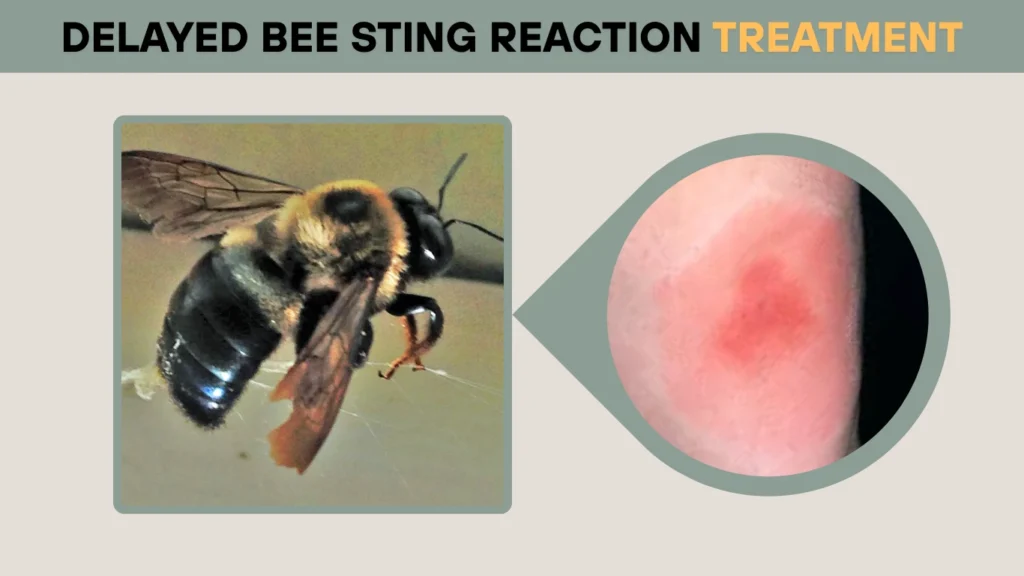
A delayed reaction appears 24 to 72 hours after the sting and may include fever, rash, joint pain, or fatigue. These symptoms occur when the immune system takes time to recognize and respond to the venom, resulting in a delayed hypersensitivity response.
Key Signs:
- Swollen lymph nodes
- Rash or red patches appearing far from the sting site
- Joint stiffness or pain
- Headache, chills, or mild fever
- No immediate allergic symptoms at time of sting
Treatment Guide
Step-by-step care:
- Monitor symptoms carefully
- Especially if it’s your first delayed reaction.
- Especially if it’s your first delayed reaction.
- Take anti-inflammatory medication
- Ibuprofen can help relieve pain, fever, and inflammation.
- Ibuprofen can help relieve pain, fever, and inflammation.
- Use topical creams
- If a rash appears, hydrocortisone or antihistamine cream can ease discomfort.
- If a rash appears, hydrocortisone or antihistamine cream can ease discomfort.
- Consult a doctor
- If symptoms worsen, persist beyond 2–3 days, or if fever exceeds 101°F (38.3°C).
- If symptoms worsen, persist beyond 2–3 days, or if fever exceeds 101°F (38.3°C).
Recovery Time:
Symptoms typically improve within 3–5 days with proper care. In rare cases, prescription medication may be needed.
Toxic Reaction from Bee Venom Treatment
Identification
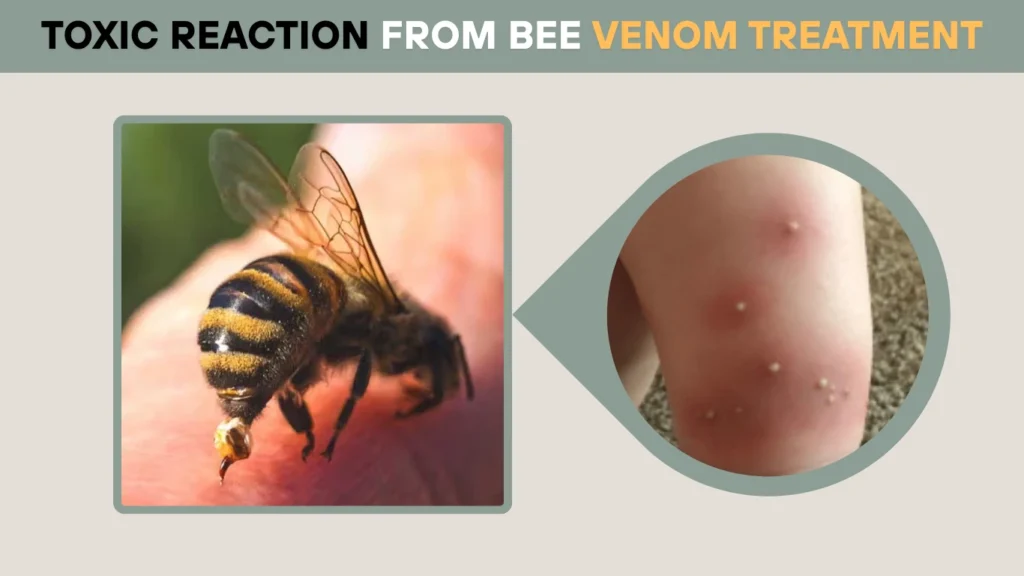
A toxic reaction occurs when a large amount of bee venom enters the body, often from dozens or hundreds of stings, or in very rare cases, a highly sensitive body reaction to venom components. This is not an allergic response, but rather a poisoning-like effect that affects muscles, organs, and the nervous system.
Key Signs:
- Nausea, vomiting, or diarrhea within hours
- Severe headache or dizziness
- Muscle pain or weakness
- Dark-colored urine (a sign of muscle breakdown)
- Low blood pressure, confusion, or fainting
- Possible kidney failure or seizure in extreme cases
Treatment Guide
Step-by-step care:
- Call emergency medical services immediately
- Toxic reactions are serious and may progress rapidly.
- Toxic reactions are serious and may progress rapidly.
- Remove all visible stingers quickly
- Use a fingernail or flat object to scrape them off.
- Use a fingernail or flat object to scrape them off.
- Lie down and stay calm
- Keep still to slow venom circulation; elevate legs if lightheaded.
- Keep still to slow venom circulation; elevate legs if lightheaded.
- Do not take food or drink unless directed
- In some cases, fluids can strain the kidneys before evaluation.
- In some cases, fluids can strain the kidneys before evaluation.
- Apply ice to sting sites
- Helps reduce local swelling and pain.
- Helps reduce local swelling and pain.
Medical Care May Include:
- IV fluids
- Kidney function monitoring
- Pain relief and antivenom support (if needed)
- Hospital observation for several days
Recovery Time:
Recovery depends on severity but may range from a few days to several weeks in serious cases.
Infected Bee Sting Treatment

Identification
A bee sting can become infected if bacteria enter the skin through the sting wound—especially if the area is scratched, not cleaned properly, or if a person has a weakened immune system. This is not due to the venom, but rather external bacteria.
Key Signs:
- Increased redness or swelling after 24–72 hours
- Skin feels warm, hard, or painful to the touch
- Pus or fluid draining from the sting site
- Fever or chills
- Red streaks spreading outward (possible cellulitis)
Treatment Guide
Step-by-step care:
- Clean the area gently
- Use soap and warm water. Avoid scrubbing too harshly.
- Use soap and warm water. Avoid scrubbing too harshly.
- Apply a topical antibiotic ointment
- Use products like Neosporin 2–3 times daily.
- Use products like Neosporin 2–3 times daily.
- Avoid scratching the sting
- It may worsen the infection or push bacteria deeper.
- It may worsen the infection or push bacteria deeper.
- Apply a clean, breathable bandage
- Especially helpful if the sting is on the foot, hand, or joint.
- Especially helpful if the sting is on the foot, hand, or joint.
- See a doctor
- If signs of infection persist, oral antibiotics may be required.
- If signs of infection persist, oral antibiotics may be required.
Recovery Time:
With early treatment, infections usually resolve within 3–7 days. More serious cases may require 1–2 weeks of antibiotics.
