
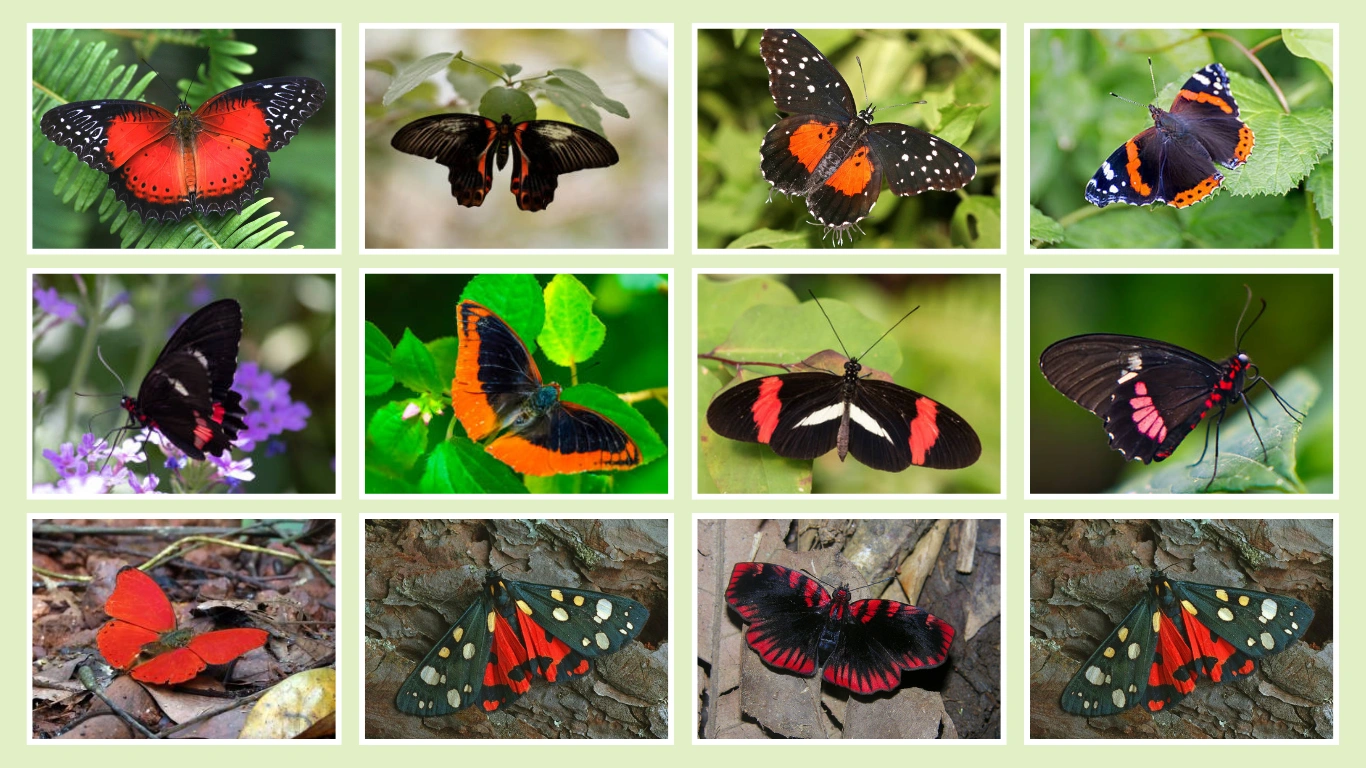
Red butterflies are bold, vibrant, and impossible to ignore. Whether it’s a deep crimson flash or a fiery red-orange glow, these stunning insects bring energy to any garden or forest trail. I’ve always been drawn to their powerful color and graceful flight, so here’s a list of 17 amazing red butterflies that truly stand out in the wild. Each one is a natural showstopper.
1. Red Lacewing

The Red Lacewing is a breathtaking butterfly known for its fiery red wings edged with black and white lace-like patterns. Native to Southeast Asia, this butterfly is often spotted fluttering gracefully through gardens and forests, drawing attention with its bold coloring and striking wing shape.
Identification
- Bright red forewings with black veins
- Hindwings bordered with black and white scalloped edges
- Wingspan ranges from 8 to 10 cm
- Underside is patterned with orange, brown, and white
- Slim black body with red accents
Color Pattern
The dominant red color is intense and eye-catching, covering most of the upper wings. The black and white frilly borders create a lace-like effect, adding to its visual appeal. The red hue can appear even more vivid under sunlight, sometimes showing an orange tint near the wing bases.
Habitat
Found in tropical forests, forest edges, and gardens across Southeast Asia, especially in Malaysia, Thailand, and Indonesia.
Behavior
Red Lacewings are active during the day and have a slow, gliding flight. They often feed on flower nectar and are also attracted to overripe fruits. Males are sometimes seen puddling on moist ground.
2. Scarlet Mormon
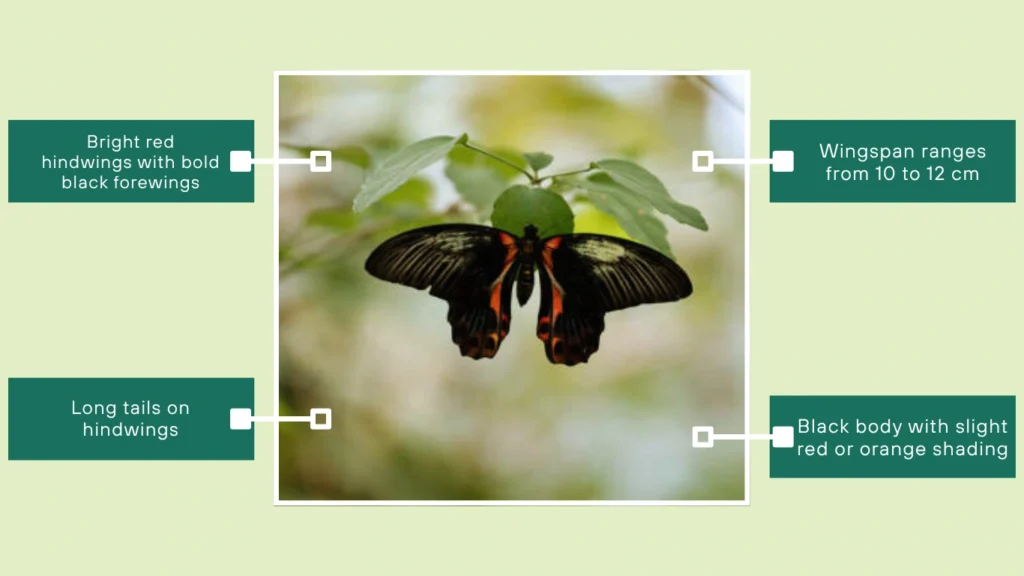
The Scarlet Mormon is a stunning butterfly with bold red wings contrasted by deep black markings. Found mostly in parts of South and Southeast Asia, it’s admired for its size, graceful flight, and fiery appearance. Males are more vivid, while females may display variations with white or yellow spots.
Identification
- Bright red hindwings with bold black forewings
- Long tails on hindwings
- Wingspan ranges from 10 to 12 cm
- Black body with slight red or orange shading
- Females show polymorphic wing patterns
Color Pattern
The hindwings display rich scarlet red with slight orange undertones, while the forewings are velvety black. Some forms have red streaks or patterns across both wings, especially in females.
Habitat
Common in lowland forests, gardens, and riverbanks across India, Sri Lanka, and Southeast Asia.
Behavior
Slow, elegant flight. Males often puddle, while females are drawn to bright flowers. They’re frequently spotted gliding around shaded pathways and sunlit clearings.
3. Crimson Patch
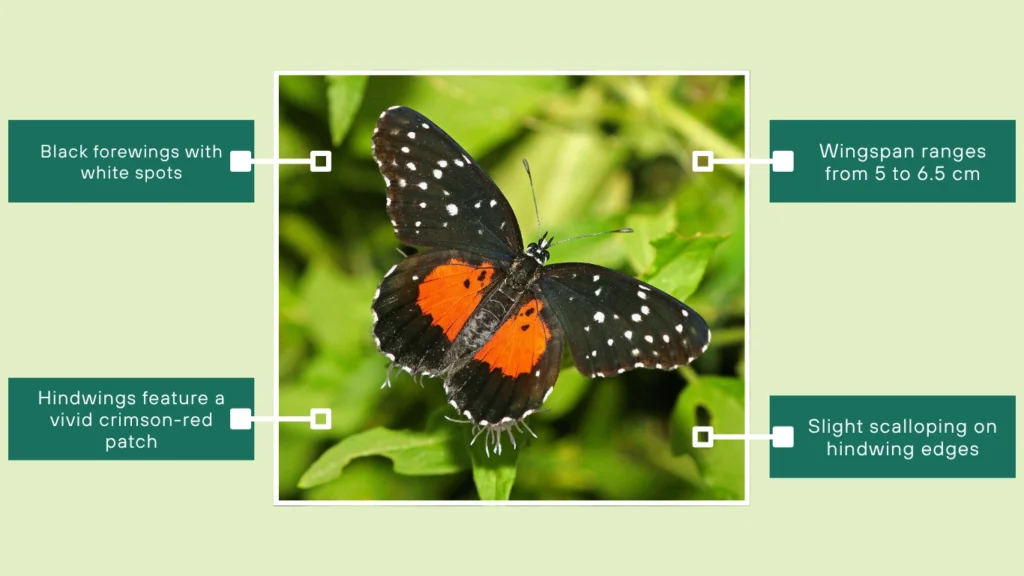
The Crimson Patch is a small but bold butterfly native to Central and South America. It gets its name from the bright red patch on its hindwings, which stands out sharply against its otherwise dark wings, making it easy to spot even at a distance.
Identification
- Black forewings with white spots
- Hindwings feature a vivid crimson-red patch
- Wingspan ranges from 5 to 6.5 cm
- Slender black body
- Slight scalloping on hindwing edges
Color Pattern
The red patch on the hindwings is deep and vivid, bordered by black. Some individuals may have an orange or golden glow around the red when viewed in bright light.
Habitat
Thrives in tropical and subtropical forests, open woodlands, and gardens from Mexico to Colombia.
Behavior
Often seen basking in the sun with wings open. Has a slow, fluttery flight and is attracted to both nectar flowers and moist ground for minerals.
4. Red Admiral

The Red Admiral is one of the most well-known butterflies in North America and Europe. Its bold red bands across dark wings give it a classic, eye-catching look. Often seen in gardens and parks, it’s a hardy species that adapts well to different environments.
Identification
- Dark brown to black wings with bright red-orange bands
- White spots near the tips of forewings
- Wingspan ranges from 6 to 7 cm
- Fuzzy black body with faint orange markings
- Hindwings have red bands near the edge
Color Pattern
Vivid red-orange bands cut across the forewings and continue along the edges of the hindwings. The contrast with the dark wing base makes the red appear even brighter, especially in sunlight.
Habitat
Common in woodlands, gardens, meadows, and urban areas throughout Europe, North America, and Asia.
Behavior
Red Admirals are fast fliers and often territorial. They’re drawn to rotting fruit, tree sap, and flower nectar. You’ll often see them basking with wings wide open on sunny surfaces.
5. Ruby Spotted Swallowtail

The Ruby Spotted Swallowtail is a tropical marvel known for its black wings sprinkled with dazzling ruby-red spots. Native to Central and South America, this butterfly combines elegance with vibrant color and graceful movement.
Identification
- Black wings with bright ruby-red spots on hindwings
- Long tails on hindwings
- Wingspan ranges from 9 to 11 cm
- Body is black with red streaks near the thorax
- Some forms may show slight blue highlights
Color Pattern
The hindwings feature several ruby-red spots, varying in size and intensity. These spots may appear deeper or warmer, sometimes with orange undertones depending on the angle of light.
Habitat
Found in tropical rainforests and along riverbanks from Mexico to Brazil.
Behavior
Graceful and powerful fliers, often seen hovering near flowering plants. Males occasionally puddle on moist soil, while both sexes are active in the warm daylight hours.
6. Flame-bordered Charaxes

The Flame-bordered Charaxes is a bold and powerful butterfly found across African forests. It’s instantly recognizable by the fiery red-orange border along its wings, creating a frame that looks almost like a burning edge. Its strong, fast flight and dramatic coloring make it a favorite among butterfly enthusiasts.
Identification
- Dark brown to black wings with a thick, flame-red border
- Slight tails on hindwings
- Wingspan ranges from 8.5 to 10.5 cm
- Body is robust and dark, with reddish shading on the thorax
- Males are usually brighter than females
Color Pattern
The outer edges of the wings glow with a deep red-orange border, resembling live embers. The inner wings remain dark, enhancing the “flame” contrast. When in flight, the butterfly flashes vivid color with every beat.
Habitat
Commonly found in tropical and subtropical forests across Central and Western Africa, often near fruiting trees and river edges.
Behavior
Flies swiftly and erratically, often darting between trees. It is known to feed on rotting fruit and sap rather than flowers. Males are aggressive and highly territorial, often chasing away intruders.
7. Red Postman
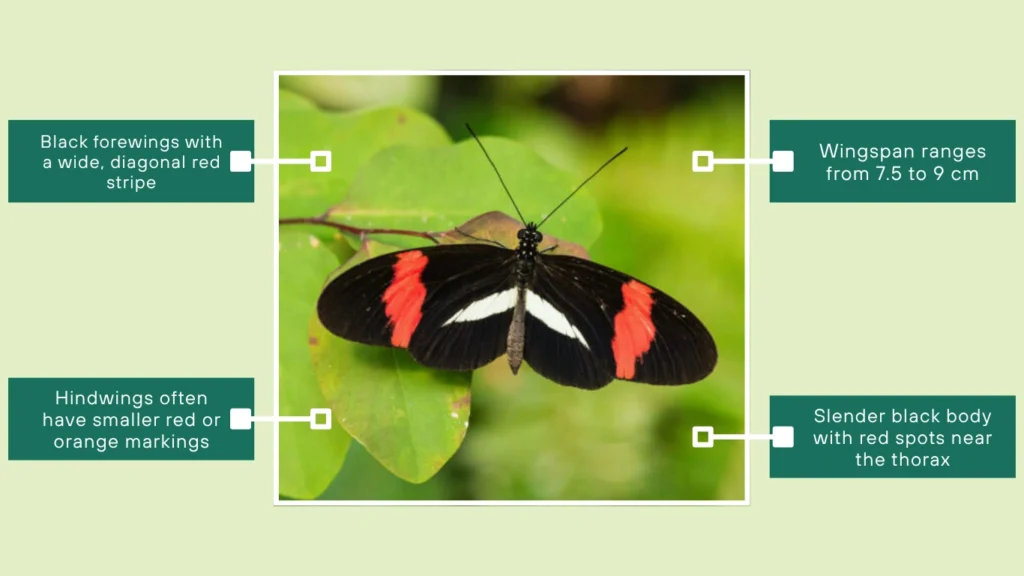
The Red Postman is a sleek and elegant butterfly native to Central and South America. It belongs to the Heliconius group, known for mimicry and bright coloring. The Red Postman is especially admired for the thick red stripe that runs across its black wings, resembling a painted line.
Identification
- Black forewings with a wide, diagonal red stripe
- Hindwings often have smaller red or orange markings
- Wingspan ranges from 7.5 to 9 cm
- Slender black body with red spots near the thorax
- Long, narrow wings with slightly rounded edges
Color Pattern
A deep red stripe slashes across the forewings, sometimes with orange tint depending on regional variations. The contrast of red on black gives it a clean, graphic appearance, similar to a bold brushstroke.
Habitat
Thrives in rainforests, gardens, and forest clearings across the Amazon basin, Panama, and Colombia.
Behavior
Known for its slow, gliding flight and tendency to follow set flight paths (like a postman’s route). It feeds on nectar and pollen and is known for its long lifespan due to its diet. Often seen flying near passionflower vines, its host plant.
8. Crimson Rose
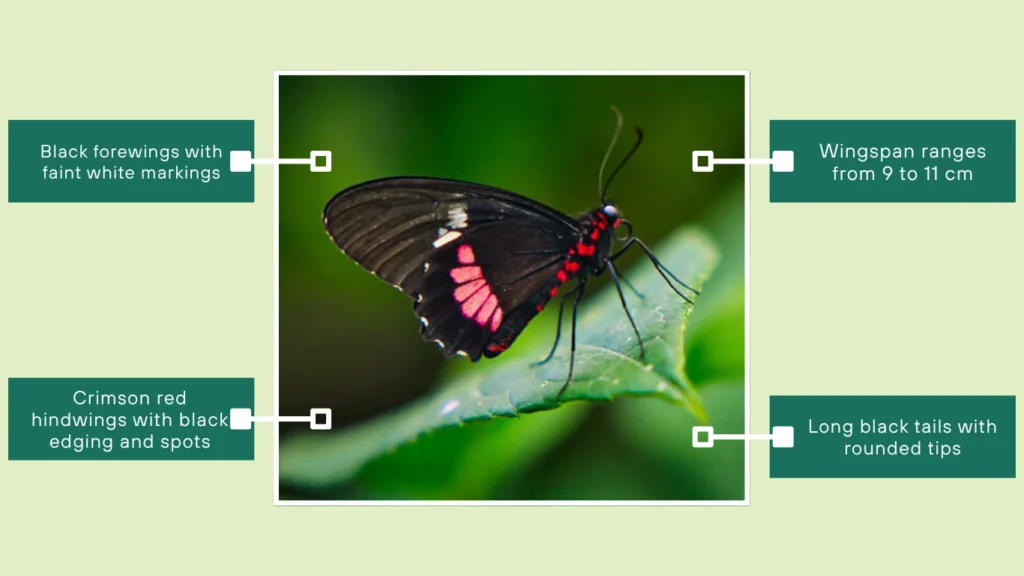
The Crimson Rose is a spectacular butterfly known for its velvety black wings and rich crimson-red hindwings. Native to South and Southeast Asia, it’s a slow, graceful flier often seen gliding through gardens and forests. Its contrasting colors and long tail streamers make it one of the most elegant butterflies in its range.
Identification
- Black forewings with faint white markings
- Crimson red hindwings with black edging and spots
- Long black tails with rounded tips
- Wingspan ranges from 9 to 11 cm
- Red thorax spots and a soft red abdomen stripe
Color Pattern
The hindwings are a brilliant crimson red, often with a subtle orange undertone near the wing base. The red sharply contrasts with the deep black wings and tails, creating a striking display during flight.
Habitat
Common in lowland tropical forests, coastal areas, and gardens across India, Sri Lanka, and Southeast Asia.
Behavior
It flies slowly but powerfully and is usually active during early mornings and late afternoons. Frequently feeds on nectar-rich flowers and is known to be unpalatable to predators due to chemical defenses from its larval host plants.
9. Red Cracker

The Red Cracker is a unique butterfly known not only for its color but also for the clicking or “cracking” sound males produce during flight. Native to Central and South America, its mottled wing pattern helps it blend into tree bark, but when in motion, the red shines through dramatically.
Identification
- Mottled gray and black upper wings with flashes of red on hindwings
- Hindwings feature scattered crimson to brick-red patches
- Wingspan ranges from 7.5 to 9 cm
- Thick body with reddish scales along the thorax
- Underside mimics rough tree bark
Color Pattern
While the resting position hides most of its red, the moment it flies, vivid crimson patches appear along the hindwings. These red flashes are often mixed with deeper shades of orange and rust.
Habitat
Found in tropical forests, riverbanks, and woodland clearings from Mexico to Brazil.
Behavior
Males are territorial and produce a cracking sound by snapping their wings. This is believed to help in mating or warding off rivals. They often rest motionless on tree trunks, camouflaging perfectly.
10. Rosy Oakblue
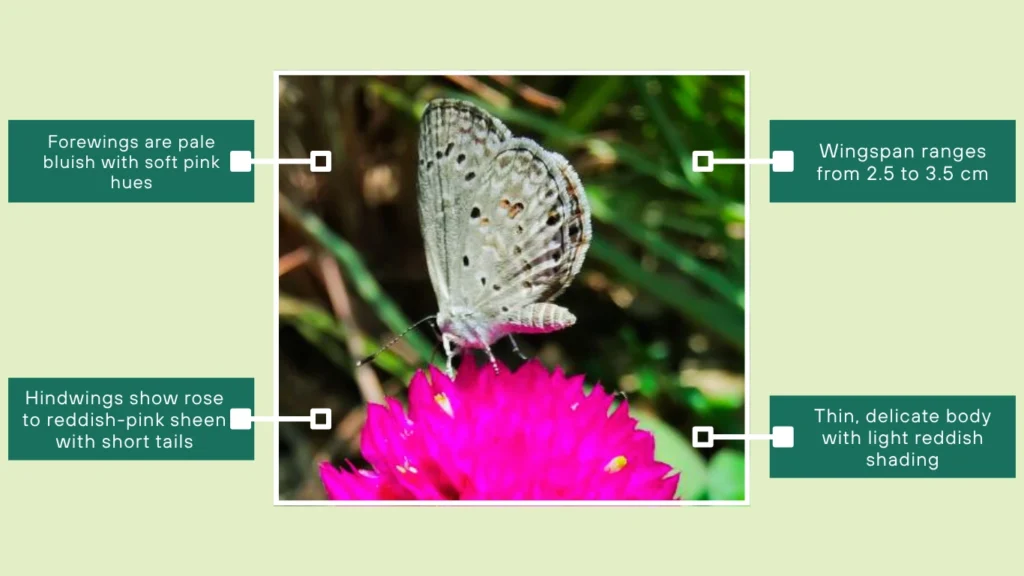
The Rosy Oakblue is a small yet dazzling butterfly native to parts of South and Southeast Asia. While it’s classified among the blues, its hindwings often shimmer with pinkish-red or rose tones, especially in sunlight. It’s a hidden gem often overlooked due to its small size and quick flight.
Identification
- Forewings are pale bluish with soft pink hues
- Hindwings show rose to reddish-pink sheen with short tails
- Wingspan ranges from 2.5 to 3.5 cm
- Thin, delicate body with light reddish shading
- Slight white-ringed eyespots near tail tips
Color Pattern
The upper side of the hindwings glows with a subtle rosy-red tone, blending with violet and sometimes orange reflections. These tones become especially vibrant when the wings catch the light.
Habitat
Inhabits forest clearings, gardens, and hilly woodlands in India, Thailand, and Malaysia.
Behavior
Quick and fluttery flier, usually seen in the early morning. It rests with wings closed and often feeds on damp soil or flowers near the forest floor.
11. Red Peacock
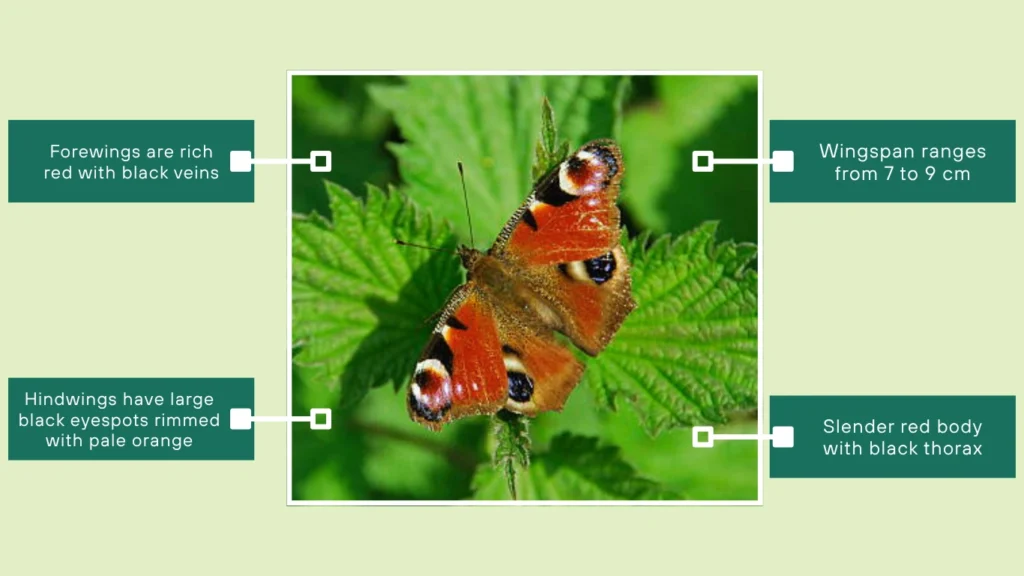
The Red Peacock is a visually stunning butterfly known for its elegant wing shape and deep red coloration combined with dramatic eyespots. Native to tropical parts of Asia, it adds both grace and intensity to any garden it visits.
Identification
- Forewings are rich red with black veins
- Hindwings have large black eyespots rimmed with pale orange
- Wingspan ranges from 7 to 9 cm
- Slender red body with black thorax
- Wing edges are scalloped with dark brown or black outlines
Color Pattern
The main color is deep, velvety red with hints of crimson. Large peacock-like eye markings with orange rims give the butterfly its name and serve as a defense mechanism to confuse predators.
Habitat
Found in tropical forests, flowering gardens, and river valleys across Southeast Asia.
Behavior
Slow, hovering flier. Frequently basks in sunny spots with wings open and is drawn to brightly colored flowers. It’s also known to flutter low and prefers quiet, undisturbed areas.
12. Red Pierrot
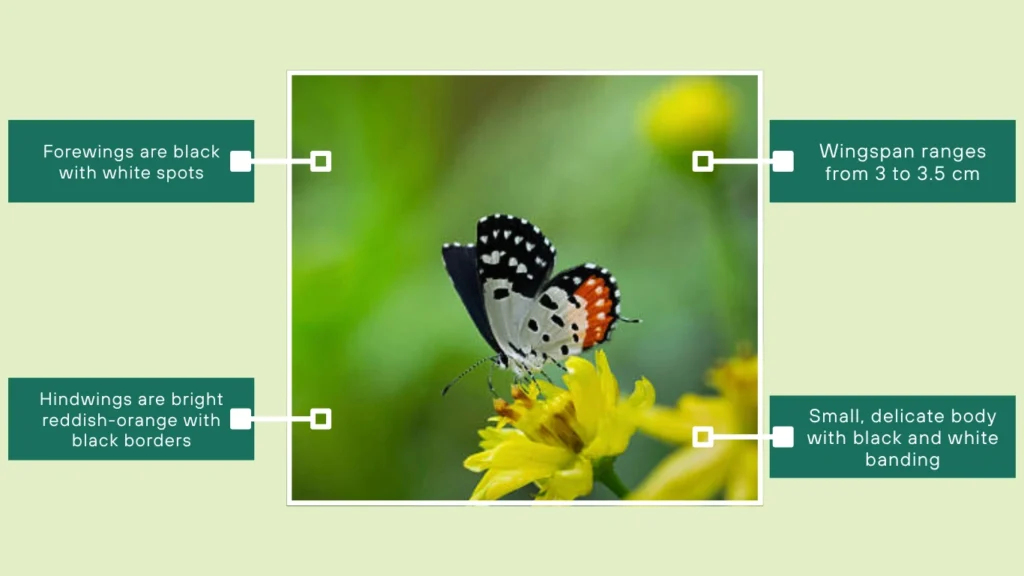
The Red Pierrot is a tiny, eye-catching butterfly found in India and parts of Southeast Asia. Despite its small size, its vibrant red-orange hindwings stand out sharply against its black and white forewings. It’s a common sight in home gardens and open fields, especially during sunny mornings.
Identification
- Forewings are black with white spots
- Hindwings are bright reddish-orange with black borders
- Wingspan ranges from 3 to 3.5 cm
- Small, delicate body with black and white banding
- Short antennae and rounded wings
Color Pattern
The upper hindwings are a bold, bright red-orange that contrasts with the stark black forewings. The undersides are beautifully patterned with black and white blotches and a splash of orange near the base of the hindwings.
Habitat
Found in gardens, forest edges, and shrublands across India, Sri Lanka, Nepal, and Myanmar.
Behavior
A low, fluttering flier that often rests on flower buds and leaves. Active during the day and often seen feeding on nectar or basking with wings half open.
13. Firetip Butterfly
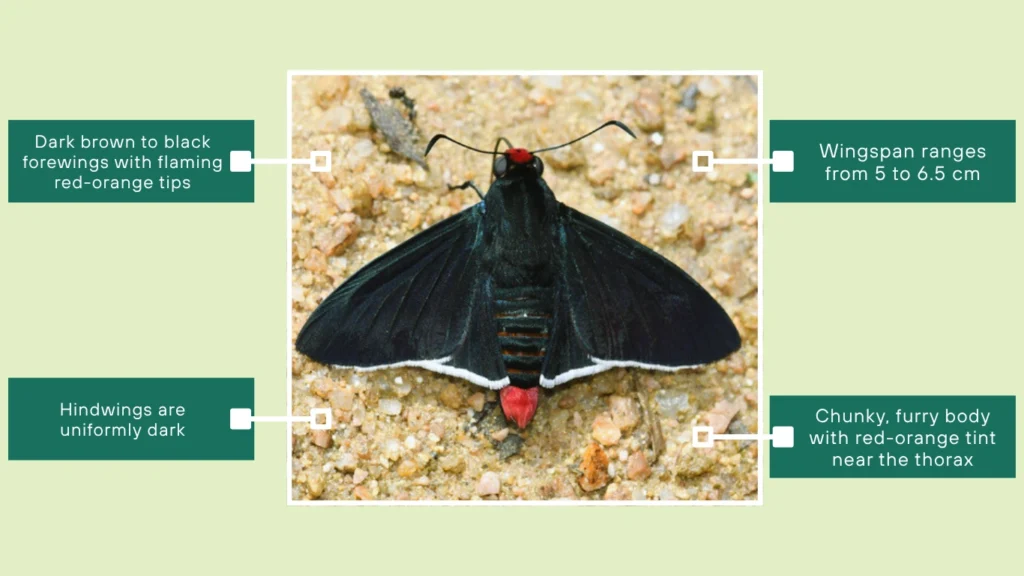
The Firetip Butterfly is a bold and charismatic species named for its bright orange-red tips on otherwise dark forewings. It belongs to the skipper family and is known for its fast, darting flight and distinct coloring, mostly found in Central and South America.
Identification
- Dark brown to black forewings with flaming red-orange tips
- Hindwings are uniformly dark
- Wingspan ranges from 5 to 6.5 cm
- Chunky, furry body with red-orange tint near the thorax
- Hooked antennae typical of skippers
Color Pattern
The outer third of the forewings glows with a fiery orange-red, often blending slightly into the dark brown base. In motion, the bright tips appear to flash, creating the impression of fire.
Habitat
Common in open woodlands, forest paths, and river edges across Panama, Costa Rica, and northern South America.
Behavior
Extremely fast and energetic flier. Males are often territorial and may patrol sunny clearings. They visit flowers for nectar but may also feed on moist soil and dung for minerals.
14. Blood-red Glider
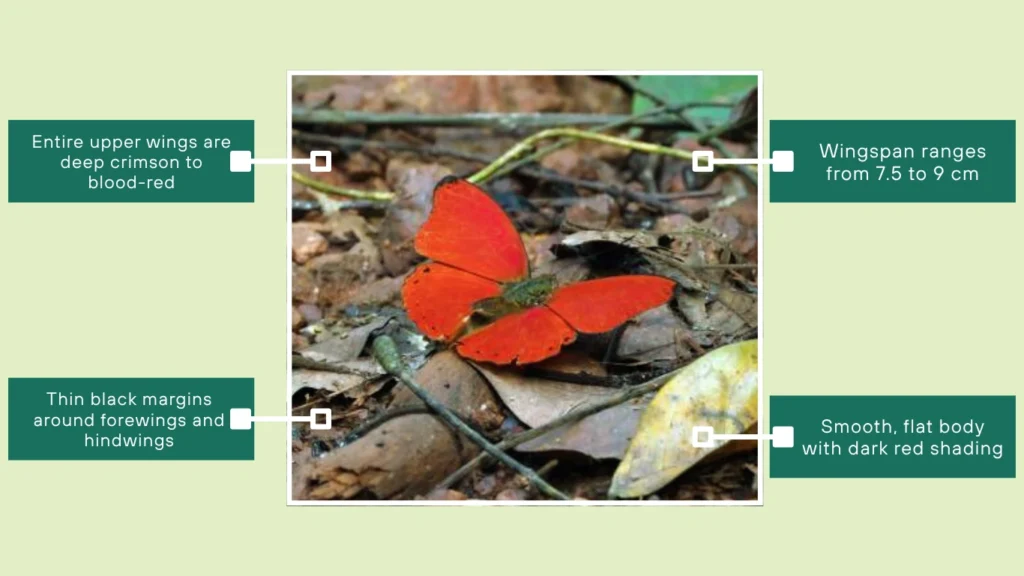
The Blood-red Glider is a striking butterfly known for its bold red wings and smooth, effortless flight. Native to the tropical forests of Africa, this butterfly is a standout with its intense crimson coloration that seems to glow against the green canopy.
Identification
- Entire upper wings are deep crimson to blood-red
- Thin black margins around forewings and hindwings
- Wingspan ranges from 7.5 to 9 cm
- Smooth, flat body with dark red shading
- Rounded wings with minimal markings
Color Pattern
The vibrant blood-red wings are uniform and rich in tone, sometimes displaying an orange tint in direct sunlight. The black borders give the red even more visual impact, making it highly visible during flight.
Habitat
Found in rainforests, wooded savannas, and river edges throughout Central and West Africa.
Behavior
Glides effortlessly through forest openings, often high in the canopy. Comes lower to feed on overripe fruit and occasionally on flowers. Males are territorial and may engage in aerial displays to ward off rivals.
15. Red Rim Butterfly
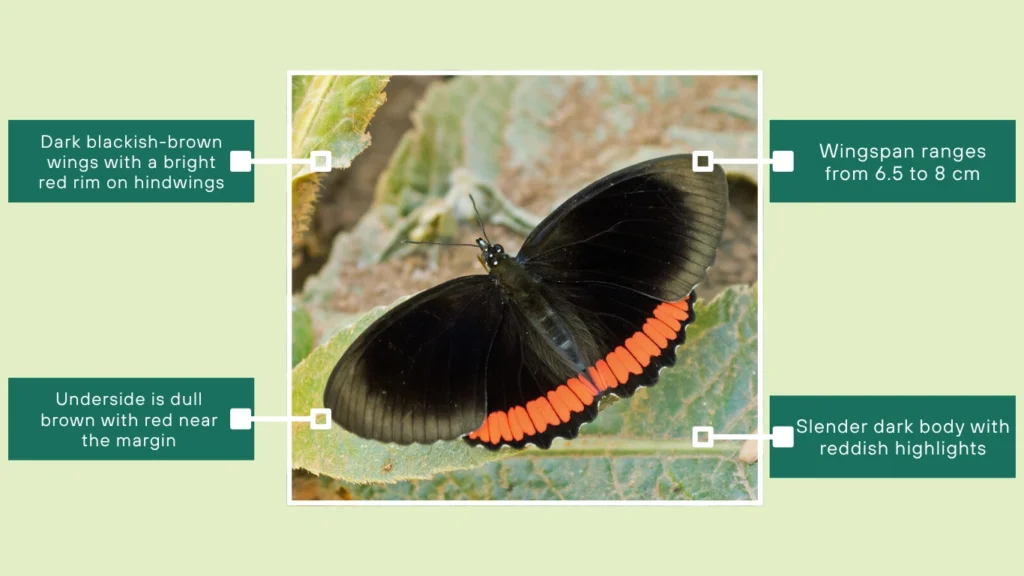
The Red Rim Butterfly, also known as Biblis hyperia, is a bold, medium-sized butterfly recognized for the bright red edge that outlines its otherwise dark wings. Native to Central and South America, it’s a common sight in both forests and gardens.
Identification
- Dark blackish-brown wings with a bright red rim on hindwings
- Underside is dull brown with red near the margin
- Wingspan ranges from 6.5 to 8 cm
- Slender dark body with reddish highlights
- Wings slightly scalloped
Color Pattern
The hindwings are lined with a vivid red border that stands out against the black upper wings. When resting with wings closed, the red is still partially visible from below, creating a flash of color with each movement.
Habitat
Thrives in tropical and subtropical forests, especially near riverbanks, flowering clearings, and gardens from Mexico to northern South America.
Behavior
Active and fast-moving. Feeds on flower nectar, rotting fruit, and sap. Often flies low and perches on sunny spots, especially in the morning hours.
16. Red Skipper
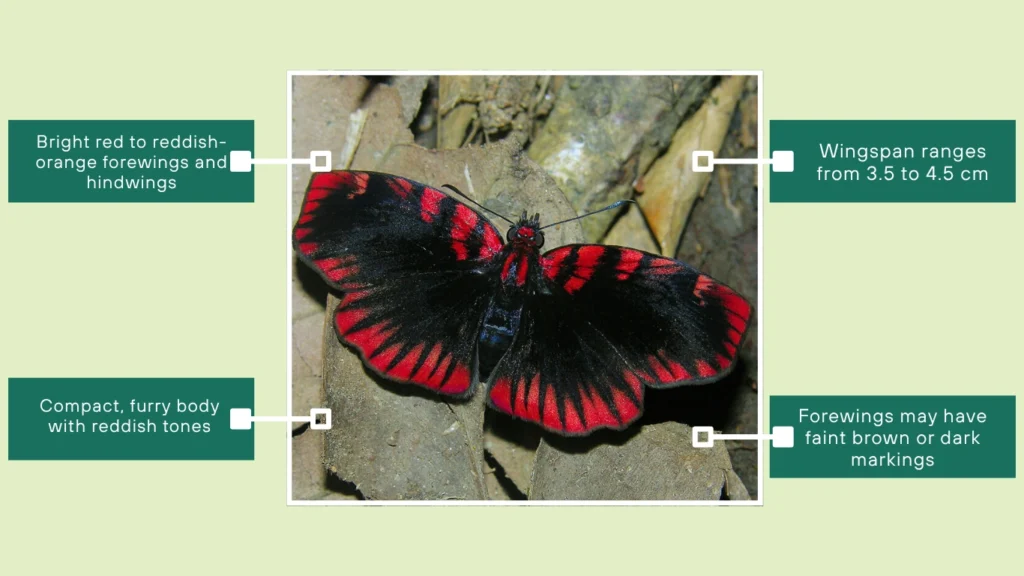
The Red Skipper is a small, energetic butterfly known for its vivid reddish-orange wings and quick, darting flight. Part of the skipper family, it’s often seen zipping through grassy fields and sunny clearings in parts of Central America and the southern U.S.
Identification
- Bright red to reddish-orange forewings and hindwings
- Compact, furry body with reddish tones
- Wingspan ranges from 3.5 to 4.5 cm
- Short, hooked antennae
- Forewings may have faint brown or dark markings
Color Pattern
The wings are coated in a rich reddish-orange shade, often appearing brighter in sunlight. The body complements this with similar tones, making it look like a small flash of fire in motion.
Habitat
Prefers sunny meadows, roadsides, open woodlands, and gardens with grasses or wildflowers.
Behavior
Moves quickly in short, zigzag flights. Often rests with wings partially open. Males patrol territories, while both sexes feed on nectar from low flowers like clover, daisies, and lantana.
17. Red Tiger Butterfly
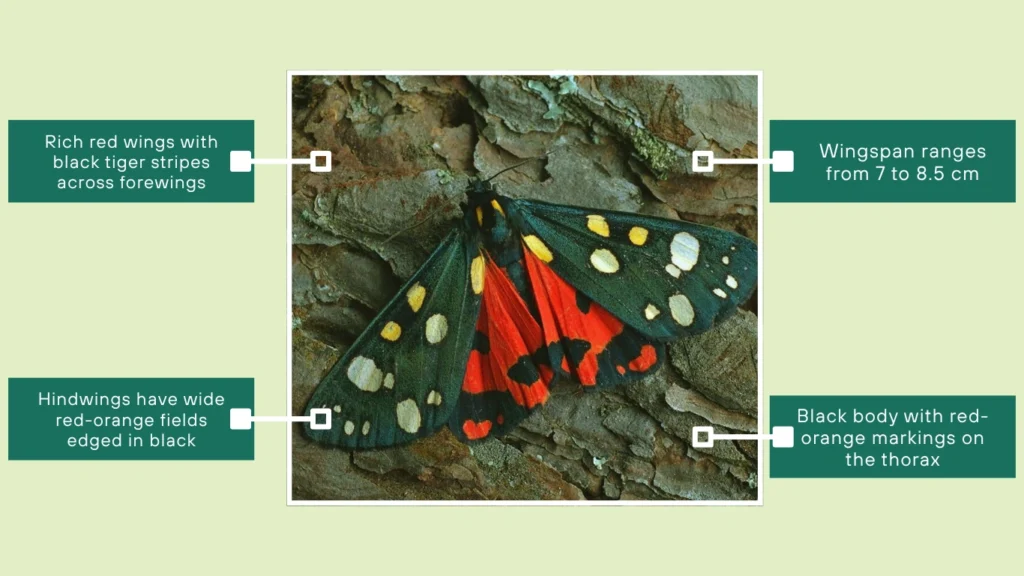
The Red Tiger Butterfly is a bold and beautiful species, known for its vivid red wings with dark tiger-like stripes. Native to tropical Asia, it mimics the warning patterns of toxic butterflies, making it less attractive to predators.
Identification
- Rich red wings with black tiger stripes across forewings
- Hindwings have wide red-orange fields edged in black
- Wingspan ranges from 7 to 8.5 cm
- Black body with red-orange markings on the thorax
- Broad, rounded wings
Color Pattern
The fiery red wings are boldly streaked with black, giving a dramatic “tiger” look. The red sometimes leans toward orange, depending on region and light, making the butterfly highly visible in motion.
Habitat
Common in lowland rainforests, jungle paths, and flower gardens across India, Thailand, and Malaysia.
Behavior
Slow and floating in flight, often seen gliding near flowering vines. It mimics unpalatable species like the Common Rose, gaining protection through visual similarity. Regularly visits flowers and wet ground for feeding.
