

Black and white butterflies are some of the most visually striking insects in nature. Their bold contrast, delicate wing patterns, and graceful flight make them stand out in gardens, forests, and meadows worldwide. From crisp zebra-like stripes to mosaic-style markings, each species has its own unique charm. Here’s a curated list of 32 stunning black and white butterflies, showcasing their elegance and natural beauty.
1. Marbled White

The Marbled White is a striking butterfly known for its bold black-and-white pattern, resembling a chessboard. Despite its name, it belongs to the “brown” family of butterflies. Its strong contrast and elegant design make it one of the most easily recognized butterflies in the UK and across parts of Europe.
Identification
- Upperside is white with thick black marbling throughout the wings
- Underside is paler, often with soft beige or tan shading in addition to black outlines
- Wingspan ranges from 5 to 5.8 cm
- Females tend to have slightly browner tones than males
Color Pattern
The Marbled White’s wings are beautifully patterned with alternating black and white patches. The forewings feature bold black veins and irregular shapes over a white base, while the hindwings often show a more rounded black-and-white checkered effect. This sharp contrast serves as both camouflage and a warning pattern in grassy meadows.
Behavior & Season
Flies from late June through July. Prefers sunny, warm days and often basks with wings open to display its dramatic pattern.
2. Zebra Swallowtail
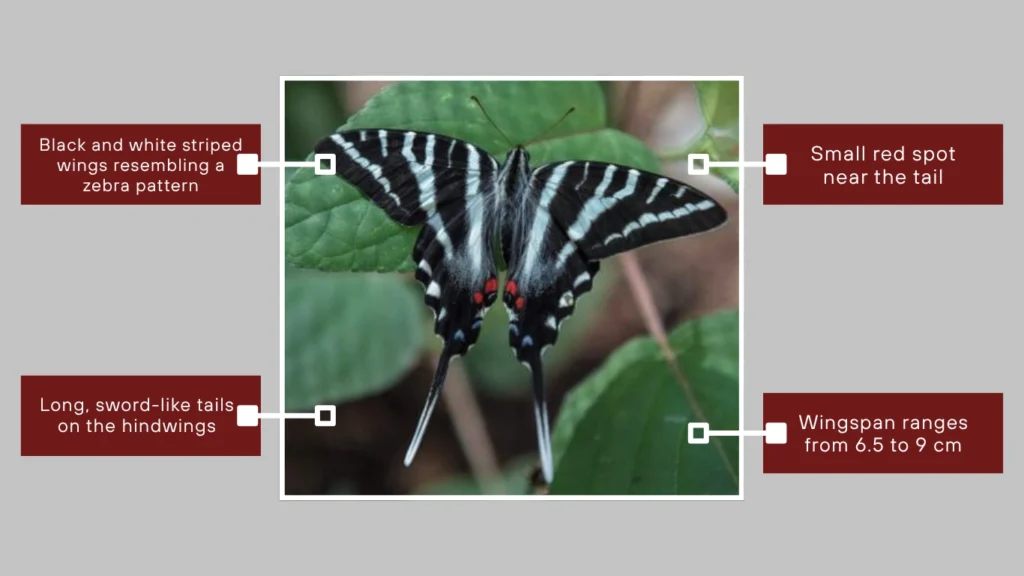
The Zebra Swallowtail is a striking butterfly native to North America, named for its bold zebra-like black and white stripes. With its long tails and sharp contrast, it’s both graceful and unforgettable in flight.
Identification
- Black and white striped wings resembling a zebra pattern
- Long, sword-like tails on the hindwings
- Small red spot near the tail
- Wingspan ranges from 6.5 to 9 cm
Color Pattern
The wings are pale white or silvery gray with thick black stripes running diagonally across both forewings and hindwings. The hindwings are elongated and taper into tails, often with a small red or blue patch near the ends. The black bands are sharp and clean, making this butterfly a true striped beauty.
Behavior & Season
Seen from spring through summer in wooded areas and along riverbanks. It flies with a gentle flutter and is often found near pawpaw trees, its caterpillar’s host plant.
3. White Admiral
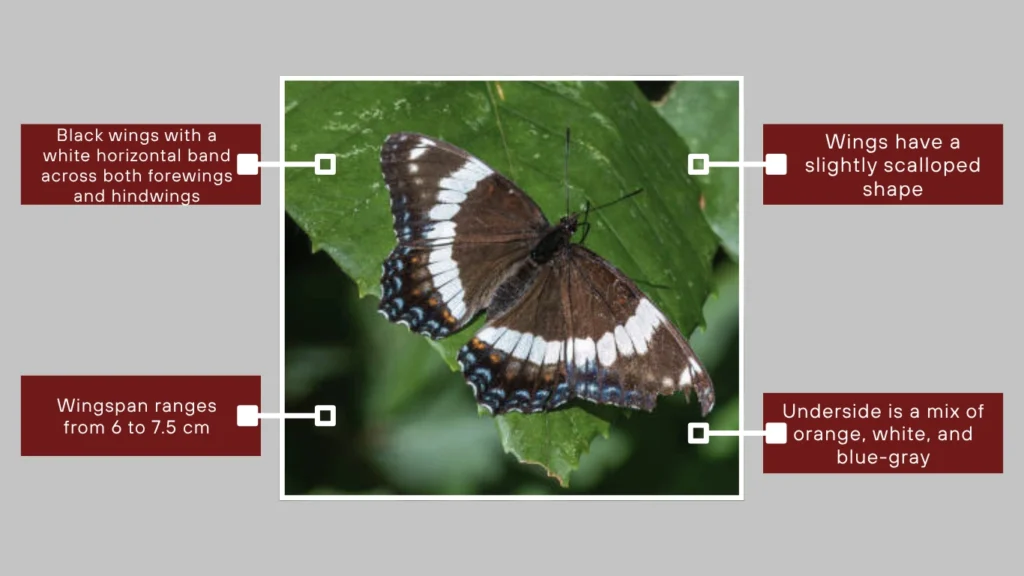
The White Admiral is a beautiful woodland butterfly found in parts of the UK and Europe. Its distinctive black wings are crossed with bright white bands, giving it a bold and elegant look as it glides through shady clearings.
Identification
- Black wings with a white horizontal band across both forewings and hindwings
- Wings have a slightly scalloped shape
- Wingspan ranges from 6 to 7.5 cm
- Underside is a mix of orange, white, and blue-gray
Color Pattern
The top side of the wings is black with a clean, white diagonal band that stands out starkly. The lower side is much more colorful, featuring a soft reddish background with white spots and bluish-gray shading. The contrast between top and bottom adds visual interest when the butterfly is in motion.
Behavior & Season
Flies gracefully in sunny woodland glades from June to July. It glides smoothly between trees and often lands on bramble flowers or sits with wings open to warm itself in dappled sunlight.
4. Black-veined White
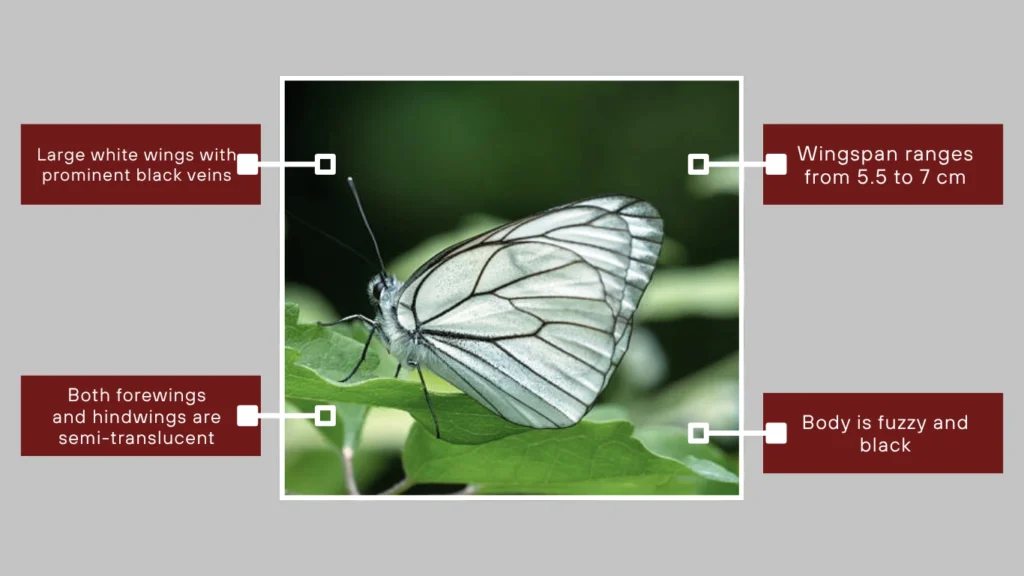
The Black-veined White is a delicate and elegant butterfly known for its translucent white wings traced with fine black veins. Though now extinct in the UK, it is still found in parts of Europe and Asia, often fluttering gracefully through orchards and meadows.
Identification
- Large white wings with prominent black veins
- Both forewings and hindwings are semi-translucent
- Wingspan ranges from 5.5 to 7 cm
- Body is fuzzy and black
Color Pattern
The white wings have a soft, milky appearance with distinct black veining that forms a delicate, net-like pattern. The veins are bolder on the forewings and become finer toward the hindwings. The combination of subtle transparency and sharp lines gives it a ghostly yet elegant look.
Behavior & Season
Active from late spring to early summer. Found in warm, flower-rich meadows, forest edges, and old orchards. It flies slowly and often settles on flowers to feed on nectar.
5. Common Jezebel
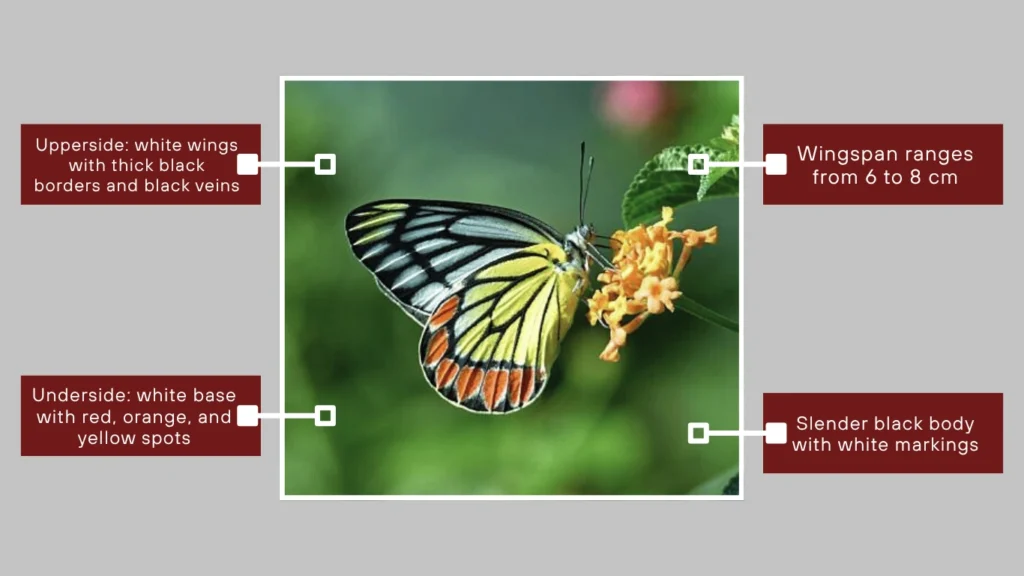
The Common Jezebel is a vibrant butterfly found throughout South and Southeast Asia. While famous for its colorful underside, its upperside features a beautiful black-and-white pattern that gives it a striking appearance in flight.
Identification
- Upperside: white wings with thick black borders and black veins
- Underside: white base with red, orange, and yellow spots
- Wingspan ranges from 6 to 8 cm
- Slender black body with white markings
Color Pattern
The upperside has a bold black-and-white design with wide black margins and dark veins spreading across a white background. When the butterfly is at rest with wings closed, the bright underside is hidden, but in flight, both sides create a vivid, eye-catching contrast.
Behavior & Season
Flies all year in tropical climates, especially in gardens, woodlands, and near flowering trees. Known for its slow, gliding flight and preference for high perches. It often feeds on nectar from flowering trees and shrubs.
6. Tree Nymph Butterfly

The Tree Nymph Butterfly, also known as the Rice Paper Butterfly, is a large, graceful species found in Southeast Asia. It’s admired for its slow, floating flight and elegant black-and-white wing pattern that resembles hand-drawn ink art.
Identification
- Large, rounded white wings with black spots and blotches
- Wingspan ranges from 10 to 14 cm
- Slender black-and-white body with long antennae
Color Pattern
The wings are pale white with soft black blotches and spots scattered in symmetrical patterns. The veins are also dark, giving the wings a stained-glass appearance. The sheer size and pattern make this butterfly both gentle and visually dramatic.
Behavior & Season
Flies year-round in tropical regions, often seen gliding slowly through gardens, butterfly houses, and forests. Despite their delicate look, they are toxic to predators due to chemicals from their larval host plant, making their slow flight safe.
7. Great Southern White
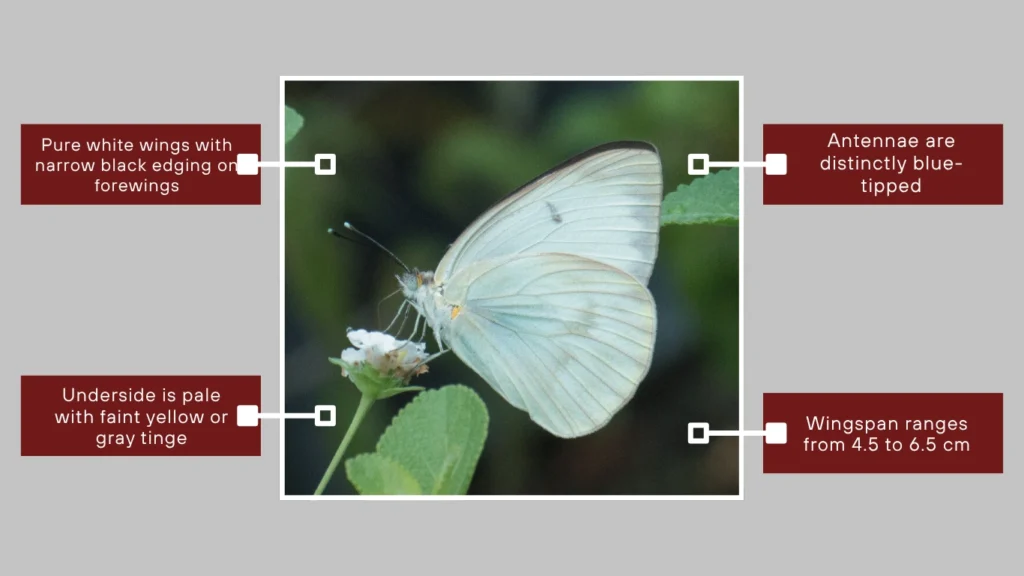
The Great Southern White is a clean-looking butterfly native to the southeastern United States and parts of Central America. Its bold white wings and black markings give it a crisp, neat appearance in gardens and coastal habitats.
Identification
- Pure white wings with narrow black edging on forewings
- Underside is pale with faint yellow or gray tinge
- Antennae are distinctly blue-tipped
- Wingspan ranges from 4.5 to 6.5 cm
Color Pattern
The wings are a clean, chalky white with black borders mainly on the forewings. These borders can vary in thickness. The contrast is sharp but minimal, giving it a tidy, refined look. The pale underside helps with camouflage in sandy or grassy areas.
Behavior & Season
Seen from spring to autumn, especially in warm coastal areas. It’s an active, fluttery flier that frequently visits flowers for nectar. Caterpillars feed on various cruciferous plants.
8. Cabbage White
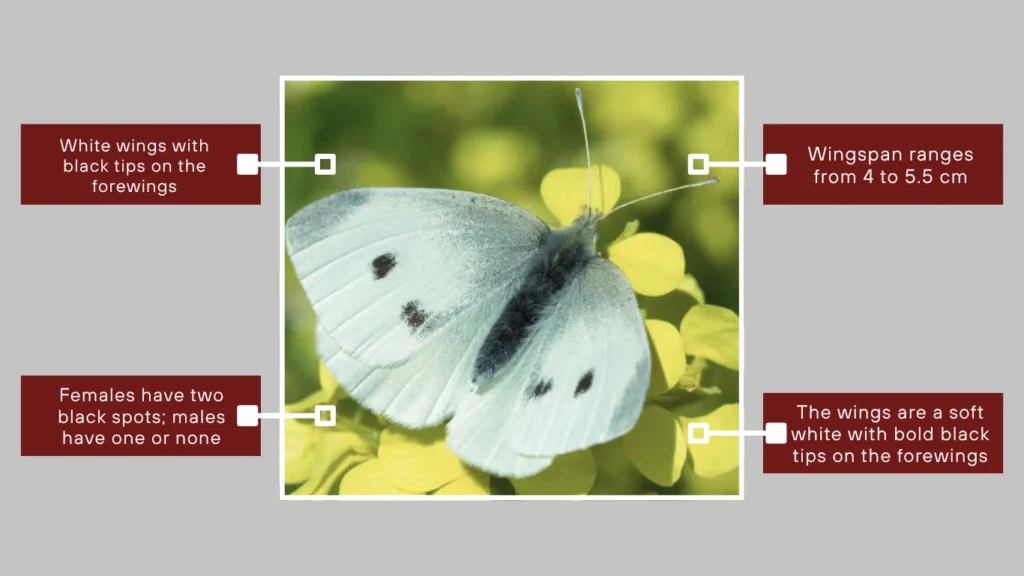
The Cabbage White, also known as the Small White, is one of the most common butterflies in the UK and Europe. It’s a simple, clean-looking butterfly that often visits gardens, especially near vegetable patches.
Identification
- White wings with black tips on the forewings
- Females have two black spots; males have one or none
- Wingspan ranges from 4 to 5.5 cm
Color Pattern
The wings are a soft white with bold black tips on the forewings. These markings are sharper in females and can vary in intensity. The underside is pale yellowish-white, helping the butterfly blend into vegetation when at rest.
Behavior & Season
Flies from early spring to late autumn. Frequently seen fluttering around gardens, fields, and parks. Often lays eggs on brassicas like cabbage, making it familiar to gardeners.
9. Small White
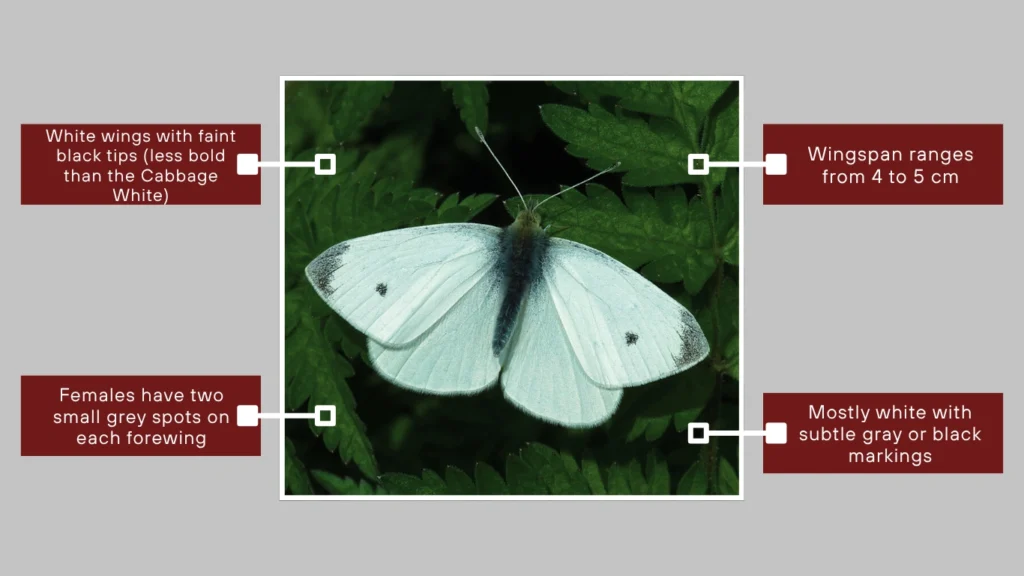
The Small White is very similar to the Cabbage White and often confused with it. It’s slightly smaller and more delicate, with lighter markings. It’s widespread and one of the UK’s most familiar garden butterflies.
Identification
- White wings with faint black tips (less bold than the Cabbage White)
- Females have two small grey spots on each forewing
- Wingspan ranges from 4 to 5 cm
Color Pattern
Mostly white with subtle gray or black markings. The black tips are lighter and more faded than those on the Cabbage White. The underside is a creamy pale yellow, providing excellent camouflage among light-colored flowers and leaves.
Behavior & Season
Active from spring to autumn in several broods. It prefers open, sunny areas and frequently visits gardens, meadows, and allotments. Flies with a fluttery, gentle movement and feeds on a variety of nectar-rich flowers.
10. Large White
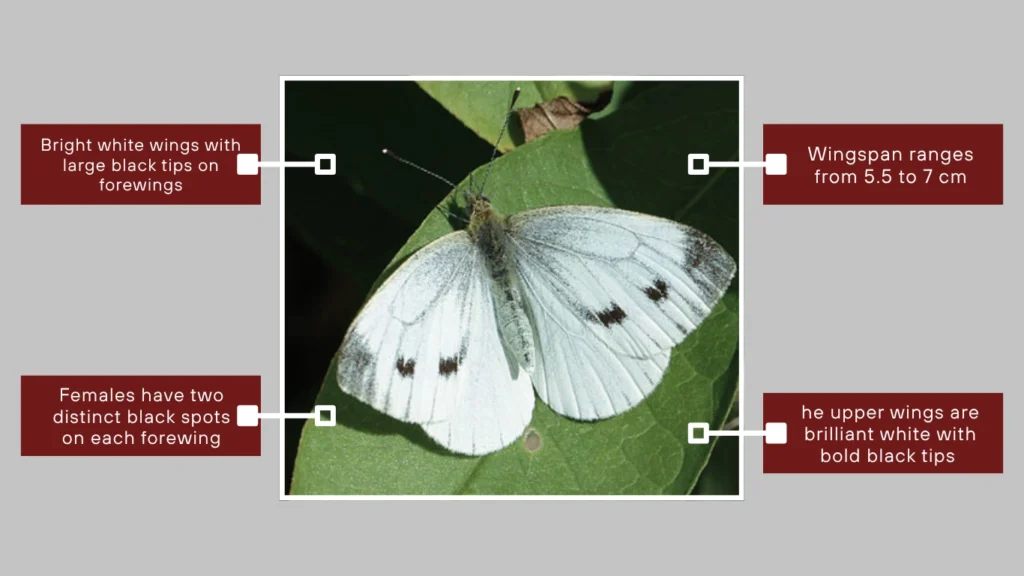
The Large White, also called the “cabbage butterfly,” is the largest of the UK’s white butterflies. It’s bold, clean, and very common, especially in gardens and farmland where brassicas grow.
Identification
- Bright white wings with large black tips on forewings
- Females have two distinct black spots on each forewing
- Wingspan ranges from 5.5 to 7 cm
Color Pattern
The upper wings are brilliant white with bold black tips and clear black spots in females. The underside of the hindwings is a soft pale yellow with faint speckling, making it less visible when resting among leaves.
Behavior & Season
Flies from spring through autumn in up to three broods. Frequently visits gardens, vegetable patches, and fields. Flies powerfully and is often seen fluttering over crops or wildflowers in open spaces.
11. Paper Kite Butterfly

The Paper Kite Butterfly, also known as the Idea leuconoe or Rice Paper Butterfly, is a large tropical species admired for its slow, graceful flight and bold black-and-white design. It’s commonly seen in butterfly conservatories and tropical forests.
Identification
- White or pale cream wings with black veins, spots, and blotches
- Long, broad wings with rounded tips
- Wingspan ranges from 12 to 14 cm
Color Pattern
The wings are soft white with striking black markings that resemble ink blots or stained glass. The black veins give structure, while the large spots and splotches form a beautiful pattern over the entire wing surface.
Behavior & Season
Flies slowly and gently, often floating rather than flapping. Seen year-round in tropical Southeast Asia and commonly raised in butterfly houses. It’s mildly toxic to predators, and its calm movement is a form of visual warning.
12. Black Swallowtail (Female Form)
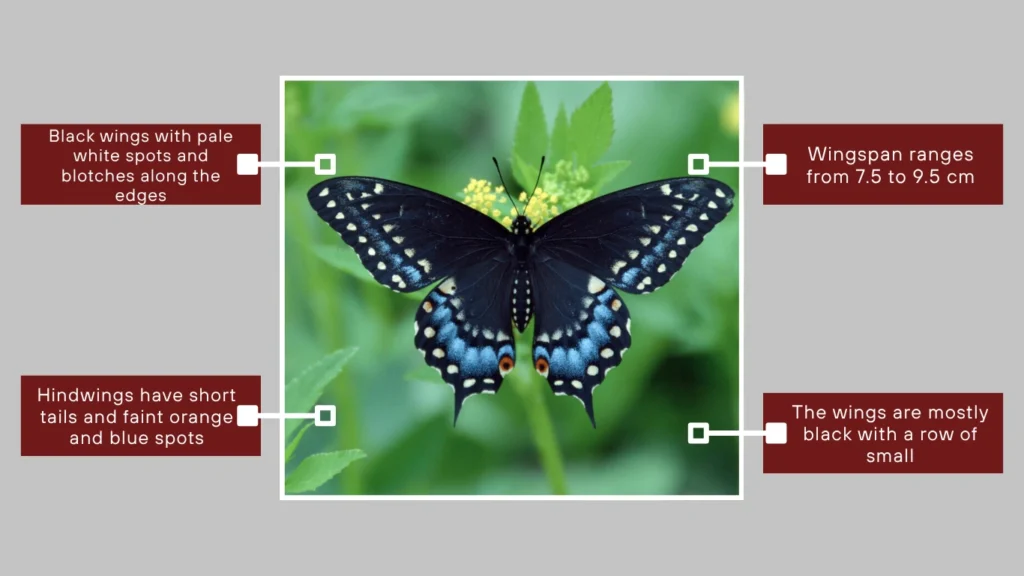
The female Black Swallowtail is a stunning butterfly that can display a black-and-white variation, particularly in its northern range, where it mimics the toxic Pipevine Swallowtail. Though more commonly known for yellow or blue markings, some females show pale white patterns on a dark background.
Identification
- Black wings with pale white spots and blotches along the edges
- Hindwings have short tails and faint orange and blue spots
- Wingspan ranges from 7.5 to 9.5 cm
Color Pattern
The wings are mostly black with a row of small, creamy white spots along the forewing and hindwing margins. These white markings contrast strongly against the black base, giving the butterfly a bold and patterned appearance, especially in motion.
Behavior & Season
Active from spring through autumn across North America. Found in gardens, meadows, and fields. Females often visit parsley, fennel, and dill to lay eggs and are strong, steady fliers.
13. Great Eggfly (Female Form)
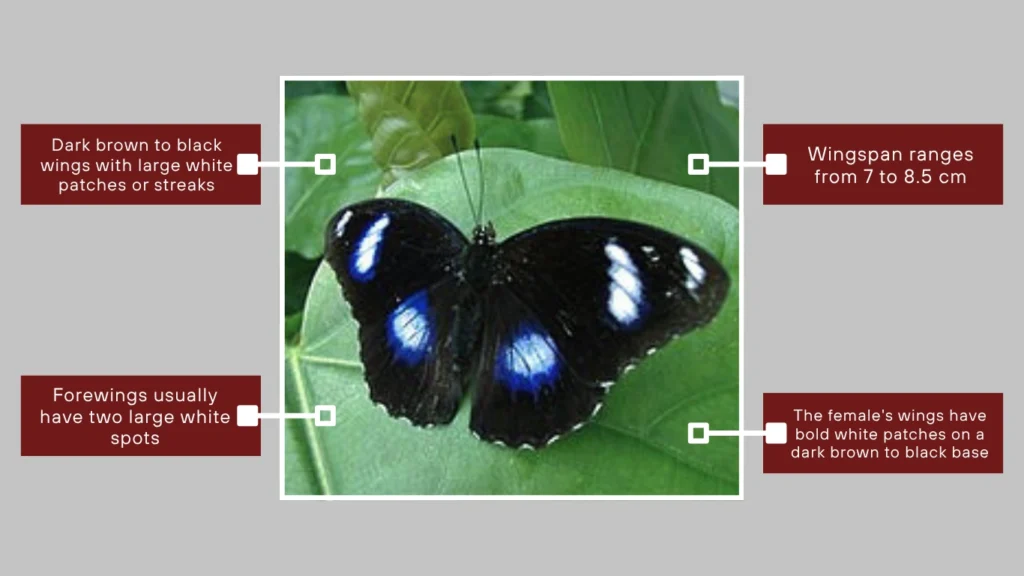
The female Great Eggfly shows remarkable variation, including forms with black-and-white wings that resemble other unpalatable species. This mimicry helps it avoid predators while still standing out with elegance.
Identification
- Dark brown to black wings with large white patches or streaks
- Forewings usually have two large white spots
- Wingspan ranges from 7 to 8.5 cm
Color Pattern
The female’s wings have bold white patches on a dark brown to black base. The forewings typically display a diagonal band of white, while the hindwings may have smaller white spots or remain plain, depending on the form.
Behavior & Season
Common in South and Southeast Asia, found in gardens, parks, and forest clearings. Active throughout the year in warm climates. Females fly slower than males and prefer sunny perches near flowering plants.
14. Hypolimnas misippus (Female Mimic Form)
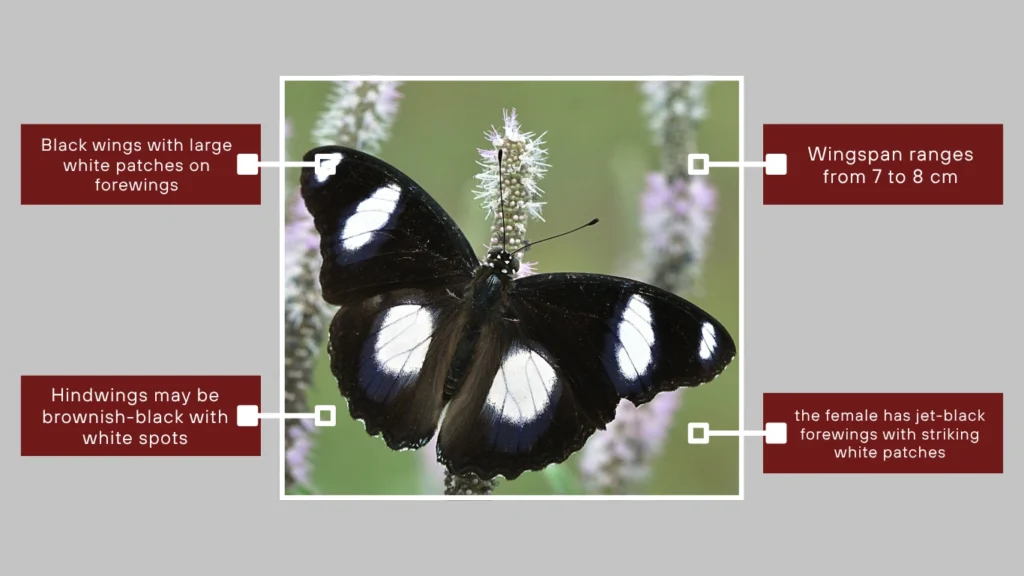
The female Hypolimnas misippus, also known as the Danaid Eggfly or Mimic, displays several forms, one of which closely resembles the black-and-white patterned Plain Tiger butterfly. This mimicry helps protect it from predators by copying the look of toxic species.
Identification
- Black wings with large white patches on forewings
- Hindwings may be brownish-black with white spots
- Wingspan ranges from 7 to 8 cm
Color Pattern
In the mimic form, the female has jet-black forewings with striking white patches and smaller white dots along the edges. The hindwings are often duller with softer markings but still contain hints of white or pale cream. This mimicry is visually convincing in motion.
Behavior & Season
Found widely across Asia, Africa, and Australia. Seen in open fields, gardens, and roadsides. Active throughout warm months and often flies low near flowers and tall grass.
15. Black-bordered Pierrot

The Black-bordered Pierrot is a small, attractive butterfly native to South and Southeast Asia. It’s part of the Lycaenidae family and is known for its dainty appearance and black-and-white wing contrast.
Identification
- White wings with black borders and black dots
- Underside is white with evenly spaced black spots and streaks
- Wingspan ranges from 2.5 to 3.5 cm
Color Pattern
The upper wings are white with a thick black border and scattered black markings. The underside is even more patterned, with crisp black spots and lines forming a neat, decorative look. Its clear-cut contrast makes it easy to spot despite its size.
Behavior & Season
Flies throughout the year in tropical and subtropical regions. Found in scrublands, forest edges, and gardens. Has a quick, fluttery flight and often rests with wings closed to show off its detailed underside.
16. Common Mime

The Common Mime is a graceful butterfly found in South and Southeast Asia, well known for its mimetic forms. One form displays a striking black-and-white pattern that closely resembles unpalatable butterflies like the Common Wanderer or Blue Tiger, offering it protection from predators.
Identification
- Black wings with white streaks and bands across forewings and hindwings
- Wingspan ranges from 8 to 9 cm
- Mimic form is untailed and more patterned
Color Pattern
The wings are deep black, crossed by bold white streaks that run diagonally across the forewings and fan out on the hindwings. The patterns are clean and mirror-like on both sides, making the butterfly look almost like a paper-cut silhouette in flight.
Behavior & Season
Commonly seen near forest paths, gardens, and open woodlands. Flies slowly and gracefully, often fluttering in a way that mimics the toxic species it resembles. Active throughout the year in tropical climates.
17. Common Sergeant

The Common Sergeant is a bold and patterned butterfly with black-and-white stripes across its wings, giving it a uniform-like appearance. Found widely across South Asia, it’s a familiar sight in both wild and urban landscapes.
Identification
- Black or dark brown wings with white horizontal bands
- Hindwings may have small white spots near the margins
- Wingspan ranges from 6 to 7.5 cm
Color Pattern
The forewings have two or three horizontal white bands cutting through the dark background, while the hindwings show a curved band and small white dots. This stripe-like design gives the butterfly a militaristic look—hence the name “Sergeant.”
Behavior & Season
Flies from spring through autumn, favoring forest clearings, urban parks, and scrublands. It has a quick and direct flight pattern and often returns to the same sunlit perch. Males are territorial and patrol open areas actively.
18. Striped Albatross

The Striped Albatross is a delicate and eye-catching butterfly found across South and Southeast Asia. Its striking white wings marked with soft black or grayish stripes give it a clean, graceful appearance, especially when fluttering low near flowering plants.
Identification
- White wings with fine black or grayish stripes on the forewings
- Males have more distinct striping; females may appear more shaded
- Wingspan ranges from 4.5 to 6 cm
Color Pattern
The forewings are bright white, overlaid with neat black or gray stripes that radiate outward from the body. The hindwings are typically plain white or lightly shaded. The underside may show yellow or greenish tinges depending on the region, but the top side maintains a clear black-and-white theme.
Behavior & Season
Flies throughout the year in warm climates. Often seen fluttering along roadside verges, gardens, and grasslands. Has a soft, gliding flight and frequently visits flowers like lantana and ixora.
19. Pioneer White
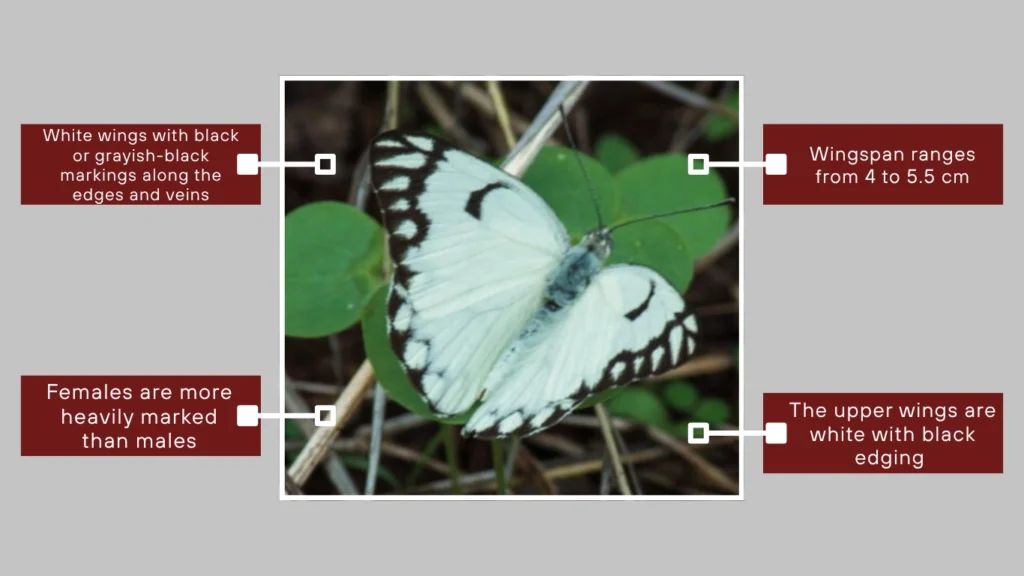
The Pioneer White is a lively butterfly species with clean, bright wings bordered and veined in black. Found across Asia and parts of Africa, it is known for its energetic flight and its attraction to open fields and disturbed ground.
Identification
- White wings with black or grayish-black markings along the edges and veins
- Females are more heavily marked than males
- Wingspan ranges from 4 to 5.5 cm
Color Pattern
The upper wings are white with black edging and bold black veins running through the forewings. In females, these markings may appear thicker and more smudged. The hindwings are usually clearer, adding to the contrast. The underside often has a creamy or yellow wash with faint outlines.
Behavior & Season
Seen all year round in warm, open areas including fields, farmland, roadsides, and wastelands. Flies in quick bursts, often landing on low vegetation or damp ground. Very social and often appears in groups near flowering herbs or water puddles.
20. Mangrove Tree Nymph
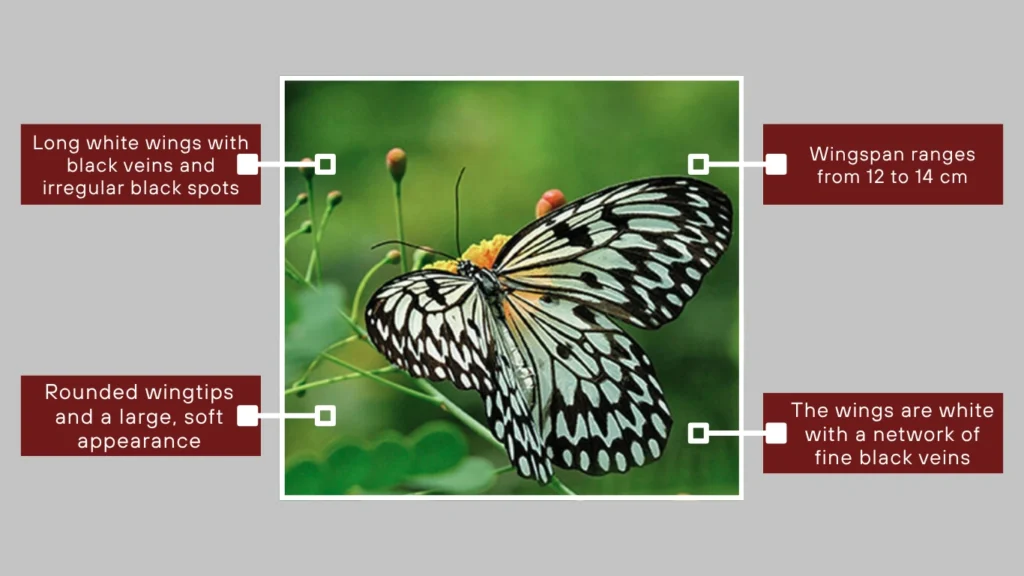
The Mangrove Tree Nymph is a large, slow-flying butterfly found in coastal mangrove forests of Southeast Asia. It is closely related to the Paper Kite butterfly and shares its elegant, floating flight and dramatic black-and-white pattern.
Identification
- Long white wings with black veins and irregular black spots
- Rounded wingtips and a large, soft appearance
- Wingspan ranges from 12 to 14 cm
Color Pattern
The wings are white with a network of fine black veins and rounded black spots, giving a soft, dappled appearance. The wing edges are often speckled, adding to its graceful, cloud-like look. When in motion, the contrast gives an impression of slow-moving lace in the air.
Behavior & Season
Flies year-round in coastal mangrove forests and wetland reserves. Moves with a slow, drifting motion and rarely flutters quickly. It is mildly toxic and relies on its distinct pattern and flight style to deter predators.
21. Painted Jezebel (Some Forms)
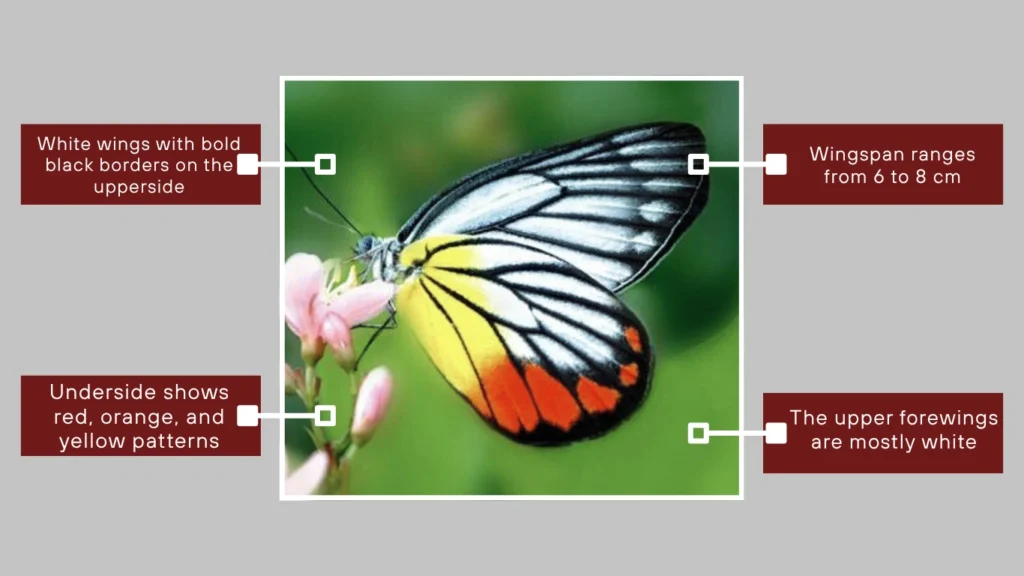
The Painted Jezebel is a colorful butterfly found throughout Asia, best known for its vibrant underside. However, the upperside of some forms presents a distinct black-and-white pattern that makes it visually striking even before the color below is revealed.
Identification
- White wings with bold black borders on the upperside
- Underside shows red, orange, and yellow patterns
- Wingspan ranges from 6 to 8 cm
Color Pattern
The upper forewings are mostly white with thick black borders and dark veins, creating a bold contrast. When the wings are closed, the underside’s vibrant colors become visible. But in flight or when basking, the stark black-and-white top gives it a formal, structured look.
Behavior & Season
Common in gardens, forests, and urban areas. Flies in a fluttery but steady pattern, often feeding on flowering trees like neem and mango. It is active almost all year in warm climates and frequently perches high in trees when not feeding.
22. Himalayan Jezebel
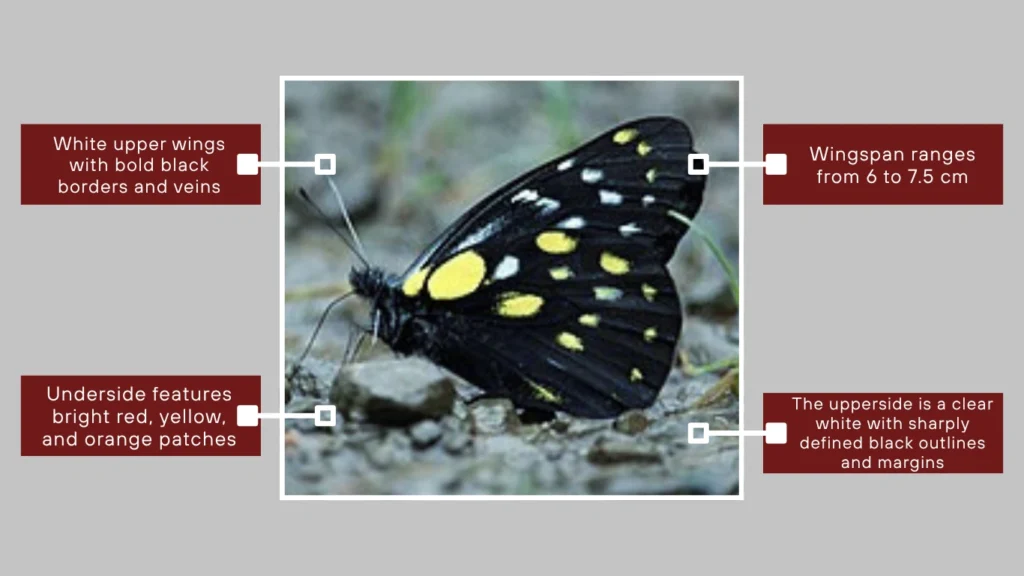
The Himalayan Jezebel is a high-altitude cousin of the Painted Jezebel, found in forested and mountainous regions of the Himalayas. It’s admired for its crisp black-and-white upperside and vibrant underside, making it both elegant and colorful depending on how it’s viewed.
Identification
- White upper wings with bold black borders and veins
- Underside features bright red, yellow, and orange patches
- Wingspan ranges from 6 to 7.5 cm
Color Pattern
The upperside is a clear white with sharply defined black outlines and margins, especially on the forewings. The hindwings are more subdued from the top but reveal vivid warm colors underneath. The contrast between the two sides makes this butterfly especially eye-catching in flight.
Behavior & Season
Flies from spring to autumn in forested slopes and foothills of the Himalayas. It often flies high and glides through sunny clearings, frequently feeding on nectar from flowering trees like rhododendrons and cherry blossoms.
23. Red-spot Sawtooth

The Red-spot Sawtooth is a bright, black-and-white butterfly native to South and Southeast Asia. Though mainly white, it earns its name from the small red spot on the hindwing underside and its jagged, “sawtooth” wing shape.
Identification
- White wings with bold black edges and dark veins
- Small red or pinkish spot on underside of hindwing
- Wingspan ranges from 6 to 7.5 cm
Color Pattern
The wings are bright white with thick, black outer borders and prominent black veins, especially on the forewings. The hindwings have a scalloped shape and sometimes faint dark edging. The red spot underneath adds a splash of color but is not visible when the wings are open.
Behavior & Season
Flies throughout the year in warm climates, especially in open areas, gardens, and near dry forests. Known for its fast, darting flight and strong attraction to flowering shrubs like lantana and ixora.
24. Dappled White
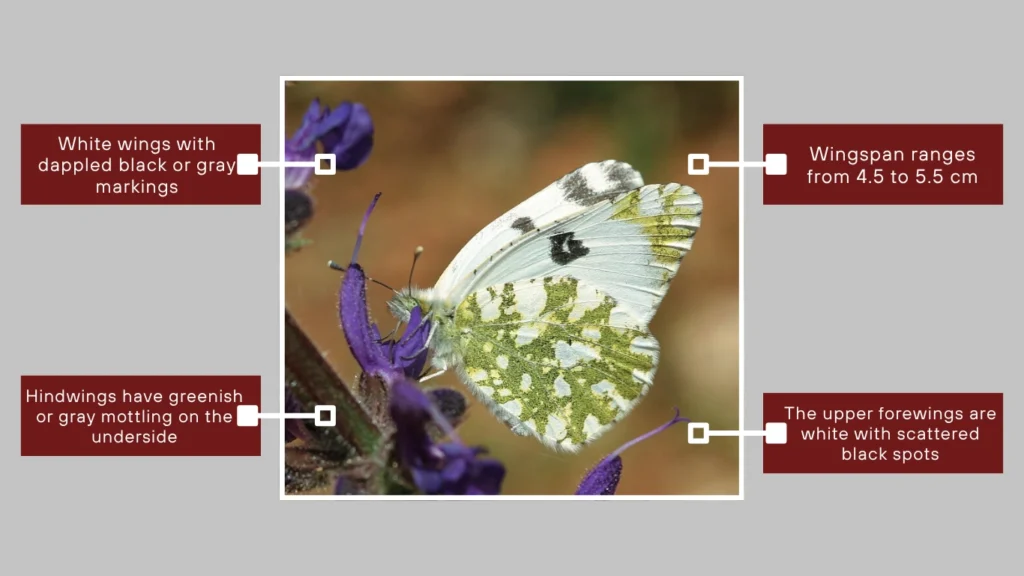
The Dappled White is a charming black-and-white butterfly found across parts of southern Europe, North Africa, and the Middle East. It belongs to the Pieridae family and is known for its mosaic-like wing patterns that help it blend into dry, rocky landscapes.
Identification
- White wings with dappled black or gray markings
- Hindwings have greenish or gray mottling on the underside
- Wingspan ranges from 4.5 to 5.5 cm
Color Pattern
The upper forewings are white with scattered black spots and fine dark markings near the tips. The hindwings may appear plain white above but show a beautiful dappled greenish-gray pattern underneath, which offers excellent camouflage against vegetation and stone.
Behavior & Season
Active from spring to early autumn. Found in dry grasslands, rocky slopes, and scrubby hillsides. Has a fast, erratic flight and usually settles with wings closed to blend into its surroundings.
25. Western White
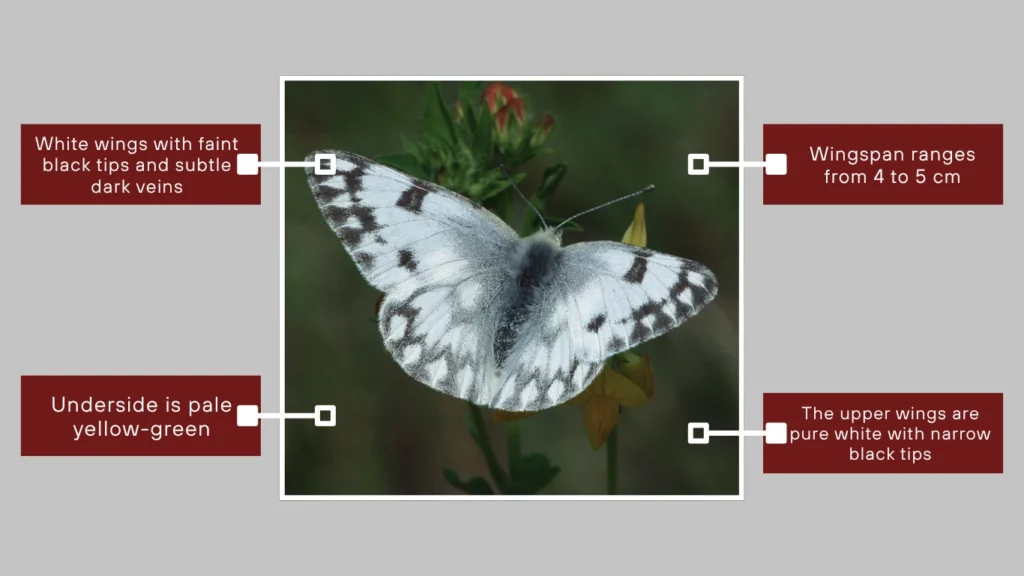
The Western White is a clean, crisp-looking butterfly found across western North America. It looks similar to the more common Cabbage White but features lighter, more delicate markings and prefers wild habitats over gardens.
Identification
- White wings with faint black tips and subtle dark veins
- Underside is pale yellow-green
- Wingspan ranges from 4 to 5 cm
Color Pattern
The upper wings are pure white with narrow black tips and faint veining. Females may have slightly darker markings. The underside of the hindwings is greenish or yellowish, helping it blend into dry grasses and wildflowers.
Behavior & Season
Flies from spring to late summer in meadows, prairies, and sagebrush areas. Moves quickly with short, direct flights and often feeds on native wildflowers like asters and milkweed. Males patrol open areas looking for mates.
26. Green-veined White
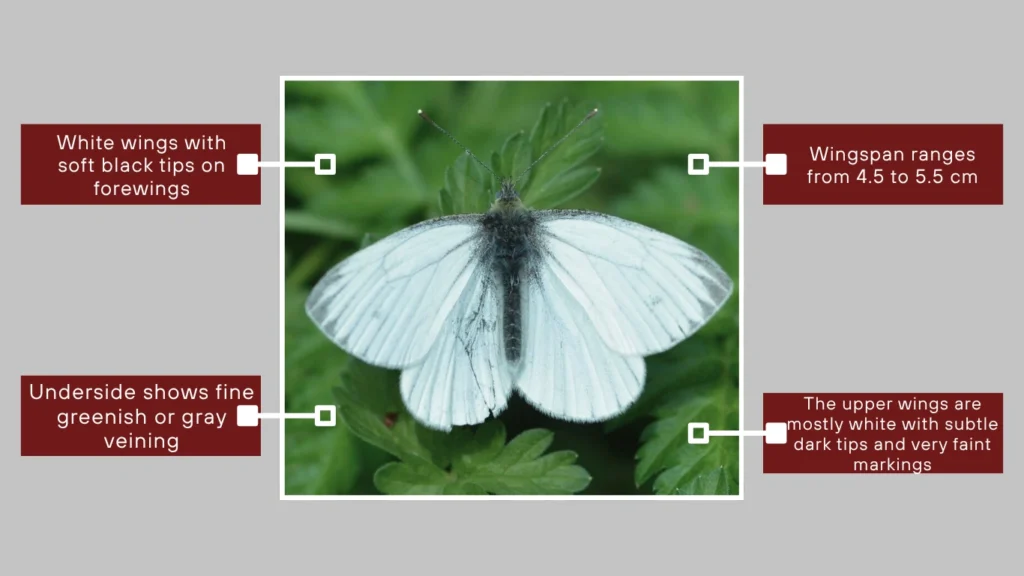
The Green-veined White is a common butterfly in the UK and Europe, often confused with the Small White. Its name comes from the greenish or grayish pattern on the underside of its hindwings, which makes it well-camouflaged in grassy areas.
Identification
- White wings with soft black tips on forewings
- Underside shows fine greenish or gray veining
- Wingspan ranges from 4.5 to 5.5 cm
Color Pattern
The upper wings are mostly white with subtle dark tips and very faint markings. The underside of the hindwings displays intricate greenish-gray veins that resemble leaf structure, offering excellent camouflage among vegetation.
Behavior & Season
Seen from spring through autumn in damp meadows, hedgerows, and woodland edges. It flies low and slowly, frequently stopping to nectar on flowers like dandelion, garlic mustard, and cuckooflower.
27. Wood White
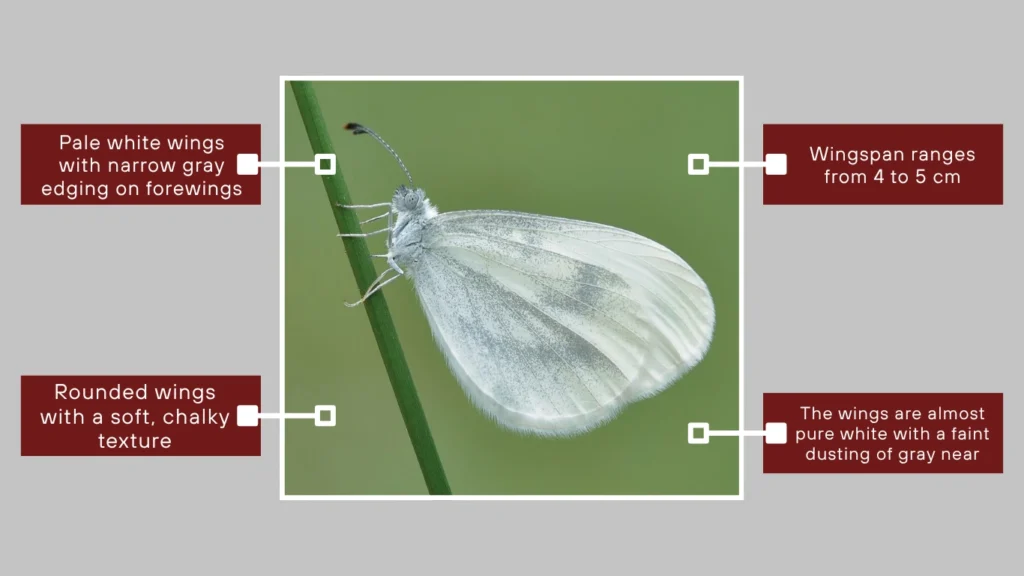
The Wood White is a delicate, ghost-like butterfly found in woodland clearings and grassy glades. Its pale appearance and fluttery flight make it stand out from other white species despite its subtle coloration.
Identification
- Pale white wings with narrow gray edging on forewings
- Rounded wings with a soft, chalky texture
- Wingspan ranges from 4 to 5 cm
Color Pattern
The wings are almost pure white with a faint dusting of gray near the tips and edges. The underside is pale cream or greenish-white, helping it remain hidden when resting among light foliage.
Behavior & Season
Flies slowly and close to the ground, often in shaded woodlands and overgrown paths. Active in late spring and early summer. Males display a characteristic fluttering courtship flight and both sexes feed on flowers like vetch and clover.
28. Black Rajah
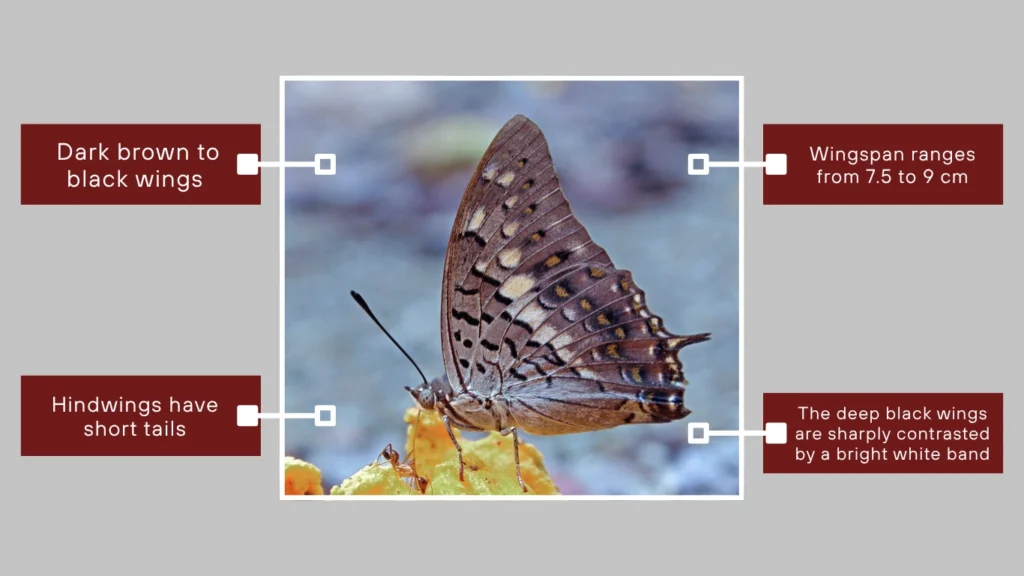
The Black Rajah is a bold and fast-flying butterfly found in South and Southeast Asia. It has a dramatic appearance with black wings lined by sharp white bands and a powerful flight style that makes it hard to miss when passing through tropical forests.
Identification
- Dark brown to black wings with a broad white band across both forewings and hindwings
- Hindwings have short tails
- Wingspan ranges from 7.5 to 9 cm
Color Pattern
The deep black wings are sharply contrasted by a bright white band that stretches diagonally from the forewing into the hindwing. Some individuals may also show faint bluish highlights near the wing base. The underside is paler, often with warm brown and cream tones.
Behavior & Season
Flies from spring to autumn in tropical forests, gardens, and plantations. Strong and rapid in flight, often darting high into the canopy. Frequently feeds on rotting fruit and tree sap rather than nectar.
29. Zebra Mosaic
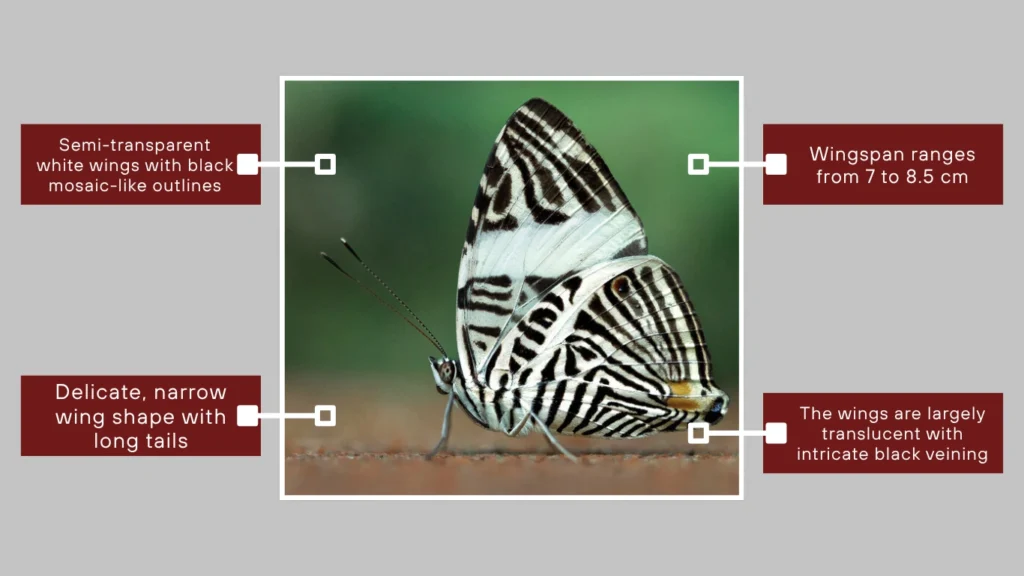
The Zebra Mosaic is an exotic and eye-catching butterfly native to Central and South America. It belongs to the clearwing group but features a distinct black-and-white mosaic pattern that gives it a stained-glass appearance when in motion.
Identification
- Semi-transparent white wings with black mosaic-like outlines
- Delicate, narrow wing shape with long tails
- Wingspan ranges from 7 to 8.5 cm
Color Pattern
The wings are largely translucent with intricate black veining and borders that form a patchwork or mosaic effect. The black outlines are bold and consistent, making it look like a piece of delicate lace when flying in dappled light.
Behavior & Season
Found in tropical rainforests, especially near streams and shaded trails. Flies gracefully and slowly, often gliding through the undergrowth. Prefers humid, forested habitats and is drawn to fermenting fruit and mineral-rich damp patches.
30. Banded Swallowtail

The Banded Swallowtail is a striking butterfly found in South and Southeast Asia. Its unique pattern of bold white bands set against a black background makes it easily recognizable, especially when seen fluttering through tropical forests.
Identification
- Black wings with a pale greenish-white band across both forewings and hindwings
- Hindwings have short, rounded tails
- Wingspan ranges from 7 to 9 cm
Color Pattern
The wings are jet black with a broad, slightly curved pale white to greenish-white band stretching across the middle. The contrast is sharp and clean, making the banded pattern stand out clearly during flight. The underside mirrors the top with subtle variations.
Behavior & Season
Active throughout the year in warm climates, especially in rainforest edges, riverbanks, and plantations. It flies swiftly and erratically, often feeding on nectar from flowering trees and shrubs.
31. Snow Flat
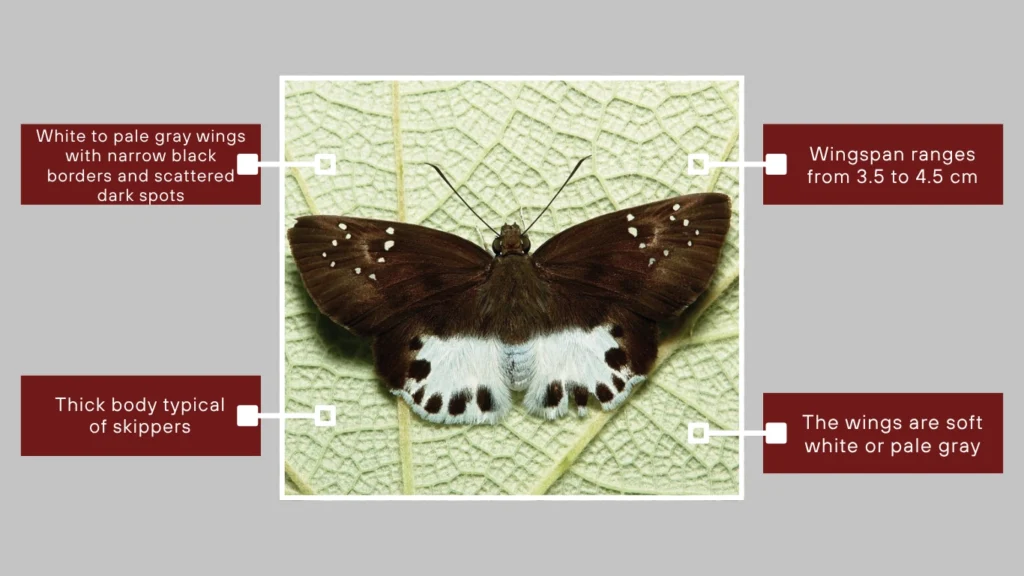
The Snow Flat is a small and fast-flying butterfly belonging to the skipper family, found in South Asia. It gets its name from its pale white wings and flat-winged resting posture.
Identification
- White to pale gray wings with narrow black borders and scattered dark spots
- Thick body typical of skippers
- Wingspan ranges from 3.5 to 4.5 cm
Color Pattern
The wings are soft white or pale gray, bordered with fine black edges and dotted with a few small dark marks. Its subtle color and flattened resting position make it well-camouflaged on rocks, tree trunks, or dry leaves.
Behavior & Season
Flies low and fast, often seen in open patches of forest, grassy trails, or near streams. Rests with wings spread flat, and is more active in early mornings and late afternoons. Often visits moist soil and animal droppings for minerals.
32. Glassy Tiger (Black and White Morph)
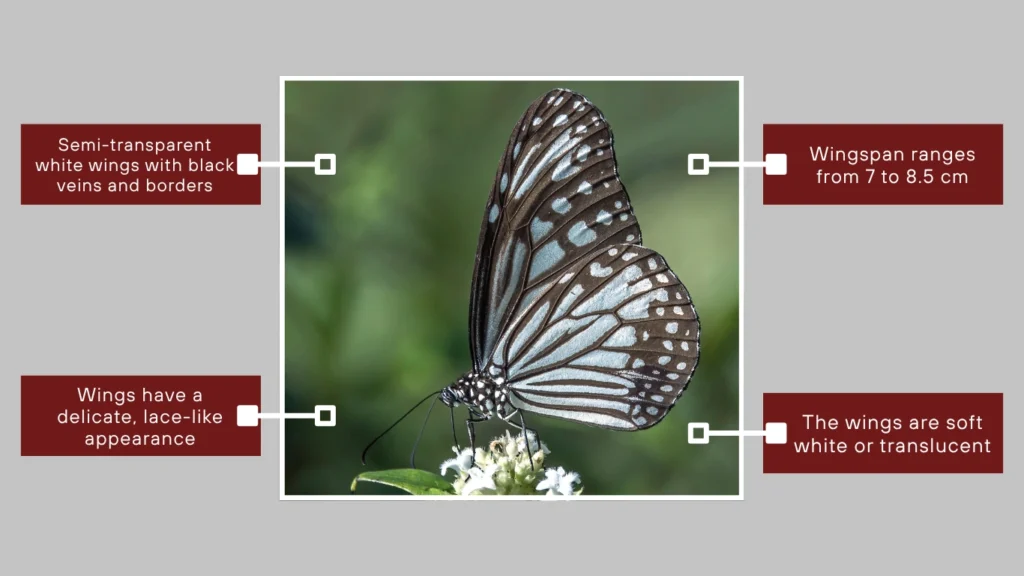
The Glassy Tiger is a graceful butterfly native to South and Southeast Asia, known for its slow, gliding flight. While it’s often associated with bluish hues, some regional or lighting variations display a predominantly black-and-white appearance, making it look elegant and ethereal.
Identification
- Semi-transparent white wings with black veins and borders
- Wings have a delicate, lace-like appearance
- Wingspan ranges from 7 to 8.5 cm
Color Pattern
The wings are soft white or translucent with thick black veins running through them, creating a stained-glass effect. The black outlines are more pronounced in certain morphs or in shadow, giving the butterfly a strong black-and-white appearance in flight.
Behavior & Season
Flies gently and slowly, often gliding more than flapping. Found year-round in gardens, forest edges, and near moist, shady areas. Frequently feeds on flowering plants and is mildly toxic to predators, making its leisurely movement relatively safe.
