

The UK is home to a stunning variety of butterflies, each bringing a splash of color to gardens, meadows, and woodlands. From the bright orange tips of spring to the migrating Painted Ladies of summer, these delicate insects are a joy to observe. In this guide, I’ll walk you through 12 common British butterflies, how to identify them, their habitats, and where you’re most likely to spot them.
1. Red Admiral

The Red Admiral is one of the most eye-catching butterflies found in the UK. Known for its vivid black, red, and white wing pattern, it frequently visits gardens, parks, and woodlands. This species is admired for its strong flight and is commonly seen from spring to late autumn.
Identification
- Wingspan: Around 64–72 mm
- Upper wings: Black with bright red bands and white spots
- Underwings: Mottled brown and gray for camouflage
- Body: Dark brown to black with fine hairs
Habitat
It thrives in a variety of environments, including gardens, woodland edges, hedgerows, and coastal areas.
Behavior
The Red Admiral is migratory and arrives from southern Europe each spring. It is often seen basking in sunny spots and feeding on nectar or fallen fruits.
Region
Widespread throughout the United Kingdom, including England, Scotland, Wales, and Northern Ireland. It is especially common in southern regions but can be found almost anywhere during warmer months.
2. Peacock
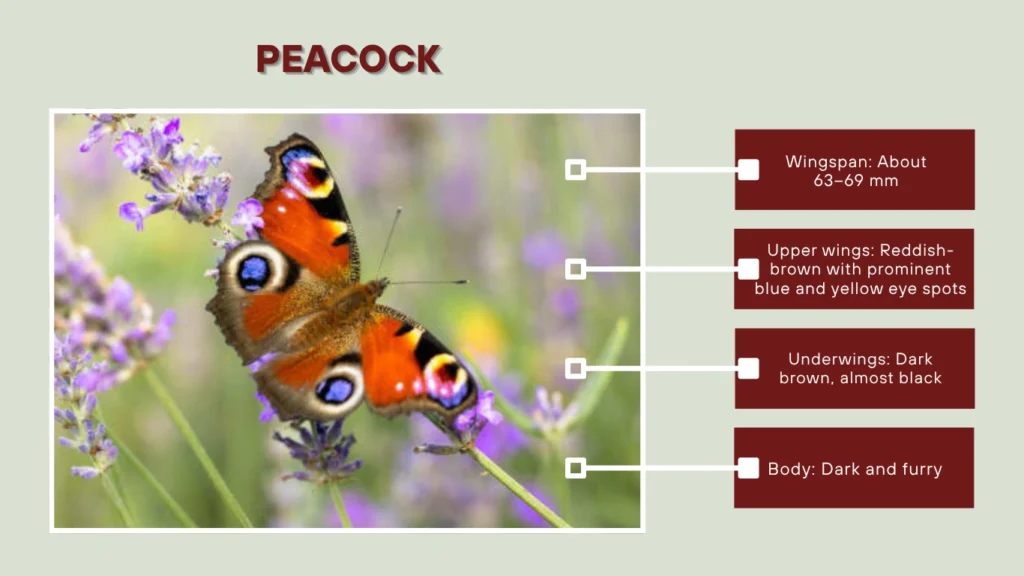
The Peacock butterfly is easily recognized by its large, eye-like spots on each wing, which serve as a defense mechanism against predators. It’s a frequent visitor in British gardens and often one of the earliest butterflies to appear after winter.
Identification
- Wingspan: About 63–69 mm
- Upper wings: Reddish-brown with prominent blue and yellow eye spots
- Underwings: Dark brown, almost black
- Body: Dark and furry
Habitat
Prefers open countryside, woodland clearings, parks, and gardens, especially where nettles grow for its caterpillars.
Behavior
Peacock butterflies hibernate during the winter in sheltered spots like sheds or tree hollows and reappear in early spring.
Region
Common throughout the UK, including England, Wales, Scotland, and Northern Ireland, with higher populations in southern and central areas.
3. Small Tortoiseshell

The Small Tortoiseshell is one of the UK’s most familiar butterflies, known for its bright colors and high-energy flight. It’s often found around homes, flowerbeds, and wild patches, bringing vibrant life to British gardens.
Identification
- Wingspan: Around 45–62 mm
- Upper wings: Orange and black with blue spots along the edges
- Underwings: Dark and mottled for camouflage
- Body: Dark and furry
Habitat
Found in gardens, grasslands, and urban areas with access to flowering plants and nettles for larvae.
Behavior
This species is territorial and active, often basking in the sun or feeding on nectar-rich flowers. It also overwinters in sheltered places.
Region
Widespread across the UK, especially common in England and Wales, but also present in suitable habitats in Scotland and Northern Ireland.
4. Comma

The Comma butterfly is named after the small white ‘comma’-shaped mark on the underside of its wings. Its ragged wing edges and deep orange coloring make it stand out. It’s one of the UK’s early spring butterflies, often seen basking in the sun.
Identification
- Wingspan: Around 50–64 mm
- Upper wings: Bright orange with black spots and scalloped edges
- Underwings: Brown and bark-like with a pale comma mark
- Body: Medium-sized and covered in fine hairs
Habitat
Prefers woodland edges, hedgerows, gardens, and sunny clearings, especially where nettles and hop plants grow.
Behavior
The Comma is known for its sunbathing habits. It hibernates through winter in dry, sheltered places and reappears in early spring.
Region
Widespread in southern and central England and Wales, increasingly seen in parts of Scotland and Northern Ireland due to climate changes.
5. Painted Lady

The Painted Lady is a long-distance migrant known for traveling thousands of miles from North Africa to the UK each summer. Its peach-orange wings and strong flight make it one of the most well-traveled butterflies in Britain.
Identification
- Wingspan: Around 58–74 mm
- Upper wings: Orange with black and white spots
- Underwings: Mottled brown and pinkish with several small eye spots
- Body: Slim and light brown
Habitat
Found in open landscapes, gardens, coastal cliffs, meadows, and even urban areas.
Behavior
It is a powerful flyer and can appear in large numbers during migration years. It does not survive the British winter but repopulates annually.
Region
Spotted across the UK, particularly in southern and eastern England, though it can be found almost everywhere during peak migration seasons.
6. Brimstone
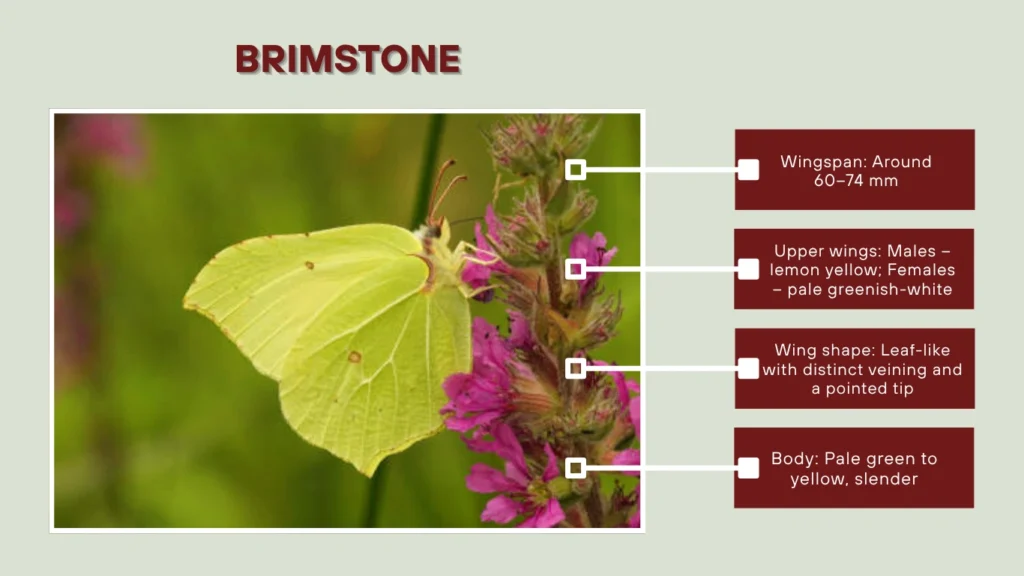
The Brimstone butterfly is often credited as the first butterfly of spring in the UK. Males are a bright yellow, while females are much paler, almost white. Its distinctive leaf-shaped wings provide excellent camouflage when resting among foliage.
Identification
- Wingspan: Around 60–74 mm
- Upper wings: Males – lemon yellow; Females – pale greenish-white
- Wing shape: Leaf-like with distinct veining and a pointed tip
- Body: Pale green to yellow, slender
Habitat
Typically found in woodland edges, hedgerows, scrub, and country lanes, especially where buckthorn plants grow, as they serve as larval food sources.
Behavior
Brimstones are strong, long-lived butterflies. They hibernate through winter and are often the first seen in early spring, flying in a zigzag pattern through sunny clearings.
Region
Widespread in southern and central England and Wales. Less common in Scotland and Northern Ireland due to the limited distribution of buckthorn.
7. Small White
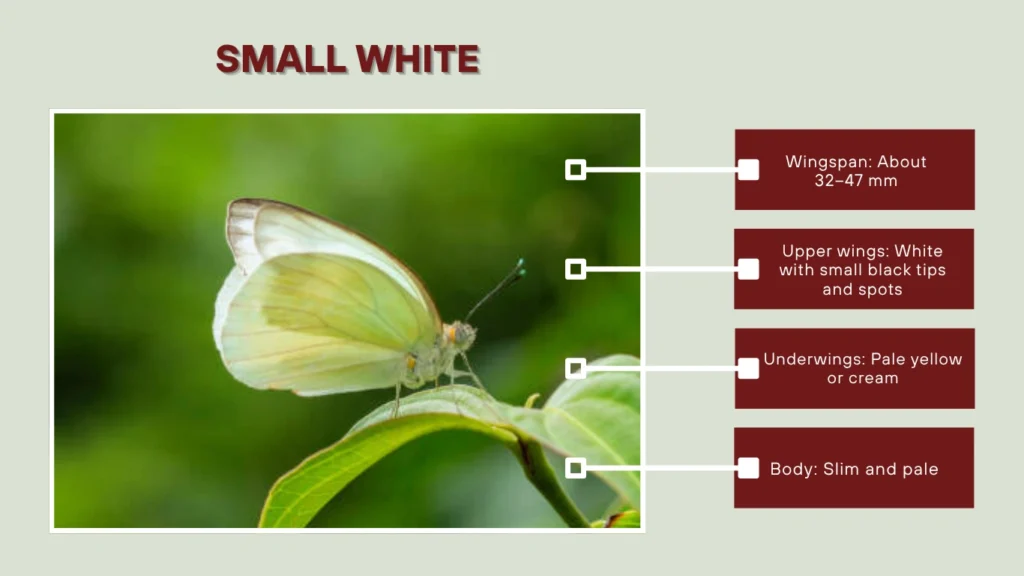
The Small White, often nicknamed the “Cabbage White,” is a common butterfly across British gardens and allotments. It’s known for its affinity for brassica plants and is frequently seen fluttering in open spaces during spring and summer.
Identification
- Wingspan: About 32–47 mm
- Upper wings: White with small black tips and spots (females have two black spots; males usually have one or none)
- Underwings: Pale yellow or cream
- Body: Slim and pale
Habitat
Occurs in gardens, farmland, grasslands, parks, and allotments—anywhere its host plants, like cabbages and nasturtiums, are grown.
Behavior
This species has multiple broods per year. It’s a strong flyer and often seen in pairs during mating or near vegetable patches where it lays eggs.
Region
Abundant and widespread throughout the UK, including England, Wales, Scotland, and Northern Ireland, even in urban centers.
8. Large White
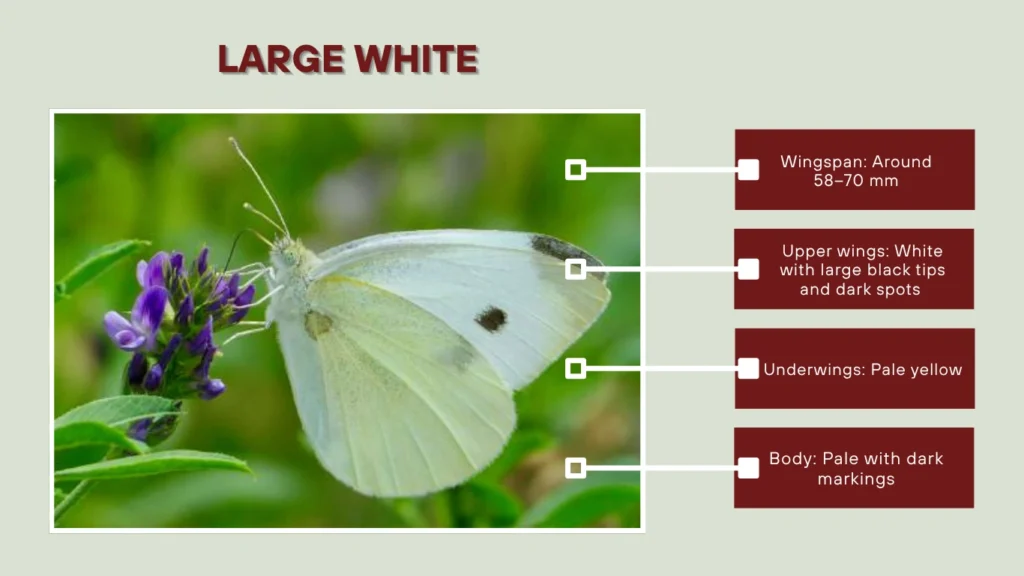
The Large White is another familiar garden butterfly often confused with the Small White. It’s bigger and bolder, and its caterpillars are known to feed on cabbages and other brassicas, making it a common sight in both rural and urban areas.
Identification
- Wingspan: Around 58–70 mm
- Upper wings: White with large black tips and dark spots (females have two black spots; males usually lack them)
- Underwings: Pale yellow
- Body: Pale with dark markings
Habitat
Thrives in gardens, allotments, meadows, hedgerows, and farmland—anywhere cruciferous plants are available for caterpillars.
Behavior
Highly mobile and often seen gliding through open areas. Known for laying large clutches of eggs and its caterpillars feeding in groups.
Region
Widespread and common across the UK, including England, Wales, Scotland, and Northern Ireland. More abundant in lowland areas and cities.
9. Speckled Wood
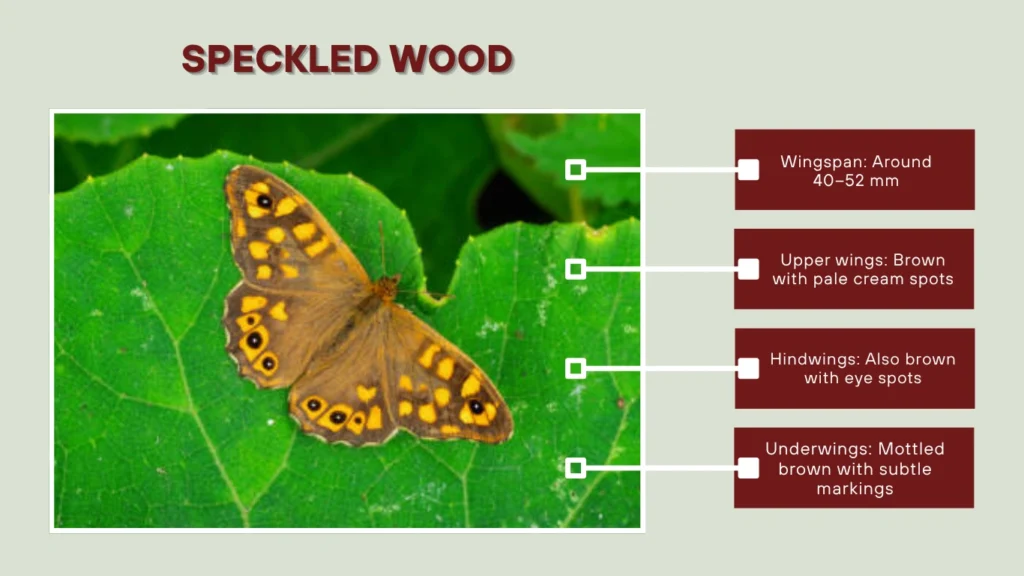
The Speckled Wood is a woodland butterfly that prefers shady areas with dappled sunlight. It has brown wings with creamy spots, helping it blend into its surroundings. It’s one of the few butterflies that can be seen throughout much of the summer and early autumn.
Identification
- Wingspan: Around 40–52 mm
- Upper wings: Brown with pale cream spots
- Hindwings: Also brown with eye spots
- Underwings: Mottled brown with subtle markings
- Body: Dark brown and furry
Habitat
Found mostly in woodland paths, glades, and shaded gardens, especially where there’s a mix of grass and scattered trees.
Behavior
Unique for preferring shaded areas. Males are territorial and perform spiraling flight displays. Often seen perching in sunny patches within woods.
Region
Common in England and Wales, especially in southern regions. Expanding its range in Scotland and parts of Northern Ireland as climate warms.
10. Common Blue

The Common Blue is the most widespread blue butterfly in Britain. Males are a brilliant sky blue, while females are more brown with hints of blue. It’s often seen in grassy places with plenty of wildflowers.
Identification
- Wingspan: Around 29–36 mm
- Males: Bright blue upper wings with thin black edges
- Females: Brown wings with orange spots and some blue scaling
- Underwings: Pale brown-gray with black and orange spots
- Body: Slender and covered in fine scales
Habitat
Prefers grasslands, meadows, road verges, coastal dunes, and wildflower-rich urban areas. Its caterpillars feed on clovers, bird’s-foot trefoil, and other legumes.
Behavior
Flies low over vegetation in search of nectar. Males patrol for females, while females often remain more hidden. It can produce two or more broods per year in southern areas.
Region
Widespread throughout the UK, especially in southern England and Wales, but also found in suitable grassland habitats in Scotland and Northern Ireland.
11. Holly Blue

The Holly Blue is a dainty butterfly often seen fluttering around holly and ivy bushes. Unlike the Common Blue, it tends to fly high and is more commonly spotted in suburban gardens and woodland edges.
Identification
- Wingspan: Around 26–34 mm
- Upper wings: Males – pale silvery-blue; Females – blue with a dark border
- Underwings: Pale grayish-blue with small black dots
- Body: Small and smooth
Habitat
Often found in gardens, parks, churchyards, and woodland edges where holly and ivy grow. Caterpillars feed on the flower buds of these plants.
Behavior
Has two broods per year—spring and late summer—using holly in spring and ivy in summer for laying eggs. Often seen flying around shrubs and hedges.
Region
Common in southern and central England and Wales, expanding into parts of northern England and Northern Ireland. Less frequent in most parts of Scotland.
12. Orange-tip

The Orange-tip is one of the first butterflies to signal the arrival of spring in the UK. Males are easy to recognize with their bright orange wingtips, while females lack the orange, making them trickier to identify.
Identification
- Wingspan: Around 45–52 mm
- Males: White with vivid orange tips on the forewings
- Females: Plain white with black wing tips (no orange)
- Underwings: Greenish marbled pattern, great for camouflage
- Body: Slender and pale
Habitat
Prefers damp meadows, hedgerows, woodland rides, and roadside verges—especially where cuckooflower and garlic mustard grow.
Behavior
Males are very active and patrol for females in the spring sunshine. Caterpillars feed on wild crucifers, and the species has a single brood per year.
Region
Widespread throughout England and Wales in spring and early summer. Also found in southern Scotland and parts of Northern Ireland, but less common in the far north.
Here are 5 FAQs related to British butterflies:
FAQs
When is the best time to see butterflies in the UK?
The best time to see butterflies in the UK is from late spring to early autumn, typically between April and September. Some species, like the Brimstone and Peacock, may appear as early as March during warm spells.
What plants attract butterflies to gardens?
Butterflies are attracted to nectar-rich flowers such as buddleia, lavender, marjoram, verbena, and red valerian. Native wildflowers and host plants like nettles, clovers, and garlic mustard are also important for caterpillars.
How can I help protect butterfly populations?
You can help by planting butterfly-friendly plants, avoiding pesticides, leaving wild areas in your garden, and supporting conservation organizations that protect natural habitats.
Are all British butterflies native to the UK?
Most butterflies seen in the UK are native, but a few, like the Painted Lady, are migratory and travel thousands of miles from regions like North Africa and southern Europe each year.
Why are some butterfly populations declining in the UK?
Habitat loss, pesticide use, climate change, and pollution are major reasons for butterfly decline. Conservation efforts aim to restore habitats and promote awareness about their importance in ecosystems.
