

Termites can silently destroy your home from the inside out, making early and effective treatment essential. Whether you’re dealing with drywood or subterranean termites, knowing the most reliable solutions can save you time, money, and structural damage. In this guide, we’ll explore seven proven termite treatment methods—ranging from chemical barriers to eco-friendly options—that professionals and homeowners alike use to eliminate infestations and protect properties long-term.
1. Liquid Termiticides
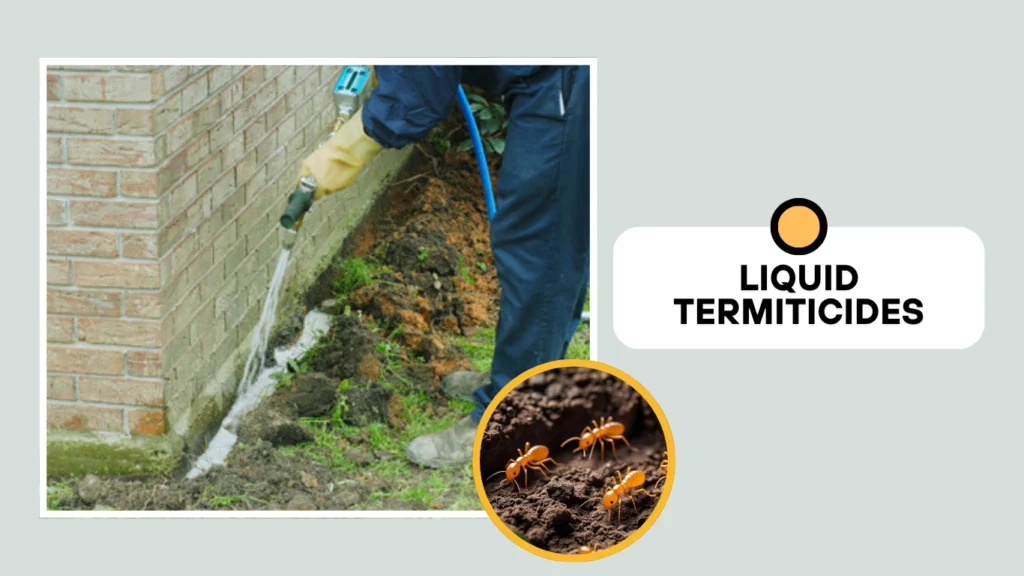
What Are Liquid Termiticides?
Liquid termiticides are chemical solutions specially formulated to protect structures from termites. They are applied directly into the soil to create a long-lasting chemical barrier around your home. This barrier either kills termites upon contact or allows them to carry the poison back to the colony, effectively eliminating the infestation over time.
How It Works
When termites try to move through the treated soil, they either die from direct exposure or unknowingly spread the toxic chemical to other members of their colony. Non-repellent termiticides (such as fipronil or imidacloprid) are especially effective because termites can’t detect them and will continue to forage, allowing the poison to spread throughout the colony.
Application Method (In Detail)
- Inspection and Planning
Professionals begin by inspecting the property to identify termite activity, wood-to-soil contact points, and vulnerable areas like foundation gaps, slab edges, and entry points. - Digging a Trench
A shallow trench, usually 6 inches wide and 6 inches deep, is dug along the perimeter of the foundation. This allows the termiticide to saturate the surrounding soil, forming a continuous barrier. - Drilling in Concrete Zones
Where soil isn’t accessible—such as driveways, patios, or walkways—holes are drilled at 12–18-inch intervals to inject the solution beneath concrete slabs or tiles. - Applying the Termiticide
A high-volume termiticide solution (typically 4 gallons per 10 linear feet) is poured into the trench and/or injected into the drilled holes using a pressure sprayer or injector tool. This saturates the soil and establishes a protective barrier. - Backfilling the Trench
After treatment, the soil removed from the trench is mixed with additional termiticide and then returned to its original position. This ensures a seamless treated zone with no gaps. - Sealing and Cleanup
All drill holes are patched with mortar or concrete, and the area is cleaned up to restore the original appearance. - Monitoring
Follow-up inspections are often scheduled to confirm effectiveness, check for re-entry points, and ensure no new termite activity has developed.
Advantages
- Offers long-term protection—some formulas last up to 10 years.
- Creates a reliable barrier to block subterranean termites.
- Non-repellent types can eliminate entire colonies over time.
Considerations
- Professional application is recommended for safe and even coverage.
- Less effective for drywood termites living above ground.
- Requires proper soil moisture and structure conditions for best results.
2. Termite Baits
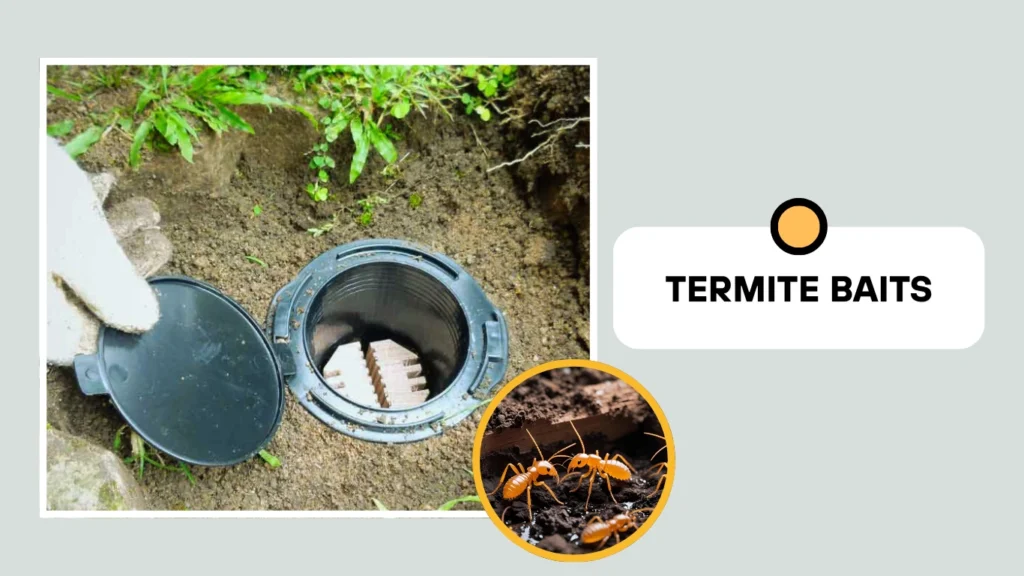
What Are Termite Baits?
Termite baits are a modern, low-toxicity method of termite control. These are slow-acting toxic substances placed in stations around your property to attract and poison termites. The goal is to let foraging termites feed on the bait, carry it back to their colony, and spread the poison to others, eventually collapsing the entire population.
How It Works
Bait stations contain a cellulose-based material laced with a slow-acting insect growth regulator (IGR) or toxicant. Termites consume the bait and return to the nest to share it through grooming and feeding behaviors. Over time, this disrupts their growth and reproduction cycles, wiping out the colony without the need for aggressive soil treatment.
Application Method (In Detail)
- Site Inspection
Pest control professionals inspect the perimeter of your home to determine termite hotspots and place bait stations accordingly—typically every 10 to 20 feet around the foundation. - Installing Bait Stations
Small holes are drilled into the ground, and plastic bait stations are inserted flush with the soil surface. These stations are designed to be discreet and tamper-resistant, making them safe for pets and children. - Pre-Baiting (Optional)
In some systems, non-toxic wood or cellulose is initially placed to encourage termite feeding before switching to a toxic bait. This helps detect active termite paths and ensures higher bait acceptance. - Switching to Toxic Bait
Once termite activity is confirmed, the stations are replaced with a cartridge containing the active toxic bait (e.g., noviflumuron or hexaflumuron). Foraging termites begin consuming and distributing it throughout the colony. - Regular Monitoring
Pest control teams monitor the stations every few weeks or months to check for activity, replenish bait, or adjust placement based on termite patterns. This ensures consistent pressure on the colony. - Continued Use for Prevention
Even after termite activity stops, the bait stations are often left in place as a preventive measure to intercept any new termite infestations early.
Advantages
- Eliminates the entire colony over time.
- Non-invasive and doesn’t require trenching or drilling.
- Safe for families, pets, and the environment.
- Excellent for long-term termite monitoring and control.
Considerations
- Slower than liquid treatments—can take weeks or months.
- Requires regular maintenance and monitoring.
- May be less effective if not placed correctly or if termites reject the bait.
3. Boric Acid Treatment
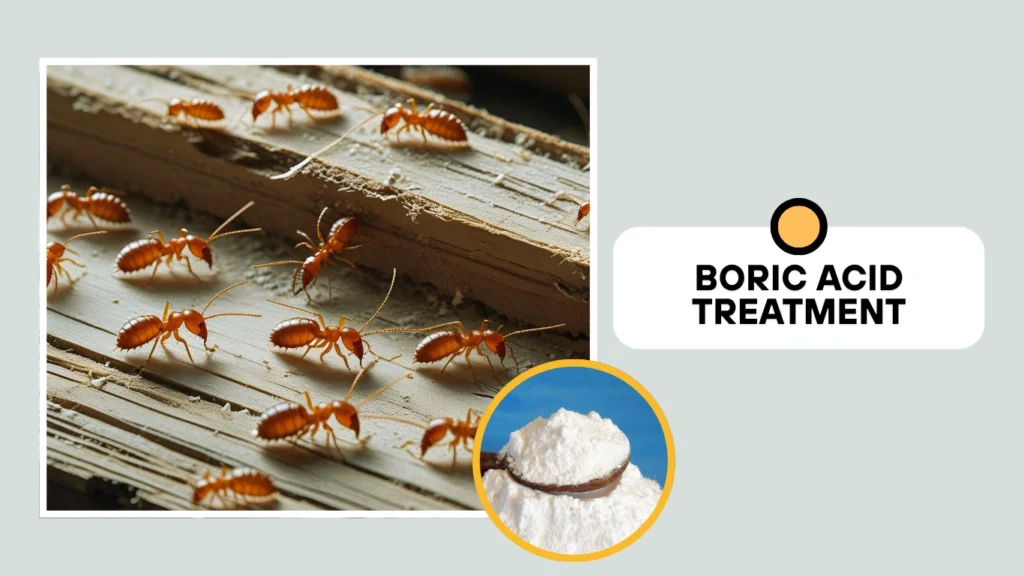
What Is Boric Acid Treatment?
Boric acid is a naturally occurring compound that acts as a slow-acting poison for termites. When ingested, it interferes with their digestive system and kills them over time. It is commonly used as a dust, spray, or wood treatment to control drywood and subterranean termites in localized areas.
How It Works
Boric acid works by attacking the termite’s nervous and digestive systems. When termites crawl through or feed on treated wood or dusted surfaces, they ingest the poison and carry it back to the colony. Over time, the spreading effect can help eliminate small infestations and act as a barrier to future activity.
Application Method (In Detail)
- Identify Infested Areas
Pinpoint the affected locations such as wooden beams, walls, furniture, or door frames. Look for signs like mud tubes, hollow-sounding wood, or termite droppings (frass). - Drilling Small Holes
In the case of internal infestations, small holes (1/8 to 1/4 inch) are drilled into the affected wood every 6–8 inches. These holes allow direct access to termite galleries. - Injecting Boric Acid Powder
Using a duster or puffer tool, boric acid powder is puffed into the drilled holes and wall voids. Alternatively, liquid formulations can be sprayed on wood surfaces to soak into the grain. - Sealing and Cleaning
After application, the holes are sealed with wood filler or plugs. Any excess powder is cleaned from surfaces, especially in living areas where pets or people may come into contact. - Repeat As Needed
Multiple applications may be required over weeks for complete control. It’s best used in conjunction with other treatments for large or well-established infestations.
Advantages
- Affordable and widely available.
- Works well for localized drywood termite problems.
- Non-toxic to humans and pets when used properly.
- Also effective against ants and other pests.
Considerations
- Not suitable for large-scale subterranean infestations.
- Slower acting than professional-grade termiticides.
- Requires precise application to active infestation sites.
- May need repeated treatments to achieve full control.
4. Orange Oil Treatment
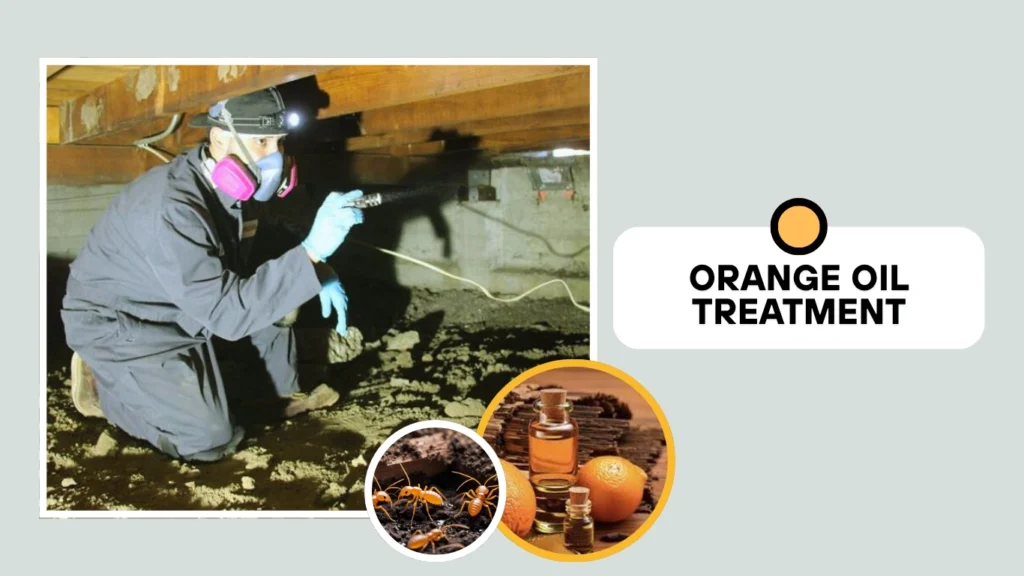
What Is Orange Oil Treatment?
Orange oil is an eco-friendly termite treatment derived from orange peels. The active compound, d-limonene, is toxic to termites but safe for humans and pets when used properly. It’s primarily used to treat drywood termites in localized infestations and works both on contact and through ingestion.
How It Works
When orange oil is injected into infested wood, it kills termites by dissolving their exoskeletons and disrupting their internal cell membranes. It also has a drying effect, which causes termites to die from dehydration. The oil doesn’t just kill on contact—residual traces may help reduce the population further over time.
Application Method (In Detail)
- Locate the Infestation
Technicians inspect wooden structures like baseboards, window frames, and furniture to identify termite galleries and drill points. - Drill Access Holes
Small holes are drilled directly into termite-infested wood at regular intervals (every 4–8 inches) to allow the orange oil to reach internal galleries where termites live and feed. - Inject Orange Oil
Using a syringe or injector, orange oil is applied into each drilled hole. The oil spreads through the tunnels, killing termites it contacts. This is often done with multiple applications depending on the severity. - Seal and Restore
After treatment, holes are filled with wood filler, and any visible damage is repaired. Orange oil leaves a citrus scent, which fades after a few days. - Monitor Activity
Follow-up inspections are conducted within a few weeks to assess success and determine if further treatment is necessary.
Advantages
- Natural and environmentally friendly.
- Effective for spot treatments of drywood termites.
- Leaves no toxic residue—safe for indoor use.
- Adds a pleasant citrus scent (temporarily).
Considerations
- Only works on localized, visible infestations—doesn’t penetrate deep or hidden colonies.
- Not suitable for subterranean termites.
- Requires skilled application for best results.
- May need repeat treatments to ensure effectiveness.
5. Heat Treatment
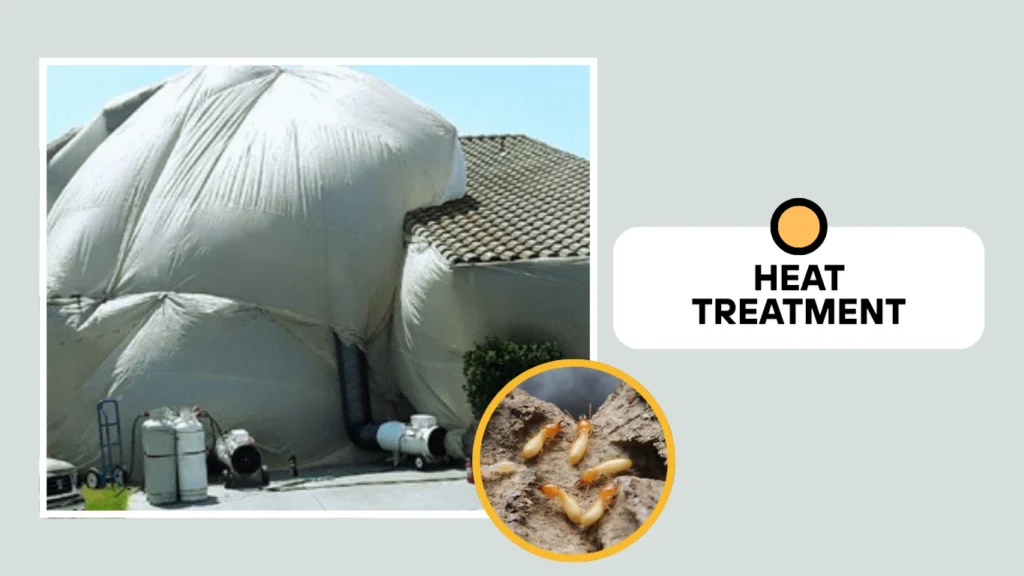
What Is Heat Treatment?
Heat treatment is a chemical-free method used to kill termites by exposing them to high temperatures. This method is especially effective against drywood termites living in furniture, walls, or attics. The process involves raising the temperature of the infested area to lethal levels, killing all termites—including eggs and larvae—within the structure.
How It Works
Termites cannot survive when exposed to sustained temperatures above 120°F (49°C). During heat treatment, special heaters and fans are used to distribute hot air throughout the infested space. The heat penetrates wood and wall voids, reaching termites hiding deep inside. This kills them within minutes and leaves no chemical residue behind.
Application Method (In Detail)
- Inspection and Preparation
Professionals inspect the site and identify termite activity. Homeowners are instructed to remove heat-sensitive items like electronics, candles, medications, and pets. - Sealing the Treatment Area
The affected area (such as a room or entire house) is sealed using tarps, insulated barriers, or plastic sheeting to trap heat. Windows and doors may be covered to prevent heat escape. - Setting Up Heaters and Sensors
Industrial-grade heaters are placed strategically to distribute heat evenly. Temperature sensors and thermal monitors are installed inside wood structures and wall voids to ensure all areas reach 120–140°F. - Heating the Space
The temperature is slowly raised and maintained for 30 minutes to over an hour, depending on the infestation size and wood thickness. The heat penetrates deep into the wood to kill hidden termites. - Cool-Down and Ventilation
After the required exposure time, the area is gradually cooled down, and fans are used to ventilate the space. Once the temperature is safe, the home is reoccupied. - Final Inspection
Technicians check treated zones to confirm the kill was successful and advise on any repairs or sealing to prevent re-infestation.
Advantages
- Kills termites at all life stages—including eggs.
- No chemical residue left behind.
- Immediate results with no need for long-term monitoring.
- Safe for use in sensitive environments or around food.
Considerations
- More expensive than chemical treatments.
- Does not offer residual protection—termites can return later.
- Requires professional equipment and trained personnel.
- Not suitable for subterranean termite infestations underground.
6. Fumigation

What Is Fumigation?
Fumigation is a whole-structure termite treatment that uses a lethal gas—commonly sulfuryl fluoride—to penetrate and eliminate drywood termite infestations throughout a building. It is one of the most effective methods for eliminating termites that are hidden deep within walls, floors, or wooden furniture.
How It Works
The entire structure is sealed off, and fumigant gas is released inside. The gas permeates the building, entering wood, cracks, and crevices where termites live. It kills termites by disrupting their respiratory system. After the treatment period, the gas is safely ventilated, and the property is declared safe for re-entry.
Application Method (In Detail)
- Pre-Fumigation Preparation
Homeowners must vacate the property for 2–3 days. All living beings (including pets and plants) are removed. Food, medicine, and anything edible is double-bagged or taken out. Cabinets are opened to allow airflow. - Sealing the Structure
The entire building is tented or sealed using large tarps to contain the gas. The seal ensures that the fumigant reaches all termite-infested zones and maintains concentration during exposure. - Releasing the Gas
Sulfuryl fluoride or another fumigant is pumped into the sealed space. The structure is filled with gas and held at a lethal concentration for a specific period (usually 18–30 hours), depending on temperature and infestation size. - Aeration Process
After the fumigation period, the structure is ventilated thoroughly using fans and open vents. Special clearance devices are used to ensure all gas has dissipated and the air inside is safe to breathe. - Final Inspection and Re-Entry
Licensed professionals test the air quality and give an all-clear notice before the property can be reoccupied. Re-entry is only allowed when gas levels are confirmed to be below the safety threshold.
Advantages
- Reaches every corner of the structure—even hidden infestations.
- Kills all termites, including eggs and larvae.
- Effective for severe, widespread infestations.
- Quick treatment compared to some slow-acting methods.
Considerations
- Requires full evacuation and preparation.
- No residual protection—termites can return later if preventive measures aren’t taken.
- Not effective for subterranean termites unless they’re inside the structure.
- More costly and labor-intensive than spot treatments.
7. Professional Pest Control Services
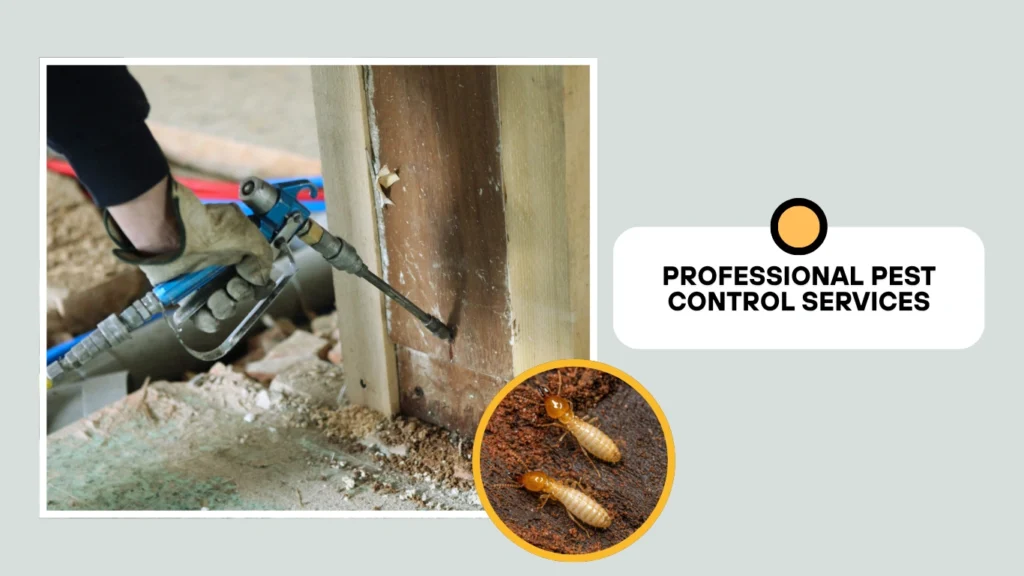
What Are Professional Pest Control Services?
Professional pest control services involve hiring licensed termite specialists to assess, treat, and monitor termite infestations using the most effective tools and techniques. These experts customize treatment plans based on the type of termite, the severity of the infestation, and the structure of the property—ensuring long-term protection and peace of mind.
How It Works
Professionals begin with a comprehensive inspection to identify termite species, damage extent, and access points. Based on their findings, they may apply a combination of liquid termiticides, baits, foam injections, or fumigation. Many services also offer follow-up visits, termite prevention plans, and warranties to protect your home for years.
Application Method (In Detail)
- Initial Inspection
Technicians perform a thorough walk-through, checking crawl spaces, attics, basements, walls, and outdoor soil. They use moisture meters, thermal imaging, or sound detection tools to locate termite activity that’s invisible to the eye. - Customized Treatment Plan
Based on the inspection, a tailored plan is created. It may include spot treatments, trenching, bait station installations, wood treatments, or structural fumigation—depending on the termite type (drywood or subterranean) and location. - Treatment Execution
Licensed experts apply professional-grade products using advanced tools. Unlike DIY treatments, professionals ensure proper chemical dosages, safe handling, and precise placement in critical zones like foundations, voids, or rooflines. - Ongoing Monitoring
Many companies include a monitoring plan with annual inspections or bait station checks. This allows early detection of any new activity and timely re-treatment if needed. - Warranty and Protection
Most professional services offer warranties (e.g., 1–5 years) and re-treatment guarantees. Some even provide damage coverage in case termites return during the warranty period.
Advantages
- Accurate identification and expert handling of infestations.
- Access to powerful, commercial-grade products.
- Long-term prevention plans and warranties available.
- Peace of mind with professional follow-up and safety measures.
Considerations
- Higher upfront cost than DIY treatments.
- Must schedule visits and be available for inspections.
- Quality may vary by company—choose licensed and well-reviewed providers.
