

Earwigs are fascinating insects known for their distinctive pincers and secretive habits. While often misunderstood and wrongly associated with myths, these creatures play vital roles in ecosystems—from decomposing organic matter to preying on garden pests. With over 2,000 species worldwide, earwigs vary in size, color, behavior, and habitat.
In this guide, we’ll explore 10 of the most common types of earwigs found across the globe. For each species, you’ll learn how to identify them, where they live, how they behave, and what they eat.
1. European Earwig (Forficula auricularia)
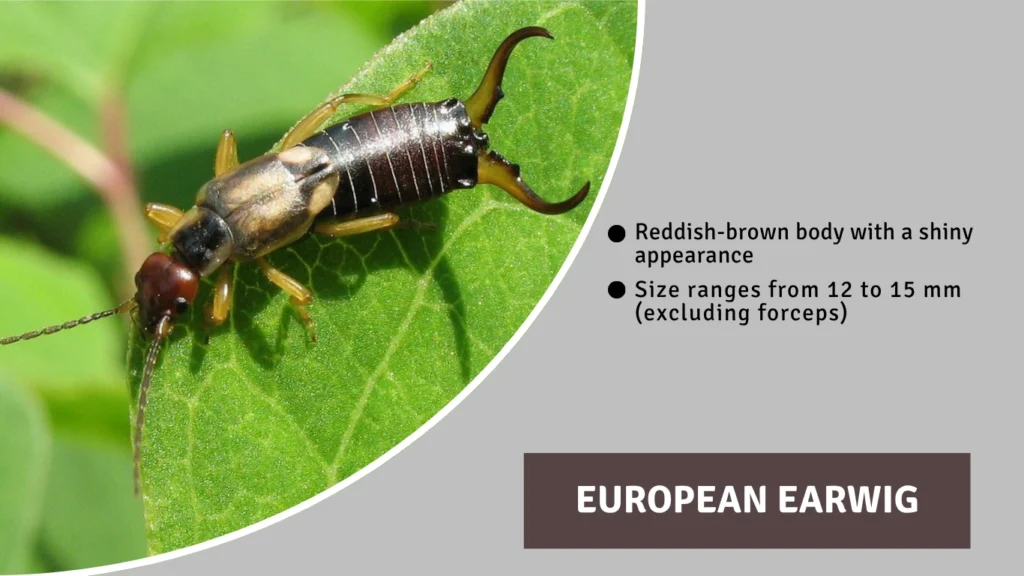
The European earwig is one of the most common and widely distributed earwig species. Originally native to Europe, it has successfully spread to North America and other temperate regions. Recognized by its characteristic pincers and reddish-brown body, this earwig is frequently found in gardens, under debris, or sometimes inside homes.
Identification
- Reddish-brown body with a shiny appearance
- Size ranges from 12 to 15 mm (excluding forceps)
- Males have curved pincers; females have straight ones
- Short, leathery forewings; membranous hindwings folded underneath
- Long, slender antennae with multiple segments
Habitat
European earwigs thrive in moist, sheltered places. During the day, they hide under flowerpots, mulch, stones, bark, and garden debris. They prefer outdoor areas but may enter homes during droughts or cold weather in search of food and humidity.
Behavior
This species is mostly active at night. They are scavengers, often feeding on decaying matter or small insects. European earwigs also exhibit notable maternal care, with females guarding and grooming their eggs and young nymphs until they molt.
Diet
European earwigs are omnivorous and opportunistic feeders. They consume aphids, insect larvae, dead plant material, flowers, fruits, and fungi. In gardens, they can be both beneficial (pest control) and destructive (feeding on young plants).
2. Ring-Legged Earwig (Euborellia annulipes)

The Ring-Legged Earwig is a small, wingless species known for its dark brown to black body and distinctively banded legs. Commonly found in warmer climates, it often inhabits compost piles, mulch, and leaf litter where moisture is retained.
Identification
- Dark brown to nearly black body
- No wings present; completely wingless
- Legs feature noticeable light-colored bands
- Straight pincers in females, slightly curved in males
- Typically measures 8–12 mm in length
Habitat
This species prefers warm, humid environments and is commonly found in gardens, greenhouses, and around rotting organic matter. They are often active beneath rocks, logs, and other ground debris.
Behavior
Ring-Legged Earwigs are nocturnal scavengers. They seek shelter during the day and emerge at night to forage. They don’t fly and rely on crawling to find food. This species often hides in tight crevices and organic waste piles.
Diet
They feed on decaying plant material, soft-bodied insects, and occasionally small larvae or mites. In gardens, they help decompose organic matter but may feed on seedlings or tender plant parts when populations grow large.
3. Seaside Earwig (Anisolabis maritima)

Also known as the Maritime Earwig, the Seaside Earwig is typically found near coastal environments. It has a robust, dark-colored body and strong pincers, adapted for life in sandy or rocky shorelines.
Identification
- Dark brown to black body, somewhat glossy
- Large, powerful forceps with sharp curves (especially in males)
- No wings; flightless
- Body size ranges from 15–25 mm
- Legs are lighter in color compared to body
Habitat
Seaside Earwigs inhabit coastal regions and are commonly found under rocks, driftwood, and seaweed along beaches. They are well-adapted to saline and brackish environments, often burrowing into moist sand.
Behavior
These earwigs are nocturnal and use their pincers both for defense and prey capture. They often burrow or hide in moist areas to avoid dehydration. Though they rarely interact with humans, they may wander into beachside buildings or boats.
Diet
Seaside Earwigs are opportunistic predators and scavengers. Their diet includes small insects, larvae, decaying seaweed, organic beach matter, and occasionally other small invertebrates found in intertidal zones.
4. Striped Earwig (Labidura riparia)

The Striped Earwig is a larger earwig species known for the pale stripe running down its back. It is commonly found in warm climates and is often attracted to lights at night. This species is also known for its strong predatory behavior.
Identification
- Light brown to yellowish body with a dark longitudinal stripe
- Size ranges from 20–25 mm in length
- Well-developed wings, capable of flight
- Robust, slightly curved pincers
- Antennae are long and tapering
Habitat
Striped Earwigs prefer sandy or loose soils near water bodies, such as riversides, lakes, or ditches. They often hide under stones or vegetation and are active in warm weather.
Behavior
This species is a fast-moving and aggressive predator. Unlike many other earwigs, it can fly when disturbed. It burrows into soil or hides in loose debris during the day and comes out at night to hunt.
Diet
Striped Earwigs primarily feed on insects such as caterpillars, fly larvae, and other soft-bodied invertebrates. They may also scavenge decaying organic matter and occasionally nibble on plants.
5. Saint Helena Earwig (Labidura herculeana)

The Saint Helena Earwig, also known as the Giant Earwig, was the largest known earwig species. Native to the island of Saint Helena in the South Atlantic, it is believed to be extinct due to habitat loss and introduced predators.
Identification
- Very large, up to 80 mm in length
- Dark, shiny black body
- Massive, thick pincers, especially in males
- Long legs and antennae
- No confirmed sightings since the 1960s
Habitat
This species was historically found in deep burrows under rocks and boulders on the volcanic slopes of Saint Helena. It preferred dry, rocky areas with minimal vegetation.
Behavior
Little is known about its behavior due to limited sightings. It was believed to be nocturnal and lived in secluded habitats away from human activity.
Diet
The Saint Helena Earwig likely fed on small insects, organic debris, and possibly plant matter. Its large size suggests it could overpower relatively large prey compared to other earwigs.
6. Tawny Earwig (Labidura truncata)

The Tawny Earwig is a common species in parts of Australia and Asia. Known for its yellowish-brown coloration and active predatory behavior, it is often spotted in gardens and agricultural fields where it contributes to pest control.
Identification
- Pale yellow to light brown body
- Size ranges from 18–25 mm
- Well-developed wings; capable of limited flight
- Strong, curved pincers in males
- Flattened head and elongated thorax
Habitat
Tawny Earwigs are typically found in leaf litter, mulch, and under rocks or logs. They prefer warm, moist environments and are often seen in gardens and farmlands.
Behavior
This earwig species is nocturnal and prefers to hide during the day. It emerges at night to hunt and is considered beneficial in agricultural settings due to its diet. It may use its wings to escape threats but rarely flies long distances.
Diet
Tawny Earwigs are active predators of aphids, caterpillars, and other soft-bodied insects. They also consume decomposing plant material and occasionally nibble on young plants if other food is scarce.
7. Shore Earwig (Anisolabis littorea)
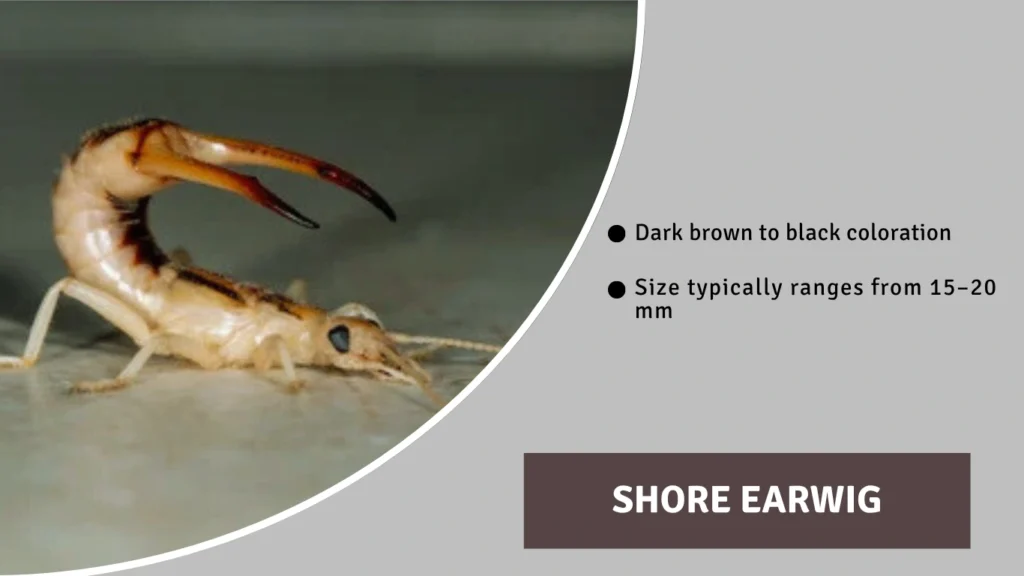
The Shore Earwig is a coastal species found along beaches and shorelines, especially in the Pacific region. It is adapted to sandy environments and often lives in burrows close to the waterline.
Identification
- Dark brown to black coloration
- Size typically ranges from 15–20 mm
- No wings; flightless
- Powerful, curved pincers in males
- Legs and antennae are lighter in contrast to the body
Habitat
Shore Earwigs are found along coastlines, hiding beneath driftwood, stones, and seaweed. They burrow into sand or moist soil to avoid predators and dehydration.
Behavior
These earwigs are reclusive and avoid open spaces during the day. They are nocturnal foragers and may be seen at night near the surf zone. They are strong diggers and often create small tunnels or hideouts in soft sand.
Diet
The Shore Earwig feeds on organic debris, small invertebrates, and decaying marine material such as dead fish or seaweed. Its scavenging helps clean the shoreline ecosystem.
8. Australian Common Earwig (Nala lividipes)

The Australian Common Earwig is widespread across Australia and parts of Southeast Asia. It is known for its adaptability to different environments and is often found in both rural and urban areas.
Identification
- Dark brown to reddish-brown body
- Body length ranges from 12–18 mm
- Straight pincers in females, curved in males
- Lighter-colored legs
- Wings may be present but rarely used for flight
Habitat
This earwig thrives in gardens, under rocks, in compost heaps, and sometimes indoors. It favors moist microhabitats but is adaptable to drier conditions as well.
Behavior
The Australian Common Earwig is nocturnal and often hides during the day in crevices or soil. It can become a minor pest indoors but typically stays outside. It is active after dusk and is attracted to lights.
Diet
This species is omnivorous. It feeds on dead insects, fungi, plant matter, and soft-bodied garden pests such as aphids and larvae. In some cases, it may damage soft fruits and vegetables.
9. African Earwig (Euborellia moesta)
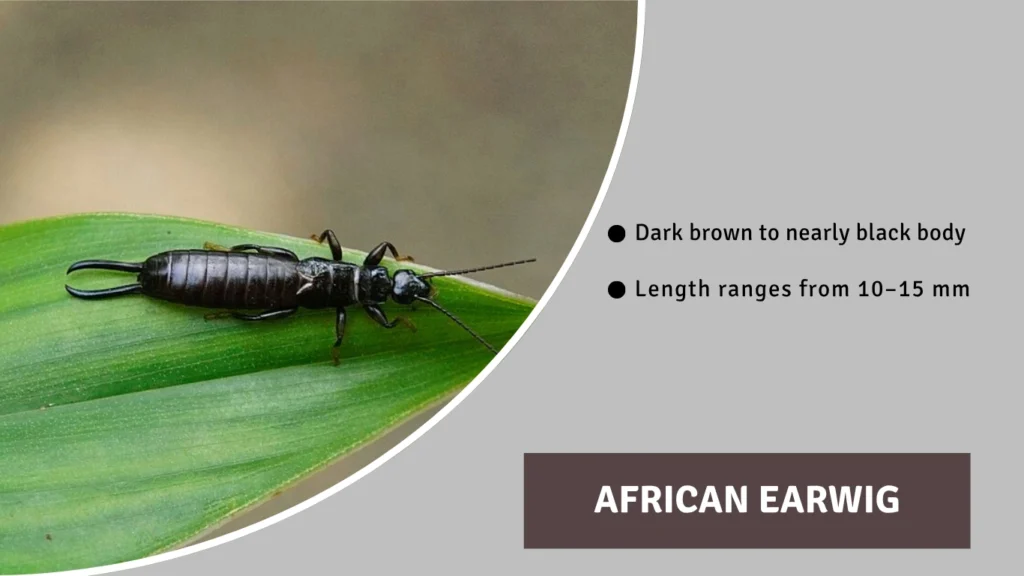
The African Earwig is commonly found in sub-Saharan regions and warm climates. It is wingless, dark in color, and typically inhabits soil-rich environments near decomposing organic matter.
Identification
- Dark brown to nearly black body
- Wingless with a glossy appearance
- Length ranges from 10–15 mm
- Legs are light brown with no banding
- Distinct forceps that are curved in males
Habitat
African Earwigs prefer damp and shaded habitats such as leaf litter, garden soil, compost bins, and decaying wood. They are also found in sugarcane fields and other agricultural zones.
Behavior
They are burrowers and remain hidden during daylight hours. This species does not fly and moves primarily by crawling. It plays a role in breaking down organic waste and is typically non-aggressive.
Diet
African Earwigs consume decomposing plant material, fungi, and small insects. They are beneficial to the soil ecosystem but can become minor pests when populations are high in cultivated areas.
10. Black Earwig (Chelisoches morio)
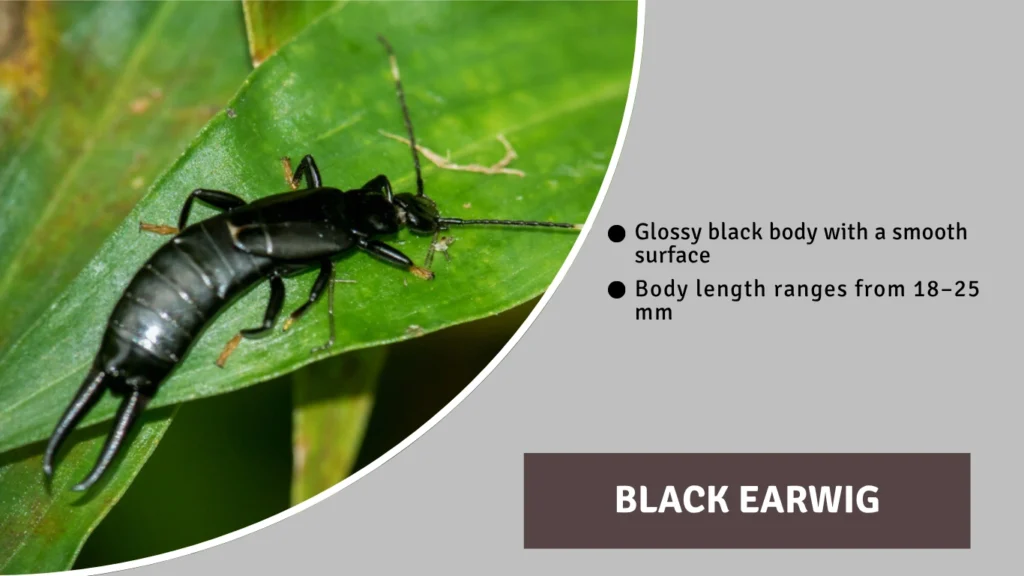
The Black Earwig, also known as the Morion Earwig, is a widespread tropical species recognized for its shiny black body and aggressive predatory behavior. It is often used in biological pest control due to its appetite for garden pests.
Identification
- Glossy black body with a smooth surface
- Body length ranges from 18–25 mm
- Strong, curved pincers in males; straight in females
- Fully winged, but flight is rare
- Brownish legs with a contrasting dark body
Habitat
Black Earwigs are typically found in humid environments such as greenhouses, tropical gardens, banana plantations, and under loose bark or stones. They are especially common in Southeast Asia, Africa, and Pacific islands.
Behavior
This species is highly active at night and known for being an aggressive predator. It hides during the day and is often found in groups. Though capable of flight, it prefers crawling through vegetation and soil.
Diet
Black Earwigs are carnivorous predators. Their diet mainly includes aphids, caterpillars, fruit fly larvae, and other soft-bodied insects. Because of this, they are considered beneficial in pest control, especially in banana and vegetable crops.
