
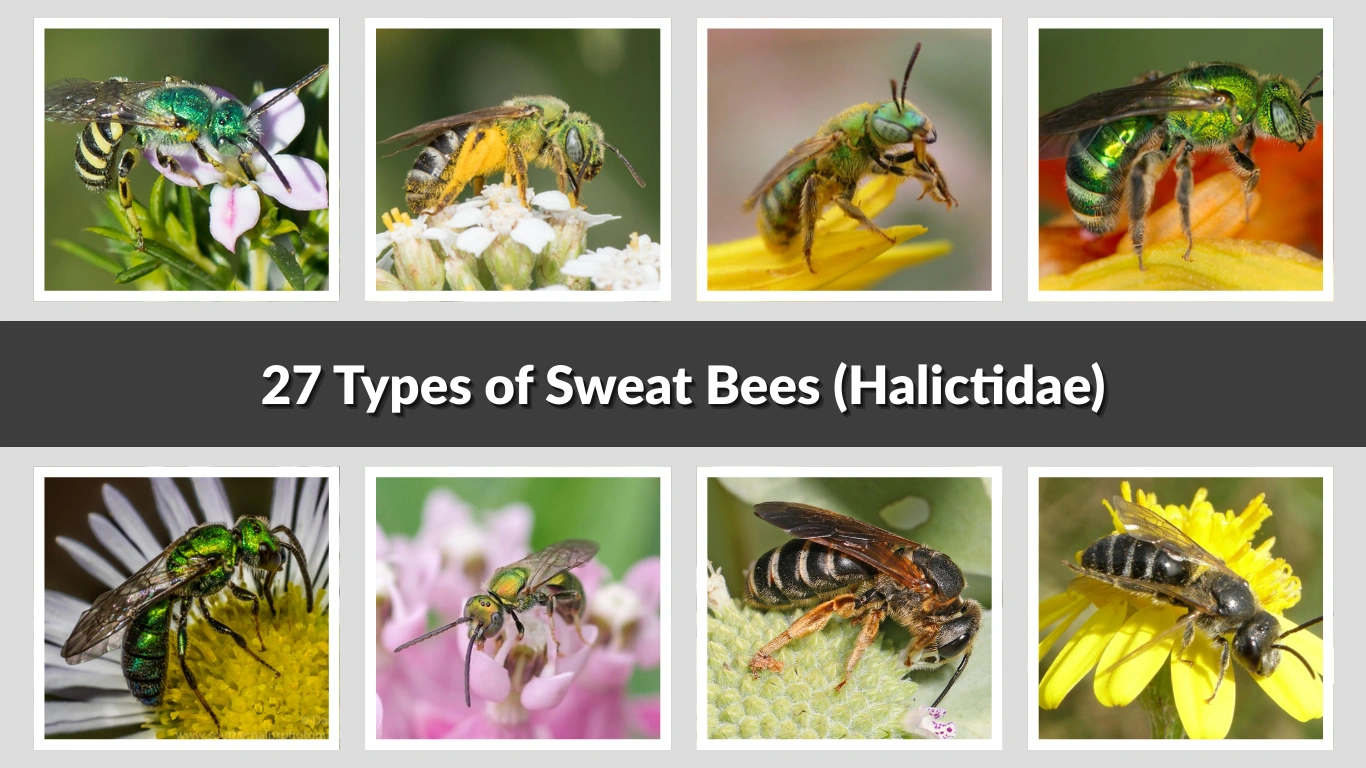
Sweat bees (Halictidae) are among the most diverse and widespread bees in the world, with species ranging from metallic green gems to small, modest ground-nesters. Despite their tiny size, they play a massive role in pollination, supporting both wild ecosystems and agriculture. This article explores 27 unique types of sweat bees, highlighting their identification, habitats, behaviors, and importance in sustaining plant life and biodiversity across different regions.
1. Agapostemon texanus

Agapostemon texanus, commonly known as the Texas green sweat bee, is a striking metallic-green bee native to North America. It is one of the most recognized sweat bees due to its bright color and frequent visits to flowers in gardens, meadows, and fields. These bees are important pollinators and often live in small ground nests.
Identification
- Size: 7–12 mm long
- Color: Bright metallic green on the head and thorax, with black and yellow striped abdomen (females may appear entirely green)
- Wings: Transparent with slight brownish veins
- Body: Slender and shiny, often mistaken for small metallic flies
- Distinct trait: Males usually have striped abdomens, while females are mostly all green
Habitat
Agapostemon texanus prefers open sunny areas, nesting in the soil. They dig tunnels in sandy or loose earth, often creating small clusters of nests near each other.
Behavior
These bees are solitary to semi-social. Females often share nests but raise their own offspring individually. They are attracted to human sweat for salt, which gave sweat bees their common name.
Importance
Agapostemon texanus plays a vital role in pollination, particularly for wildflowers and crops like sunflowers, asters, and clovers. Their metallic green appearance also makes them a favorite among photographers and insect enthusiasts.
2. Agapostemon virescens

Agapostemon virescens, also known as the bicolored striped sweat bee, is one of the most widespread and easily recognized sweat bee species in North America. Its combination of a bright green upper body and striped abdomen makes it especially eye-catching while foraging on flowers in gardens, meadows, and urban landscapes.
Identification
- Size: Around 8–11 mm long
- Color: Metallic green head and thorax; abdomen black with distinct yellow or white bands
- Wings: Clear with brownish veins
- Sexual dimorphism: Females have a mostly green body, while males have striped abdomens with a green thorax
- Distinct trait: Strong contrast between green thorax and striped abdomen, giving a “two-toned” appearance
Habitat
This species thrives in a variety of habitats, from prairies and open meadows to suburban backyards. They often build nests underground in bare or lightly vegetated soil, sometimes forming loose nesting aggregations.
Behavior
Agapostemon virescens is considered semi-social. Multiple females may share a nest entrance but maintain separate brood cells. Males are commonly seen resting overnight on grass stems or flowers, often in small groups. Like other sweat bees, they are occasionally attracted to human sweat for salt.
Importance
This species is a key pollinator for many wildflowers and crops such as sunflowers, asters, goldenrods, and clovers. Its adaptability to human-modified landscapes makes it an important urban pollinator as well.
3. Agapostemon splendens

Agapostemon splendens, often called the splendid green sweat bee, is a dazzling species with an entirely metallic-green body that shines vividly under sunlight. It is a native North American bee frequently found in gardens, grasslands, and wildflower fields, making it one of the most admired sweat bees for its striking appearance.
Identification
- Size: Approximately 8–12 mm long
- Color: Entire body metallic green, sometimes with a bluish sheen
- Wings: Transparent with faint brownish veins
- Body: Slender, smooth, and shiny, resembling a small jewel
- Sexual dimorphism: Males may have slightly slimmer abdomens but remain mostly green
- Distinct trait: Lacks the striped abdomen pattern seen in other Agapostemon species
Habitat
This bee favors sunny, open habitats with loose or sandy soil for nesting. It constructs ground burrows, often in small clusters near other individuals. Gardens with abundant flowers also attract this species, making it a common visitor in urban and rural areas alike.
Behavior
Agapostemon splendens is mostly solitary, though some females may share nest entrances. They are active during warm months, visiting a wide range of flowering plants. Males are often seen resting on flowers or leaves in groups at night. Like other sweat bees, they are occasionally drawn to perspiration for minerals.
Importance
The splendid green sweat bee is an important pollinator of wildflowers, clovers, asters, and sunflowers. Its adaptability to various environments ensures its significant role in both natural ecosystems and agricultural pollination. Its metallic beauty also makes it a favorite subject for insect photography and pollinator studies.
4. Agapostemon angelicus
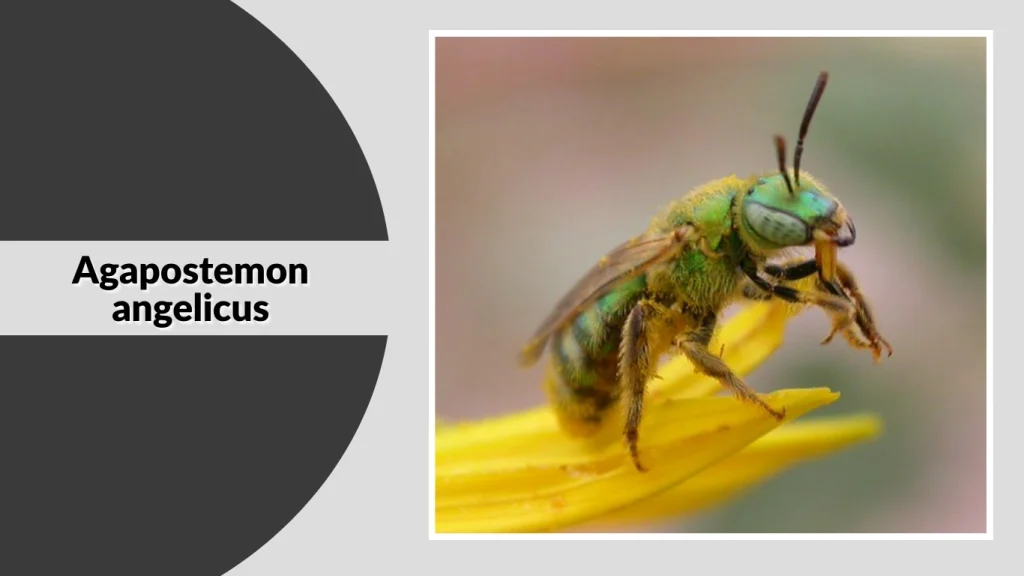
Agapostemon angelicus, commonly referred to as the angelic green sweat bee, is a striking metallic species found across the western United States and parts of Mexico. It is admired for its jewel-like body and plays a crucial role in pollinating native wildflowers as well as agricultural crops.
Identification
- Size: About 7–11 mm in length
- Color: Brilliant metallic green covering head, thorax, and abdomen
- Wings: Transparent with light brown venation
- Body: Smooth and shiny, giving it a gem-like appearance
- Sexual dimorphism: Males sometimes show faint striping on the abdomen, but females are entirely green
- Distinct trait: Entire body appears luminous green without bold contrasting stripes
Habitat
This bee prefers dry, open landscapes such as deserts, grasslands, and scrub areas. It nests underground, often in loose, sandy soil. Nests may occur singly or in small aggregations in areas with suitable ground conditions.
Behavior
Agapostemon angelicus is primarily solitary, though multiple females may share burrow entrances. They are strong foragers, active during the hottest part of the day, and visit a wide variety of flowers including asters, sunflowers, and daisies. Males are often spotted sleeping communally on grass stems or flower heads overnight.
Importance
This species is a vital pollinator in arid and semi-arid regions. It contributes significantly to the pollination of desert wildflowers, as well as cultivated crops like sunflowers and melons. Its brilliant coloration also makes it a favorite among naturalists and pollinator enthusiasts.
5. Agapostemon sericeus

Agapostemon sericeus, often called the silky green sweat bee, is a beautiful metallic bee found mainly in North and Central America. Its shimmering body and active foraging habits make it a noticeable presence in fields, gardens, and meadows where wildflowers are abundant.
Identification
- Size: Around 8–12 mm long
- Color: Brilliant metallic green across the head and thorax, with abdomen sometimes showing faint yellowish striping in males
- Wings: Transparent with subtle brownish veins
- Body: Smooth, glossy, and finely haired, giving it a silky appearance
- Sexual dimorphism: Females are mostly solid green, while males may have partial stripes on the abdomen
- Distinct trait: Slightly more elongated body compared to other Agapostemon species, with a silken shine
Habitat
This species prefers open, sunny landscapes such as meadows, gardens, and prairies. Nests are constructed underground in loose soil, often near other individuals but maintained as separate burrows.
Behavior
Agapostemon sericeus is primarily solitary but may nest in loose aggregations. Females dig and maintain their own burrows, provisioning brood cells with pollen and nectar. Males are active foragers and are frequently observed resting in groups on plants during the night.
Importance
The silky green sweat bee is an important pollinator of both native wildflowers and crops. It visits clovers, asters, goldenrods, and sunflowers, contributing to the reproduction of numerous plants. Its adaptability to human-altered habitats also makes it a valuable urban pollinator.
6. Augochlora pura

Augochlora pura, known as the pure green sweat bee, is one of the most stunning sweat bees in North America. Its brilliant emerald-green body, sometimes with golden or coppery reflections, makes it easily recognizable among pollinators. Unlike many other sweat bees, it is strictly solitary and does not form colonies.
Identification
- Size: Typically 7–10 mm in length
- Color: Metallic green to golden green, sometimes showing copper or blue highlights
- Wings: Clear to slightly smoky with light veins
- Body: Slender, elongated, and finely haired, shimmering under sunlight
- Distinct trait: Uniform green sheen across the entire body, with no banded abdomen
Habitat
This species inhabits wooded areas, gardens, and meadows, often preferring shaded places near rotting wood. Unlike ground-nesting sweat bees, Augochlora pura usually nests in decaying logs, hollow stems, or soft wood, excavating tunnels for brood cells.
Behavior
Augochlora pura is strictly solitary. Each female builds her own nest, provisions it with pollen and nectar, and seals the brood cells without sharing labor. They are active throughout spring and summer, frequently visiting composite flowers like asters and sunflowers. Males patrol flowers and vegetation while females remain focused on nesting and provisioning.
Importance
This bee is a critical pollinator in forested and garden ecosystems. By nesting in rotting wood, it plays a dual ecological role—pollinating flowering plants while contributing to wood decomposition processes. Its striking metallic color also makes it a favorite subject for pollinator studies and nature photography.
7. Augochlora aurata

Augochlora aurata, commonly known as the golden green sweat bee, is a solitary metallic bee found throughout North America. Its vibrant coloration ranges from green to golden-bronze, making it one of the most beautiful species in the Halictidae family. Like Augochlora pura, it does not form colonies but prefers to nest in wood.
Identification
- Size: About 7–10 mm long
- Color: Metallic green with golden or bronze reflections, sometimes showing blue hues
- Wings: Transparent with pale brownish veins
- Body: Elongated and shiny, with fine hairs that assist in pollen collection
- Distinct trait: Warmer golden sheen compared to the emerald tone of Augochlora pura
Habitat
This species is widespread in eastern and central North America. It prefers wooded habitats, gardens, and areas with abundant flowering plants. Nests are usually made in rotting logs, fallen branches, or soft wood, where females bore tunnels for their brood cells.
Behavior
Augochlora aurata is a solitary bee. Each female is responsible for nest construction, provisioning, and sealing her brood cells. They are strong foragers, visiting a wide variety of flowers from spring through late summer. Males often patrol flowers in search of mates and may rest on vegetation during evenings.
Importance
The golden green sweat bee is an important pollinator for wildflowers, shrubs, and crops like sunflowers and clovers. Its nesting in rotting wood highlights its ecological contribution beyond pollination, as it aids in decomposition processes. Its shimmering appearance also makes it a key species in pollinator diversity studies.
8. Augochlorella striata

Augochlorella striata, also known as the striped green sweat bee, is a small, metallic bee commonly found in eastern North America. Despite its small size, it is one of the most abundant sweat bee species and plays a vital role in pollinating both wild plants and crops.
Identification
- Size: Usually 5–8 mm long
- Color: Metallic green to bluish-green across the head, thorax, and abdomen
- Wings: Transparent with faint brown veins
- Body: Compact, with subtle striations (fine lines) on the abdomen, giving it a striped texture rather than bold bands
- Distinct trait: Very small size and fine abdominal striations
Habitat
This species thrives in a wide range of environments, including gardens, meadows, open fields, and even urban areas. Nests are built underground in bare or lightly vegetated soil, often forming large nesting aggregations.
Behavior
Augochlorella striata shows flexible social behavior, ranging from solitary nesting to semi-social colonies where multiple females share a nest. They are active from spring through late summer and forage on a wide range of flowers, especially composites like asters and dandelions.
Importance
As one of the most common green sweat bees, Augochlorella striata is an essential pollinator for wildflowers, fruits, and vegetable crops. Its adaptability to disturbed habitats makes it particularly important in urban gardens and agricultural fields.
9. Augochlorella persimilis

Augochlorella persimilis is a small metallic-green sweat bee closely related to Augochlorella striata. Though less common, it shares many similarities in appearance and behavior, making it an important pollinator in its native range across North and Central America.
Identification
- Size: Around 5–8 mm long
- Color: Metallic green to blue-green, with a slightly duller sheen compared to A. striata
- Wings: Clear to faintly smoky with pale brown veins
- Body: Compact and slender, with fine striations on the abdomen
- Distinct trait: Subtler coloration and less reflective shine than other Augochlorella species
Habitat
This species inhabits meadows, grasslands, gardens, and forest edges. Like many sweat bees, it nests underground in bare or sparsely vegetated soil. Nests are often solitary but may appear in loose aggregations when conditions are favorable.
Behavior
Augochlorella persimilis is typically solitary, although it can sometimes display communal nesting behavior. Females construct burrows and provision brood cells with pollen and nectar. Males spend much of their time patrolling flowers and resting on vegetation at night.
Importance
While not as abundant as A. striata, this species is still a valuable pollinator for wildflowers and crops. It helps maintain biodiversity by supporting the reproduction of native plants, and its adaptability allows it to thrive in both natural and human-modified landscapes.
10. Augochloropsis metallica

Augochloropsis metallica, often called the metallic green sweat bee, is one of the most striking species in the Halictidae family. Its brilliant metallic coloration ranges from emerald green to golden-blue, making it look like a living jewel while foraging among flowers. It is native to the Americas, especially abundant in Central and South America.
Identification
- Size: Around 7–12 mm long
- Color: Metallic green, golden, or bluish across the entire body
- Wings: Clear to faintly smoky, with strong venation
- Body: Smooth and elongated with dense pollen-collecting hairs on the legs
- Distinct trait: Shimmering metallic coloration across head, thorax, and abdomen, brighter than most sweat bee species
Habitat
This bee is found in tropical and subtropical regions, inhabiting open fields, gardens, and forest edges. It nests in the ground, preferring sandy or loose soils. In agricultural regions, it is often abundant around flowering crops.
Behavior
Augochloropsis metallica is generally solitary, though multiple females may build nests near each other. Females excavate burrows and create individual brood cells, each stocked with pollen and nectar. They are highly active foragers and can be seen visiting a wide range of flowering plants throughout the warm months.
Importance
This species is a key pollinator in both natural ecosystems and agricultural fields. It is especially important for crops like beans, peppers, and various fruiting plants. Its abundance, combined with its wide flower preference, makes it a critical pollinator in tropical agriculture.
11. Augochloropsis sumptuosa

Augochloropsis sumptuosa, often called the sumptuous green sweat bee, is a dazzling species found mainly in Central and South America. Its shimmering metallic hues make it stand out among pollinators, while its ecological role ensures the survival of countless flowering plants.
Identification
- Size: About 8–12 mm in length
- Color: Brilliant metallic green, often with golden or bluish reflections across the body
- Wings: Transparent to lightly smoky with strong venation
- Body: Elongated and smooth, with dense scopal hairs on the hind legs for pollen transport
- Distinct trait: Richer metallic sheen compared to other Augochloropsis species, giving it a “luxurious” appearance
Habitat
This bee inhabits tropical and subtropical regions, thriving in open meadows, gardens, forest edges, and agricultural fields. It prefers well-drained soils for nesting, where females excavate burrows for brood chambers.
Behavior
Augochloropsis sumptuosa is primarily solitary, with each female responsible for digging and provisioning her nest. They forage widely, visiting both wild and cultivated plants. Males are active flower visitors and often rest communally on vegetation at night.
Importance
The sumptuous green sweat bee plays an essential role in pollination, particularly for tropical crops such as peppers, beans, and melons. Its wide floral preference makes it an efficient generalist pollinator, while its abundance in agricultural areas enhances crop productivity.
12. Augochloropsis anonyma

Augochloropsis anonyma is a lesser-known but striking metallic sweat bee found in the Americas. Like its relatives, it shines with vivid green and golden hues, making it easily recognizable in gardens and natural habitats. Despite its name “anonyma,” this bee plays a clear and important role in pollination across a wide range of flowering plants.
Identification
- Size: Around 7–11 mm in length
- Color: Metallic green with golden or bluish highlights on the thorax and abdomen
- Wings: Clear to slightly smoky, with visible venation
- Body: Slender, glossy, and covered in fine hairs for pollen collection
- Distinct trait: Slightly duller metallic tone compared to Augochloropsis metallica and sumptuosa, but still highly iridescent
Habitat
This species inhabits open meadows, forest edges, and agricultural landscapes. It prefers loose, sandy soil for ground-nesting but is also found in disturbed areas such as gardens and pastures.
Behavior
Augochloropsis anonyma is mostly solitary, with each female constructing and provisioning her own nest. They are highly active during warm months, foraging on a wide variety of flowers. Males are often observed hovering around flower patches or resting on grasses in groups at night.
Importance
This bee is an effective pollinator for native wildflowers and crop plants, particularly legumes, sunflowers, and other composites. Its adaptability to both natural and human-modified environments ensures that it contributes significantly to pollination diversity.
13. Lasioglossum zephyrus

Lasioglossum zephyrus is a small sweat bee native to North America and a member of the diverse genus Lasioglossum, which contains hundreds of species worldwide. Though not as brightly metallic as some of its relatives, it plays a vital role in pollination across gardens, meadows, and agricultural fields.
Identification
- Size: Around 5–8 mm long
- Color: Dark brown to black, sometimes with a faint metallic green or bronze sheen
- Wings: Transparent with light brown veins
- Body: Slender, covered with short, pale hairs, especially on the thorax
- Distinct trait: Subtle metallic highlights and small size compared to other sweat bees
Habitat
This species thrives in open habitats such as grasslands, prairies, gardens, and forest edges. It usually nests in the ground, preferring loose or sandy soil, and often forms small aggregations of burrows.
Behavior
Lasioglossum zephyrus exhibits flexible social behavior, ranging from solitary to communal or even semi-social nesting. Females share burrows in some populations, cooperating in nest maintenance while individually provisioning brood cells. They forage on a wide range of flowers, making them excellent generalist pollinators.
Importance
As a generalist pollinator, Lasioglossum zephyrus visits a variety of wildflowers and crops, including clovers, sunflowers, asters, and garden plants. Its adaptability and abundance make it a critical contributor to pollination, especially in disturbed or urban landscapes where other bees may be less common.
14. Lasioglossum coriaceum
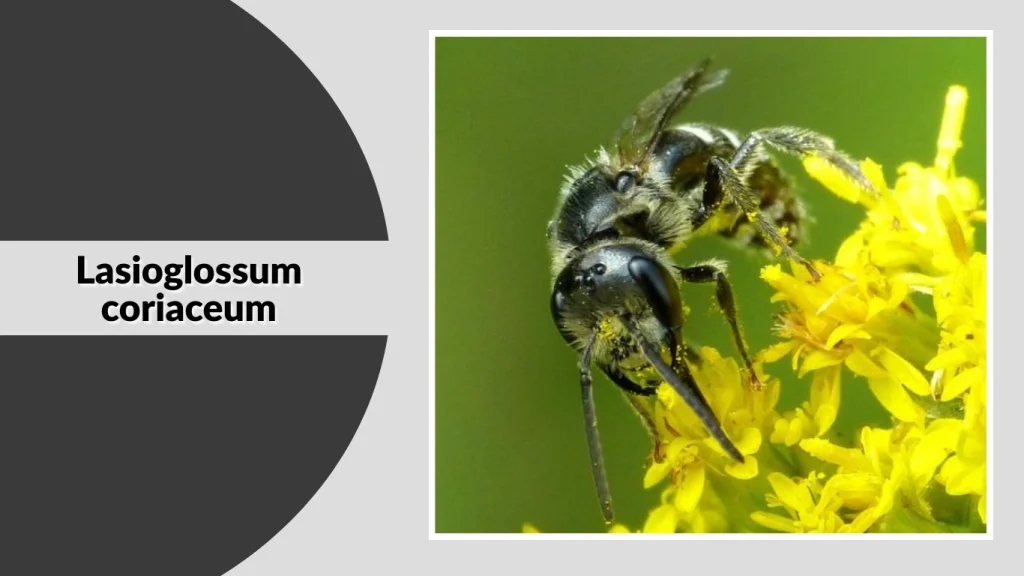
Lasioglossum coriaceum is a small ground-nesting sweat bee native to North America. Though not as colorful as the metallic green sweat bees, this species is an efficient pollinator and often goes unnoticed due to its dark, modest appearance.
Identification
- Size: About 4–7 mm long
- Color: Dark brown to black, with occasional faint metallic sheen on the thorax
- Wings: Clear with pale brownish veins
- Body: Slender, finely haired, with a slightly leathery texture to the exoskeleton
- Distinct trait: Less iridescent than many other sweat bees, giving it a duller, matte look
Habitat
This species is common in open fields, prairies, gardens, and forest edges. It nests underground in bare or lightly vegetated soil, often forming small, scattered aggregations of burrows.
Behavior
Lasioglossum coriaceum is typically solitary, though it sometimes exhibits communal nesting where multiple females use the same entrance. Each female provisions her own brood cells with pollen and nectar. They are active during the warm months, foraging on a wide variety of flowers.
Importance
While less flashy than metallic sweat bees, Lasioglossum coriaceum is a crucial pollinator of wildflowers and agricultural plants. It contributes to pollination in both natural and urban ecosystems, supporting biodiversity and crop production.
15. Lasioglossum imitatum

Lasioglossum imitatum is a small, dark-colored sweat bee that belongs to one of the largest and most complex bee genera in the world. Though less noticeable than metallic species, it is a highly effective pollinator found across North America.
Identification
- Size: About 4–7 mm long
- Color: Dark brown to black, with only a faint or absent metallic sheen
- Wings: Clear, sometimes slightly smoky, with pale brown veins
- Body: Slim and finely haired, giving a velvety look under close observation
- Distinct trait: Very subtle appearance, often mistaken for small flies or other bees due to its plain coloration
Habitat
This bee inhabits meadows, grasslands, gardens, and lightly wooded areas. It prefers to nest in loose soil, creating burrows either alone or in small clusters. Its adaptability allows it to survive in both rural and suburban environments.
Behavior
Lasioglossum imitatum is generally solitary but may show semi-social behavior depending on environmental conditions. Females dig underground nests and create brood chambers, provisioning them with pollen and nectar. They are active throughout spring and summer, visiting a wide range of flowering plants.
Importance
This species is an important pollinator of native wildflowers and crop plants. Its role in agriculture, especially in pollinating clovers, asters, and sunflowers, makes it a valuable contributor to both natural ecosystems and farming landscapes.
16. Lasioglossum leucozonium

Lasioglossum leucozonium, also known as the white-banded sweat bee, is a small ground-nesting bee with a wide distribution across North America, Europe, and parts of Asia. It is one of the most widespread sweat bee species and is well-adapted to a variety of habitats.
Identification
- Size: About 6–9 mm long
- Color: Dark brown to black body with faint metallic highlights on the thorax
- Wings: Clear with light brownish venation
- Abdomen: Distinct pale hair bands across segments, giving it a striped appearance
- Distinct trait: Characteristic whitish bands on the abdomen, unlike many plain-colored Lasioglossum species
Habitat
This species thrives in open, sunny environments such as meadows, prairies, farmland, and gardens. It nests underground in sandy or loose soil, often forming small groups of burrows in favorable areas.
Behavior
Lasioglossum leucozonium is primarily solitary, with each female digging her own burrow and provisioning brood cells individually. However, it may form loose nesting aggregations. They are active during warm months and forage on a wide range of flowering plants, from wildflowers to crops.
Importance
This bee is an efficient pollinator of clovers, asters, sunflowers, and other composite flowers. Its adaptability to disturbed landscapes, including agricultural fields, makes it an important pollinator in both natural and human-modified ecosystems.
17. Lasioglossum oenotherae
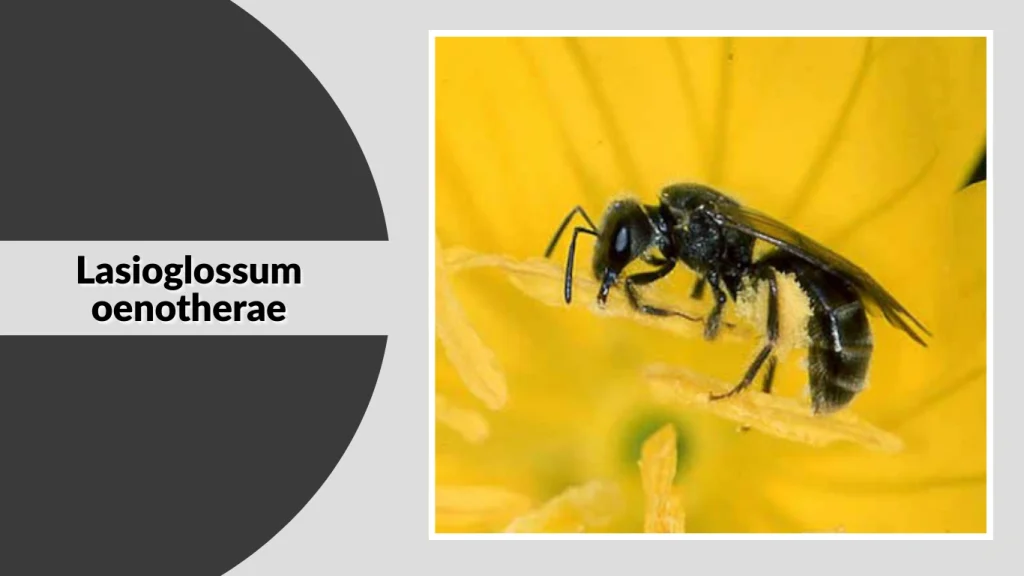
Lasioglossum oenotherae, often called the evening primrose sweat bee, is a specialist pollinator strongly associated with primrose flowers (Oenothera species). It has a close ecological relationship with these plants, making it an excellent example of plant–pollinator specialization.
Identification
- Size: Around 6–8 mm long
- Color: Dark brown to black, sometimes with faint metallic green on the thorax
- Wings: Clear with pale brown veins
- Body: Slim, with pale hairs scattered on the thorax and abdomen
- Distinct trait: Frequently observed on evening primrose flowers, where it collects both nectar and pollen
Habitat
This bee is typically found in areas where evening primrose plants grow, including meadows, prairies, forest edges, and open fields. Nests are built in the ground, usually in sandy or well-drained soils.
Behavior
Lasioglossum oenotherae is a solitary ground nester. Females dig tunnels and construct brood cells, each stocked with pollen and nectar. They show a preference for evening primrose and related flowers, which bloom in the evening and at night. Males are often observed hovering near these flowers in search of mates.
Importance
As a specialist pollinator, this species is vital for the reproduction of evening primrose plants. Its close relationship with Oenothera highlights the importance of pollinator diversity in maintaining native plant populations. While not as generalist as other sweat bees, its role in specialized pollination makes it ecologically significant.
18. Lasioglossum pilosum

Lasioglossum pilosum, commonly known as the hairy sweat bee, is a widespread species in North America. It is one of the most important pollinators of various wildflowers and crops, often seen foraging actively throughout the summer. Its dense body hairs make it particularly effective at carrying pollen.
Identification
- Size: About 7–9 mm long
- Color: Dark brown to black, with faint metallic sheen on the thorax
- Wings: Clear with light brown venation
- Body: Densely covered with pale hairs, especially on the thorax and legs
- Distinct trait: Noticeably hairier than many other Lasioglossum species, aiding in pollen transfer
Habitat
This species inhabits meadows, fields, gardens, and agricultural areas. It nests underground in sandy or loose soils, often choosing sunny and open locations. Nests are usually solitary but can occur in loose aggregations.
Behavior
Lasioglossum pilosum is typically solitary, with each female digging and provisioning her own nest. However, semi-social behavior has been observed in some populations. It is a generalist forager, visiting a wide variety of flowers including clovers, asters, sunflowers, and fruit blossoms.
Importance
This bee is considered one of the key pollinators in agriculture. It is especially important for crops such as apples, blueberries, and sunflowers. Its abundance, adaptability, and hairy body make it highly effective in transferring pollen, supporting both wild ecosystems and farming productivity.
19. Halictus rubicundus

Halictus rubicundus, commonly called the orange-legged furrow bee, is a widespread sweat bee found across North America, Europe, and Asia. It is one of the most well-studied sweat bees because of its flexible social behavior, ranging from solitary nesting to forming small colonies.
Identification
- Size: About 7–10 mm long
- Color: Dark brown to black body with faint metallic sheen
- Legs: Distinct reddish-orange coloration on the hind legs
- Wings: Transparent with pale brown veins
- Abdomen: Marked with fine pale hair bands on each segment
- Distinct trait: Orange-tinted legs, which make it easily recognizable compared to other Halictus species
Habitat
This species occupies a wide range of habitats including meadows, grasslands, forest edges, and even suburban gardens. It nests underground in bare or lightly vegetated soil, often forming large aggregations of burrows in suitable areas.
Behavior
Halictus rubicundus displays unusual social flexibility. In colder climates, females are solitary, while in warmer areas, they may form small eusocial colonies where multiple females cooperate in brood care. They forage on a wide variety of flowers and are active from spring through late summer.
Importance
This bee is an essential pollinator for wildflowers and crops, including clovers, asters, and fruit trees. Its wide distribution and ability to thrive in different environments make it one of the most ecologically significant sweat bees worldwide.
20. Halictus ligatus

Halictus ligatus, often referred to as the ligated furrow bee, is one of the most common and widespread sweat bees in North America. It is highly adaptable, thriving in both natural landscapes and urban environments, making it a key pollinator for wild and cultivated plants.
Identification
- Size: About 7–10 mm long
- Color: Dark brown to black body with faint metallic reflections
- Wings: Transparent with light brown venation
- Abdomen: Marked with pale hair bands along the segments
- Distinct trait: Lacks bright metallic coloring but is identified by its characteristic abdominal banding and robust body shape
Habitat
This species inhabits meadows, gardens, fields, and suburban landscapes. It nests underground in open or lightly vegetated soil, often forming large aggregations in suitable sandy or loose ground.
Behavior
Halictus ligatus is semi-social to eusocial depending on location and climate. In warmer areas, colonies may include a dominant queen and cooperative workers, while in cooler climates, females are more solitary. They are generalist foragers, visiting a broad range of flowers including asters, clovers, goldenrods, and fruit blossoms.
Importance
This bee is an important agricultural pollinator, especially for sunflowers, alfalfa, clovers, and various fruit crops. Its adaptability to disturbed and urban areas further enhances its role as a key pollinator in both farming and wild ecosystems.
21. Halictus tripartitus
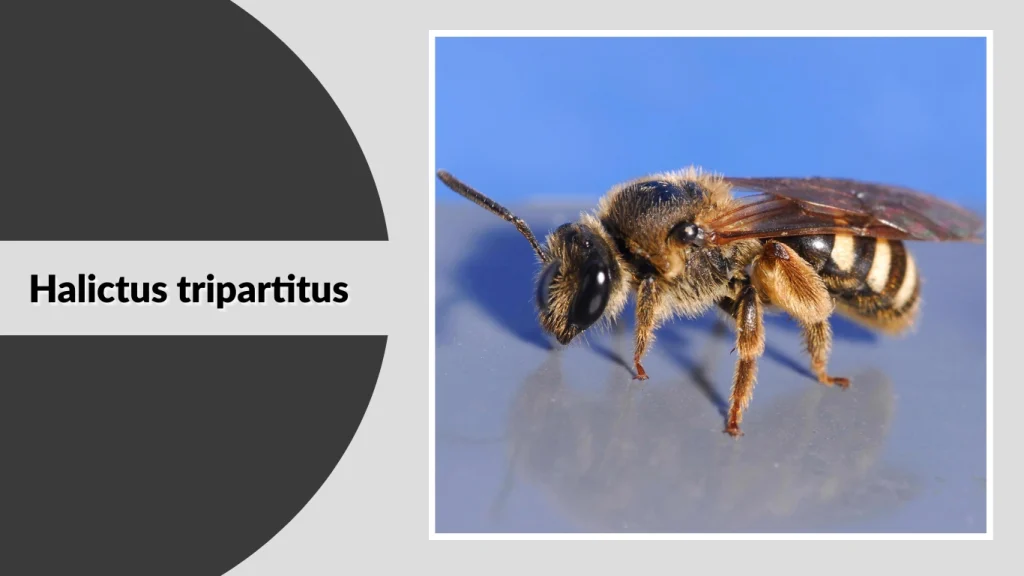
Halictus tripartitus, a member of the furrow bee group, is a North American sweat bee known for its ground-nesting habits and important role in pollination. Though not as brightly metallic as some other sweat bees, it is widespread and commonly encountered in gardens, fields, and natural meadows.
Identification
- Size: About 7–9 mm long
- Color: Dark brown to black with faint metallic sheen on the thorax
- Wings: Clear with light brown venation
- Abdomen: Pale hair bands on each segment, giving a striped appearance
- Distinct trait: Subtle metallic reflections combined with well-defined pale abdominal bands
Habitat
This species inhabits open areas such as grasslands, meadows, agricultural fields, and suburban gardens. It prefers loose, sandy, or lightly vegetated soil for nesting and often creates burrows in small clusters.
Behavior
Halictus tripartitus is generally solitary but may also show semi-social nesting behavior depending on environmental conditions. Females dig burrows and construct brood chambers underground, provisioning each with pollen and nectar. They forage widely on seasonal flowers and are especially active in mid-summer.
Importance
This bee is a valuable pollinator of both wildflowers and crops. It frequently visits asters, sunflowers, clovers, and various fruit blossoms, contributing to both natural plant reproduction and agricultural yield.
22. Halictus parallelus

Halictus parallelus is a small ground-nesting sweat bee belonging to the furrow bee group. It is distributed across parts of North America and is a reliable pollinator for both wildflowers and cultivated crops. Its modest appearance often causes it to be overlooked, yet it plays an important role in local ecosystems.
Identification
- Size: Around 6–8 mm long
- Color: Dark brown to black, with a faint metallic sheen on the thorax
- Wings: Clear with pale brown venation
- Abdomen: Narrow pale hair bands across the segments, creating a striped pattern
- Distinct trait: More slender body and parallel-shaped abdominal bands compared to other Halictus species
Habitat
Halictus parallelus inhabits meadows, grasslands, agricultural fields, and gardens. It prefers sandy or loose soil for burrow construction, often selecting sunny, open ground. Nests may be scattered or form small aggregations.
Behavior
This species is typically solitary, with each female digging her own burrow and provisioning brood cells with pollen and nectar. Activity peaks in summer, when females are frequently seen foraging on a wide variety of flowers. Males patrol flower patches and rest on vegetation overnight.
Importance
Halictus parallelus is a versatile pollinator, contributing to the reproduction of wildflowers as well as crops such as sunflowers, clovers, and alfalfa. Its adaptability to disturbed habitats makes it a consistent presence in both natural and agricultural ecosystems.
23. Halictus confusus
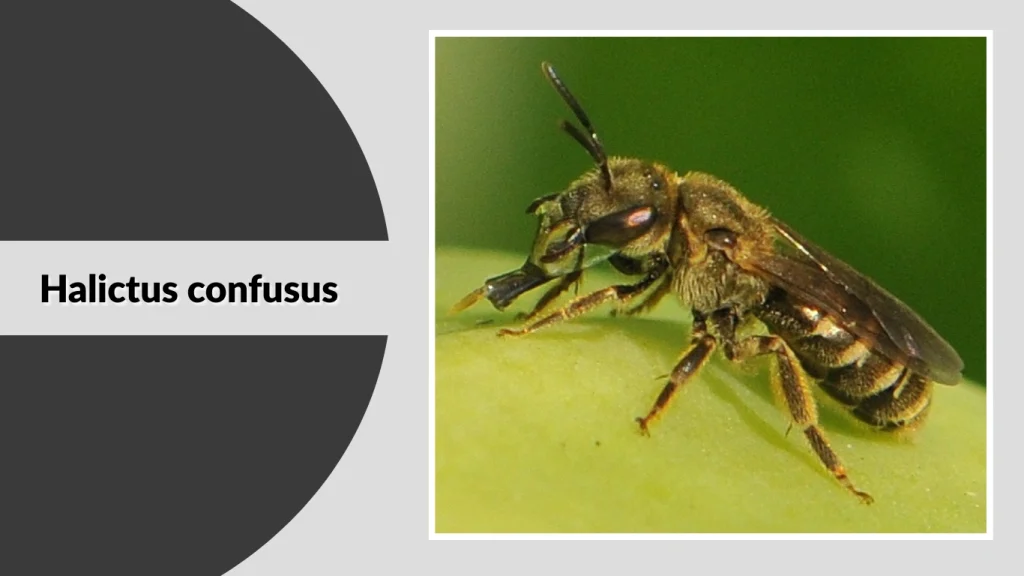
Halictus confusus, often called the confused sweat bee, is a widespread species across North America and parts of Europe. Despite its small and modest appearance, it is a vital pollinator for wild plants and crops, frequently seen foraging in summer months.
Identification
- Size: About 6–9 mm long
- Color: Dark brown to black with a faint metallic or bronze sheen
- Wings: Clear with light venation
- Abdomen: Pale hair bands across each segment, giving it a striped look
- Distinct trait: Easily mistaken for other Halictus species due to its similar markings, hence the name “confusus”
Habitat
This bee inhabits meadows, prairies, gardens, and agricultural landscapes. It prefers bare or lightly vegetated soil for nesting and often creates burrows in small aggregations.
Behavior
Halictus confusus is mostly solitary but may nest near other individuals in loose clusters. Females dig underground tunnels and provision brood cells with pollen and nectar. Foraging occurs on a wide variety of flowers, with peak activity in midsummer.
Importance
This species is an effective pollinator of clovers, asters, sunflowers, and numerous wildflowers. Its adaptability to different habitats ensures its ecological value in both natural and human-modified ecosystems.
24. Halictus farinosus

Halictus farinosus is a modestly colored sweat bee species found in parts of North America. Like many in the Halictus genus, it nests in the ground and contributes significantly to the pollination of wild and cultivated plants.
Identification
- Size: Around 6–8 mm long
- Color: Dark brown to black body with faint metallic sheen on the thorax
- Wings: Transparent with pale brown venation
- Abdomen: Pale hair bands across each segment, giving a striped pattern
- Distinct trait: Slightly dusty or “powdery” appearance on the thorax due to fine hairs, setting it apart from similar species
Habitat
This bee inhabits meadows, grasslands, gardens, and agricultural landscapes. It prefers open, sandy, or loose soils for burrow construction, often choosing sunny, exposed patches of ground.
Behavior
Halictus farinosus is primarily solitary, though nests may occur in loose aggregations. Females dig underground tunnels and construct brood cells, provisioning them with pollen and nectar. Foraging occurs on a wide variety of flowering plants, especially composites like asters and sunflowers.
Importance
As a generalist pollinator, Halictus farinosus plays an important role in maintaining wild plant biodiversity and supporting crop yields. Though not brightly metallic, its ecological contribution makes it a valuable member of pollinator communities.
25. Halictus sexcinctus

Halictus sexcinctus, also known as the six-banded furrow bee, is a distinctive sweat bee found in Europe, parts of Asia, and introduced populations in North America. It is one of the more easily recognized Halictus species due to its bold abdominal banding.
Identification
- Size: About 8–11 mm long
- Color: Dark brown to black body with faint metallic sheen on the thorax
- Wings: Transparent with light brown venation
- Abdomen: Marked with six pale hair bands, giving the species its name
- Distinct trait: Strong, clearly visible striping across the abdomen, making it stand out among furrow bees
Habitat
Halictus sexcinctus prefers open, sunny habitats such as grasslands, meadows, agricultural fields, and forest edges. It nests in bare or sparsely vegetated soil, often creating burrows in small clusters.
Behavior
This species shows flexible nesting behavior, ranging from solitary females digging their own burrows to semi-social groups with multiple females sharing an entrance. They are active foragers throughout the summer, visiting a wide range of flowering plants.
Importance
Halictus sexcinctus is a highly effective pollinator of clovers, asters, sunflowers, and many other wildflowers and crops. Its abundance and adaptability make it an important species for sustaining both natural plant communities and agricultural productivity.
26. Nomia melanderi (Alkali Bee)

Nomia melanderi, commonly known as the alkali bee, is a highly valued native pollinator in western North America, especially in the United States. It is famous for its efficiency in pollinating alfalfa, making it one of the most important managed solitary bees in agriculture.
Identification
- Size: About 9–12 mm long
- Color: Dark body with bold white or pale bands across the abdomen
- Wings: Clear with light brown venation
- Body: Robust, with a shiny thorax and striped abdomen
- Distinct trait: Strongly banded abdomen and slightly iridescent sheen, making it resemble a small wasp
Habitat
Alkali bees thrive in arid and semi-arid regions, particularly in areas with alkaline soils where they nest in large aggregations. They prefer moist, salty soil near irrigation ditches and alkaline meadows, where farmers often manage nesting beds specifically for them.
Behavior
Nomia melanderi is a solitary species, but it nests in dense aggregations, sometimes with thousands of burrows close together. Each female digs her own tunnel and provisions brood cells with pollen and nectar. They are highly active foragers, focusing heavily on alfalfa blossoms.
Importance
The alkali bee is one of the most significant pollinators for alfalfa seed production. Farmers in the western U.S. manage alkali bee beds to support this species, as it is more efficient at pollinating alfalfa than honeybees. Its ecological and agricultural value makes it one of the most economically important sweat bees.
27. Sphecodes monilicornis

Sphecodes monilicornis is a cleptoparasitic sweat bee found across Europe, Asia, and parts of North America. Unlike many other sweat bees that build and provision their own nests, this species lays its eggs in the nests of other ground-nesting bees, making it a “cuckoo bee.”
Identification
- Size: Around 6–9 mm long
- Color: Distinct red abdomen with a contrasting dark brown to black head and thorax
- Wings: Clear to slightly smoky with light venation
- Body: Smooth and shiny with sparse hairs
- Distinct trait: Striking red abdomen, a key feature separating it from most other sweat bees
Habitat
This species is found in meadows, grasslands, and forest edges where host bees are abundant. It relies on the nesting sites of ground-nesting bees, particularly other Halictidae species, for reproduction.
Behavior
Sphecodes monilicornis does not build nests or gather pollen. Instead, females invade the nests of host bees, laying their eggs inside brood cells. The developing Sphecodes larvae consume the host’s stored pollen and sometimes the host’s larvae. Adults are still frequent flower visitors, feeding on nectar.
Importance
Although parasitic, this bee plays an ecological role in regulating populations of its host species. Its presence indicates a healthy and diverse bee community. The striking coloration also makes it one of the more easily recognized sweat bee.
