
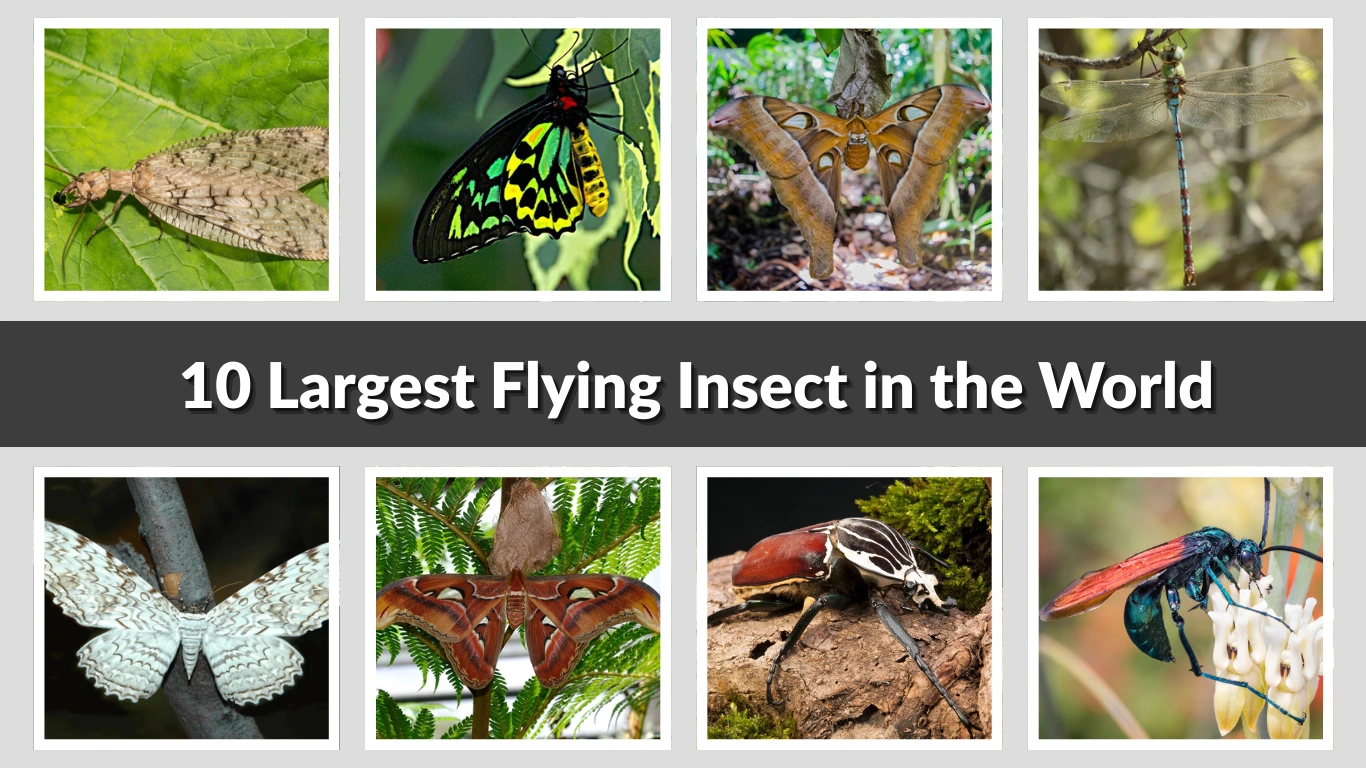
Flying insects are some of the most fascinating creatures on Earth, ranging from delicate butterflies to powerful beetles and fearsome wasps. Among them, a few species stand out for their massive size, impressive wingspans, and unique adaptations. In this article, we’ll explore the 10 largest flying insects in the world, uncovering their key traits, habitats, and the remarkable roles they play in nature’s balance.
1. Atlas Moth

The Atlas Moth (Attacus atlas) is considered one of the largest living moths in the world, with a wingspan that can reach up to 10–12 inches (25–30 cm). Found mainly in Southeast Asia, it is admired for its massive size and beautifully patterned wings that resemble a map, which is how it got its name. Despite its impressive wingspan, the Atlas Moth has a very short adult lifespan, living only a few days without feeding.
Identification
- Wingspan: Up to 12 inches (30 cm)
- Color: Brownish-red with white, black, and orange markings
- Unique Feature: Wing tips resemble snake heads for predator protection
- Habitat: Tropical and subtropical forests of Southeast Asia
Behavior and Life Cycle
The adult Atlas Moth does not eat because it lacks fully developed mouthparts. It relies entirely on the fat reserves built up during its larval stage. The caterpillar stage feeds on a variety of host plants, storing enough energy to survive through metamorphosis and the adult phase.
Importance and Role in Nature
The Atlas Moth plays a role in maintaining the balance of forest ecosystems by being part of the food chain. Its caterpillars feed on leaves, while the moth itself becomes prey for birds, bats, and other predators. Additionally, the silk produced by Atlas Moth caterpillars, known as “fagara silk,” is sometimes harvested in certain regions.
2. White Witch Moth
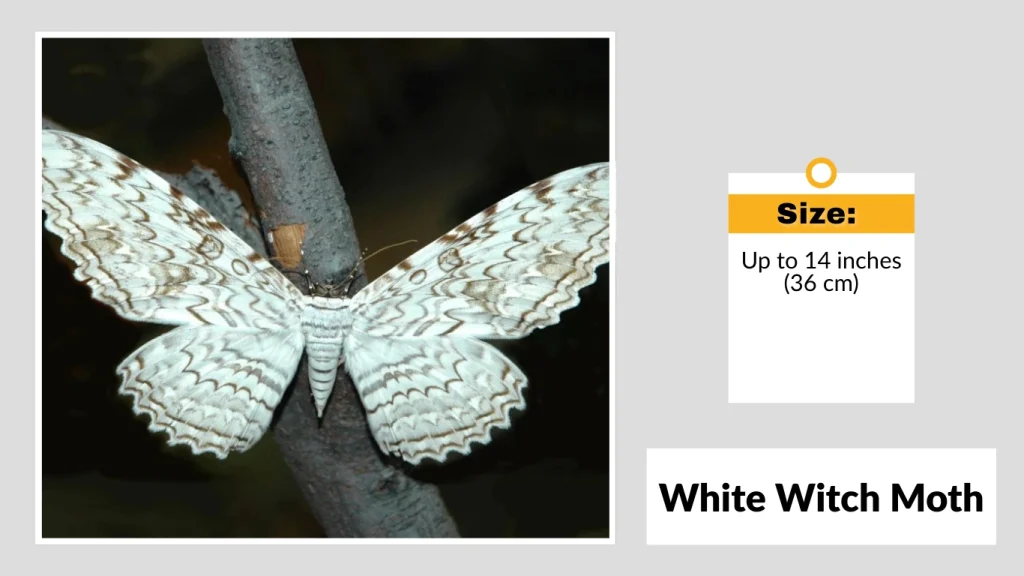
The White Witch Moth (Thysania agrippina) is famous for having the widest wingspan of any living insect, reaching up to 12–14 inches (30–36 cm). It is native to Central and South America and is often called the “Ghost Moth” because of its pale, patterned wings that allow it to blend into tree bark. This moth is elusive and rarely seen, making it a fascinating species for researchers and collectors.
Identification
- Wingspan: Up to 14 inches (36 cm)
- Color: White to pale gray with wavy, intricate dark lines
- Unique Feature: Holds the record for the widest wingspan of any insect
- Habitat: Tropical forests of Central and South America
Behavior and Life Cycle
The White Witch Moth is nocturnal and well-camouflaged during the day, resting flat against tree trunks. Like the Atlas Moth, the adult form has limited feeding capability and a short lifespan, focusing its energy on reproduction. The caterpillars feed on legume plants, building up reserves for metamorphosis.
Importance and Role in Nature
This moth contributes to the biodiversity of tropical ecosystems and supports the natural food chain. Its rarity also makes it an important species for conservation awareness, as deforestation and habitat loss could threaten its populations.
3. Hercules Moth

The Hercules Moth (Coscinocera hercules) is one of the heaviest and largest moths in the world, native to northern Australia and Papua New Guinea. With a wingspan of up to 11 inches (28 cm) and wing surface area exceeding 300 square centimeters, it ranks as a true giant among flying insects. The species is known for its broad, triangular wings with long tails on the hindwings that add to its unique appearance.
Identification
- Wingspan: Up to 11 inches (28 cm)
- Color: Brownish with white, transparent patches
- Unique Feature: Hindwings extend into long tails
- Habitat: Rainforests of northern Australia and Papua New Guinea
Behavior and Life Cycle
The Hercules Moth is nocturnal and lives only a few days in its adult stage since it does not feed. The caterpillar stage is large and feeds voraciously on eucalyptus and rainforest tree leaves. After metamorphosis, the adults focus solely on reproduction before their short lives end.
Importance and Role in Nature
The Hercules Moth contributes to rainforest ecosystems by influencing plant growth during its caterpillar phase. It also serves as a natural prey species for birds, reptiles, and bats, making it vital in maintaining ecological balance. Its impressive size and beauty have also made it a symbol of Australia’s rich biodiversity.
4. Giant Darner Dragonfly

The Giant Darner (Anax walsinghami) is one of the largest dragonflies in the world, found mainly in the southwestern United States and parts of Mexico. Known for its incredible wingspan and elongated body, it can reach lengths of up to 5 inches (13 cm) and a wingspan of nearly 6 inches (15 cm). Its speed and agility make it a master predator in the insect world.
Identification
- Body Length: Up to 5 inches (13 cm)
- Wingspan: Around 6 inches (15 cm)
- Color: Green and blue body with transparent wings
- Unique Feature: Exceptionally long abdomen compared to other dragonflies
- Habitat: Marshes, ponds, and slow-moving streams in the southwestern U.S. and Mexico
Behavior and Life Cycle
The Giant Darner is a powerful flier and can hover, glide, and dart with precision, making it one of the most efficient insect hunters. It feeds on mosquitoes, flies, and other small insects. Its nymph stage is aquatic, living in ponds or streams for several years before emerging as an adult dragonfly.
Importance and Role in Nature
This dragonfly is vital in controlling populations of mosquitoes and other pests. Its presence indicates healthy freshwater ecosystems. It also plays a role in the food chain, serving as prey for birds, frogs, and larger fish.
5. Queen Alexandra’s Birdwing Butterfly

The Queen Alexandra’s Birdwing (Ornithoptera alexandrae) is the largest butterfly in the world, native to the rainforests of Papua New Guinea. With a wingspan reaching up to 12 inches (30 cm), it is a striking species and a true natural wonder. The females are larger and darker, while the males are smaller but more colorful, featuring iridescent blue and green hues.
Identification
- Wingspan: Up to 12 inches (30 cm)
- Color: Females are brown with white markings; males are metallic blue and green
- Unique Feature: World’s largest butterfly by wingspan
- Habitat: Lowland rainforests of Papua New Guinea
Behavior and Life Cycle
This butterfly has a strong, graceful flight and feeds on nectar from various rainforest flowers. Its caterpillars consume toxic plants from the Aristolochia genus, storing toxins that make both larvae and adults distasteful to predators. The life cycle includes egg, caterpillar, pupa, and adult stages, with the caterpillar being particularly large and black with red spines.
Importance and Role in Nature
As pollinators, these butterflies contribute to rainforest plant reproduction. They are also a flagship species for conservation, as their habitat is under threat from deforestation and agricultural expansion. Protecting them helps safeguard the broader rainforest ecosystem.
6. Goliath Beetle

The Goliath Beetle (Goliathus goliatus) is one of the largest and heaviest flying insects in the world, found mainly in the tropical forests of Africa. Adult males can reach lengths of up to 4.3 inches (11 cm) and weigh more than 100 grams in the larval stage. Despite their bulky size, these beetles are strong fliers, supported by powerful wings hidden under their hard exoskeleton.
Identification
- Length: Up to 4.3 inches (11 cm)
- Weight: Can exceed 100 grams (as larvae)
- Color: Black and white patterns with brown or reddish shades depending on the species
- Unique Feature: Extremely robust body structure and great strength
- Habitat: Tropical forests of central and western Africa
Behavior and Life Cycle
Goliath Beetles are primarily active during the day. Adults feed on fruit, sap, and nectar, while the larvae consume decaying wood and plant matter, helping in nutrient recycling. The larvae are enormous and require a protein-rich diet to grow to their maximum size.
Importance and Role in Nature
These beetles are important decomposers, breaking down decaying plant material and recycling nutrients back into the ecosystem. They also serve as food for birds, reptiles, and mammals. Their massive size and striking appearance make them a popular subject of study and fascination.
7. Titan Beetle

The Titan Beetle (Titanus giganteus) is one of the largest beetles in the world, native to the rainforests of South America, particularly the Amazon Basin. Adults can grow up to 6.5 inches (17 cm) long, making them a true giant among insects. Though bulky, they are capable of short flights using their strong wings, and they are well known for their powerful mandibles, which can snap pencils and even cause painful bites.
Identification
- Length: Up to 6.5 inches (17 cm)
- Color: Dark brown to black
- Unique Feature: Enormous mandibles strong enough to break wood
- Habitat: Amazon rainforest regions of Brazil, Peru, Colombia, and surrounding areas
Behavior and Life Cycle
The adult Titan Beetle is rarely seen and is thought not to feed during its short lifespan. Instead, its energy is stored from the larval stage, though the larvae themselves are rarely observed and remain a mystery to science. Adults are nocturnal and are often attracted to lights.
Importance and Role in Nature
The Titan Beetle represents the impressive biodiversity of the Amazon rainforest. Its larvae are believed to play an important role in decomposing wood, though direct observations are scarce. The adult beetle itself is an apex among insects in terms of size and power, fascinating entomologists and nature enthusiasts alike.
8. Meganeura (Prehistoric Giant Dragonfly)

Meganeura was a prehistoric insect closely related to modern dragonflies, and it is considered one of the largest flying insects to have ever lived. It thrived during the Carboniferous period, around 300 million years ago, when oxygen levels were higher than today. With a wingspan of up to 27 inches (70 cm), it dominated the skies as a top predator among insects.
Identification
- Wingspan: Up to 27 inches (70 cm)
- Color: Fossil evidence suggests dragonfly-like transparent wings with veins
- Unique Feature: Largest known wingspan of any insect in history
- Habitat: Ancient swamp forests during the Carboniferous period
Behavior and Life Cycle
Though now extinct, scientists believe Meganeura behaved like modern dragonflies, preying on smaller insects and possibly amphibians. Its life cycle likely included an aquatic larval stage, where the nymphs lived in prehistoric waters before emerging as giant adults.
Importance and Role in Nature
Meganeura demonstrates how environmental conditions, such as higher oxygen concentrations, allowed insects to grow much larger in prehistoric times. It provides key insights into evolution, atmospheric science, and the limits of insect size today.
9. Tarantula Hawk Wasp

The Tarantula Hawk Wasp (Pepsis grossa) is one of the largest wasps in the world, known for its enormous size and one of the most painful stings in the insect kingdom. Found in deserts and tropical regions of the Americas, these wasps are striking with their metallic blue-black bodies and bright orange wings. Their wingspan can reach up to 4.5 inches (11 cm), making them powerful fliers.
Identification
- Wingspan: Up to 4.5 inches (11 cm)
- Color: Metallic blue-black body with vibrant orange wings
- Unique Feature: Notorious for having one of the most excruciatingly painful stings
- Habitat: Deserts, grasslands, and tropical areas of North, Central, and South America
Behavior and Life Cycle
Tarantula Hawk Wasps are solitary hunters. Females paralyze tarantulas with their sting and drag them to a burrow, where they lay a single egg on the spider. The larva hatches and feeds on the living tarantula, eventually emerging as an adult wasp. Adults, however, feed mainly on nectar and are important pollinators.
Importance and Role in Nature
These wasps help control tarantula populations and serve as pollinators for certain plants, including milkweed. Despite their fearsome sting, they are generally non-aggressive toward humans and sting only when threatened.
10. Dobsonfly

The Dobsonfly (Corydalus cornutus and related species) is one of the largest flying insects alive today, with males sporting intimidating, long mandibles. Native to the Americas and parts of Asia, these insects can reach wingspans of up to 8.5 inches (21 cm). Despite their fearsome appearance, adult dobsonflies are generally harmless to humans.
Identification
- Wingspan: Up to 8.5 inches (21 cm)
- Color: Brown to gray with translucent, veined wings
- Unique Feature: Males have long, sickle-shaped mandibles; females have shorter, stronger jaws
- Habitat: Near rivers, streams, and freshwater bodies across the Americas and Asia
Behavior and Life Cycle
Dobsonflies spend most of their lives in the larval stage, known as hellgrammites, which live in freshwater streams and are voracious predators of aquatic insects. Adults live only a few days to reproduce. Males use their long mandibles during mating displays, while females can deliver a sharp bite if provoked.
Importance and Role in Nature
Hellgrammites are important indicators of freshwater quality, as they thrive in clean, oxygen-rich water. They are also popular as fishing bait due to their size and toughness. Adult dobsonflies play a smaller ecological role but are part of the food web for birds and bats.
