
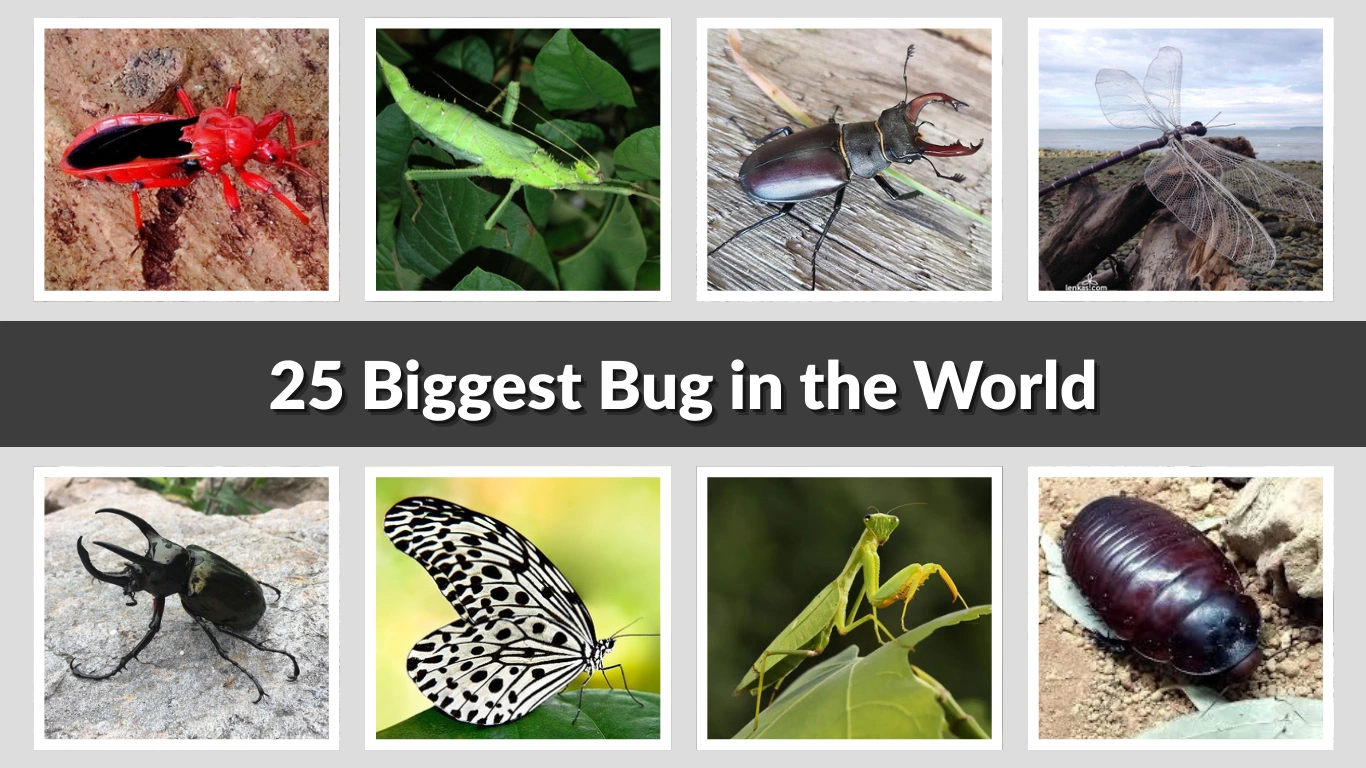
Bugs come in all shapes and sizes, but some species truly stand out for their extraordinary size, strength, and unique adaptations. From enormous beetles and giant moths to record-breaking stick insects, these creatures dominate their environments and capture human fascination. In this article, we’ll explore 25 of the biggest bugs in the world, highlighting their features, habitats, and importance in ecosystems across the globe.
1. Goliath Beetle
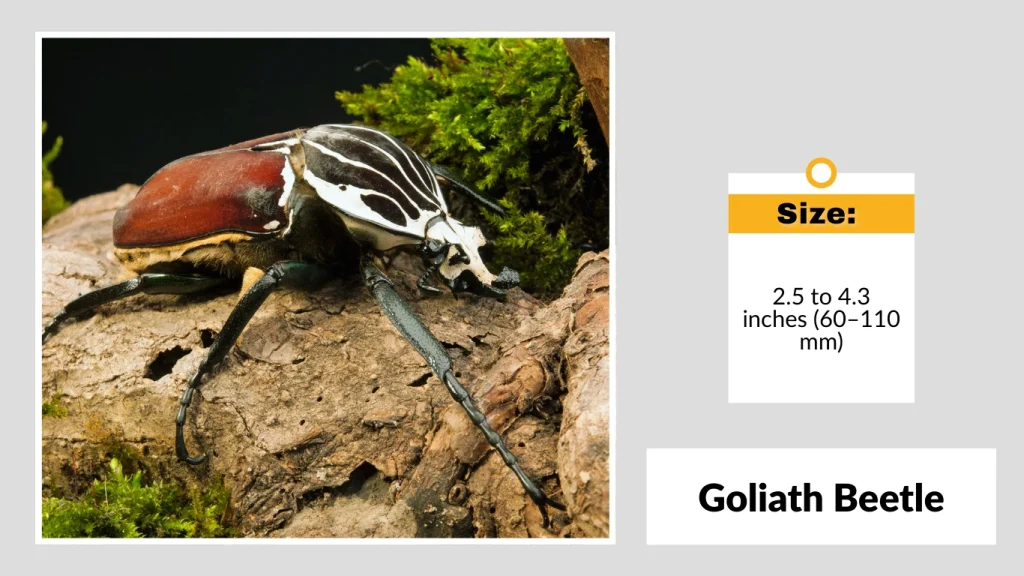
Goliath beetles are among the largest and heaviest insects in the world, mainly found in the tropical forests of Africa. They are famous for their massive size, striking patterns, and strong exoskeleton. Despite their intimidating look, they mostly feed on tree sap and fruits.
Identification
- Scientific name: Goliathus goliatus (and related species)
- Size: 2.5 to 4.3 inches (60–110 mm)
- Weight: up to 100 grams (the heaviest insect on Earth)
- Color: Varied patterns in black, brown, and white depending on species
- Habitat: Tropical rainforests of central Africa
Behavior
Goliath beetles are mainly active during the day and spend much of their time climbing trees in search of food. They feed on sap, nectar, and fruits. Despite their bulk, they can fly using strong wing muscles, though flying consumes a lot of energy.
Habitat
These beetles are found in dense tropical rainforests of central and western Africa. They prefer warm, humid areas with plenty of decaying wood and fruit sources, which are essential for both larvae and adults.
Importance
In their ecosystems, Goliath beetles play a role in recycling nutrients by feeding on decomposing matter and fruits. They are also a food source for birds, reptiles, and small mammals. Additionally, they attract attention from scientists and collectors due to their impressive size and unique biology.
2. Titan Beetle

The Titan beetle is considered the largest beetle in the world by length, found in the rainforests of South America. Known for its powerful jaws and massive body, it can reach sizes that rival many small animals. Despite its fearsome appearance, very little is known about its complete life cycle.
Identification
- Scientific name: Titanus giganteus
- Size: Up to 6.5 inches (16.7 cm)
- Color: Dark brown to black, with a shiny exoskeleton
- Special feature: Extremely strong mandibles capable of snapping pencils and piercing wood
- Habitat: Amazon rainforest regions of Brazil, Peru, Colombia, Ecuador, and French Guiana
Behavior
Titan beetles are nocturnal and usually attracted to light sources at night. They are powerful flyers but prefer to crawl or cling to trees. Their strong mandibles act as a defense mechanism against predators.
Habitat
They inhabit dense Amazon rainforests, especially near rotting logs and decaying wood. These areas are vital for their larvae, although the larvae have rarely been observed in the wild.
Importance
Titan beetles are a symbol of biodiversity in the Amazon. Their size and strength make them an important attraction for researchers and collectors. They also indicate the health of rainforest ecosystems since they thrive in undisturbed habitats.
3. Hercules Beetle
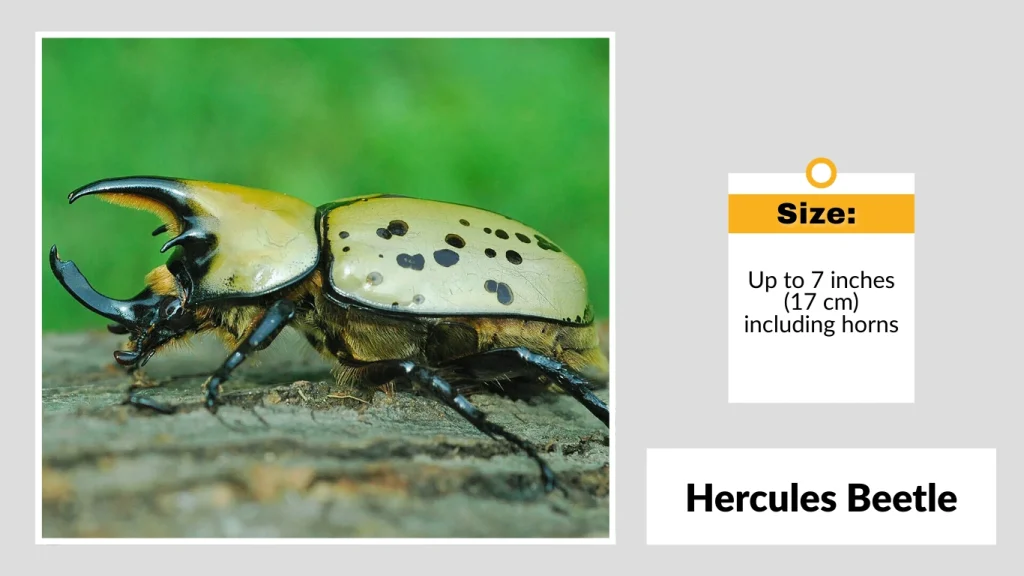
The Hercules beetle is one of the most famous giant insects in the world, admired for its incredible horn-like structures. Males are especially striking, with long horns that resemble pincers, used in battles for dominance. They are native to the rainforests of Central and South America and are among the largest beetles by length.
Identification
- Scientific name: Dynastes hercules
- Size: Up to 7 inches (17 cm) including horns
- Color: Males have a greenish or yellow elytra with black spots, while females are usually darker
- Special feature: Males possess two large horns, one on the head and one on the thorax, used in fights
- Habitat: Tropical rainforests of Central and South America
Behavior
Male Hercules beetles are known for their strength and combat behavior. They use their horns to flip and push rivals when competing for mates. Despite their aggressive looks, they feed mainly on rotting fruit, sap, and decaying plant material.
Habitat
These beetles are found in humid, tropical forests, where they live among decaying logs, tree trunks, and fruit sources. The larvae develop in rotting wood and can take up to two years to mature before pupating.
Importance
Hercules beetles are vital decomposers, breaking down plant matter and recycling nutrients. They are also widely studied for their strength, as they can carry up to 850 times their body weight. Their dramatic horns make them popular among insect collectors worldwide.
4. Giant Weta
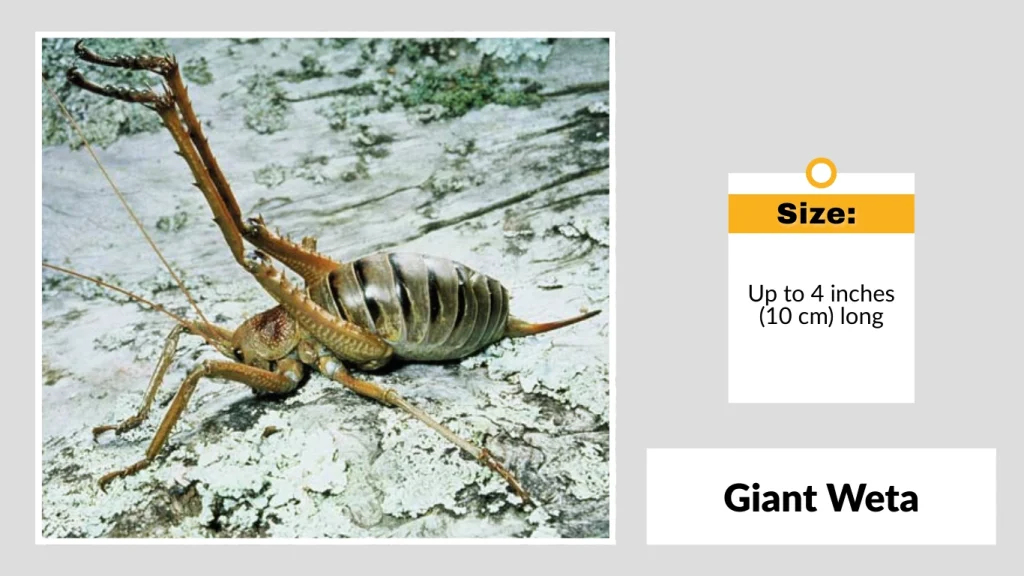
The Giant Weta is one of the heaviest insects on Earth, native to New Zealand. Resembling an oversized cricket, it is famous for its bulk rather than its length. Some individuals weigh more than a sparrow, making them a true giant in the insect world.
Identification
- Scientific name: Deinacrida heteracantha (and related species)
- Size: Up to 4 inches (10 cm) long
- Weight: Can exceed 70 grams, sometimes over 100 grams in females
- Color: Brownish with spiny legs and long antennae
- Special feature: Enormous body mass and strong, spiny legs
- Habitat: Islands and forests of New Zealand
Behavior
Giant Wetas are nocturnal and slow-moving insects. They feed mainly on leaves, fruit, and other plant material. Unlike many insects, they are not agile jumpers and rely on their large size and camouflage for protection.
Habitat
They live in shrublands, forests, and protected island reserves in New Zealand. Some species have been relocated to predator-free islands to ensure their survival, as they are highly vulnerable to introduced predators like rats.
Importance
Giant Wetas are ecologically significant herbivores in their habitats, helping with plant matter recycling. They are also considered a conservation icon in New Zealand, symbolizing the country’s unique biodiversity and efforts to protect endangered species.
5. Giant Burrowing Cockroach

The Giant Burrowing Cockroach, also known as the rhinoceros cockroach, is the heaviest cockroach species in the world. Unlike common household cockroaches, it is harmless, clean, and plays an important role in the ecosystem. Native to Australia, it is a burrowing insect that spends most of its life underground.
Identification
- Scientific name: Macropanesthia rhinoceros
- Size: Up to 3.3 inches (8 cm) long
- Weight: Can weigh more than 30 grams
- Color: Dark brown to black, with a smooth, glossy exoskeleton
- Special feature: Wingless, heavy-bodied cockroach adapted for digging
- Habitat: Dry eucalyptus forests of Queensland, Australia
Behavior
This cockroach digs burrows up to 3 feet deep, where it spends most of its life. It feeds mainly on dry eucalyptus leaves and other organic matter. Unlike other cockroaches, it does not infest homes and has a slow, calm lifestyle.
Habitat
Found in northeastern Australia, especially in Queensland, it thrives in sandy soils where burrows can be made. The stable underground temperature protects it from harsh surface conditions.
Importance
The Giant Burrowing Cockroach is a natural recycler, breaking down leaf litter and enriching the soil. It is also kept as a pet due to its docile nature and long lifespan, living up to 10 years. Its ecological role highlights the importance of insects in maintaining healthy ecosystems.
6. Atlas Moth
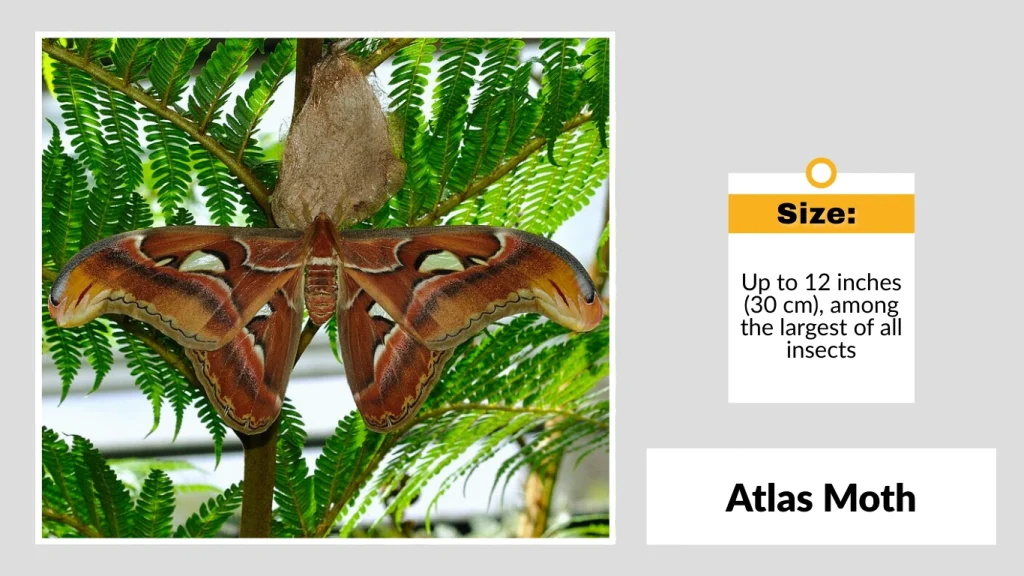
The Atlas moth is one of the largest moths in the world, with wingspans that can rival small birds. Native to Southeast Asia, it is admired for its striking wing patterns and massive size. Despite its beauty, the adult moth lives only a short time since it lacks functional mouthparts.
Identification
- Scientific name: Attacus atlas
- Wingspan: Up to 12 inches (30 cm), among the largest of all insects
- Color: Reddish-brown wings with intricate patterns and white markings
- Special feature: Wing tips resemble snake heads, which help deter predators
- Habitat: Tropical and subtropical forests of Southeast Asia, including India, China, and Indonesia
Behavior
Atlas moths are nocturnal and are most active during the night. Adults do not eat; instead, they rely on fat reserves stored from the caterpillar stage. Their primary purpose as adults is reproduction, and they live only about one to two weeks.
Habitat
They thrive in warm, humid tropical forests and are often found resting on trees and vegetation. The caterpillars feed on a wide variety of plants, including citrus, guava, and cinnamon trees.
Importance
Atlas moths are ecologically significant as pollinators during their short adult stage and as caterpillars that influence plant growth through feeding. They are also culturally admired for their size and beauty, often displayed in insect collections and nature exhibits.
7. Queen Alexandra’s Birdwing
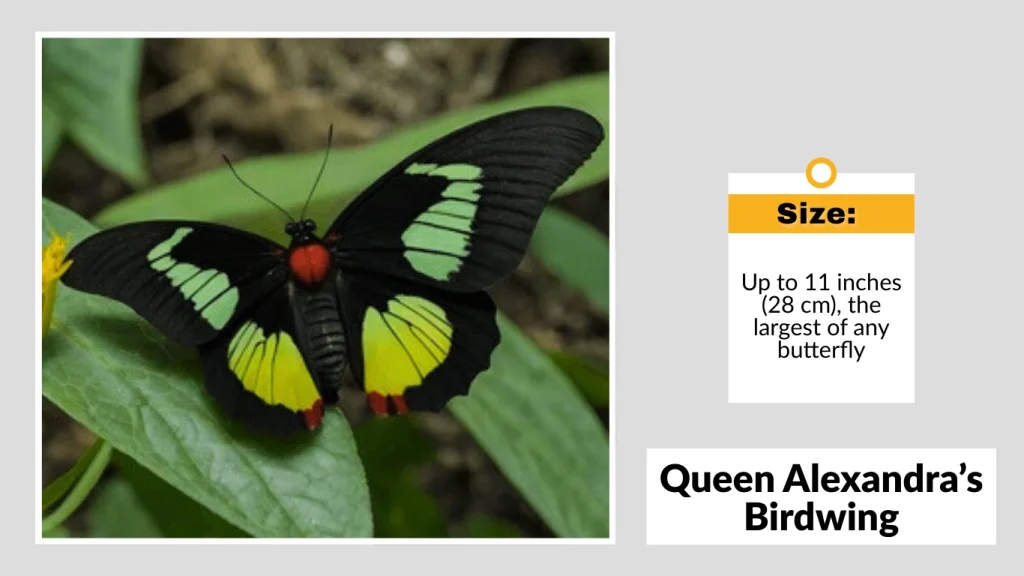
Queen Alexandra’s Birdwing is the largest butterfly in the world, famous for its enormous wingspan and vibrant colors. Endemic to Papua New Guinea, this butterfly is considered rare and highly protected due to its limited habitat and conservation status.
Identification
- Scientific name: Ornithoptera alexandrae
- Wingspan: Up to 11 inches (28 cm), the largest of any butterfly
- Color: Females are brown with white markings, while males are iridescent blue-green with yellow highlights
- Special feature: Exceptionally large wings and vibrant sexual dimorphism
- Habitat: Lowland rainforests of Papua New Guinea
Behavior
These butterflies are strong fliers and usually active during the day. Males patrol territories in search of females, while females are more sedentary, focusing on laying eggs on specific host plants. Caterpillars feed on toxic plants, making the adults distasteful to predators.
Habitat
Queen Alexandra’s Birdwing is found only in the lowland rainforests of Oro Province, Papua New Guinea. Its survival depends on the presence of Aristolochia vines, the host plant for its larvae.
Importance
This butterfly is an important symbol of biodiversity and conservation. Due to habitat loss and collection pressures, it is classified as endangered. Protecting its habitat not only preserves the species but also safeguards the unique rainforest ecosystem where it thrives.
8. Megasoma Beetle

The Megasoma beetles are massive rhinoceros beetles known for their bulky bodies and impressive horns. Found in the Americas, they belong to a group of scarab beetles that are among the heaviest insects on Earth. Their size and strength make them a standout among giant beetles.
Identification
- Scientific name: Megasoma elephas (and related species)
- Size: 2.5 to 4.7 inches (6–12 cm)
- Weight: Up to 100 grams in some species
- Color: Usually dark brown or black, covered with fine golden hairs
- Special feature: Males have large horns on the head and thorax, while females lack horns
- Habitat: Tropical and subtropical forests in Central and South America
Behavior
Megasoma beetles are mostly nocturnal and attracted to lights at night. Males use their horns in combat to compete for females, lifting and pushing rivals in battles. Their diet mainly consists of fruit, nectar, and tree sap.
Habitat
They thrive in humid rainforests, often staying near rotting logs, fallen trees, and fruit-rich areas. The larvae develop in decaying wood, where they can take several years to mature.
Importance
Megasoma beetles are essential decomposers, breaking down plant matter and aiding nutrient recycling in forests. They are also studied for their extraordinary strength and admired by insect collectors for their impressive appearance.
9. Elephant Beetle
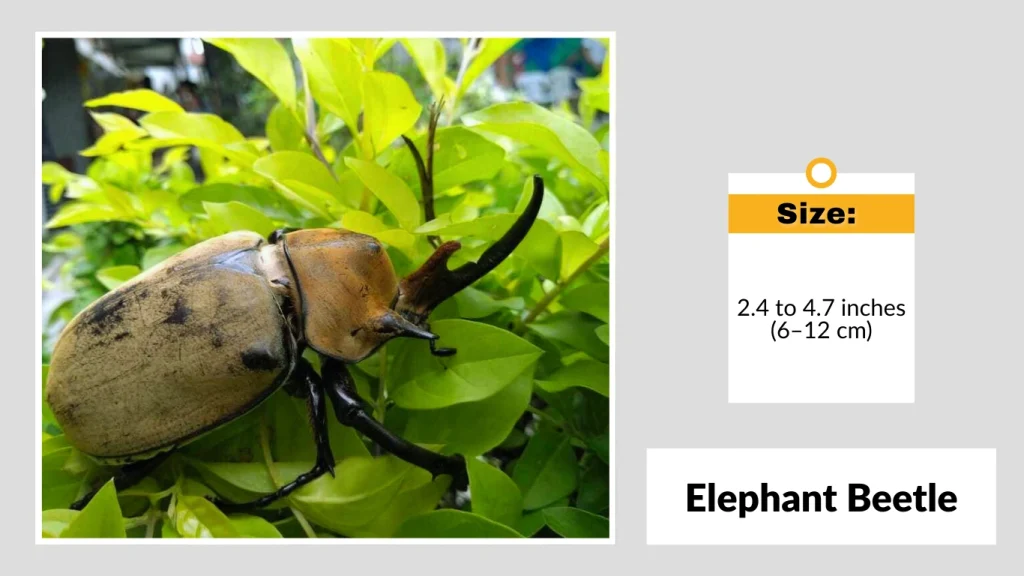
The Elephant beetle is a giant rhinoceros beetle native to Central and South America. Its name comes from the large, trunk-like horn found on males. These beetles are powerful, heavy-bodied, and among the strongest insects in the world.
Identification
- Scientific name: Megasoma elephas
- Size: 2.4 to 4.7 inches (6–12 cm)
- Color: Yellowish-brown to black, covered in fine hairs that give a dusty appearance
- Special feature: Males have three prominent horns on the head and thorax, resembling an elephant’s trunk
- Habitat: Tropical rainforests in Central and South America
Behavior
Elephant beetles are nocturnal and use their horns primarily for combat. Males fight by wrestling and pushing rivals away to secure mates. Their diet consists mainly of sap, nectar, and rotting fruit, making them important in forest nutrient cycles.
Habitat
They inhabit humid rainforests and are usually found around fallen logs, decaying trees, and fruit sources. Their larvae live in rotting wood, where they feed and grow for up to two years before becoming adults.
Importance
Elephant beetles are vital decomposers that help recycle nutrients in forest ecosystems. They are also admired for their size and strength, making them popular among insect enthusiasts and collectors. Their presence indicates a healthy and balanced rainforest environment.
10. Actaeon Beetle

The Actaeon beetle is one of the largest and heaviest beetles in the world, belonging to the rhinoceros beetle group. It is named after Actaeon, a figure in Greek mythology, due to its imposing size and strength. These beetles are powerful and robust, with males showcasing huge horns.
Identification
- Scientific name: Megasoma actaeon
- Size: Up to 5.1 inches (13 cm)
- Weight: Can exceed 100 grams
- Color: Dark brown to black, with a smooth, shiny exoskeleton
- Special feature: Males have a massive horn on the head and two shorter ones on the thorax
- Habitat: Tropical rainforests of South America, especially in Venezuela, Colombia, Ecuador, Peru, and Bolivia
Behavior
Actaeon beetles are primarily nocturnal. Males engage in fights, using their horns to lift and flip rivals when competing for females. They feed on fruits, tree sap, and decaying vegetation. Despite their size, they are relatively slow movers.
Habitat
They thrive in humid rainforest environments with plenty of rotting wood and fruit sources. Larvae grow inside decaying logs and take up to three years to develop before becoming adults.
Importance
The Actaeon beetle plays a key role in nutrient cycling by breaking down decaying plant matter. It is also a species of interest for entomologists and collectors because of its remarkable size and horn structure. Its presence reflects the richness of South American rainforests.
11. Wallace’s Golden Birdwing
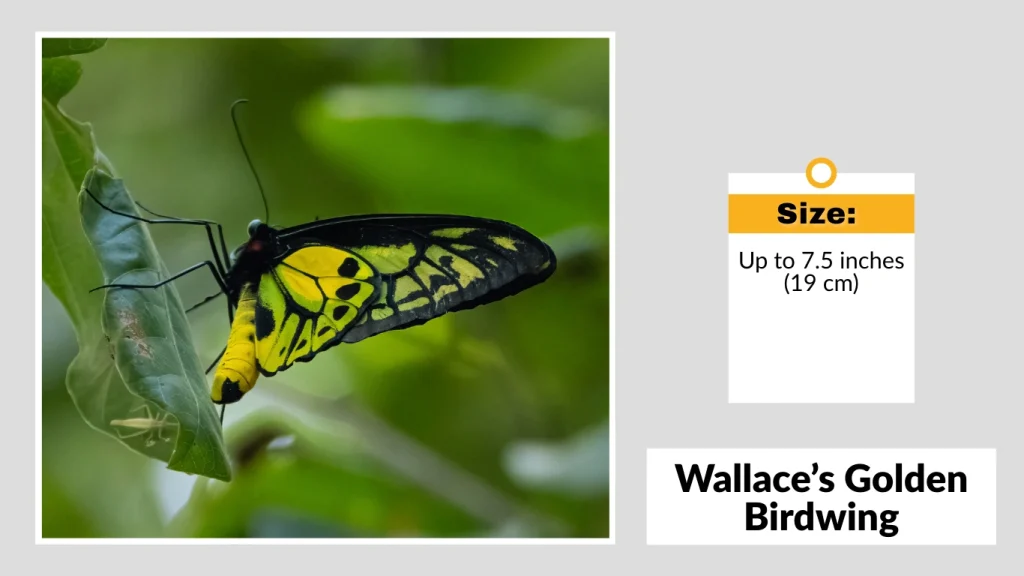
Wallace’s Golden Birdwing is one of the largest butterflies in the world and is named after the naturalist Alfred Russel Wallace, who discovered it. Its striking golden coloration and impressive wingspan make it one of the most beautiful insects on Earth.
Identification
- Scientific name: Ornithoptera croesus
- Wingspan: Up to 7.5 inches (19 cm)
- Color: Males are golden-orange with black borders, while females are larger and darker with cream markings
- Special feature: Bright golden wings in males, which are unique among birdwing butterflies
- Habitat: Northern Maluku Islands (Indonesia)
Behavior
Wallace’s Golden Birdwing is a strong flier and mostly active during the day. Males are territorial and patrol areas in search of females, while females focus on locating suitable host plants for egg-laying. Caterpillars feed on toxic Aristolochia vines, which makes the butterfly unpalatable to predators.
Habitat
This butterfly inhabits lowland rainforests and forest edges on the Maluku Islands. It thrives in undisturbed environments with an abundance of host plants and nectar sources.
Importance
Wallace’s Golden Birdwing is an important symbol of biodiversity and conservation in Indonesia. It is protected due to its rarity and restricted habitat. Its beauty also makes it a significant species for eco-tourism and a reminder of the importance of preserving tropical rainforests.
12. Giant Water Bug
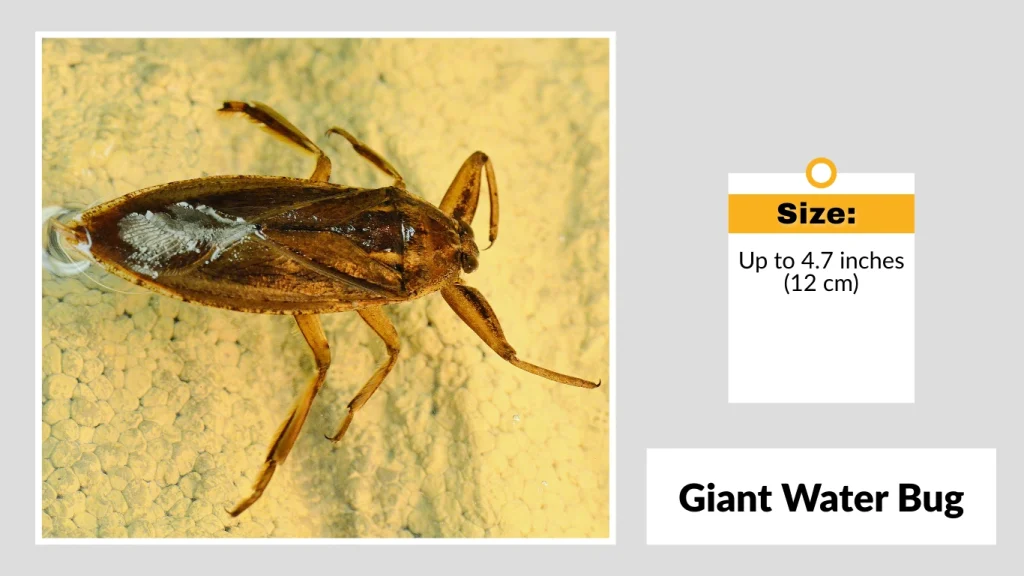
The Giant Water Bug is one of the largest true bugs in the world, known for its powerful bite and unique underwater lifestyle. Often called “toe-biters,” these aquatic insects are fierce predators and play a vital role in freshwater ecosystems.
Identification
- Scientific name: Lethocerus americanus (and related species)
- Size: Up to 4.7 inches (12 cm)
- Color: Brown to dark gray, blending well with muddy waters
- Special feature: Strong front legs for grasping prey and a sharp beak for injecting venom
- Habitat: Freshwater ponds, lakes, and slow-moving streams in North and South America, Asia, and parts of Africa
Behavior
Giant water bugs are ambush predators, feeding on fish, frogs, tadpoles, and even small snakes. They use their front legs to capture prey and inject digestive saliva to liquefy tissues. They are nocturnal hunters and can also fly to move between water bodies.
Habitat
These bugs prefer calm, freshwater habitats with abundant vegetation, where they can hide and ambush prey. They spend most of their time submerged but come to the surface to breathe.
Importance
Giant water bugs are essential predators that help control aquatic populations of fish and amphibians. They are also indicators of freshwater health. In some Asian countries, they are considered a delicacy and even used in traditional cuisine.
13. Tarantula Hawk Wasp
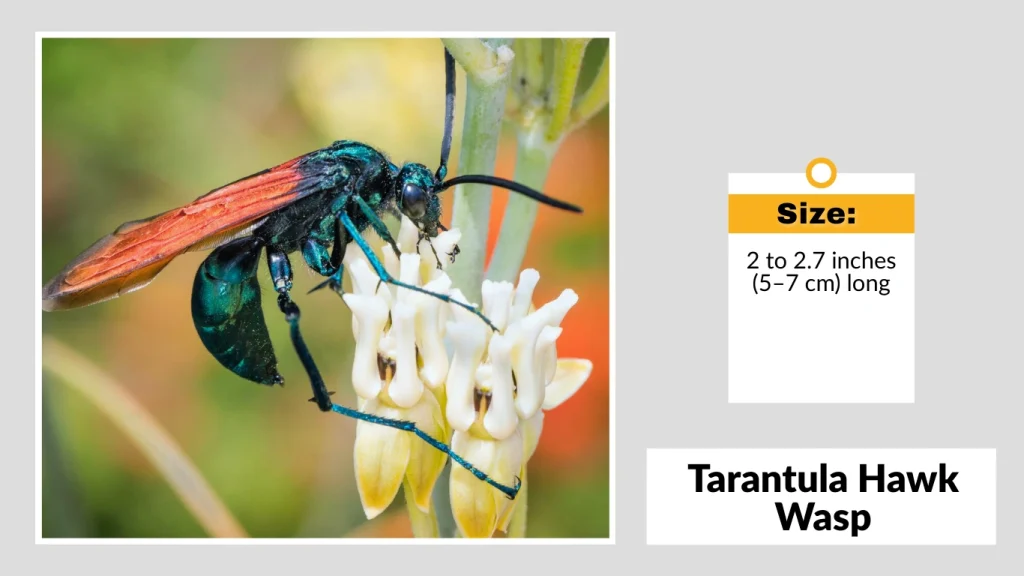
The Tarantula Hawk Wasp is one of the largest wasps in the world and is renowned for having one of the most painful stings of any insect. These wasps are striking in appearance and are famous for hunting tarantulas to provide food for their larvae.
Identification
- Scientific name: Pepsis grossa (and related species)
- Size: 2 to 2.7 inches (5–7 cm) long
- Color: Shiny black body with metallic blue wings or orange wings, depending on species
- Special feature: Extremely painful sting, used for paralyzing tarantulas
- Habitat: Deserts, grasslands, and forests of the Americas, especially the southwestern United States and Central/South America
Behavior
Female tarantula hawks paralyze tarantulas with their sting and drag them into burrows, where they lay eggs on the spider’s body. The developing larva feeds on the still-living tarantula. Adults primarily feed on nectar and are active during the day. Males are territorial and guard nectar sources.
Habitat
They are found in warm regions with plenty of flowering plants and spider populations. Open landscapes like deserts, meadows, and scrublands are common habitats for these wasps.
Importance
Tarantula hawk wasps play an ecological role in controlling tarantula populations. They are also important pollinators since adults feed on nectar. Despite their painful sting, they rarely attack humans unless provoked. Their unique behavior makes them one of the most fascinating insects in the world.
14. Giant Long-Horned Beetle
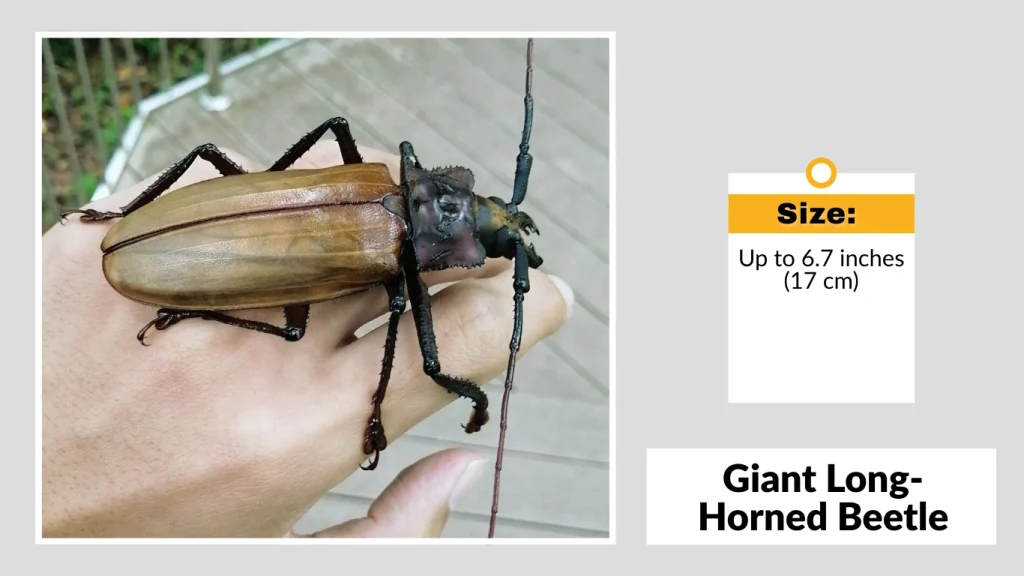
The Giant Long-Horned Beetle is among the largest beetles in the world, recognized for its extremely long antennae that can exceed its body length. Belonging to the Cerambycidae family, these beetles are powerful wood-borers and play a significant role in forest ecosystems.
Identification
- Scientific name: Macrodontia cervicornis
- Size: Up to 6.7 inches (17 cm)
- Color: Dark brown to reddish with rough, textured elytra
- Special feature: Antennae often longer than the body; males have large mandibles resembling deer antlers
- Habitat: Tropical rainforests of South America, especially in Brazil, Peru, Ecuador, and Bolivia
Behavior
These beetles are mostly nocturnal and are strong fliers despite their size. The larvae live inside trees, boring through hardwood and feeding on decaying wood for several years before maturing. Adults feed less frequently, mainly on tree sap and fruit.
Habitat
They inhabit humid tropical rainforests, staying close to rotting logs and trees, which provide food and shelter for their larvae. The presence of mature trees is essential for their survival.
Importance
Giant Long-Horned Beetles are important decomposers that recycle nutrients by breaking down dead wood. Their impressive appearance makes them highly sought after by insect collectors. Additionally, they highlight the biodiversity of South American rainforests.
15. White Witch Moth

The White Witch Moth holds the record for the largest wingspan of any living insect, making it one of the most remarkable moths in the world. Known for its ghostly appearance and immense size, it is sometimes called the “ghost moth” due to its pale, flowing wings.
Identification
- Scientific name: Thysania agrippina
- Wingspan: Up to 12 inches (30 cm), the widest among all insects
- Color: Silvery white to gray, with delicate wavy patterns across the wings
- Special feature: Immense wingspan and camouflage that helps it blend with tree bark
- Habitat: Central and South America, especially in rainforests of Brazil, Peru, and Mexico
Behavior
The White Witch Moth is nocturnal and primarily active during the night. It spends the day resting on tree trunks, where its wing patterns provide excellent camouflage. Adults feed very little, relying on energy reserves from their larval stage.
Habitat
They inhabit tropical rainforests, particularly dense, moist environments where they can hide effectively during the day. Their caterpillars feed on leguminous plants, which are common in their natural range.
Importance
The White Witch Moth is an important part of rainforest ecosystems, serving as prey for birds and bats. Its size and beauty also make it a species of fascination for entomologists and collectors, symbolizing the diversity and wonder of tropical insects.
16. Meganeura (Prehistoric, Extinct)

Meganeura was a giant dragonfly-like insect that lived around 300 million years ago during the Carboniferous period. It is considered one of the largest flying insects to have ever existed, dominating prehistoric skies long before birds appeared.
Identification
- Scientific name: Meganeura monyi
- Wingspan: Up to 27 inches (70 cm)
- Body length: Around 17 inches (43 cm)
- Color: Believed to be dark with translucent wings, similar to modern dragonflies
- Special feature: Enormous wings that allowed it to glide and hunt efficiently
- Habitat: Ancient swampy forests with high oxygen levels
Behavior
Meganeura was a predator, much like modern dragonflies. It hunted other insects and possibly small amphibians, using its sharp mandibles and excellent eyesight. Its large size was supported by the high oxygen concentration in Earth’s atmosphere at the time.
Habitat
This giant insect thrived in Carboniferous forests filled with ferns, horsetails, and vast swamp ecosystems. Fossil evidence suggests it was widespread across Europe.
Importance
Meganeura represents an evolutionary milestone, showing how atmospheric conditions once allowed insects to grow to incredible sizes. It is often studied as an example of gigantism in prehistoric life and provides valuable insights into ancient ecosystems.
17. Phryganistria chinensis Zhao (World’s Longest Stick Insect)
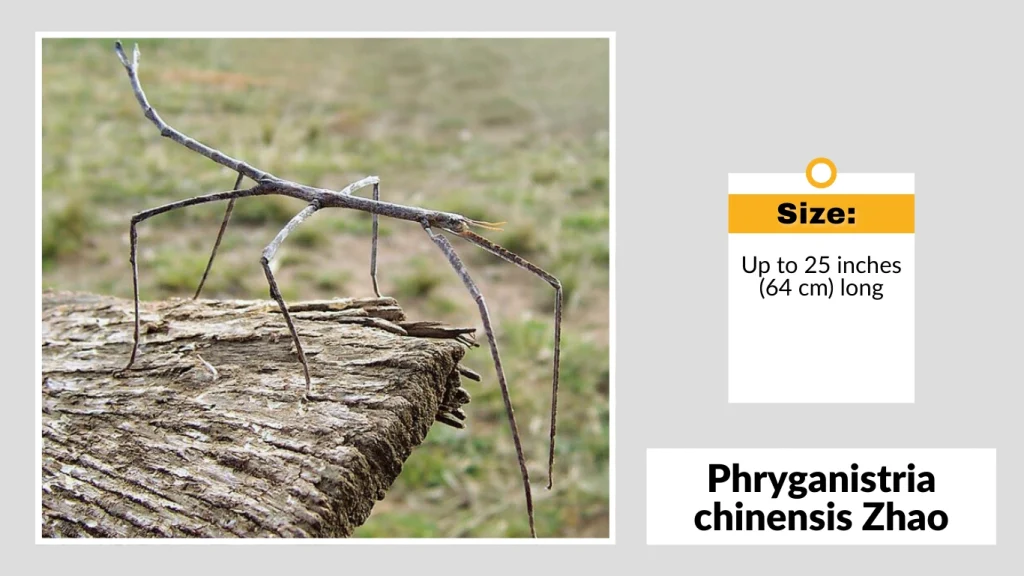
Phryganistria chinensis Zhao is the longest insect ever recorded, belonging to the stick insect family. Discovered in China in 2014, it broke records with its extraordinary body length, resembling a twig so perfectly that it is nearly impossible to spot in its natural habitat.
Identification
- Scientific name: Phryganistria chinensis Zhao
- Size: Up to 25 inches (64 cm) long
- Color: Brown to greenish, mimicking branches and twigs
- Special feature: Exceptional body length, holding the record as the world’s longest insect
- Habitat: Forested regions of southern China
Behavior
This stick insect is nocturnal and relies heavily on camouflage to avoid predators. It feeds on leaves and remains almost motionless during the day, blending seamlessly with tree branches.
Habitat
It inhabits dense forests in southern China, where vegetation provides both food and cover. Its survival depends on blending into woody plants and shrubs to avoid detection by birds and reptiles.
Importance
Phryganistria chinensis Zhao is an extraordinary example of evolutionary adaptation, showing how camouflage can reach extremes in the insect world. Its discovery highlights the richness of biodiversity still hidden in Earth’s forests and the importance of conservation.
18. Macrodontia cervicornis (Long-Horn Beetle)
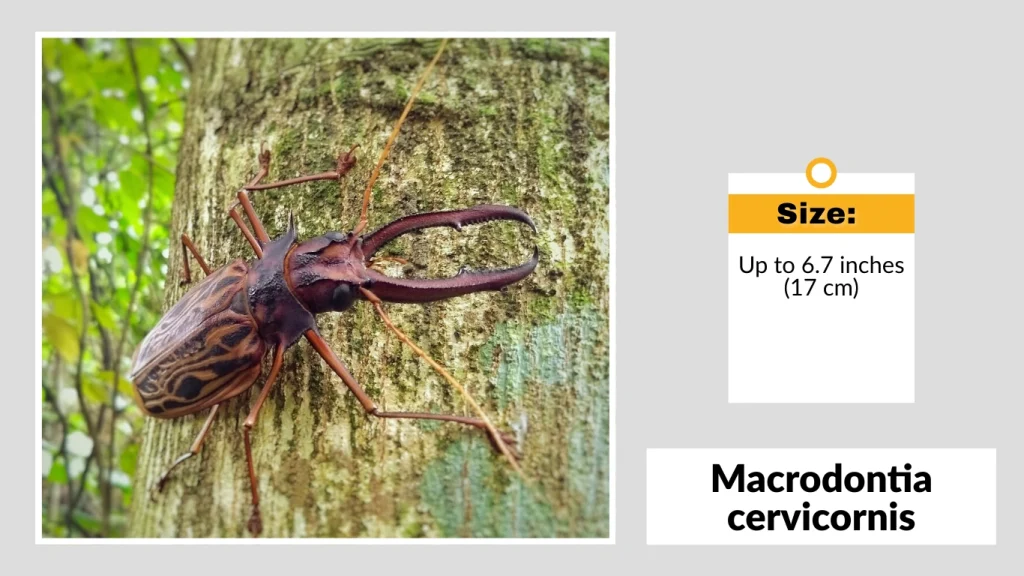
Macrodontia cervicornis is one of the largest beetles in the world, belonging to the long-horn beetle family (Cerambycidae). It is famous for its massive size and large mandibles, which resemble deer antlers, giving it an intimidating appearance.
Identification
- Scientific name: Macrodontia cervicornis
- Size: Up to 6.7 inches (17 cm)
- Color: Dark brown to black with ridged elytra
- Special feature: Enormous mandibles in males, used for defense and combat
- Habitat: Tropical rainforests of South America, especially in Brazil, Ecuador, Peru, and Colombia
Behavior
This beetle is nocturnal and powerful, with males using their mandibles to fight rivals and defend territory. The larvae bore deep into trees and can spend several years feeding on decaying wood before pupating into adults. Adults themselves feed sparingly, mainly on plant sap and fruit.
Habitat
Macrodontia cervicornis thrives in humid tropical rainforests, where large, decaying hardwood trees are abundant. Such environments provide ideal food sources for larvae and shelter for adults.
Importance
As a decomposer, this beetle plays a crucial role in recycling nutrients from decaying trees. Its extraordinary size and appearance make it one of the most sought-after beetles among insect collectors and researchers studying insect gigantism.
19. Goliath Stick Insect

The Goliath Stick Insect is one of the largest stick insects in the world, known for its long, slender body that perfectly mimics branches and twigs. Its impressive size and camouflage make it a master of disguise in the insect world.
Identification
- Scientific name: Eurycnema goliath
- Size: Up to 11 inches (28 cm)
- Color: Green or brown, resembling fresh or dried sticks
- Special feature: Extremely long legs and body with leaf-like extensions for camouflage
- Habitat: Forested regions of Australia
Behavior
Goliath stick insects are nocturnal feeders, spending most of the day motionless on branches to avoid predators. They rely almost entirely on camouflage for defense, though they may spread their wings or release a defensive odor if threatened.
Habitat
They inhabit eucalyptus forests and other wooded areas in Australia. Their diet consists mainly of eucalyptus leaves and other native plants.
Importance
This insect highlights the extraordinary adaptations of stick insects for survival. Its camouflage abilities make it a key species for understanding insect defense strategies, while also contributing to forest ecosystems through herbivory.
20. Atlas Beetle

The Atlas Beetle is a massive rhinoceros beetle named after the Titan Atlas from Greek mythology. It is famous for its impressive horns and extraordinary strength, capable of lifting objects many times its body weight.
Identification
- Scientific name: Chalcosoma atlas
- Size: Up to 5 inches (13 cm)
- Color: Dark brown to black, with a glossy exoskeleton
- Special feature: Males have three large horns on the head and thorax, while females are hornless
- Habitat: Tropical forests of Southeast Asia, including Malaysia, Indonesia, and Thailand
Behavior
Male Atlas beetles are highly aggressive and use their horns to fight rivals, often lifting and throwing opponents. Despite their fierce looks, adults mainly feed on fruit, nectar, and tree sap. Larvae spend years developing in decaying wood before becoming adults.
Habitat
They live in humid tropical rainforests with plenty of rotting wood and fruit sources. Fallen logs and decaying trees provide ideal shelter and food for larvae.
Importance
Atlas beetles are essential in nutrient recycling by breaking down decaying plant material. They are also widely studied for their strength, as they can lift more than 100 times their body weight. Collectors prize them for their size and dramatic horn structure.
21. Stag Beetle (Lucanus cervus)

The Stag Beetle is one of the most recognizable beetles in the world, named for the large, antler-like jaws of the males. It is the largest beetle species in Europe and is admired for both its size and striking appearance.
Identification
- Scientific name: Lucanus cervus
- Size: Up to 3 inches (7.5 cm) long, with mandibles extending even further in males
- Color: Dark brown to black body with reddish-brown mandibles
- Special feature: Males have oversized mandibles resembling stag antlers, used in combat
- Habitat: Deciduous woodlands across Europe, especially oak forests
Behavior
Male stag beetles use their massive mandibles to wrestle rivals during the breeding season, often lifting and throwing opponents. Despite their fearsome appearance, they feed mainly on tree sap and rotting fruit. Females have smaller mandibles and are more reclusive.
Habitat
Stag beetles thrive in forests, gardens, and woodlands with abundant rotting wood. Larvae live inside decaying logs and stumps, feeding for several years before maturing into adults.
Importance
Stag beetles are vital decomposers, helping recycle nutrients from decaying wood. They are also considered an iconic species in Europe and are protected in many countries due to habitat loss and declining populations. Their presence indicates healthy forest ecosystems.
22. Giant Leaf Insect

The Giant Leaf Insect is a remarkable master of camouflage, mimicking leaves so perfectly that it can be difficult to distinguish from real foliage. Its broad, leaf-like body and intricate vein patterns make it one of the most fascinating large insects in the world.
Identification
- Scientific name: Phyllium giganteum
- Size: Up to 4 inches (10 cm)
- Color: Bright green with brownish edges resembling dried leaf spots
- Special feature: Flat, leaf-shaped body with vein-like markings
- Habitat: Tropical forests of Southeast Asia, including Malaysia and Indonesia
Behavior
Giant leaf insects rely entirely on mimicry for survival. They sway gently like leaves in the breeze to avoid detection by predators. They are herbivores, feeding mainly on guava, mango, and other broadleaf plants.
Habitat
These insects inhabit dense tropical forests with plenty of leafy vegetation. Their survival depends on staying hidden among host plants, where they blend seamlessly with their surroundings.
Importance
The Giant Leaf Insect plays an important role in forest ecosystems as a herbivore. Its unique camouflage also makes it a key species for studying mimicry and evolutionary adaptations in insects. It is often kept in insect collections and admired for its extraordinary appearance.
23. Giant Praying Mantis (Tenodera sinensis)
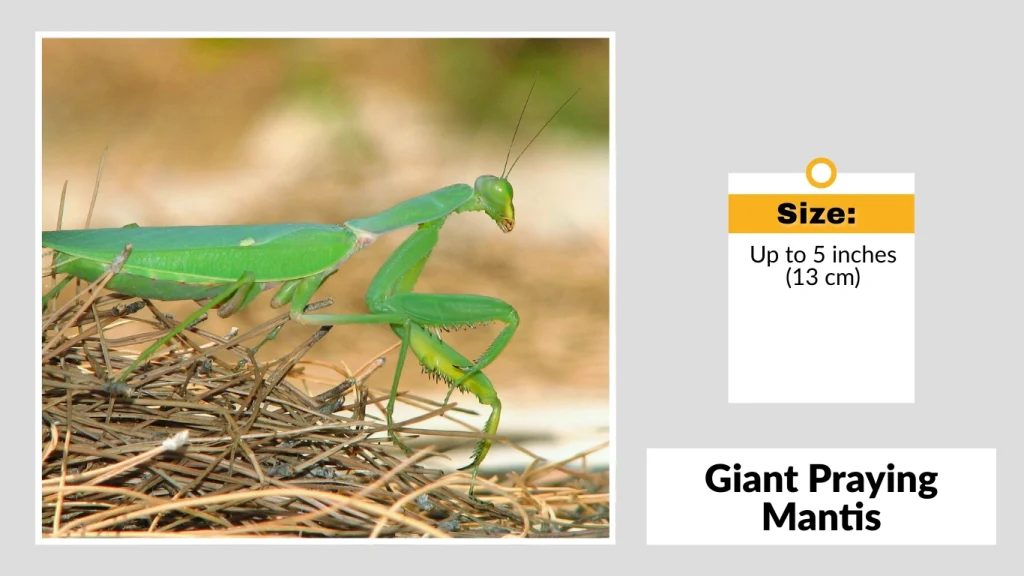
The Giant Praying Mantis is one of the largest mantis species, known for its predatory behavior and impressive size. Native to Asia but introduced to other regions, it is a skilled hunter that helps control insect populations.
Identification
- Scientific name: Tenodera sinensis
- Size: Up to 5 inches (13 cm)
- Color: Green to brown, aiding in camouflage among vegetation
- Special feature: Long forelegs adapted for grasping prey with spines for a secure grip
- Habitat: Grasslands, forests, gardens, and agricultural fields
Behavior
The Giant Praying Mantis is an ambush predator. It waits motionless for prey, then strikes rapidly with its spiny forelegs to capture insects, spiders, and even small vertebrates. They are solitary and can display cannibalism, especially during mating.
Habitat
This species thrives in warm, vegetated areas with plenty of insect prey. It has adapted well to human-influenced environments, often seen in gardens and farmlands where prey is abundant.
Importance
Giant Praying Mantises are valuable natural pest controllers, reducing populations of harmful insects. They are also studied for their predatory strategies and are admired for their unique hunting style, making them one of the most iconic mantis species.
24. Malayan Stick Insect
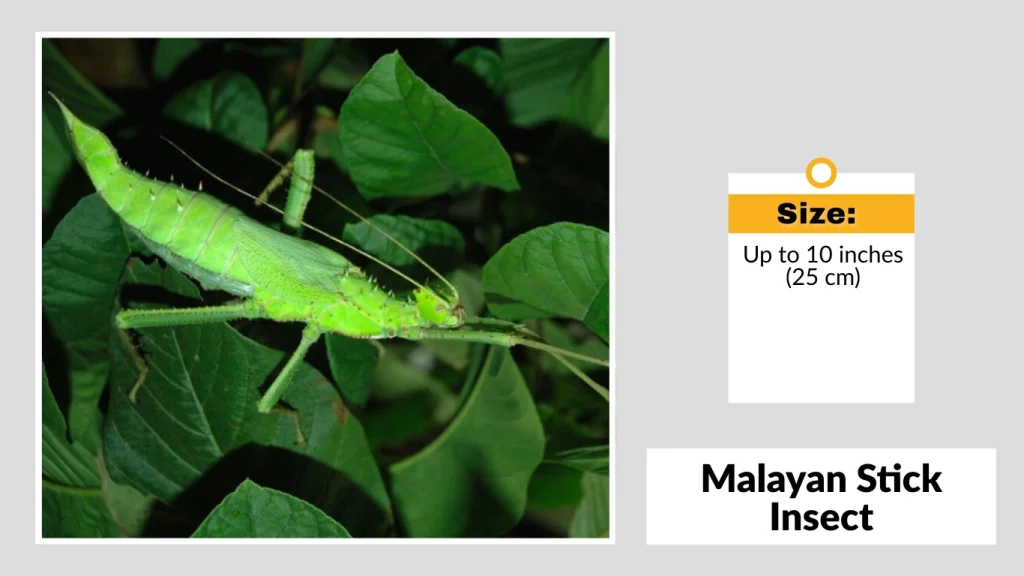
The Malayan Stick Insect is one of the largest stick insects in the world, famous for its incredible length and ability to blend seamlessly with twigs and branches. Its elongated body and slow movements make it nearly invisible in its natural habitat.
Identification
- Scientific name: Heteropteryx dilatata
- Size: Up to 10 inches (25 cm)
- Color: Green to brown, often with leaf-like extensions on the legs
- Special feature: Females are heavier and more robust, while males are slender and longer
- Habitat: Tropical rainforests of Malaysia and surrounding regions
Behavior
Malayan stick insects are nocturnal and rely heavily on camouflage to avoid predators. They move slowly, mimicking the swaying of branches. Females can also produce a defensive hissing sound by rubbing their wings when threatened.
Habitat
They inhabit dense tropical forests with abundant foliage, where they feed primarily on leaves. Their survival depends on blending with surrounding vegetation to escape detection by birds and reptiles.
Importance
These insects are an important part of forest ecosystems, acting as herbivores that influence plant growth. They are also highly valued by insect collectors and researchers for their size, defensive adaptations, and incredible camouflage.
25. Giant Assassin Bug

The Giant Assassin Bug is one of the largest predatory true bugs, known for its powerful hunting abilities and striking appearance. Unlike many plant-feeding bugs, assassin bugs are active predators, using stealth and strength to capture their prey.
Identification
- Scientific name: Psytalla horrida (and other large assassin bug species)
- Size: Up to 2 inches (5 cm), making it one of the largest assassin bugs
- Color: Bright red, orange, or patterned with black, often serving as a warning to predators
- Special feature: Long piercing beak used to inject venom and digestive enzymes into prey
- Habitat: African tropical and subtropical forests and savannas
Behavior
Giant Assassin Bugs are ambush predators, attacking insects and sometimes small vertebrates. They pierce their prey with a sharp proboscis, injecting venom that liquefies tissues, which they then suck out. Some species are aggressive and can deliver painful bites to humans if handled.
Habitat
They thrive in tropical forests and savanna regions, where insect prey is abundant. They are often found on plants, tree trunks, or the forest floor, waiting for unsuspecting prey.
Importance
Giant Assassin Bugs play an important ecological role in controlling insect populations. They are also studied for their unique hunting methods and venomous bite, which provides insights into insect predation and defense strategies.
