
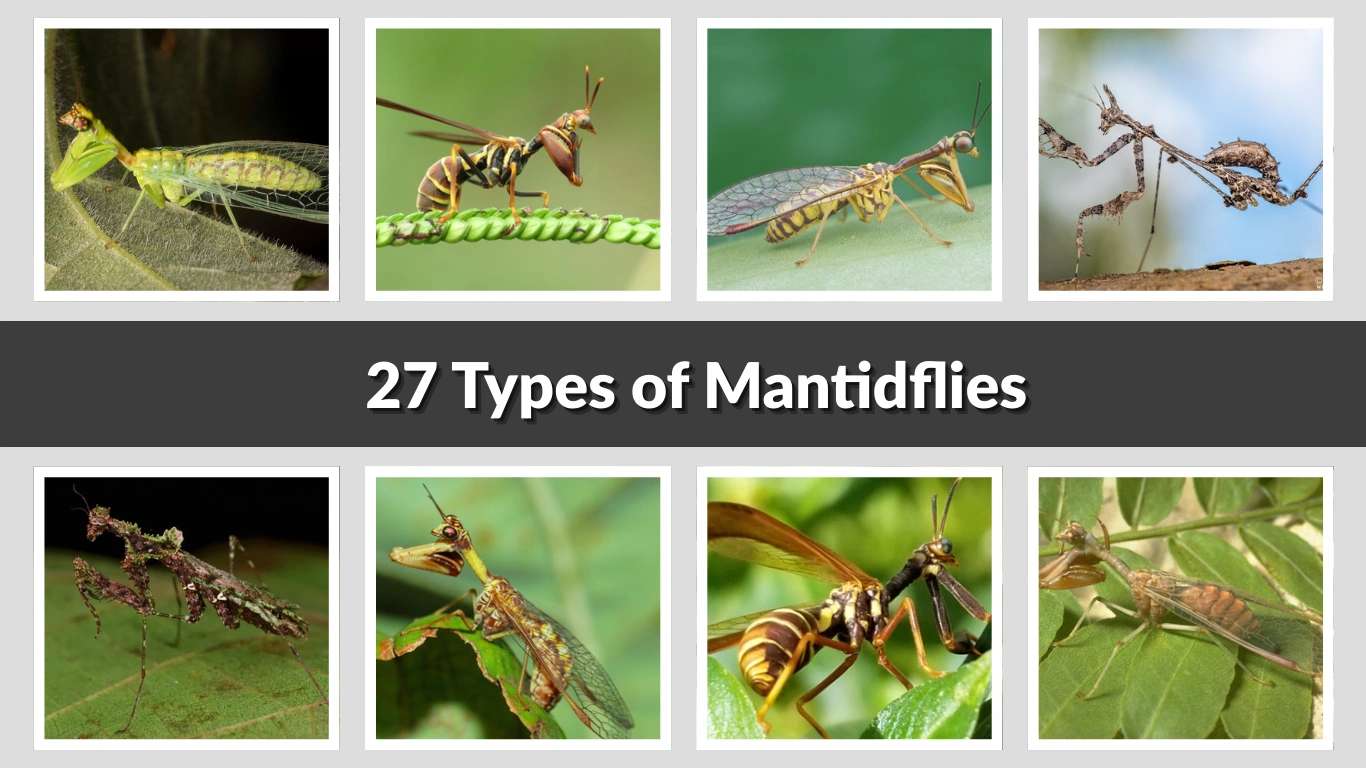
Mantidflies are fascinating insects that belong to the family Mantispidae, often mistaken for small praying mantises due to their raptorial forelegs. With their unique blend of mantis-like hunting behavior and lacewing ancestry, they play an important role in ecosystems worldwide. From colorful and spotted species to those adapted for deserts and forests, each mantidfly has its own characteristics. Below are 27 different types, showcasing their incredible diversity.
1. Green Mantidfly
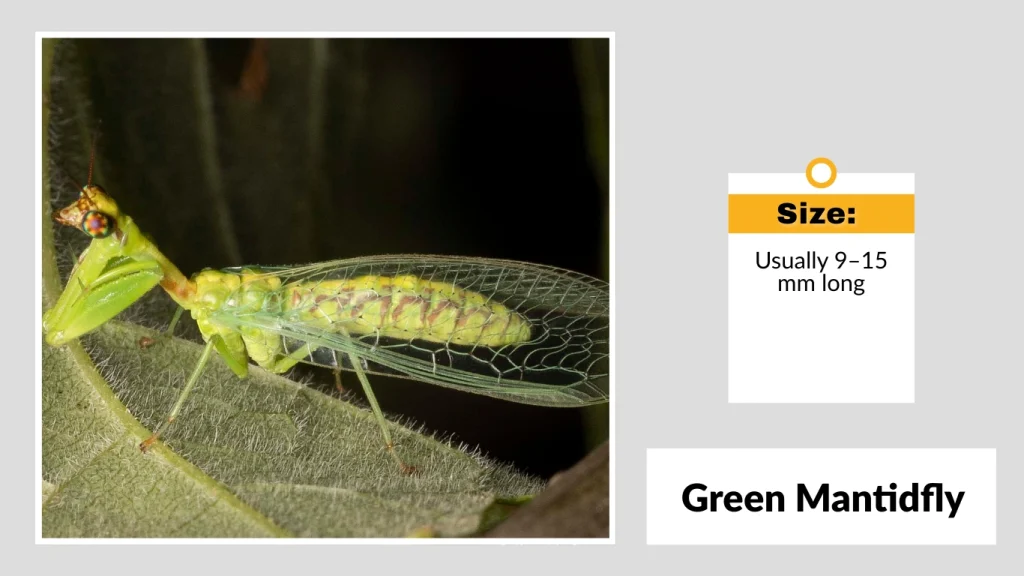
The Green Mantidfly (Zeugomantispa minuta) is a small but fascinating insect that resembles a praying mantis due to its raptorial front legs. Belonging to the family Mantispidae, this species is widely distributed across North and South America. Its bright green body makes it stand out among foliage, where it hunts for small insects.
Identification
- Small size, usually 9–15 mm long
- Slender green body with delicate wings
- Raptorial forelegs similar to praying mantises
- Transparent wings with a faint greenish tint
- Large, bulging eyes adapted for spotting prey
Behavior
Green Mantidflies are active hunters, using their spiny forelegs to snatch small insects like flies and beetles. They are ambush predators, remaining still until prey comes close. Despite their mantis-like appearance, they are closer relatives of lacewings.
Habitat
They are commonly found in meadows, gardens, woodlands, and areas with plenty of vegetation across the Americas. Adults are most active during warm months and are often attracted to lights at night.
Importance
This mantidfly helps control insect populations, making it a beneficial predator in natural ecosystems. Its unusual appearance also sparks scientific and public interest, helping raise awareness of insect diversity.
2. Brown Mantidfly

The Brown Mantidfly (Dicromantispa sayi) is a widespread North American mantidfly that mimics wasps with its brownish body and narrow waist. Its appearance often causes confusion, but its raptorial forelegs clearly reveal its predatory nature. This species is one of the most frequently encountered mantidflies in the United States.
Identification
- Medium-sized, about 10–15 mm long
- Slender body with yellow-brown to reddish-brown coloration
- Raptorial forelegs resembling those of a praying mantis
- Clear wings with a slight amber tint
- Narrow “wasp-like” waist, aiding in mimicry
Behavior
Brown Mantidflies are ambush predators, lying in wait for unsuspecting insects such as flies, moths, and small beetles. Their wasp-like mimicry provides protection against predators. They are strong fliers and are sometimes seen near lights during summer nights.
Habitat
This species inhabits gardens, woodlands, fields, and forest edges throughout North America, especially in the eastern and southern United States. They thrive in warm, vegetated areas with abundant insect prey.
Importance
The Brown Mantidfly plays an important ecological role by reducing populations of pest insects. Its mimicry and predatory behavior make it a subject of entomological research and interest among insect enthusiasts.
3. Yellow Mantidfly

The Yellow Mantidfly (Climaciella brunnea) is one of the most remarkable mantidflies, known for its striking resemblance to paper wasps. This mimicry not only protects it from predators but also makes it one of the most recognized species in North America. Despite its wasp-like look, it uses mantis-like forelegs to catch prey.
Identification
- Medium-sized insect, 15–20 mm long
- Bright yellow and brown banded body resembling paper wasps
- Narrow waist, enhancing wasp-like mimicry
- Raptorial forelegs with sharp spines for grasping prey
- Transparent wings with brownish venation
Behavior
The Yellow Mantidfly is an ambush predator, waiting motionless until small insects such as flies, moths, or beetles come within reach. Its mimicry of stinging wasps deters birds and other insectivores. Adults are active during warm months and may be seen on flowers or near lights at night.
Habitat
This species is commonly found across North and Central America, especially in gardens, meadows, and forest edges. They prefer areas where both prey insects and wasps are abundant, reinforcing their protective mimicry.
Importance
The Yellow Mantidfly plays a role in controlling insect populations, particularly pest species. Its wasp mimicry makes it a fascinating example of evolutionary adaptation and a favorite subject for insect photographers and researchers.
4. Cryptic Mantidfly

The Cryptic Mantidfly (Plega signata) is a small mantidfly species recognized for its camouflaged appearance. Unlike brightly colored species, this insect blends well into bark and leaves, giving it the name “cryptic.” Found mainly in the Americas, it is a stealthy predator that relies on disguise rather than mimicry.
Identification
- Small body, about 8–12 mm long
- Brown to gray coloration with mottled patterns for camouflage
- Raptorial forelegs adapted for seizing prey
- Narrow wings with subtle venation that resemble dried leaves
- Short antennae and rounded head
Behavior
Cryptic Mantidflies are ambush predators that rely heavily on camouflage. They perch quietly on bark or leaf surfaces, waiting for small insects to pass by. When threatened, they remain motionless, blending seamlessly into their surroundings.
Habitat
This species inhabits woodlands, forest edges, and areas with dense vegetation across Central and South America. They are often found on tree trunks, shrubs, and dry foliage.
Importance
The Cryptic Mantidfly contributes to insect population control by preying on small arthropods. Its incredible camouflage makes it an example of natural adaptation, showcasing how survival often depends on invisibility rather than mimicry.
5. Mexican Mantidfly
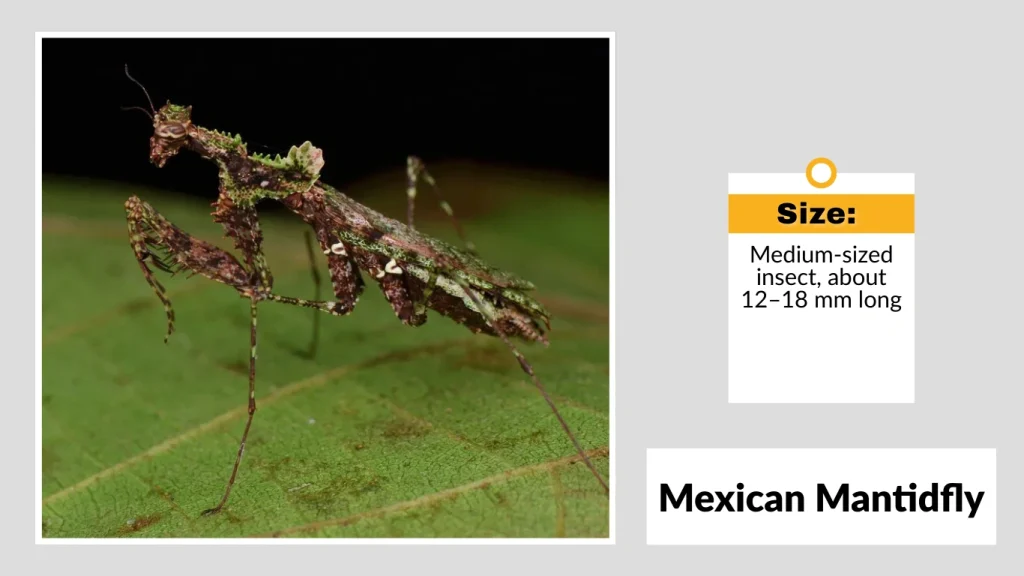
The Mexican Mantidfly (Mantispa mexicana) is a striking species native to parts of Central and North America. With its elongated body and mantis-like forelegs, it is an efficient predator of small insects. Its distinct coloration and structure make it stand out among mantidflies.
Identification
- Medium-sized insect, about 12–18 mm long
- Light brown to yellowish body with darker markings
- Prominent raptorial forelegs used for grasping prey
- Clear wings with noticeable brown veins
- Slender abdomen tapering to a point
Behavior
The Mexican Mantidfly is an ambush predator, sitting still until prey approaches within reach. It primarily hunts flies, moths, and other soft-bodied insects. Adults are strong fliers and are often attracted to artificial lights at night.
Habitat
This species is distributed in Mexico and extends into parts of Central America and the southern United States. It favors warm, semi-arid regions, open forests, and scrublands where insect prey is abundant.
Importance
The Mexican Mantidfly plays a role in natural pest control, feeding on insects that can damage crops and plants. It also serves as an important species for studying the diversity and distribution of mantidflies in the Americas.
6. Western Mantidfly

The Western Mantidfly (Dicromantispa morio) is a mantidfly species found mainly in the western regions of North America. Its dark coloration and predatory forelegs make it an efficient insect hunter, and it is one of the more commonly observed species in its range.
Identification
- Medium-sized, about 10–15 mm long
- Dark brown to nearly black body
- Distinct raptorial forelegs resembling those of a praying mantis
- Clear wings with darker venation
- Slender thorax and narrow waist
Behavior
The Western Mantidfly is an active ambush predator, feeding on flies, moths, and other small insects. It perches quietly and uses its spiny forelegs to strike quickly when prey comes close. Adults are nocturnal and are often attracted to artificial lights.
Habitat
This species is found in western parts of North America, particularly in open woodlands, scrublands, and dry grasslands. They prefer habitats with plentiful insect activity.
Importance
The Western Mantidfly helps regulate populations of pest insects, making it ecologically valuable. Its resemblance to both lacewings and mantises highlights its evolutionary adaptations and role in insect biodiversity.
7. Black Mantidfly
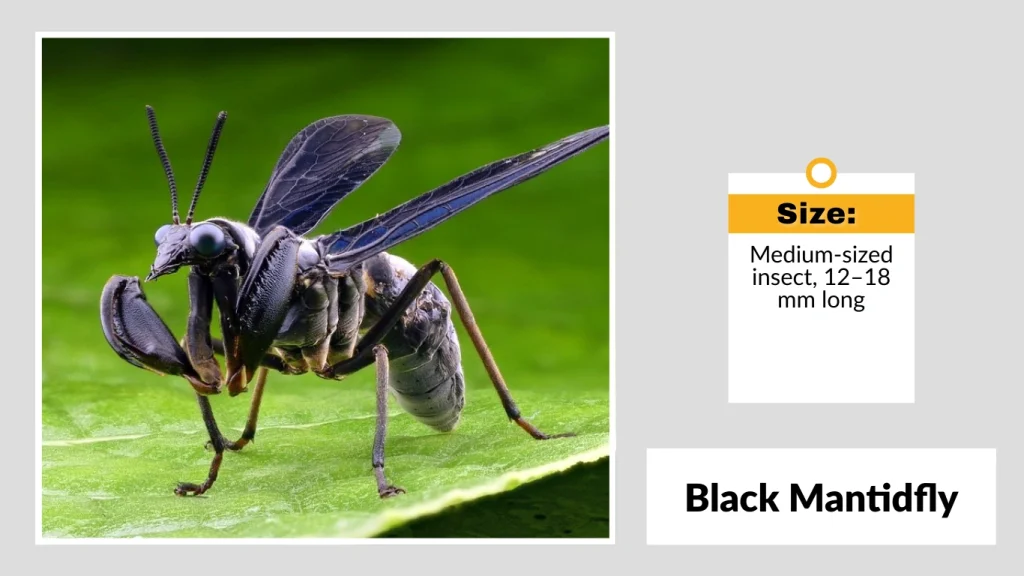
The Black Mantidfly (Mantispa styriaca) is one of the most well-known mantidflies in Europe and parts of Asia. Its dark body and mantis-like forelegs make it an impressive predator, while its unusual life cycle, involving parasitism of spider egg sacs, sets it apart from many other insects.
Identification
- Medium-sized insect, 12–18 mm long
- Glossy dark brown to black body
- Strong raptorial forelegs adapted for grasping prey
- Clear wings with darkened veins
- Elongated prothorax giving a mantis-like appearance
Behavior
The Black Mantidfly is an ambush predator, preying on flies, small moths, and other soft-bodied insects. Its larvae are parasitic, often invading spider egg sacs and feeding on developing spiderlings. Adults are usually active in summer and may be seen resting on vegetation.
Habitat
This species inhabits grasslands, forest edges, meadows, and agricultural fields across Europe, the Middle East, and western Asia. It prefers sunny areas with plenty of insect activity.
Importance
The Black Mantidfly contributes to controlling insect populations and is scientifically important due to its parasitic relationship with spiders. Its unique biology makes it a fascinating species for entomologists and insect enthusiasts.
8. Brazilian Mantidfly

The Brazilian Mantidfly (Mantispa brasiliensis) is a striking species native to South America, particularly Brazil and surrounding regions. Like other mantidflies, it has mantis-like forelegs for capturing prey, but it also stands out with its coloration and regional distribution.
Identification
- Medium-sized insect, around 12–17 mm long
- Light brown to reddish-brown body with darker markings
- Raptorial forelegs with strong spines for grasping prey
- Clear wings with noticeable brown veins
- Slender elongated body resembling both mantises and lacewings
Behavior
The Brazilian Mantidfly is an active ambush predator, primarily feeding on small flying insects such as flies, mosquitoes, and moths. It often perches quietly on vegetation, waiting for prey. Like many mantidflies, its larvae parasitize spider egg sacs for survival.
Habitat
This species inhabits tropical and subtropical forests, grasslands, and shrublands of South America, with a strong presence in Brazil. Adults are often active during warm months and are sometimes attracted to artificial lights at night.
Importance
The Brazilian Mantidfly plays an ecological role in controlling insect populations and also provides insight into the diversity of mantidflies in South America. Its unique biology and regional presence make it valuable for entomological studies.
9. African Mantidfly
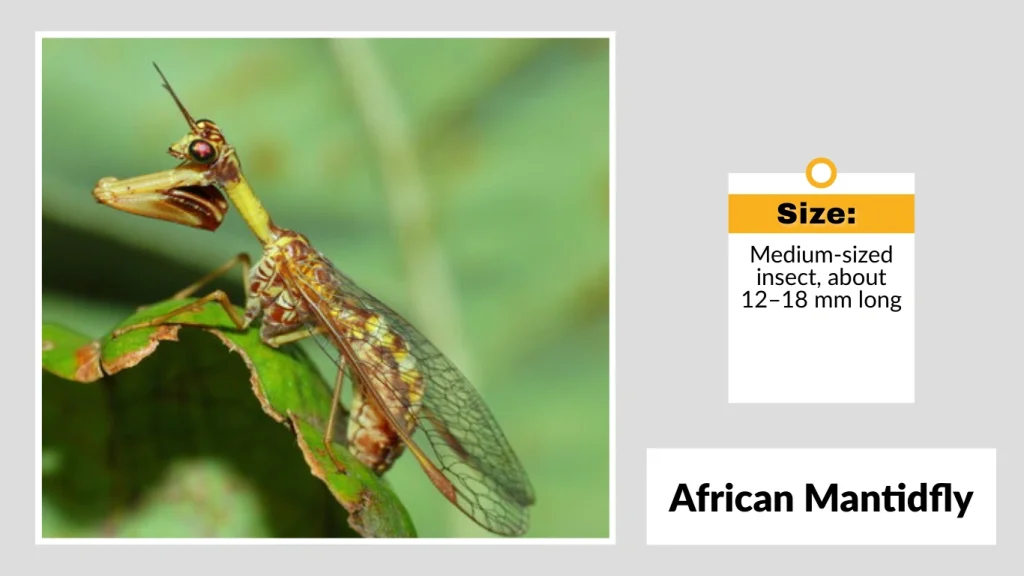
The African Mantidfly (Mantispa africana) is a distinctive species native to the African continent. Known for its mantis-like hunting forelegs and predatory habits, it thrives in warm regions where insect activity is abundant. Its camouflage and predatory style make it a fascinating insect within its range.
Identification
- Medium-sized insect, about 12–18 mm long
- Brown to reddish body with subtle darker patterns
- Elongated prothorax with spiny raptorial forelegs
- Clear wings with fine brown venation
- Narrow waist and slender abdomen
Behavior
The African Mantidfly is an ambush predator that hunts flies, moths, and other small insects. It often sits still among vegetation, striking quickly when prey comes close. Like other mantidflies, its larvae parasitize spider egg sacs, ensuring survival into adulthood.
Habitat
This species is distributed across sub-Saharan Africa, inhabiting grasslands, open woodlands, and scrublands. It thrives in warm climates and is more active during the summer and rainy seasons.
Importance
The African Mantidfly plays a role in controlling insect populations and is an important representative of the Mantispidae family in Africa. Its predatory lifestyle and unique life cycle highlight the ecological balance within its habitats.
10. Giant Mantidfly
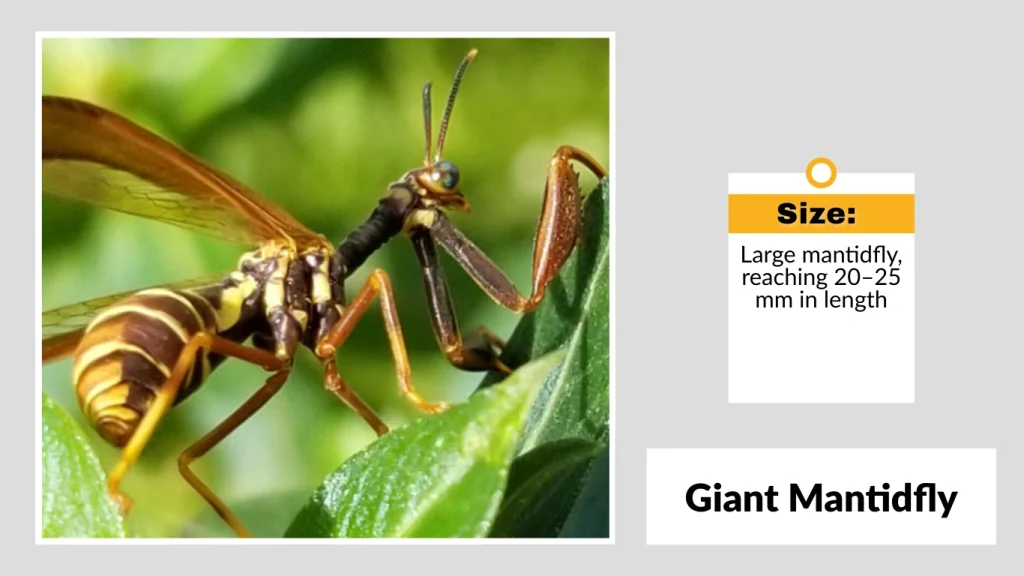
The Giant Mantidfly (Mantispa gigantea) is among the largest members of the mantidfly family, standing out for its size and powerful predatory forelegs. Its imposing appearance makes it a fascinating insect to encounter, especially in regions where it is native.
Identification
- Large mantidfly, reaching 20–25 mm in length
- Robust body with brown to dark reddish coloration
- Strong, heavily spined raptorial forelegs for capturing larger prey
- Long, transparent wings with darker venation
- Extended thorax, giving a mantis-like stance
Behavior
The Giant Mantidfly is an ambush predator capable of hunting larger insects compared to smaller mantidfly species. It feeds on moths, flies, and beetles, waiting patiently on vegetation before striking with speed. Its larvae, like others in its family, parasitize spider egg sacs.
Habitat
This species inhabits tropical and subtropical forests, woodlands, and savannas. It is distributed in parts of South America and possibly extends into Central America. Adults are more often seen during the warmer months.
Importance
The Giant Mantidfly contributes to balancing ecosystems by preying on various insect species. Its large size and striking resemblance to mantises make it an important subject of entomological studies and an interesting find for insect collectors.
11. Slender Mantidfly
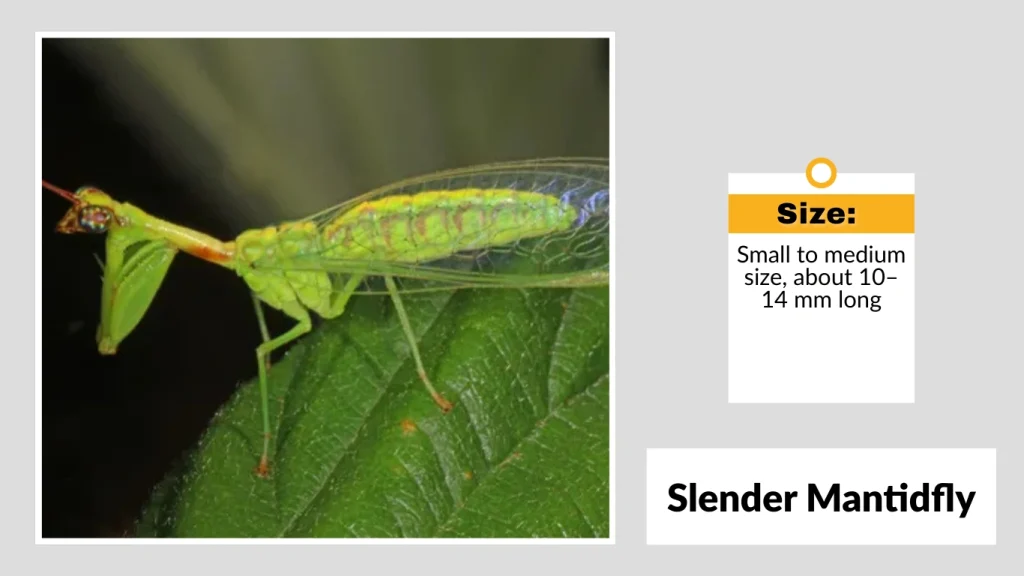
The Slender Mantidfly (Mantispa tenuicornis) is a delicate-looking species characterized by its narrow body and long antennae. Despite its fragile appearance, it is a skilled predator, using its mantis-like forelegs to seize unsuspecting prey.
Identification
- Small to medium size, about 10–14 mm long
- Slender, elongated body with light brown or pale yellow coloration
- Long, thread-like antennae (hence the name “tenuicornis”)
- Raptorial forelegs with fine spines for grasping prey
- Transparent wings with faint venation, held roof-like over the body
Behavior
The Slender Mantidfly is an ambush predator, sitting still among vegetation until small insects pass by. It feeds on flies, gnats, and other soft-bodied arthropods. Its slim form allows it to hide easily in grasses and shrubs, avoiding detection from predators.
Habitat
This species inhabits grasslands, scrublands, and open woodland areas in parts of Asia and Europe. It prefers warm climates and areas with tall grass or bushes that provide both cover and hunting grounds.
Importance
The Slender Mantidfly plays a role in natural pest control by preying on small insects. Its slim build and long antennae make it an interesting species for entomologists studying adaptations within the Mantispidae family.
12. Common Mantidfly
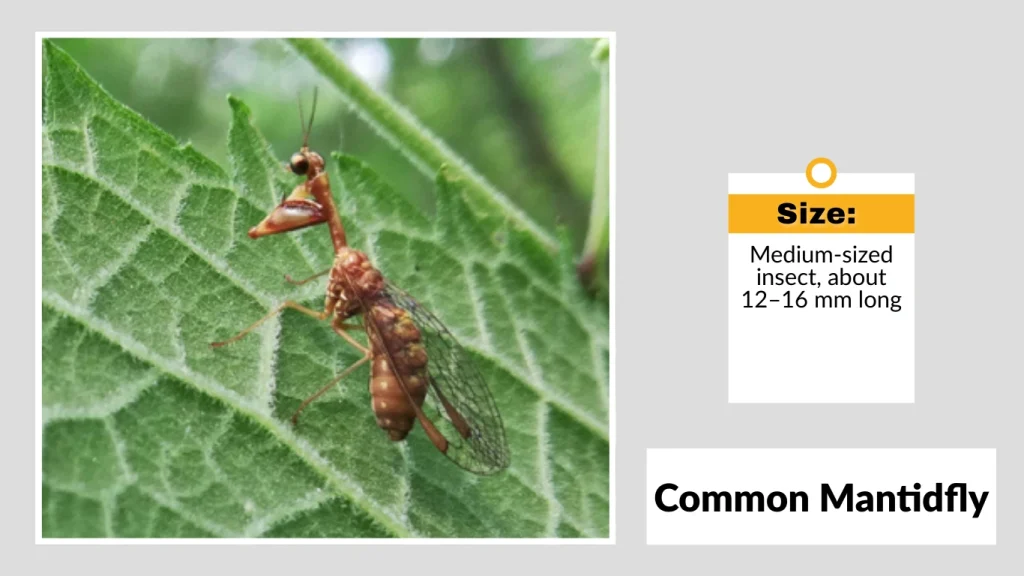
The Common Mantidfly (Mantispa viridis) is a widely distributed species recognized for its bright green coloration and typical mantis-like hunting style. It is one of the more familiar mantidflies, often spotted during summer months in vegetated areas where insect prey is abundant.
Identification
- Medium-sized insect, about 12–16 mm long
- Bright green body, blending well with foliage
- Elongated thorax with spiny raptorial forelegs
- Transparent wings with faint green veins
- Large, rounded eyes well-suited for spotting prey
Behavior
The Common Mantidfly is an ambush predator, waiting patiently among leaves to seize flies, moths, and small beetles. It is active during the day and may also come to lights at night. Like other mantidflies, its larvae develop inside spider egg sacs.
Habitat
This species inhabits grasslands, meadows, gardens, and forest edges across parts of Europe, Asia, and Africa. Its green coloration allows it to remain well camouflaged among leaves and shrubs.
Importance
The Common Mantidfly contributes to natural pest regulation by hunting insect species that can harm crops or spread disease. Its wide distribution makes it one of the most studied representatives of the Mantispidae family.
13. White-spotted Mantidfly

The White-spotted Mantidfly (Mantispa vittata) is a distinctive mantidfly species named for the pale spots on its wings and body. Its patterned appearance sets it apart from many other mantidflies, while its mantis-like hunting forelegs make it an efficient predator of small insects.
Identification
- Medium-sized insect, about 12–18 mm long
- Brown to reddish body with small white spots on the wings and thorax
- Raptorial forelegs with sharp spines for catching prey
- Transparent wings marked with pale whitish patches
- Elongated thorax and narrow waist
Behavior
The White-spotted Mantidfly is an ambush hunter, waiting still among vegetation until prey approaches. It preys mainly on small flying insects such as flies, gnats, and moths. Adults are strong fliers and sometimes appear around artificial lights at night.
Habitat
This species is found in warm regions, including parts of Africa, Asia, and South America. It favors open woodlands, meadows, and shrublands where prey is plentiful.
Importance
The White-spotted Mantidfly plays a role in controlling pest insects while also being of interest to researchers studying insect mimicry and camouflage. Its spotted wing patterns help distinguish it from closely related mantidfly species.
14. Two-spotted Mantidfly
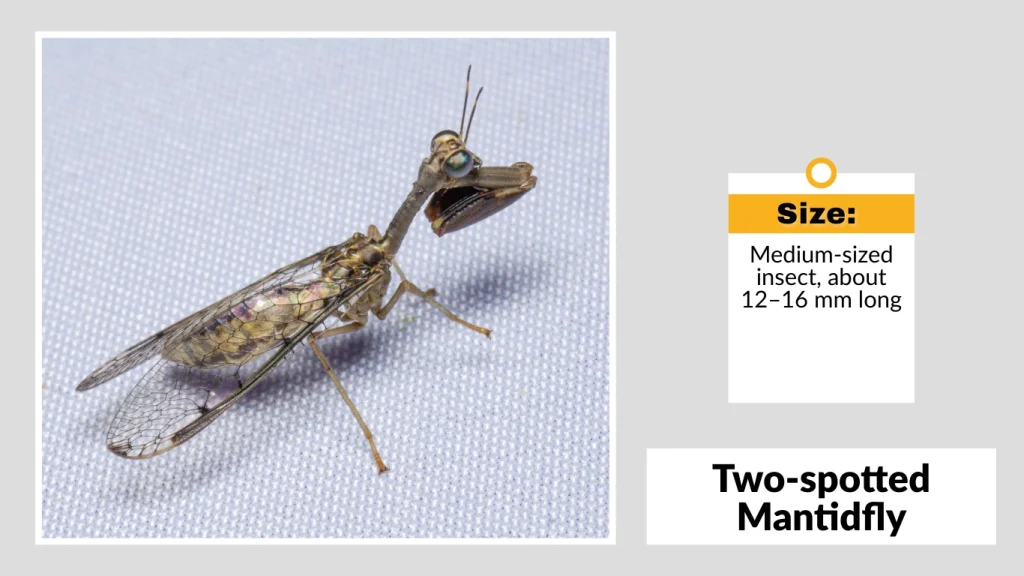
The Two-spotted Mantidfly (Mantispa bipunctata) is easily recognized by the pair of distinct dark spots on its wings. Like other mantidflies, it resembles a praying mantis in its hunting style but remains closer in relation to lacewings.
Identification
- Medium-sized insect, about 12–16 mm long
- Brown to yellowish body with darker markings
- Two clear dark spots on the wings, giving the species its name
- Elongated thorax with strong raptorial forelegs
- Transparent wings with fine venation
Behavior
The Two-spotted Mantidfly is an ambush predator, feeding on flies, mosquitoes, moths, and other small insects. It perches quietly on leaves and stems, striking quickly with its spiny forelegs when prey gets close. Adults are sometimes attracted to lights at night.
Habitat
This species is distributed across warm regions of Europe, Asia, and parts of Africa. It prefers grasslands, open woodlands, and areas with shrubs or low vegetation.
Importance
The Two-spotted Mantidfly contributes to insect population control and is often studied for its predatory habits. Its wing markings make it easier to identify compared to other closely related mantidflies.
15. Banded Mantidfly
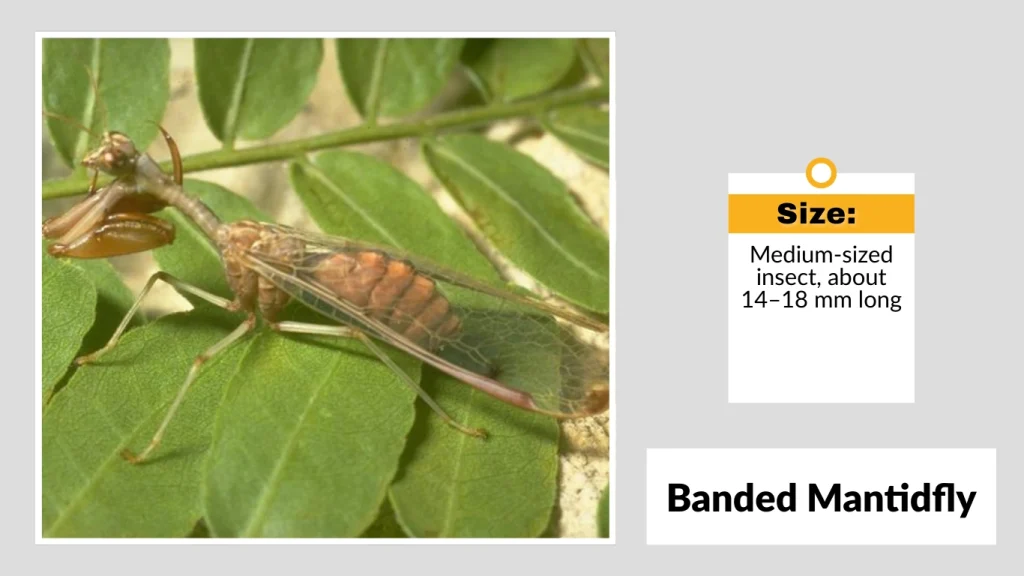
The Banded Mantidfly (Mantispa fasciata) is a visually striking species, named for the dark and light banded patterns along its wings and body. Its distinctive markings, combined with mantis-like forelegs, make it a fascinating predator to observe in its natural environment.
Identification
- Medium-sized insect, about 14–18 mm long
- Body marked with alternating dark and pale bands
- Raptorial forelegs with spines for capturing prey
- Transparent wings with bold band-like patterns
- Slender elongated thorax resembling that of a mantis
Behavior
The Banded Mantidfly hunts small insects such as flies, moths, and beetles. It often perches quietly on vegetation, using its patterned body as camouflage. Adults are strong fliers and may also be seen near lights on warm nights.
Habitat
This species is typically found in warm regions, inhabiting meadows, grasslands, and forest edges. It is more common in tropical and subtropical zones with abundant insect activity.
Importance
The Banded Mantidfly plays a role in natural pest control by reducing populations of flying insects. Its bold coloration and mimicry make it an important species for entomologists studying predator adaptations.
16. Australian Mantidfly
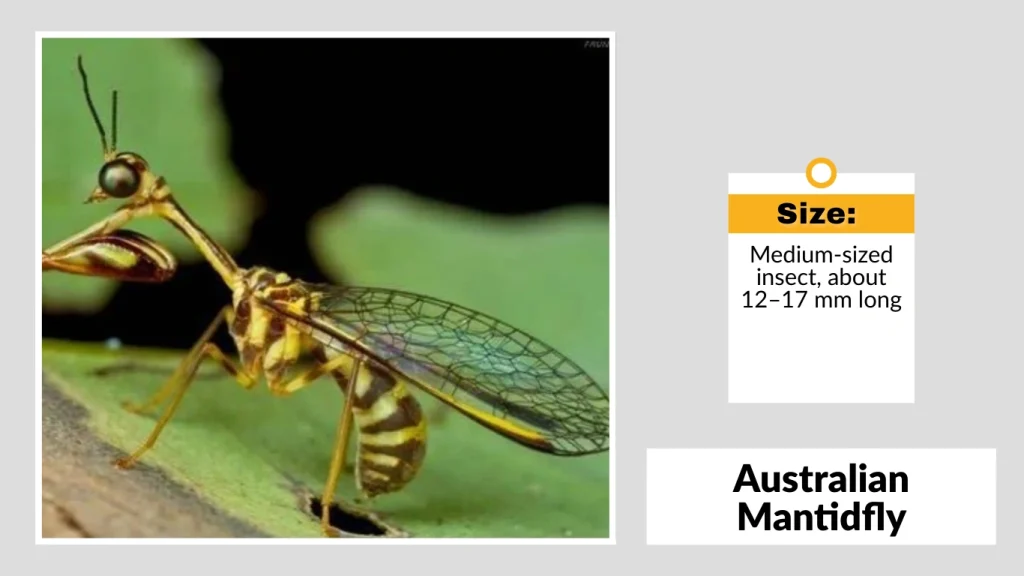
The Australian Mantidfly (Ditaxis australis) is a fascinating mantidfly native to Australia, where it inhabits warm regions with abundant insect life. Known for its mantis-like forelegs and delicate body structure, it is one of the more distinctive members of the Mantispidae family in the region.
Identification
- Medium-sized insect, about 12–17 mm long
- Pale brown to greenish body with fine markings
- Raptorial forelegs with spines for grasping prey
- Transparent wings with brownish veins
- Slender thorax, giving a mantis-like appearance
Behavior
The Australian Mantidfly is an ambush predator, feeding on flies, moths, and small beetles. It relies on stealth, perching quietly among vegetation before striking swiftly at prey. Like other mantidflies, its larvae are parasitic on spider egg sacs.
Habitat
This species is distributed across Australia, especially in grasslands, shrublands, and open forests. It is more active during the warmer months and may also be drawn to artificial lights at night.
Importance
The Australian Mantidfly plays a role in insect population control, contributing to the ecological balance of its environment. Its regional uniqueness also makes it valuable for studies on insect biodiversity in Australia.
17. Asian Mantidfly
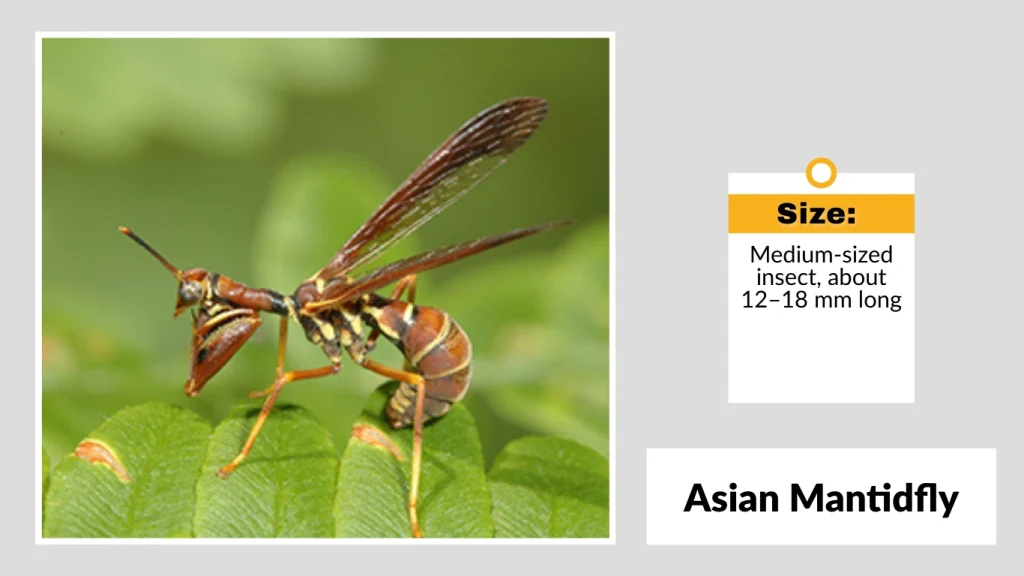
The Asian Mantidfly (Mantispa asiatica) is a widespread species found across parts of Asia. With its mantis-like forelegs and slender body, it is an efficient predator of small insects. Its adaptability allows it to thrive in diverse environments, from forests to agricultural lands.
Identification
- Medium-sized insect, about 12–18 mm long
- Light brown to greenish body with darker markings
- Long prothorax with strong, spined raptorial forelegs
- Transparent wings with brown venation
- Slender abdomen with a narrow waist
Behavior
The Asian Mantidfly is an ambush hunter, feeding on flies, moths, and other soft-bodied insects. It waits motionless on vegetation before swiftly striking at prey. Like most mantidflies, its larvae invade spider egg sacs for development.
Habitat
This species is distributed widely across South and East Asia, including India, China, and Southeast Asia. It inhabits grasslands, fields, forest edges, and areas near human settlements with abundant insect prey.
Importance
The Asian Mantidfly contributes to controlling pest insect populations, particularly in farmlands and gardens. Its wide distribution makes it an important representative of mantidflies in Asia and a useful species for entomological research.
18. Golden Mantidfly
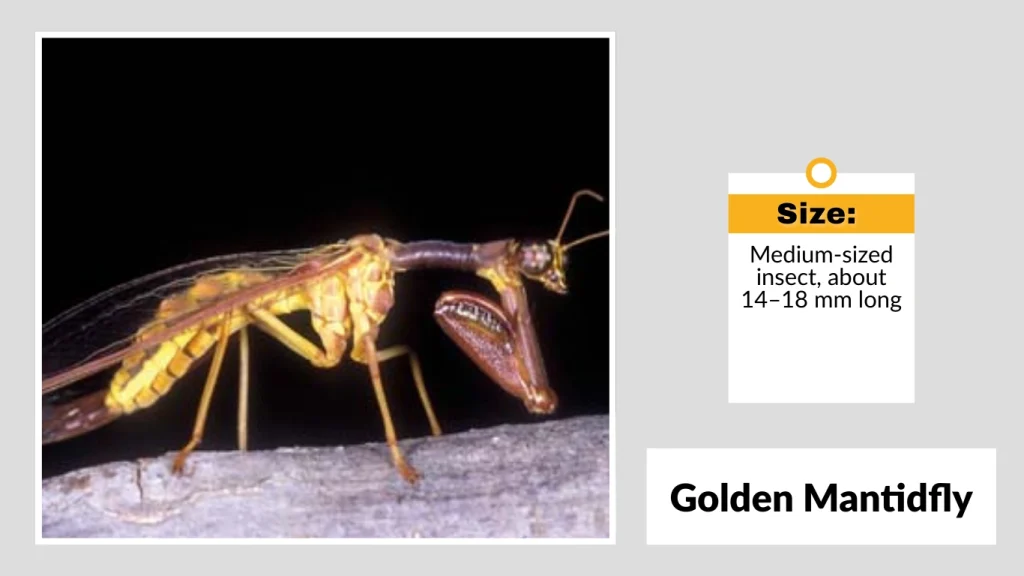
The Golden Mantidfly (Mantispa aurea) is a visually striking species recognized for its shimmering golden or yellowish coloration. Its bright appearance makes it stand out from many other mantidflies, though it retains the same predatory traits and mantis-like hunting forelegs.
Identification
- Medium-sized insect, about 14–18 mm long
- Golden-yellow to amber-colored body
- Raptorial forelegs with spines for capturing prey
- Transparent wings with golden veins that glisten in sunlight
- Elongated thorax and narrow waist, giving a mantis-like posture
Behavior
The Golden Mantidfly is an ambush predator, preying on flies, small moths, and beetles. Its golden body may provide camouflage among sunlit foliage or dried grasses. It waits patiently before striking swiftly at nearby insects.
Habitat
This species is found in warm regions of Asia and Africa, especially in dry grasslands, shrublands, and open forests. Adults are more active during the summer months and may sometimes be attracted to artificial lights at night.
Importance
The Golden Mantidfly helps maintain insect balance in its ecosystem by preying on pest species. Its bright coloration and unique adaptations make it an attractive subject for entomologists and insect enthusiasts.
19. European Mantidfly

The European Mantidfly (Mantispa europaea) is a well-known mantidfly species native to Europe. Its mantis-like hunting forelegs and distinctive appearance make it one of the most recognized members of the Mantispidae family in the region.
Identification
- Medium-sized insect, about 12–16 mm long
- Brown to greenish body with faint mottling
- Elongated thorax with raptorial forelegs armed with spines
- Transparent wings with pale brown venation
- Narrow abdomen, resembling a small praying mantis
Behavior
The European Mantidfly is an ambush predator that feeds on flies, moths, and other soft-bodied insects. It often sits quietly on vegetation, striking quickly when prey approaches. Its larvae are parasitic, typically developing inside spider egg sacs.
Habitat
This species is found throughout much of Europe, especially in meadows, forest edges, and grasslands. It prefers sunny areas with plenty of flowers and insect activity. Adults are most active in summer.
Importance
The European Mantidfly plays a role in pest control by preying on small insects. Its unique combination of mantis-like hunting behavior and lacewing-related lineage makes it scientifically significant for studies on insect evolution and adaptation.
20. Long-winged Mantidfly
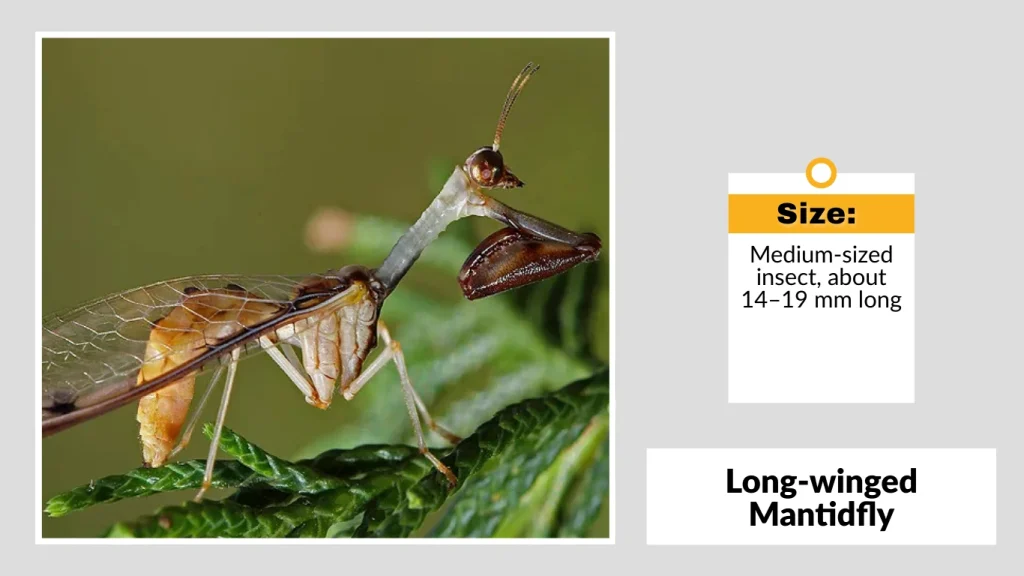
The Long-winged Mantidfly (Mantispa longipennis) is a distinctive species named for its noticeably elongated wings. While it shares the typical mantis-like hunting forelegs of its relatives, its extended wings give it a more delicate and elegant appearance.
Identification
- Medium-sized insect, about 14–19 mm long
- Brown to yellowish body with subtle markings
- Extra-long transparent wings extending well beyond the abdomen
- Raptorial forelegs with spines for grasping prey
- Slender thorax and narrow waist
Behavior
The Long-winged Mantidfly is an ambush predator, feeding on flies, moths, and small beetles. It perches quietly on leaves or flowers, striking swiftly when prey enters its reach. The elongated wings may provide better flight efficiency, helping it evade predators.
Habitat
This species is found in warm regions of Asia and Africa, often in meadows, woodlands, and scrublands. Adults are more active in summer and may also be seen around lights at night.
Importance
The Long-winged Mantidfly contributes to insect population control in its habitats. Its unique wing structure and elegant body make it a point of interest for entomologists studying the diversity of mantidflies.
21. Short-winged Mantidfly

The Short-winged Mantidfly (Mantispa brachyptera) is a rare species recognized for its reduced wing size compared to other mantidflies. Despite its shorter wings, it maintains the same mantis-like predatory adaptations, making it an effective hunter of small insects.
Identification
- Small to medium-sized insect, about 10–14 mm long
- Brown to reddish body with faint mottling
- Shorter wings that do not extend much beyond the abdomen
- Raptorial forelegs armed with spines for seizing prey
- Elongated thorax and narrow waist resembling a mantis
Behavior
The Short-winged Mantidfly is less adapted for long flights but is an excellent ambush predator. It feeds on flies, gnats, and other small insects by waiting patiently and striking quickly. Adults are less frequently seen around lights due to their limited flying ability.
Habitat
This species inhabits grasslands, scrublands, and warm woodland areas, mainly in regions of Africa and Asia. Its shorter wings may be an adaptation to dense vegetation where strong flight is less necessary.
Importance
The Short-winged Mantidfly plays a role in maintaining insect balance within ecosystems. Its unusual wing development makes it an interesting subject for studies on insect morphology and evolutionary adaptations.
22. Desert Mantidfly
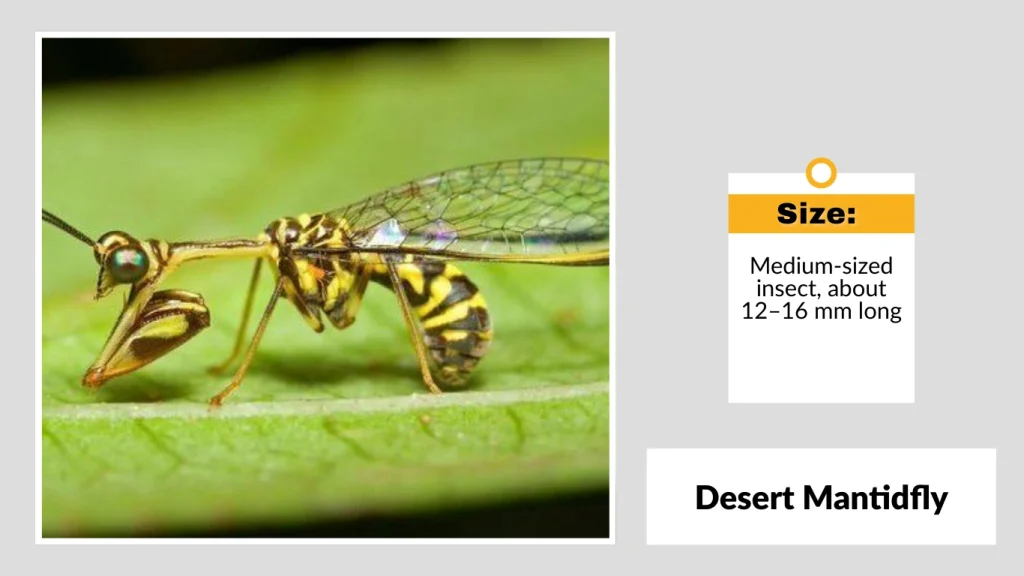
The Desert Mantidfly (Mantispa deserticola) is a species adapted to dry and arid environments, where it thrives despite limited resources. Its sandy coloration provides excellent camouflage, making it well-suited for life in desert and semi-desert habitats.
Identification
- Medium-sized insect, about 12–16 mm long
- Sandy brown or pale yellow body for desert camouflage
- Elongated thorax with raptorial, spiny forelegs
- Transparent wings with light brown venation
- Narrow abdomen blending with dry terrain
Behavior
The Desert Mantidfly is an ambush predator, lying motionless on sand, rocks, or dry vegetation. It feeds mainly on flies, small beetles, and moths that inhabit desert areas. Its larvae, like other mantidflies, parasitize spider egg sacs to survive.
Habitat
This species is found in deserts and semi-arid regions of Africa and parts of Asia. It prefers open sandy environments with sparse vegetation, often active during warm evenings and nights.
Importance
The Desert Mantidfly contributes to insect balance in harsh ecosystems, where every predator plays a critical role. Its adaptations to arid climates highlight the evolutionary flexibility of mantidflies.
23. Forest Mantidfly
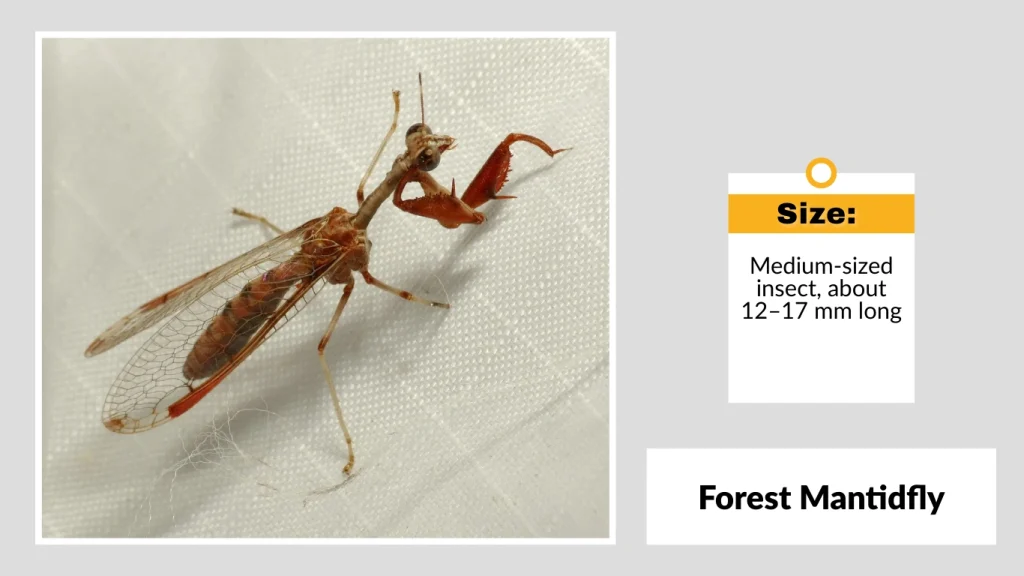
The Forest Mantidfly (Mantispa silvatica) is a species commonly associated with wooded areas and dense vegetation. Its muted colors and slim body allow it to blend easily with bark and leaves, making it a stealthy predator in forest ecosystems.
Identification
- Medium-sized insect, about 12–17 mm long
- Brown to greenish body with mottled patterns resembling bark or leaves
- Elongated thorax with spiny raptorial forelegs
- Transparent wings with fine venation, slightly tinted
- Narrow abdomen adapted for camouflage in shaded habitats
Behavior
The Forest Mantidfly is an ambush predator, feeding on flies, moths, and small beetles found in woodland environments. It relies on camouflage to remain undetected while waiting for prey. Adults are active during the warmer months and may sometimes be seen resting on tree trunks.
Habitat
This species inhabits forest edges, woodlands, and shaded areas across parts of Asia, Africa, and South America. It prefers moist environments with dense vegetation that supports diverse insect populations.
Importance
The Forest Mantidfly plays a role in keeping insect numbers in check, helping maintain ecological balance in woodland ecosystems. Its camouflage makes it a notable example of adaptation to forest life.
24. Spotted Mantidfly
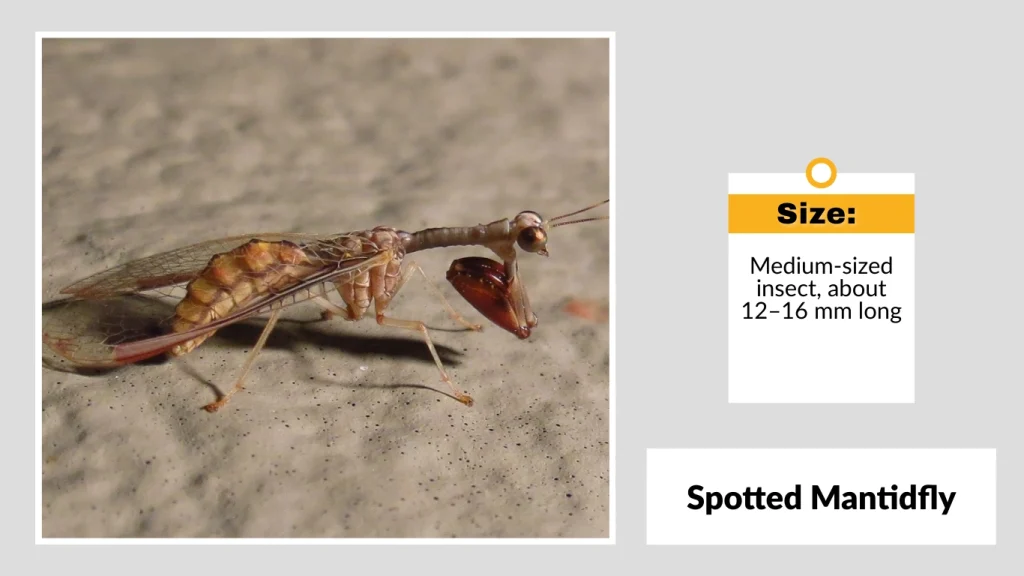
The Spotted Mantidfly (Mantispa maculata) is a distinctive species easily recognized by the dark or pale spots scattered across its wings and body. Its patterned appearance provides camouflage while still retaining the classic mantis-like predatory adaptations.
Identification
- Medium-sized insect, about 12–16 mm long
- Brown or yellowish body with dark spots on the wings and thorax
- Elongated thorax with raptorial forelegs for seizing prey
- Transparent wings with irregular dark spotting
- Narrow waist, giving a mantis-like profile
Behavior
The Spotted Mantidfly is an ambush predator, preying on flies, gnats, moths, and small beetles. Its spotted wings help it blend with mottled backgrounds like bark, leaves, or forest floors. Adults are often active during the evening and sometimes come to lights at night.
Habitat
This species occurs in warm regions of Europe, Asia, and Africa, often inhabiting forest edges, meadows, and grasslands. It prefers areas where vegetation provides both cover and abundant insect prey.
Importance
The Spotted Mantidfly contributes to natural pest control and is valued for its unique coloration, which makes it easy to distinguish from other mantidflies. Its adaptability to multiple habitats makes it a successful species across its range.
25. Striped Mantidfly

The Striped Mantidfly (Mantispa lineata) is a visually distinctive species characterized by the longitudinal stripes running along its body and wings. These markings provide camouflage among grasses and stems, making it an effective stealth predator.
Identification
- Medium-sized insect, about 13–17 mm long
- Brown or yellowish body with clear longitudinal stripes
- Raptorial forelegs with strong spines for grasping prey
- Transparent wings with striped venation matching body markings
- Elongated thorax giving a mantis-like hunting stance
Behavior
The Striped Mantidfly hunts small insects such as flies, moths, and beetles. It remains perched along grass stems or leaves, where its striped body blends perfectly with the background. When prey comes close, it strikes swiftly with its forelegs.
Habitat
This species is found in grasslands, meadows, and open woodlands across parts of Asia, Africa, and South America. It is most active during the warmer months and is occasionally attracted to light sources at night.
Importance
The Striped Mantidfly helps regulate populations of small insects and is an excellent example of how camouflage enhances survival. Its striped body pattern makes it one of the more easily identifiable mantidflies for entomologists and naturalists.
26. Lesser Mantidfly

The Lesser Mantidfly (Mantispa minor) is a smaller representative of the Mantispidae family, known for its reduced size compared to other species. Despite being more delicate, it retains the same mantis-like predatory forelegs and hunting behavior.
Identification
- Small to medium size, about 8–12 mm long
- Light brown or yellowish body with subtle markings
- Shorter wings compared to larger species, but still transparent
- Raptorial forelegs with fine spines for grasping prey
- Narrow thorax and abdomen, giving a slim profile
Behavior
The Lesser Mantidfly is an ambush predator, feeding on gnats, flies, and other tiny insects. Its smaller size allows it to move easily among grasses and low vegetation. Adults are active in summer and may occasionally be seen near lights at night.
Habitat
This species is found in grasslands, scrublands, and lightly wooded areas in warmer regions of Europe, Asia, and Africa. It prefers habitats with dense vegetation that offers cover and ample small insect prey.
Importance
The Lesser Mantidfly plays a role in regulating small insect populations, contributing to ecosystem balance. Its smaller size makes it an interesting contrast to larger mantidflies and highlights the diversity within the family.
27. Greater Mantidfly

The Greater Mantidfly (Mantispa major) is one of the largest species in the Mantispidae family, known for its robust build and strong predatory adaptations. Its impressive size and mantis-like stance make it a formidable hunter among mantidflies.
Identification
- Large mantidfly, about 18–25 mm long
- Sturdy brown to reddish body with darker markings
- Long, transparent wings extending beyond the abdomen
- Strong raptorial forelegs with large spines for catching bigger prey
- Elongated thorax, enhancing its mantis-like appearance
Behavior
The Greater Mantidfly is an active ambush predator, capable of tackling larger insect prey such as moths, beetles, and flies. It often perches on vegetation, waiting motionless until an insect comes within striking distance. Its larvae, like other mantidflies, parasitize spider egg sacs.
Habitat
This species is distributed across warm regions in Africa, Asia, and South America. It inhabits open woodlands, savannas, and grasslands, preferring areas with plenty of insect activity.
Importance
The Greater Mantidfly plays a significant ecological role by reducing insect populations. Its large size and powerful hunting style make it a fascinating subject for entomologists and insect enthusiasts, representing the upper range of mantidfly diversity.
