

Africanized bees are a hybrid type of honeybee known for their strong defensive behavior and rapid colony growth. Often referred to as “killer bees,” they originated from a cross between African honeybees and European honeybees. While they play an important role in pollination like other bees, their aggressive defense of nests makes them different from regular honeybees. Understanding Africanized bee facts, identifying characteristics, habitat, and life cycle can help people recognize them and stay safe when encountering these bees in the wild.
What Is an Africanized Bee?
Africanized bees are a subspecies of honeybee that developed through the hybridization of African honeybees and European honeybees. They belong to the species Apis mellifera and are known for their ability to adapt to warm climates and rapidly expand their colonies.
These bees behave similarly to regular honeybees in many ways, such as collecting nectar and pollinating flowers. However, they are much more defensive when their hive is disturbed. Because of this strong defense behavior, Africanized bees have gained a reputation for being dangerous, though they are still essential pollinators in many ecosystems.
Origin and History of Africanized Bees
The Africanized bee originated from a scientific experiment in Brazil during the 1950s. Researchers attempted to breed African honeybees with European honeybees to create a bee that could produce more honey in tropical climates.
African honeybees were known for their productivity and ability to survive hot environments, but they were also more defensive than European honeybees. During the experiment, several African queen bees escaped from a laboratory, allowing them to breed with local European bees.
Over time, this hybrid species spread rapidly throughout South America and eventually moved north into Central America, Mexico, and parts of the southern United States. Their ability to swarm frequently and adapt to different environments helped them expand quickly across the Americas.
Why They Are Called “Killer Bees”
Africanized bees earned the nickname “killer bees” due to their highly defensive behavior. When their colony feels threatened, they respond quickly and in large numbers to protect the hive.
Unlike regular honeybees that may sting only when necessary, Africanized bees can react aggressively to disturbances near their nest. They may pursue perceived threats for hundreds of meters. However, the term “killer bee” is often exaggerated in media reports, as these bees typically attack only when defending their colony.
Scientific Classification
Africanized bees belong to the honeybee species Apis mellifera. They are closely related to European honeybees but contain genetic traits from the African honeybee subspecies Apis mellifera scutellata.
Their classification includes:
- Kingdom: Animalia
- Phylum: Arthropoda
- Class: Insecta
- Order: Hymenoptera
- Family: Apidae
- Genus: Apis
- Species: Apis mellifera
This classification shows that Africanized bees are not a completely separate species but rather a hybrid variation within the honeybee family.
Africanized Bee Identifying Characteristics
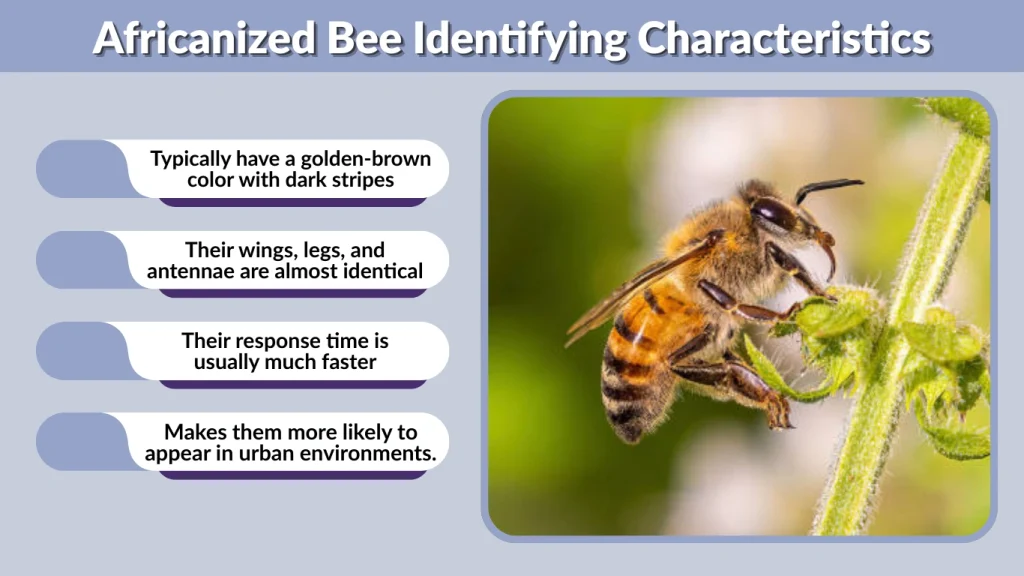
Identifying Africanized bees can be challenging because they look very similar to European honeybees. In fact, many physical differences between the two are so small that they can only be detected through laboratory testing.
However, certain behavioral and physical characteristics can help experts distinguish Africanized bees from regular honeybees.
Physical Characteristics
Africanized bees are slightly smaller than European honeybees, but the difference is difficult to notice without careful measurement. Their bodies typically have a golden-brown color with dark stripes along the abdomen, similar to other honeybees.
Their wings, legs, and antennae are almost identical to those of European honeybees. Because of these similarities, scientists often rely on specialized techniques to identify Africanized bees accurately.
Behavioral Characteristics
Behavior is often the most noticeable difference between Africanized bees and regular honeybees. Africanized bee colonies tend to react more quickly and aggressively when disturbed.
They are highly protective of their nest and will send large numbers of worker bees to defend the colony if they sense danger. Their response time is usually much faster than that of European honeybees.
Africanized bees also swarm more often, meaning they frequently relocate to new nesting sites. This behavior contributes to their rapid spread and makes them more likely to appear in urban environments.
Africanized Bee Life Cycle
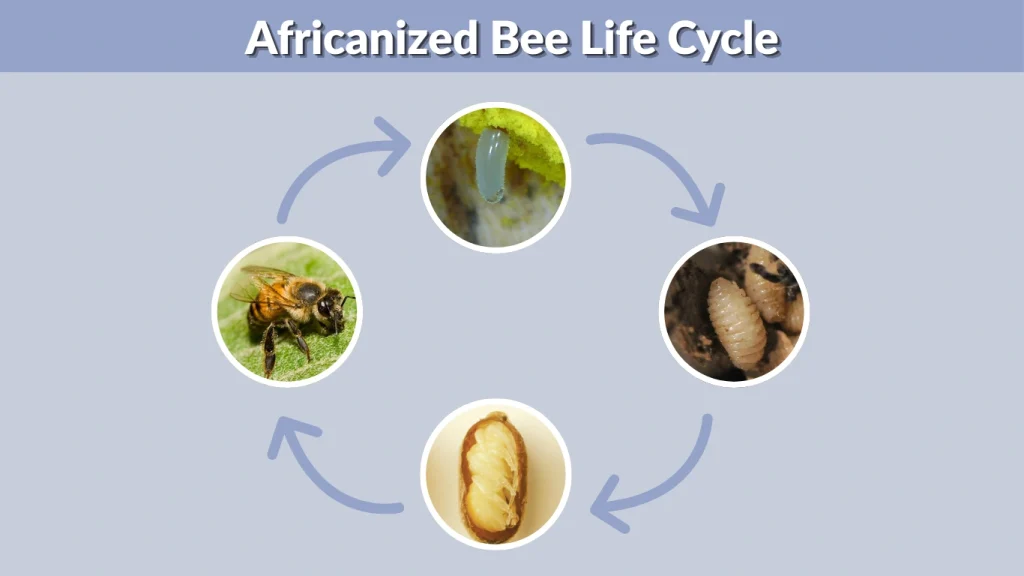
Like other honeybees, Africanized bees go through a complete life cycle consisting of four main stages: egg, larva, pupa, and adult. Each stage plays an important role in the development of the colony.
Egg Stage
The life cycle of an Africanized bee begins when the queen lays eggs inside wax cells in the hive. The queen can lay thousands of eggs during her lifetime, ensuring the rapid growth of the colony.
Each egg is very small and usually hatches within about three days. The eggs are carefully protected and maintained by worker bees, which help regulate the temperature and cleanliness of the hive.
Larval Stage
Once the egg hatches, it becomes a larva. During this stage, the larva looks like a tiny white worm and depends entirely on worker bees for food.
Worker bees feed the larvae with a mixture of pollen, honey, and royal jelly. The larvae grow quickly during this stage, shedding their skin several times as they develop. After about five to six days, the larva becomes ready to transform into the next stage.
Pupal Stage
In the pupal stage, the larva is sealed inside a wax cell by worker bees. Inside the cell, the larva undergoes a transformation process called metamorphosis.
During this stage, the body structure of the bee begins to form. Wings, legs, eyes, and other body parts develop as the insect prepares to become an adult bee. This stage usually lasts around one to two weeks.
Adult Stage
After completing the pupal stage, the adult bee emerges from the wax cell. There are three main types of adult bees within the colony: the queen, worker bees, and drones.
Worker bees are responsible for collecting nectar, building honeycombs, protecting the hive, and caring for the young. Drones are male bees whose primary role is to mate with a queen. The queen bee is the reproductive leader of the colony and is responsible for laying eggs.
Africanized bee colonies often grow quickly because the queen lays eggs rapidly and the worker bees develop efficiently.
Africanized Bee Habitat
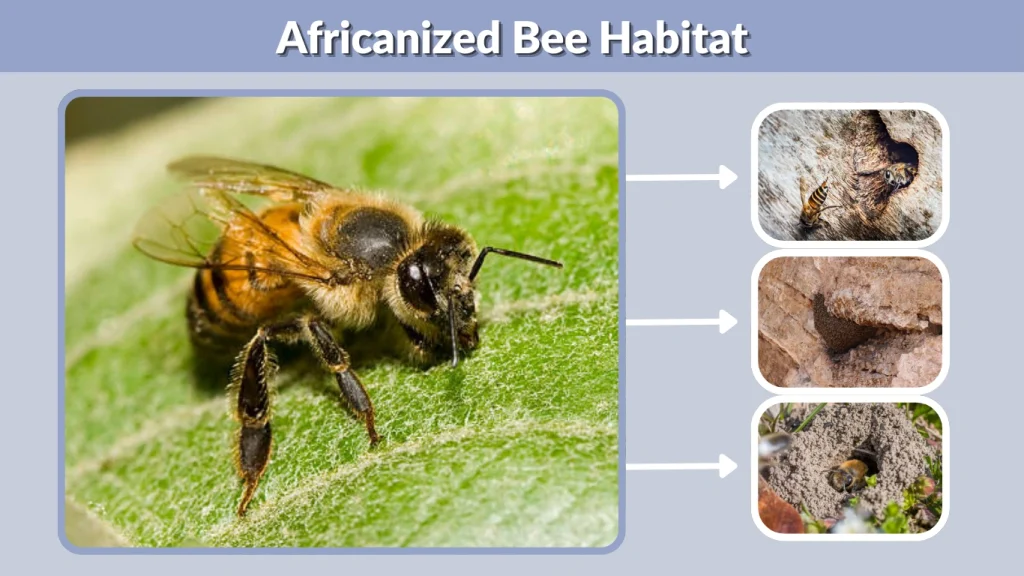
Africanized bees are highly adaptable and can live in a wide variety of environments. However, they generally prefer warm climates where flowers and nectar sources are abundant.
Preferred Climate
These bees thrive in tropical and subtropical regions where temperatures remain relatively warm throughout the year. Warm environments support continuous colony growth and provide consistent food sources such as flowering plants.
Because Africanized bees are less tolerant of cold weather, their populations are mainly concentrated in warmer regions of the Americas.
Nesting Locations
Africanized bees build their nests in many types of natural and human-made structures. Unlike managed honeybees that typically live in beehives, Africanized bees often select hidden cavities.
Common nesting locations include:
- Tree hollows
- Rock crevices
- Underground spaces
- Abandoned buildings
- Wall cavities in houses
- Empty containers or boxes
Their ability to nest in small spaces allows them to survive in both rural and urban environments.
Urban vs Wild Habitat
Africanized bees can live in forests, grasslands, and agricultural areas, but they are also commonly found in cities. Urban environments provide many potential nesting sites, such as buildings, fences, and utility boxes.
This adaptability increases the chances that humans may encounter Africanized bees in residential areas.
Seasonal Habitat Behavior
Africanized bees frequently relocate their colonies through swarming. Swarming occurs when part of a colony leaves the original nest to establish a new one.
Because these bees swarm more often than European honeybees, they can quickly spread into new habitats and expand their range.
Africanized Bee vs Regular Bee

Although Africanized bees and European honeybees belong to the same species, they differ in behavior, colony structure, and adaptability.
Behavior Differences
One of the most noticeable differences is their defensive behavior. Africanized bees react much faster to disturbances and attack in larger numbers when their hive is threatened.
European honeybees, often called regular honeybees, are generally calmer and less aggressive. Beekeepers commonly manage European bees because they are easier to handle and maintain in controlled hives.
Africanized bees are also more persistent when defending their colony. They may pursue perceived threats for longer distances compared to regular honeybees.
Colony and Swarming Differences
Africanized bees swarm more frequently than European honeybees. Frequent swarming allows them to form new colonies quickly and spread to new areas.
Their colonies also grow rapidly because their queens produce eggs at a high rate. European honeybee colonies typically grow at a slower and more stable pace.
Physical Differences
Physically, Africanized bees look very similar to European honeybees. The differences in body size and wing structure are very small and difficult to see without scientific measurement.
Because of these similarities, professional researchers often use laboratory tests or genetic analysis to determine whether a colony is Africanized.
How to Identify Africanized Bees Safely
Because Africanized bees look almost identical to regular honeybees, identification usually relies on observing their behavior rather than their physical appearance.
Warning Signs of Africanized Bees
Some behaviors may suggest the presence of Africanized bees:
- A large number of bees leaving the hive quickly when disturbed
- Loud and intense buzzing when people or animals approach
- Aggressive pursuit of perceived threats
If these signs are observed, it is important to move away from the area calmly and avoid disturbing the colony further.
Professional Identification Methods
Scientists and pest control professionals often use specialized methods to identify Africanized bees. These methods include morphometric analysis, which measures wing size and body characteristics, and DNA testing to confirm genetic traits.
Because accurate identification requires specialized tools, it is best left to trained experts.
What To Do If You Encounter Them
If you encounter a swarm or nest that may belong to Africanized bees, it is best to stay calm and slowly leave the area. Running to a sheltered location such as a building or vehicle can help reduce the risk of stings.
Covering your face and head may also provide some protection if bees become aggressive. In situations where a colony is located near homes or public spaces, contacting professional pest control or local authorities is recommended.
Ecological Role of Africanized Bees
Despite their defensive reputation, Africanized bees play an important role in nature. Like other honeybees, they are effective pollinators.
Pollination Benefits
Africanized bees help pollinate many types of plants, including wildflowers and agricultural crops. Pollination allows plants to reproduce and produce fruits and seeds.
Because of their high activity levels and large colony sizes, Africanized bees can contribute significantly to pollination in some ecosystems.
Agricultural Impact
In some regions, Africanized bees assist in pollinating crops such as fruits, vegetables, and nuts. However, their aggressive behavior can create challenges for beekeepers who traditionally manage European honeybee colonies.
Managing Africanized bees safely often requires special equipment and protective clothing.
Africanized Bee Facts
Africanized bees have several unique characteristics that distinguish them from other honeybee populations. Their behavior, colony structure, and adaptability allow them to survive in many different environments.
Key Facts About Africanized Bees
One of the most important facts about Africanized bees is their rapid colony growth. Their queens lay eggs quickly, allowing colonies to expand faster than those of European honeybees. This fast reproduction increases the number of worker bees available to defend the hive and gather food.
Another notable fact is their defensive nature. Africanized bee colonies react quickly to disturbances, sending many worker bees to protect the nest. Their defensive response is usually triggered by vibrations, noise, or movement near the hive.
Africanized bees also swarm more frequently than regular honeybees. Swarming is a natural process in which a portion of a colony leaves to form a new nest. Because Africanized bees swarm often, they spread quickly across large geographic areas.
Interesting Facts
There are many interesting facts about Africanized bees that highlight their unique behavior and survival strategies.
These bees can chase perceived threats for long distances, sometimes up to several hundred meters from their hive. Their strong defense system helps protect the colony from predators but can also make encounters with humans more dangerous.
Africanized bees are also extremely adaptable. They can survive in a wide range of environments, from forests and grasslands to urban areas. Their nests are often built in small cavities, such as tree hollows, abandoned structures, or even underground spaces.
Despite their aggressive reputation, Africanized bees still produce honey and pollinate plants just like other honeybees. Their role in pollination makes them important for maintaining biodiversity and supporting agriculture.
Global Distribution
Africanized bees are primarily found in warm regions of the Americas. After their initial spread from Brazil, they gradually expanded across much of South America and Central America.
Today, Africanized bee populations exist in several parts of the southern United States, including states with warm climates such as Texas, Arizona, California, and Florida. Their expansion is limited by colder temperatures, which makes it difficult for them to survive in northern regions.
These bees continue to thrive in tropical and subtropical environments where food sources and warm weather allow colonies to grow throughout the year.
FAQs
Are Africanized bees really killer bees?
The term “killer bee” is mostly a media nickname. Africanized bees are not naturally aggressive toward humans unless their colony is threatened, but they defend their hive more aggressively than regular honeybees.
Where are Africanized bees found?
Africanized bees are mainly found in South America, Central America, Mexico, and parts of the southern United States where the climate is warm.
How can you tell if a bee is Africanized?
It is very difficult to identify Africanized bees by appearance alone. Scientists usually rely on laboratory tests such as morphometric measurements or genetic analysis.
Are Africanized bees more dangerous than regular bees?
Africanized bees can be more dangerous in defensive situations because they attack in larger numbers and pursue threats for longer distances.
Do Africanized bees produce honey?
Yes, Africanized bees produce honey just like other honeybee species. However, their defensive nature makes them more difficult to manage for commercial honey production.
Conclusion
Africanized bees are a unique hybrid of African and European honeybees known for their adaptability and strong colony defense behavior. Although they are often called “killer bees,” they share many characteristics with regular honeybees, including their important role in pollination.
Understanding Africanized bee facts, identifying characteristics, habitat, and life cycle helps people recognize these insects and respond safely if they encounter them. While their defensive nature can pose risks, Africanized bees remain an important part of many ecosystems and contribute to the pollination of plants and crops across the Americas.
