
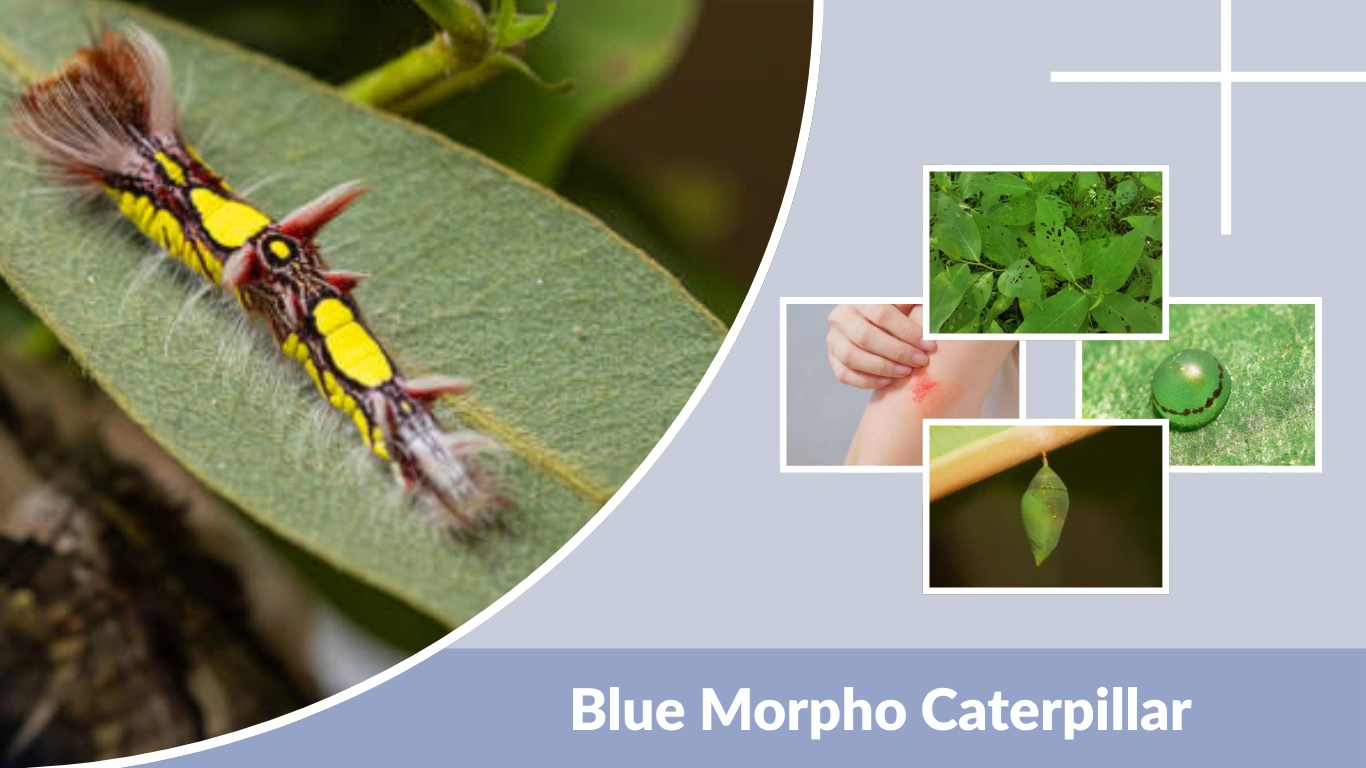
The blue morpho caterpillar is the larval stage of one of the world’s most famous butterflies, the blue morpho. While the adult butterfly is known for its brilliant metallic-blue wings, the caterpillar looks completely different—dark, hairy, and surprisingly intimidating. Found in the tropical rainforests of Central and South America, this caterpillar plays an essential role in the rainforest ecosystem. It feeds on specific host plants, stores energy for metamorphosis, and serves as a vital link in the forest food chain.
Scientific Classification and Natural Identity
The blue morpho caterpillar belongs to the order Lepidoptera and the family Nymphalidae, which includes many of the world’s most colorful butterflies. Its genus, Morpho, is famous for species with iridescent blue wings, but all of them begin life as leaf-eating larvae.
Scientifically, the caterpillar stage is considered the primary growth phase. Nearly all feeding and size increase happen during this period. The caterpillar’s biological mission is simple but critical: eat constantly, avoid predators, and store enough energy to complete metamorphosis.
Researchers study blue morpho caterpillars to better understand insect defense systems, rainforest biodiversity, and the chemical interactions between insects and host plants.
Physical Appearance and Body Structure
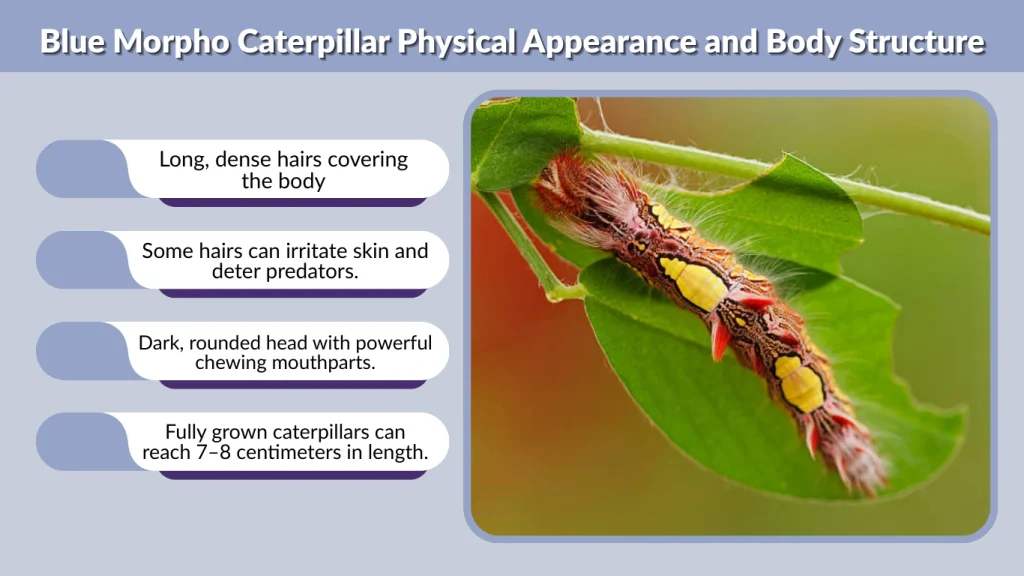
The blue morpho caterpillar is visually striking and unlike the adult butterfly.
Key physical features include:
- Body color and pattern: Reddish-brown to dark maroon body with lighter patches along the sides.
- Hair-like bristles: Long, dense hairs covering the body, giving it a fuzzy appearance.
- Spines and defense hairs: Some hairs can irritate skin and deter predators.
- Head capsule: Dark, rounded head with powerful chewing mouthparts.
- Length and growth: Fully grown caterpillars can reach 7–8 centimeters in length.
These features combine to make the caterpillar both intimidating and well protected in its rainforest environment.
Habitat and Geographic Distribution
Native Rainforest Range
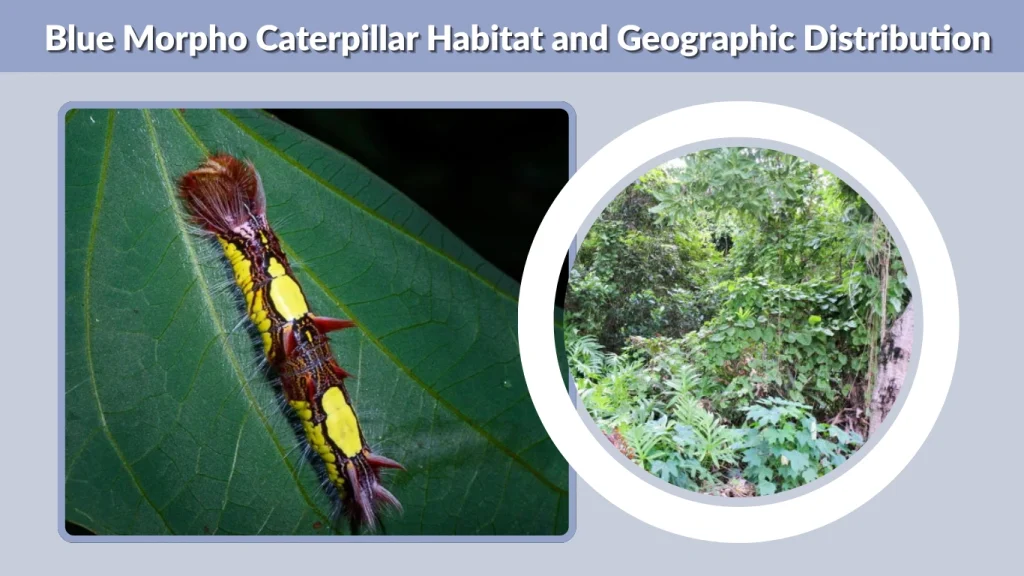
Blue morpho caterpillars are native to Central America, southern Mexico, and much of South America, especially the Amazon Basin. They are commonly found in Brazil, Costa Rica, Panama, Colombia, Peru, and surrounding tropical regions.
Preferred Microhabitats
They live primarily on the leaves of host plants, usually within the forest understory. Caterpillars rest on the undersides of leaves, where they are hidden from birds and direct sunlight. Some remain near forest edges, while others live deeper within dense vegetation.
Climate Requirements
Blue morpho caterpillars require warm temperatures, constant humidity, and abundant plant growth. Heavy rainfall influences plant health, which directly affects caterpillar survival and development.
Behavior and Daily Activity
Blue morpho caterpillars are mostly nocturnal feeders. They hide during the day and become active at night, reducing the risk of being eaten by birds and other daytime predators.
During daylight hours, they remain motionless on leaves or stems, relying on camouflage and their hairy appearance for protection. When threatened, a caterpillar may curl its body, stiffen its hairs, or drop suddenly from the plant.
Younger caterpillars sometimes feed in loose groups, but as they grow larger, they tend to become more solitary. Throughout their larval life, their behavior is focused on feeding, resting, and avoiding detection.
Diet and Feeding Habits
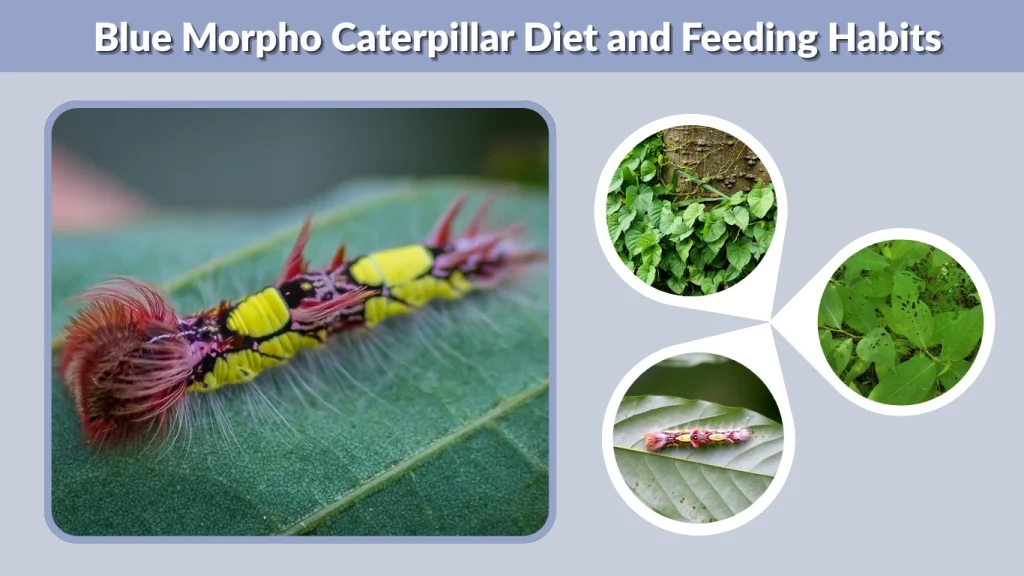
The blue morpho caterpillar is a specialized herbivore, feeding on a limited range of rainforest plants.
Its feeding habits include:
- Primary host plants: Trees and vines in the legume family, especially Machaerium species.
- Leaf consumption: Chewing large irregular holes in leaves.
- Night feeding: Most feeding occurs after sunset.
- Nutrient storage: Converting plant matter into fat reserves.
- Plant interaction: Influencing leaf growth and plant regeneration.
This steady feeding supplies the energy needed for rapid growth and eventual transformation.
Life Cycle Connection: From Caterpillar to Butterfly
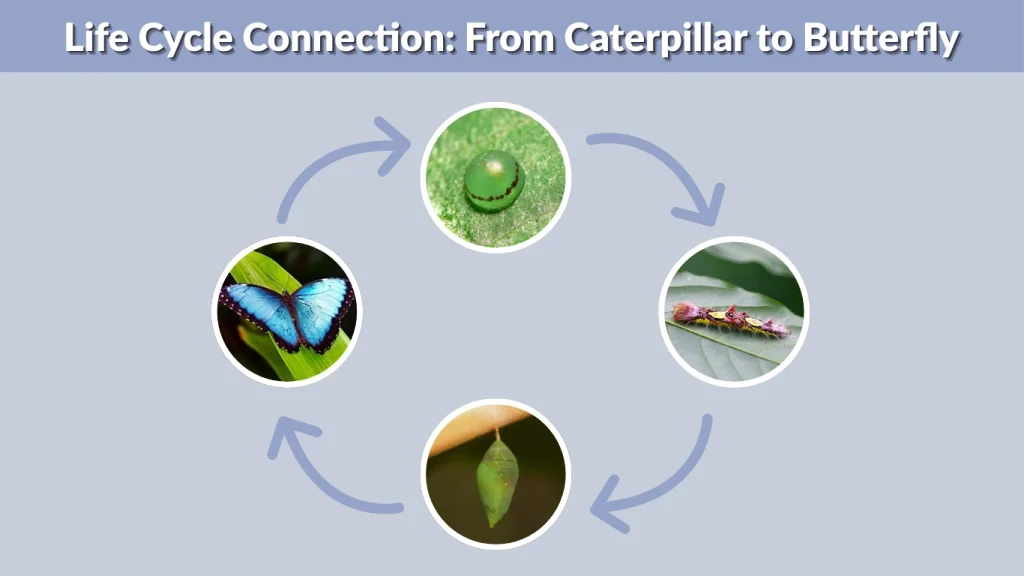
Egg Stage
Female blue morpho butterflies lay small, pale-green eggs on host plant leaves. After about one to two weeks, the eggs hatch, releasing tiny caterpillars.
Larval Growth Stages (Instars)
The caterpillar passes through several instars, or growth stages. After each stage, it sheds its outer skin to allow further expansion. With every molt, the caterpillar becomes larger, hairier, and darker in color.
Chrysalis Formation
When fully grown, the blue morpho caterpillar stops feeding and searches for a protected location such as the underside of a leaf or a hidden stem. It attaches itself using silk and gradually transforms into a smooth green chrysalis. This pupa often resembles a fresh leaf, helping it blend into the rainforest environment. Inside the chrysalis, the caterpillar’s tissues reorganize completely, forming the wings, legs, antennae, and organs of the adult butterfly.
Emergence into the Blue Morpho Butterfly
After about one to two weeks, the adult butterfly emerges from the chrysalis. At first, its wings are soft and wrinkled. The butterfly pumps fluid into the veins, expanding and strengthening the wings before flying away. This marks the end of the caterpillar’s life stage and the beginning of the iconic blue morpho butterfly.
Growth and Molting Process
Throughout its larval life, the blue morpho caterpillar molts several times. Each molt is controlled by hormonal changes that loosen the old skin. The caterpillar anchors itself, splits the skin behind the head, and slowly pulls free. After molting, the new skin is soft, allowing rapid size increase.
With each instar, body hairs become longer and denser, and the caterpillar’s color deepens. Feeding intensity increases dramatically in later stages, as the caterpillar builds the fat reserves needed for pupation and adult survival.
Defense Mechanisms and Survival Strategies
The blue morpho caterpillar is well equipped to survive in predator-rich rainforests.
Its main defenses include:
- Irritating hairs: Can cause itching or discomfort when touched.
- Chemical defenses: Derived from host plants.
- Camouflage coloration: Blends with leaves and stems.
- Eye-like markings: May confuse predators.
- Sudden dropping behavior: Escapes birds and insects.
These adaptations reduce predation and increase survival rates.
Is the Blue Morpho Caterpillar Poisonous?
Toxicity vs Irritation
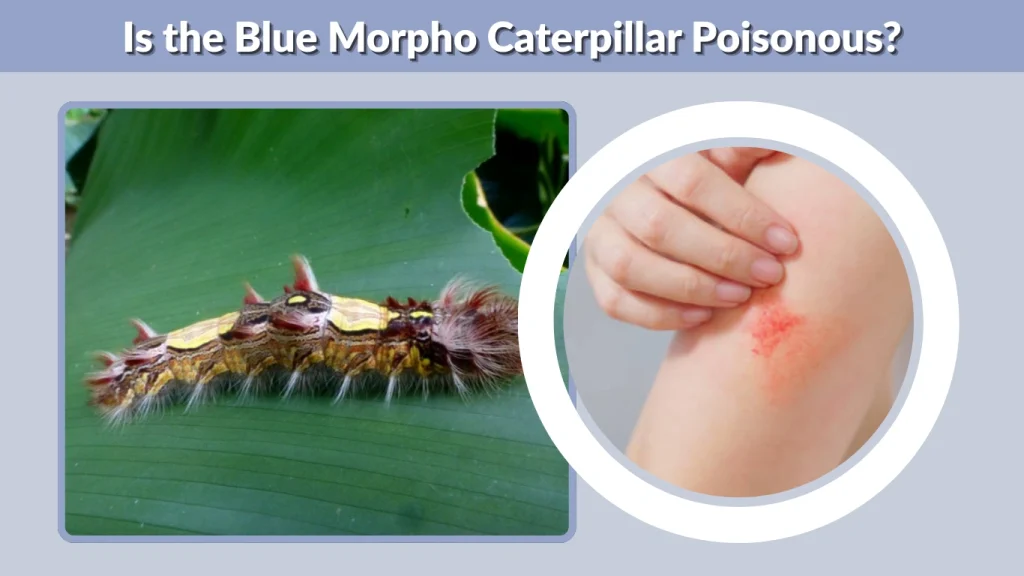
Blue morpho caterpillars are not truly poisonous, meaning they do not inject venom. However, their hairs can cause skin irritation, redness, or itching in humans and animals.
Predator Deterrence
The combination of irritating hairs and plant-based chemicals discourages birds, reptiles, and insect predators from feeding on them.
Human Interaction Safety
Direct handling is not recommended. Observing without touching prevents skin reactions and protects the caterpillar from stress or injury.
Role in the Rainforest Ecosystem
Blue morpho caterpillars play a key role in energy transfer within rainforest food webs. They convert plant material into animal biomass, becoming food for birds, parasitic wasps, ants, and small mammals.
Their leaf-feeding helps regulate plant growth and contributes to nutrient recycling. By eventually becoming blue morpho butterflies, they also support pollination and rainforest biodiversity.
Threats and Survival Challenges
Natural threats include birds, frogs, lizards, spiders, and parasitoid insects. Heavy rainfall and fungal infections can also reduce survival.
Human-driven threats include deforestation, pesticide drift, and climate change, which reduce host plant availability and disrupt breeding cycles.
Blue Morpho Caterpillar in Education and Research
Blue morpho caterpillars are widely used in butterfly farms, museums, and classrooms to teach metamorphosis and rainforest ecology. Scientists study their hairs, chemical defenses, and growth hormones to better understand insect survival systems and evolutionary adaptation.
Interesting Facts About Blue Morpho Caterpillars
Blue morpho caterpillars can double in size between molts. They often feed at night to avoid predators. Their hairs are defensive, not venomous. Many individuals never reach adulthood, making survival adaptations essential. Their dramatic transformation is one of the most studied in tropical insects.
FAQs
What does a blue morpho caterpillar look like?
It has a dark reddish-brown body covered in long hair-like bristles, with lighter patches and faint eye-like markings. Fully grown, it can reach about 7–8 centimeters in length.
What do blue morpho caterpillars eat?
They feed mainly on leaves of legume family plants, especially Machaerium species found in tropical rainforests.
Are blue morpho caterpillars poisonous?
They are not poisonous, but their hairs can cause skin irritation, itching, or redness if touched.
How long is the blue morpho caterpillar stage?
The caterpillar stage usually lasts several weeks, depending on temperature, humidity, and food availability.
Where can you find blue morpho caterpillars?
They are found on host plants in tropical rainforests of Central and South America, especially in understory vegetation.
