

All butterflies go through four life stages—egg, caterpillar, pupa, and adult. While this cycle is the same, the timing and behavior differ from species to species.
In this article, we’ll share 10 butterflies with unique life cycle patterns shaped by their environment and survival needs.
1. Monarch Butterfly (Danaus plexippus)
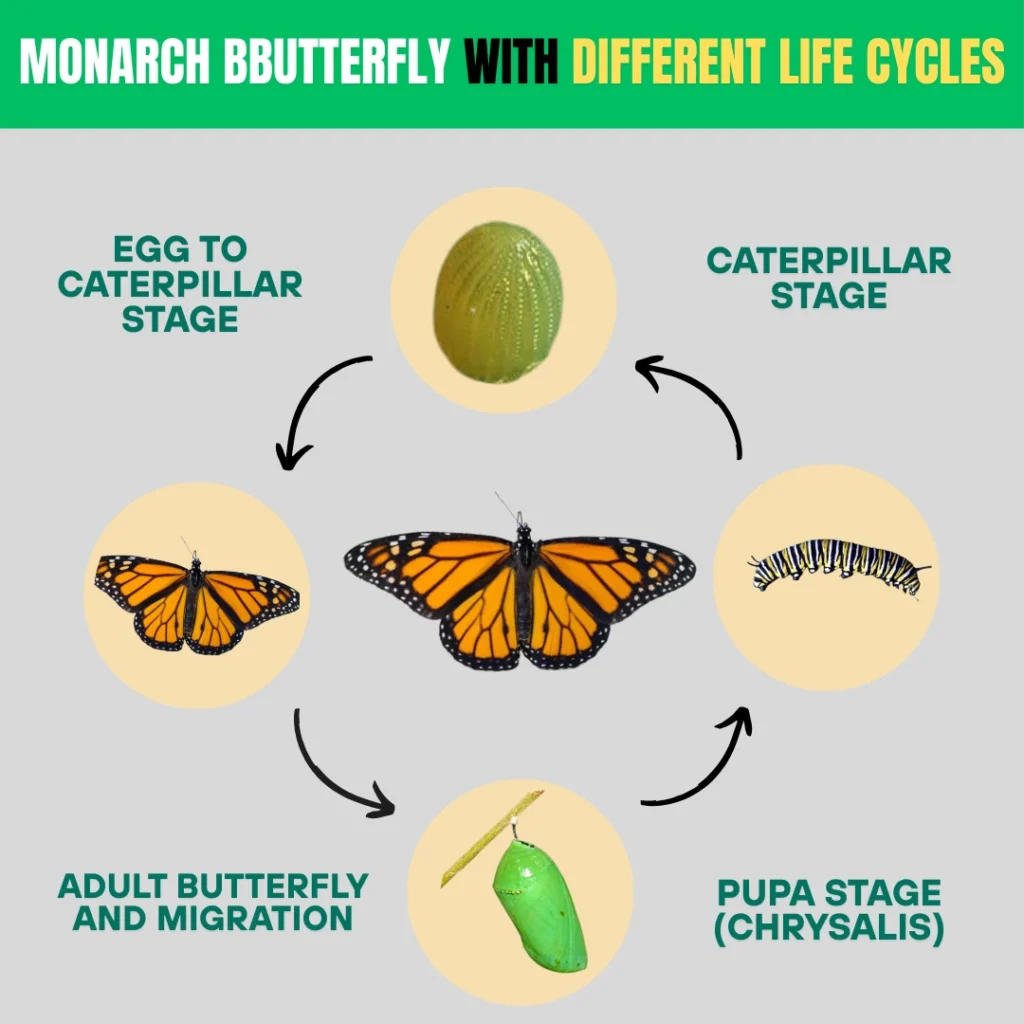
The monarch butterfly is one of the most famous butterflies in the world. It is well-known for its bright orange wings with black and white spots, and even more famous for its long-distance migration. Monarchs travel thousands of miles from Canada and the United States to central Mexico every year. This journey affects their life cycle in a unique way.
Egg to Caterpillar Stage
The female monarch lays tiny white eggs on milkweed plants. After 3 to 5 days, a small caterpillar hatches. Monarch caterpillars are striped with black, white, and yellow. They feed only on milkweed, which makes them poisonous to predators.
Pupa Stage (Chrysalis)
After about 10 to 14 days of eating and growing, the caterpillar turns into a green chrysalis. This is the transformation stage. Inside, it changes into a butterfly. The pupal stage usually lasts about 10 days in warm weather, but it can be longer in cooler temperatures.
Adult Butterfly and Migration
Here is where monarchs are very different. The early summer generations live only about 2–6 weeks. But the last generation of the year—born in late summer—can live up to 8 months! These long-living monarchs are the ones that migrate to Mexico. They rest during the winter and start flying back in spring to lay eggs and begin the next cycle.
Why It’s Unique
Most butterflies don’t migrate or live this long. Monarchs have a special life cycle with different generation lifespans. Their connection to milkweed and their long journey make them one of the most interesting butterfly species in the world.
2. Painted Lady (Vanessa cardui)

The painted lady is one of the most widespread butterflies on Earth. It can be found on every continent except Antarctica and South America. With orange, brown, and black wings, it’s beautiful and strong. It can fly long distances and adapts easily to many places. Its life cycle is fast and flexible, which makes it very different from other butterflies.
Egg to Caterpillar Stage
Female painted ladies lay eggs on many types of plants, like thistles and mallow. The eggs hatch in about 3 to 5 days. The caterpillars are dark with tiny spines and grow quickly by eating the leaves of their host plant. This stage lasts around 7 to 10 days.
Pupa Stage (Chrysalis)
After feeding and growing, the caterpillar hangs upside down and forms a brownish chrysalis. Inside, the caterpillar transforms into a butterfly. This stage usually takes 7 to 10 days, but it can be a little longer depending on the weather.
Adult Butterfly and Flight
The adult painted lady has a short life span of about 2 to 4 weeks. It spends its time flying, mating, and laying eggs. In warmer regions, it can produce several generations in a year. Sometimes it even migrates, like monarchs, but not in a set pattern.
Why It’s Unique
What makes the painted lady special is its fast and flexible life cycle. It doesn’t rely on just one plant or one climate. It grows quickly, reproduces often, and can adapt to many environments. That’s why it’s found in more places than almost any other butterfly.
3. Black Swallowtail (Papilio polyxenes)

The black swallowtail is a striking butterfly with black wings, blue and yellow markings, and long tail-like extensions. It’s common in North America and is often seen fluttering around gardens and meadows. Its life cycle changes with the seasons, especially in colder climates.
Egg to Caterpillar Stage
Females lay small, round eggs on plants like parsley, dill, and fennel. The eggs hatch in about 4 to 9 days. The young caterpillars are dark with a white band, but as they grow, they turn green with black stripes and yellow spots. This stage lasts about 10 to 20 days.
Pupa Stage (Chrysalis)
The caterpillar forms a chrysalis that blends well with branches—green or brown, depending on its surroundings. In warm months, the butterfly emerges in 9 to 14 days. But in late summer or fall, the chrysalis may stay through winter and emerge in spring. This is called overwintering.
Adult Butterfly and Seasons
The adult lives for 10 to 20 days. In warmer areas, there may be 2–3 generations per year. In colder regions, the last generation stays in chrysalis over winter, which makes this species different from butterflies that die in fall.
Why It’s Unique
The black swallowtail’s ability to pause its life cycle during winter is a special adaptation. This helps it survive freezing temperatures and return when flowers bloom again.
4. Cabbage White (Pieris rapae)
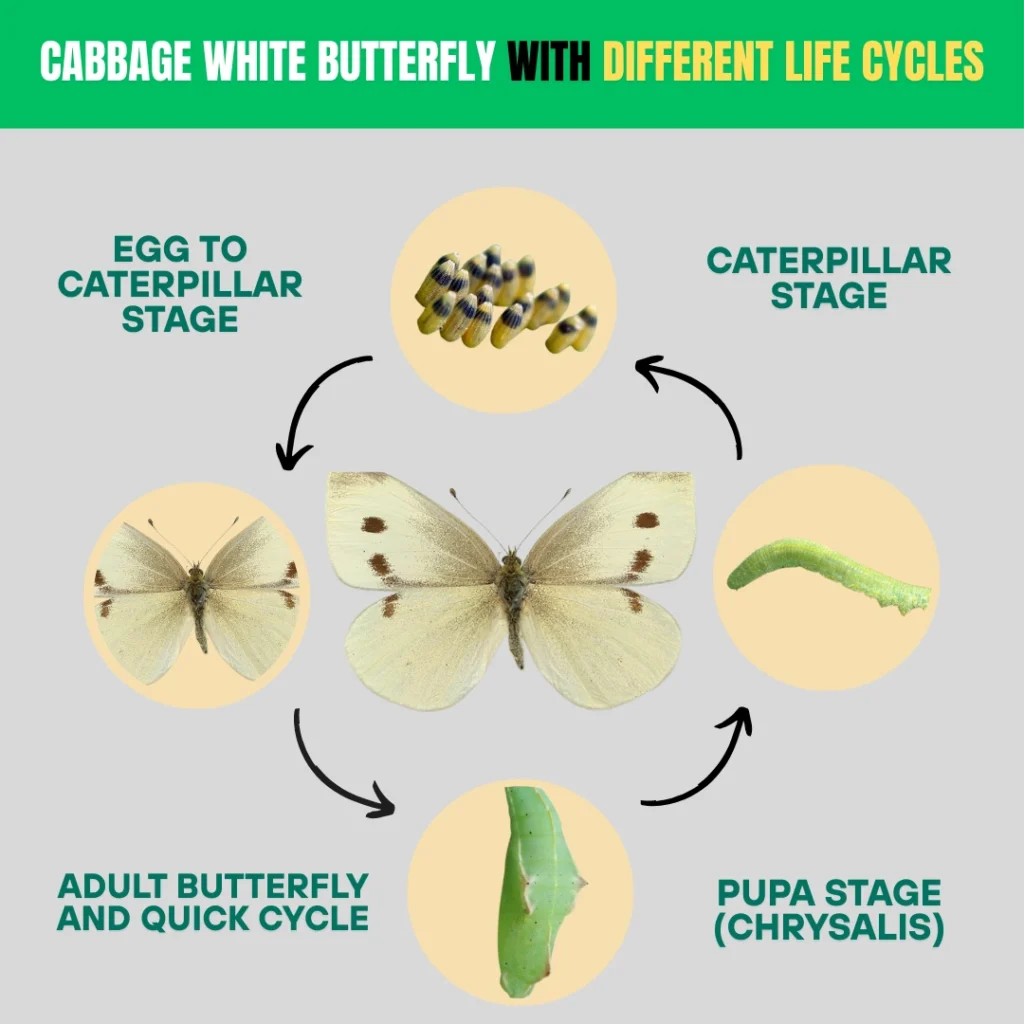
The cabbage white may not look very fancy, but it is one of the most common butterflies in the world. It has white wings with small black spots and flies quickly in gardens and fields. Its life cycle is very short, especially in warm weather.
Egg to Caterpillar Stage
The female lays tiny yellow eggs on cabbage, kale, and other leafy vegetables. These hatch in just 3 to 5 days. The green caterpillars are well-camouflaged and eat nonstop. This stage lasts about 7 to 10 days.
Pupa Stage (Chrysalis)
The caterpillar forms a smooth, light green chrysalis on a plant stem or nearby surface. After 7 to 12 days, a butterfly emerges. In some cases, the chrysalis may wait longer if it’s cooler.
Adult Butterfly and Quick Cycle
The adult butterfly lives for about 2 to 3 weeks. In warm climates, the cabbage white can go through up to 5 generations per year, which is more than many other butterflies.
Why It’s Unique
The cabbage white is known for its fast life cycle and ability to reproduce quickly. This makes it successful in gardens and farms, although it’s also seen as a pest by farmers due to its plant-eating caterpillars.
5. Mourning Cloak (Nymphalis antiopa)

The mourning cloak is a unique butterfly with dark maroon wings and creamy yellow edges. It’s often one of the first butterflies seen in early spring, even before flowers bloom. Unlike most butterflies, it spends the winter as an adult, which makes its life cycle very different.
Egg to Caterpillar Stage
Females lay clusters of eggs on willow, elm, or poplar trees. The eggs hatch in about 4 to 10 days. The caterpillars are black with tiny white spots and red dots on their backs. They feed in groups and stay on the host tree for about 15 to 20 days.
Pupa Stage (Chrysalis)
Once fully grown, the caterpillars crawl away and form a greyish-brown chrysalis hanging from a surface. The pupal stage lasts around 10 to 15 days. After that, the adult butterfly emerges.
Adult Butterfly and Overwintering
Here’s where the mourning cloak stands out. After becoming an adult, it does not die right away. It lives for up to 10 to 11 months. It hibernates through the winter in tree bark or logs and reappears in early spring to mate and start the next cycle. This long adult phase is rare in butterflies.
Why It’s Unique
Most butterflies don’t survive winter. But the mourning cloak hibernates as an adult instead of dying or staying in the chrysalis. This special ability allows it to be one of the earliest butterflies flying in spring, often when snow is still on the ground.
6. Zebra Longwing (Heliconius charithonia)
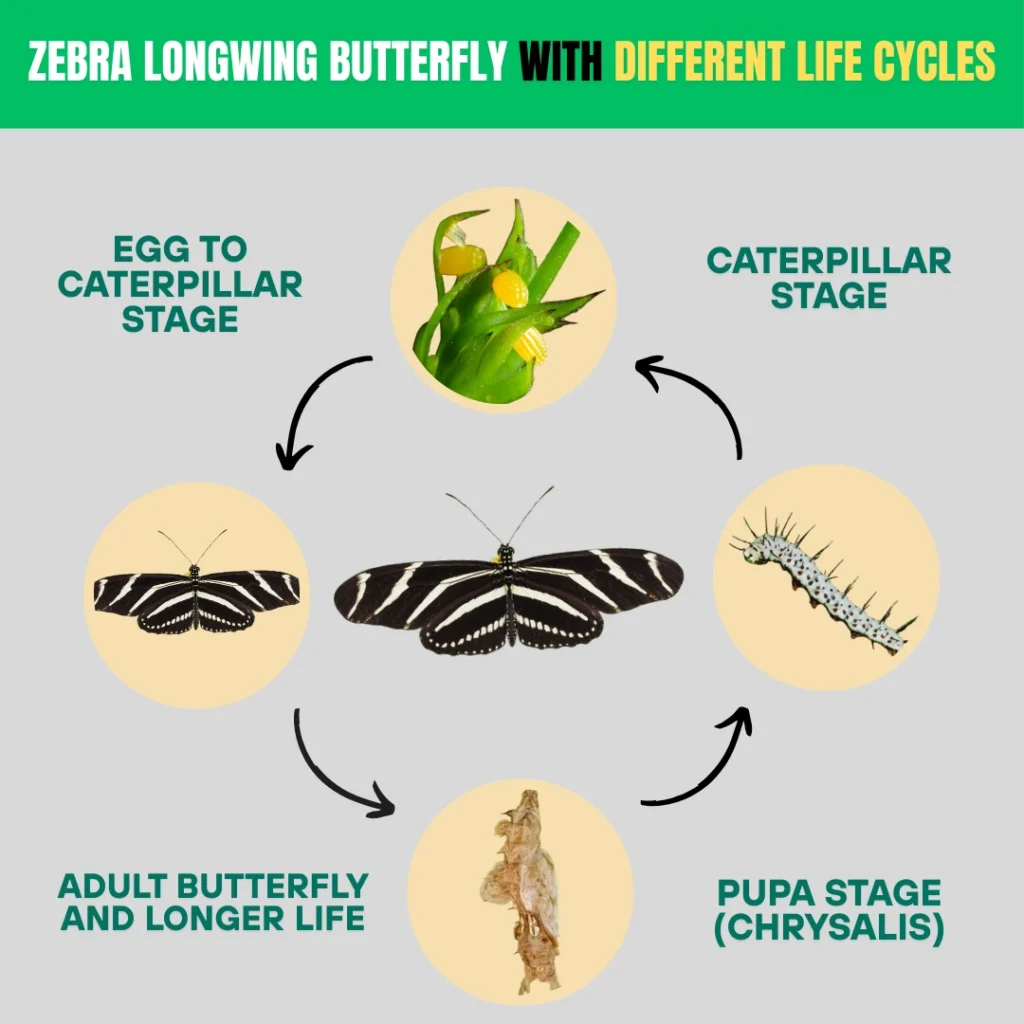
The zebra longwing is a tropical butterfly with long black wings marked with thin yellow stripes—just like a zebra. It’s the state butterfly of Florida and lives in warm, humid areas. What makes it truly special is its long adult lifespan and its diet.
Egg to Caterpillar Stage
The female lays eggs on passionflower vines. The eggs hatch in about 3 to 5 days. The caterpillars are white with black spines. They feed on passionflower leaves and grow for around 10 to 14 days.
Pupa Stage (Chrysalis)
When ready, the caterpillar forms a chrysalis that hangs from a leaf or stem. It’s often brownish or gray, helping it hide from predators. The pupal stage lasts around 7 to 10 days before the adult butterfly emerges.
Adult Butterfly and Longer Life
Unlike most butterflies that live only a few weeks, the zebra longwing can live up to 3 months or more. This is because it feeds on both nectar and pollen, which gives it extra nutrients. Most butterflies don’t eat pollen at all. It also rests in groups at night, which helps it stay warm and protected.
Why It’s Unique
The zebra longwing is different because of its long adult life, its social sleeping behavior, and its pollen diet. These traits help it survive longer and stay active for a greater part of the year compared to other butterflies.
7. Common Buckeye (Junonia coenia)

The common buckeye is a medium-sized butterfly with brown wings covered in bold eyespots of orange, purple, and black. It’s often found in sunny fields and roadsides across the U.S. Its life cycle can change depending on the temperature.
Egg to Caterpillar Stage
Females lay single eggs on host plants like plantain, snapdragon, and monkey flower. The eggs hatch in 3 to 5 days. The caterpillars are mostly dark brown or black with orange lines and small spines. This stage lasts about 10 to 14 days.
Pupa Stage (Chrysalis)
The caterpillar forms a spiny, brownish chrysalis. The pupal stage lasts 7 to 14 days depending on the season. In warm conditions, the butterfly may emerge faster. In cooler climates, it may take longer.
Adult Butterfly and Seasonal Behavior
Adults live about 10 to 20 days. In warm climates, like the southern U.S., the buckeye may have 3 to 4 generations per year. In colder areas, the butterfly may migrate or the population may die off until spring.
Why It’s Unique
The buckeye is special because of its climate-based flexibility. Its life cycle adjusts to the weather—speeding up or slowing down—and it produces more generations in warm seasons.
8. Blue Tiger (Tirumala limniace)
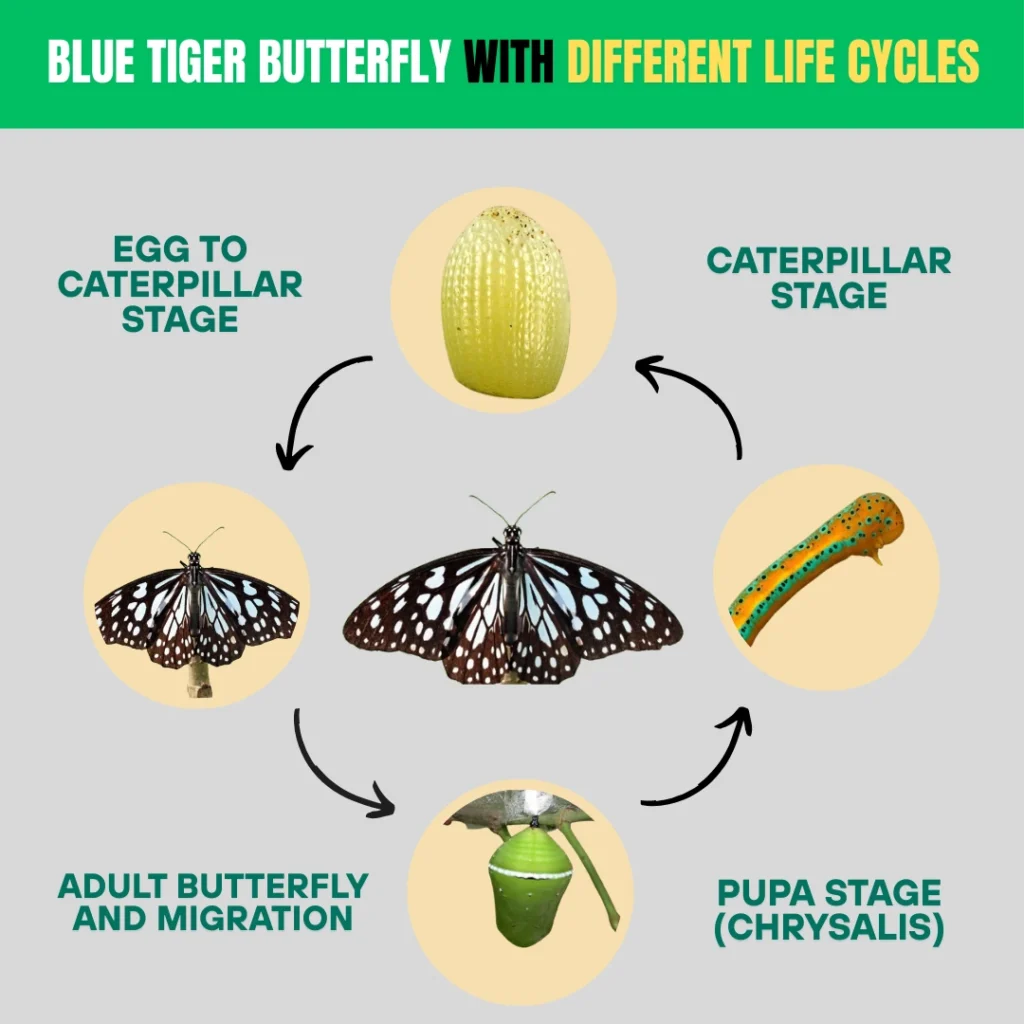
The blue tiger is a beautiful butterfly found in South and Southeast Asia. It has black wings with sky-blue streaks. You can often see them flying in groups or resting together during migration.
Egg to Caterpillar Stage
Females lay eggs on host plants like milkweed. The eggs hatch in 3 to 6 days. The caterpillars are black with white and yellow stripes. This stage lasts 10 to 15 days depending on temperature and food supply.
Pupa Stage (Chrysalis)
The caterpillar forms a green chrysalis with golden spots. It stays in this form for 8 to 12 days. But in some cases, if the season changes or during migration, it may delay emergence.
Adult Butterfly and Migration
The adult butterfly lives for about 2 to 4 weeks. During certain times of the year, thousands of blue tigers migrate together. This movement affects how long they stay in chrysalis or how many times they breed in a year.
Why It’s Unique
The blue tiger stands out because of its migratory behavior and how it changes its life cycle based on the season. It can delay its development or adjust its timing to survive harsh conditions.
9. Red Admiral (Vanessa atalanta)
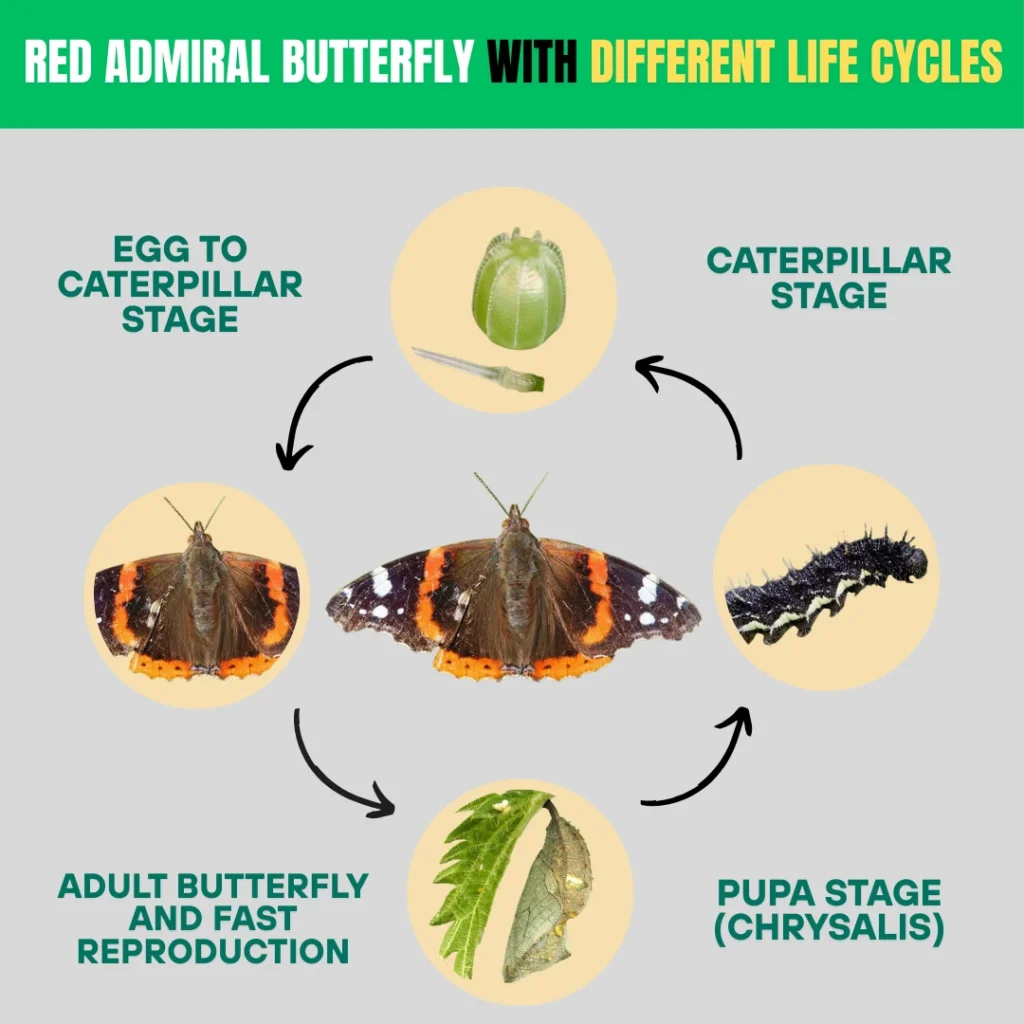
The red admiral is a fast and active butterfly with black wings and bright red-orange bands. It’s found in many parts of the world, including North America, Europe, and Asia. Its life cycle is very quick, especially in warmer climates.
Egg to Caterpillar Stage
Females lay single eggs on nettle plants. The eggs hatch in about 3 to 6 days. The caterpillars are dark and spiny, often hidden inside folded leaves. They grow quickly, feeding for about 10 to 14 days.
Pupa Stage (Chrysalis)
After eating enough, the caterpillar forms a chrysalis that is brown or green. The pupal stage lasts around 7 to 10 days, but sometimes a little longer depending on the weather.
Adult Butterfly and Fast Reproduction
The adult butterfly lives about 2 to 4 weeks. In warm areas, red admirals can produce multiple generations each year, sometimes as many as 3 or 4. They’re also strong fliers and may migrate to find better weather.
Why It’s Unique
The red admiral’s fast-growing cycle and ability to adapt to different climates make it one of the most flexible butterflies. It can take advantage of warm weather to breed quickly and spread widely.
10. Peacock Butterfly (Aglais io)

The peacock butterfly is a European species known for its large eye spots that look like a peacock’s feathers. These spots help scare away birds and other predators. It has a life cycle that includes a long winter hibernation.
Egg to Caterpillar Stage
The female lays hundreds of eggs on nettle plants. The eggs hatch in 7 to 10 days. The caterpillars are black with small white spots and spikes. They feed in groups and grow for about 2 to 3 weeks.
Pupa Stage (Chrysalis)
The caterpillar forms a brownish chrysalis attached to a plant. The pupal stage lasts 10 to 15 days, depending on temperature and weather.
Adult Butterfly and Winter Survival
After emerging, the adult butterfly flies for a few weeks, feeding and mating. Then it finds a safe place, like a shed or hollow tree, and hibernates through winter. It reappears in early spring to lay eggs and start a new generation.
Why It’s Unique
The peacock butterfly is one of the few that hibernates as an adult and survives cold winters. Its life cycle is shaped around this survival strategy, making it different from butterflies that die off before winter.
Life Cycle Differences of 10 Butterfly Species
Here’s a comparison table showing the key differences in the life cycles of the 10 butterflies:
| Butterfly Name | Egg Stage (Days) | Caterpillar Stage (Days) | Pupa Stage (Days) | Adult Lifespan | Unique Feature(s) |
| Monarch | 3–5 | 10–14 | ~10 | 2–6 weeks or 8 months | Long migration, last gen lives longer for overwintering |
| Painted Lady | 3–5 | 7–10 | 7–10 | 2–4 weeks | Rapid life cycle, adapts to many climates |
| Black Swallowtail | 4–9 | 10–20 | 9–14 or overwinter | 10–20 days | Can pause pupal stage for winter (overwintering) |
| Cabbage White | 3–5 | 7–10 | 7–12 | 2–3 weeks | Very fast life cycle, up to 5 generations yearly |
| Mourning Cloak | 4–10 | 15–20 | 10–15 | Up to 11 months | Hibernates as an adult, very long life |
| Zebra Longwing | 3–5 | 10–14 | 7–10 | Up to 3 months | Eats pollen, lives longer, sleeps in groups |
| Common Buckeye | 3–5 | 10–14 | 7–14 | 10–20 days | Flexible timing, up to 4 generations per year |
| Blue Tiger | 3–6 | 10–15 | 8–12 | 2–4 weeks | Migration affects development timing |
| Red Admiral | 3–6 | 10–14 | 7–10 | 2–4 weeks | Very quick cycle, migrates, adapts to climate |
| Peacock Butterfly | 7–10 | 14–21 | 10–15 | Several weeks to months | Hibernates as adult, large eyespots for protection |
FAQs:
Do all butterflies follow the same life cycle stages?
Yes, all butterflies go through four stages: egg, caterpillar, pupa, and adult. However, the duration and behavior in each stage vary between species.
Which butterfly lives the longest?
The Mourning Cloak butterfly can live up to 11 months, making it one of the longest-living butterflies due to its ability to hibernate as an adult.
Do all butterflies migrate?
No. Only a few species, like the Monarch and Blue Tiger, are known for migration. Most butterflies stay local and adapt their life cycle to the climate.
Can a butterfly survive winter?
Some butterflies survive winter by hibernating as adults (like the Peacock and Mourning Cloak), while others pause development in the chrysalis stage (like the Black Swallowtail).
Which butterfly has the fastest life cycle?
The Cabbage White butterfly has one of the fastest life cycles, often completing it in just 3 to 4 weeks, with multiple generations per year.
