
Carpenter bees are large, solitary bees often mistaken for bumble bees due to their similar size and coloration. However, their smooth, shiny abdomens and unique nesting habits set them apart. Proper identification is important for both protecting beneficial pollinators and managing potential damage to wooden structures.
This guide provides a detailed carpenter bee identification chart along with clear descriptions of physical traits, behaviors, and key differences between species, helping you recognize them with confidence.
Understanding Carpenter Bees
Carpenter bees belong to the genus Xylocopa and are found in many parts of the world, including North America, Europe, Asia, and Australia. They play an essential role as pollinators but are also known for drilling neat, round holes into wood to create their nests. Unlike social bees, carpenter bees are mostly solitary, with each female constructing and maintaining her own nest.
What Are Carpenter Bees?
Carpenter bees are robust, heavy-bodied insects with smooth, shiny abdomens, usually black or metallic in color. They are named for their habit of boring into wood to make nesting tunnels.
Why Identification Matters
Knowing how to identify carpenter bees can help distinguish them from similar species like bumble bees and wasps. This ensures that you can protect valuable pollinators while taking steps to prevent or repair structural damage caused by nesting activity.
Carpenter Bee Identification Chart
Carpenter bees can be identified by a combination of body size, coloration, hair patterns, and behavioral traits. The chart below organizes the most common identifying features to help you quickly recognize different carpenter bee species and distinguish them from similar insects.
Identification Chart Columns:
- Species Name – Scientific and common names of the bee.
- Body Size – Average length and weight range.
- Color & Patterns – Notable colors, markings, and hair coverage.
- Key Identifying Features – Distinct traits like facial markings, wing tint, and abdominal texture.
- Geographic Range – Areas where the species is most commonly found.
- Behavior Notes – Nesting preferences, aggressiveness, and pollination habits.
Key Physical Characteristics of Carpenter Bees
Carpenter bees share certain physical traits that make them easy to identify once you know what to look for. These features can help you tell them apart from bumble bees, wasps, and other similar insects.
Body Size & Shape
Carpenter bees are generally large, ranging from 12 to 25 mm in length, with a robust, rounded body. Their build is stocky, giving them a powerful appearance during flight.
Coloration & Hair Patterns
Most carpenter bees have black, metallic, or dark brown bodies with sparse yellow hairs on the thorax. The abdomen is smooth and shiny, unlike the fuzzy abdomen of bumble bees.
Wing Color & Texture
Wings can appear transparent, brownish, or slightly iridescent, depending on the species. They have a delicate, veined structure that is visible when resting.
Antennae Shape
Their antennae are medium-length, slightly curved, and positioned close to the top of the head, aiding in sensing vibrations and detecting flowers.
Male vs Female Carpenter Bees
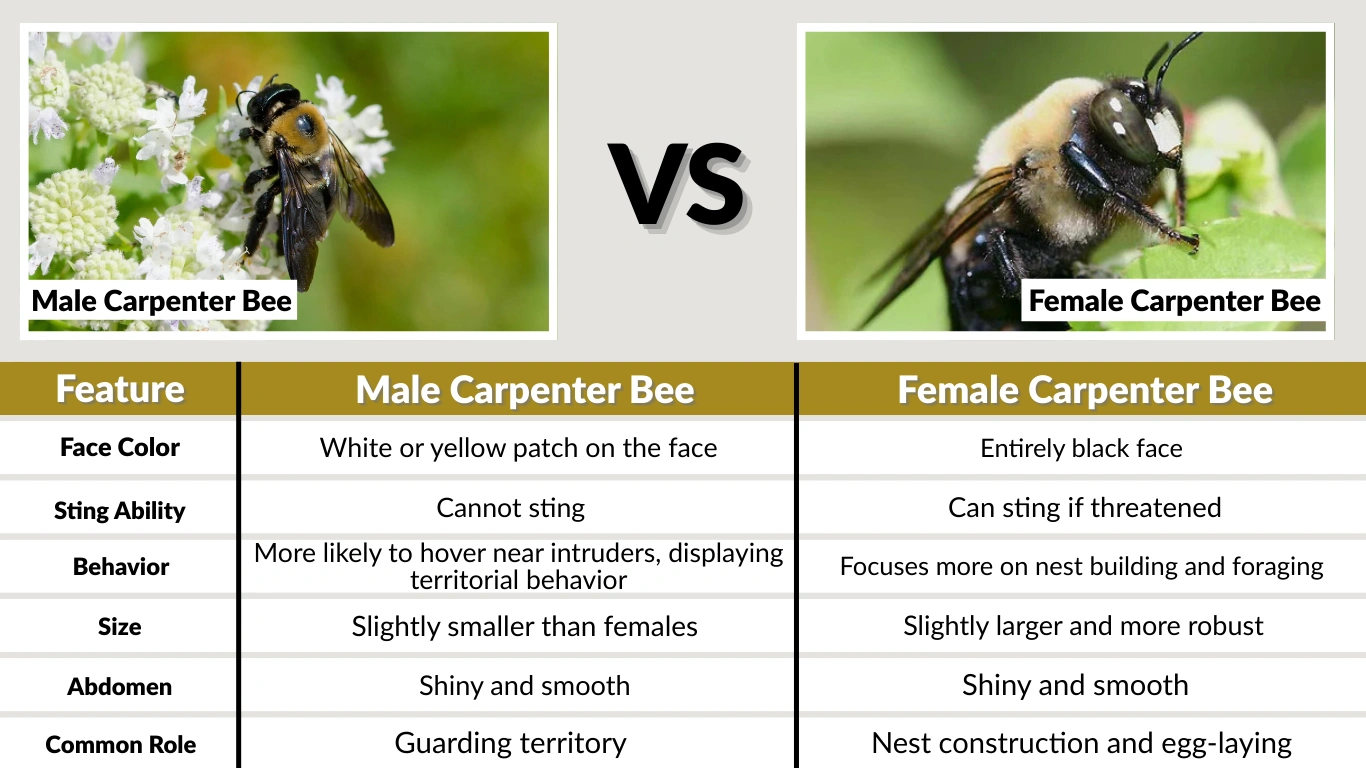
Male and female carpenter bees can look very similar at first glance, but several visual and behavioral differences make it possible to tell them apart. Recognizing these distinctions can help with safe identification, especially since only females are capable of stinging.
Comparison Table:
| Feature | Male Carpenter Bee | Female Carpenter Bee |
| Face Color | White or yellow patch on the face | Entirely black face |
| Sting Ability | Cannot sting | Can sting if threatened |
| Behavior | More likely to hover near intruders, displaying territorial behavior | Focuses more on nest building and foraging |
| Size | Slightly smaller than females | Slightly larger and more robust |
| Abdomen | Shiny and smooth | Shiny and smooth |
| Common Role | Guarding territory | Nest construction and egg-laying |
| Aggressiveness | Aggressive in flight display but harmless | Defensive when nest is disturbed |
Common Carpenter Bee Species and Their Identification
Different species of carpenter bees vary in size, coloration, and distribution. Knowing these distinctions can help you identify the exact type you encounter.
Eastern Carpenter Bee (Xylocopa virginica)
- Large, black abdomen with a metallic sheen
- Yellow hairs on the thorax
- Common in eastern North America
- Often nests in unpainted or weathered wood
Southern Carpenter Bee (Xylocopa micans)
- Slightly smaller, with a dark metallic blue-green body
- Sparse yellow hairs
- Found in the southeastern United States
- Prefers softwood for nesting
California Carpenter Bee (Xylocopa californica)
- Robust body with black or metallic green sheen
- Minimal yellow hair
- Found in western United States
- Nests in dead branches or wooden structures
Valley Carpenter Bee (Xylocopa varipuncta)
- Females: shiny black body; Males: golden fuzzy body
- Common in southwestern U.S.
- Known for striking sexual dimorphism
Differentiating Carpenter Bees from Similar Insects
Carpenter bees are often mistaken for other stinging insects or pollinators. Recognizing the key differences prevents misidentification and unnecessary extermination.
Carpenter Bees vs Bumble Bees
- Carpenter bees have smooth abdomens; bumble bees are fully hairy
- Carpenter bees are solitary; bumble bees are social
Carpenter Bees vs Wasps
- Wasps have slender bodies and narrow waists; carpenter bees are thick-bodied
- Wasps have smooth, shiny exoskeletons without dense thoracic hair
Carpenter Bees vs Honey Bees
- Honey bees are smaller with golden-brown, striped abdomens
- Honey bees live in colonies; carpenter bees are solitary nesters
Regional Identification Tips
Carpenter bee appearance and behavior can vary depending on the region, climate, and available nesting materials. Recognizing these regional differences can make identification easier.
North America
Species such as the Eastern Carpenter Bee and Valley Carpenter Bee are common. Most have shiny black abdomens, though some males in the Southwest are golden. They often nest in untreated lumber and fence posts.
Australia
Australian species like the Great Carpenter Bee (Xylocopa aruana) are large and predominantly black, with some species displaying vibrant metallic blues or greens. They often nest in softwood tree trunks and branches.
Asia
Asian carpenter bees can display a range of metallic colors, from deep purple to blue-green. Many species are found in rural areas with ample wooden structures and flowering plants.
Europe
The Violet Carpenter Bee (Xylocopa violacea) is one of the largest European bees, with a completely black body and purplish wings. It often nests in deadwood and old wooden beams.
Behavior and Nesting Clues for Identification
Observing a carpenter bee’s behavior and nesting patterns can be just as useful as examining its physical traits. These habits often reveal whether you are dealing with a carpenter bee or a different insect.
Nesting Holes in Wood
Carpenter bees create perfectly round entry holes, usually about ½ inch in diameter, leading into tunnels where they lay eggs. These holes are often found in decks, fences, eaves, or other exposed wooden structures.
Pollen Collection Patterns
They collect pollen by landing directly on flowers and vibrating their bodies, a process known as buzz pollination. This behavior makes them excellent pollinators for certain plants.
Flight Style
Carpenter bees tend to hover in place for extended periods, especially males guarding territory. Their flight is steady and direct, often near wooden areas where nests are built.
Seasonal Identification Guide
The time of year can provide strong clues when identifying carpenter bees, as their activity patterns shift with the seasons.
Spring (Mating & Nesting)
In early spring, males become highly visible, hovering near wooden structures to defend territory, while females begin drilling new nesting holes or reusing old ones. This is the most active period for sightings.
Summer (Foraging)
During summer, carpenter bees focus on collecting pollen and nectar to feed their developing larvae. They are often seen visiting flowers and may be less aggressive around their nesting sites.
Fall & Winter (Dormancy or Shelter)
As temperatures drop, activity slows. Carpenter bees may remain inside their wooden tunnels to overwinter, emerging again in spring. In colder regions, they are rarely seen during winter months.
FAQs
How can I tell a carpenter bee from a bumble bee quickly?
Check the abdomen—carpenter bees have smooth, shiny abdomens, while bumble bees are covered in dense hair.
Do carpenter bees change color with age?
Yes, some species may lose hair or show wear on their bodies over time, making them appear darker and shinier.
What is the largest carpenter bee species?
The Great Carpenter Bee (Xylocopa latipes), found in Asia, can reach up to 1.5 inches in length, making it the largest in the genus.
