
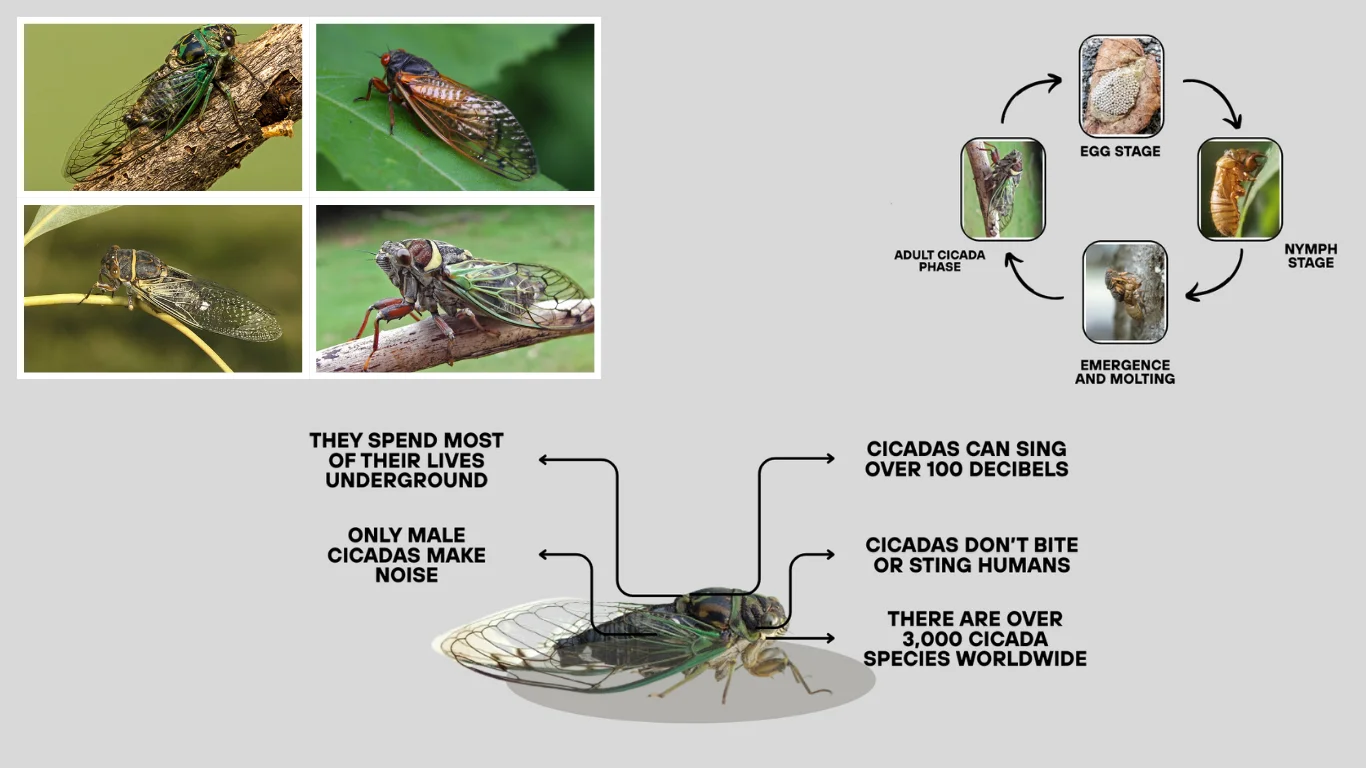
Cicada bugs are among the most recognizable insects, known for their buzzing calls and sudden mass appearances. With various types like green and black cicadas, these creatures live fascinating lives—most of it hidden underground. In this guide, you’ll explore different cicada types, their unique life cycle, how to identify them with pictures, and key facts that separate them from other bugs like locusts. Let’s uncover the secrets of cicadas.
What is a Cicada Bug?

Cicadas are unique, noisy insects known for their distinct appearance and loud buzzing sounds, especially during warm seasons. They belong to the order Hemiptera and the superfamily Cicadoidea, with over 3,000 species found across the globe. Cicadas are most commonly spotted in trees, where males sing to attract mates using specialized organs called tymbals.
Cicadas vs Locusts – What’s the Difference?
Many people confuse cicada bugs with locust bugs, but they’re completely different insects.
- Cicadas are true bugs with sucking mouthparts and do not swarm or destroy crops.
- Locusts, on the other hand, are a type of grasshopper known for forming destructive swarms that devour vegetation.
Locusts belong to the order Orthoptera, while cicadas belong to Hemiptera, making them biologically and behaviorally distinct.
Types of Cicadas: Green, Black, and More
Cicadas vary in color and size depending on the species. Two of the most commonly observed types are:
- Green Cicada Bug: Often seen during summer, these cicadas have green bodies and transparent wings. They’re among the loudest singers and are commonly found in North America.
- Black Cicada Bug: These have darker exoskeletons and are often confused with different insect species due to their stark appearance. Black cicadas are more common in tropical regions.
Each species has its own life cycle, call, and behavior, but all contribute to the unique charm of the cicada world.
Cicada Bug Identification

- Size: Typically 1 to 2 inches long, with some species reaching up to 3 inches.
- Body Shape: Stout, with a broad head and prominent eyes.
- Wings: Clear, membranous wings held tent-like over the body; often veined and long.
- Color: Common colors include green, black, brown, and reddish hues depending on the species.
- Eyes: Large, bulging, and usually red, black, or brown.
- Sound: Loud buzzing or clicking sound (only males produce it).
- Behavior: Slow-moving, usually found on tree trunks, leaves, or branches.
- Habitat: Forested areas, gardens, and places with plenty of trees.
- Season: Mostly seen during warm months, especially late spring to summer.
- Unique Feature: Nymph exoskeletons often found clinging to bark or walls after molting.
Life Cycle of a Cicada Bug

The life cycle of a cicada is one of the most fascinating in the insect world, marked by long underground phases and sudden, dramatic emergences. Depending on the species, a cicada can live underground for 2 to 17 years before appearing above ground as an adult. Here’s how their life unfolds:
Egg Stage
After mating, female cicadas lay hundreds of eggs in slits they carve into tree branches or twigs. The eggs are tiny, white, and oval-shaped. Within six to ten weeks, these eggs hatch into small nymphs.
Nymph Stage and Underground Life
Once hatched, the nymphs drop to the ground and immediately burrow into the soil. They remain underground for several years—some species for up to 17 years—feeding on the sap from tree roots. During this period, cicadas go through several nymphal stages (called instars), gradually developing in size.
Emergence and Molting
When the soil temperature reaches around 64°F (18°C) in the spring, mature nymphs dig their way to the surface, usually at night. They climb onto tree trunks or other vertical surfaces, where they molt one final time, shedding their exoskeleton and emerging as winged adults.
Adult Cicada Phase
Freshly emerged adult cicadas are soft and pale, but within hours, they harden and darken in color. Adult cicadas live for 2 to 6 weeks. During this time, males produce loud calls to attract females, using their tymbals. After mating, the cycle begins again.
Lifespan and Death
Despite their long development underground, adult cicadas live only a short while above ground. After mating and laying eggs, they die and fall to the ground, providing nutrients to the soil and other organisms.
Cicada Bug Sound
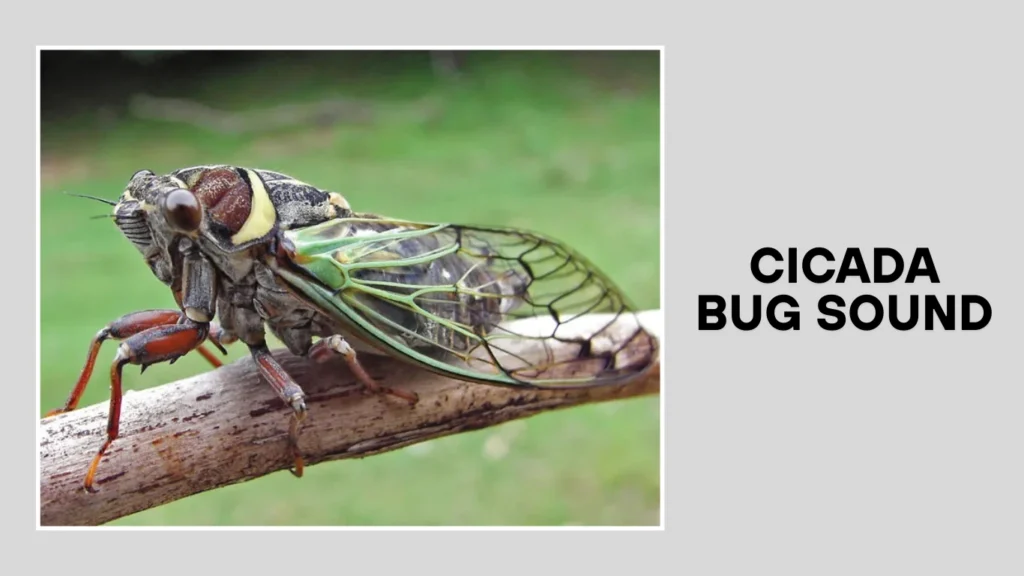
One of the most remarkable traits of cicadas is their loud, rhythmic buzzing sound, often heard in trees during hot summer days. This sound can be both fascinating and overwhelming, depending on the number of cicadas singing at once.
Why Do Cicadas Make Noise?
Cicadas produce sound primarily for mating purposes. Only male cicadas make noise, and they do so to attract females. Each species has its own unique call, which helps females find males of the same kind. In large emergence years, this chorus can reach up to 100 decibels, louder than a lawn mower.
How Cicadas Produce Their Signature Sound
Cicadas use special organs called tymbals, located on either side of their abdomen. When the male contracts the muscles around the tymbals, they buckle inward, making a clicking sound. Rapid contractions produce the buzzing noise we associate with summer cicadas. The hollow body of the cicada acts as a resonating chamber, amplifying the sound.
When Are Cicadas the Loudest?
Cicadas are typically most vocal:
- During hot daylight hours, especially midday and early afternoon.
- When there are many males in an area, creating a competitive chorus.
- In peak cicada years, particularly for periodical species like the 13- and 17-year cicadas.
7 Types of Cicada Bugs

Cicadas are a diverse group of insects with unique appearances, sounds, and life cycles. Below are seven distinct types of cicadas you’re likely to encounter or hear about, each with notable traits.
1. Magicicada septendecim (17-Year Cicada)

This species is part of the periodical cicada group that emerges every 17 years in massive swarms. Found mostly in the eastern United States, it has black bodies, bright red eyes, and orange-veined wings. Their synchronized emergence overwhelms predators and creates a rare natural spectacle. Their buzzing chorus is almost deafening during peak season.
2. Magicicada tredecim (13-Year Cicada)

Closely related to M. septendecim, this species appears every 13 years and has a more southern range. They look very similar but produce a slightly different pitch in their mating calls. Both 13- and 17-year cicadas belong to the same genus and follow precise timing controlled by soil temperature and internal clocks.
3. Neotibicen canicularis (Dog-Day Cicada)

These annual cicadas appear during the hottest part of summer, hence the name. They are greenish-black with silvery wings and produce a long, high-pitched whirring sound. Unlike periodical cicadas, they don’t emerge in swarms and are seen more individually.
4. Neotibicen tibicen (Swamp Cicada)

This species prefers moist environments like marshes and riverbanks. It’s larger than the dog-day cicada and emits a deep, rhythmic buzzing call. Its body is often dark brown with olive green markings.
5. Neotibicen lyricen (Lyric Cicada)

Named for its melodic, rising-and-falling call, the lyric cicada is common in woodlands and forest edges. Its distinctive sound is often used in nature documentaries to set a warm summer mood.
6. Diceroprocta apache (Apache Cicada)

Native to arid regions like Arizona and New Mexico, the Apache cicada thrives in desert heat. It has light green and brown coloring and produces an extremely loud call that echoes through canyons and open spaces.
7. Quesada gigas (Giant Cicada)

Found in Central and South America, this is one of the largest cicada species in the world, with a wingspan up to 6 inches. Its deep, resonating call can be heard from far distances and is sometimes mistaken for machinery.
Cicada Bug Bites – Are They Harmful?

Cicadas may look intimidating due to their size and noise, but they are completely harmless to humans. They do not bite or sting intentionally and are not aggressive in any way.
Do Cicadas Bite or Sting Humans?
No, cicadas do not bite or sting. They have a straw-like mouthpart designed for sucking sap from trees, not for piercing human skin. In rare cases, if a cicada mistakenly lands on a person and probes the skin, it may feel like a mild poke but it’s not a true bite and causes no harm.
Safety Tips Around Cicadas
You don’t need to avoid cicadas—they don’t carry disease, don’t infest homes, and won’t attack you. However:
- Avoid handling them roughly—they’re fragile.
- If one flies into you, stay calm; they often mistake humans for trees due to their poor eyesight.
- If you have pets, supervise them—dogs and cats may try to eat cicadas, which could cause mild digestive upset.
In short, cicadas may be noisy and startling, but they’re gentle giants of the insect world.
Cicada Killer Bug – Predator or Threat?
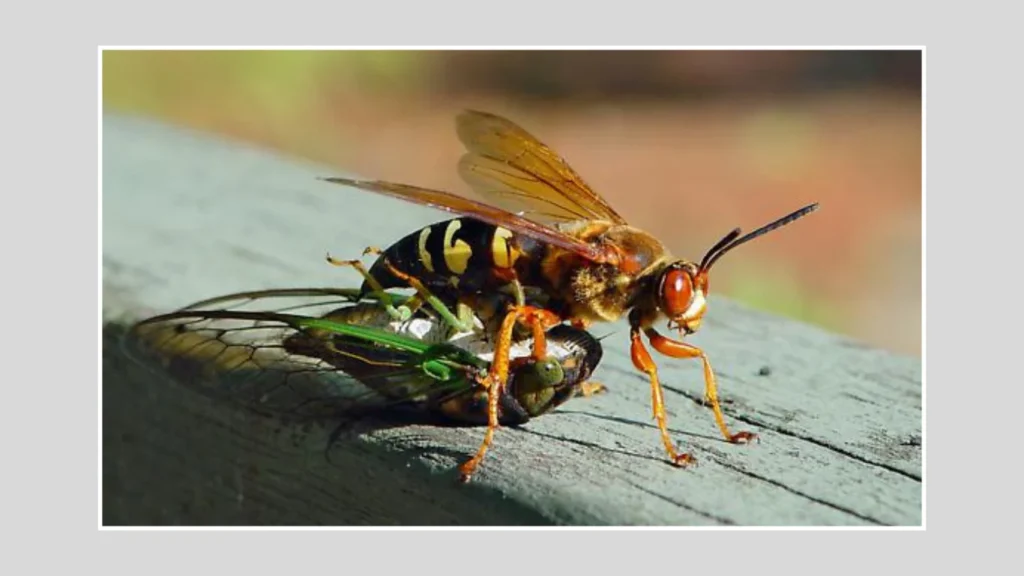
The cicada killer wasp may sound like a terrifying predator—and it is, at least to cicadas. But to humans, it’s far less dangerous than its name suggests. These large, solitary wasps specialize in hunting cicadas, making them key players in the cicada life cycle.
What is a Cicada Killer Wasp?
The cicada killer is a large wasp, often over 1.5 inches long, with black and yellow markings similar to a hornet. Found in North America, they appear during summer—just in time for adult cicadas to emerge. Despite their size, they are not aggressive toward people.
How It Hunts Cicadas
Female cicada killers paralyze cicadas with a sting, then drag them into a burrow. There, she lays an egg on the paralyzed cicada. When the larva hatches, it feeds on the cicada, using it as a fresh food source. This process helps regulate cicada populations naturally.
Is It Dangerous to Humans?
While their size and buzzing flight can be alarming, cicada killer wasps are not a threat to humans. They rarely sting unless provoked or handled. Males can be territorial and hover near people, but they can’t sting at all.
If you see one, there’s no need to panic—just observe from a distance and let it go about its business.
What Eats Cicada Bugs?

Cicadas may be loud and noticeable, but they’re also an easy target for many predators. Birds, bats, squirrels, raccoons, spiders, praying mantises, and even fish feast on cicadas during emergence seasons. One of the most specialized predators is the cicada killer wasp, which hunts them to feed its young. Their sheer numbers help ensure species survival—even if many are eaten, plenty survive to reproduce.
Cicada Bug Facts You Didn’t Know

Here are 5 interesting cicada bug facts
- Cicadas Can Sing Over 100 Decibels
Male cicadas produce sound using tymbals, and their calls can reach volumes louder than a chainsaw. - They Spend Most of Their Lives Underground
Some cicadas live underground for up to 17 years before emerging for just a few weeks. - Only Male Cicadas Make Noise
Females are silent; the loud calls are exclusively from males trying to attract mates. - Cicadas Don’t Bite or Sting Humans
Despite their size and noise, cicadas are harmless and lack the ability to bite or sting. - There Are Over 3,000 Cicada Species Worldwide
Cicadas are found on every continent except Antarctica, with species adapted to diverse climates.
Conclusion
Cicadas are truly fascinating insects—harmless to humans, yet essential to the environment. From their long underground life to their thunderous summer songs, every stage of the cicada bug life cycle offers something unique. Whether it’s understanding their sounds, spotting green or black cicadas, or observing how predators like the cicada killer interact with them, these bugs remind us just how complex and interesting nature can be.
