

Cicadas are among nature’s most fascinating insects — known for their loud buzzing calls that echo through the warm months and for their mysterious life cycles that unfold largely underground. These remarkable creatures belong to the order Hemiptera, or true bugs, and their lives are divided between hidden years beneath the soil and a short, spectacular appearance above ground.
Though they may seem ordinary at first glance, cicadas possess one of the most complex and longest life cycles in the insect world. Some species live underground for several years before emerging in synchronized waves that can number in the billions. Despite their noisy presence, cicadas are harmless to humans and vital to ecosystems, helping aerate soil, recycle nutrients, and feed countless other animals.
This article explores the full life cycle of a cicada — from egg to adult — revealing how these insects survive, grow, and maintain nature’s delicate balance.
What Is the Cicada Life Cycle?

The cicada life cycle consists of three main stages: egg, nymph, and adult. Like butterflies and beetles, cicadas go through metamorphosis, but their transformation is gradual rather than complete. Most of their life is spent underground as a nymph, feeding quietly on sap from plant roots. Only at the very end of their lives do they emerge to molt, sing, and reproduce.
The length of the cicada’s life cycle depends on the species. Some, called annual cicadas, complete their development in about 2 to 5 years, but because generations overlap, adults appear every summer. Others, known as periodical cicadas, take 13 or 17 years to mature underground before emerging en masse in a synchronized event that transforms entire forests into humming choruses.
Temperature plays a crucial role in their emergence. When the soil reaches about 64°F (18°C), nymphs begin their climb to the surface. This precision ensures that cicadas appear during warm, humid conditions ideal for survival and reproduction.
The cicada life cycle isn’t just a biological process — it’s a story of patience and timing, finely tuned to environmental cues that have evolved over millions of years.
Life Cycle Stages of a Cicada
Stage 1 — Eggs
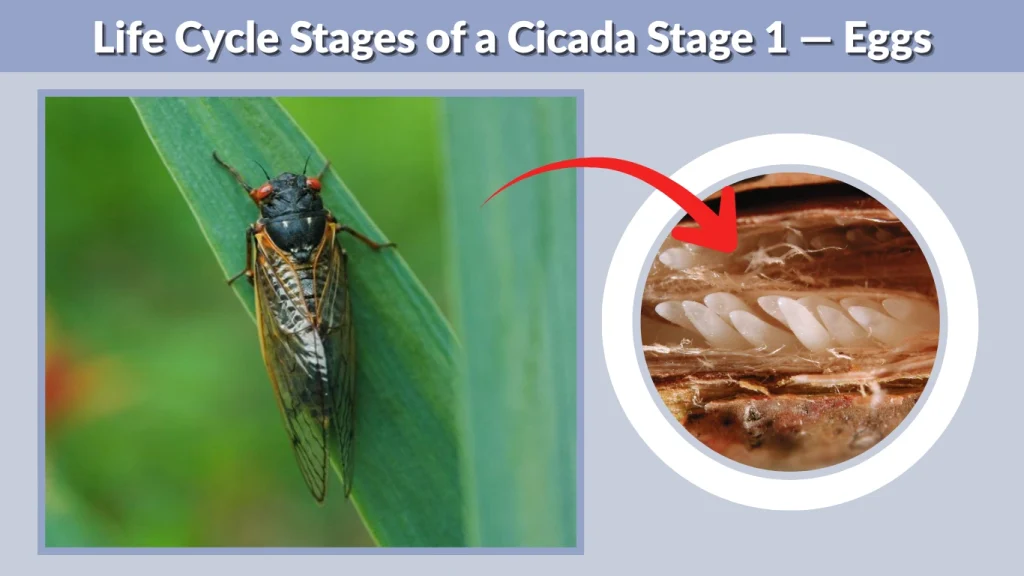
The life of every cicada begins when a female deposits her eggs into slender twigs or branches. Using her sharp ovipositor (a specialized egg-laying structure), she cuts small slits into the plant’s bark and carefully places 200–400 eggs inside. This process usually occurs in late summer, after mating.
After about 6–10 weeks, the eggs hatch, releasing tiny white nymphs that are scarcely visible to the naked eye. These newborns instinctively drop to the ground, burrow into the soil, and begin their long subterranean life. The entire above-ground stage of egg-laying lasts only a few weeks, but it sets in motion a process that can span decades.
Stage 2 — Nymph (Underground Stage)
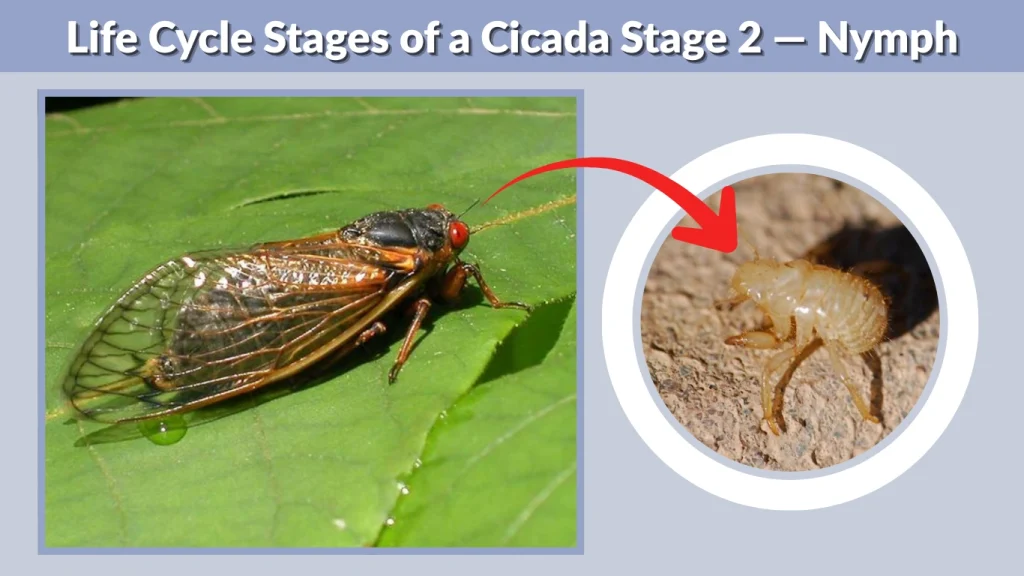
The nymph stage is the longest and most secretive part of the cicada’s life. Once underground, the nymphs use their strong, claw-like forelegs to dig tunnels and attach themselves to plant roots, where they feed on xylem sap — a nutrient-poor liquid that provides just enough energy for slow but steady growth.
Cicada nymphs molt multiple times as they grow, each molt marking a new developmental stage called an instar. For annual cicadas, this phase lasts 2–5 years, while for periodical cicadas, it may stretch to 13 or even 17 years.
Buried anywhere from 1 to 2 feet below the surface, nymphs live in total darkness, protected from most predators and temperature fluctuations. Scientists believe this long underground phase evolved as a survival strategy — reducing exposure to predators and allowing synchronization of mass emergencies.
When the time is right, and the soil temperature rises to about 64°F, the mature nymphs begin their final ascent. On warm spring nights, they climb tree trunks, fence posts, or walls in silence. There, they undergo their final molt — a breathtaking transformation from underground dweller to winged adult.
Stage 3 — Adult Cicada
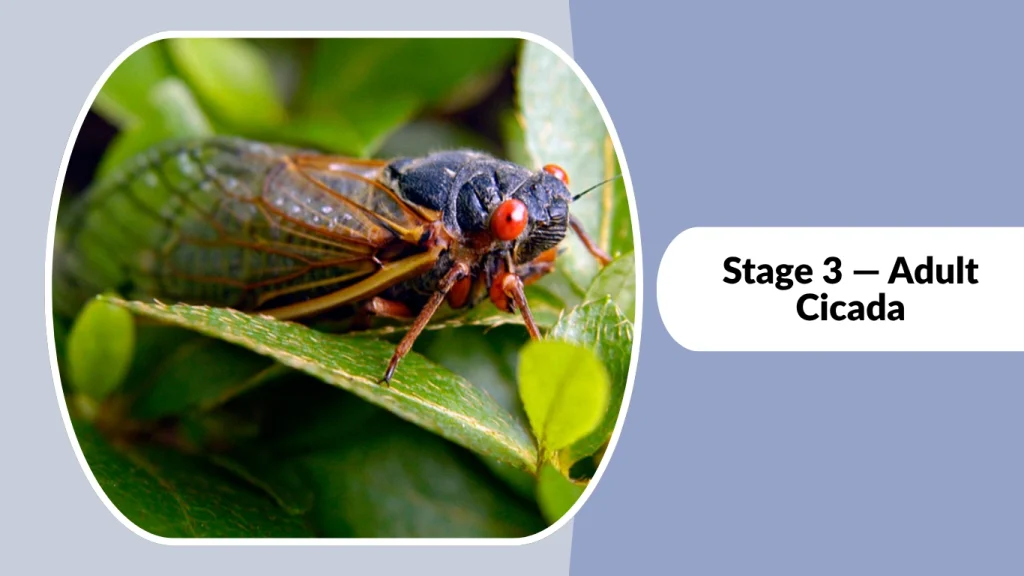
Once the nymph reaches the surface, it clings to a vertical surface and begins its final molt. The adult cicada slowly emerges from its old brown shell (exuviae), unfolding delicate, pale wings. In its first few hours, it appears soft and almost white — known as a teneral cicada — before hardening and taking on its species-specific colors: green, brown, or black with shimmering transparent wings.
Adult cicadas live for three to five weeks. During this time, males begin to sing using special vibrating membranes called timbals, producing the familiar buzzing or clicking sound that can reach over 100 decibels. Each species has a distinct song used to attract females and defend territories.
After mating, females lay eggs in tree branches, and the life cycle begins anew. When the adults die, their bodies enrich the soil with nutrients, continuing nature’s cycle of renewal.
Annual Cicada Life Cycle
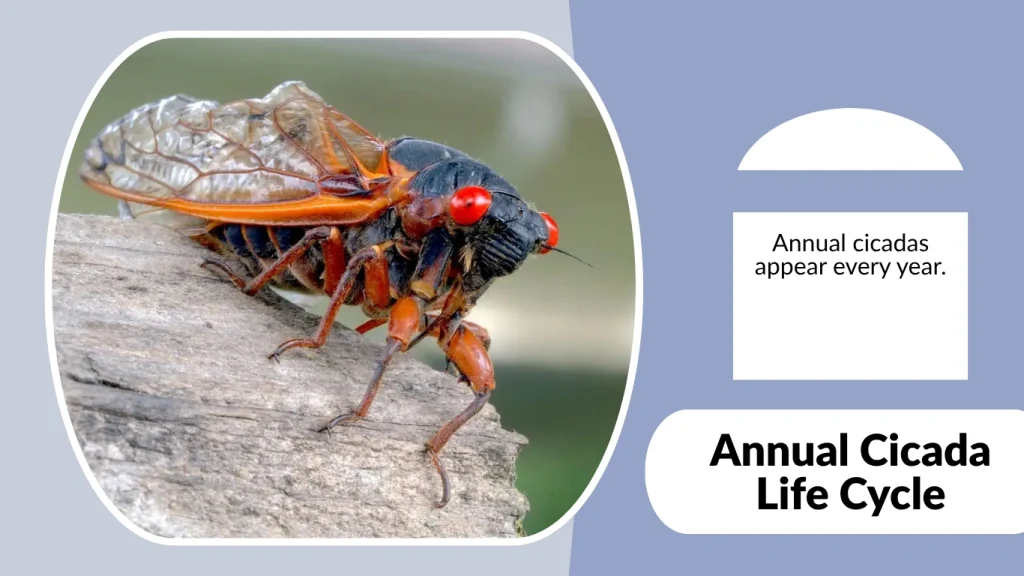
While many people associate cicadas with 13- or 17-year cycles, annual cicadas appear every year. However, this doesn’t mean each individual lives only one year — rather, their overlapping generations ensure some emerge every summer.
Common in North America, species like the Dog-day cicada (Neotibicen canicularis) are easy to recognize by their large greenish bodies and loud, whirring calls. They’re most active during the hottest part of summer — hence the name “dog-day.”
These cicadas spend 2–5 years underground before surfacing, molting, and reproducing. Because individuals from different generations mature at different times, there’s always a visible population of adults each year.
Dog-day cicadas are less synchronized and appear singly or in small groups, unlike the massive, forest-filling swarms of periodical species. Despite their shorter underground stay, they follow the same basic life cycle pattern — egg, nymph, and adult — but on a smaller and more continuous scale.
Their presence marks the height of summer, and their steady droning calls are a defining sound of warm afternoons. Beyond their songs, they play an ecological role as natural soil aerators and a food source for birds, mammals, and even predatory wasps.
Cicada Killer Wasp Life Cycle (Predator Connection)

In the summer, when cicadas fill the air with their buzzing songs, another insect emerges — the cicada killer wasp (Sphecius speciosus). Despite their intimidating size and name, these wasps are generally non-aggressive toward humans. Their appearance, however, is directly linked to the cicada’s life cycle.
How the Cicada Killer Hunts
Female cicada killers are expert hunters. When adult cicadas appear, the wasp swoops in, paralyzes one with a precise sting, and carries it — sometimes awkwardly — back to her underground burrow. The journey can be quite a spectacle: a large wasp dragging an even larger cicada across the ground or through the air.
Feeding the Next Generation
Inside her burrow, the female lays a single egg on the cicada’s body. The wasp’s larva will hatch and feed on the immobilized cicada, which remains alive but paralyzed. After consuming the cicada, the larva spins a cocoon and overwinters in the soil. It will emerge as an adult the following summer, just in time to hunt newly emerged cicadas.
The cicada killer’s life cycle is thus synchronized with the cicada’s emergence. Without cicadas, the wasps would have no food for their young. This predator-prey relationship keeps populations balanced and demonstrates how deeply interconnected these insects are within their ecosystem.
Cicada Life Cycle Timeline and Duration
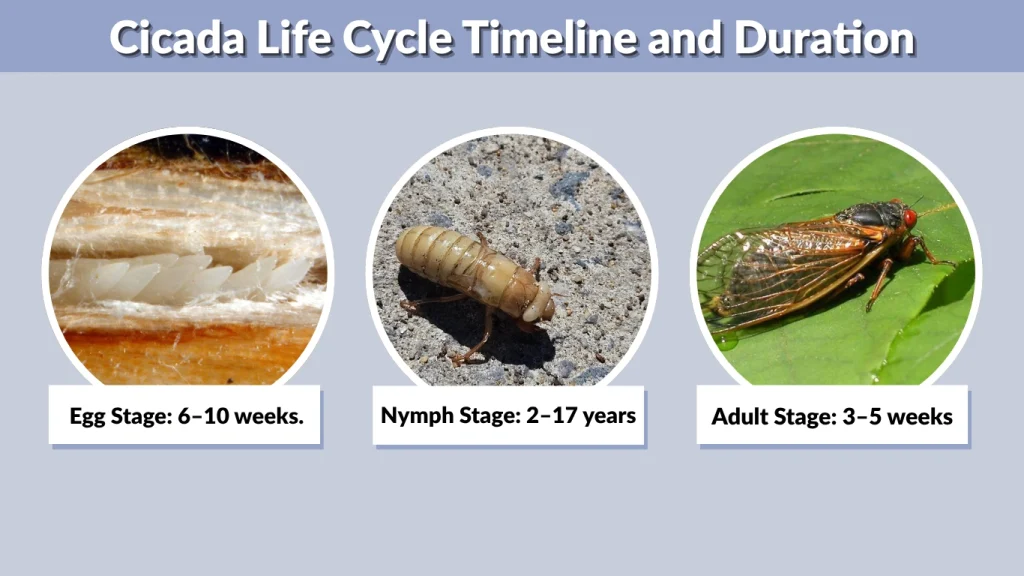
Understanding how long each stage lasts helps make sense of the cicada’s incredible patience underground.
- Egg Stage: 6–10 weeks. Eggs are laid in late summer and hatch by early fall.
- Nymph Stage: 2–17 years, depending on species. The nymph lives underground, feeding on plant sap and slowly developing.
- Adult Stage: 3–5 weeks. Adults emerge, sing, mate, and die shortly after reproduction.
Cicadas are one of the few insects with such variable life spans, ranging from two years to nearly two decades. Periodical cicadas hold the record for the longest-known insect development cycle, taking up to 17 years to mature.
Environmental conditions influence these timelines. Cicadas rely on soil temperature and moisture for cues. Warmer climates lead to shorter cycles, while cooler or drier environments can extend development. As climate patterns shift, scientists are observing slight changes in emergence timing — a reminder of how sensitive these insects are to environmental changes.
Regional Cicada Life Cycles
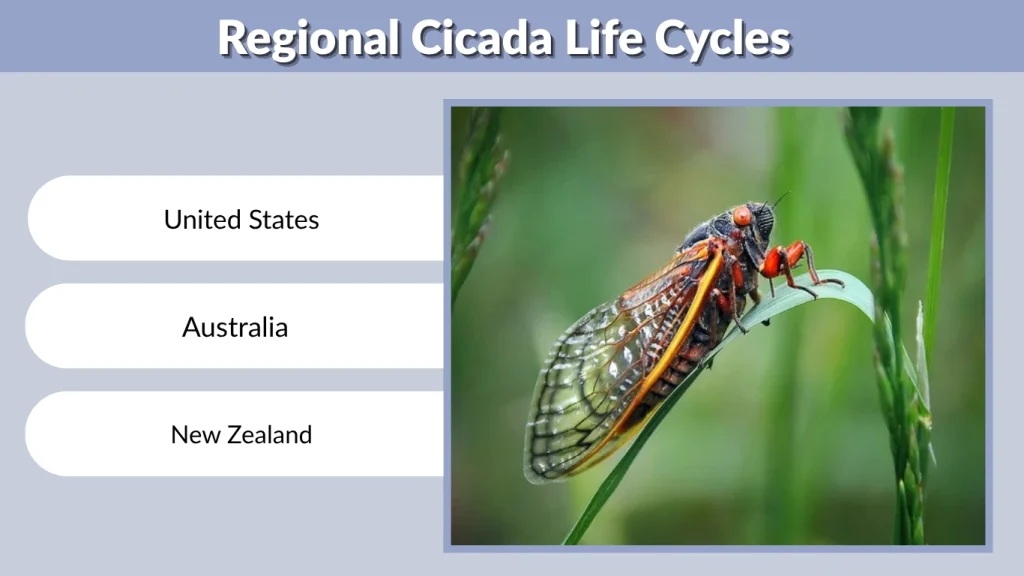
Cicadas live on nearly every continent except Antarctica, but their life cycles differ based on region and climate.
United States
- The U.S. is home to both annual and periodical cicadas.
- In the Midwest and East, periodical species emerge in vast numbers, forming broods that return every 13 or 17 years.
- Southern and western states like Texas and Arizona host annual cicadas that appear each summer, often producing their characteristic evening hum.
- In states such as Ohio, Maryland, and North Carolina, soil conditions determine when local populations emerge.
Australia
- Australia boasts some of the world’s loudest cicadas, including the Green Grocer (Cyclochila australasiae) and Yellow Monday species.
- These are annual cicadas, with overlapping generations ensuring yearly appearances.
- Their emergence is often linked to rain patterns and summer heat.
New Zealand
- Known for the Amphisalta zelandica, or chorus cicada, famous for its synchronized group singing.
- They emerge each year in late summer and autumn.
Asia and Japan
- Japan’s Cryptotympana facialis (brown cicada) and Meimuna opalifera (large black cicada) have cycles lasting 4–6 years.
- In some regions, cicadas are considered symbols of rebirth and summer, and their songs are woven into poetry and art.
Across all regions, cicadas share one remarkable trait — their emergence is perfectly timed with seasonal warmth, allowing adults to thrive for a few short weeks before completing their life cycle.
Visual Learning: Diagrams and Videos
The cicada’s life cycle is often used in classrooms to teach metamorphosis and ecosystem dynamics.
- Diagrams: A cicada life cycle diagram usually shows eggs on a tree branch, underground nymphs, and adult cicadas on the surface.
- Videos: Online cicada life cycle videos show their dramatic molting process, where nymphs shed their exoskeletons and unfurl their wings.
- Worksheets: Printable life cycle worksheets help students label each stage and understand the timing of emergence.
- Images: Educational pictures and infographics provide close-up views of each stage, making this natural process easier to visualize.
These materials are especially popular during large emergence years, when schools and nature centers use them to engage students with real-life examples.
Fascinating Cicada Facts
- Longest Insect Life Cycle: Some cicadas spend up to 17 years underground — longer than any other known insect.
- Natural Musicians: Males use vibrating membranes called timbals to produce sounds as loud as 100 decibels.
- Eco Engineers: Their burrowing helps aerate soil, improving water absorption and nutrient flow.
- Global Diversity: Over 3,000 species of cicadas exist worldwide.
- Life After Death: When they die, their bodies decompose, enriching the soil with nitrogen and promoting plant growth.
- Climate Sensitivity: Soil temperature determines emergence — a difference of just a few degrees can shift their timing by weeks.
- Symbolism: In many cultures, cicadas symbolize rebirth, immortality, and transformation.
FAQs
What are the stages of a cicada’s life cycle?
The cicada’s life cycle has three stages: egg, nymph, and adult.
How long do cicadas live underground?
Depending on the species, they can remain underground for 2 to 17 years before emerging.
Do cicadas bite or sting?
No. Cicadas do not bite, sting, or harm humans. They only feed on plant sap.
Why do cicadas emerge at the same time?
Synchronized emergence overwhelms predators, ensuring more cicadas survive to reproduce.
How long do adult cicadas live?
Only about 3 to 5 weeks after emerging from the ground.
