

Dermatobia hominis, commonly known as the human botfly, is one of the most fascinating yet unsettling insects found in nature. Unlike ordinary flies, this species has evolved a unique parasitic life cycle that depends on mammals, including humans, to complete its development. The fly itself is harmless in its adult stage, but its larvae are notorious for burrowing under the skin and causing painful lesions. Found mostly in the tropical regions of Central and South America, the human botfly is a medically significant insect due to its ability to cause myiasis, a parasitic infestation of the skin.
Taxonomy and Classification
Dermatobia hominis belongs to the family Oestridae, which includes a variety of botflies that infest mammals. Its full classification is:
- Kingdom: Animalia
- Phylum: Arthropoda
- Class: Insecta
- Order: Diptera
- Family: Oestridae
- Genus: Dermatobia
- Species: Dermatobia hominis
This species is unique because it specifically targets humans and large mammals, unlike other botflies that primarily infest rodents or wildlife. Its ability to use other insects as egg carriers makes it one of the most effective parasites in the insect world.
Identification

Physical Characteristics
The adult human botfly is often mistaken for a bumblebee because of its appearance. It measures 12–18 mm in length, has a metallic blue thorax, and a yellowish abdomen covered in dense hair. This hairy structure is an adaptation that helps it mimic harmless bees and avoid predators. The larvae, on the other hand, are white to yellowish, segmented, and covered with small spines that anchor them firmly inside the host’s skin.
Geographic Distribution
The natural habitat of Dermatobia hominis is confined to Central and South America, ranging from Mexico to northern Argentina and Chile. It is especially common in rural areas and tropical forests where mosquito populations are high, since these insects act as primary vectors for egg transfer. Farmers, travelers, and outdoor workers in these regions are more likely to encounter infestations, making it a well-known medical issue in Latin America.
Life Cycle of Dermatobia hominis
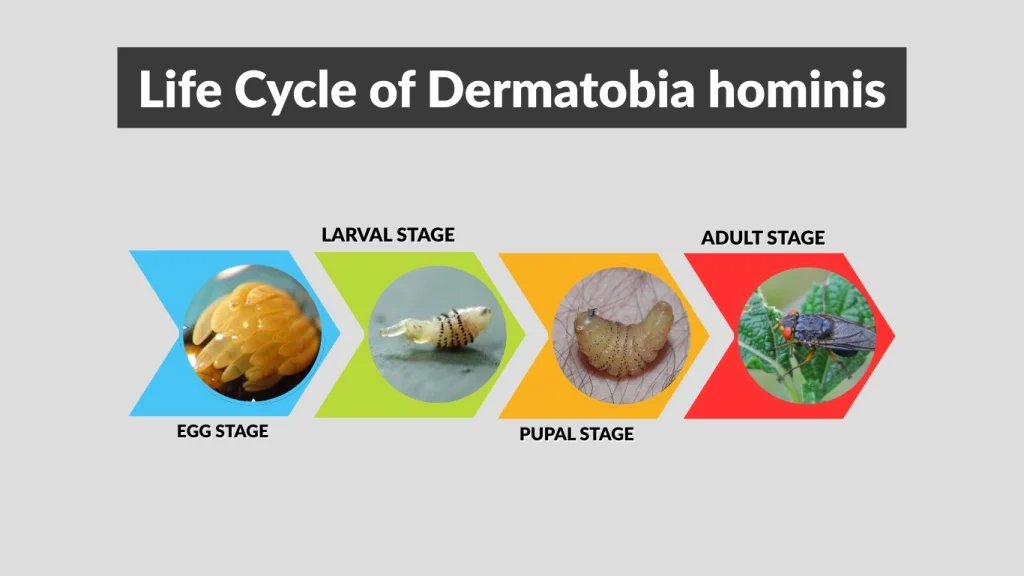
The life cycle of this species is both complex and ingenious, relying on intermediate insect hosts to deliver eggs. It consists of four main stages:
Egg Laying via Vector
Unlike most flies that lay eggs directly on a host, the human botfly attaches its eggs to blood-feeding insects like mosquitoes, ticks, or sandflies. When the vector lands on a warm-blooded host, the body heat triggers the eggs to hatch almost instantly.
Larval Stage in Humans and Animals
The newly hatched larvae burrow into the host’s skin through the bite wound or hair follicles. Once inside, they develop within a painful, boil-like swelling called a furuncle. The larva uses a small breathing hole at the surface of the skin to access oxygen, while spines on its body prevent easy removal.
Pupal Stage
After about 6–12 weeks, the mature larva emerges from the host and drops to the ground, where it pupates in the soil. This stage is relatively short and lasts a few weeks until it develops into an adult fly.
Adult Fly
The adult human botfly lives only long enough to mate and reproduce, usually a few days to a week. Unlike the larvae, adult flies do not feed on human tissue. Their sole purpose is reproduction, continuing the cycle of infestation.
Host Interaction and Symptoms

In Humans
In humans, botfly larvae cause a condition called cutaneous myiasis. The symptoms include:
- Painful, raised lesions resembling boils.
- A sensation of movement beneath the skin as the larva grows.
- Inflammation, pus, or discharge from the breathing hole.
The presence of the larva can be extremely uncomfortable, and the open wound also increases the risk of secondary bacterial infections.
In Animals
Infestations are also common in cattle, dogs, and other mammals. In livestock, multiple larvae can infest the same animal, causing economic losses due to hide damage, reduced meat quality, and poor overall health.
Medical Importance
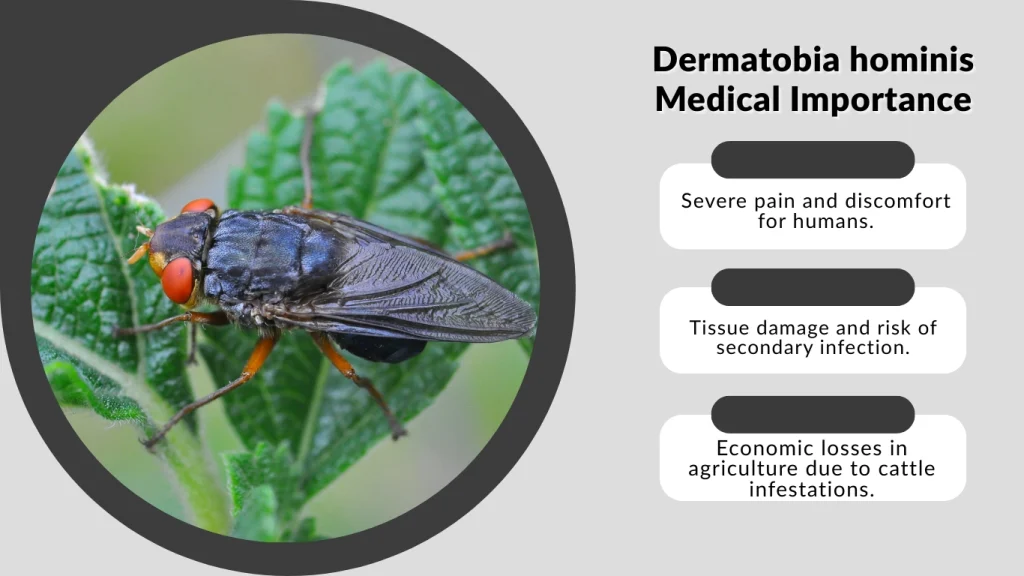
Dermatobia hominis is classified as a myiasis-causing parasite, meaning it develops by feeding on the living tissue of its host. Although the larvae rarely cause death, their infestation is considered medically important due to:
- Severe pain and discomfort for humans.
- Tissue damage and risk of secondary infection.
- Economic losses in agriculture due to cattle infestations.
For travelers in endemic regions, encountering the human botfly is often a shocking experience, making it one of the most memorable—and dreaded—insect encounters of the tropics.
Diagnosis and Detection
Detecting a human botfly infestation is often straightforward because of the distinct boil-like lesion it creates. Key diagnostic methods include:
- Visual Inspection: A central hole in the swelling, often with discharge, signals the larva’s breathing pore.
- Patient Symptoms: Reports of pain, itching, and a “moving” sensation under the skin.
- Ultrasound or Dermoscopy: In difficult cases, imaging can reveal the larva’s presence and position.
- Differentiation from Abscesses: Unlike bacterial infections, botfly lesions usually do not respond to antibiotics unless a secondary infection is present.
Treatment and Removal
Removing botfly larvae is crucial to relieve pain and prevent complications. Several methods are used depending on access to medical care:
Manual Extraction
- Doctors or veterinarians often remove the larva using forceps through the breathing hole.
- Care must be taken not to rupture the larva inside the skin, as this can worsen inflammation.
Suffocation Methods
- Since larvae require oxygen, applying substances like petroleum jelly, adhesive tape, or bacon strips over the breathing hole blocks air.
- This forces the larva to emerge partially, making extraction easier.
Medical Treatment
- In some cases, surgical removal under local anesthesia is performed.
- Antibiotics may be prescribed to treat or prevent secondary bacterial infections.
- Anti-inflammatory medication helps reduce swelling and pain after removal.
Behavior and Adaptations
The human botfly has developed remarkable survival strategies:
- Vector Hijacking: By attaching eggs to mosquitoes, it avoids direct contact with hosts, increasing its chance of successful infestation.
- Heat-Sensing Eggs: Eggs hatch upon sensing body heat, ensuring the larva enters the host immediately.
- Anchoring Spines: The larva’s spines hold it firmly in the skin, preventing accidental removal.
- Minimal Host Damage: Although painful, infestations usually do not kill the host, allowing the parasite to complete its life cycle.
Prevention and Control
Avoiding botfly infestations requires protective measures, especially for travelers and farmers in tropical regions:
- Protective Clothing: Long sleeves and pants reduce exposure to mosquito bites.
- Insect Repellent: Effective against mosquitoes that may carry botfly eggs.
- Mosquito Control: Reducing vector populations in rural areas lowers infestation risk.
- Veterinary Practices: Livestock are treated with insecticides and medications to reduce losses from infestations.
Comparison with Other Botflies
While Dermatobia hominis is the only botfly that specifically targets humans, other species in the Oestridae family parasitize different animals:
- Cuterebra: Infests rodents and rabbits in North America.
- Hypoderma: Targets cattle, causing warble fly infestations.
- Gasterophilus: Infests horses, with larvae developing in the stomach lining.
The unique feature of Dermatobia hominis is its vector-based egg delivery system, which makes it more versatile and harder to avoid than other botflies.
Economic and Social Impact
The presence of the human botfly has consequences beyond medical discomfort:
- Agricultural Losses: Infested cattle suffer from skin damage and weight loss, lowering their market value.
- Healthcare Burden: In rural communities, infestations increase medical costs and loss of productivity.
- Tourism Concerns: Travelers often return home with botfly larvae, leading to unpleasant medical cases and increased awareness of tropical risks.
Interesting Facts
- Locally, the human botfly is called torsalo in many Latin American countries.
- Indigenous communities often use herbal remedies to suffocate larvae before removal.
- Despite their parasitic nature, botflies are part of delicate ecological systems, controlling certain mammal populations.
- The adult fly is short-lived and does not feed, focusing entirely on reproduction.
FAQs
What is Dermatobia hominis?
It is the human botfly, a parasitic insect whose larvae infest the skin of humans and animals, causing a condition known as cutaneous myiasis.
How do humans get infected?
Infection occurs when mosquitoes or other biting insects carrying botfly eggs land on a person. The eggs hatch and the larvae burrow into the skin.
Is the human botfly dangerous?
It is not typically life-threatening but can cause severe pain, tissue damage, and secondary infections if untreated.
How long does the larva stay in the skin?
The larva remains in the skin for 6 to 12 weeks before dropping to the soil to pupate and emerge as an adult fly.
Can botfly infestations be prevented?
Yes. Wearing protective clothing, using insect repellent, and avoiding mosquito bites in endemic regions are effective prevention methods.
