
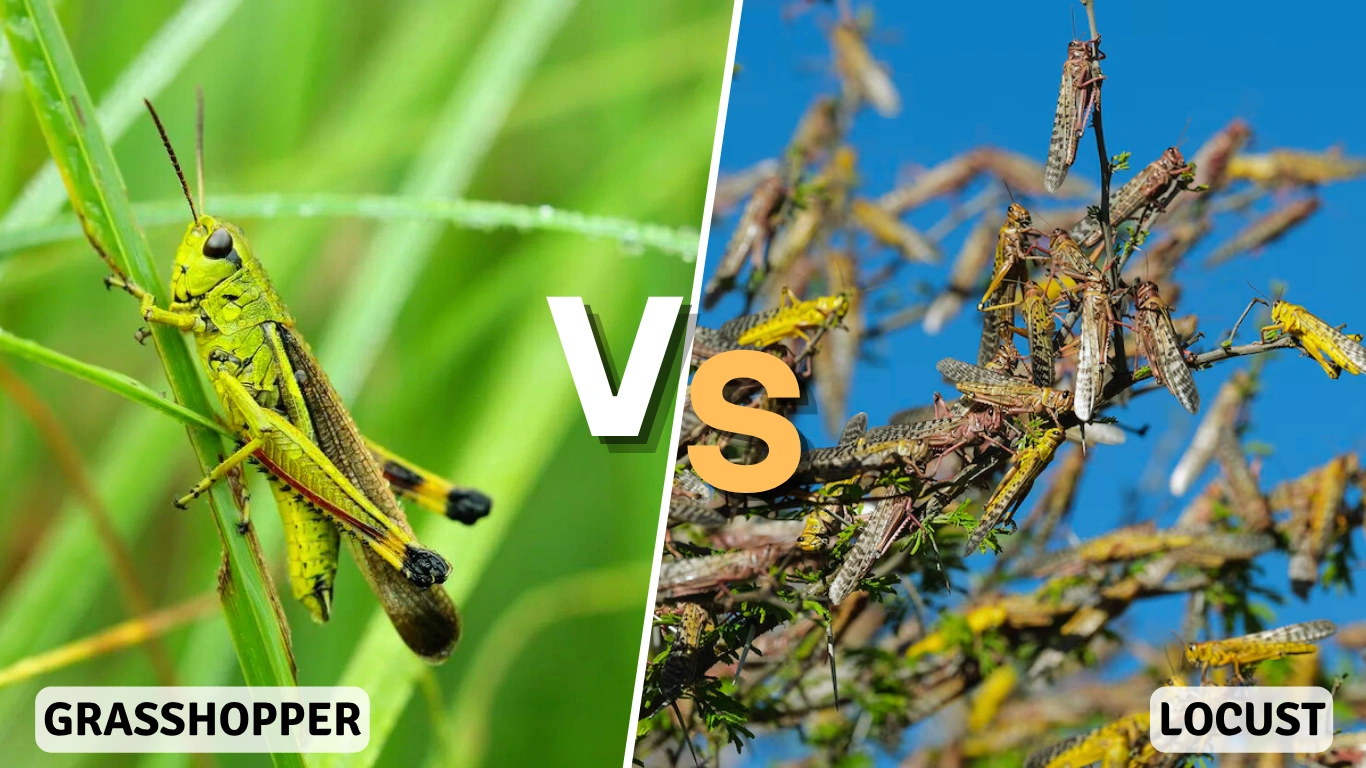
Grasshoppers and locusts are often confused because they look almost identical and belong to the same insect family, Acrididae. However, despite their similar appearance, they are not the same. The key difference lies in their behavior, especially how they react to environmental conditions. While grasshoppers are solitary insects, locusts can transform into aggressive, swarming pests that devastate crops and ecosystems. This article will help you clearly identify the differences between grasshoppers and locusts, with detailed descriptions and pictures for easy recognition.
Grasshopper vs Locust – Quick Comparison Table
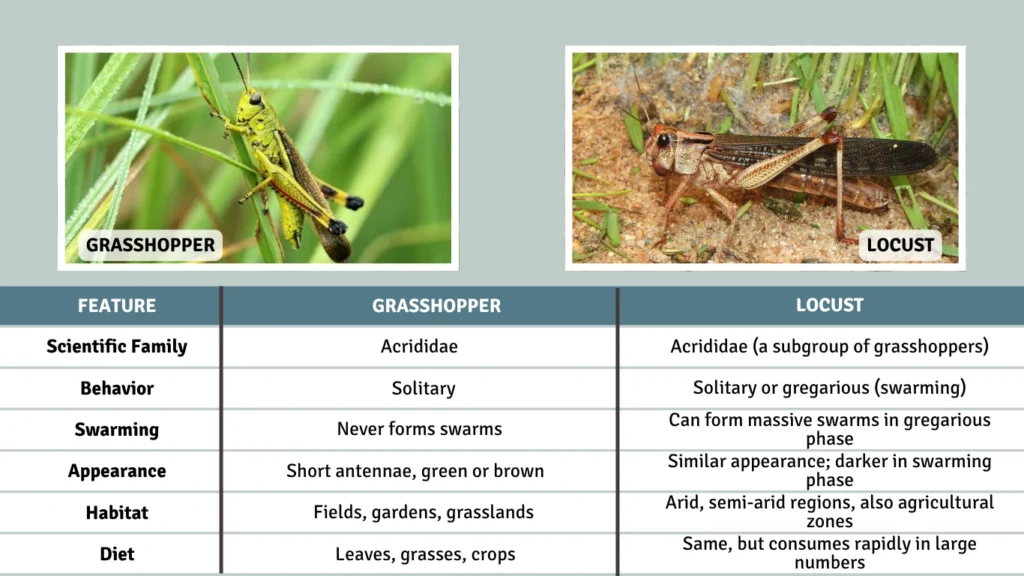
| Feature | Grasshopper | Locust |
| Scientific Family | Acrididae | Acrididae (a subgroup of grasshoppers) |
| Behavior | Solitary | Solitary or gregarious (swarming) |
| Swarming | Never forms swarms | Can form massive swarms in gregarious phase |
| Appearance | Short antennae, green or brown | Similar appearance; darker in swarming phase |
| Habitat | Fields, gardens, grasslands | Arid, semi-arid regions, also agricultural zones |
| Diet | Leaves, grasses, crops | Same, but consumes rapidly in large numbers |
| Migration | No migration | Migratory in swarming phase |
| Impact on Agriculture | Local crop damage | Widespread crop devastation |
What Is a Grasshopper?

Grasshoppers are common insects found around the world in grassy areas, fields, and gardens. They’re best known for their powerful hind legs that allow them to jump long distances. Most species live solitary lives and are active during the day.
Identification Features
Grasshoppers come in a variety of green, brown, or tan shades that help them blend into vegetation. They have:
- Short antennae
- Two pairs of wings (hind wings are large and folded under the front)
- Strong hind legs for jumping
- Straight body with visible thorax segments
They do not exhibit drastic behavioral changes based on population density, which is one major difference from locusts.
What Is a Locust?

Locusts are technically a type of grasshopper. What sets them apart is their ability to change behavior and form in response to environmental conditions—especially crowding and food availability. This transformation is known as phase polymorphism.
Identification Features
Locusts in their solitary phase look and behave like regular grasshoppers. But in the gregarious (swarming) phase, they:
- Grow larger and darker
- Develop longer wings
- Become highly mobile and sociable
- Multiply rapidly and form huge migrating groups
These changes can happen within a generation, meaning a harmless locust population can turn into a swarm within weeks.
Key Differences Between Grasshopper and Locust
1. Behavior and Social Structure
Grasshoppers are solitary and do not form groups. They live alone or in small scattered populations, feeding on nearby vegetation. In contrast, locusts can shift into a gregarious phase where they become highly social and form massive swarms. These swarms can include millions or even billions of insects moving together across large regions.
2. Physical Appearance
In their solitary state, locusts and grasshoppers look alike. But during the gregarious phase, locusts:
- Develop longer wings
- Darken in color (often brown, yellow, or black tones)
- Appear more robust
- Fly farther and more efficiently than grasshoppers
These changes support their long-distance migration and intense feeding behavior.
3. Swarming and Migration
This is one of the most dramatic differences. Grasshoppers do not swarm. Locusts, when triggered by environmental factors like heavy rainfall followed by vegetation growth, can switch into swarm mode. Swarming locusts:
- Fly long distances (over 100 km/day)
- Destroy crops, grasses, and trees
- Cover entire regions across continents
Famous examples include desert locust swarms that devastated East Africa and Asia.
4. Environmental Triggers
Grasshoppers remain solitary regardless of food or weather conditions. Locusts, however, respond to crowding, humidity, and abundant food by releasing serotonin in their brains, which triggers changes in body structure and behavior. In just a few generations, solitary locusts can produce gregarious offspring ready to swarm.
5. Agricultural Impact
Grasshoppers cause localized crop damage, chewing through leaves, flowers, and stems in gardens or fields. However, the scale is generally manageable.
Locusts, especially in swarms, can eat thousands of tons of crops per day, leading to severe food shortages, economic losses, and environmental disruption. They are among the most feared pests in agriculture.
Pictures for Visual Identification

Include the following labeled images in your article for clarity:
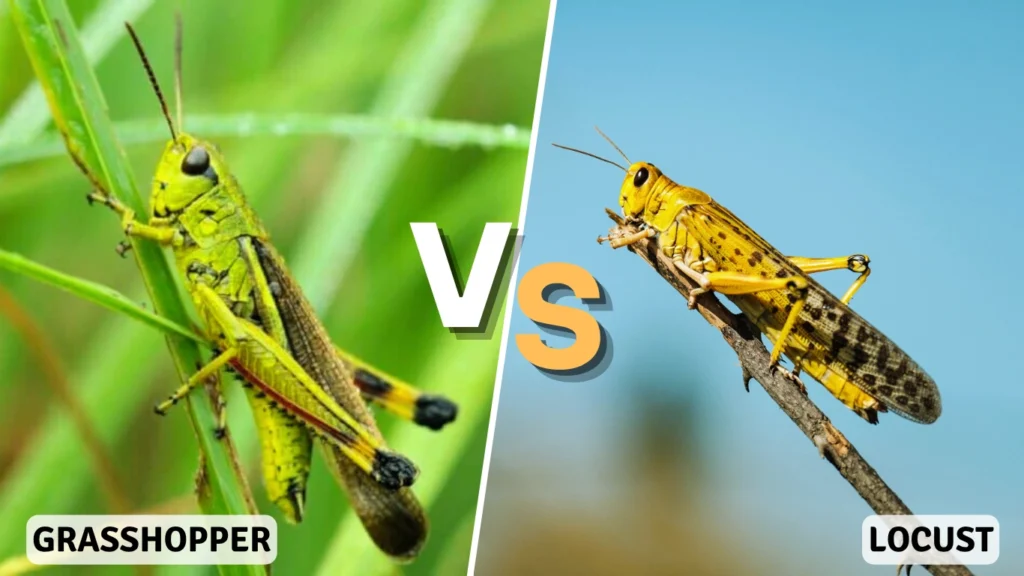
- Grasshopper (solitary) – sitting on a leaf, green or brown color
- Solitary Locust – similar to grasshopper, but slight difference in wing length
- Swarming Locust – group in flight or crawling on crops, darker color
- Side-by-side comparison – highlighting antenna length, wing size, body color
- Locust damage – field before and after a locust swarm
Images make it easier for readers, especially farmers and gardeners, to visually identify and prepare for potential locust invasions.
Why It’s Important to Know the Difference
Understanding the difference between grasshoppers and locusts isn’t just about identification—it’s about action. These insects may look similar, but their behaviors and risks are vastly different.
For Farmers and Gardeners
Being able to spot a potential locust outbreak early can help in launching control measures before swarms form. Farmers need to monitor for signs of crowding and shifting behavior. On the other hand, dealing with grasshoppers usually involves localized pest control strategies like neem oil, row covers, or traps.
For Students and Enthusiasts
Learning how a simple grasshopper can evolve into a region-destroying locust demonstrates one of the most fascinating examples of insect adaptation. It also underscores the importance of ecological balance and monitoring insect populations.
FAQs
1. Are all locusts grasshoppers?
Yes, all locusts are a type of grasshopper within the Acrididae family. However, not all grasshoppers are locusts. Only certain species have the ability to shift into a swarming, gregarious phase.
2. What makes a grasshopper turn into a locust?
Crowding, increased contact with other grasshoppers, high humidity, and plentiful food can trigger biochemical changes in some grasshopper species. These changes cause them to transform into locusts capable of swarming.
3. Can locusts be found in the United States?
Yes, locust swarms have historically occurred in the U.S., such as the Rocky Mountain locust. However, most of the large swarming locust species are now found in Africa, the Middle East, and parts of Asia.
4. Do locusts and grasshoppers eat the same things?
Both eat grasses, leaves, and crops, but locusts do it in massive numbers. While grasshoppers may nibble on plants here and there, a locust swarm can strip entire fields bare in a matter of hours.
5. How do I know if I’m seeing a locust or grasshopper?
Check the behavior first. If it’s alone, it’s likely a grasshopper or solitary locust. If there are large numbers moving together, especially if they’re darker and more active, you are likely witnessing a locust group forming or already swarming.
