

Mosquito eaters, often called crane flies, are one of the most misunderstood insects. Their long, fragile legs and mosquito-like appearance cause many people to assume they are giant mosquitoes that feed on smaller ones. Some even believe these insects play a role in controlling mosquito populations. But is there any truth to this belief? Do mosquito eaters actually eat mosquitoes, or is this just a myth? In this article, we’ll explore their diet, role in nature, lifespan, and the real reason they’re called mosquito eaters.
What Are Mosquito Eaters?
Mosquito eaters are not mosquitoes at all—they are crane flies, belonging to the family Tipulidae. These insects can be identified by their:
- Slender bodies resembling oversized mosquitoes.
- Extremely long, delicate legs that break off easily.
- Wings that often make them clumsy fliers indoors.
Because of their appearance, many people mistake them for giant mosquitoes. However, crane flies do not have piercing mouthparts and cannot bite humans or animals.
Do Mosquito Eaters Eat Mosquitoes?

This is one of the most common questions people ask—and the answer is no. Despite their misleading name, mosquito eaters do not eat mosquitoes at any stage of their life cycle.
- Adults: Most crane flies do not feed at all during their short adult lifespan. A few species sip nectar, but they do not hunt insects.
- Larvae: Known as leatherjackets, the larvae live in soil and feed on roots, decaying vegetation, and organic matter.
The myth likely originated because crane flies look like oversized mosquitoes, leading people to assume they prey on them. In reality, crane flies are harmless and have no role in mosquito control.
What Do Mosquito Eaters Eat?
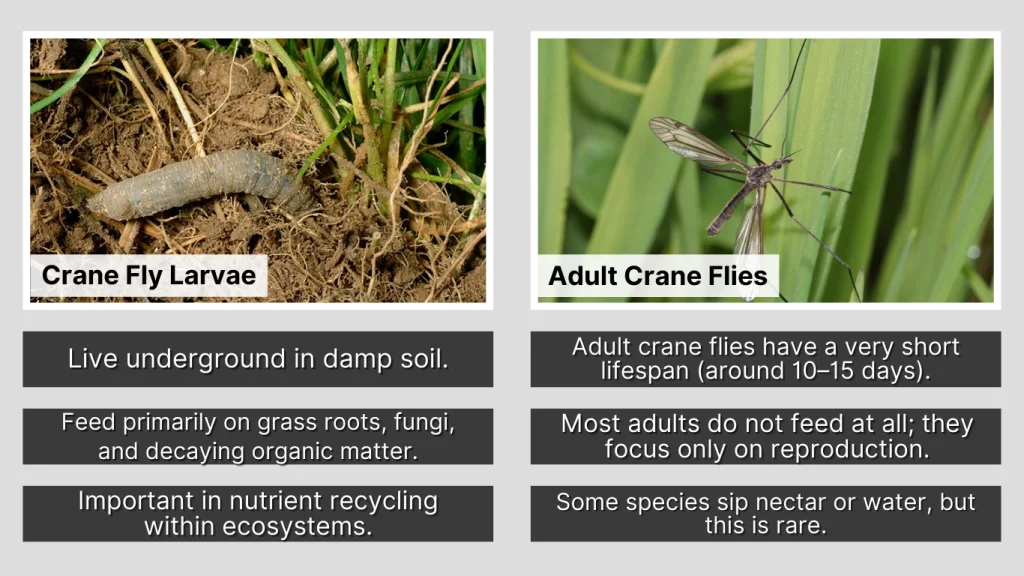
Even though crane flies don’t eat mosquitoes, they do have specific diets depending on their life stage.
Crane Fly Larvae (Leatherjackets)
- Live underground in damp soil.
- Feed primarily on grass roots, fungi, and decaying organic matter.
- Important in nutrient recycling within ecosystems.
- Sometimes considered agricultural pests when present in large numbers, as they damage turf and crops.
Adult Crane Flies
- Adult crane flies have a very short lifespan (around 10–15 days).
- Most adults do not feed at all; they focus only on reproduction.
- Some species sip nectar or water, but this is rare.
Thus, calling them “mosquito eaters” is misleading—they don’t eat mosquitoes, blood, or even humans.
Do Mosquito Eaters Bite Humans?
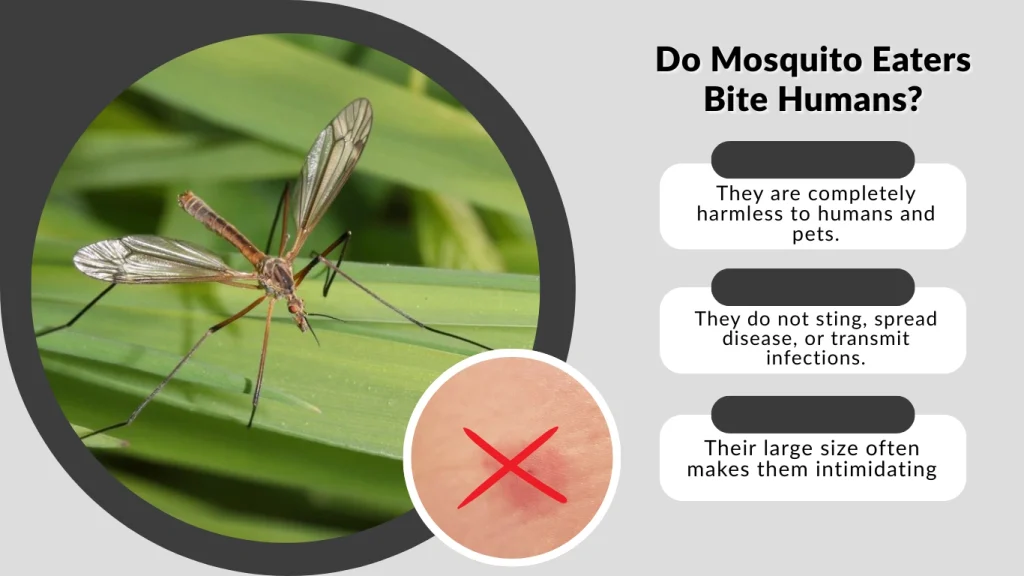
One of the most important facts to clarify is that mosquito eaters do not bite. Unlike mosquitoes, they do not have needle-like proboscises for sucking blood.
- They are completely harmless to humans and pets.
- They do not sting, spread disease, or transmit infections.
- Their large size often makes them intimidating, but they are fragile and pose no threat.
If you see a crane fly buzzing around your home, it’s likely just attracted to light rather than looking to bite.
Why Are They Called Mosquito Eaters?
The name “mosquito eater” comes from a misconception. Since crane flies resemble giant mosquitoes, people assumed they must eat smaller mosquitoes.
- Folklore and myths: Many cultures gave them this name, passing along the belief that they controlled mosquito populations.
- Scientific truth: No evidence supports the idea that crane flies prey on mosquitoes.
In some regions, they are also called “mosquito hawks”, further fueling the confusion. However, true mosquito predators include dragonflies, birds, and bats—not crane flies.
What Are Mosquito Eaters Good For?
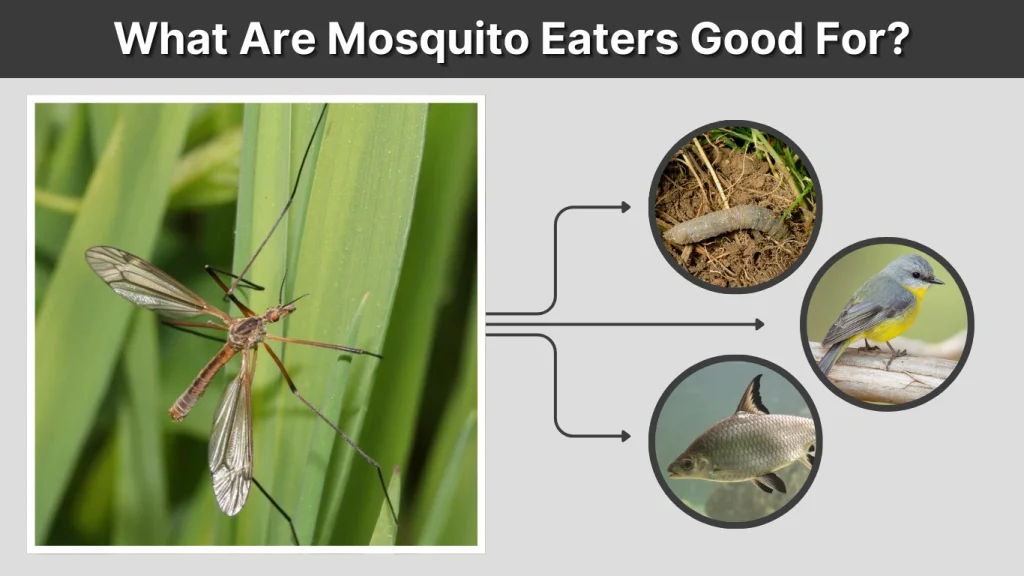
Even though crane flies don’t eat mosquitoes, they are not useless. They play several important roles in nature:
Soil aeration: Their larvae help aerate the soil, improving its structure.
Nutrient recycling: By feeding on decaying matter, they enrich the soil with nutrients.
Food source: Birds, amphibians, fish, and other predators rely on crane flies and their larvae as a nutritious food source.
While they may seem annoying when flying indoors, they are valuable contributors to natural ecosystems.
How Long Do Mosquito Eaters Live?
The lifespan of a mosquito eater varies depending on its life stage:
- Larvae: Can live several months in the soil. This is the longest part of their life cycle.
- Pupae: Lasts a few weeks before emerging as adults.
- Adults: Survive only 10–15 days, sometimes less.
Because their adult life is so short, crane flies spend most of their existence underground as larvae, feeding and growing.
What Do Mosquito Eaters Do?
Even though they don’t eat mosquitoes, mosquito eaters (crane flies) still have a role to play in their environment.
- In the larval stage, they help break down organic matter and recycle nutrients into the soil. This process improves soil fertility.
- As adults, their main purpose is reproduction. They mate shortly after emerging and lay eggs in moist soil, starting the next generation.
- In food chains, both larvae and adults serve as prey for birds, fish, amphibians, and small mammals.
So, while they don’t actively hunt mosquitoes, their presence supports ecological balance in other ways.
Mosquito Eater vs Mosquito

Since crane flies are often confused with mosquitoes, here’s how they compare.
Physical Comparison
- Crane flies: Large, fragile insects with very long legs, slender bodies, and clumsy flight.
- Mosquitoes: Smaller, more agile, with shorter legs and distinct piercing mouthparts.
Feeding Habits
- Crane flies: Do not suck blood. Adults may sip nectar or not eat at all.
- Mosquitoes: Female mosquitoes require blood to produce eggs; males feed on nectar.
Life Cycle Differences
- Mosquitoes: Egg → larva (wriggler) → pupa → adult.
- Crane flies: Egg → larva (leatherjacket) → pupa → adult.
- Both insects have aquatic or soil-based larvae, but their diets are completely different.
This comparison shows why they are often mistaken for one another—but their biology and behavior are not alike.
Mosquito Hawks – Another Name Confusion
In many regions, crane flies are also called mosquito hawks. This adds to the myth that they feed on mosquitoes, since “hawk” suggests they prey on other insects.
However, the term “mosquito hawk” is misleading:
- True mosquito predators include dragonflies, sometimes also called mosquito hawks, because they genuinely hunt and eat mosquitoes.
- Crane flies do not hunt at all; the nickname is simply a case of mistaken identity.
What Eats Mosquitoes (If Not Mosquito Eaters)?
If mosquito eaters don’t reduce mosquito numbers, then who does? Several natural predators play this role:
- Dragonflies: Both nymphs and adults eat large numbers of mosquitoes.
- Birds: Swallows, purple martins, and other insectivorous birds feed on mosquitoes.
- Fish: Species like guppies and mosquito fish eat mosquito larvae in water.
- Bats: Consume many flying insects at night, including mosquitoes.
- Frogs and amphibians: Some tadpoles and adult frogs also eat mosquito larvae.
These predators are far more important in mosquito control than crane flies.
What Do Crane Flies Eat? (Clarified)
To clear up confusion once and for all:
- Larvae (leatherjackets): Eat roots, grasses, algae, and decaying matter in soil.
- Adults: Mostly do not feed; some sip nectar or water.
Their diet has nothing to do with mosquitoes. Instead, they contribute to ecosystems as decomposers and as a food source for other animals.
FAQs
Are mosquito eaters dangerous?
No, mosquito eaters are harmless. They do not bite, sting, or spread diseases.
Why do mosquito eaters come into houses?
They are strongly attracted to light, which is why they often fly around lamps or windows at night.
Do mosquito eaters reduce mosquito populations?
No. They do not eat mosquitoes or control their numbers. This is a common myth.
What’s the difference between a crane fly and a giant mosquito?
Crane flies are larger but fragile and harmless. Giant mosquitoes do not exist; mosquitoes are much smaller.
Should I kill mosquito eaters?
There’s no need. They do not harm humans, and they play a small role in the ecosystem as decomposers and prey for other animals.
