
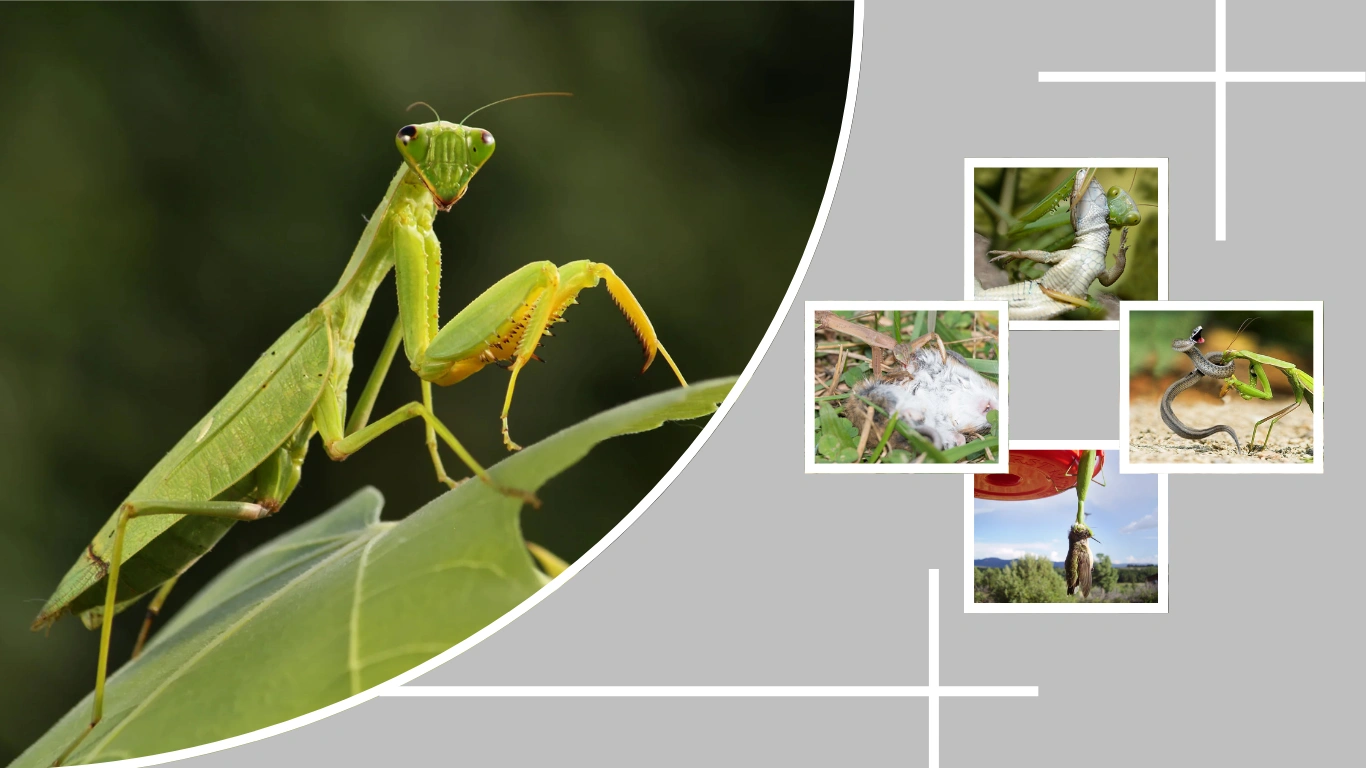
Praying mantises are best known for eating insects, but their hunting skills go far beyond flies and crickets. Shocking footage and scientific records have shown mantises attacking and consuming lizards, snakes, birds, and even baby mice.
These rare but real events raise questions about the mantis’s strength, strategy, and appetite. In this article, we explore whether these predators truly eat such animals, how often it happens, and what it reveals about one of nature’s most unexpected hunters.
Do Praying Mantises Eat Lizards?

Yes, praying mantises have been observed eating small lizards, particularly hatchlings or tiny geckos. These incidents are rare and usually involve larger mantis species such as the Chinese mantis (Tenodera sinensis) or the Giant Asian mantis (Hierodula membranacea). In such cases, the mantis uses its powerful, spiked forelegs to grab the lizard—usually by the head or neck—and slowly begins consuming it alive.
These attacks generally occur when the lizard is resting or distracted, giving the mantis a clear opportunity to strike. Although lizards are not a regular part of their diet, mantises are opportunistic predators, and when the right chance presents itself, they take it—even if it means eating a vertebrate.
Do Praying Mantises Eat Snakes?

Incredibly, yes. There have been multiple documented cases and videos of praying mantises eating snakes—specifically small, slender species like juvenile garter snakes or hatchlings. These events are extremely rare and usually only occur with large mantises, measuring 4 to 6 inches in length.
The mantis typically ambushes the snake, latching onto its head with its raptorial forelegs and beginning to feed on the brain or neck region. These encounters can last for several minutes, and in most cases, the snake does not escape. While this isn’t common behavior, it highlights the remarkable strength and precision mantises have, even against prey that most would assume is beyond their capability.
Do Praying Mantises Eat Birds?
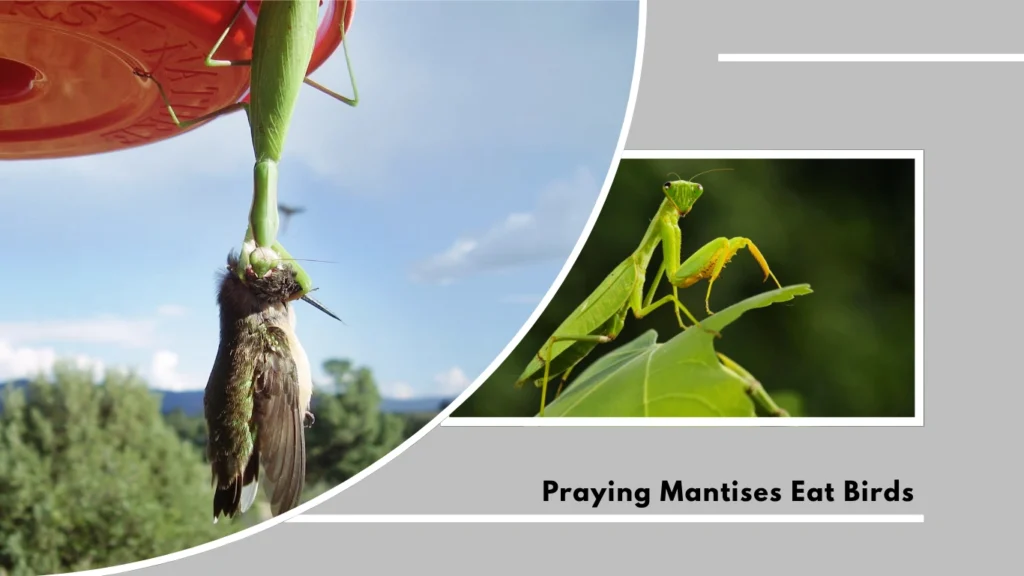
Yes, though shocking, praying mantis eating bird incidents have been scientifically documented—most notably involving hummingbirds. A 2017 study in The Wilson Journal of Ornithology recorded over 140 confirmed cases of mantises attacking birds, especially around hummingbird feeders.
These attacks occur when mantises perch on or near feeders, waiting for birds to hover within striking distance. Once close enough, the mantis grabs the bird by the neck or head and holds it in place, feeding on it while the bird is still alive. Most attacks involve species like the Chinese mantis and target smaller birds. Though rare, the fact that these encounters occur naturally makes the praying mantis one of the few insects capable of killing birds.
Do Praying Mantises Eat Mice?

While extremely rare, there are isolated cases—mostly in controlled or captive environments—where a praying mantis has eaten a baby mouse, also known as a pinky mouse. These videos often involve very large mantis species and carefully controlled conditions where the mouse is small, immobile, or newly born.
In nature, this is highly unlikely due to the size, strength, and mobility of even juvenile mice. However, the few recorded cases prove that mantises are capable of subduing small vertebrates when given the opportunity. Still, mice are not a natural or preferred food source for mantises and should not be introduced into their diet in captivity for ethical and safety reasons.
How Do Praying Mantises Kill and Eat Larger Prey?
Praying mantises are built for ambush. They have long, spiked raptorial forelegs designed to grab and hold prey with incredible strength. Their binocular vision allows them to judge distance precisely, and they strike with lightning-fast reflexes.
Once the mantis catches its prey—whether it’s an insect or a bird—it holds it tightly while using its strong mandibles to chew through flesh. When attacking large prey like hummingbirds, snakes, or lizards, they usually begin feeding at the head or neck. This immobilizes the prey and gives the mantis time to consume it over several minutes, sometimes while the prey is still alive. Their ability to stay completely still and strike at the perfect moment is key to their success.
Which Mantis Species Are Capable of Eating Large Prey?
Not all praying mantises can handle large or vertebrate prey. This behavior is mostly limited to larger, stronger species, including:
- Chinese mantis (Tenodera sinensis) – One of the largest and most documented species for extreme predation
- Giant Asian mantis (Hierodula membranacea) – Known for its size, strength, and occasional predation on small vertebrates
- African mantis (Sphodromantis spp.) – Aggressive and robust, capable of overpowering larger insects and occasionally more
- Devil’s flower mantis (Idolomantis diabolica) – While visually striking, they’re also strong and can attack sizable prey
Should You Be Concerned If You See a Praying Mantis in Your Garden?
In general, praying mantises are beneficial predators for gardens and natural spaces. They feed on a wide range of insects, including pests like aphids, grasshoppers, and caterpillars. However, they are not selective—they may also eat pollinators such as bees, butterflies, or even small birds like hummingbirds if feeders are nearby.
If you keep hummingbird feeders, it’s a good idea to check them regularly for lurking mantises. Relocate any mantis perched nearby to another area of your garden. While these ambush attacks are rare, they can occur, especially in late summer when mantises reach full size and feeders are active.
So, while you don’t need to fear them, a little awareness and observation can help protect your smaller wildlife visitors.
FAQs
1. Do praying mantises really eat lizards and snakes?
Yes. Though rare, larger mantis species have been observed eating small lizards and baby snakes. These attacks have been captured in videos and scientific reports.
2. Can praying mantises kill birds?
Yes, particularly small birds like hummingbirds. Over 140 incidents have been documented, mostly near feeders where birds hover and are easier to ambush.
3. Do all mantises eat animals like snakes or mice?
No. Only the largest mantis species are capable of attacking and eating small vertebrates. Most mantises feed exclusively on insects.
4. Why do praying mantises eat such large prey?
Mantises are opportunistic predators. If a prey item is within reach and the mantis can overpower it, they will take the chance—even if it’s unusually large.
5. Are mantises dangerous to humans or pets?
No. While they are skilled hunters, mantises pose no threat to humans or larger animals. Their hunting is strictly focused on manageable prey.
Conclusion
The praying mantis may be best known for eating insects—and even its own kind—but it turns out this stealthy predator has a much more powerful appetite than most people realize. From birds and lizards to snakes and even baby mice, the praying mantis proves to be one of nature’s most surprising and versatile hunters.
