
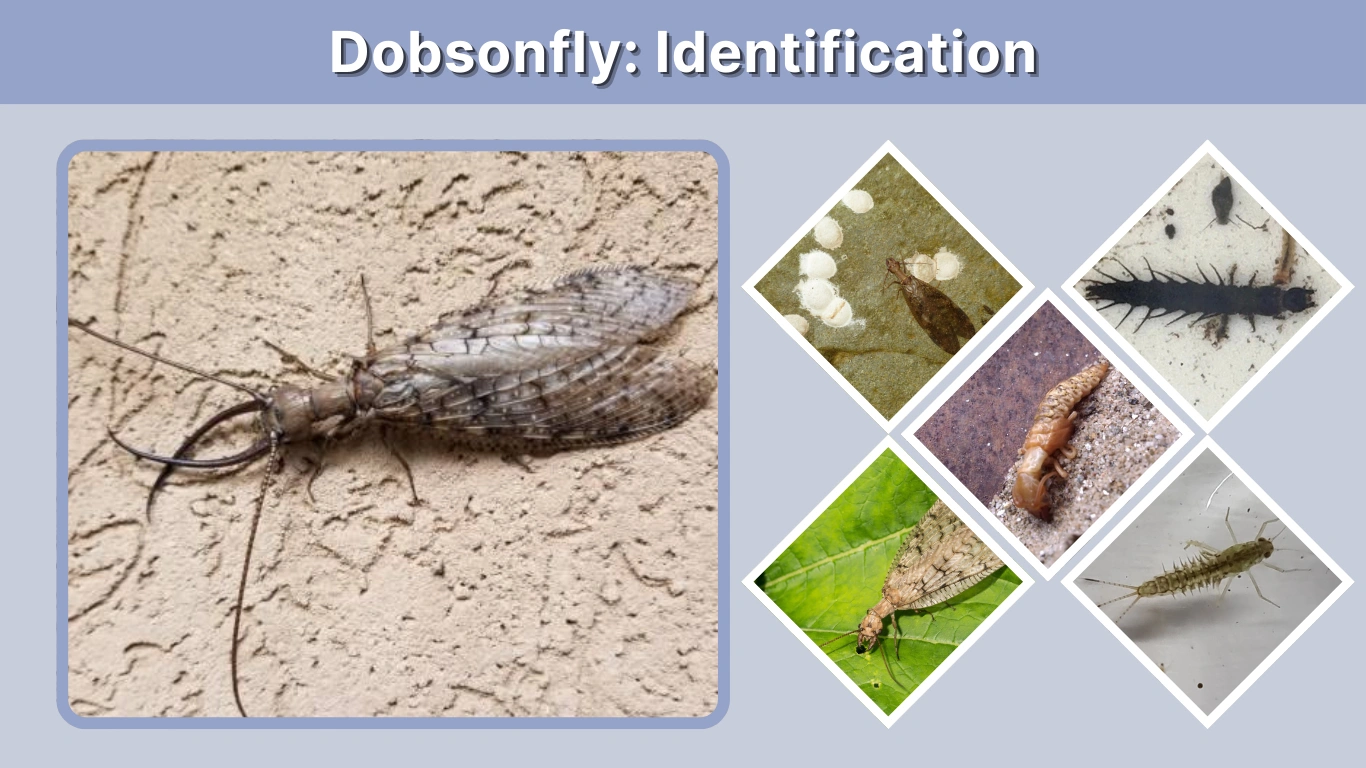
Dobsonflies are large, prehistoric-looking insects best known for their long wings and, in males, dramatically curved mandibles. They are closely tied to freshwater environments and spend most of their lives underwater as fierce larvae called hellgrammites. Although their appearance can seem frightening, dobsonflies are not dangerous and play an important ecological role. Understanding their identification, life cycle, larvae, and physical traits helps explain why these insects are both fascinating and valuable indicators of clean, healthy waterways.
Dobsonfly Identification
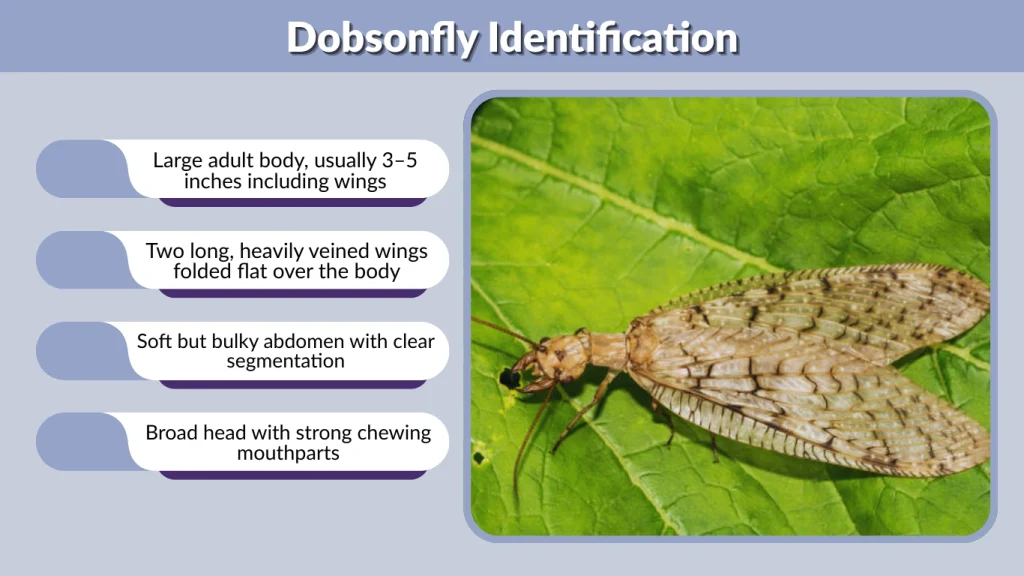
Dobsonflies belong to an ancient group of insects and can be recognized by their size, wing structure, and distinctive head features. Correct identification is important because they are often confused with fishflies, alderflies, or even dragonflies.
- Scientific classification: Order Megaloptera, Family Corydalidae
- Large adult body, usually 3–5 inches including wings
- Two long, heavily veined wings folded flat over the body
- Soft but bulky abdomen with clear segmentation
- Broad head with strong chewing mouthparts
- Long antennae and prominent compound eyes
- Males with extremely elongated, curved mandibles
Physical Appearance and Size
Dobsonflies are among the largest non-stinging insects found near freshwater systems. Adults typically range from 2.5 to 5 inches in length when the wings are included. Their wings are long, smoky, and densely veined, giving them a net-like appearance when viewed up close. At rest, the wings lie flat over the body, extending well past the abdomen.
Coloration varies from yellow-brown to dark brown or nearly black, helping them blend into tree bark, rocks, and riverbank debris. Their bodies are soft compared to beetles but appear heavy and thick, which contributes to their intimidating look. The head is broad, with powerful jaws and long, threadlike antennae that extend forward.
One of the most striking features is their overall “ancient” appearance. Dobsonflies resemble insects from prehistoric times due to their large wings, slow movements, and rugged body structure. This unusual look often causes people to mistake them for dangerous or aggressive insects, even though they are generally harmless when left undisturbed.
Male vs Female Dobsonfly

Male Dobsonfly
Male dobsonflies are famous for their long, sickle-shaped mandibles, which can be nearly as long as their entire head. These jaws look threatening but are actually weak and are used mainly during mating displays to grasp females or compete with other males. Males are unable to bite humans effectively and pose no real threat.
Despite their dramatic appearance, male dobsonflies are fragile insects. Their mandibles are more like ornaments than weapons, making them better suited for courtship than defense.
Female Dobsonfly
Female dobsonflies have much shorter mandibles, but they are thicker and far more powerful. While females are not aggressive, they can deliver a noticeable pinch if handled roughly. Their jaws are used for gripping surfaces, protecting themselves, and manipulating egg-laying sites.
Females are also slightly heavier-bodied than males, as their primary adult function is reproduction. After mating, they search for suitable locations near water to lay clusters of eggs on rocks, vegetation, or man-made structures.
Dobsonfly Life Cycle Overview
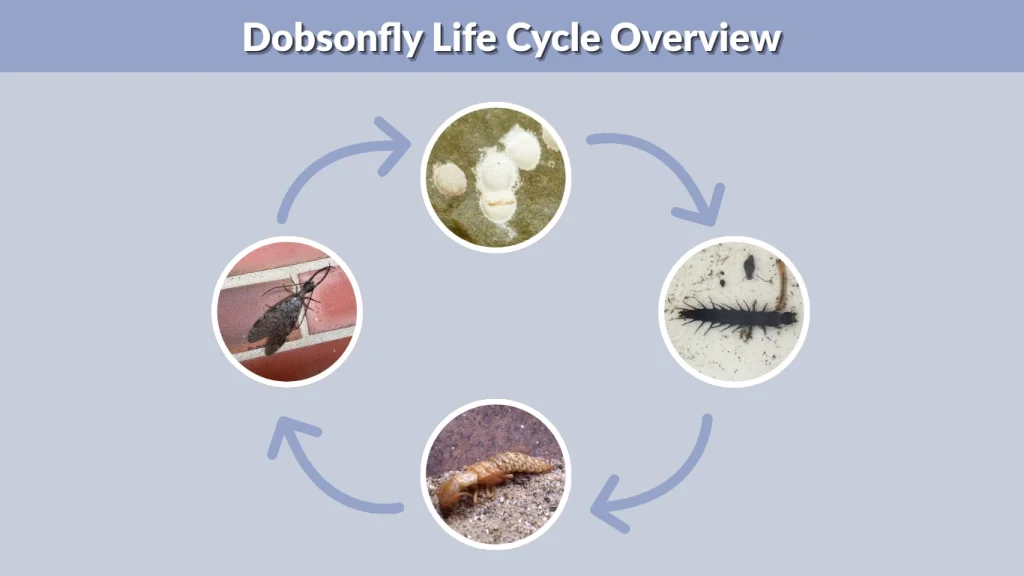
Dobsonflies undergo complete metamorphosis, meaning they pass through four distinct stages: egg, larva, pupa, and adult. Unlike butterflies or beetles, however, the majority of their life is spent underwater as larvae. The adult stage is brief and focused almost entirely on reproduction.
Egg Stage
Female dobsonflies lay hundreds to thousands of eggs in compact masses on surfaces close to rivers and streams. These eggs are often coated in a chalky or white protective layer that helps prevent drying and reduces the risk of parasites. After one to two weeks, the tiny larvae hatch and drop or crawl into the water below.
Larval Stage (Hellgrammite)
The larval stage is the longest and most important phase of a dobsonfly’s life. Hellgrammites live in fast-moving, oxygen-rich streams, hiding under rocks and debris. They may remain in this stage for one to three years, molting several times as they grow. During this period, they develop strong jaws, armored bodies, and lateral filaments that help them survive in turbulent water.
Pupal Stage
When fully grown, the larva leaves the water and burrows into moist soil or hides beneath logs and stones along the bank. There it forms a pupa, undergoing a dramatic internal transformation. This stage usually lasts one to two weeks before the adult emerges.
Adult Stage
Adult dobsonflies live only a few days to a couple of weeks. They are weak fliers and mostly active at night. Their primary role is reproduction, after which the life cycle begins again.
Dobsonfly Larvae (Hellgrammites)
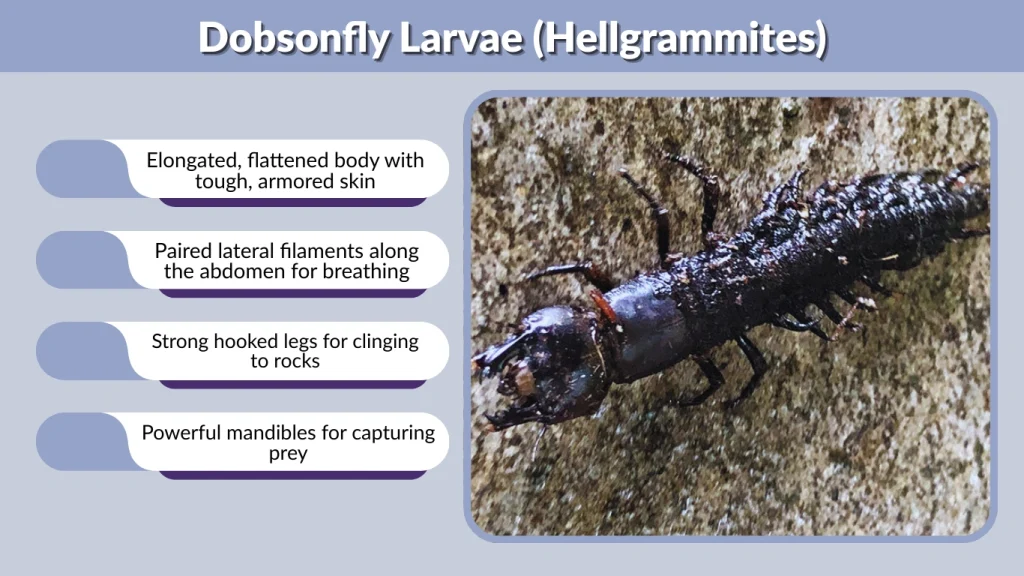
Hellgrammites are the aquatic larvae of dobsonflies and are far more commonly encountered than the adults. They are fierce predators and highly adapted to life in fast-flowing freshwater.
- Elongated, flattened body with tough, armored skin
- Paired lateral filaments along the abdomen for breathing
- Strong hooked legs for clinging to rocks
- Powerful mandibles for capturing prey
- Active hunters of aquatic insects, worms, and small organisms
- Widely used as fishing bait due to their toughness
- Can live underwater for up to three years
Habitat and Geographic Distribution
Dobsonflies are closely tied to freshwater ecosystems and are almost always found near clean, well-oxygenated rivers and streams. Their larvae require moving water with high oxygen levels, which is why dobsonflies are most common in rocky streams, forested creeks, and unpolluted river systems. Muddy, stagnant, or heavily polluted waters usually cannot support hellgrammite populations.
Geographically, dobsonflies are widely distributed but unevenly spread. They are most diverse in North and Central America, where many species inhabit mountainous and woodland watersheds. Some species are also found in South America, Asia, and parts of southern Africa. Adults rarely travel far from water, often resting on nearby trees, rocks, bridge walls, or buildings.
The presence of dobsonflies in an area often signals a healthy aquatic environment. Because their larvae are sensitive to pollution and oxygen depletion, they disappear quickly when water quality declines, making them valuable natural indicators of ecosystem condition.
Behavior and Activity Patterns
Adult dobsonflies are primarily nocturnal. During the day, they remain hidden on tree trunks, under leaves, or along shaded riverbanks. At night, they become active and are strongly attracted to artificial lights, which is why they are often seen on walls, porch lights, or street lamps near water.
Their flight is slow and heavy, and they are not agile in the air. Most adult movement involves short glides rather than long-distance travel. When disturbed, dobsonflies usually attempt to crawl away rather than attack.
Larval behavior is very different. Hellgrammites are aggressive underwater predators that cling tightly to stones and debris. They are territorial, quick to strike, and well adapted to resisting strong currents. When handled, larvae may bite defensively, which is why anglers treat them carefully.
Diet and Feeding Habits
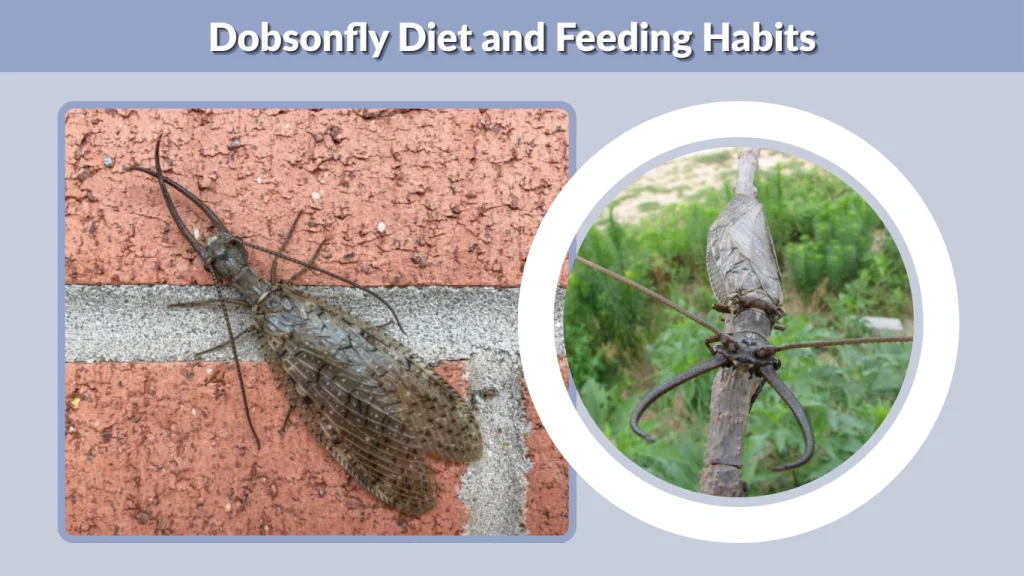
Dobsonfly larvae are carnivorous and highly active hunters. They feed on a wide variety of aquatic organisms, including mayfly nymphs, stonefly larvae, small crustaceans, worms, and even other hellgrammites. Using their powerful mandibles, they seize prey and drag it beneath rocks to consume it.
Their predatory lifestyle helps regulate insect populations in freshwater systems, preventing any one group from becoming overly dominant. This makes hellgrammites important stabilizers within stream food webs.
Adult dobsonflies, in contrast, feed very little or not at all. Their mouthparts are not well designed for sustained feeding, and their short lifespan is focused almost entirely on reproduction. Some adults may sip nectar or moisture, but they do not play a significant feeding role.
Dobsonfly Bite: Are They Dangerous?
Dobsonflies are not dangerous insects, despite their intimidating appearance. Males cannot effectively bite humans because their long mandibles are weak and poorly suited for pinching. Females, however, have shorter, stronger jaws and can bite if handled roughly.
A female dobsonfly bite can be painful and may break the skin, similar to a firm pinch. The bite is not venomous and rarely causes serious problems. Mild swelling, redness, or soreness may occur, but basic cleaning is usually sufficient.
Dobsonflies do not chase or attack people. Nearly all bites happen when someone tries to hold or squeeze the insect. Leaving them undisturbed eliminates any risk.
Ecological Importance
Dobsonflies play a vital role in freshwater ecosystems. As larvae, they are major predators within streams, helping control populations of smaller aquatic insects. This balance supports healthier and more diverse aquatic communities.
They are also an important food source. Fish, amphibians, birds, and other aquatic predators rely on hellgrammites as a nutritious meal. The adult insects, though short-lived, also become prey for bats, birds, and nocturnal hunters.
Perhaps most importantly, dobsonflies serve as bioindicators. Their presence suggests high water quality, good oxygen levels, and minimal pollution. Scientists and conservationists often use their populations to assess the health of rivers and streams.
Dobsonfly vs Similar Insects
Dobsonflies are often confused with other large, winged insects found near water. While they share some similarities, several clear differences exist.
- Dobsonfly vs Fishfly: Fishflies are smaller and lack the extremely long mandibles of male dobsonflies.
- Dobsonfly vs Alderfly: Alderflies are much smaller, darker, and have shorter wings.
- Dobsonfly vs Dragonfly: Dragonflies have upright resting wings, large eyes, and are agile fliers, unlike dobsonflies.
- Wing differences: Dobsonfly wings are long, soft, and heavily veined.
- Larval differences: Hellgrammites are bottom-dwelling predators, unlike many insect larvae that swim freely.
- Mandibles: Only male dobsonflies develop exaggerated curved jaws.
Interesting Facts About Dobsonflies
Dobsonflies belong to one of the oldest surviving insect groups, with fossil relatives dating back more than 200 million years. Their basic body design has changed very little, which explains their primitive appearance.
Despite their size, adult dobsonflies live extremely short lives. Some survive only a few days after emerging, spending nearly all their energy on mating and egg-laying.
Hellgrammites, however, are among the longest-lived aquatic insect larvae. Their extended underwater life allows them to grow slowly, develop strong armor, and become top predators in their environment.
FAQs
What is a dobsonfly?
A dobsonfly is a large aquatic insect from the family Corydalidae. It is known for its long wings and, in males, extremely elongated mandibles. Most of its life is spent underwater as a larva called a hellgrammite, living in clean, fast-moving streams.
Are dobsonflies harmful to humans?
Dobsonflies are not harmful. Males cannot bite effectively, and females only bite if handled. A female’s bite may be painful, but it is not venomous and rarely serious. Dobsonflies are not aggressive and do not attack people.
What is a hellgrammite?
A hellgrammite is the larval stage of a dobsonfly. It lives underwater in rivers and streams, hiding under rocks and preying on other aquatic insects. This stage can last one to three years and is essential to freshwater food webs.
Where do dobsonflies usually live?
Dobsonflies live near clean rivers, streams, and creeks. Their larvae are fully aquatic, while adults stay close to water sources. They are most common in forested or mountainous regions with well-oxygenated freshwater systems.
Why are dobsonflies important to ecosystems?
Dobsonflies help control aquatic insect populations, serve as food for fish and birds, and act as indicators of water quality. Their presence suggests a healthy freshwater environment with good oxygen levels and low pollution.
