
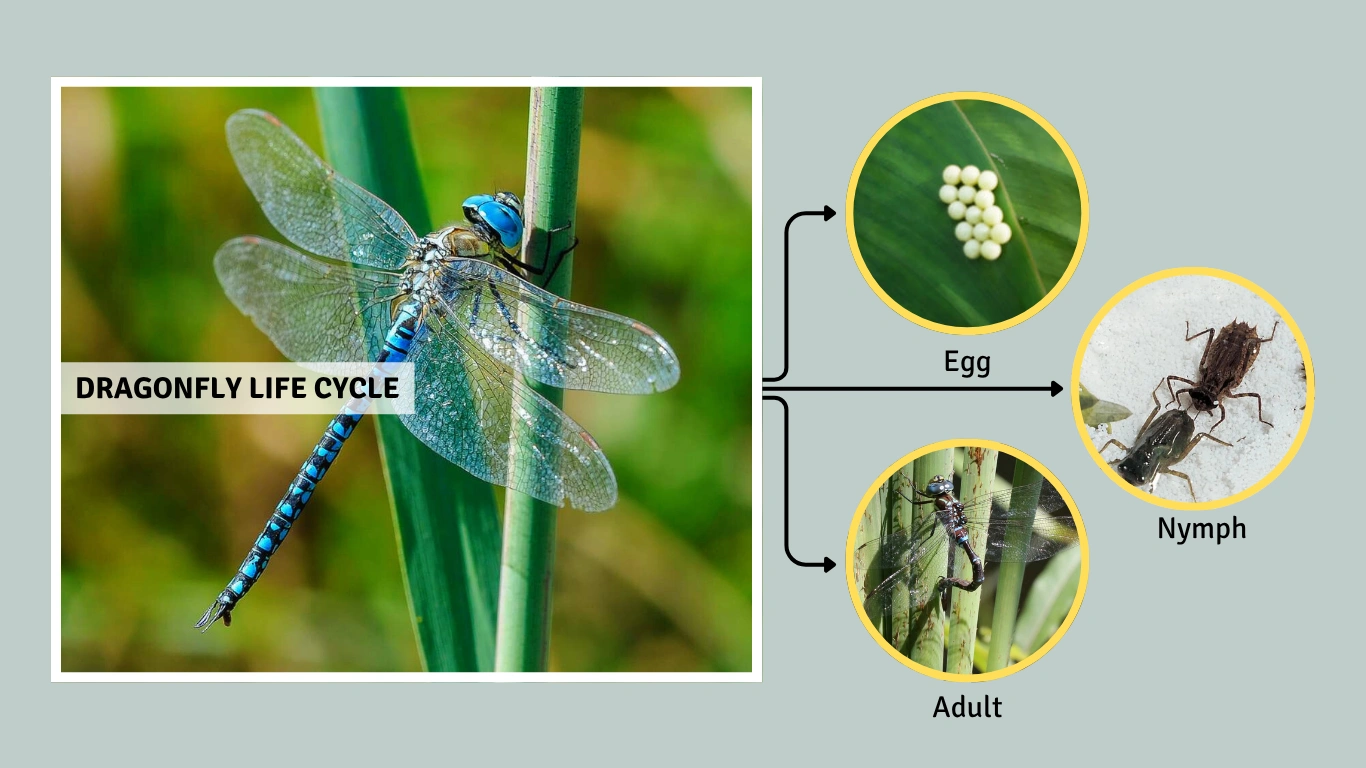
Dragonflies are more than just colorful insects darting through the air—they have one of the most fascinating life cycles in the insect world. Starting their journey underwater, dragonflies go through dramatic changes before becoming the fast-flying adults we see in our gardens and ponds. In this guide, we’ll explore the full dragonfly life cycle, from eggs to nymphs to adults, along with fun facts, lifespan details, diagrams, and tips for kids and curious learners.
What Is the Life Cycle of a Dragonfly?
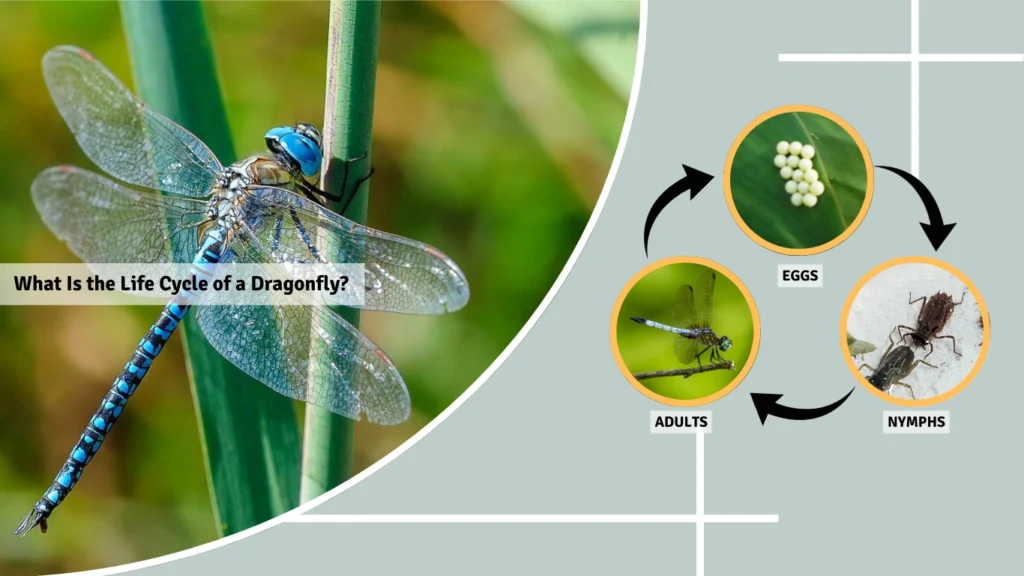
Dragonflies go through incomplete metamorphosis, meaning they don’t have a pupal stage like butterflies. Instead, their life unfolds in three main stages: egg, nymph (larva), and adult. This simple yet fascinating transformation starts in water and ends in the air. Each stage plays a crucial role in the dragonfly’s survival, growth, and ability to reproduce.
Overview of Metamorphosis
- Dragonflies undergo hemimetabolous development (incomplete metamorphosis).
- The three stages are: Egg → Nymph → Adult.
- There’s no cocoon or chrysalis like in butterflies.
- Nymphs live underwater and look nothing like adults.
Lifespan of a Dragonfly
Total lifespan: Can range from 6 months to 7 years, depending on the species.
Nymph stage: The longest phase, lasting months to several years.
Adult stage: Shorter, lasting a few weeks to several months.
Myth busted: Dragonflies do not live for only 24 hours—that’s a common misconception.
Stage 1 – Egg Stage

After mating, female dragonflies begin the life cycle by laying eggs. This happens either directly in water, on aquatic plants, or in mud near water bodies. Each female can lay hundreds of eggs in a single session, ensuring at least some offspring survive to the next stage.
Where Eggs Are Laid
- In still or slow-moving water: ponds, lakes, marshes, wetlands.
- Some lay on floating leaves or submerged stems.
- Others insert eggs into plant tissue using a sharp ovipositor.
How Long They Last
- Eggs typically hatch in a few days to a few weeks, depending on species and temperature.
- Warmer climates speed up development.
- Species like the Green Darner and Emperor Dragonfly show variations in egg-laying behavior.
Stage 2 – Nymph Stage (Larval Stage)

After hatching, dragonfly eggs release nymphs—aquatic larvae that look nothing like the winged adults. This stage is the longest and most active part of a dragonfly’s life. Nymphs are fierce underwater predators, equipped with extendable jaws to catch prey like mosquito larvae, tadpoles, and even small fish.
What Is a Dragonfly Nymph?
- Also called naiads, dragonfly nymphs are brown or greenish and blend into their aquatic environment.
- They have no wings, but do have extendable prehensile jaws for grabbing prey.
- Nymphs breathe through gills located inside their rectum and can even shoot water to propel themselves.
Nymph Stage Duration
- This stage can last from a few months to 5 years, depending on the species and climate.
- Some species, like the Baskettail Dragonfly, develop quickly, while others, such as the Green Darner, may remain in this stage for several years.
- The nymph will molt 8–17 times, shedding its skin as it grows.
Molting Process
- Each time the nymph grows, it sheds its exoskeleton in a process called molting.
- Before becoming an adult, the nymph will leave the water, cling to a plant, and undergo one final molt, emerging as a fully formed adult dragonfly.
Stage 3 – Adult Dragonfly
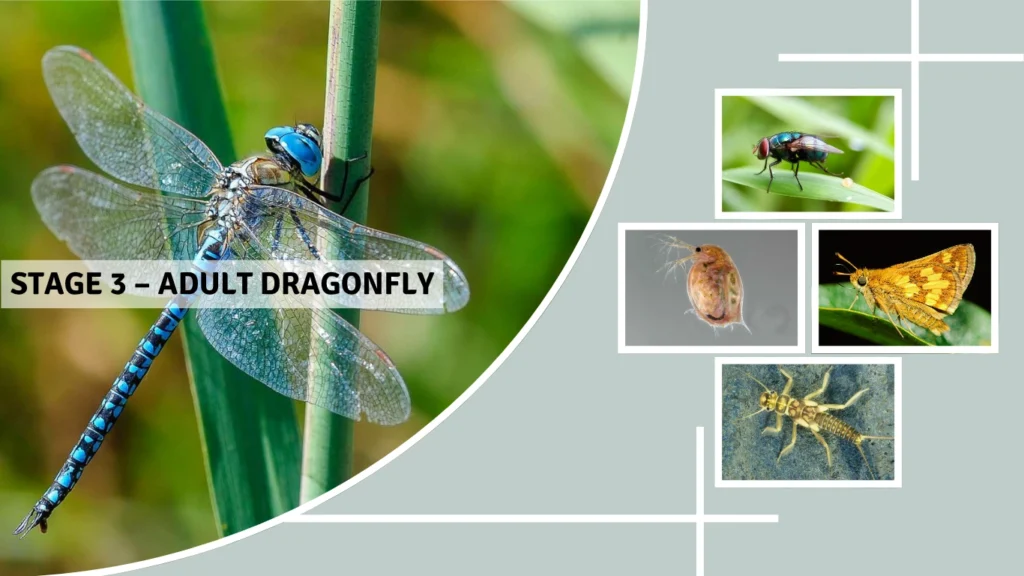
After the final molt, the dragonfly transforms into a flying adult. This stage is the most visible to us and is all about flight, feeding, and reproduction. Although short-lived compared to the nymph stage, adult dragonflies play a vital role in controlling insect populations and attracting mates.
Transformation to Adult
- The adult emerges from the exuvia (the shed skin) and rests while its wings and body expand and harden.
- This process can take a few hours, during which the dragonfly is vulnerable to predators.
- Once ready, it takes its first flight.
Behavior and Mating
- Adult dragonflies are strong flyers and aggressive hunters, feeding on mosquitoes, flies, and other small insects.
- Males are territorial, often seen chasing away rivals.
- Mating involves a “wheel” position, and females lay eggs shortly afterward to begin the cycle again.
Adult Lifespan
- Most adult dragonflies live from 1 to 8 weeks, though some may survive up to 6 months in mild climates.
- Factors affecting lifespan include weather, predation, and food availability.
- Species like the Flame Skimmer and Emperor Dragonfly show seasonal variations in their adult stage.
Dragonfly Life Cycle Diagram & Chart

Visual aids help make the dragonfly life cycle easier to understand—especially for kids and students. A simple diagram clearly shows the three main stages in order, helping to reinforce how dragonflies change from egg to nymph to adult.
Visual Explanation
A typical dragonfly life cycle diagram includes:
- Egg – laid in or near water
- Nymph – lives underwater, molts multiple times
- Adult – emerges with wings and begins flying, mating, and laying eggs
You can also find life cycle coloring pages, printable worksheets, and illustrated timelines for children. These are useful tools in classrooms and nature education.
Timeline Example
Here’s a general timeline of how long each stage might last:
| Stage | Timeframe | Notes |
| Egg | 1–3 weeks | Depends on species and temperature |
| Nymph | Several months–5 years | Longest stage, lives underwater |
| Adult | 1 week–6 months | Most visible stage, capable of flight |
Dragonfly Life Cycle Facts
Dragonflies have a life cycle full of surprises. Their unique biology and behaviors make them one of the most fascinating insects in the world. Here are some fun and educational facts that highlight their incredible journey.
Fun and Educational Facts
- Not just 24 hours: Adult dragonflies live much longer than a day—some live up to 6 months.
- Deadly hunters: Dragonfly nymphs are expert predators, using extendable jaws to snatch prey underwater.
- Jet-propelled escape: Nymphs can shoot water from their back end to escape predators—like built-in jetpacks.
- Ancient insects: Dragonflies have existed for over 300 million years and once had wingspans over 2 feet.
- Environmental indicators: The presence of dragonflies signals clean, unpolluted water, making them key indicators of ecosystem health.
Species Spotlights
Different dragonfly species have slightly varied life cycles based on climate, habitat, and behavior. Let’s take a closer look at a few well-known types that highlight unique features of the dragonfly life cycle.
Green Darner Dragonfly
- Habitat: Found across North America
- Unique Trait: Migratory species—adults fly south for winter, similar to birds
- Life Cycle Highlight: Some generations hatch in the north, mature, migrate south, and lay eggs that restart the cycle in spring
Emperor Dragonfly
- Habitat: Common in the UK and Europe
- Egg-laying: Females deposit eggs on floating or submerged plants
- Nymph Phase: Can last up to 2 years, especially in cooler climates
- Adult Stage: Large, vivid blue dragonflies seen patrolling ponds during summer
Flame Skimmer
- Habitat: Western United States
- Appearance: Bright red-orange with broad wings
- Life Cycle Trait: Eggs are laid in warm still water, and nymphs thrive in desert springs and ponds
Baskettail Dragonfly
- Habitat: North America
- Adult Flight Time: Very early in the spring
- Nymph Duration: Shorter development time compared to other species
- Name Origin: Females carry a visible egg mass, resembling a basket
Dragonfly Life Cycle for Kids
Learning about dragonflies can be exciting and educational for children. The dramatic transformation from water nymph to flying insect helps explain basic science concepts like metamorphosis and ecosystems.
Simplified Explanation for Kids
- Dragonflies go through 3 stages: Egg → Nymph → Adult
- They begin life underwater, where they stay for a long time
- Then they climb out, shed their skin, and fly as adults
- No cocoon like butterflies—they change directly from nymph to dragonfly!
Educational Activities
- Coloring Pages: Print diagrams showing each life stage
- Worksheets: Label the parts of a dragonfly and its life cycle stages
- Crafts & Games: Create life cycle wheels or draw each stage
- Best for: KS2 students (UK) or Grades 2–4 (US)
FAQs About Dragonfly Life Cycle
What are the stages in a dragonfly’s life cycle?
The dragonfly goes through three main stages: egg, nymph (larva), and adult. This is called incomplete metamorphosis, as there is no pupal stage like in butterflies.
How long do dragonflies live?
The total lifespan of a dragonfly can range from six months to seven years, depending on the species. Most of this time is spent in the nymph stage, living underwater.
Do dragonflies live for only 24 hours?
No, that is a myth. While some insects like mayflies live for just a day, dragonflies live much longer. Adult dragonflies usually survive from a few weeks to several months.
What is the nymph stage in dragonflies?
The nymph is the underwater stage of a dragonfly’s life. It hunts small aquatic creatures, grows by molting multiple times, and eventually crawls out of the water to become an adult.
How do dragonflies lay eggs?
Female dragonflies lay eggs in or near water—either on aquatic plants, in the water, or sometimes in mud. The eggs hatch into nymphs and start the life cycle all over again.
