

The eastern tiger swallowtail caterpillar is one of the most striking caterpillars found in North America. Famous for its bright green body and large false eye spots, it often looks more like a tiny snake than an insect. This caterpillar is the larval stage of the eastern tiger swallowtail butterfly, a large yellow-and-black species commonly seen in gardens and woodlands. Beyond its appearance, the eastern tiger swallowtail caterpillar plays an important ecological role by supporting healthy pollinator populations.
What Is an Eastern Tiger Swallowtail Caterpillar?
The eastern tiger swallowtail caterpillar is the juvenile form of Papilio glaucus, a butterfly species native to eastern North America. During this stage of life, the insect’s main purpose is to feed continuously and store energy for its upcoming transformation. Unlike adult butterflies, which feed on nectar, caterpillars consume leaves from specific host trees.
What makes this caterpillar especially interesting is how dramatically it changes as it grows. Newly hatched larvae look nothing like their later forms. Over time, they develop bright green coloring, bold markings, and defensive features that help them survive in open environments. These changes allow the caterpillar to remain visible on leaves while still being protected from many predators.
Identification of Eastern Tiger Swallowtail Caterpillar

Eastern tiger swallowtail caterpillars can be recognized by a combination of color, body shape, and unique defensive traits. Their appearance becomes more dramatic as they mature.
- Bright green body in later stages
- Thick, soft body divided into clear segments
- Large yellow-and-black false eye spots behind the head
- Dark “saddle” or band across the middle
- Small, hidden true head beneath the eye-spot area
- Orange, forked osmeterium that appears when threatened
A fully grown caterpillar may reach about two inches in length. When disturbed, it often raises the front of its body and pushes out the osmeterium, releasing a strong odor that repels ants, spiders, and small predators.
Forms and Appearance Changes
Eastern tiger swallowtail caterpillars go through noticeable appearance changes as they grow. Each stage serves a survival purpose.
Early Instar Appearance
When the caterpillar first hatches, it is small, dark, and blotchy. Its brown, black, and white coloring makes it resemble a bird dropping. This form of camouflage helps protect it during its most vulnerable stage, when its body is too small to rely on intimidation. Early instars usually hide along leaf edges and feed lightly.
Late Instar Appearance
As the caterpillar grows, it turns bright green and develops large eye spots that mimic the face of a small snake. This visual trick can startle birds and discourage attacks. During this stage, the caterpillar feeds heavily, consuming large amounts of leaves and becoming more visible on host plants.
Seasonal Variation
Caterpillars from spring and summer generations may differ slightly in size and growth speed. Warmer temperatures usually result in faster development and sometimes larger final size. Seasonal changes in host plant quality can also influence body color intensity and survival rates.
Life Cycle of the Eastern Tiger Swallowtail

The eastern tiger swallowtail experiences complete metamorphosis, meaning its life is divided into several clearly defined stages.
- Eggs are laid singly on the leaves of host trees
- Eggs hatch into tiny caterpillars within a few days
- Caterpillars grow through several molts, increasing rapidly in size
- A mature caterpillar forms a chrysalis attached to a stem or twig
- An adult butterfly eventually emerges
In southern regions, two or even three generations may occur each year. In northern areas, there is usually only one, with the chrysalis overwintering until spring.
Growth Stages of the Caterpillar
As it grows, the eastern tiger swallowtail caterpillar passes through multiple instars, each marked by a molt and an increase in size.
First and Second Instars
During the earliest stages, the caterpillar feeds slowly and remains well hidden. Its bird-dropping mimicry is its primary defense. These instars are the most vulnerable to predators and environmental stress.
Final Instars
Later stages are characterized by rapid growth, bright green coloration, and fully developed eye spots. The caterpillar becomes thicker, stronger, and more active. It also begins preparing internally for pupation, storing energy and reducing movement shortly before forming a chrysalis.
What Do Eastern Tiger Swallowtail Caterpillars Eat?
Eastern tiger swallowtail caterpillars are leaf feeders that depend on specific host trees. They chew steadily throughout the day and night, often leaving smooth-edged holes or partially eaten leaves. Their diet provides not only energy but also the chemical compounds needed for proper growth, coloration, and successful metamorphosis.
Host Plants of Eastern Tiger Swallowtail Caterpillars

Eastern tiger swallowtail caterpillars rely on a variety of deciduous trees for food. Female butterflies carefully choose these host plants so the young caterpillars can begin feeding immediately after hatching. Healthy host plants are essential for proper growth, coloration, and successful metamorphosis.
- Wild cherry
- Tulip tree (tulip poplar)
- Birch
- Willow
- Ash
- Cottonwood
- Magnolia
Caterpillars usually remain on a single tree throughout their development. While they may remove a noticeable amount of foliage, established trees rarely suffer long-term harm.
Habitat and Natural Range

Eastern tiger swallowtail caterpillars are native to the eastern half of North America. They are commonly found from southern Canada through the eastern and central United States. Their habitats include deciduous forests, woodland edges, wetlands, riverbanks, parks, and residential gardens.
Because many of their host trees are widely planted, these caterpillars often thrive in suburban environments. Warmer regions may support multiple generations each year, while cooler climates usually have one generation that overwinters in the chrysalis stage.
Behavior and Defense Mechanisms
Although they lack stingers or venom, eastern tiger swallowtail caterpillars have effective defensive strategies. Their bright green color allows them to blend into leaves, making them difficult to notice at rest. The large eye spots behind the head create the illusion of a small snake, which can startle birds and cause hesitation.
When physically disturbed, the caterpillar extends its orange osmeterium. This forked organ releases a strong-smelling chemical that deters ants, spiders, and some vertebrate predators. Sudden head movements combined with this display further enhance its ability to avoid attack.
Chrysalis and Metamorphosis
When the caterpillar reaches full size, it stops feeding and searches for a sheltered place to pupate. It secures itself with silk and forms a chrysalis that may be green or brown, helping it blend into surrounding vegetation.
Inside the chrysalis, the caterpillar’s tissues reorganize completely. Over one to two weeks in warm seasons—or several months if overwintering—the adult butterfly develops. When ready, the eastern tiger swallowtail emerges, expands its wings, and soon begins flying in search of nectar and mates.
Eastern Tiger Swallowtail Caterpillar in Gardens
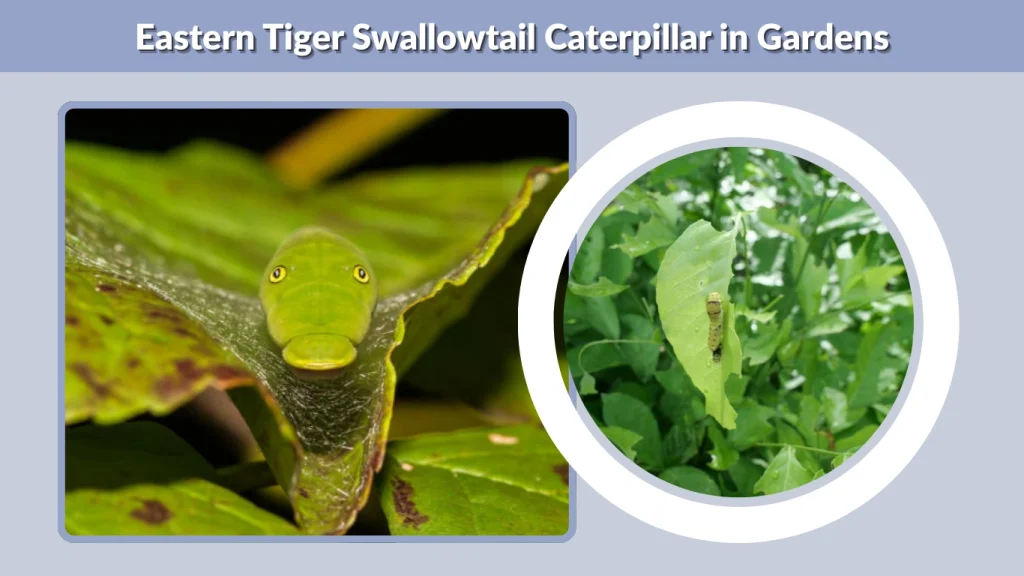
Eastern tiger swallowtail caterpillars are welcome guests in wildlife-friendly gardens. Their presence indicates healthy plant diversity and contributes to local pollinator populations. Planting host trees such as tulip poplar, cherry, and willow increases the likelihood of attracting egg-laying butterflies.
Although leaf damage may be visible, it is usually minor and temporary. Many gardeners choose to protect caterpillars rather than remove them, allowing children and adults alike to observe the full life cycle of a butterfly up close.
Predators, Parasites, and Survival Challenges
Despite their defenses, many eastern tiger swallowtail caterpillars fall prey to birds, predatory insects, spiders, and small mammals. Parasitic wasps and flies are also major threats, laying eggs on or inside caterpillars.
Environmental factors such as heavy rain, drought, temperature extremes, and pesticide exposure significantly reduce survival. Habitat preservation, native plantings, and reduced chemical use are key to supporting healthy populations.
Interesting Facts About Eastern Tiger Swallowtail Caterpillars
Eastern tiger swallowtail caterpillars can increase their body size many times over in just a few weeks. Their eye spots are among the most convincing examples of snake mimicry in insects. Some populations produce multiple generations per year, while northern groups rely on a single annual cycle.
The adult butterflies they become are powerful fliers and important pollinators, visiting a wide variety of flowering plants.
FAQs
What does an eastern tiger swallowtail caterpillar look like?
Eastern tiger swallowtail caterpillars are bright green in later stages, with large yellow-and-black false eye spots near the head. Younger caterpillars are dark and blotchy, resembling bird droppings. Fully grown individuals are thick-bodied and usually about two inches long.
Are eastern tiger swallowtail caterpillars harmful to humans?
They are harmless to humans. They do not bite, sting, or produce venom. When disturbed, they may release a strong smell from the osmeterium, but this is not dangerous and serves only to deter predators.
What trees attract eastern tiger swallowtail caterpillars?
They are attracted to deciduous trees such as wild cherry, tulip tree, birch, willow, ash, cottonwood, and magnolia. Planting these species increases the chances of seeing caterpillars and adult butterflies in your area.
How long does the caterpillar stage last?
The caterpillar stage typically lasts three to four weeks, depending on temperature and food quality. After this period, the caterpillar forms a chrysalis and begins the transformation into a butterfly.
Can eastern tiger swallowtail caterpillars be raised at home?
Yes. They can be raised by providing fresh host leaves daily and keeping them in a clean, ventilated container. Once the butterfly emerges, it should be released outdoors to support natural populations.
