

The fig wasp is one of nature’s most extraordinary insects, celebrated for its vital role in pollinating fig trees. These wasps are tiny, often invisible to the casual observer, yet their contribution to ecosystems is immense. Over millions of years, fig wasps and fig trees have evolved together in perfect harmony, creating one of the most fascinating examples of coevolution found in nature.
Identification

Physical Description
The fig wasp is remarkably small, typically measuring between 1–2 millimeters in length. Despite their size, their anatomy is highly specialized.
- Females are winged, with elongated bodies that help them enter figs through the small natural opening called the ostiole. Their bodies are streamlined, built for navigating the fig’s narrow tunnels.
- Males, in contrast, are wingless and smaller, adapted for life entirely within the fig. They rarely, if ever, leave the fruit, as their only purpose is to mate and assist the females’ exit.
Their color varies by species, often in muted shades of brown, black, or golden yellow. The wings of females are transparent, with delicate veins that shimmer under light. Their antennae are highly sensitive, designed to detect the scent of a receptive fig even from a considerable distance.
Sexual Dimorphism
The differences between male and female fig wasps are among the most striking in the insect world. While females are active pollinators and travelers, males live short, hidden lives inside the fig, completing their existence in darkness. This dimorphism ensures reproductive efficiency — females spread pollen and genes, while males enable internal mating and tunneling.
Scientific Classification

| Rank | Classification |
| Kingdom | Animalia |
| Phylum | Arthropoda |
| Class | Insecta |
| Order | Hymenoptera |
| Family | Agaonidae |
| Common Name | Fig Wasp |
There are more than 750 identified species of fig wasps, each closely linked to a specific species of fig tree. This one-to-one relationship ensures that both wasp and fig can only reproduce through each other’s cooperation.
Habitat and Distribution

Natural Range
Fig wasps inhabit tropical and subtropical regions across the globe. They are most abundant in areas rich with fig trees, such as Southeast Asia, Central and South America, Africa, and northern Australia. Their distribution mirrors that of fig species, reflecting the deep biological dependency between the two.
Preferred Environment
Fig wasps thrive in humid, forested regions where fig trees grow year-round. These trees often fruit continuously, providing a constant breeding habitat for the wasps. Some species live near riverbanks or in rainforests, while others adapt to drier climates where fig trees can still survive. Because the fig is both home and nursery for their young, fig wasps rarely exist far from their host trees.
Life Cycle

The life cycle of a fig wasp is as short as it is intricate. Every stage — from egg to adult — takes place within the fig itself, making the fruit not only a food source but a complete life-support system.
Egg Stage
The process begins when a fertilized female fig wasp locates a fig that is ready for pollination. Guided by chemical signals emitted by the tree, she squeezes through the ostiole to reach the inner cavity. Inside, she lays her eggs within tiny flowers that line the fig’s interior. As she does so, she inadvertently pollinates the fig, transferring pollen from a previous fig she visited.
Larval Stage
After a few days, the eggs hatch into larvae. These larvae feed on gall tissue that forms around them, gaining nourishment while safely enclosed inside the fig. The fruit’s structure provides perfect protection against predators and environmental threats, allowing the larvae to mature in a completely secure environment.
Pupal Stage
As the larvae grow, they enter the pupal stage. During this transformation, the wasps develop their adult features — wings, antennae, and reproductive organs — while still encased within the fig’s gall structures. This stage marks the quiet preparation before emergence.
Adult Stage and Reproduction
Once mature, males emerge first from their galls. They immediately seek out females still in their pupal cells, mating with them within the fig. After mating, the males chew exit tunnels through the fig’s wall, allowing females to escape. Their work complete, the males die soon after, never leaving the fruit that sheltered them since birth.
The fertilized females then collect pollen from the fig’s male flowers, storing it in specialized pockets on their bodies. They exit through the tunnels made by the males and fly away in search of a new fig, restarting the cycle. This behavior not only ensures the continuation of their species but also the pollination and reproduction of fig trees.
Behavior and Adaptations
Pollination Behavior
The fig wasp’s pollination process is one of the most remarkable examples of biological precision. While laying eggs, females transfer pollen that fertilizes some of the fig’s flowers, allowing them to develop into seeds. The remaining flowers become galls that support larval development. Thus, every action of the wasp simultaneously benefits both insect and tree — a perfect model of mutualism.
Navigation and Host Detection
Female fig wasps possess an extraordinary sense of smell. They are guided by volatile organic compounds emitted by receptive figs, enabling them to identify the right species from long distances. This accuracy prevents them from entering unsuitable figs, which could mean death for both the wasp and her offspring.
Mating Behavior
All mating occurs inside the fig. The males’ lives revolve entirely around this act — they are born, mate, create escape routes, and die within the same fruit. Females, however, emerge to begin the next generation’s journey, often traveling great distances before finding a new host fig.
Lifespan
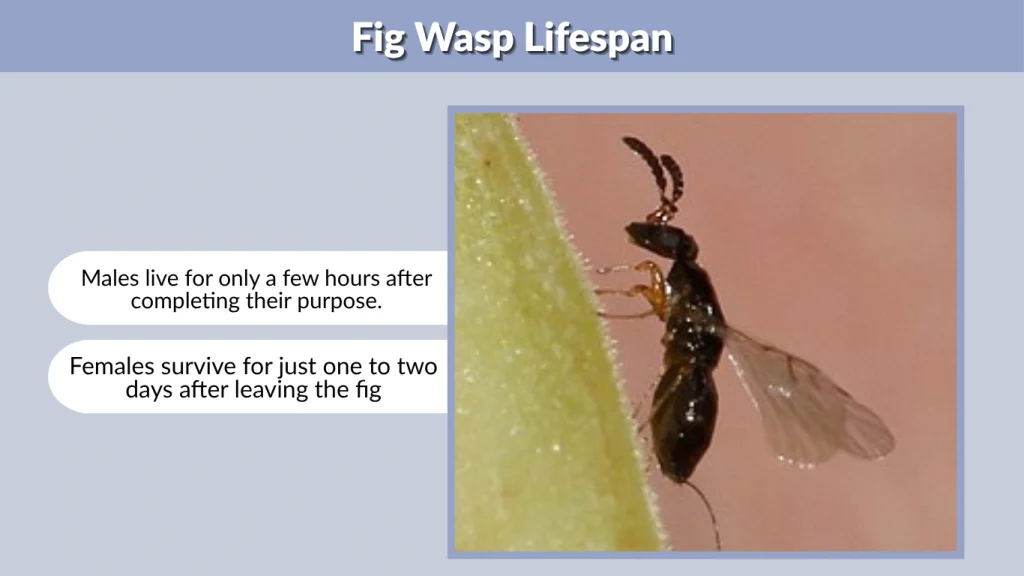
The fig wasp’s life is brief but incredibly efficient.
- Males live for only a few hours after completing their purpose.
- Females survive for just one to two days after leaving the fig, during which they must locate and enter another fig to continue the life cycle.
This rapid yet effective reproduction process ensures the persistence of both wasp and tree species despite their fleeting individual lives.
Diet and Feeding Habits
The fig wasp’s diet depends entirely on its stage of life. Adult fig wasps do not feed at all — their brief existence revolves solely around reproduction and pollination. They rely on stored energy reserves accumulated during the larval stage. This energy sustains them during their short lifespan, often less than two days.
Larval Nutrition
During the larval stage, fig wasps feed on gall tissue — a nutrient-rich growth formed inside the fig where eggs are laid. These galls provide all the protein and carbohydrates necessary for the larvae to mature into adults. The fig, in turn, benefits from the larvae’s presence, as some flowers inside the fruit are pollinated during egg-laying, allowing the fig to produce viable seeds.
This tightly linked feeding cycle ensures that the fig tree and wasp coexist in mutual benefit, with neither surviving long-term without the other.
Reproductive Strategy
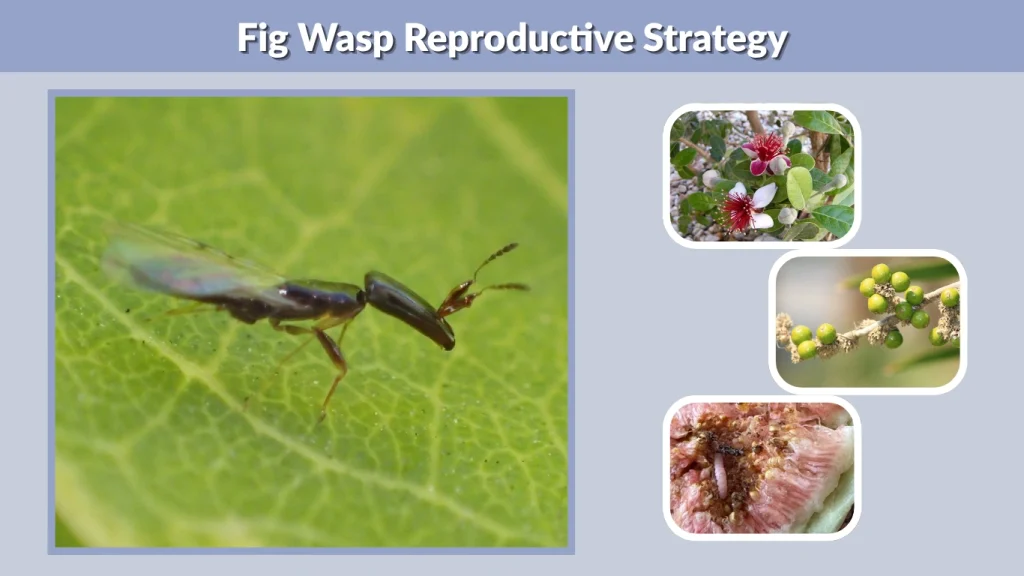
The reproductive process of fig wasps is a stunning demonstration of synchronized evolution. Both fig and wasp have evolved together for millions of years to depend entirely on one another.
Timing and Synchronization
Figs do not bloom like ordinary flowers — their blossoms grow inside the fruit. Only when the fig reaches a specific stage of ripeness does it release chemical signals that attract female wasps. If the wasp arrives too early or too late, it cannot enter or lay eggs. This perfect timing shows an evolutionary balance fine-tuned over millennia.
Selective Pollination
Each fig tree species is matched to a specific wasp species. A female can recognize her correct fig through chemical scent alone, ensuring that cross-pollination never occurs. This exclusivity maintains biodiversity and prevents hybridization among different fig species.
Mutual Dependence
The relationship between figs and wasps is an excellent example of obligate mutualism — meaning both species depend entirely on each other for reproduction. Without the wasp, the fig tree cannot produce seeds, and without the fig, the wasp cannot complete its life cycle.
Ecological Importance
Fig wasps are not only important to fig trees but to entire tropical ecosystems. Figs are known as keystone species, meaning many other animals depend on them for survival. Because fig trees can produce fruit throughout the year, they provide a constant food source for hundreds of species — birds, bats, monkeys, and even reptiles.
By ensuring the reproduction of fig trees, fig wasps indirectly sustain these species. In essence, a tiny insect plays a monumental role in maintaining forest balance and biodiversity.
Predators and Natural Enemies

Despite their small size and hidden life, fig wasps face numerous predators and threats.
Natural Predators
- Parasitic wasps often lay eggs in the same figs, allowing their larvae to consume those of the fig wasp.
- Ants and mites may invade figs and prey on developing larvae.
- Birds and bats sometimes eat figs that contain the developing insects.
Environmental Threats
Climate change and deforestation pose significant risks. Changes in temperature or humidity can disrupt the synchronization between fig flowering and wasp reproduction. Without this harmony, both species could decline, leading to ecological imbalance.
Behavioral Adaptations
The fig wasp’s survival depends on several unique adaptations:
- Specialized body shape enables females to enter figs through narrow ostioles.
- Pollen pockets allow them to store and transfer pollen efficiently.
- Chemical sensitivity ensures they locate the correct fig species for reproduction.
- Rapid reproduction compensates for their short lifespan.
These adaptations highlight the wasp’s evolutionary refinement and deep integration with its environment.
Evolutionary Background
The partnership between figs and fig wasps dates back over 60 million years, making it one of the oldest examples of coevolution in the natural world. Fossil records and genetic studies reveal that as fig trees diversified into hundreds of species, so did their associated wasps — each evolving to fit a specific fig type.
This mutual evolution has shaped not only the biology of both species but also the ecosystems they inhabit. The relationship demonstrates how cooperation, rather than competition, can be a powerful force in evolution.
Human and Agricultural Significance
Role in Fig Cultivation
In agriculture, fig wasps are essential for certain varieties of figs, such as Smyrna figs, which require pollination to develop fruit. Without these wasps, such figs cannot mature.
However, common edible figs (Ficus carica) are typically parthenocarpic, meaning they can develop fruit without pollination. This allows for large-scale cultivation without depending on fig wasp populations.
Scientific Value
Fig wasps are studied extensively in the fields of ecology, genetics, and evolution. Their intricate life cycles help scientists understand coevolutionary mechanisms, species interdependence, and the balance of natural systems.
Conservation and Future Outlook
Current Challenges
Habitat loss due to deforestation and urban expansion threatens fig wasp populations worldwide. Climate change can alter fig flowering periods, breaking the synchronization between the wasp’s life cycle and fig development. Because each wasp species relies on one specific fig, the extinction of one can directly lead to the loss of the other.
Conservation Efforts
Preserving tropical forests and native fig species is crucial for sustaining fig wasp populations. Conservation projects increasingly recognize the fig-wasp partnership as an indicator of ecosystem health. Protecting this tiny insect ultimately protects the vast network of life that depends on figs.
Interesting Traits and Behavior
- Female fig wasps can detect suitable figs from over a kilometer away using scent cues.
- Inside a fig, a miniature ecosystem exists — including fungi, mites, and microorganisms living alongside the wasps.
- Though their lives last only days, fig wasps ensure the survival of ancient fig species that feed thousands of animals.
- Their entire existence demonstrates precision, purpose, and ecological balance on a microscopic scale.
FAQs
Do all figs rely on fig wasps?
No. Some fig varieties, especially cultivated ones like Ficus carica, can produce fruit without wasps through a process called parthenocarpy. Wild fig species, however, depend entirely on fig wasps for pollination.
Are fig wasps dangerous to humans?
Not at all. Fig wasps are harmless and do not sting or bite. Their size and gentle nature make them essential pollinators, not pests.
Do we eat fig wasps in figs?
Sometimes. In certain natural figs, female wasps die inside the fruit after laying eggs. Enzymes called ficin break down their bodies completely, leaving no trace by the time the fig ripens.
Why are fig wasps so important to the environment?
They maintain fig tree reproduction, which supports countless species across tropical ecosystems. Without fig wasps, many forest animals would lose their primary food source.
What would happen if fig wasps went extinct?
If fig wasps disappeared, fig trees would fail to reproduce. This loss would ripple through food chains, leading to the decline of hundreds of species dependent on figs for nourishment.
