

Red and black ants are common across the world, but many people struggle to tell the difference between fire ants and red ants. While these terms are often used interchangeably, they do not always describe the same insect. Fire ants are a specific type of stinging ant with aggressive behavior and painful bites, whereas “red ants” may refer to several ant species, including carpenter ants and harvester ants. Knowing the difference is important for safety, pest control, and even property protection.
What Are Fire Ants?
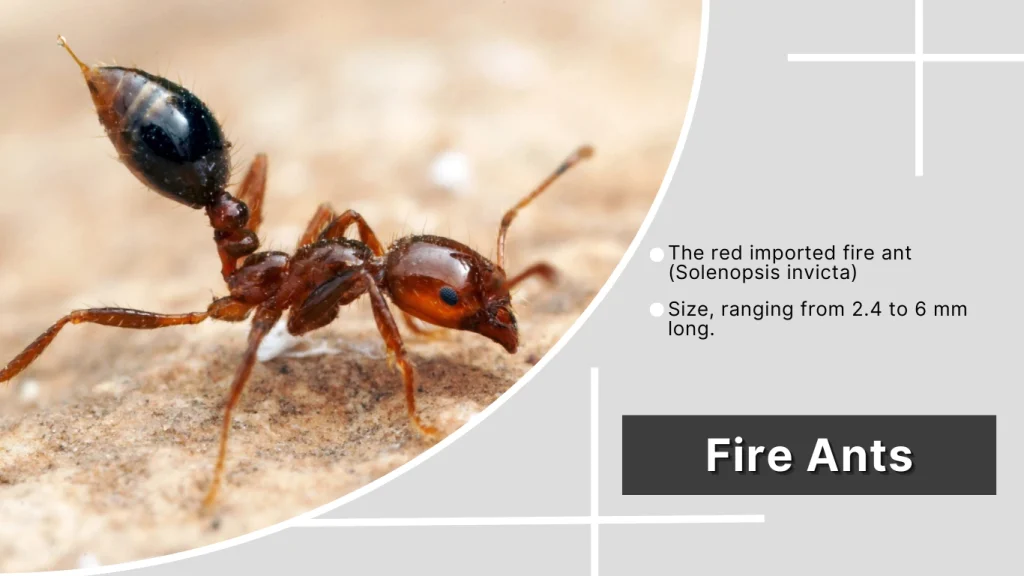
Fire ants are aggressive ants belonging to the genus Solenopsis. The most notorious is the red imported fire ant (Solenopsis invicta), originally from South America but now widespread across the southern United States.
Identification
Fire ants are small to medium in size, ranging from 2.4 to 6 mm long. Their color is typically reddish-brown with a darker abdomen. Colonies contain both small and large workers, and they build visible soil mounds in lawns, gardens, and fields.
Habitat and Range
They thrive in warm climates, especially in Texas, Florida, Georgia, and other southern states. Their nests are often located in open sunny areas, lawns, pastures, and near sidewalks or driveways.
Aggression and Behavior
Fire ants are known for their aggressive swarming response. When disturbed, hundreds of workers rush out of the mound and sting repeatedly, injecting venom that causes burning pain and pustules.
Colony Structure
Fire ant colonies can contain hundreds of thousands of ants, with multiple queens in some cases. This makes eradication difficult, as colonies can relocate and survive even after partial destruction.
What Are Red Ants?

The term “red ant” is more general and may refer to several species that are reddish in color but not necessarily fire ants. Common examples include red carpenter ants (Camponotus spp.) and red harvester ants (Pogonomyrmex spp.).
Identification
Red ants vary widely in size depending on the species. Carpenter ants are among the largest, often over 12 mm long, with reddish thoraxes and black abdomens. Harvester ants are smaller, usually 5–10 mm, with entirely reddish bodies.
Types of Red Ants
- Carpenter ants – wood-nesting ants that can damage homes.
- Harvester ants – soil-nesting ants with painful stings.
- Other “red ants” – smaller local species often mistaken for fire ants.
Habitat and Distribution
Red ants are found worldwide, from North America to Asia. In the U.S., carpenter ants are common in northern and eastern regions, while harvester ants dominate dry western and southern landscapes.
General Behavior
Unlike fire ants, red ants are not universally aggressive. Carpenter ants are mostly nuisance pests indoors, while harvester ants can sting but do not swarm as aggressively as fire ants.
Fire Ants vs Red Ants: Quick Comparison

| Feature | Fire Ants (Solenopsis invicta) | Red Ants (Carpenter & Harvester Ants) |
| Size | Small: 2.4–6 mm workers, queens ~15 mm | Medium–Large: 5–13 mm workers, queens 15–20+ mm |
| Coloration | Uniform reddish-brown with darker abdomen | Carpenter: red thorax + black abdomen; Harvester: solid reddish body |
| Nest Type | Dome-shaped soil mounds in open areas | Carpenter: wood cavities; Harvester: flat soil nests |
| Aggression | Extremely aggressive, swarm attackers | Carpenter: not aggressive; Harvester: sting but less swarming |
| Bites/Stings | Sting repeatedly with venom causing pustules | Carpenter: strong bites, no sting; Harvester: painful sting |
| Danger Level | High – painful stings, risk of allergic reaction | Moderate – carpenter ants damage wood; harvester ants sting individually |
| Distribution | Southern U.S. (Texas, Florida, Georgia, etc.) | Carpenter: across U.S. in homes/forests; Harvester: western/southern dry regions |
| Colony Size | Huge, up to 250,000 workers, multiple queens | Smaller, tens of thousands, usually one queen |
| Pest Concern | Medical threat due to stings | Carpenter: structural damage; Harvester: nuisance outdoors |
Fire Ants vs Red Ants: Key Differences

Although both are reddish in color, fire ants and red ants differ in appearance, behavior, and danger.
Physical Appearance (Size, Color, Shape)
- Fire ants – smaller, uniform reddish-brown with darker abdomens.
- Red ants – vary in size, often larger, with a mix of red and black coloration.
Nesting Behavior (Mounds vs Wood Nests)
- Fire ants build soil mounds in open areas.
- Carpenter ants nest in wood, while harvester ants build large flat soil nests.
Aggression Levels
- Fire ants are extremely aggressive and sting in swarms.
- Red ants can bite or sting but are generally less aggressive.
Biting and Stinging Ability
- Fire ants sting repeatedly, leaving pustules.
- Carpenter ants bite with strong jaws but do not sting.
- Harvester ants deliver painful stings but usually attack individually.
Diet and Foraging
- Fire ants are omnivorous, feeding on insects, seeds, and household scraps.
- Red ants vary: carpenter ants forage for sweets and proteins, while harvester ants collect seeds.
Fire Ants vs Red Ants Bites

One of the biggest reasons people want to know the difference is the bite or sting.
Fire Ant Bites and Stings: Symptoms and Risks
Fire ants bite to grip skin, then inject venom with repeated stings. This causes a burning sensation (“fire” pain) followed by white pustules that can last days. Severe allergic reactions, including anaphylaxis, are possible in sensitive individuals.
Red Ant Bites: Harvester, Carpenter, and Other Types
- Carpenter ants use their strong mandibles to bite, which can feel like a pinch but does not involve venom.
- Harvester ants sting with venom that causes sharp pain and swelling, though they rarely swarm.
Pain Level Comparison
Fire ant stings are more widespread and painful in numbers, while harvester ants deliver more isolated but equally sharp stings. Carpenter ant bites are less dangerous.
Allergic Reactions and Medical Concerns
Both fire ant and harvester ant stings can trigger allergic responses, ranging from itching and swelling to anaphylaxis. Carpenter ant bites are unlikely to cause severe reactions.
Bite Treatment and First Aid
- Wash the affected area with soap and water.
- Apply cold compresses to reduce swelling.
- Use antihistamines or hydrocortisone cream for itching.
- Seek emergency care if breathing difficulty or systemic reactions occur.
Fire Ants vs Red Ants Size
Fire Ant Worker and Queen Size
Fire ant workers are small, 2.4–6 mm, while queens can reach 15 mm.
Red Ant Worker and Queen Size
Carpenter ants are much larger, with workers ranging from 6–13 mm and queens over 20 mm. Harvester ants are medium-sized, usually 5–10 mm.
Comparison Table of Fire Ant vs Red Ant Size
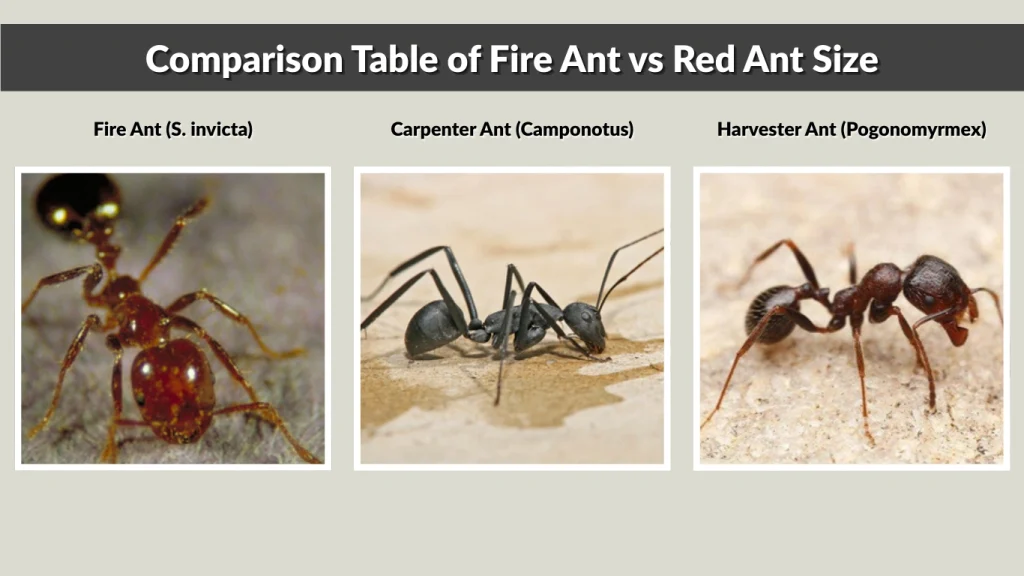
| Ant Type | Worker Size | Queen Size | Coloration | Nest Type | Sting/Bite |
| Fire Ant (S. invicta) | 2.4–6 mm | ~15 mm | Reddish-brown w/ black abdomen | Soil mounds | Painful stings |
| Carpenter Ant (Camponotus) | 6–13 mm | 20+ mm | Red thorax, black abdomen | Wood cavities | Strong bites |
| Harvester Ant (Pogonomyrmex) | 5–10 mm | ~12 mm | Reddish overall | Soil nests | Painful sting |
Difference Between Fire Ants and Red Ants
In summary, the main differences include:
- Appearance – Fire ants are smaller and uniform, while red ants vary in size and coloration.
- Habitat – Fire ants make soil mounds, carpenter ants prefer wood, and harvester ants live in open sandy soils.
- Danger – Fire ants swarm aggressively and sting repeatedly, while red ants sting or bite individually.
- Impact – Fire ants are a greater medical concern, while carpenter ants are more damaging to property.
Red Carpenter Ant vs Fire Ant
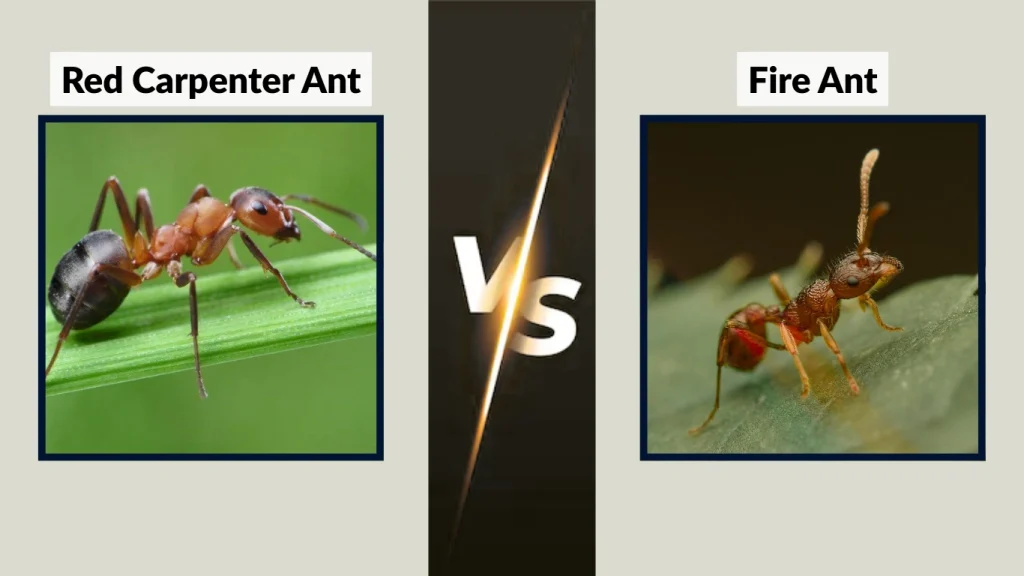
Identification and Size Differences
Red carpenter ants are larger, with workers ranging from 6–13 mm, compared to fire ants that are only 2.4–6 mm. Carpenters have a distinct reddish thorax and black abdomen, while fire ants appear more uniformly reddish-brown.
Habitat and Nesting Habits
Carpenter ants prefer damp or decaying wood, nesting in tree trunks, logs, or house frames. Fire ants, on the other hand, build large soil mounds in open areas.
Damage to Property vs Health Risks
Fire ants are dangerous because of their venomous stings. Carpenter ants do not sting but can damage homes by tunneling into wood, sometimes causing costly repairs.
Red Harvester Ant vs Fire Ant
Nesting in Soil vs Mounds
Red harvester ants nest in open soil with flat, crater-like entrances, often clearing vegetation around them. Fire ants create tall mounds with multiple tunnels just below the surface.
Painful Sting of Harvester Ants vs Fire Ants
Both species sting, but harvester ant venom can be equally painful or worse than fire ants. However, harvester ants do not swarm aggressively like fire ants.
Danger to Humans and Pets
Harvester ants pose more risk to pets and livestock in rural areas, while fire ants are the greater threat to humans due to their large colony numbers and swarming stings.
Red Imported Fire Ant vs Other Species
Red Imported Fire Ant vs Argentine Ant
Argentine ants are small, dark brown, and do not sting. Red imported fire ants are larger, reddish, and aggressive stingers. Argentine ants often outcompete other ant species but cannot match the sting of fire ants.
Red Imported Fire Ant vs Southern Fire Ant
Southern fire ants (Solenopsis xyloni) are slightly smaller and less aggressive than imported fire ants but still sting painfully. The imported fire ant is the dominant invasive species.
Red Imported Fire Ant vs Western Harvester Ant
Western harvester ants (Pogonomyrmex occidentalis) are reddish and collect seeds. They sting powerfully but do not swarm. Fire ants outnumber them and spread more rapidly.
Red vs Black Imported Fire Ants
There are two types: the red imported fire ant and the black imported fire ant (Solenopsis richteri). The black variant is darker, but both are aggressive and dangerous.
Fire Ants vs Red Ants in Different States
Texas Red Ants vs Fire Ants
Texas has both native red ants, such as harvester ants, and invasive fire ants. Fire ants dominate urban areas, while harvester ants are found in rural and dry landscapes.
California Red Ant vs Fire Ant
California is home to native red ants like harvester ants, but invasive fire ants are spreading. Fire ants pose a greater sting risk to people, while native red ants are more ecologically balanced.
Fire Ants in Florida vs Red Ant Species
Florida has both fire ants and carpenter ants. Fire ants thrive in open lawns and cause painful stings, while Florida carpenter ants often infest homes, chewing wood and becoming household pests.
Fire Ants vs Red Ant Pictures (Visual Guide)
Visual comparisons help quickly distinguish between the two.
- Fire ant pictures: show small reddish-brown ants swarming from soil mounds.
- Red ant pictures: show larger carpenter ants with reddish thoraxes and black abdomens, or harvester ants with reddish bodies and seed piles near nests.
Fire Ant Colony vs Red Ant Colony
Fire Ant Nest Structures and Mound Building
Fire ant colonies build dome-shaped mounds that can reach 40 cm high. Their underground tunnels spread outward, allowing ants to swarm rapidly when disturbed.
Red Ant Colony Behavior
Carpenter ants nest in wood, creating hollow galleries. Harvester ants form flatter soil nests and clear areas of vegetation around their entrances.
Colony Size and Queen Structure
Fire ant colonies can contain up to 250,000 workers and multiple queens. Red ant colonies (carpenter or harvester) are smaller, often under 20,000 ants, with a single queen.
Are Red Fire Ants the Same as Red Ants?
There is frequent confusion because people often call fire ants “red ants.”
- Yes, all fire ants are red ants, but not all red ants are fire ants.
- Red ants may include carpenter ants, harvester ants, and other species that are not aggressive swarmers.
- Correct identification prevents unnecessary alarm and helps with the right pest control approach.
Pest Control: Fire Ants vs Red Ants
How to Get Rid of Fire Ants
- Use slow-acting fire ant baits spread around colonies.
- Apply mound drenches for direct control.
- Professional extermination is often needed due to colony resilience.
How to Control Carpenter and Harvester Ants
- For carpenter ants, eliminate damp or decaying wood in and around the home.
- For harvester ants, apply outdoor baits near soil nests.
DIY vs Professional Treatments
Small infestations can be handled with store-bought baits, but large infestations, especially of fire ants, require professionals.
Long-Term Prevention Tips
- Keep lawns trimmed and dry.
- Seal cracks in buildings to prevent carpenter ant entry.
- Avoid leaving food crumbs that attract ants indoors.
