
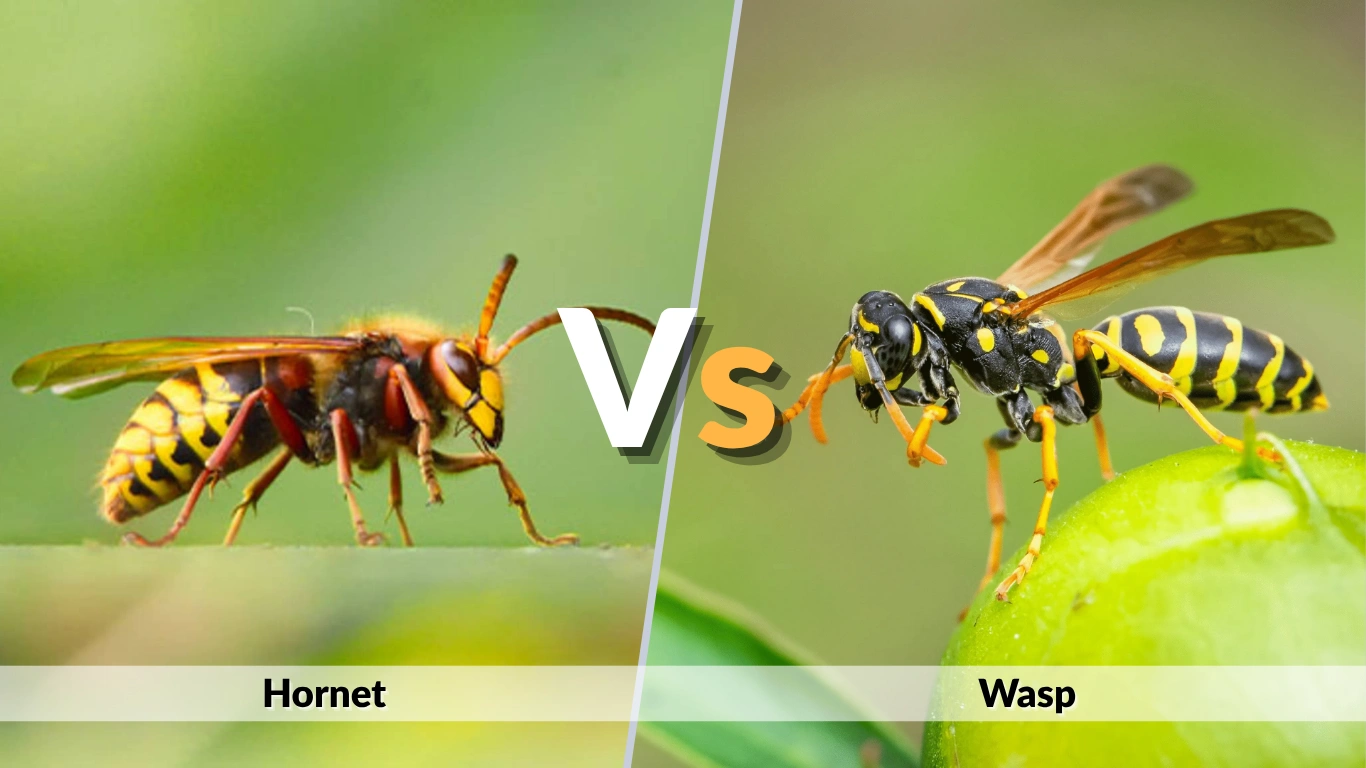
Hornets and wasps are often mistaken for each other because of their similar appearance, but these flying insects have several key differences. Both belong to the same family, Vespidae, yet they vary in size, nesting habits, and temperament. Understanding how to identify and distinguish them helps prevent unnecessary fear and encourages respect for their ecological importance.
Understanding Hornets and Wasps
Hornets
Hornets are the largest members of the wasp family. They have robust bodies, wide heads, and strong mandibles for chewing through wood and prey. Common species include the European hornet, Asian giant hornet, and bald-faced hornet (technically a type of wasp). Hornets are highly social and build enclosed paper nests in trees, attics, or other elevated areas.
Despite their fearsome reputation, hornets play a crucial role in controlling pest populations. They feed on flies, caterpillars, and other insects that damage crops and gardens.
Wasps
Wasps are slimmer, faster, and more colorful than hornets. Their bodies have narrow waists and long legs that hang when they fly. Common examples include paper wasps, yellow jackets, and mud daubers. Some species are solitary, while others form small colonies.
Wasps are both hunters and scavengers. They feed on nectar, small insects, and human food scraps, making them common visitors at picnics and outdoor gatherings. Though they can be aggressive, they are also beneficial pollinators and natural pest controllers.
Physical Differences

| Feature | Hornet | Wasp |
| Body Shape | Thick, rounded body with broad head and waist | Slim, narrow waist with elongated body |
| Color Pattern | Brown, orange, or black with pale stripes | Bright yellow and black with bold markings |
| Size Range | Larger — about 1 to 2 inches long | Smaller — about 0.5 to 1 inch long |
| Wings | Shorter, wider wings for steady flight | Longer, narrower wings for quick movement |
| Legs | Stout legs that hang close to the body | Long, dangling legs visible in flight |
| Stinger | Thicker, longer stinger — delivers more venom | Shorter stinger — can sting repeatedly |
| Head and Eyes | Broader head with large compound eyes | Narrower head and smaller eyes |
| Flight Behavior | Slower and more deliberate flight | Faster, darting flight patterns |
| Nesting Location | Builds large enclosed nests high in trees or attics | Builds open nests under eaves, ledges, or in the ground |
| Aggression Level | Defensive — attacks when nest is threatened | Aggressive — defends food sources and territory |
| Common Species | European hornet, Asian giant hornet, bald-faced hornet | Paper wasp, yellow jacket, mud dauber |
Nest Differences
Hornet Nests
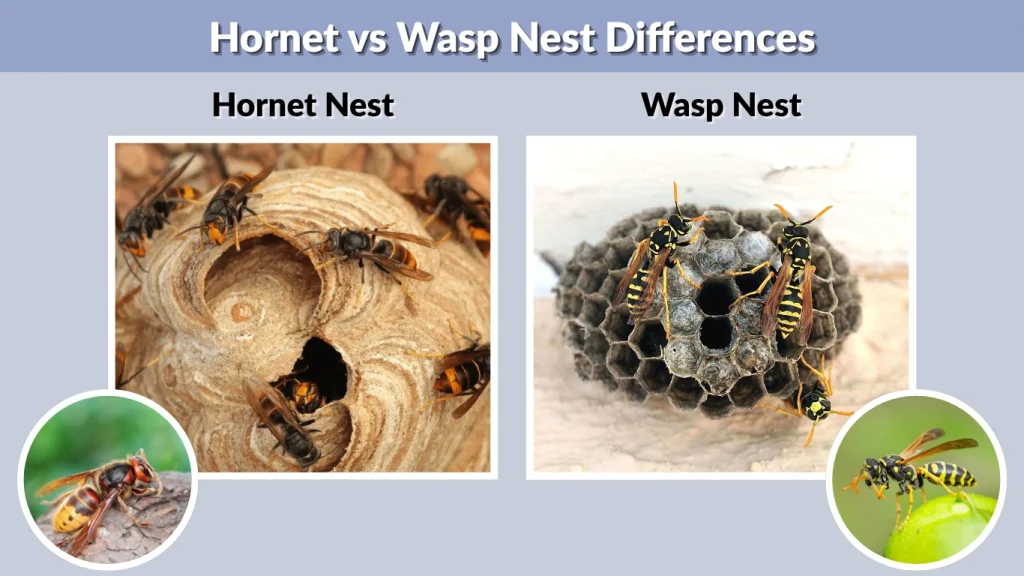
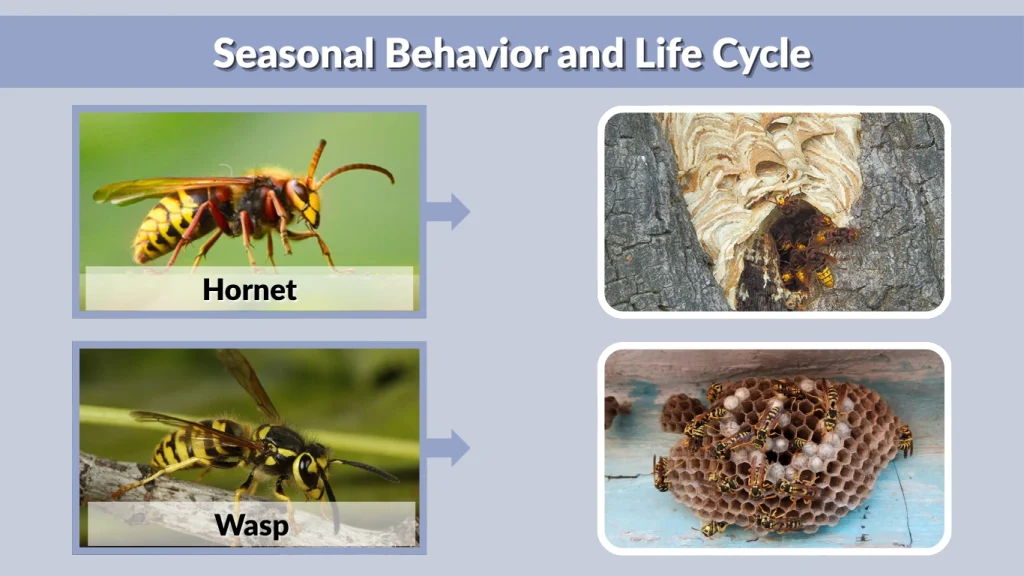
Hornet nests are large, enclosed paper structures that resemble footballs or teardrops. They are made by chewing wood fibers and mixing them with saliva to create a papery material. Nests often hang from tree branches, eaves, or in attic spaces. Each nest can house hundreds of workers during peak summer months.
Inside, hornets build multiple comb layers stacked vertically. These chambers protect larvae from predators and weather, making hornet colonies highly organized and well-defended.
Wasp Nests
Wasps build open, umbrella-shaped nests with visible hexagonal cells. Unlike hornets, they don’t enclose their combs, leaving the larvae exposed. Paper wasps prefer sheltered spots such as porch ceilings, sheds, and window frames.
Their nests are smaller, hosting 20–100 workers. Some wasp species, like yellow jackets, build underground nests made of soft paper pulp, which can be hard to detect until disturbed.
Visual Clues
- Hornet nests = closed, oval-shaped, high above ground.
- Wasp nests = open, flat, often attached under ledges.
- Hornet nests can reach basketball size by late summer; wasp nests rarely exceed a softball.
Behavior and Aggression
Social Behavior
Hornets are structured and cooperative. Each colony has a queen, sterile workers, and male drones. Workers defend the nest fiercely but do not seek confrontation unless provoked.
Wasps, especially yellow jackets, are more unpredictable. They guard food sources aggressively and sting repeatedly when disturbed. Solitary wasps, however, are generally calm and non-threatening.
Aggression Levels
Hornets are territorial defenders, protecting their nests within a certain radius. They become aggressive only when humans or animals get too close. Wasps, on the other hand, are opportunistic attackers — quick to react to movement or scent near their nests or food.
Environmental factors like vibration, loud noises, or strong odors can trigger defense responses. Understanding these behaviors helps people stay safe around nests.
Sting and Venom Comparison
Sting Mechanics
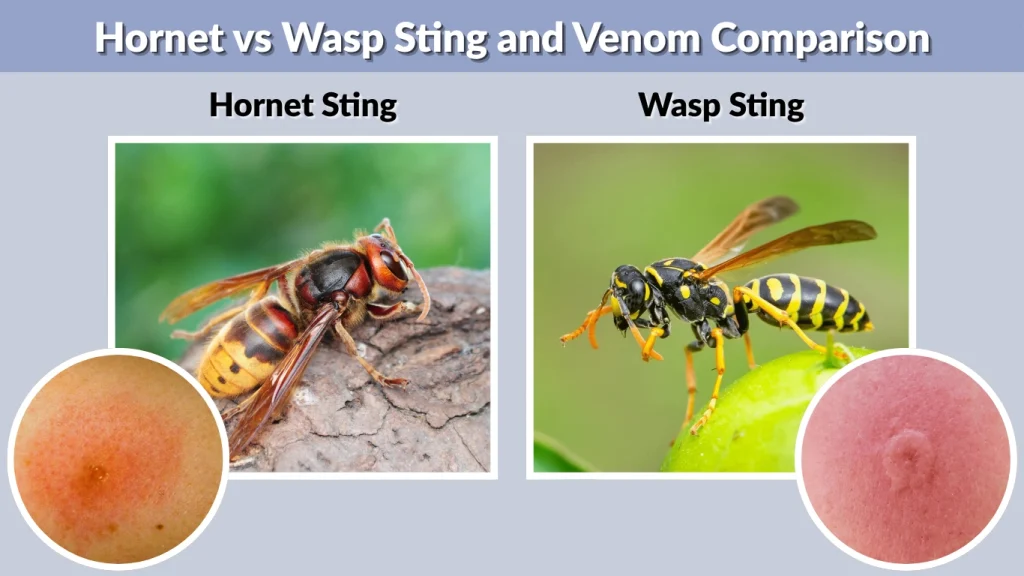
Hornets and wasps both have smooth stingers that allow multiple stings without dying. Hornets possess larger stingers and inject more venom per sting, which causes sharp, burning pain. Wasps have smaller stingers but can swarm quickly, delivering repeated stings.
Both species release alarm pheromones, alerting nearby colony members to join the defense. This chemical response makes disturbing a nest extremely risky.
Pain and Venom Effects
Hornet venom contains powerful enzymes that break down tissue, causing immediate swelling and redness. Some species, like the Asian giant hornet, have venom potent enough to trigger allergic reactions or, in rare cases, anaphylaxis.
Wasp venom is slightly less toxic but still painful. It contains histamines and neurotoxins that cause itching and irritation. For most people, the effects subside in a few hours; for sensitive individuals, medical attention may be needed.
Hornet vs Wasp Sting Pain
The sting of a hornet is generally more painful and longer-lasting than that of a wasp. Hornets inject more venom per sting and target deep tissue layers. On the Schmidt Pain Index, a hornet’s sting ranks higher due to its burning, throbbing pain.
Wasp stings are sharp and immediate but fade faster. Multiple wasp stings, however, can be more dangerous than a single hornet sting because of cumulative venom effects.
Both insects are capable of stinging repeatedly, unlike honeybees, which lose their stinger after one attack. For most people, hornet and wasp stings cause swelling, redness, and mild pain — but for those allergic, they can trigger serious reactions.
What to Do After a Sting
- Clean the area with soap and water to prevent infection.
- Apply an ice pack to reduce pain and swelling.
- Use antihistamines or hydrocortisone cream for itching.
- If breathing becomes difficult or swelling spreads, seek emergency care immediately — signs of anaphylaxis.
Diet and Ecological Roles
Feeding Habits
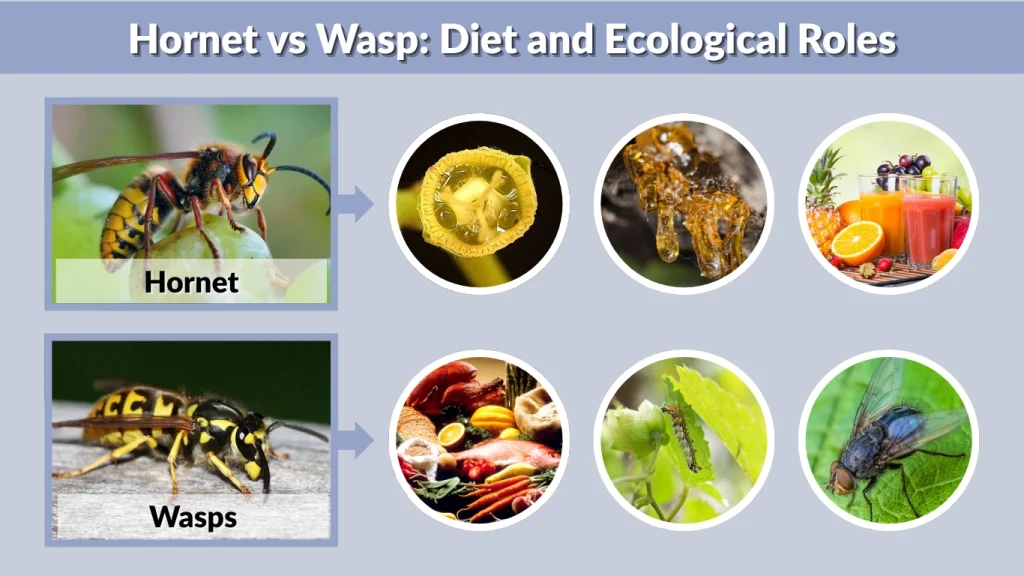
Both hornets and wasps are omnivorous predators. They feed on nectar, tree sap, fruit juices, and other insects. Hornets are particularly efficient hunters, preying on flies, caterpillars, and even other wasps. Their strong mandibles allow them to chew prey into pulp to feed larvae.
Wasps have a broader diet and often scavenge human food, which is why they’re frequent picnic pests. Some wasps, like the cicada killer, target specific insects and are harmless to humans. Others, such as yellow jackets, aggressively defend food and nesting areas.
Pollination and Pest Control
Despite their bad reputation, both hornets and wasps play vital roles in nature.
- Wasps act as natural pest controllers, keeping caterpillar and spider populations in check.
- Hornets help balance ecosystems by hunting other insects and maintaining biodiversity.
While they’re less efficient pollinators than bees, their nectar feeding still contributes to plant reproduction. Destroying them indiscriminately can disrupt local ecological balance.
Common Species Comparisons
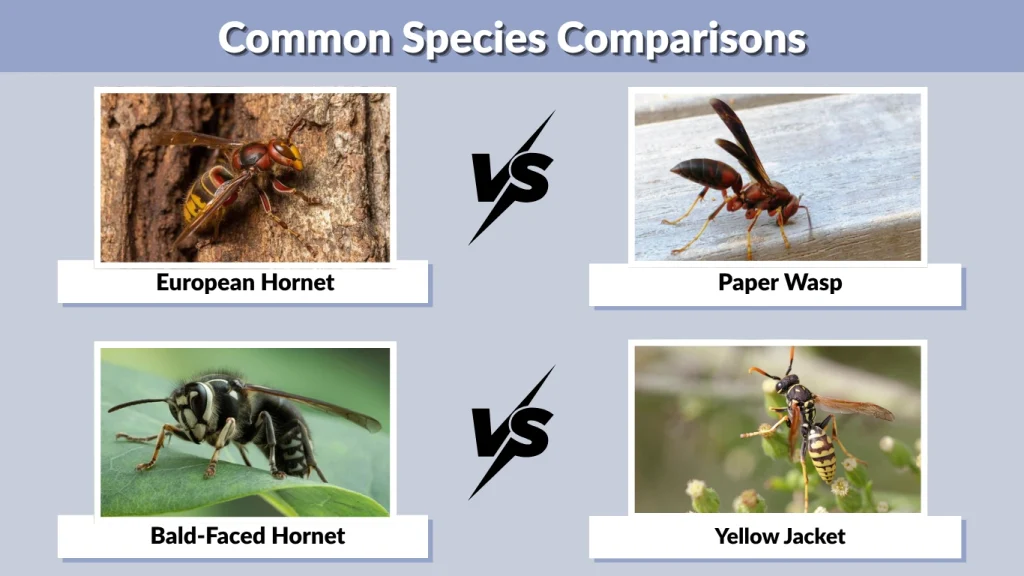
European Hornet vs Paper Wasp
The European hornet (Vespa crabro) is one of the most widespread hornets in North America. It builds large, enclosed nests high in trees or hollow walls and is active at night. It’s defensive but not aggressive unless provoked.
The paper wasp, in contrast, builds small, open nests with visible cells under roofs and ledges. These wasps are active during the day and are less aggressive unless the nest is disturbed.
Key difference: hornet nests are sealed and massive; wasp nests are exposed and small.
Bald-Faced Hornet vs Yellow Jacket
Despite its name, the bald-faced hornet (Dolichovespula maculata) is technically a type of wasp. It has black-and-white markings and builds large, football-shaped aerial nests. It is highly territorial and will sting repeatedly to protect its colony.
Yellow jackets are ground-dwelling wasps with bright yellow and black stripes. They are among the most aggressive stinging insects and frequently invade human spaces in search of food.
Key difference: bald-faced hornets nest above ground, while yellow jackets nest below ground or in wall voids.
Asian Giant Hornet vs Cicada Killer Wasp
The Asian giant hornet (Vespa mandarinia), also known as the “murder hornet,” is the largest hornet species in the world, reaching up to 2 inches long. It’s a fierce predator of honeybees and other insects but rarely poses danger to humans.
The cicada killer wasp is a large, solitary wasp that preys exclusively on cicadas. Despite its intimidating size, it’s gentle toward humans and helps control cicada populations.
Key difference: Asian giant hornets are social and build colonies; cicada killers are solitary and non-aggressive.
Who Would Win: Hornet vs Wasp?
In a direct encounter, the hornet usually wins. Its larger size, heavier armor, and stronger venom give it a clear advantage in combat. Hornets are built for domination — they can overpower and kill smaller wasps quickly.
However, wasps have speed and agility on their side. Species like yellow jackets can overwhelm a single hornet with sheer numbers. Still, in most one-on-one fights, hornets emerge victorious.
This rivalry highlights how both insects have evolved powerful survival tools — hornets as defenders and hunters, and wasps as versatile, adaptive predators.
Seasonal Behavior and Life Cycle
Spring and Summer
In spring, fertilized queens emerge from hibernation to build new nests. They lay eggs and care for the first brood until workers hatch. By summer, colonies expand rapidly as workers take over feeding and nest maintenance duties.
Autumn and Winter
By late autumn, colonies begin to die out. Only new queens survive, seeking shelter in soil or bark to overwinter. Old nests are abandoned and not reused the following year.
This annual cycle ensures population balance and prevents overgrowth in natural environments.
Human Interaction and Safety Tips
Avoiding Conflicts
- Stay calm and move slowly if a wasp or hornet approaches.
- Avoid wearing bright colors or floral scents outdoors.
- Keep trash sealed and food covered when eating outside.
- Never swat at them — sudden movement triggers attack responses.
When to Remove a Nest
If a nest is far from human activity, it’s best to leave it undisturbed. Hornets and wasps die off naturally in winter. For nests close to homes, contact a licensed pest control service. Avoid DIY removal of large nests, especially at night, as colonies can attack in groups.
You can also use deterrents such as fake nests or peppermint oil sprays to discourage new colonies from forming.
Environmental Importance
Though often feared, hornets and wasps are valuable members of the ecosystem. They help manage insect populations, assist in pollination, and recycle organic material. Their presence signals a healthy environment.
Instead of eliminating them entirely, the goal should be safe coexistence — maintaining distance, understanding behavior, and allowing nature’s balance to function as intended.
FAQs
What is the main difference between a hornet and a wasp?
Hornets are larger, bulkier, and build enclosed nests, while wasps are slimmer and make open or ground nests. Hornets are generally more defensive; wasps are more aggressive scavengers.
Which has the more painful sting?
Hornets have a stronger sting due to more venom per strike, but both can sting multiple times. Wasp stings fade faster, while hornet stings cause deeper burning pain.
How can I tell a hornet nest from a wasp nest?
Hornet nests are closed, oval, and made of layered paper, often hanging high. Wasp nests are open and umbrella-shaped, typically under eaves or ledges.
Are hornets more aggressive than wasps?
Hornets defend their colonies fiercely but only when provoked. Wasps are more likely to attack unprovoked, especially near food or garbage.
Do hornets and wasps die after stinging?
No. Unlike bees, both hornets and wasps have smooth stingers that allow them to sting multiple times without dying.
