
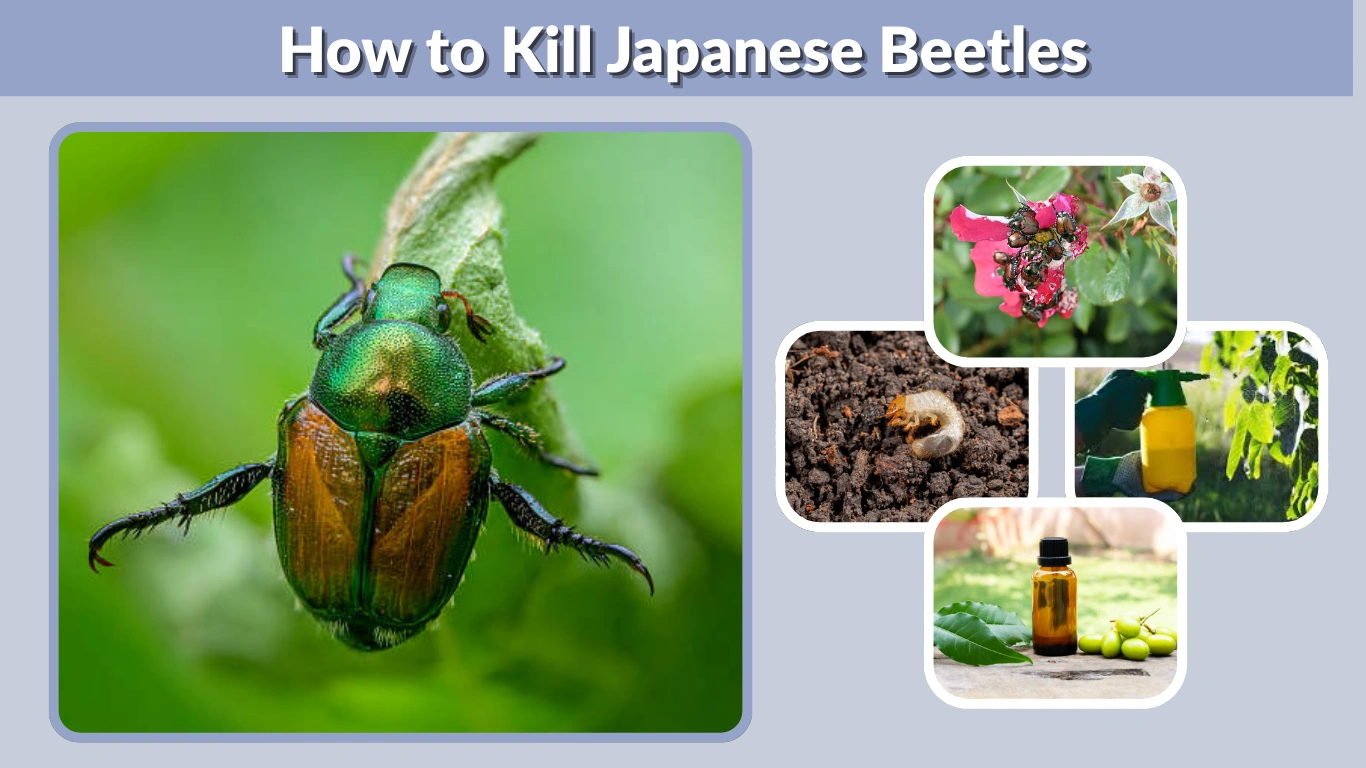
Japanese beetles are among the most destructive garden pests, famous for skeletonizing leaves, destroying roses, and spreading rapidly across lawns and landscapes. Homeowners often search for how to kill Japanese beetles, how to kill Japanese beetle grubs, and how to get rid of them without harming bees or beneficial insects. Because these beetles attack in large groups, a small problem can quickly turn into a serious infestation. This guide explains proven ways to kill Japanese beetles on plants, control them naturally, and stop future outbreaks.
Understanding Japanese Beetles
Japanese beetles (Popillia japonica) are invasive scarab beetles introduced from East Asia. Adult beetles emerge from the soil in early summer and immediately begin feeding on more than 300 plant species, including roses, grapes, linden trees, beans, and fruit crops. They feed in clusters, leaving behind lace-like, skeletonized leaves that quickly turn brown.
The real threat is not only the adult beetles you see on plants but also the unseen grubs living underground. Japanese beetle larvae feed on grassroots, weakening lawns and creating dead patches that lift easily from the soil. Because adults lay eggs in turf, untreated lawns become breeding grounds that release new waves of beetles each year.
Why Japanese Beetles Are Hard to Control
Japanese beetles are difficult to control because they use aggregation pheromones. When one beetle finds a good food source, it releases scents that attract many more. This means a single beetle can quickly turn into hundreds. Killing beetles slowly or leaving damaged plants untreated can actually draw in more beetles.
Another challenge is timing. Adult beetles are visible and easy to target, but if the grubs are ignored, new adults will emerge the following season. Effective control always combines adult beetle removal with grub management.
Identification of Japanese Beetles and Grubs
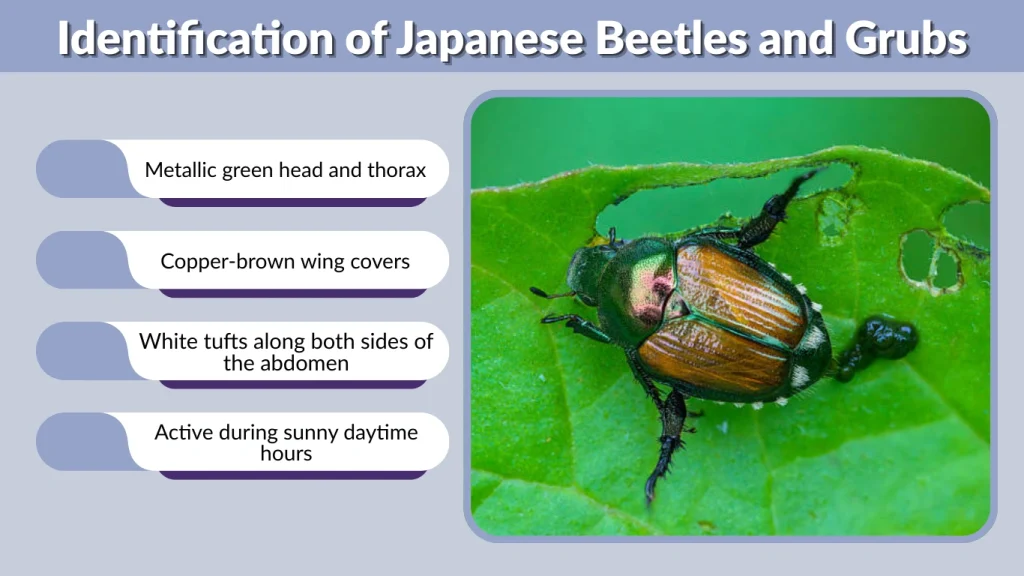
Correct identification ensures you target the right pest.
- Metallic green head and thorax
- Copper-brown wing covers
- White tufts along both sides of the abdomen
- Active during sunny daytime hours
- Feed openly on flowers, fruits, and leaves
- C-shaped white grubs in soil
- Brown head capsule and six small legs
Knowing both adult and grub forms helps you control infestations at every stage.
How to Kill Japanese Beetles on Plants
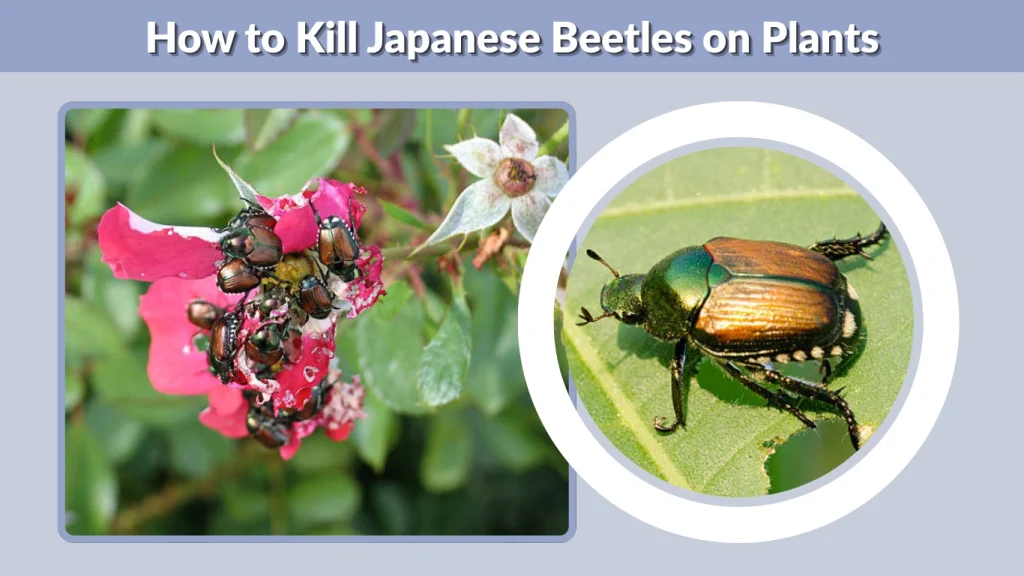
The fastest way to reduce damage is to remove adult beetles as soon as they appear. Early control limits plant injury and reduces the pheromone signals that attract more beetles.
Hand-picking is one of the most effective methods for small to medium infestations. In the early morning, beetles are sluggish and easier to remove. Shake plants over a bucket of water mixed with dish soap. The soapy water breaks surface tension and kills beetles quickly.
Strong water sprays can also knock beetles off leaves, interrupting feeding and mating. Repeated daily removal dramatically lowers beetle numbers within a week.
How to Kill Japanese Beetles on Roses
Roses are among the most heavily attacked plants. Inspect rose bushes daily, focusing on buds, blooms, and upper leaves. Remove beetles by hand early in the morning. Neem oil and insecticidal soap can be used to reduce feeding when applied directly to beetles and leaf surfaces.
Deadheading damaged blooms and pruning heavily infested sections reduces scent signals that attract more beetles. Consistent removal is critical, because roses quickly become gathering points.
How to Kill Japanese Beetles in the Garden
In larger gardens, combine mechanical removal with targeted treatments. Neem oil, spinosad-based sprays, or insecticidal soap can kill beetles on contact and disrupt feeding. Applications should be focused on affected plants rather than broadcast spraying.
Regular monitoring is essential. Removing beetles before populations peak is far more effective than reacting after heavy damage occurs.
How to Naturally Kill Japanese Beetles
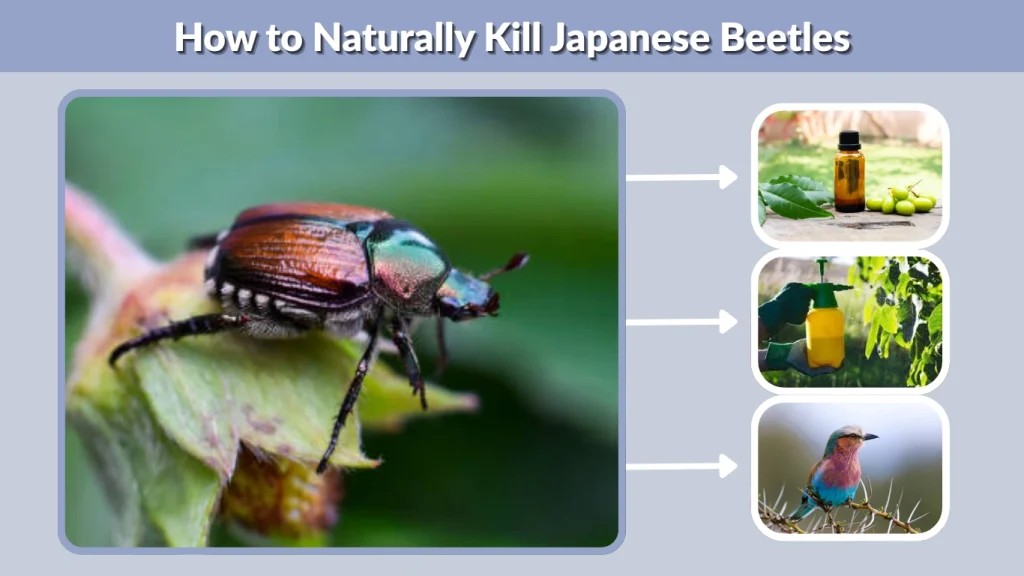
Natural control methods are popular because they reduce environmental harm and protect pollinators when used properly. Organic solutions work best when combined with physical removal.
Neem oil is one of the most widely used natural treatments. It interferes with feeding and reproduction. Insecticidal soap breaks down beetles’ outer coating, leading to dehydration. Both require direct contact and repeated applications.
Beneficial organisms also play a role. Birds, tachinid flies, and parasitic wasps prey on beetles, while beneficial nematodes target grubs in the soil.
Natural Sprays That Kill Japanese Beetles
Common natural sprays include neem oil, garlic-based sprays, and mild soap solutions. These sprays deter feeding, reduce mating, and kill beetles on contact. Applications are most effective in the evening, when pollinators are less active.
How to Get Rid of Japanese Beetles Without Killing Bees
Protecting bees is essential. Spray in the evening or early morning, avoid spraying open flowers, and use spot treatments instead of broad coverage. Mechanical removal and beetle-specific treatments help minimize impact on beneficial insects.
How to Attract and Kill Japanese Beetles
Attraction-based control can be useful when used correctly. Japanese beetles are strongly drawn to floral scents and pheromones. Some gardeners plant sacrificial plants, such as evening primrose or borage, to concentrate beetles in one area where they can be easily removed.
However, attraction methods must be used carefully. Poorly placed lures can pull more beetles into your yard than you kill. Attraction strategies work best when they direct beetles away from valued plants and into controlled kill zones.
How to Trap and Kill Japanese Beetles
Japanese beetle traps use pheromones and floral scents to lure adults into collection bags. When properly positioned, traps can reduce local beetle populations. The key is placement: traps should be set far from gardens and rose bushes, ideally along property edges.
Empty traps frequently. Traps left unattended become odor sources that draw even more beetles. Traps are most effective as population monitoring tools and as part of a broader control plan, not as the only solution.
How to Kill Japanese Beetle Grubs

Eliminating grubs is the foundation of long-term Japanese beetle control. Grubs live underground feeding on grassroots, weakening lawns and creating easy digging spots for birds and animals.
Treating soil prevents new adult beetles from emerging the following season. Without grub control, adult removal becomes an endless cycle.
Best Time to Kill Japanese Beetle Grubs
The most effective time to treat grubs is late summer through early fall, when young larvae are small and close to the soil surface. Spring treatments are less effective because older grubs are deeper and harder to kill.
Soil temperature and moisture play major roles. Treatments work best when soil is moist and above 55°F (13°C).
Effective Grub Control Methods
Beneficial nematodes are microscopic organisms that infect and kill grubs naturally. Milky spore is a bacterial treatment that targets Japanese beetle larvae specifically. Both are long-term biological solutions.
Other options include targeted soil drenches and lawn treatments designed for grub control. Watering lawns properly after treatment improves results and helps treatments penetrate root zones.
How to Kill Japanese Beetles in the House

Japanese beetles occasionally enter homes through open doors, windows, and small gaps. Indoors, they are attracted to light and often gather near windowsills.
The safest way to kill or remove Japanese beetles inside is vacuuming. Dispose of the vacuum contents immediately. Avoid crushing beetles on surfaces, as this can stain walls and release odors.
Indoor Removal and Prevention
Seal entry points, repair window screens, and reduce nighttime lighting near windows. Removing outdoor beetle populations also lowers the chance of indoor encounters.
Chemical vs Natural Japanese Beetle Control
Chemical insecticides offer rapid knockdown but can affect pollinators and beneficial insects. Natural controls are safer for ecosystems but require consistency and monitoring.
The most effective approach is integrated pest management: mechanical removal, targeted natural sprays, and seasonal grub treatment. Chemicals should be reserved for severe infestations and applied precisely according to label directions.
Long-Term Japanese Beetle Prevention
Sustainable prevention reduces future outbreaks.
- Treat lawns yearly to control grubs
- Inspect plants daily during peak beetle season
- Encourage birds and beneficial insects
- Remove heavily infested plants early
- Rotate control methods to avoid resistance
Common Mistakes When Killing Japanese Beetles
Common errors include placing traps near prized plants, spraying during pollinator activity, ignoring grub control, and relying on a single control method. Japanese beetle management is most successful when multiple strategies are combined.
FAQs
How can I kill Japanese beetles naturally?
Japanese beetles can be controlled naturally using hand removal, neem oil, insecticidal soap, garlic sprays, and beneficial insects. These methods work best when started early and repeated consistently, combined with lawn treatments to control grubs.
How do I kill Japanese beetles on roses?
Remove beetles early in the morning, shake them into soapy water, and treat plants with neem oil or insecticidal soap. Prune heavily damaged blooms and inspect roses daily to prevent mass swarming.
What is the best way to kill Japanese beetle grubs?
Beneficial nematodes and milky spore are highly effective biological controls. Late summer and early fall treatments work best, when grubs are small and close to the soil surface.
How can I get rid of Japanese beetles without killing bees?
Use mechanical removal, apply sprays in the evening, avoid open flowers, and target only infested plants. Bee-safe practices rely on timing, precision, and minimal chemical use.
How do I kill Japanese beetles in the house?
Vacuum beetles, dispose of them immediately, seal entry points, and reduce outdoor lighting near windows. Indoor infestations usually indicate heavy outdoor populations.
