

Large black flying insects are often striking in appearance and can be found in a wide variety of habitats, from forests and meadows to gardens and wetlands. Some are harmless nectar feeders, while others are formidable predators or even blood-feeders. Their roles in nature range from pollination and pest control to decomposition. This guide explores 12 remarkable species of large black flying insects, highlighting their unique features, habitats, and behaviors.
1. Black Horse Fly (Tabanus atratus)
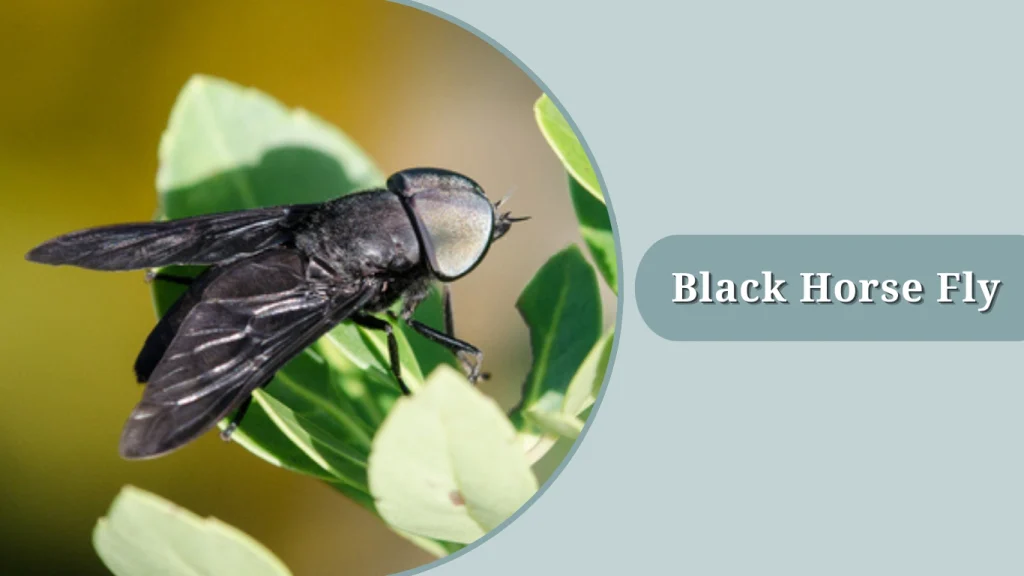
The Black Horse Fly is one of the largest biting flies in North America. Its sheer size and aggressive feeding behavior make it a notorious summer insect around wetlands, farms, and wooded areas. Females are blood-feeders, while males live on nectar.
Identification
- Large, robust body reaching 25–30 mm in length
- Shiny black coloration with broad wings
- Huge compound eyes, often dark or iridescent
- Strong, rapid flight capability
- Females have cutting mouthparts for blood-feeding
Habitat
Common near lakes, rivers, marshes, and damp forests. Females need blood meals to produce eggs, so they often target livestock, horses, and occasionally humans.
Behaviors
Known for persistent biting. Females are aggressive, while males feed harmlessly on nectar. They are powerful fliers and can chase hosts for long distances.
Lifecycle & Lifespan
Eggs are laid on vegetation near water. Larvae develop in wet soil or mud, feeding on small invertebrates. The full life cycle may take a year, though adults live only a few weeks.
Diet
- Females: feed on blood from mammals and sometimes birds
- Males: consume nectar and plant juices
2. Black Carpenter Bee (Xylocopa virginica)
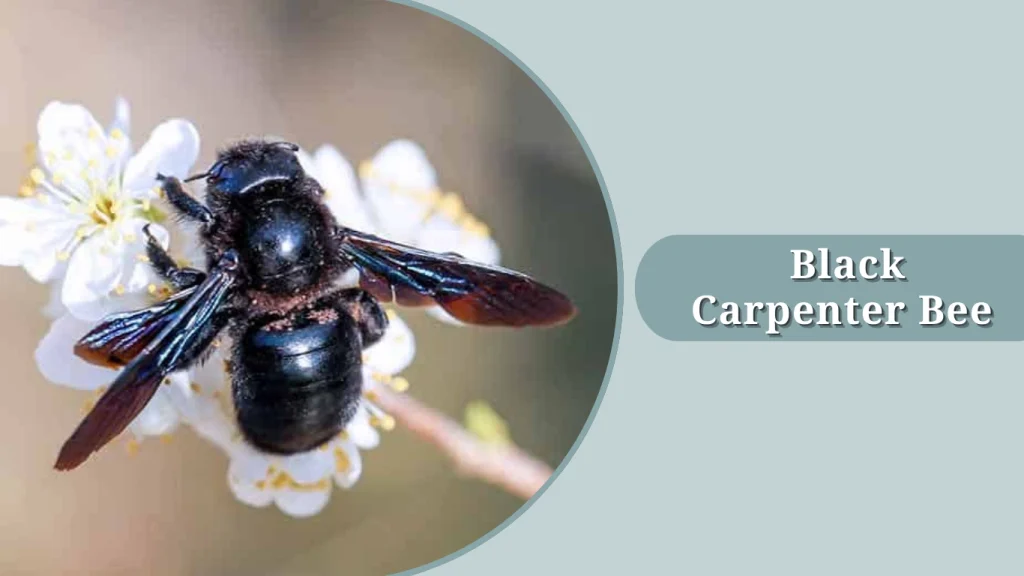
The Black Carpenter Bee is one of the largest bees in North America, often mistaken for a bumblebee. Unlike honeybees, it bores into wood to create nests, which can sometimes cause structural damage.
Identification
- Large, shiny black body, 20–25 mm long
- Robust build with sparse hair compared to bumblebees
- Strong, buzzing flight
- Males have a white or yellow patch on the face; females do not
- Clear wings with a dark tint
Habitat
Common in forests, gardens, and urban areas across the U.S. Prefers untreated or weathered wood for nesting, such as decks, beams, and fences.
Behaviors
Solitary nesters that bore tunnels into wood to lay eggs. Males are territorial but harmless, while females may sting if provoked.
Lifecycle & Lifespan
Females excavate tunnels and lay eggs in separate chambers stocked with pollen and nectar. Adults can live up to one year, overwintering in wood cavities.
Diet
Feeds on nectar and pollen from flowering plants.
3. Black Hornet (Vespa dybowskii)
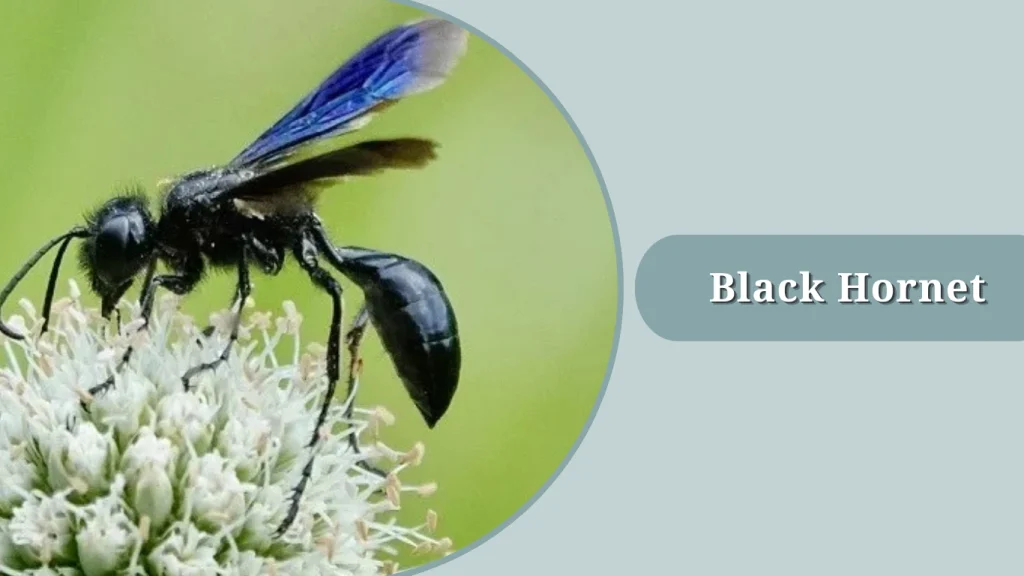
The Black Hornet, also called the Asian Black Hornet, is a large and powerful wasp. Known for its jet-black body, it stands out among other hornet species and is considered a formidable predator.
Identification
- Glossy black body, 18–25 mm long
- Thick, wasp-like build with narrow waist
- Long black wings with smoky tint
- Large mandibles used for hunting insects
- Queens larger than workers
Habitat
Native to East Asia and parts of Siberia. Found in forests, mountains, and rural areas, where it builds paper nests in trees, bushes, or under eaves.
Behaviors
Aggressive defender of its nest. Hunts other insects, especially bees and caterpillars, to feed its larvae. Unlike some hornets, it has a preference for shaded, cooler areas.
Lifecycle & Lifespan
Queens emerge in spring to establish nests. Colonies grow through summer and die off in autumn, with only new queens overwintering. Workers live a few weeks, queens up to a year.
Diet
- Adults: feed on nectar, tree sap, and ripe fruit
- Larvae: consume chewed-up insects provided by adults
4. Giant Ichneumon Wasp (Megarhyssa atrata)

The Giant Ichneumon Wasp is one of the most dramatic-looking insects, often mistaken for a “giant black flying insect” due to its enormous size. Females have an exceptionally long ovipositor that can be mistaken for a stinger, but they are harmless to humans.
Identification
- Slender black body, 20–50 mm long (females larger)
- Females possess an ovipositor that can reach up to 100 mm
- Long, clear wings with a dark tint
- Antennae long and threadlike
- Males smaller and without a long ovipositor
Habitat
Found in forests across North America. Prefers wooded areas where it can find hosts—larvae of wood-boring horntail wasps living inside trees.
Behaviors
Females use their long ovipositor to drill into wood and lay eggs inside the larvae of horntail wasps. Adults are weak fliers and spend most of their time near trees.
Lifecycle & Lifespan
Eggs hatch inside horntail larvae, and ichneumon larvae feed on them. Pupation occurs within the wood, and adults emerge the following summer. Adults live only a few weeks.
Diet
Adults feed on nectar and tree sap. Larvae parasitize wood-boring insects.
5. Black Cicada (Tibicen spp.)

The Black Cicada is a large, loud insect recognized by its droning summer calls. It is one of the most noticeable large black flying insects, especially in warm climates where populations emerge seasonally.
Identification
- Stocky black body, 20–30 mm long
- Large, transparent wings with dark veins
- Bulging, dark compound eyes
- Short antennae
- Males produce loud calls using vibrating membranes (tymbals)
Habitat
Found in woodlands, grasslands, and suburban areas across North America and parts of Asia. Often seen on trees, where adults feed and sing.
Behaviors
Males call loudly to attract females, with choruses that define summer soundscapes. Strong but clumsy fliers, often bumping into lights or buildings at night.
Lifecycle & Lifespan
Cicadas have complex lifecycles, with some species emerging annually and others (periodical cicadas) emerging every 13 or 17 years. Adults live only 4–6 weeks, focused on reproduction.
Diet
- Adults: suck sap from trees and shrubs
- Nymphs: live underground for years, feeding on root juices
6. Black Digger Wasp (Sphex funerarius)

The Black Digger Wasp is a large solitary wasp known for its jet-black body and strong flight. It is often seen hovering low over sandy ground as it searches for nesting sites.
Identification
- Shiny black elongated body, 20–25 mm long
- Long, narrow waist and spiny legs adapted for digging
- Dark, transparent wings
- Large mandibles for subduing prey
- Males slightly smaller and slimmer than females
Habitat
Prefers sandy soils, grasslands, and open areas across Europe and Asia. Often seen in sunny habitats where it can dig nesting burrows.
Behaviors
Females dig burrows and provision them with paralyzed prey—usually grasshoppers or crickets—for their larvae. Solitary nesters, though multiple females may nest in the same area.
Lifecycle & Lifespan
Eggs are laid on paralyzed prey inside burrows. Larvae feed on the fresh prey until maturity. Adults live a few weeks to months during summer.
Diet
- Adults: nectar and plant juices
- Larvae: grasshoppers and crickets provided by the mother
7. Great Black Wasp (Sphex pensylvanicus)

The Great Black Wasp is a large, imposing insect found in North America. Despite its intimidating size and deep black color, it is generally non-aggressive toward humans.
Identification
- Glossy black body, 20–28 mm long
- Long, narrow waist and robust legs
- Wings dark and smoky, often shimmering blue in sunlight
- Females larger and bulkier than males
- Long antennae and powerful mandibles
Habitat
Found in gardens, meadows, and fields across the United States and southern Canada. Prefers open areas with loose soil for nesting.
Behaviors
Females paralyze katydids or grasshoppers and carry them back to underground burrows as food for their larvae. Adults are strong fliers and are frequently seen visiting flowers.
Lifecycle & Lifespan
Eggs are laid on paralyzed prey in the burrow. Larvae feed on the insect until pupation. Adults live a few months during summer and early fall.
Diet
- Adults: feed on nectar from flowers such as milkweed, goldenrod, and thistles
- Larvae: katydids and grasshoppers supplied by females
8. Black Robber Fly (Promachus spp.)

The Black Robber Fly is a fearsome aerial predator often mistaken for a giant black fly. With its powerful flight and hunting skills, it preys on other large insects midair.
Identification
- Large, robust black body, 15–25 mm long
- Long legs covered in bristles
- Strong, dark wings with smoky tint
- Prominent “bearded” face (mystax) for protection
- Resembles a cross between a fly and a dragonfly
Habitat
Found in grasslands, woodlands, and gardens across North America and Europe. Often perches in sunny spots waiting to ambush prey.
Behaviors
Ambush predator: launches from a perch to snatch prey in flight. Known to capture bees, wasps, dragonflies, and even other robber flies. Despite its size, it rarely bothers humans.
Lifecycle & Lifespan
Eggs are laid in soil or decaying wood. Larvae develop for months feeding on soft-bodied insects before pupating. Adults live for a few weeks to months during summer.
Diet
Feeds on other insects, piercing them with a proboscis and injecting digestive enzymes to liquefy tissues.
9. Black Soldier Fly (Hermetia illucens)

The Black Soldier Fly is a common, harmless insect valued for its ecological role. Despite its appearance as a large black flying insect, it does not bite or sting and is often raised for composting and animal feed.
Identification
- Elongated black body, 15–20 mm long
- Clear wings with smoky tips, held folded over the back
- Antennae long and angled forward
- Adults resemble small wasps but lack stingers
- White markings near the head and legs
Habitat
Found worldwide in warm climates, especially around compost, manure, and decaying organic matter. Frequently seen near farms and gardens.
Behaviors
Adults are weak fliers and often rest on walls, windows, or vegetation. Non-aggressive and short-lived, their primary role is reproduction. Larvae are voracious decomposers.
Lifecycle & Lifespan
Eggs are laid in decaying organic matter. Larvae feed for weeks before pupating. Adults live only 5–8 days, surviving on water.
Diet
- Adults: rarely feed, may drink water or nectar
- Larvae: consume decaying plant and animal matter, making them excellent natural recyclers
10. Black Blister Beetle (Epicauta pensylvanica)
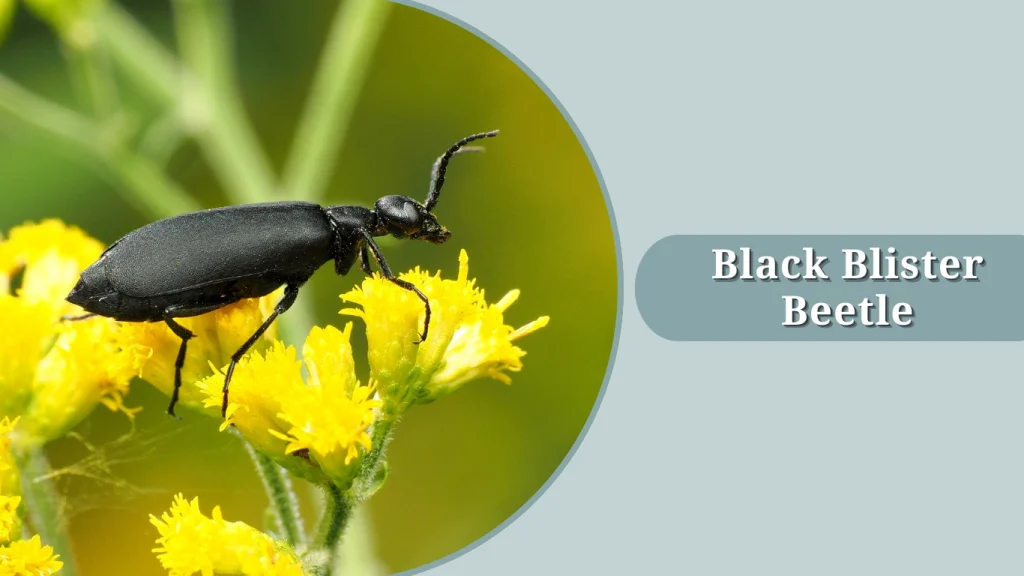
The Black Blister Beetle is a medium-to-large dark beetle sometimes noticed as a black flying insect in gardens and fields. It is known for producing cantharidin, a chemical that can cause skin blisters if handled.
Identification
- Elongated, soft black body, 12–15 mm long
- Narrow pronotum (segment behind the head)
- Flexible wing covers that extend past the abdomen
- Long legs and threadlike antennae
- Adults appear matte black, sometimes with slight sheen
Habitat
Found in fields, meadows, and gardens across eastern North America. Adults are commonly seen on flowering plants.
Behaviors
Adults are weak fliers and often gather in groups on flowers. They release defensive chemicals when threatened. Larvae are parasitic on grasshopper eggs, making them beneficial in controlling grasshopper populations.
Lifecycle & Lifespan
Eggs hatch into mobile larvae that seek out grasshopper egg pods. Later larval stages become immobile before pupating. Adults emerge in late spring or summer and live several weeks.
Diet
- Adults: feed on flowers, leaves, and crops such as alfalfa
- Larvae: consume grasshopper eggs
11. Black Oil Beetle (Meloe spp.)
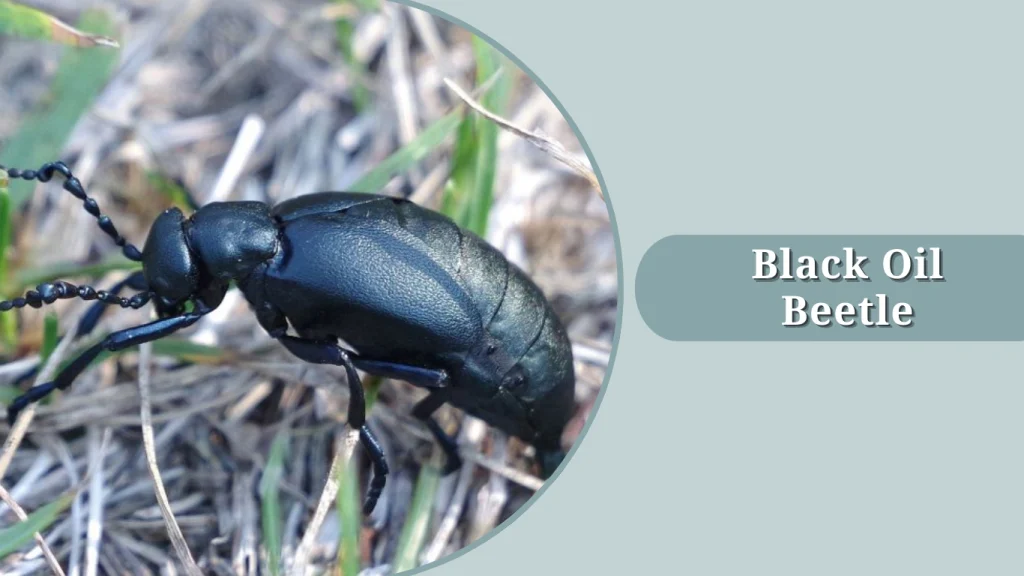
The Black Oil Beetle is a large, heavy-bodied beetle that sometimes takes flight, though it is more commonly seen walking. Its unusual life cycle and chemical defenses make it a fascinating insect.
Identification
- Bulky, shiny black body, 10–15 mm long (some species larger)
- Soft, shortened wing covers that expose the abdomen
- Cylindrical, bloated body shape
- Short antennae with segmented tips
- Females noticeably larger than males
Habitat
Common in fields, grasslands, and gardens across North America and Europe. Often found crawling low on plants and soil.
Behaviors
Adults are slow-moving and release toxic cantharidin when threatened. Larvae are highly specialized, hitchhiking on bees to reach nests where they consume eggs and provisions.
Lifecycle & Lifespan
Eggs are laid in soil. First-stage larvae climb flowers and attach to visiting bees. They develop inside bee nests, pupating before emerging as adults the next year. Adults live only a few weeks.
Diet
- Adults: feed on flowers and foliage
- Larvae: parasitic on solitary bees, consuming their eggs and stored pollen/nectar
12. Black Ground Beetle (Carabus spp. – flying types)
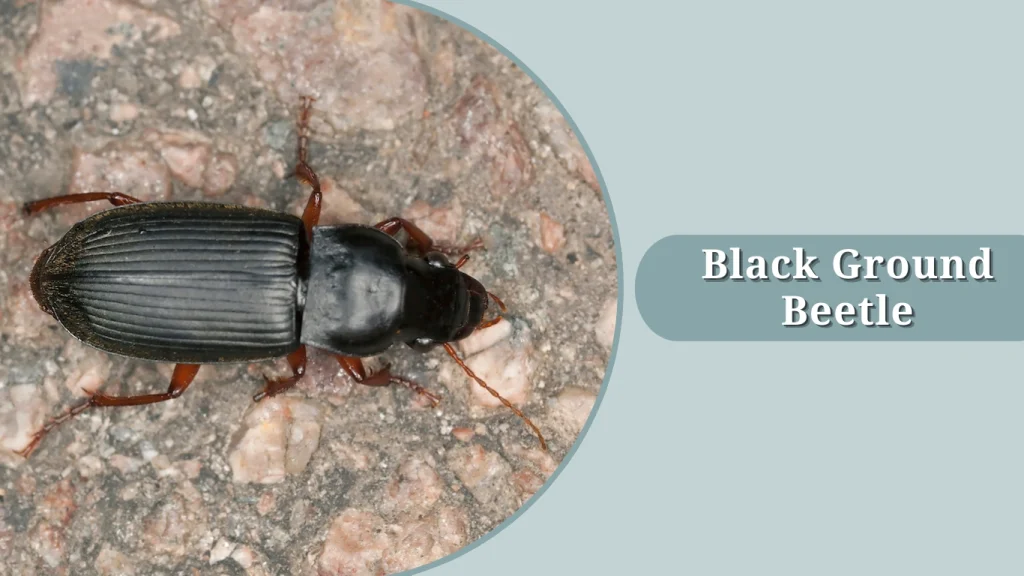
The Black Ground Beetle is a member of a large family of predatory beetles. While many species are strictly ground-dwellers, some can take flight, making them noticeable as a large black flying insect during warm nights.
Identification
- Glossy black or dark metallic body, 10–12 mm long (some species larger)
- Long legs adapted for running
- Strong mandibles for hunting
- Elytra (wing covers) often ridged or grooved
- Some species fully winged and capable of flight
Habitat
Found in forests, grasslands, gardens, and farmland worldwide. Often shelter under stones, logs, and leaf litter during the day, becoming active at night.
Behaviors
Primarily nocturnal hunters. Some species climb vegetation or fly short distances in search of prey. Despite their size, they avoid humans and pose no threat.
Lifecycle & Lifespan
Eggs are laid in soil. Larvae are active predators before pupating into adults. Adults can live 1–2 years, longer than many other beetles.
Diet
- Adults and larvae: feed on caterpillars, slugs, snails, and other insects
- Important natural pest controllers in gardens and crops
