
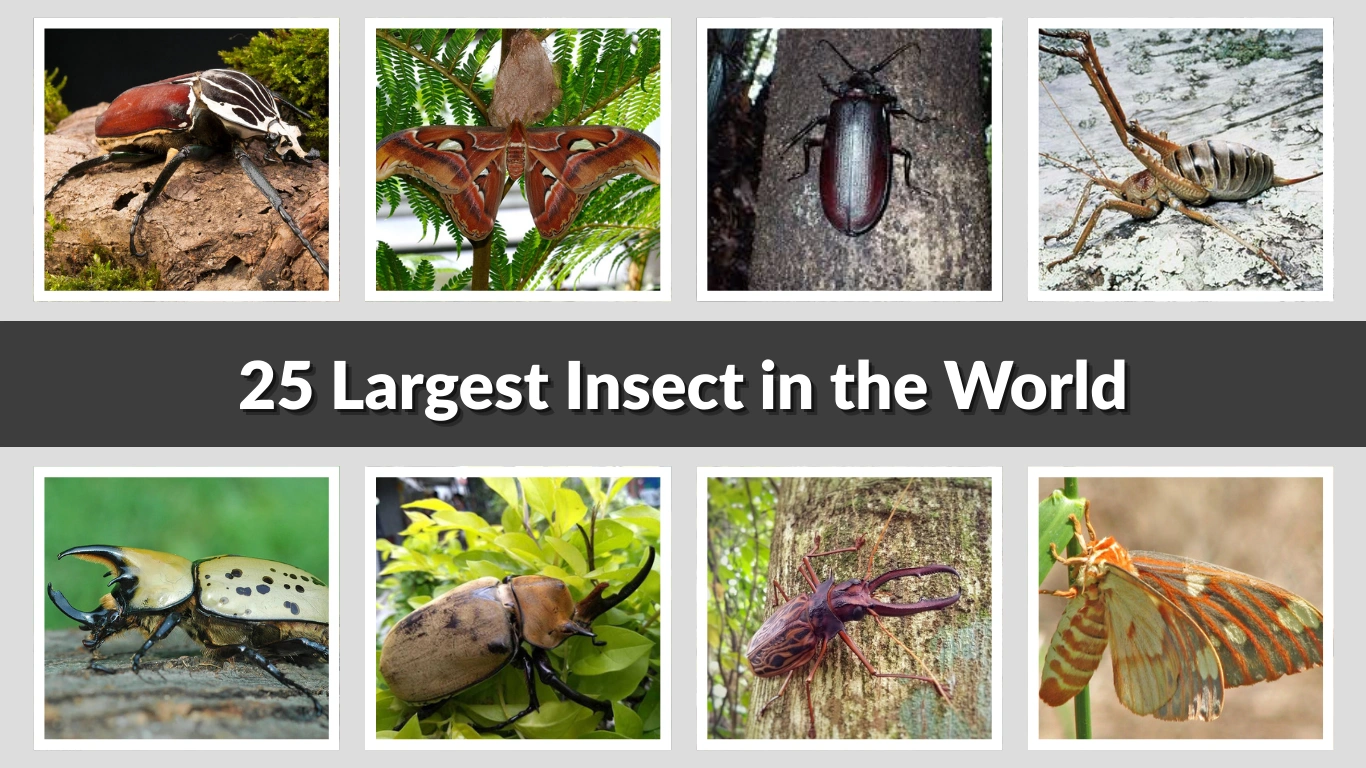
Insects are some of the most diverse and fascinating creatures on Earth, but a few stand out for their enormous size. From giant beetles with powerful horns to butterflies with birdlike wings, these colossal insects dominate their habitats with strength, beauty, or camouflage. In this article, we’ll explore the 25 largest insects in the world, highlighting their identification, behavior, habitat, and importance in ecosystems.
1. Goliath Beetle

The Goliath Beetle (Goliathus goliatus) stands out as one of the heaviest and most powerful insects in the world. These beetles belong to the scarab family (Scarabaeidae) and are widely admired for their massive size, striking color patterns, and strength, which allows them to lift objects several times their own body weight. Native to Africa’s tropical forests, they are sometimes referred to as “giants of the insect world” because of their extraordinary bulk and dominance among beetles.
Identification
- Scientific Name: Goliathus goliatus
- Family: Scarabaeidae (Scarab beetles)
- Length: Males can reach 4–5 inches (100–120 mm), while females are slightly smaller
- Weight: Up to 100 grams (3.5 ounces), making them among the heaviest insects on Earth
- Color Pattern: Distinctive black, white, or brown markings across the wings and thorax
- Sexual Dimorphism: Males have a Y-shaped horn on their head used for fighting other males, while females lack this feature
- Lifespan: Around 1 year in the wild; slightly longer in captivity under controlled care
Behavior
Goliath Beetles are diurnal, meaning they are most active during the day. Males are territorial and use their horns to wrestle rivals when competing for food or mates. Their larval stage is particularly interesting, as the larvae can weigh more than 100 grams, consuming large amounts of decaying matter and protein to grow. Adults feed mainly on high-sugar foods such as fruit, nectar, and tree sap, but in captivity, they can adapt to diets of dog food or commercial beetle jelly for added protein.
Habitat
These beetles are found in dense tropical and subtropical forests across central and western Africa, especially in countries such as Cameroon, Congo, and Nigeria. They thrive in humid climates with abundant vegetation, which provides both food sources and shelter. During their larval stage, they live in the soil, feeding on decaying plant matter, while adults are often seen on trees and flowering plants.
Importance
Goliath Beetles play an important ecological role in nutrient cycling by breaking down rotting organic matter and aiding in soil fertility. They are also highly prized among insect collectors due to their rarity, vibrant colors, and large size. In some cultures, they are kept as exotic pets, while in others, they symbolize strength and resilience. Additionally, researchers study them to better understand insect development, adaptation, and biomechanics, since they are capable of lifting objects over 800 times their body weight.
2. Atlas Moth
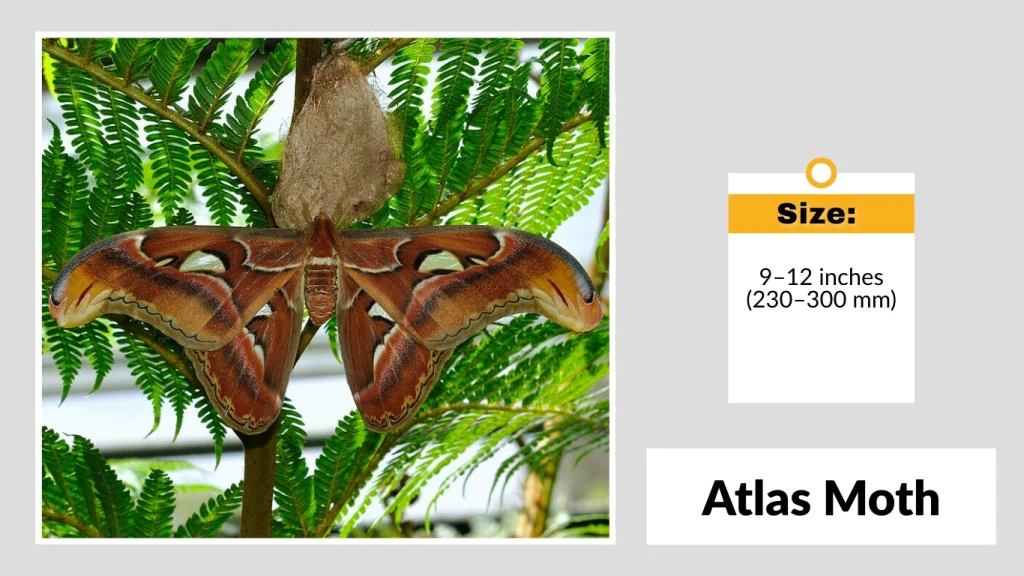
The Atlas Moth (Attacus atlas) is one of the largest moths in the world, with wings so broad and patterned that they resemble the head of a snake at the tips, a natural defense against predators. Native to the tropical and subtropical forests of Asia, this moth is a true giant among insects, admired for both its massive wingspan and its striking beauty. Despite its size, the Atlas Moth lives only a short time in its adult stage, as it lacks functional mouthparts and survives solely on energy stored from its caterpillar stage.
Identification
- Scientific Name: Attacus atlas
- Family: Saturniidae (giant silk moths)
- Wingspan: 9–12 inches (230–300 mm), among the largest of any moth
- Color Pattern: Rusty red or brown wings with triangular transparent “windows” and snake-like tips
- Body Size: Surprisingly small compared to its wings, making the wings even more impressive
- Lifespan: 1–2 weeks as an adult moth
- Caterpillar Stage: Large green caterpillars covered with fleshy spines, feeding heavily on leaves
Behavior
Atlas Moths are primarily nocturnal, flying at night to avoid predators. Adults do not eat; instead, they rely entirely on fat reserves stored during the caterpillar phase. Their short life is dedicated to reproduction, with males using their large, feathery antennae to detect female pheromones from several miles away. The snake-like wing tips also serve as a defense mechanism, deterring predators such as birds and lizards.
Habitat
Atlas Moths are distributed throughout South and Southeast Asia, including India, Malaysia, Indonesia, and the Philippines. They prefer tropical rainforests and secondary forests, where humidity is high and host plants are abundant for their caterpillars. The caterpillars feed on a wide range of plants, including guava, cinnamon, and citrus species.
Importance
The Atlas Moth holds ecological and cultural significance. Its caterpillars contribute to the balance of plant life by feeding on tree leaves, while adult moths are prey for bats and other nocturnal predators, thus supporting the food web. In some regions, their silk—called “fagara silk”—is harvested from the cocoons, though it is coarser than that of domesticated silkworms. The moth’s sheer size and beauty also make it a favorite subject for photographers, naturalists, and educators aiming to raise awareness about insect diversity.
3. Titan Beetle

The Titan Beetle (Titanus giganteus) is considered one of the largest beetles in the world, famous for its massive size and powerful jaws. Native to the Amazon rainforest, this beetle can grow longer than many people’s hands, making it a true giant among insects. Its strong mandibles are capable of snapping pencils in half and even piercing human skin, which makes it both fascinating and intimidating. Despite its fearsome appearance, it spends most of its life hidden in the rainforest canopy, rarely seen by humans.
Identification
- Scientific Name: Titanus giganteus
- Family: Cerambycidae (longhorn beetles)
- Length: Up to 6.5 inches (170 mm)
- Color: Dark brown to black, with a shiny exoskeleton
- Body Features: Elongated body with long legs and extremely strong mandibles
- Larvae: Believed to live inside decaying wood, though very rarely observed
- Lifespan: Several years in larval stage; a few weeks to months as adults
Behavior
Titan Beetles are nocturnal and mostly active at night, when they fly in search of mates. Their strong mandibles are used defensively against predators rather than for feeding, since adults are thought not to eat much, if at all. Instead, they rely on the energy stored during their larval stage. When threatened, Titan Beetles hiss by rubbing their wings against their abdomen, a sound that warns predators of their strength.
Habitat
This beetle is found across the Amazon Basin, including countries such as Brazil, Peru, Colombia, Ecuador, and French Guiana. They prefer dense tropical rainforests, where decaying wood provides shelter for their larvae and the humid climate supports their survival. The larvae are believed to live hidden deep inside logs and tree trunks, feeding on rotting wood for years before transforming into adults.
Importance
The Titan Beetle plays a vital role in forest ecosystems, as its larvae help decompose dead wood and recycle nutrients back into the soil. Its presence is also an indicator of healthy rainforest conditions. Beyond its ecological role, the beetle has become a symbol of the Amazon’s biodiversity and is highly valued by insect collectors due to its rarity and size. Researchers continue to study it to learn more about its hidden larval stage, which remains one of the least understood aspects of its life cycle.
4. Giant Weta
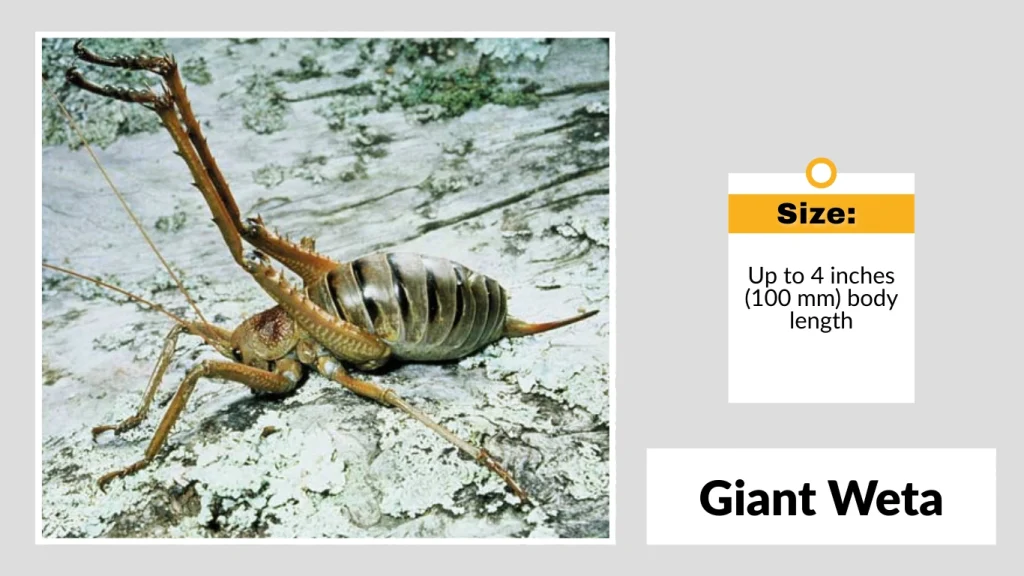
The Giant Weta (Deinacrida species) is one of the heaviest insects in the world, sometimes weighing more than a sparrow. Native to New Zealand, these large, flightless insects belong to the family Anostostomatidae and are often described as “prehistoric crickets” because of their massive bodies and long legs. There are around 11 species of Giant Weta, many of which are endangered and found only on small, predator-free islands. Their impressive weight and unique evolutionary history make them one of the most remarkable insects on Earth.
Identification
- Scientific Name: Deinacrida (genus)
- Family: Anostostomatidae
- Length: Up to 4 inches (100 mm) body length, excluding legs and antennae
- Weight: Some females can weigh over 70 grams, heavier than most small birds
- Color: Usually brown or earthy tones, with rough exoskeleton texture
- Body Features: Large, bulky body with long spiny legs and long antennae
- Lifespan: Around 2 years in the wild
Behavior
Giant Wetas are nocturnal and prefer to remain hidden during the day in logs, burrows, or under leaves. They are mostly herbivorous, feeding on leaves, fruit, and flowers, though some species may consume small invertebrates when available. Unlike many insects, they do not jump often because of their heavy bodies. Instead, they slowly crawl through vegetation. Giant Wetas are generally non-aggressive, but when threatened, they can raise their legs and produce a rasping sound to deter predators.
Habitat
These insects are native to New Zealand and were once widespread across the mainland. However, the introduction of predators such as rats, cats, and stoats has driven many species close to extinction. Today, they survive mostly on small offshore islands and conservation sanctuaries where predators are controlled. They thrive in forests, scrublands, and grasslands, depending on the species.
Importance
Giant Wetas are ecologically important as herbivores, helping maintain plant growth balance by feeding on leaves and fruit. They are also a key part of New Zealand’s natural heritage, symbolizing the country’s unique evolutionary history. Conservationists are working to protect Giant Wetas through predator-free reserves and breeding programs. Their sheer size and rarity also make them important ambassadors for insect conservation, drawing global attention to the challenges faced by island ecosystems.
5. Hercules Beetle
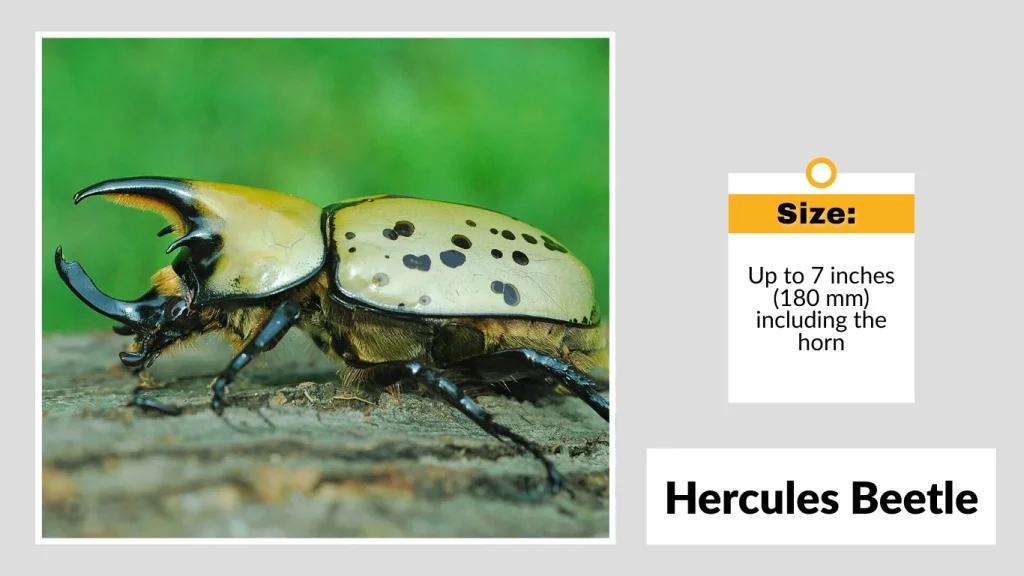
The Hercules Beetle (Dynastes hercules) is one of the longest beetles in the world and a true icon of insect strength. Famous for its enormous size and impressive horn, this beetle belongs to the rhinoceros beetle group within the Scarabaeidae family. Found in the rainforests of Central and South America, males are instantly recognizable by their massive horns, which can be longer than their own body. Despite their fearsome look, Hercules Beetles are harmless to humans and rely mainly on decaying fruit and plant matter for food.
Identification
- Scientific Name: Dynastes hercules
- Family: Scarabaeidae (rhinoceros beetles)
- Length: Up to 7 inches (180 mm) including the horn
- Weight: Around 85–140 grams, depending on food availability and sex
- Color: Elytra (wing covers) usually olive-green, yellow, or brown, with black spots; color can change depending on humidity
- Sexual Dimorphism: Males have long, curved horns extending from the head and thorax; females lack horns and are smaller
- Lifespan: 1–2 years as larvae; 3–6 months as adults
Behavior
Male Hercules Beetles are known for their strength and aggression during mating competitions. They use their massive horns to wrestle rivals, flipping them over to secure access to females. Despite their strength, adults are not active predators—they feed mostly on decaying fruit, sap, and occasionally tree bark. Their larvae, which can reach up to 4.5 inches long, live underground in rotting wood and consume decaying plant matter. Interestingly, the beetle’s elytra can change color from greenish to black depending on humidity levels, an adaptation thought to help with camouflage.
Habitat
Hercules Beetles inhabit tropical rainforests of Central America, South America, and parts of the Caribbean, particularly in countries like Mexico, Colombia, Venezuela, and Brazil. They thrive in moist, forested environments where fallen fruit and decaying wood are plentiful. Larvae develop underground, where they remain hidden for most of their lives before pupating and emerging as adults.
Importance
Ecologically, Hercules Beetles are essential decomposers, breaking down rotting organic matter and enriching soil nutrients. Their unique strength—they can lift objects up to 850 times their body weight—has made them a subject of fascination in scientific research, particularly in studies of biomechanics. They are also popular in insect collections and cultural symbolism, where they often represent power and resilience. In some regions, conservation efforts are crucial, as deforestation and habitat loss threaten their populations.
6. White Witch Moth
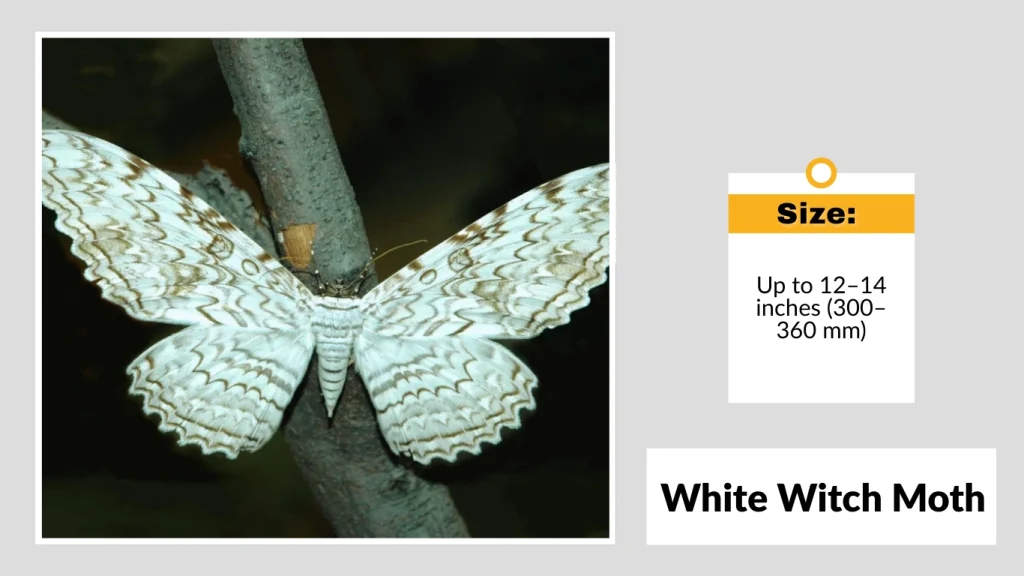
The White Witch Moth (Thysania agrippina) is often regarded as the insect with the largest wingspan in the world, making it a true giant among moths. Its pale, ghostly wings stretch wider than most birds, giving it a striking and ethereal appearance when in flight. Known as “La Bruja Blanca” in Spanish (meaning “the White Witch”), this moth is rare to see in the wild due to its nocturnal habits and wide but sparse distribution across Central and South America.
Identification
- Scientific Name: Thysania agrippina
- Family: Erebidae
- Wingspan: Up to 12–14 inches (300–360 mm), the widest recorded of any insect
- Color: White to gray with delicate wavy patterns resembling tree bark
- Body Size: Relatively small compared to its wings
- Lifespan: Adults live only a few days to a week, as they do not feed
Behavior
The White Witch Moth is nocturnal and attracted to light, which is often how it is spotted. Adults do not feed and instead dedicate their short lives to reproduction. The broad wings with bark-like markings help them blend into tree trunks during the day, providing camouflage from predators like birds and bats.
Habitat
This moth ranges across Mexico, Central America, and South America, particularly in tropical forests and humid environments. It prefers areas with tall trees where it can rest undisturbed and where its caterpillars have access to host plants.
Importance
Though rare, the White Witch Moth holds ecological significance as part of the forest food chain, serving as prey for nocturnal predators. It also fascinates entomologists and collectors due to its record-breaking wingspan and ghostly beauty, symbolizing the mysterious diversity of the insect world.
7. Megasoma Beetle
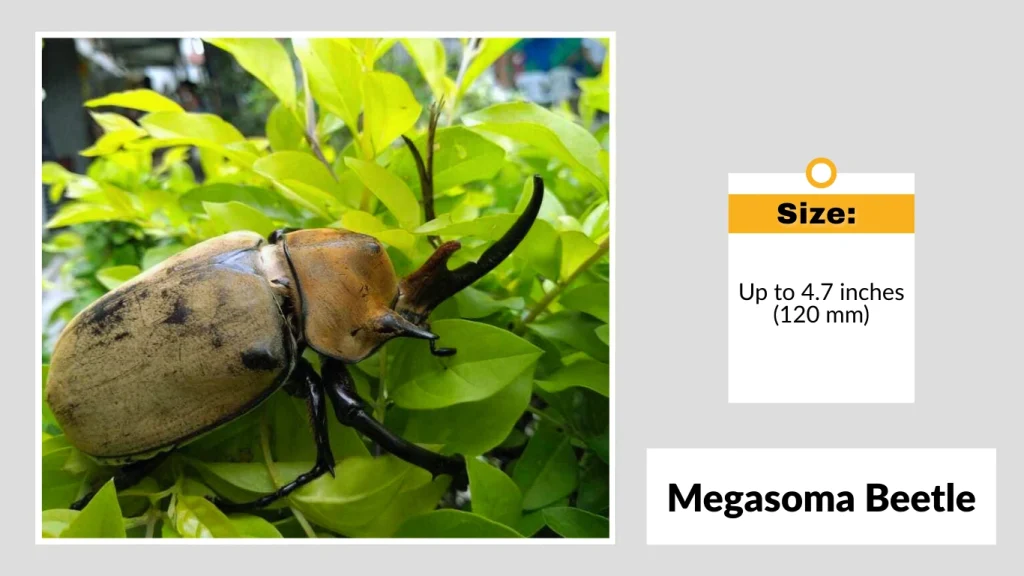
The Megasoma Beetle (Megasoma elephas and related species) is one of the heaviest beetles on Earth, rivaling the Goliath and Hercules beetles in size. Known for their bulk and horned appearance, these beetles belong to the rhinoceros beetle group and are primarily found in Central and South America. Their massive bodies, thick exoskeletons, and strong horns make them powerful competitors in the insect kingdom.
Identification
- Scientific Name: Megasoma elephas (Elephant Beetle), among other species
- Family: Scarabaeidae (rhinoceros beetles)
- Length: Up to 4.7 inches (120 mm)
- Weight: Around 80–100 grams
- Color: Dark brown to black, often covered in fine yellowish hair, giving a velvety look
- Sexual Dimorphism: Males have large forward-curving horns; females are hornless and smaller
- Lifespan: 1–2 years as larvae; several months as adults
Behavior
Megasoma Beetles are nocturnal and spend much of their time hidden in logs or under vegetation. Males use their horns to battle one another, flipping rivals during competition for mates. Their diet consists of fruit, tree sap, and rotting plant material, while larvae develop in decaying wood, consuming large amounts of organic matter.
Habitat
These beetles inhabit tropical rainforests and cloud forests across Central America and South America, particularly in countries like Costa Rica, Ecuador, and Brazil. They thrive in areas with abundant fruiting trees and decaying wood, which provide food for both adults and larvae.
Importance
Megasoma Beetles play a vital ecological role as decomposers, recycling nutrients from rotting material. Their size and strength have made them popular in insect exhibitions and collections. In some cultures, they are symbols of endurance and toughness. Conservation efforts are important, as habitat destruction and deforestation pose threats to their survival.
8. Queen Alexandra’s Birdwing Butterfly
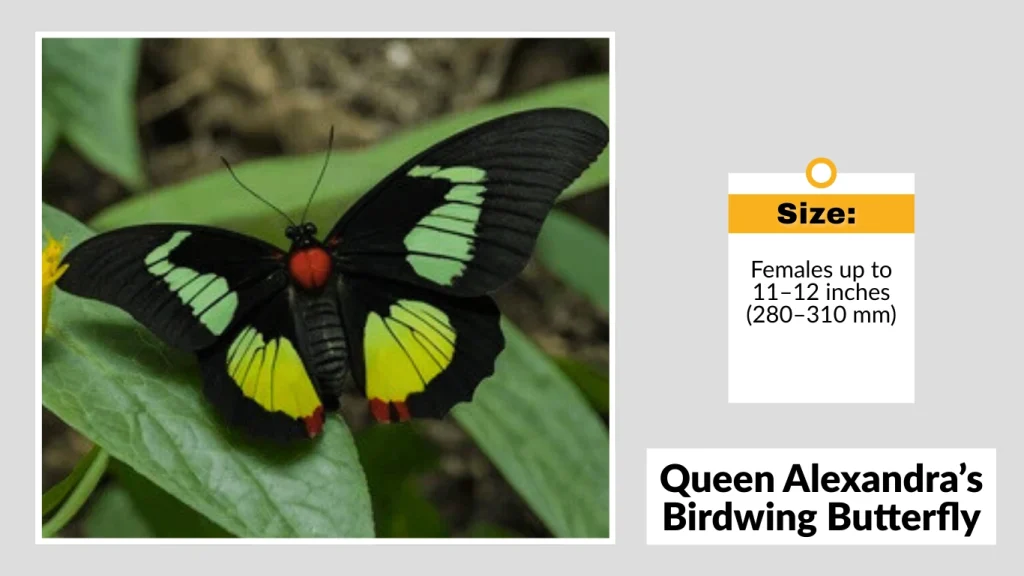
The Queen Alexandra’s Birdwing (Ornithoptera alexandrae) is the largest butterfly in the world, with wings so broad and vibrant that it looks more like a bird than an insect in flight. Native to Papua New Guinea, this butterfly is a rare and protected species, admired for its dazzling size and beauty. Unfortunately, it is also critically endangered due to deforestation and habitat destruction.
Identification
- Scientific Name: Ornithoptera alexandrae
- Family: Papilionidae (swallowtail butterflies)
- Wingspan: Females up to 11–12 inches (280–310 mm); males smaller at around 8 inches (200 mm)
- Color: Females are brown with cream spots and blue markings; males are iridescent blue-green with striking patterns
- Body Size: Large, sturdy body capable of strong, birdlike flight
- Lifespan: Around 3 months in the wild
Behavior
Males are highly active and patrol territories to find females, often flying high above the treetops. They feed on nectar from rainforest flowers, using their long proboscis. Females are larger and slower, focusing on laying eggs, which they deposit on specific host plants. Caterpillars are equally impressive, feeding voraciously on toxic leaves, which provide them with chemical protection against predators.
Habitat
This butterfly is found only in the lowland rainforests of Oro Province, Papua New Guinea. Its habitat includes areas with plenty of Aristolochia vines, the exclusive host plants for its larvae. Because of its very limited range, the species is extremely vulnerable to habitat loss.
Importance
The Queen Alexandra’s Birdwing is a flagship species for conservation in Papua New Guinea. Its rarity and beauty have made it a symbol of biodiversity, though it has also been threatened by illegal trade among collectors. Conservationists are working to protect its rainforest home, as the survival of this butterfly is tied directly to the preservation of its ecosystem.
9. Macrodontia Cervicornis (Sabertooth Longhorn Beetle)
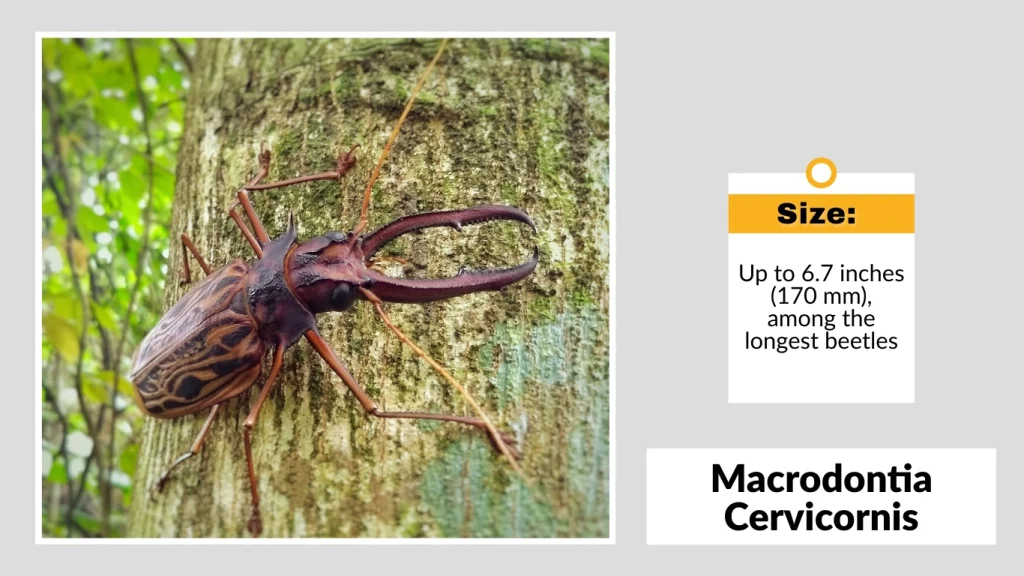
The Sabertooth Longhorn Beetle (Macrodontia cervicornis) is one of the largest beetles in the world, known for its huge size and massive mandibles, which resemble the fangs of a saber-toothed cat. This beetle is rare and highly sought after by insect collectors due to its formidable appearance and scarcity.
Identification
- Scientific Name: Macrodontia cervicornis
- Family: Cerambycidae (longhorn beetles)
- Length: Up to 6.7 inches (170 mm), among the longest beetles
- Color: Dark brown to reddish with elongated antennae
- Body Features: Gigantic jaws in males, used for defense and competition
- Larvae: Large wood-boring grubs that develop inside rotting logs for years
- Lifespan: Several years as larvae, a few months as adults
Behavior
Males use their enormous mandibles during combat with rivals, clashing head-to-head to secure mating rights. Despite their size, adults are thought to eat very little, relying on energy stored from their larval stage. The larvae are wood borers, tunneling through dead or decaying trees, which makes them important in decomposition processes. Adults are nocturnal and rarely seen, making encounters with them extraordinary.
Habitat
This beetle is native to South America, especially in countries like Brazil, Ecuador, Peru, and Colombia. They live in tropical rainforests, where larvae burrow deep into rotting logs and adults emerge during warm, humid seasons.
Importance
Ecologically, Macrodontia cervicornis contributes to forest health by breaking down decaying trees and recycling nutrients. Its rarity and size have made it one of the most famous longhorn beetles in the world. However, habitat destruction and illegal collecting have reduced its population, raising conservation concerns.
10. Giant Burrowing Cockroach

The Giant Burrowing Cockroach (Macropanesthia rhinoceros), also called the Rhinoceros Cockroach or Queensland Giant Cockroach, is the heaviest cockroach in the world and one of the longest-lived insects. Unlike household cockroaches, this species is harmless, wingless, and ecologically beneficial. Native to Australia, it plays an important role in recycling leaf litter and maintaining soil health.
Identification
- Scientific Name: Macropanesthia rhinoceros
- Family: Blaberidae
- Length: Up to 3.3 inches (85 mm)
- Weight: Can reach over 30 grams, making it the heaviest cockroach
- Color: Dark brown, glossy exoskeleton
- Body Features: Broad, armored body and strong front legs adapted for digging
- Lifespan: Up to 10 years, one of the longest lifespans for an insect
Behavior
This cockroach is nocturnal and fossorial, spending most of its life underground in burrows up to a meter deep. It is not a pest—it does not infest human homes or feed on stored food. Instead, it feeds on dry eucalyptus leaves and organic litter. Males sometimes fight over territory, using their strong pronotum to push rivals away from burrow entrances.
Habitat
The Giant Burrowing Cockroach is found in northeastern Australia, particularly in Queensland. It prefers sandy soils where it can easily dig burrows, and eucalyptus forests where its food source is abundant.
Importance
Ecologically, this cockroach is vital for recycling dead plant material, enriching the soil, and promoting forest health. It is also popular as a pet in Australia due to its docile nature and low maintenance. Far from being a nuisance, it represents the diverse and beneficial side of cockroaches.
11. Tarantula Hawk Wasp
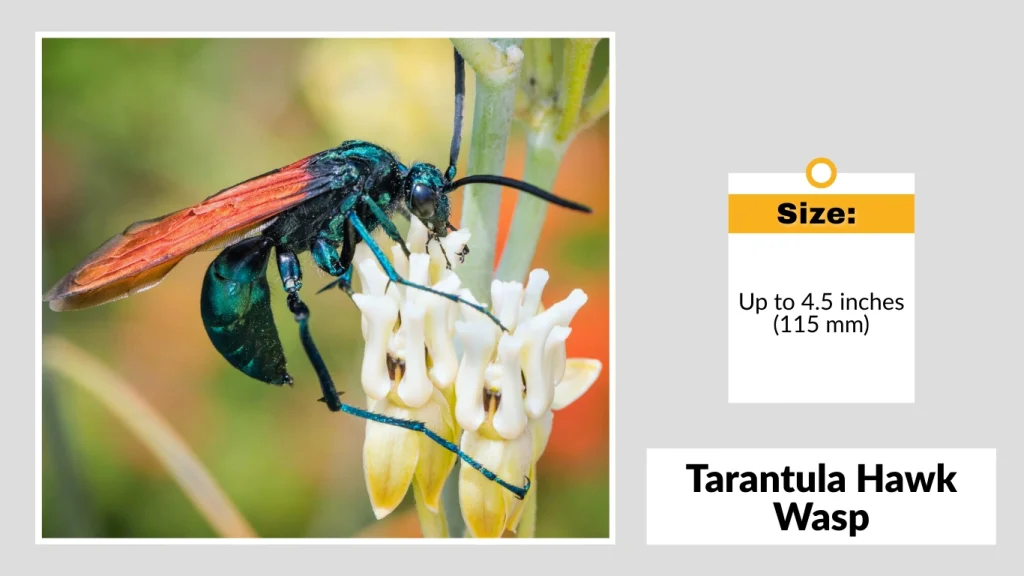
The Tarantula Hawk Wasp (Pepsis grossa and related Pepsis species) is one of the largest wasps in the world and is infamous for having one of the most painful stings known to humans. These wasps are fearless hunters of tarantulas, which they paralyze and use as living hosts for their larvae. Despite their fearsome reputation, adults are not aggressive toward humans unless provoked.
Identification
- Scientific Name: Pepsis grossa (one of several species)
- Family: Pompilidae (spider wasps)
- Length: 2–2.7 inches (50–70 mm)
- Wingspan: Up to 4.5 inches (115 mm)
- Color: Metallic blue-black body with striking orange or rust-colored wings
- Sting: Ranked among the most painful stings in the insect world, though not lethal
- Lifespan: Several months, depending on food and climate
Behavior
Female Tarantula Hawk Wasps are specialized hunters. They sting and paralyze tarantulas, then drag them into burrows where they lay a single egg on the spider’s abdomen. The wasp larva hatches and slowly consumes the still-living tarantula. Adults feed primarily on nectar and fermented fruit, and are powerful fliers, often seen gliding in open habitats. Despite their size and sting, they rarely attack humans unless handled.
Habitat
Tarantula Hawk Wasps are found across deserts, grasslands, and forests of the Americas, especially in the southwestern United States, Central America, and South America. They prefer warm climates where tarantulas are common.
Importance
Ecologically, Tarantula Hawk Wasps help regulate tarantula populations, maintaining balance in ecosystems. They are also important pollinators, feeding on nectar from a variety of flowers. Culturally, they are both feared and respected due to their painful sting, and in some regions, they are even designated as state insects (such as in New Mexico, USA).
12. Elephant Beetle
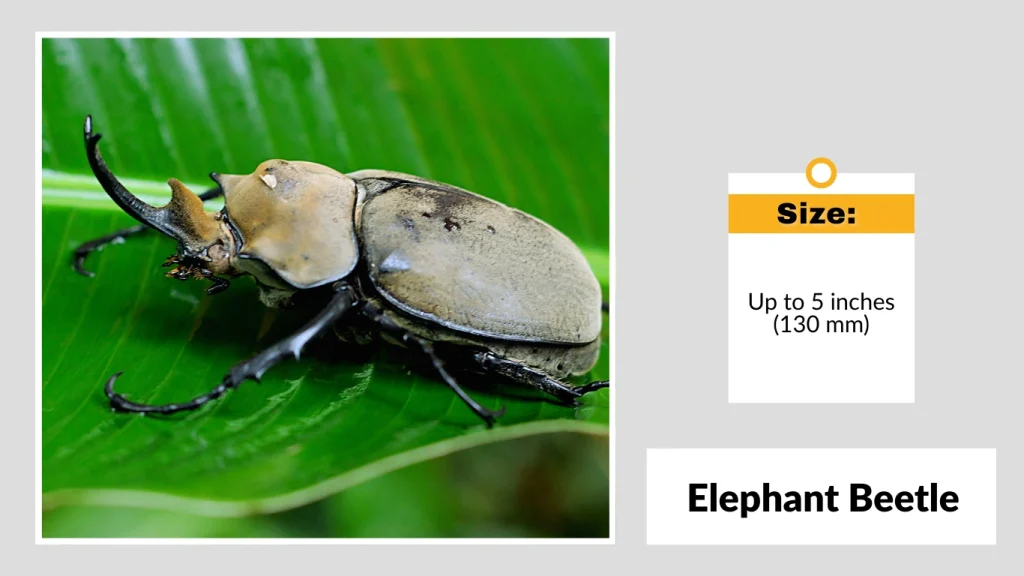
The Elephant Beetle (Megasoma elephas) is one of the largest rhinoceros beetles in the world, well-known for its impressive horns and bulky body. Named for its elephant-like strength and size, this beetle is a close relative of the Hercules Beetle. Males use their large horns in combat, while females are hornless but still massive. They are gentle giants, harmless to humans, and play a vital role in rainforest ecosystems.
Identification
- Scientific Name: Megasoma elephas
- Family: Scarabaeidae (rhinoceros beetles)
- Length: Up to 5 inches (130 mm)
- Weight: 80–120 grams
- Color: Dark brown to black, covered in a yellowish fuzz that gives a velvety look
- Sexual Dimorphism: Males have two large forward-curving horns; females are hornless and smaller
- Lifespan: 1–2 years as larvae, several months as adults
Behavior
Male Elephant Beetles use their horns to fight rivals, lifting and flipping competitors to win access to females. Despite their fearsome appearance, they feed mainly on tree sap and fruit. Their larvae live inside rotting logs, consuming decaying plant matter for years before emerging as adults. Adults are mostly nocturnal, flying at night in search of mates.
Habitat
This beetle inhabits tropical rainforests across Central and South America, especially in Costa Rica, Panama, Colombia, and Brazil. It thrives in moist, dense forests where decaying wood and fruit are abundant.
Importance
Elephant Beetles are crucial decomposers, recycling nutrients from fallen trees and plant matter. Their strength and unique appearance have made them popular in insect collections, and in some cultures, they symbolize endurance and power. However, deforestation poses a threat to their natural habitats.
13. Actaeon Beetle

The Actaeon Beetle (Megasoma actaeon) is one of the heaviest beetles in the world and a close relative of the Hercules and Elephant beetles. Known for its sheer bulk and solid appearance, it is less elongated than the Hercules Beetle but far more massive. Some specimens weigh more than 150 grams, making it one of the heaviest insects on record.
Identification
- Scientific Name: Megasoma actaeon
- Family: Scarabaeidae (rhinoceros beetles)
- Length: Up to 5 inches (130 mm)
- Weight: Can exceed 150 grams, heavier than Hercules and Elephant beetles
- Color: Shiny black or dark brown with smooth, solid exoskeleton
- Sexual Dimorphism: Males have three large horns on the head and thorax; females are smaller and hornless
- Lifespan: 1–2 years as larvae; 3–5 months as adults
Behavior
The Actaeon Beetle is primarily nocturnal. Males use their horns to battle rivals, locking and pushing with brute force. Their immense size makes them poor fliers compared to other rhinoceros beetles, and they are often found clinging to tree trunks. Adults feed on rotting fruit and tree sap, while larvae live underground, feeding on decayed wood for years before pupating.
Habitat
These beetles are found in tropical rainforests of South America, especially in Brazil, Peru, Ecuador, and Colombia. They prefer dense forests with abundant organic matter and decaying logs.
Importance
Actaeon beetles are vital decomposers, contributing to the breakdown of dead plant material and enriching rainforest soils. They are highly valued by insect collectors because of their massive weight and rarity. Their presence also reflects the overall health of rainforest ecosystems, making them important indicators for conservation.
14. Wallace’s Golden Birdwing
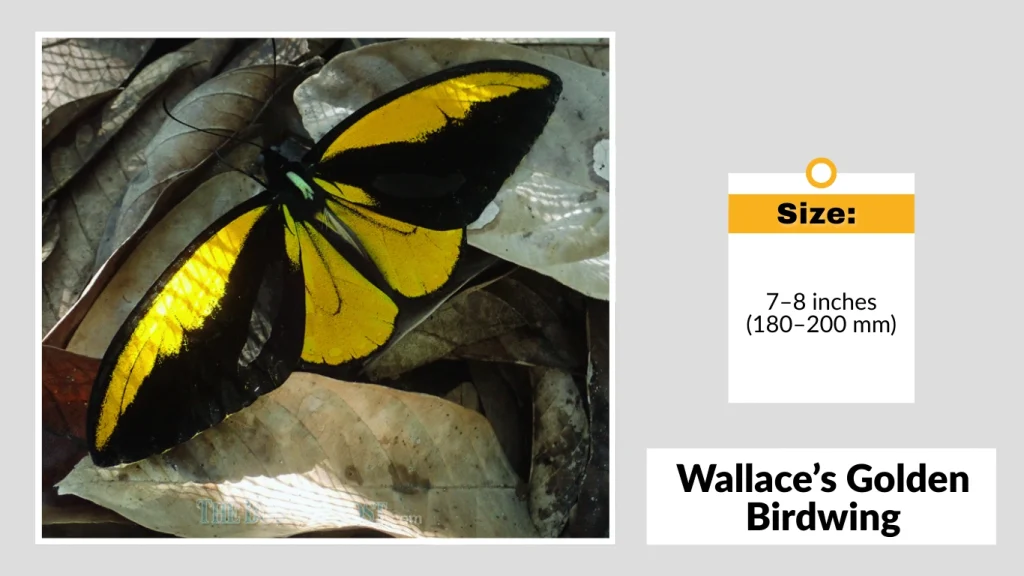
Wallace’s Golden Birdwing (Ornithoptera croesus) is one of the most spectacular butterflies in the world, named after the famous naturalist Alfred Russel Wallace who discovered it in the Maluku Islands of Indonesia. Known for its striking golden and black wings, it is among the largest butterflies and an important symbol of Wallace’s contributions to evolutionary biology.
Identification
- Scientific Name: Ornithoptera croesus
- Family: Papilionidae (swallowtail butterflies)
- Wingspan: 7–8 inches (180–200 mm)
- Color: Males have bright golden-yellow wings with black margins; females are larger with darker, brownish wings patterned with white and yellow
- Body Features: Slender body adapted for strong, graceful flight
- Lifespan: About 6–8 weeks in adult form
Behavior
Males are highly territorial, often patrolling the forest canopy in search of females. Their brilliant golden coloration makes them unmistakable in flight. Females, though less colorful, are larger and focus on egg-laying. The caterpillars feed exclusively on Aristolochia vines, storing toxic compounds that make them unpalatable to predators.
Habitat
This butterfly is restricted to the northern Maluku Islands in Indonesia. It thrives in tropical rainforests with plenty of flowering plants and host vines for its larvae. Due to its limited range, its survival depends on the conservation of local forests.
Importance
Wallace’s Golden Birdwing is not only ecologically significant but also historically important, as it played a role in Wallace’s groundbreaking work on natural selection. Today, it is a protected species, cherished as a symbol of biodiversity and conservation in Indonesia.
15. Giant Water Bug

The Giant Water Bug (Lethocerus indicus and related species) is the largest member of the true bug order Hemiptera and a formidable aquatic predator. Sometimes called “toe-biters,” these insects are known for their painful bite and powerful hunting abilities in freshwater habitats. Despite their intimidating reputation, they are an essential part of aquatic ecosystems.
Identification
- Scientific Name: Lethocerus indicus (one of the largest species)
- Family: Belostomatidae
- Length: Up to 4.5 inches (120 mm)
- Color: Brown or dark gray, flattened body adapted for aquatic life
- Body Features: Raptorial forelegs for grabbing prey, sharp beak for piercing and injecting enzymes
- Wings: Fully developed, allowing strong flight between water bodies
- Lifespan: About 1 year
Behavior
Giant Water Bugs are ambush predators, feeding on fish, tadpoles, insects, and even small amphibians. They use their powerful forelegs to grab prey, then inject digestive enzymes through their proboscis, liquefying the insides before sucking them out. They are mostly nocturnal and can deliver a painful bite if mishandled, hence their nickname “toe-biters.” Interestingly, males of some species carry fertilized eggs on their backs until they hatch, providing protection and oxygenation.
Habitat
These bugs inhabit ponds, lakes, and slow-moving streams in Asia, North America, and South America, depending on the species. They prefer shallow waters with vegetation where prey is abundant and where they can camouflage themselves.
Importance
As top invertebrate predators in freshwater ecosystems, Giant Water Bugs help control populations of fish, amphibians, and other insects. In some cultures, especially in Southeast Asia, they are also collected and eaten as delicacies. Ecologically, they indicate the health of freshwater systems, as they thrive in clean water environments.
16. Giant Cicada (Megapomponia imperatoria)
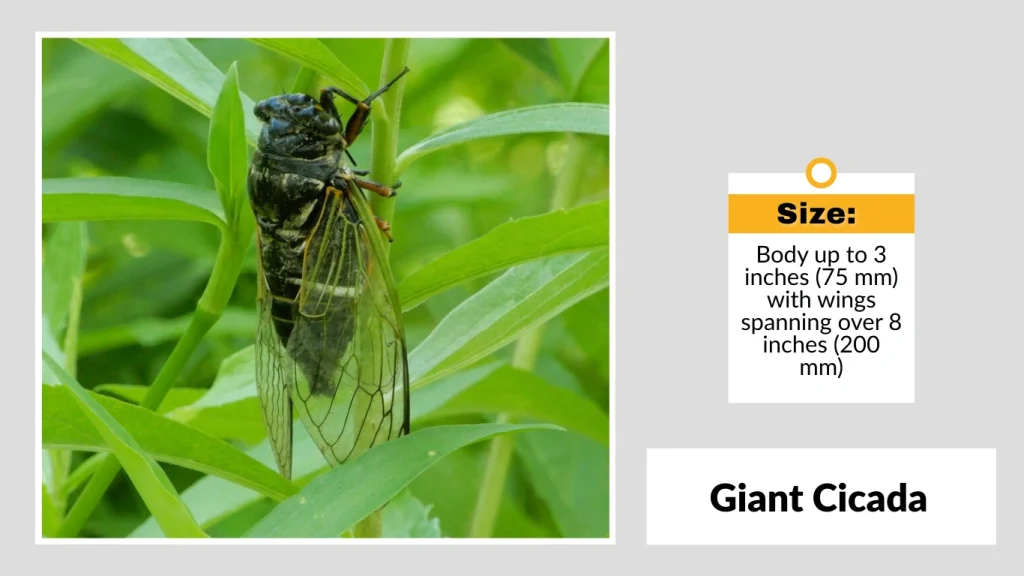
The Giant Cicada, scientifically known as Megapomponia imperatoria, holds the record as the largest cicada species in the world. With its long wings and loud, resonating call, it dominates the forests of Southeast Asia. These insects are famous for their unique life cycles, with many cicada species spending years underground before emerging, though this giant is especially notable for its size and powerful sound.
Identification
- Scientific Name: Megapomponia imperatoria
- Family: Cicadidae
- Length: Body up to 3 inches (75 mm) with wings spanning over 8 inches (200 mm)
- Color: Greenish to brown with transparent wings
- Body Features: Robust body, long veined wings, and a strong sound-producing organ (tymbals)
- Lifespan: Nymph stage lasts several years underground; adults live only a few weeks
Behavior
Male Giant Cicadas produce an extremely loud buzzing call, amplified by their tymbals, to attract females. Their sound can be heard from hundreds of meters away and is among the loudest of all insects. Adults feed on tree sap using piercing mouthparts, while nymphs suck fluids from underground roots. They are generally harmless to humans but can be startling due to their size and noise.
Habitat
This cicada is native to Southeast Asia, especially in Malaysia, Thailand, and surrounding regions. It thrives in tropical and subtropical forests, where tall trees provide both food and calling perches.
Importance
Giant Cicadas are key components of forest ecosystems. As nymphs, they aerate soil while feeding underground, and as adults, they provide food for birds, reptiles, and mammals. Their emergence also represents an ecological event, supplying a temporary feast for predators. For humans, their distinctive calls are a cultural symbol in Asia, often associated with summer.
17. Sabertooth Longhorn Beetle (Macrodontia cervicornis)
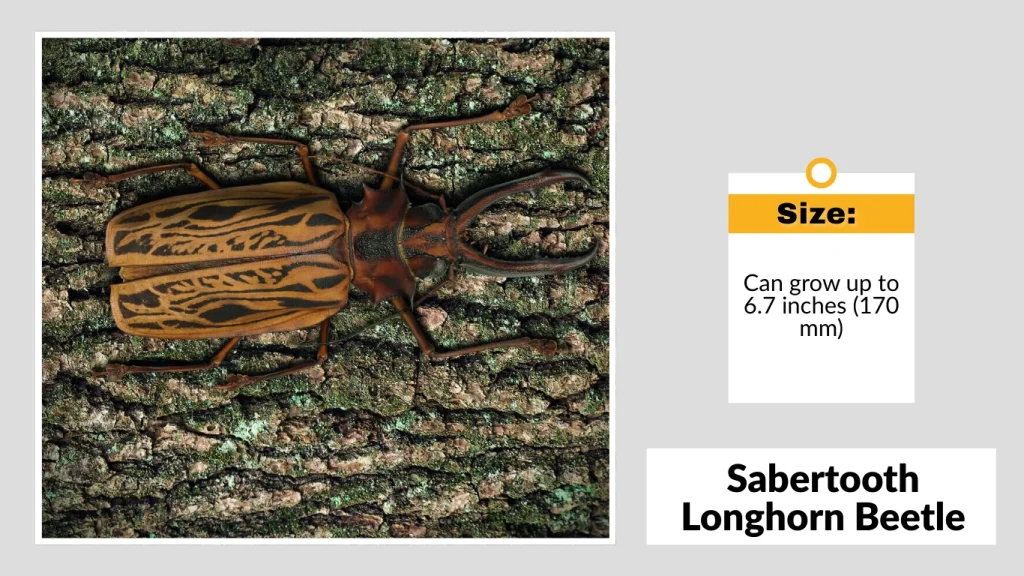
The Sabertooth Longhorn Beetle, sometimes referred to simply as Macrodontia cervicornis, is one of the largest and most fearsome-looking beetles in the world. Its name comes from the huge, saber-like mandibles of males, which they use in combat and defense. These beetles are extremely rare and prized by collectors for their immense size and unusual appearance.
Identification
- Scientific Name: Macrodontia cervicornis
- Family: Cerambycidae (longhorn beetles)
- Length: Can grow up to 6.7 inches (170 mm)
- Color: Dark brown to reddish with elongated antennae nearly as long as the body
- Body Features: Gigantic mandibles in males, used for rival battles and defense
- Larvae: Large wood-boring grubs living inside logs for several years
- Lifespan: Several years underground as larvae; adults live only a few months
Behavior
Males use their sabertooth-like jaws in fights, locking with rivals to push and overpower opponents. Adults are nocturnal and are attracted to lights at night, though sightings are extremely rare. Their larvae bore into decaying wood, where they live for years before transforming into adults. Adult beetles feed very little, relying mainly on reserves from their larval stage.
Habitat
The Sabertooth Longhorn Beetle inhabits tropical rainforests of South America, particularly in Brazil, Ecuador, Peru, and Colombia. They live in areas with abundant rotting logs where their larvae can grow undisturbed.
Importance
These beetles play an important role in breaking down decaying trees, aiding in nutrient recycling within rainforest ecosystems. Their massive size and rarity make them highly sought-after by entomologists and collectors. Unfortunately, habitat destruction and over-collecting pose threats to their populations, highlighting the need for conservation.
18. Regal Moth (Royal Walnut Moth)

The Regal Moth (Citheronia regalis), also known as the Royal Walnut Moth, is one of the largest moths in North America. It is admired for its striking coloration and impressive wingspan, but it is perhaps most famous for its caterpillar form, the Hickory Horned Devil, which is one of the largest and most intimidating-looking caterpillars in the world. Despite its fierce appearance, both the adult moth and the caterpillar are harmless to humans.
Identification
- Scientific Name: Citheronia regalis
- Family: Saturniidae (giant silk moths)
- Wingspan: 4–6 inches (100–150 mm)
- Color: Adults are orange with gray wings marked by yellow spots; caterpillars are green with long, spiny, horn-like structures
- Body Features: Thick, furry body with large wings designed for short bursts of flight
- Lifespan: Adults live only about 1 week, focusing solely on reproduction
Behavior
Adult Regal Moths are nocturnal and fly mostly in midsummer. They do not feed, surviving only on stored energy from the caterpillar stage. Caterpillars (Hickory Horned Devils) feed voraciously on hickory, walnut, sweetgum, and persimmon leaves, reaching up to 6 inches in length before pupating. Despite their fearsome spines, they are harmless and rely on intimidation for protection.
Habitat
The Regal Moth is found in deciduous forests across the eastern United States, from New Jersey to Missouri and as far south as Texas and Florida. They prefer areas with an abundance of their caterpillar host plants.
Importance
These moths are an important part of forest ecosystems, as their caterpillars help regulate tree growth by feeding on leaves. Their striking appearance also makes them a favorite among naturalists, educators, and photographers, highlighting the beauty of North American moths.
19. Goliath Stick Insect

The Goliath Stick Insect (Eurycnema goliath) is one of the largest stick insects in the world, capable of blending seamlessly into its surroundings with its remarkable leaf- and twig-like camouflage. Native to Australia, this insect is both enormous and highly adapted for survival through mimicry, making it a fascinating example of evolutionary design.
Identification
- Scientific Name: Eurycnema goliath
- Family: Phasmatidae (stick insects)
- Length: Up to 10 inches (250 mm)
- Color: Green to brown, often with leaf-like markings on wings
- Body Features: Elongated, stick-like body with broad wings; females are much larger than males
- Lifespan: 12–18 months in the wild or captivity
Behavior
Goliath Stick Insects are herbivorous, feeding on eucalyptus and acacia leaves. They rely heavily on camouflage to avoid predators, remaining motionless during the day and feeding at night. When threatened, they spread their wings and make a loud rustling sound to startle predators. Females can also release defensive sprays with an unpleasant odor.
Habitat
This species is native to northern and eastern Australia, where it inhabits eucalyptus forests and woodlands. Its coloration and body shape allow it to blend into the leaves and branches of its environment almost perfectly.
Importance
Goliath Stick Insects play a role in controlling vegetation by feeding on leaves, contributing to plant diversity in ecosystems. They are also popular in educational displays and insect collections, serving as living examples of camouflage and adaptation. Their sheer size and survival strategies highlight the diversity of Australia’s insect life.
20. Chan’s Megastick (Phobaeticus chani)

Chan’s Megastick holds the record as one of the longest insects in the world, often exceeding 22 inches (560 mm) when including its legs. Named after a Malaysian naturalist, Datuk Chan Chew Lun, this extraordinary stick insect demonstrates the incredible extremes of insect evolution. Despite its remarkable length, it is so well camouflaged that it is rarely noticed in the wild.
Identification
- Scientific Name: Phobaeticus chani
- Family: Phasmatidae (stick insects)
- Length: Body length up to 14 inches (357 mm); total length with legs over 22 inches (560 mm)
- Color: Brown or green, mimicking twigs and branches
- Body Features: Extremely elongated body and legs, with females much larger than males
- Lifespan: Up to 1 year
Behavior
Chan’s Megastick relies almost entirely on camouflage for survival, remaining motionless on branches during the day. It is herbivorous, feeding on leaves from a variety of trees and shrubs. When disturbed, it may sway gently to mimic a twig moving in the wind. Females lay eggs that resemble seeds, which fall to the forest floor and remain hidden until hatching.
Habitat
This insect is native to the rainforests of Borneo, where dense foliage and tall trees provide the perfect environment for its mimicry. Its extreme length makes it highly adapted to blending into the forest canopy.
Importance
Chan’s Megastick is a striking example of natural selection and adaptation, representing one of the most extreme cases of insect camouflage. Its rarity makes it a valuable symbol for conservation, as Borneo’s rainforests face ongoing threats from deforestation.
21. Giant Praying Mantis (Tenodera aridifolia)

The Giant Praying Mantis (Tenodera aridifolia) is one of the largest mantis species, known for its impressive size and predatory skills. Native to Asia, particularly Japan and Korea, this mantis is both a skilled hunter and a master of stealth. Its large size allows it to take down prey that smaller mantises cannot, including larger insects and even small vertebrates.
Identification
- Scientific Name: Tenodera aridifolia
- Family: Mantidae
- Length: Up to 5 inches (130 mm)
- Color: Green to brown, blending into vegetation
- Body Features: Long body with raptorial forelegs adapted for grasping prey; triangular head with large compound eyes
- Lifespan: About 1 year
Behavior
This mantis is an ambush predator, remaining still and striking quickly when prey comes within reach. Its diet includes grasshoppers, beetles, butterflies, and occasionally small reptiles or amphibians. Males are smaller and more agile, while females are bulkier and sometimes cannibalize males after mating. Mantises rely on both camouflage and speed to survive, and they can rotate their heads up to 180 degrees to spot prey.
Habitat
The Giant Praying Mantis is widespread across East Asia, particularly in forests, grasslands, and agricultural fields. They thrive in areas with plenty of tall grass and shrubs, which provide both camouflage and hunting grounds.
Importance
These mantises play a crucial role in pest control, feeding on insects that could otherwise damage crops. They are also popular among insect enthusiasts for their size, behavior, and hunting abilities. In some cultures, mantises are symbols of patience, focus, and strategy.
22. Malaysian Tree Nymph Butterfly

The Malaysian Tree Nymph (Idea leuconoe), also known as the Paper Kite Butterfly, is one of the largest butterflies in Southeast Asia. Its broad, delicate wings and slow, graceful flight give it a unique presence in the forest canopy. With its striking black-and-white pattern, it is not only beautiful but also well protected by natural toxins that make it unappealing to predators.
Identification
- Scientific Name: Idea leuconoe
- Family: Nymphalidae (subfamily Danainae)
- Wingspan: 4.7–6 inches (120–150 mm)
- Color: White wings with black veins and spots, resembling paper or parchment
- Body Features: Slender body with long, rounded wings designed for gliding flight
- Lifespan: About 3–4 weeks in the wild
Behavior
The Malaysian Tree Nymph is a slow and gentle flier, gliding more than flapping. This butterfly is unpalatable to predators due to toxins obtained from its caterpillar stage, similar to monarch butterflies. Adults feed on nectar from a variety of flowers, while caterpillars feed on plants from the milkweed family (Apocynaceae), absorbing toxic compounds for protection.
Habitat
This butterfly is found in tropical and subtropical forests across Southeast Asia, especially Malaysia, the Philippines, and Thailand. It thrives in lowland forests, mangroves, and areas with abundant host plants for its caterpillars.
Importance
The Malaysian Tree Nymph is an important pollinator and plays a role in maintaining plant diversity. Its striking appearance also makes it a star attraction in butterfly gardens and conservation parks, raising awareness about the importance of protecting forest habitats.
23. Giant Assassin Bug
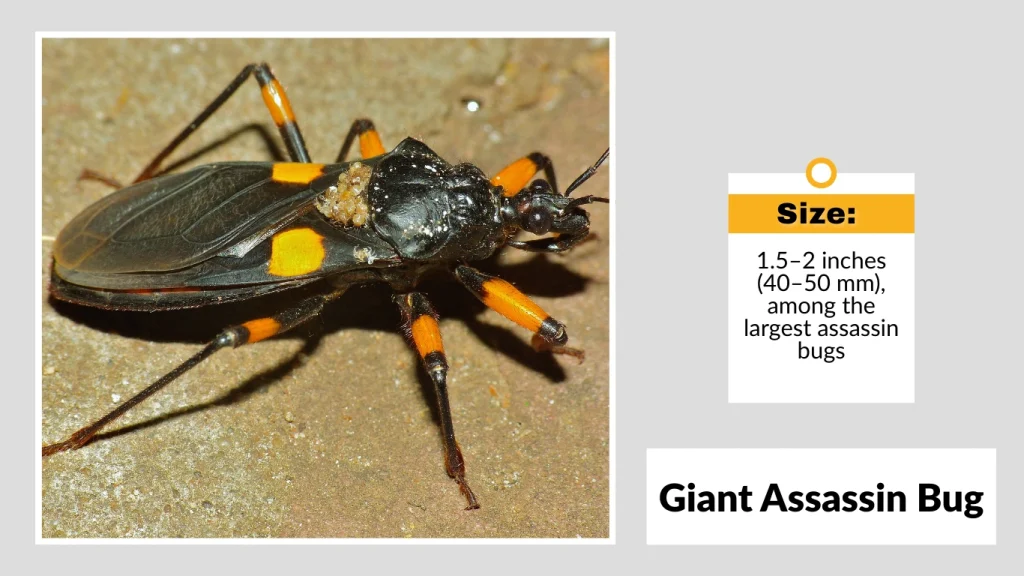
The Giant Assassin Bug (Psytalla horrida) is one of the largest species of assassin bugs, feared for its painful bite and remarkable predatory abilities. Found in parts of Africa, this insect is an apex invertebrate predator, capable of taking down prey larger than itself using stealth and a venomous strike.
Identification
- Scientific Name: Psytalla horrida
- Family: Reduviidae (assassin bugs)
- Length: 1.5–2 inches (40–50 mm), among the largest assassin bugs
- Color: Black body with orange or red markings, often with spiny legs
- Body Features: Long piercing-sucking mouthparts (proboscis) used to inject venom into prey
- Lifespan: Around 1 year
Behavior
Giant Assassin Bugs are ambush predators. They stalk their prey—usually other insects—and use their sharp proboscis to inject a powerful enzyme that liquefies the prey’s insides, which they then suck out. They are solitary and aggressive, even toward members of their own species. Their bite can be extremely painful to humans, comparable to a wasp sting, but is not life-threatening.
Habitat
This species is native to tropical and subtropical regions of Africa, especially in forested and savanna environments. They prefer habitats where insects are abundant, such as near flowering plants or agricultural areas.
Importance
Giant Assassin Bugs are important in controlling insect populations, making them beneficial in natural pest management. However, their painful bite means they should be handled with caution. They are also studied for their unique hunting strategies and venom, which may have potential uses in scientific research.
24. Atlas Beetle
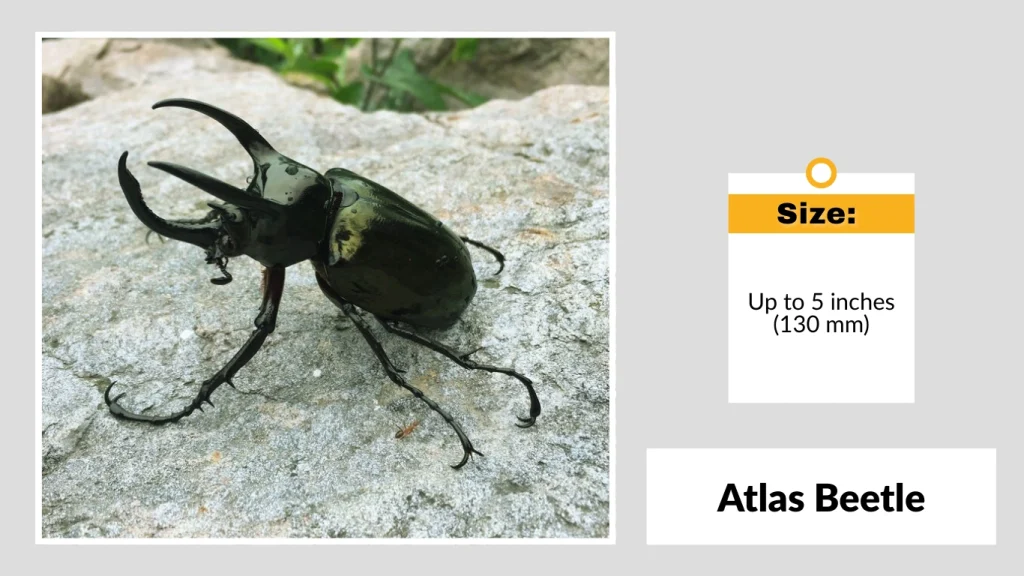
The Atlas Beetle (Chalcosoma atlas) is a powerful rhinoceros beetle native to Southeast Asia, well-known for its enormous horns and incredible strength. Named after the Titan Atlas from Greek mythology, this beetle can lift objects more than 100 times its own body weight. It is one of the most striking and aggressive rhinoceros beetles, with males often engaging in fierce battles.
Identification
- Scientific Name: Chalcosoma atlas
- Family: Scarabaeidae (rhinoceros beetles)
- Length: Up to 5 inches (130 mm)
- Color: Glossy black or dark brown
- Body Features: Males have three large horns on the head and thorax; females are smaller and hornless
- Larvae: Large grubs that feed on decaying wood and can weigh more than 60 grams
- Lifespan: 1–2 years as larvae, a few months as adults
Behavior
Male Atlas Beetles are territorial and use their horns to wrestle rivals, attempting to flip or push them away from females. They are considered highly aggressive compared to other rhinoceros beetles. Adults feed on fruit and tree sap, while larvae spend most of their lives underground, consuming rotting wood.
Habitat
Atlas Beetles are found in tropical forests across Southeast Asia, particularly in Malaysia, Thailand, and Indonesia. They thrive in humid environments with abundant fruiting trees and decaying logs.
Importance
These beetles are ecologically important as decomposers and are also prized by insect collectors for their spectacular horns. Their immense strength has made them a symbol of power and endurance in many cultures. However, habitat destruction poses a threat to their natural populations.
25. Chinese Golden Stick Insect

The Chinese Golden Stick Insect (Phobaeticus serratipes) is one of the longest insects in the world, rivaling Chan’s Megastick in size. Its slender, twig-like body makes it a master of camouflage, while its golden-brown coloration gives it a distinct appearance. Native to Southeast Asia, it is both extraordinary in size and delicate in appearance.
Identification
- Scientific Name: Phobaeticus serratipes
- Family: Phasmatidae (stick insects)
- Length: Body length up to 13 inches (330 mm); total length with legs over 21 inches (540 mm)
- Color: Golden-brown to light green, resembling twigs
- Body Features: Extremely slender and elongated body; females are larger and bulkier than males
- Lifespan: About 1 year
Behavior
Chinese Golden Stick Insects are nocturnal herbivores, feeding on the leaves of trees and shrubs. They rely almost entirely on camouflage for defense, often remaining motionless for hours to blend into branches. When disturbed, they may sway like twigs in the wind or drop to the ground to avoid predators. Females drop eggs that mimic seeds, which blend with the forest floor until hatching.
Habitat
This species is native to tropical and subtropical forests of Southeast Asia, particularly in Malaysia, Singapore, and southern China. Dense vegetation provides the perfect environment for concealment and survival.
Importance
Chinese Golden Stick Insects contribute to plant regulation in their ecosystems by feeding on leaves. They are also a popular species in insect displays and educational collections due to their extraordinary length and camouflage. Their survival, however, depends heavily on the preservation of forest habitats.
