

The orchid mantis (Hymenopus coronatus) is a strikingly beautiful insect that looks like a living orchid flower. With its petal-shaped legs and colorful body, it is often mistaken for a real blossom—perfect for ambushing unsuspecting prey. While both males and females share this amazing camouflage, they are surprisingly different in many ways. If you’re trying to tell them apart or considering keeping them as pets, this article covers everything you need to know.
What Is an Orchid Mantis?
The orchid mantis is a tropical mantid native to Southeast Asia, especially Malaysia and Indonesia. It mimics orchid flowers with its white, pink, and sometimes yellow coloring. This disguise helps it both avoid predators and catch prey. Because of its unique appearance, it’s a popular choice among exotic pet owners and insect photographers.
Understanding the differences between males and females is crucial—not just for breeding, but also for proper care and behavior observation.
Size Differences
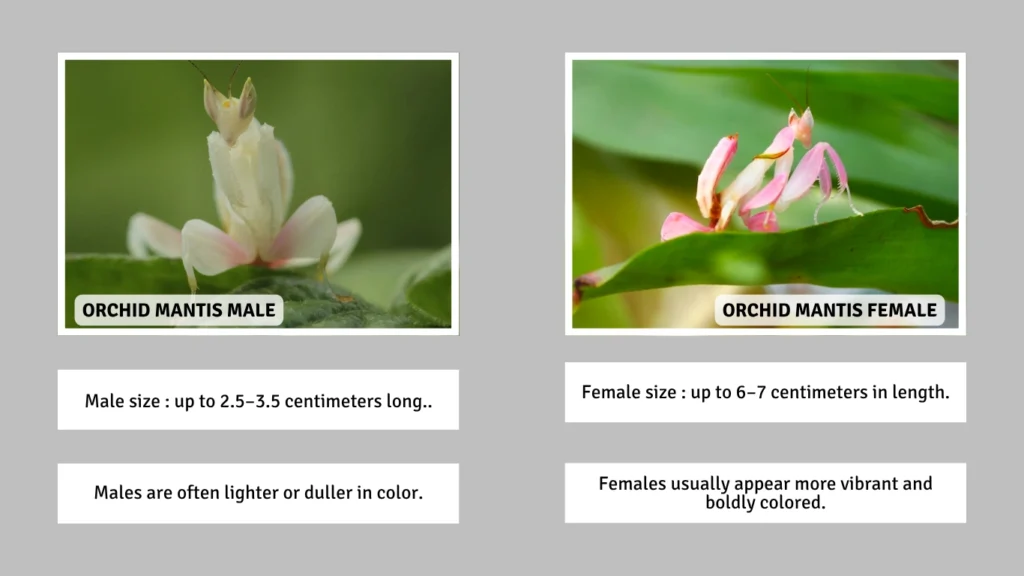
One of the most noticeable differences between male and female orchid mantises is their size.
Female Orchid Mantis Size
- Adult females can reach up to 6–7 centimeters in length.
- They have a thicker, more robust body structure.
- Their legs and thorax are broader, giving them a powerful, predatory look.
Male Orchid Mantis Size
- Males are much smaller, usually only
- Their bodies are slim and lightweight, built more for mobility than strength.
- At first glance, males can look like juveniles due to their tiny size.
This large difference in size is called sexual dimorphism, and it’s quite common in mantids.
Color and Wing Differences
Both males and females share a similar color pattern—usually white or pink with petal-like limbs. But there are subtle differences in wings and shading.
Female Color and Wings
- Females usually appear more vibrant and boldly colored.
- Their wings are shorter, ending at or just covering the abdomen.
- The wing surface is slightly broader and more opaque.
Male Color and Wings
- Males are often lighter or duller in color.
- Their wings are longer, sometimes extending past the abdomen, a feature that helps with flight.
- Their wings are more transparent and streamlined for easier movement.
This design difference is functional—males rely more on flight, especially during the mating season.
Antennae and Eye Differences
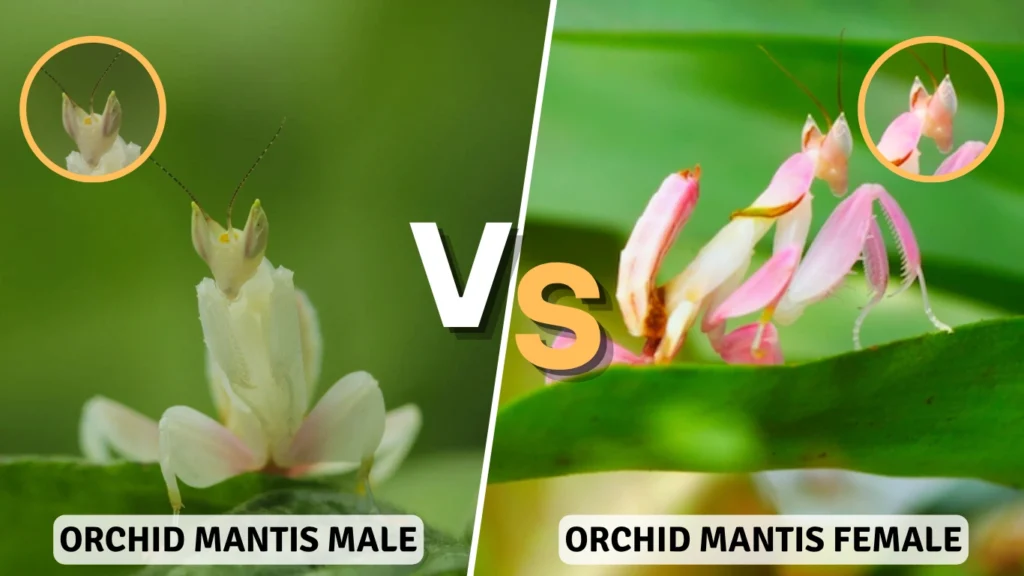
To distinguish males from females even more accurately, look at their antennae and eyes.
Male Antennae and Eyes
- Males have longer and bushier antennae.
- These antennae are highly sensitive to female pheromones.
- Males often have larger, more protruding eyes to help navigate while flying and finding mates.
Female Antennae and Eyes
- Females have shorter, thinner antennae.
- Their eyes are large but less protruding compared to males.
- They rely more on sight for ambush hunting rather than mate-seeking.
These sensory differences are adaptations to each gender’s role in reproduction and survival.
Behavioral Differences
Male and female orchid mantises not only look different but also behave differently, especially when it comes to mating, movement, and feeding.
Male Behavior
- Males are nervous and skittish, often flying away at the slightest disturbance.
- They are very active, especially during mating periods.
- Their small size and fast reflexes help them avoid being eaten by females.
Female Behavior
- Females are stationary and deliberate in their movements.
- They are far more aggressive and predatory.
- Females often cannibalize males after mating, especially if hungry or stressed.
These behavioral traits are critical for breeders to observe and manage.
Molting and Life Cycle
Like all mantids, orchid mantises molt several times before becoming adults. However, the number of molts varies between genders.
Female Molting and Development
- Females go through around 8–9 molts.
- They take longer to mature but grow significantly larger.
- Their life cycle includes a longer post-adult lifespan, especially if they lay eggs.
Male Molting and Development
- Males molt around 6–7 times before adulthood.
- They mature faster but have a shorter life span.
- Once mature, they live only a few weeks, mainly to find a mate.
This accelerated male development is common among insects where males exist primarily for reproduction.
Reproductive Roles and Risks
Female Reproduction
- Females produce oothecae (egg cases) after mating.
- They need protein-rich diets to support egg development.
- If food is scarce, they may resort to sexual cannibalism—eating the male after mating.
Male Reproductive Behavior
- Males approach cautiously, often using their antennae to detect pheromones from afar.
- They perform slow and careful mating rituals to avoid triggering the female’s predatory instincts.
- Many males are killed post-mating, especially if the female is not well-fed.
Though brutal, this behavior ensures the female has enough nutrition to produce healthy offspring.
Identification Summary Table
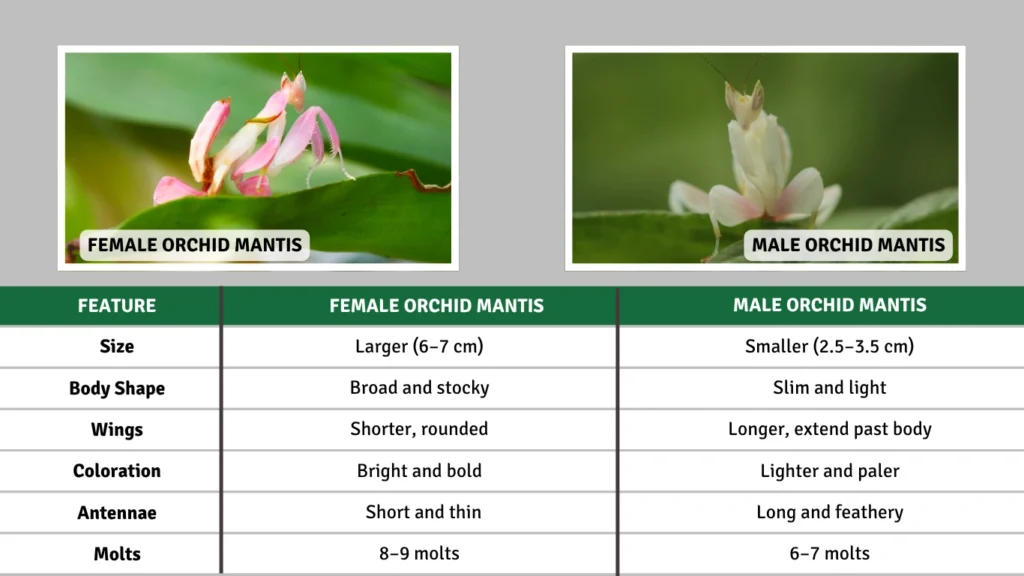
| Feature | Female Orchid Mantis | Male Orchid Mantis |
| Size | Larger (6–7 cm) | Smaller (2.5–3.5 cm) |
| Body Shape | Broad and stocky | Slim and light |
| Wings | Shorter, rounded | Longer, extend past body |
| Coloration | Bright and bold | Lighter and paler |
| Antennae | Short and thin | Long and feathery |
| Behavior | Aggressive, still | Active, fast, flighty |
| Molts | 8–9 molts | 6–7 molts |
| Lifespan | Longer | Shorter |
| Reproduction | Lays eggs, may eat male | Mates once, may be eaten |
Which Is Better for Pets?
Whether you should choose a male or female orchid mantis depends on your preferences:
- Females are larger, more beautiful, and easier to observe—but more aggressive and short-tempered.
- Males are smaller, more delicate, and better flyers—but more active and less tolerant of handling.
For display purposes, many hobbyists prefer females. But if you’re interested in breeding or observing mating behavior, having both (separated until ready) is ideal.
FAQs
1. Can male and female orchid mantises be kept together?
No, it’s not recommended. Females often kill males after mating. Always supervise and separate them immediately after copulation.
2. Do all female orchid mantises eat the male after mating?
Not always, but it’s common—especially if the female is hungry or stressed. Feeding the female before mating may reduce the risk.
3. How do I tell the sex of a juvenile orchid mantis?
Count the abdominal segments: males typically have 8 visible segments, while females have 6–7. Males also tend to develop longer antennae earlier.
4. Do male and female orchid mantises have different care needs?
Slightly. Females need more food and space as they grow larger. Males are more sensitive to stress and may require a tighter enclosure to prevent injury during flight.
5. Which one is better for first-time mantis keepers?
Females are generally better for beginners—they’re easier to feed, more tolerant of enclosure changes, and have a longer life.
