

Mayflies are among the most fascinating insects in the natural world, known for their fragile beauty and incredibly short lives. Despite their brief time as adults, they play a crucial role in freshwater ecosystems and often spark curiosity when they appear in massive swarms. People frequently wonder about their lifespan, behavior, diet, and whether they pose any risk. In this article, we’ll answer 50 of the most common questions about mayflies in a clear and detailed way.
Basic Questions About Mayflies

What is a mayfly?
A mayfly is a delicate insect that belongs to the order Ephemeroptera. These insects are famous for their very short adult lifespan, sometimes lasting only a few hours to a couple of days. They have slender bodies, large transparent wings that stand upright, and two or three long tail filaments. While adults live briefly, their aquatic nymph stage can last from several months to a few years. Mayflies are considered one of the oldest groups of winged insects, with fossil records dating back more than 300 million years.
What’s a mayfly?
The term “mayfly” is commonly used to describe these insects because they often emerge in huge numbers during the month of May in many parts of the world. However, their hatching times can vary depending on climate and region. They are also sometimes called “dayflies” due to their brief adult lives. Unlike many insects, mayflies do not sting, bite, or carry diseases, making them completely harmless to humans.
Why are they called mayflies?
The name “mayfly” comes from the fact that in temperate regions, the largest hatches occur in late spring, especially around May. These swarming events can be so large that they are visible on weather radar. Despite the name, mayflies can appear from spring through late summer depending on species and location. Their synchronized hatching ensures that countless individuals emerge at once, increasing their chances of finding mates.
Why do mayflies exist?
Mayflies exist as an essential part of freshwater ecosystems. In their nymph stage, they help recycle nutrients by feeding on algae, leaves, and organic matter, which improves water quality. They also provide a reliable food source for fish like trout and for many bird species during swarming events. From an ecological perspective, mayflies represent both indicators of water health—because they thrive in clean rivers—and a vital link in the food web.
Appearance & Features of Mayflies

What does a mayfly look like?
A mayfly has a slim, elongated body with two or three long tail filaments, which are one of its most recognizable features. Its wings are large, transparent, and held upright like those of a butterfly when at rest. The forewings are usually bigger than the hindwings, giving them a delicate, fluttering flight pattern. Their eyes are large and well-developed, especially in males, which helps them locate females during swarming.
What’s a mayfly look like?
Mayflies resemble very delicate dragonflies but are smaller and more fragile. Their bodies are soft, their legs are thin, and their wings are lightly veined, almost glass-like. Because of their upright resting wing position and long tails, they are easy to distinguish from other flying insects. In flight, their fragile structure makes them appear fluttery, especially when large swarms gather near rivers or lakes.
How big are mayflies?
Most mayflies are quite small, typically ranging from 5 to 25 millimeters in length. However, size depends on the species, with some tropical mayflies growing slightly larger. Their long tails can make them appear longer than they actually are, often doubling their body length when fully extended.
How big is a mayfly?
The largest mayflies can reach up to 30 millimeters in body length, with tails adding extra length. Despite their size, they are extremely lightweight and fragile. Even the biggest species are delicate compared to dragonflies, making them vulnerable to wind and predators.
Habitat & Distribution of Mayflies
Where do mayflies live?
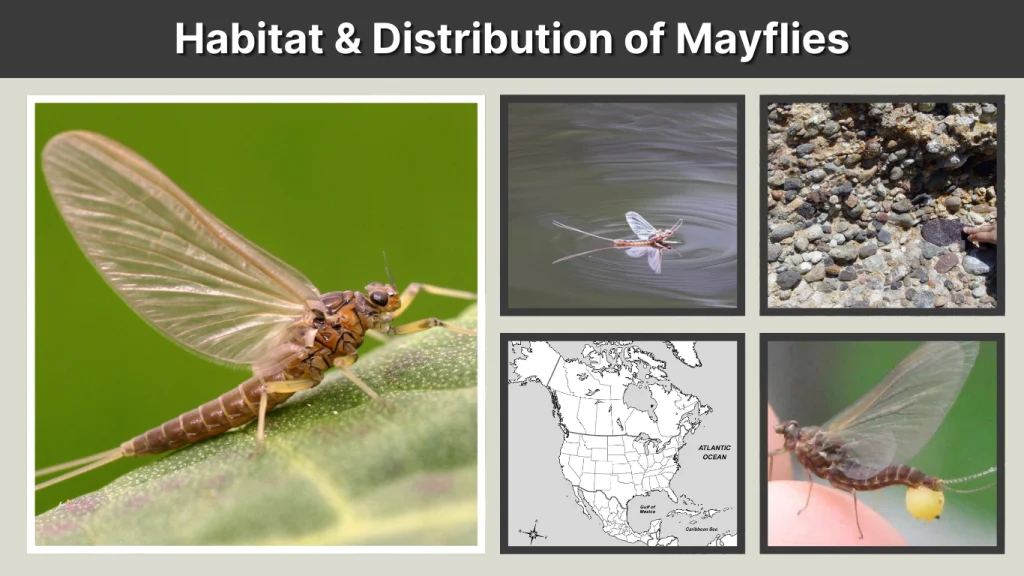
Mayflies live in freshwater habitats such as rivers, streams, lakes, and ponds. They are most abundant in clean, oxygen-rich waters where their nymphs can thrive. These environments provide algae, decaying leaves, and other organic matter that nymphs feed on. Adults are often seen swarming near the water where they hatched, as they never stray far from aquatic environments.
Where does a mayfly live?
During the nymph stage, mayflies live underwater, often clinging to rocks, vegetation, or burrowing into sediments. This stage can last several months to a few years depending on the species. Once they emerge as adults, they stay close to the same water body, resting on nearby plants, bridges, or houses before mating swarms occur.
Where are mayflies found?
Mayflies are found on every continent except Antarctica. They are especially common in North America, Europe, and Asia, where seasonal hatches can be enormous. Because they require clean water, their presence is a sign of good water quality, making them excellent bioindicators used by scientists to assess freshwater health.
Where do mayflies come from?
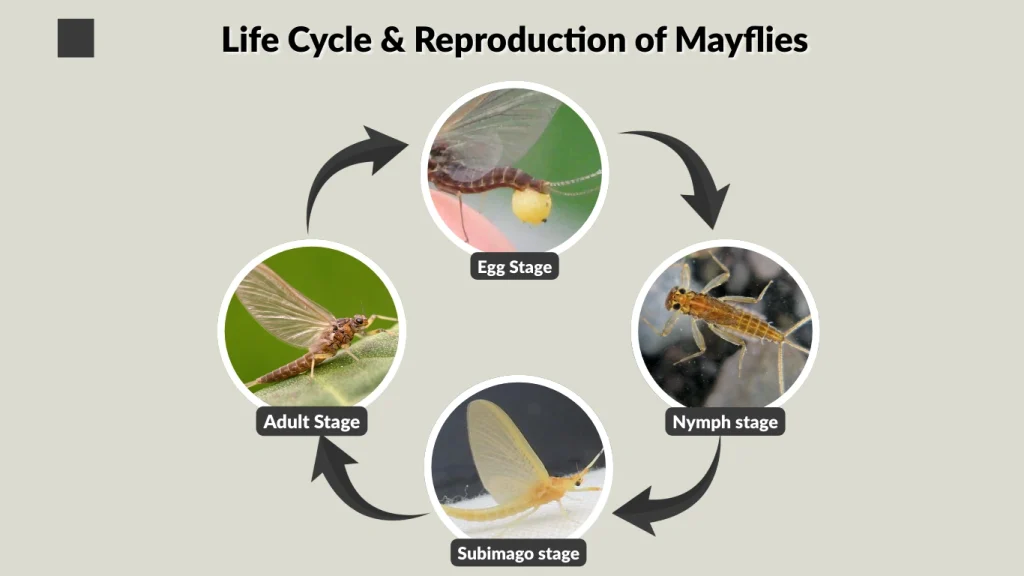
Mayflies begin life as eggs laid in freshwater by female adults. The eggs sink to the bottom, where they hatch into aquatic nymphs. These nymphs go through multiple molts while feeding on organic material. After months or even years, they rise to the surface, shed their skins, and emerge as winged adults ready to mate.
Diet & Feeding of Mayflies

What do mayflies eat?
Mayflies eat different things depending on their life stage. As nymphs, they primarily feed on algae, microscopic plants, and decomposing organic matter found in freshwater habitats. This helps keep rivers and lakes clean by recycling nutrients. Once they reach adulthood, mayflies do not eat at all because their mouthparts are underdeveloped and non-functional.
What does mayflies eat?
In their aquatic stage, mayflies consume fine particles like decaying leaves, diatoms, and small microorganisms that drift in the water. Some species are collectors, scraping algae from rocks, while others filter-feed by capturing food particles carried by water currents. This feeding behavior makes them vital to nutrient cycling in freshwater systems.
Do mayflies eat?
Adult mayflies do not eat, as their digestive system is non-functional at this stage. Their short life span is focused only on reproduction. However, nymphs are active feeders, constantly grazing or filtering organic matter to survive until they metamorphose into adults.
Do mayflies eat mosquitoes?
No, mayflies do not eat mosquitoes or other insects. They are not predators. Instead, they are herbivores or detritivores during the nymph stage, feeding on plant-based material. Because adults cannot feed, they have no interaction with mosquitoes in terms of diet.
Do mayflies have mouths?
Adult mayflies have vestigial mouthparts that are incapable of chewing or sucking. Their digestive tract is present but non-functional. Only the nymphs possess working mouthparts, which they use to scrape, gather, or filter organic material from their freshwater environment.
Life Cycle & Reproduction of Mayflies
Do mayflies shed their skin?
Yes, mayflies shed their skin many times during their aquatic nymph stage. Depending on the species, nymphs can molt 20 to 50 times before reaching maturity. This molting allows them to grow and develop new body structures, such as functional gills, before they transform into winged adults.
Do mayflies molt?
Mayflies are unique among insects because they molt even after developing wings. After leaving the water, they first emerge as a dull-colored “subimago,” which is a pre-adult stage. Within hours or a day, they shed their skin again to become a fully mature adult, or “imago,” ready for reproduction.
What do mayflies turn into?
Mayflies start as eggs, hatch into aquatic nymphs, and eventually transform into winged adults. The final transformation is unusual because of the subimago stage, making them the only insects that molt after gaining wings. This adaptation ensures they develop fully functional reproductive organs before mating.
How do mayflies reproduce?
Mayflies reproduce through mass swarming events near water. Males gather in large clouds, and females fly into these swarms to mate mid-air. After mating, females lay eggs on the surface of lakes or rivers, and the eggs sink to the bottom. This synchronized behavior ensures that billions of eggs are deposited at once.
What does a mayfly do?
The purpose of a mayfly depends on its stage of life. As nymphs, they filter and clean freshwater by feeding on algae and decaying matter. As adults, their sole role is reproduction. Once they mate and lay eggs, they die, leaving behind the next generation to continue the cycle.
Lifespan of Mayflies

How long do mayflies live?
Most adult mayflies live only 24 to 48 hours. Some species may survive up to three days, but their time as adults is always short. Their brief existence is dedicated to reproduction, after which they die naturally.
How long does a mayfly live?
A mayfly’s adult life is extremely short, but its full life cycle can last much longer. The nymph stage underwater can range from several months to as long as two years, depending on the species and water temperature. Once they emerge as adults, survival is measured in hours or days.
How long do mayfly live?
Once mayflies reach adulthood, they usually live no more than one or two days. Their reproductive role means they do not need to survive long. The majority of their lifetime energy is spent during the nymph stage preparing for metamorphosis.
How long do mayflies live for?
Including both nymph and adult stages, a mayfly’s lifespan can range from a few months to a couple of years. However, the adult phase is the shortest, often less than 48 hours. This is why they are commonly associated with “living for a day.”
Why do mayflies die so fast?
Mayflies die quickly because their bodies are not designed for long-term survival outside water. Adult mayflies have vestigial mouthparts and cannot eat, meaning they lack the ability to sustain themselves. Their biology is entirely focused on reproducing and ensuring the next generation survives.
Why is mayfly lifespan so short?
The short lifespan of mayflies is an evolutionary adaptation. By emerging in massive synchronized swarms, they ensure maximum reproduction within a very short timeframe. Their quick death reduces competition for resources and keeps the ecosystem balanced.
Why do mayflies die so quickly?
Mayflies die quickly because their energy reserves are limited once they leave the water. Without feeding capabilities, they cannot extend their lives. Their life strategy is not about longevity but about overwhelming numbers that guarantee successful mating.
How long do female mayflies live?
Female mayflies generally live slightly longer than males. This extra time, usually a few hours to one day more, allows them to lay eggs in water after mating. While males often die immediately after reproduction, females survive just long enough to ensure the next generation begins.
What is the lifespan of a mayfly?
The lifespan of a mayfly varies widely depending on the stage of life. As aquatic nymphs, they may live for months or even years, while as adults, they typically live just one to three days. This combination of a long juvenile phase and a short adult stage makes them unique among insects.
Behavior & Swarming of Mayflies

When do mayflies hatch?
Mayflies usually hatch in late spring and early summer, though timing varies with species and climate. In many temperate regions, the heaviest hatches occur in May and June. Hatching often happens in the evening, when conditions are cooler and safer from predators.
When do mayflies come out?
Mayflies come out after spending months or years as aquatic nymphs. Once water temperatures rise and conditions are right, they rise to the surface, shed their skins, and take flight as winged adults. This emergence happens in huge numbers, often within a very short timeframe.
When is mayfly season?
Mayfly season typically peaks in late spring and early summer, though it can stretch into July or August in some regions. The exact timing depends on water temperatures and local climate. During this season, massive swarms gather near lakes and rivers.
How long does mayfly season last?
The mayfly season usually lasts a few weeks each year. While an individual insect only lives for a day or two, new groups hatch continuously over several weeks, creating the impression of a prolonged presence.
How long do mayflies stay around?
Once they emerge, mayflies stay around for one to three days before dying. However, in areas with large populations, different groups hatch at different times, so people may see mayflies for two to four weeks in total.
Why do mayflies swarm?
Mayflies swarm as part of their reproductive strategy. By emerging in massive groups, they overwhelm predators and ensure that enough individuals survive to mate and lay eggs. Swarms are often dense, filling the air above rivers and lakes.
Why are there so many mayflies?
There are often so many mayflies because their hatching is synchronized, with millions emerging at once. This evolutionary tactic increases mating success and provides a survival advantage by sheer numbers, even though predators like fish and birds feed heavily on them.
Interaction With Humans

Do mayflies bite?
No, mayflies do not bite. Unlike mosquitoes or midges, they do not have the mouthparts needed to pierce skin. Their adult form is harmless and poses no threat to humans or pets.
Can mayflies bite?
Mayflies cannot bite at all. Their mouths are vestigial (undeveloped), and they do not feed in the adult stage. Their only purpose after emerging is to mate and reproduce.
Do mayflies sting?
Mayflies do not sting because they lack stingers or venom glands. They cannot inject venom, cause allergic reactions, or harm people in any way.
Do mayflies bite humans?
No, mayflies do not bite humans. They are often mistaken for biting insects because they fly in large swarms, but they are completely harmless.
Do mayflies bite or sting?
Neither. Mayflies do not bite, sting, or feed in their adult stage. Their swarms may seem intimidating, but they are harmless gatherings for reproduction.
Are mayflies dangerous?
Mayflies are not dangerous at all. They do not spread disease, cause bites, or damage property. Their swarms may be inconvenient, but they are ecologically important and harmless to people.
Are mayflies harmful?
No, mayflies are not harmful. In fact, they are beneficial, as they provide food for birds and fish and indicate clean water quality.
Can mayflies hurt you?
Mayflies cannot hurt humans or animals. Their fragile bodies make them more of a nuisance when swarming in large numbers near lights or buildings, but they do no physical harm.
Control & Prevention of Mayflies

How to get rid of mayflies?
To get rid of mayflies around your home, start by reducing outdoor lighting at night, as bright lights strongly attract them. Seal entry points such as windows, doors, and vents, and install fine mesh screens to block swarms from coming indoors. Using outdoor fans on porches or patios also helps, since mayflies are weak fliers.
How to get rid of mayflies naturally?
Natural methods include replacing bright white lights with yellow “bug lights,” which are less attractive to insects. Planting herbs like lavender or using citronella candles outdoors can also help deter them. Encouraging natural predators—such as fish in ponds, birds, and bats—keeps mayfly populations under control without chemicals.
How to repel mayflies?
Repelling mayflies is best achieved by disrupting their attraction to light and air movement. Essential oils like eucalyptus, peppermint, or citronella act as natural repellents when used in outdoor diffusers. Fans create steady airflow, which makes it nearly impossible for mayflies to fly near sitting areas.
How to deter mayflies?
To deter mayflies, limit their attraction points around your home. Keep outdoor lighting dim or off during peak swarming hours in late spring and early summer. Cover water sources like pools or birdbaths when possible, and remove unnecessary standing water that could increase their presence nearby.
How to keep mayflies away?
Keeping mayflies away requires long-term prevention. Switch to warm-colored or low-intensity outdoor bulbs, close windows and doors during hatching seasons, and regularly clean up piles of dead mayflies to avoid attracting more. Installing light traps away from living areas can also lure them away from your home.
What keeps mayflies away?
Several simple things can keep mayflies away, including citronella candles, outdoor fans, and yellow LED lights. Because they are fragile fliers, any steady breeze is enough to discourage them from gathering. Choosing outdoor lighting that minimizes UV output is one of the most reliable methods.
What repels mayflies?
Mayflies are repelled by strong scents like citronella, lavender, and peppermint. In addition, dim or yellow lighting around houses and patios is highly effective. Outdoor netting or screens can also serve as a physical barrier to keep swarms from entering porches and balconies.
What kills mayflies?
Predators such as fish, birds, and bats are the primary killers of mayflies, keeping their populations balanced in nature. Outdoors, pesticide sprays can kill them, but this is not recommended since mayflies are harmless and important for ecosystems. Allowing natural predators to do the job is the safest and most eco-friendly solution.
