

The pipevine swallowtail caterpillar is one of the most visually striking caterpillars in North America. Unlike green, leaf-blending larvae, this species stands out with a dark body covered in bright orange, fleshy spines that signal danger to predators. It is the larval stage of the pipevine swallowtail butterfly (Battus philenor) and is closely tied to pipevine plants, from which it gains powerful chemical defenses. Understanding its identification, behavior, and lifecycle reveals why this caterpillar plays such an important ecological role.
Pipevine Swallowtail Caterpillar Overview
The pipevine swallowtail caterpillar is the juvenile stage of the pipevine swallowtail butterfly, a species widely distributed across the United States, Mexico, and parts of Central America. While the adult butterfly is metallic blue and black, the caterpillar looks completely different, using bold warning colors instead of camouflage.
This caterpillar is especially important because it feeds exclusively on pipevine plants in the genus Aristolochia. These plants contain toxic compounds that the caterpillar stores in its body tissues. As a result, pipevine swallowtail caterpillars become poisonous to many predators, making them one of the few truly chemically protected caterpillars in North America.
Because the toxins remain in the body through metamorphosis, even adult butterflies are distasteful to birds. This chemical defense has influenced entire butterfly mimicry systems, where harmless species imitate the pipevine swallowtail’s appearance to gain protection.
Identification Features of the Pipevine Swallowtail Caterpillar

The pipevine swallowtail caterpillar is easy to recognize once its main traits are known.
- Deep reddish-black to black body color
- Rows of soft, fleshy tubercles covering the body
- Bright orange to red spines projecting outward
- Thick, smooth, segmented body form
- Mature length of about 4–5 cm (1.5–2 inches)
- Slow, deliberate crawling movement
These features clearly separate it from green swallowtail caterpillars and from spiny moth larvae.
Pipevine Swallowtail Caterpillar vs Other Swallowtail Caterpillars
Pipevine Swallowtail vs Black Swallowtail Caterpillar
The black swallowtail caterpillar is green with black bands and yellow spots, blending into herbs like dill and parsley. In contrast, the pipevine swallowtail caterpillar is dark and spiny with bold warning colors. While black swallowtail caterpillars rely mostly on camouflage, pipevine swallowtail caterpillars rely on toxicity and visual deterrence. Their host plants also differ completely, with pipevine caterpillars feeding only on Aristolochia species.
Pipevine Swallowtail vs Tiger Swallowtail Caterpillar
Tiger swallowtail caterpillars are bright green and famous for their large false eye spots that scare predators. Pipevine swallowtail caterpillars lack eye spots but compensate with chemical defenses and spiny projections. Tiger swallowtails hide among leaves, while pipevine swallowtail caterpillars openly feed in visible clusters, confident in their toxicity.
Natural Habitat and Distribution
Pipevine swallowtail caterpillars occur wherever pipevine plants grow. This includes much of the eastern and southern United States, the southwestern deserts, parts of California, Mexico, and Central America. Their presence is directly tied to the availability of host vines such as wild pipevine and Dutchman’s pipe.
They are commonly found in woodland edges, river corridors, rocky slopes, gardens, and naturalized landscapes where pipevine is planted. Because pipevine thrives in both wild and cultivated settings, pipevine swallowtail caterpillars are often spotted in home butterfly gardens.
Seasonally, caterpillars appear from spring through fall, depending on climate. Warmer regions support multiple generations per year, while cooler areas may see only one or two broods.
Lifecycle of the Pipevine Swallowtail
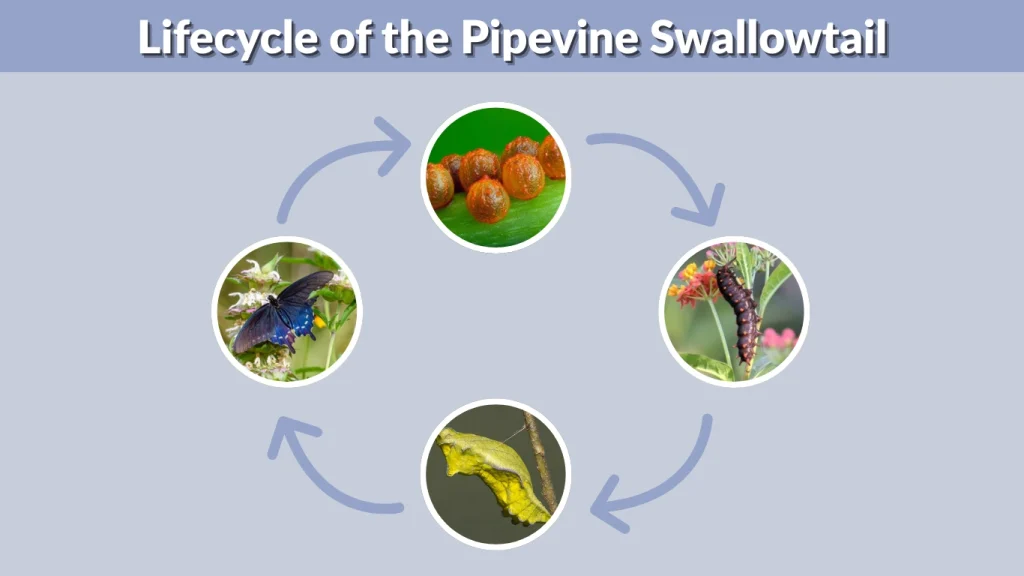
The pipevine swallowtail undergoes complete metamorphosis, moving through clearly defined stages.
- Egg stage: Females lay small red eggs in clusters on pipevine leaves and stems.
- Early instar caterpillars: Young larvae emerge dark and begin feeding in groups.
- Mature caterpillar stage: As they grow, their spines become more prominent and their bodies darker.
- Chrysalis stage: The caterpillar forms a brown or gray chrysalis attached to stems or structures.
- Adult butterfly stage: The adult emerges with iridescent blue wings and begins feeding and reproducing.
- Generations per year: One to three broods may occur annually, depending on climate.
Appearance Changes During Growth
Newly hatched pipevine swallowtail caterpillars are small, dark, and only lightly textured. As they molt through successive instars, the fleshy tubercles enlarge and brighten, giving the caterpillar its distinctive spiny look. The body thickens, segmentation becomes more visible, and coloration deepens to a rich, velvety black.
Before pupation, the caterpillar often wanders away from the host plant to find a sheltered place. It then anchors itself and forms a chrysalis, entering the transformation stage that will eventually produce the adult butterfly.
Host Plants and Feeding Behavior

Pipevine Plants as Host Species
Pipevine swallowtail caterpillars feed almost exclusively on plants in the genus Aristolochia, commonly known as pipevines or Dutchman’s pipe. These vines contain aristolochic acids, toxic compounds that most animals avoid. By feeding on these plants, the caterpillars absorb and store the toxins in their bodies, making themselves poisonous to many predators.
Native pipevines grow in woodlands, rocky slopes, and along streams, while ornamental varieties are often planted in gardens. Without pipevine plants, pipevine swallowtails cannot complete their life cycle, making these vines absolutely essential to their survival.
How the Caterpillar Feeds
Pipevine swallowtail caterpillars usually feed in clusters when young, often stripping sections of leaves together. As they grow larger, they may spread out across the host plant. They feed steadily, day and night, resting between meals along stems and leaf undersides. Their feeding creates irregular holes and scalloped leaf edges, a common sign of their presence.
Defense Mechanisms and Toxicity
The pipevine swallowtail caterpillar is famous for its strong chemical and visual defenses.
- Sequestration of toxic compounds from pipevine leaves
- Bright orange and red tubercles that warn predators
- Unpalatable taste that discourages repeated attacks
- Survival advantage that allows open, visible feeding
- Chemical protection that carries into the adult butterfly
Because birds quickly learn to associate the caterpillar’s colors with sickness, the species benefits from long-term predator avoidance.
Behavior of Pipevine Swallowtail Caterpillars
Pipevine swallowtail caterpillars often display social behavior, especially during early growth stages. Groups of larvae can be seen feeding side by side, which may enhance their warning signals and reduce individual risk.
They spend most of their time eating, resting, or molting. When preparing to molt, a caterpillar may stop feeding and become inactive for a short period. If disturbed, it typically curls slightly or freezes rather than attempting to flee.
As they approach pupation, caterpillars leave the host plant and search for sturdy surfaces such as stems, fences, rocks, or walls. This wandering stage is often when people notice them most.
Predators and Survival Strategies
Despite their toxicity, pipevine swallowtail caterpillars still face threats. Some spiders, parasitic wasps, and specialized predators can tolerate or bypass their chemical defenses. Eggs and newly hatched larvae are especially vulnerable to ants and small insects.
Their greatest protection comes from their chemical composition and warning coloration. Predators that attempt to eat them often experience nausea or irritation, learning to avoid them in the future. This predator education benefits not only pipevine swallowtails but also other butterflies that mimic their appearance.
Through these interactions, the caterpillar becomes an important driver of mimicry systems in butterfly communities.
Pipevine Swallowtail Caterpillars in Gardens
How to Identify Them
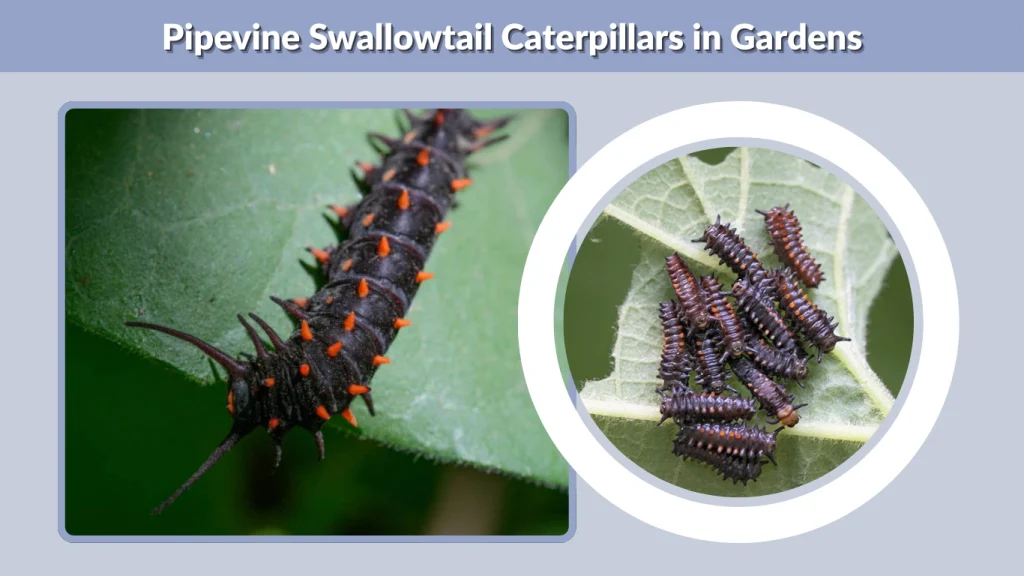
Gardeners usually find pipevine swallowtail caterpillars on pipevine leaves, where dark clusters of spiny larvae stand out clearly. Leaf damage combined with the presence of orange-spined caterpillars is a strong identification sign. They are most common from spring through late summer.
How to Support Them Safely
The best way to support them is to grow native pipevine species and avoid pesticide use. Leaf loss is normal and temporary, as healthy vines usually recover quickly. Observing without disturbing allows caterpillars to complete development and contribute to local butterfly populations.
Conservation Importance
Pipevine swallowtail caterpillars play a critical role in sustaining pipevine swallowtail butterfly populations and the mimicry networks built around them. Protecting their host plants protects entire ecological relationships.
Habitat destruction, removal of native vines, and chemical spraying can quickly eliminate local populations. Encouraging native plant gardening and preserving woodland corridors help maintain healthy breeding environments.
Because caterpillars are the foundation of butterfly life cycles, their conservation has long-term effects on pollinator diversity and ecosystem stability.
Interesting Facts About Pipevine Swallowtail Caterpillars
Pipevine swallowtail caterpillars are among the few North American caterpillars that are genuinely toxic rather than merely irritating. Their bright colors are honest warning signals, not bluffs. The chemicals they store protect them throughout life, influencing the evolution of several other butterfly species that copy their appearance.
FAQs
What does a pipevine swallowtail caterpillar look like?
A pipevine swallowtail caterpillar is dark reddish-black with rows of soft, fleshy spines that are bright orange or red. Its thick, segmented body and slow movement make it easy to identify. These bold colors serve as a warning to predators that it is toxic.
What do pipevine swallowtail caterpillars eat?
They feed almost exclusively on pipevine plants in the genus Aristolochia. These leaves contain toxic compounds that the caterpillars absorb into their bodies. This specialized diet provides both nutrition and powerful chemical protection from predators.
Are pipevine swallowtail caterpillars poisonous?
Yes, pipevine swallowtail caterpillars are toxic to many predators. They store poisons from pipevine plants in their tissues, making them unpalatable and sometimes harmful if eaten. Their bright colors advertise this danger, helping predators learn to avoid them.
Where are pipevine swallowtail caterpillars found?
They are found across much of the United States, Mexico, and parts of Central America wherever pipevine grows. Common habitats include woodlands, river corridors, rocky slopes, and gardens that cultivate pipevine species.
How do you attract pipevine swallowtails to your garden?
Planting native pipevine vines is the most effective way to attract them. Avoid pesticides, allow caterpillars to feed naturally, and grow nectar flowers for adult butterflies. A garden that supports both stages encourages long-term population growth.
