

Thrips are minute, slender insects that belong to the order Thysanoptera. Known for their fringed wings and piercing-sucking mouthparts, they may be tiny—often just 1–2 mm in length—but their impact on plants can be severe. From garden flowers to commercial crops, these pests damage leaves, buds, and fruits, while also transmitting plant viruses like Tomato Spotted Wilt Virus (TSWV). Understanding their life cycle is key to effective control.
Let’s explore the stages of thrips development, how long they live, and how their life cycle varies by species and environment.
What Are Thrips?

Thrips are small, fast-moving insects that thrive in warm, dry environments. There are over 6,000 known species worldwide, many of which are pests of economic importance. They feed by puncturing plant cells and sucking out their contents, leaving behind silvering, speckling, or browning on leaves and petals.
Some well-known species include:
- Western Flower Thrips (Frankliniella occidentalis)
- Onion Thrips (Thrips tabaci)
- Citrus Thrips (Scirtothrips citri)
- Chilli Thrips (Scirtothrips dorsalis)
- Black Thrips (Haplothrips spp.)
Here is the all types of thrips that help you identify them
Overview of the Thrips Life Cycle
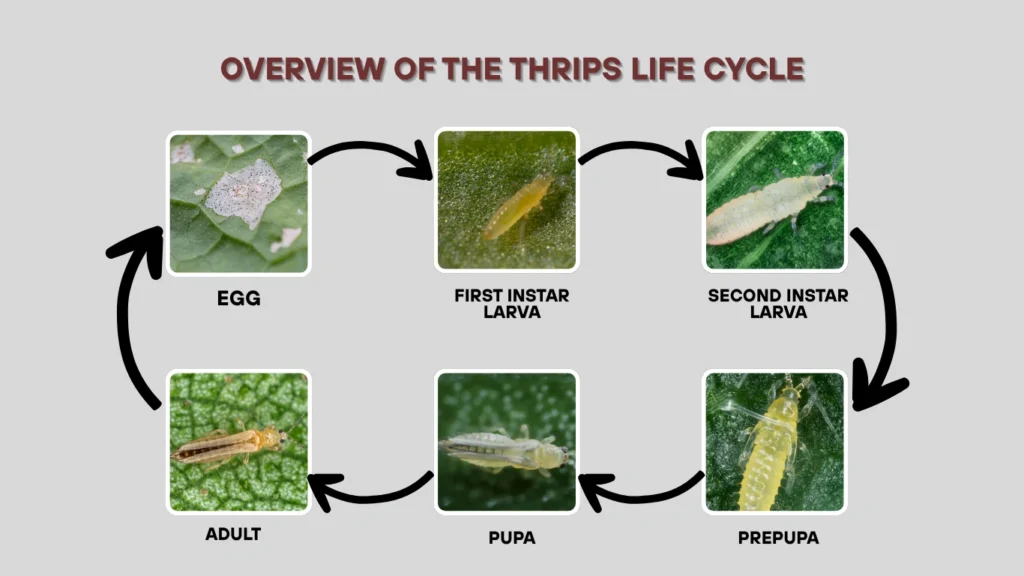
Thrips undergo a gradual metamorphosis, which includes both active and inactive stages. The complete life cycle consists of:
- Egg
- First instar larva
- Second instar larva
- Prepupa
- Pupa
- Adult
The total duration of the life cycle depends on environmental conditions and species, ranging from 10 to 35 days. Thrips can produce multiple generations each year, especially in greenhouses or tropical regions.
Thrips Life Cycle Stages
Egg Stage
Female thrips insert their eggs into plant tissues—usually leaves, stems, or flower petals. These tiny eggs are oval-shaped and nearly invisible to the naked eye. The incubation period lasts 2 to 7 days, depending on temperature.
Larval Stages (1st and 2nd Instars)
Once hatched, the larvae begin feeding immediately. These stages are the most damaging, as thrips extract plant fluids from soft tissues. Larvae are pale and wingless, and remain on leaves, flowers, or buds. This stage lasts 4 to 6 days in ideal conditions.
Prepupal Stage
After the second larval stage, the thrips enters a non-feeding prepupal stage. It often drops to the soil or leaf litter. This transitional stage lasts around 1–2 days.
Pupal Stage
The pupa is also non-feeding and immobile. It completes the transformation into an adult in 1 to 3 days. Pupation often takes place in crevices, soil, or beneath dead leaves.
Adult Stage
Adult thrips emerge with fully developed wings. They are active, mobile, and capable of reproduction within a day or two. Depending on the species and environment, adult thrips live from 7 to 30 days, sometimes longer in cooler conditions.
Life Cycle Duration by Thrips Species

Different thrips species complete their life cycles at varying speeds:
| Species | Life Cycle Duration |
| Western Flower Thrips | 15–28 days |
| Onion Thrips | 20–30 days |
| Chilli Thrips (Black Thrips) | 18–22 days |
| Citrus Thrips | Up to 35 days |
| Rice Thrips | 14–20 days |
| Flower Thrips | 12–18 days |
Environmental Influence on Development
Temperature and humidity play a crucial role in the development speed of thrips. Warmer conditions shorten the lifecycle dramatically. For example, Western Flower Thrips may complete development in just 7 days at 30°C, while the same cycle might take 20 days at 20°C.
Greenhouses often promote faster cycles due to their stable, warm conditions—making thrips management even more challenging.
How Long Do Thrips Live?
Thrips lifespans vary by species and environmental conditions:
- Adults typically live 2–4 weeks
- Some can live up to 45 days in ideal greenhouse environments
- Without host plants, thrips can only survive 2–5 days, depending on humidity and temperature
How Far Can Thrips Fly?
Though small, thrips are equipped with fringed wings and can fly short distances. They are more often carried by wind than through active flight. In greenhouse settings, they can move quickly between plants. Outdoors, wind can spread them across fields or even between farms.
Life Cycle in Major Crops
Onion Thrips
Lay eggs in onion leaves and go through their full cycle in 20–30 days, depending on the season. Larvae feed aggressively on foliage, causing silvery streaks.
Chilli (Black) Thrips
Active year-round in warm climates, completing their life cycle in 18–22 days. Eggs are laid on young leaves and fruits.
Citrus Thrips
Usually synchronized with the spring flush and bloom period. The lifecycle can extend up to 35 days in citrus orchards.
Rice Thrips
Infest rice during its vegetative and flowering stages. Lifecycle is relatively short—14–20 days in hot, humid conditions.
Developmental Stages and Identification

Identifying each stage helps in choosing the right time for treatment:
- Eggs: Hidden in plant tissue, difficult to detect
- Larvae (instars): Yellow or pale, highly active feeders
- Prepupa/Pupa: Inactive, hidden in soil or crevices
- Adults: Slender, winged, often yellow, brown, or black
Early detection during the larval stages is crucial for controlling population growth.
Thrips Control Based on Life Cycle
Cultural Control
- Remove plant debris and weeds
- Use reflective mulches
- Avoid excess nitrogen which promotes soft, attractive growth
Biological Control
- Introduce predatory mites (Amblyseius swirskii, Neoseiulus cucumeris)
- Release beneficial insects like Orius insidiosus (minute pirate bugs)
- Use entomopathogenic fungi like Beauveria bassiana
Chemical Control
- Apply insecticidal soaps or neem oil during larval stages
- Rotate systemic insecticides (e.g., spinosad, abamectin) to prevent resistance
- Target the base of plants and soil to disrupt pupation
Timing is critical—treating during larval stages provides the best results.
FAQs
What is the full life cycle of thrips?
Thrips undergo a six-stage life cycle: egg, first instar larva, second instar larva, prepupa, pupa, and adult. The egg is laid inside plant tissue. The two larval stages actively feed on plant cells. The prepupal and pupal stages are non-feeding and usually occur in the soil or leaf litter. Finally, the adult emerges ready to feed and reproduce. The entire cycle can take 10 to 35 days, depending on species and temperature.
How long do thrips live?
Adult thrips typically live for 7 to 30 days, though lifespan varies by species and environmental conditions. In protected environments like greenhouses, where temperature and humidity are stable, some adults may survive longer. Female thrips live slightly longer than males and may lay up to 80 eggs during their lifetime.
Can thrips survive without plants?
Thrips are highly dependent on plant tissue for survival and reproduction. Without access to host plants, they may survive for only 2 to 5 days, especially in dry or hot conditions. In humid environments or shaded indoor spaces, they might live slightly longer, but their population will not grow without plant material.
How far can thrips travel?
While thrips have wings, their flight range is limited to short distances. However, they are easily dispersed by wind, which can carry them hundreds of meters or more. In greenhouses or indoor environments, they move rapidly between plants. This wind-assisted travel makes thrips difficult to contain, especially in open agricultural fields.
What is the best time to treat thrips?
The larval stage is the most vulnerable and damaging part of the thrips’ life cycle. Targeting them during this stage with insecticidal soaps, neem oil, or biological controls is most effective. Adults can evade sprays and continue laying eggs, so early detection and regular monitoring (e.g., with blue or yellow sticky traps) are essential for timely intervention and long-term control.
