

Carpenter bees, often called wood bees, are a diverse group of pollinators found around the world. While some are large and capable of boring into wood, others are small and nest in plant stems. This guide explores seven distinct types of carpenter bees, detailing their appearance, habitat, behavior, and role in the ecosystem so you can identify and appreciate these fascinating insects.
1. Eastern Carpenter Bee (Xylocopa virginica)

The Eastern Carpenter Bee is one of the most common large carpenter bees in North America, especially in the eastern and central United States. Known for its bumblebee-like appearance, it plays an important role in pollination but can also bore into wooden structures to make nests.
Identification
- Size: 0.75–1 inch (19–25 mm)
- Color: Black body with yellow hair on the thorax; shiny black abdomen with little or no hair
- Wings: Transparent with a slight purple tint
- Sex Difference: Males have a white spot on the face, females do not
Habitat & Nesting
Eastern Carpenter Bees prefer soft, unpainted, or weathered wood for nesting, often drilling round entry holes about 0.5 inches wide. They can be found in fences, decks, eaves, and wooden furniture.
Behavior
They are solitary bees, meaning each female builds her own nest. Males may appear aggressive, hovering around humans, but they lack stingers and cannot sting. Females can sting but are usually non-aggressive unless provoked.
2. California Carpenter Bee (Xylocopa californica)
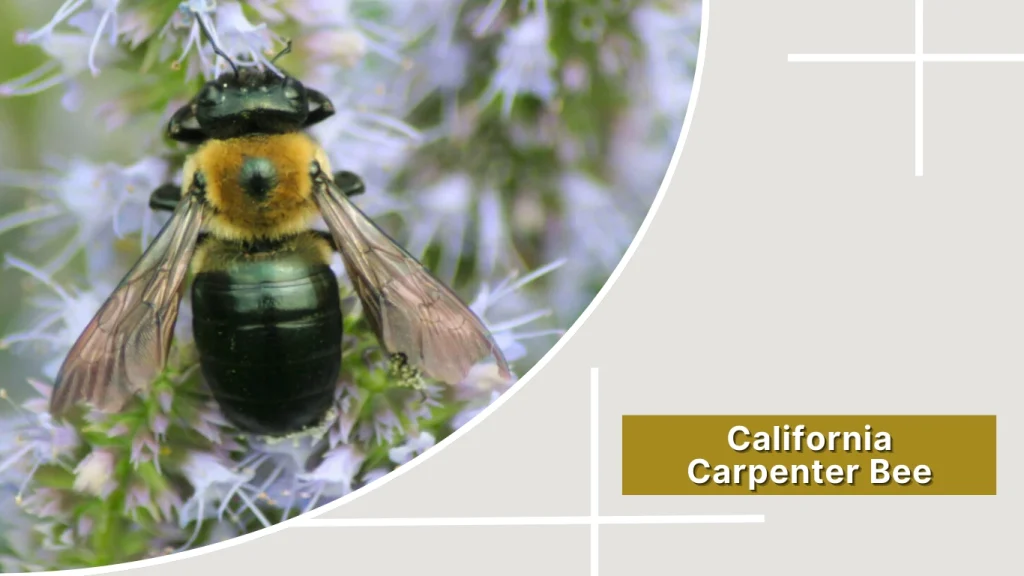
The California Carpenter Bee is a large, robust bee native to the southwestern United States and northern Mexico. It is well adapted to hot, dry climates and is often spotted in gardens and open woodlands. This species is an important pollinator for many native plants and crops.
Identification
- Size: 0.75–1 inch (19–25 mm)
- Color: Females are all black with a metallic sheen; males are golden with light hair on the thorax
- Wings: Dark with a purplish tint
- Distinctive Mark: Males have large, light-colored eyes compared to females
Habitat & Nesting
They prefer dry, dead wood, fence posts, and structural timbers for nesting. Entry holes are round and about 0.5 inches in diameter. The tunnels inside may extend several inches and be reused for years.
Behavior
California Carpenter Bees are generally non-aggressive. Males may guard nesting areas and chase intruders but cannot sting. Females sting only if handled roughly.
Role in Pollination
They are efficient pollinators for various flowering plants, including passion flowers, sunflowers, and some orchard crops.
3. Southern Carpenter Bee (Xylocopa micans)

The Southern Carpenter Bee is found mainly in the southeastern United States. Known for its beautiful metallic blue-green sheen, it is both a pollinator and a wood-boring insect, often nesting in dead tree limbs and untreated wooden structures.
Identification
- Size: Around 0.8–1 inch (20–25 mm)
- Color: Dark metallic blue-green body with a shiny, smooth abdomen
- Wings: Transparent to dark with an iridescent reflection
- Sex Difference: Males have lighter facial markings; females have solid dark faces
Habitat & Nesting
These bees typically bore into dead wood, fence posts, and building timbers, creating smooth, round entry holes. They prefer warmer, humid regions and often nest near flowering plants.
Behavior
Males patrol territories aggressively but are harmless since they cannot sting. Females can sting but rarely do unless provoked.
Role in Ecosystem
Southern Carpenter Bees are important for the pollination of wildflowers, fruit trees, and vegetable crops, making them a valuable part of their environment.
4. Tropical Carpenter Bee (Xylocopa latipes)

The Tropical Carpenter Bee is one of the largest carpenter bee species in the world, native to Southeast Asia, India, and parts of Australia. Its impressive size and loud buzzing make it easy to spot in gardens and forests.
Identification
- Size: 1–1.3 inches (25–33 mm)
- Color: Glossy black body with dense yellow or golden hair on the thorax (in some males)
- Wings: Dark brown to black with a metallic blue or violet sheen
- Sex Difference: Males often have lighter hair on the thorax, while females are entirely black
Habitat & Nesting
They typically nest in dead bamboo, tree trunks, and large pieces of untreated timber. Their nesting tunnels can be longer than those of many other species, sometimes reaching over a foot in length.
Behavior
While large and loud, these bees are generally gentle. Males guard territories near flowers, and females are focused on nest building and foraging.
Role in Ecosystem
Tropical Carpenter Bees are key pollinators for passion fruit, eggplants, and other tropical crops, contributing to both wild plant reproduction and agriculture.
5. Valley Carpenter Bee (Xylocopa varipuncta)

The Valley Carpenter Bee, also called the “Teddy Bear Bee,” is a striking species native to the southwestern United States and northern Mexico. Males have a distinctive golden color that makes them easily recognizable.
Identification
- Size: About 1 inch (25 mm)
- Color: Males are bright golden with greenish eyes; females are shiny black
- Wings: Dark with iridescent blue or purple highlights
- Unique Feature: Males’ dense golden hair gives them a fuzzy, teddy bear-like appearance
Habitat & Nesting
They prefer soft, unpainted wood, wooden beams, and dead tree branches. The nests are usually short tunnels but can expand over years if reused.
Behavior
Males are territorial but harmless, often hovering near flowers. Females are non-aggressive unless disturbed in the nest.
Role in Pollination
These bees are effective pollinators for citrus, tomatoes, and many ornamental plants, helping sustain garden biodiversity.
6. Green Metallic Carpenter Bee (Ceratina smaragdula)

The Green Metallic Carpenter Bee is a small carpenter bee species native to Asia and parts of the Pacific. Its shimmering metallic green body sets it apart from the larger, more common carpenter bees.
Identification
- Size: 0.25–0.4 inches (6–10 mm)
- Color: Bright metallic green or bluish-green body
- Wings: Transparent to slightly tinted with a faint sheen
- Sex Difference: Males are slightly smaller and slimmer than females
Habitat & Nesting
Unlike large carpenter bees that bore into solid wood, this species prefers soft pithy stems, such as bamboo, rose, or sunflower stalks. They make linear tunnels for nesting, sealing each brood cell with chewed plant fibers.
Behavior
They are non-aggressive and often go unnoticed due to their small size. Males rarely guard territories, focusing on mating opportunities, while females are busy building and provisioning nests.
Role in Pollination
These bees are important pollinators for herbs, wildflowers, and small-flowered crops, especially in tropical and subtropical regions.
7. Black Small Carpenter Bee (Ceratina calcarata)

The Black Small Carpenter Bee is a tiny North American carpenter bee, often overlooked because of its ant-like appearance. Despite its size, it plays a big role in pollinating wild and garden plants.
Identification
- Size: 0.25–0.4 inches (6–10 mm)
- Color: Completely black with a faint metallic sheen
- Wings: Transparent with light brown veins
- Distinctive Feature: Narrow body shape with sparse hair, giving a sleek look
Habitat & Nesting
They nest in dead plant stems such as raspberry, sumac, and elderberry, creating a series of brood chambers in a single stem. These nests are reused or extended each year.
Behavior
Very docile and unlikely to sting, these bees can often be found foraging on small blossoms. Females take care of their brood by guarding and feeding developing larvae.
Role in Pollination
They are especially important for small-flowered plants like blueberries, raspberries, and goldenrods, making them vital for both natural and cultivated landscapes.
FAQs
1. Are all carpenter bees the same species?
No, carpenter bees include many species across two main groups: large carpenter bees (Xylocopa) and small carpenter bees (Ceratina). Each species varies in size, color, habitat, and nesting habits.
2. Do carpenter bees damage wood?
Large carpenter bees can bore into untreated or weathered wood to build nests, which may cause structural damage over time. Small carpenter bees usually nest in plant stems and are not harmful to buildings.
3. Are carpenter bees aggressive?
Carpenter bees are generally non-aggressive. Males may hover around people but cannot sting. Females can sting but usually do so only if handled or provoked.
4. Are carpenter bees good for the environment?
Yes. Carpenter bees are valuable pollinators for many wild plants, garden flowers, and crops. Even though some can cause wood damage, their ecological benefits are significant.
5. How can you tell a carpenter bee from a bumblebee?
Carpenter bees have shiny, mostly hairless abdomens, while bumblebees have densely hairy, fuzzy abdomens. Carpenter bees are also more likely to nest in wood, whereas bumblebees nest in the ground or in cavities.
