

Dog fleas are more than just a nuisance—they can cause serious discomfort, allergic reactions, and even transmit diseases or parasites to your pets. While many people think of fleas as a single type, there are actually several species that can infest dogs. Some are common household pests like the dog and cat flea, while others originate from rodents, rabbits, poultry, or even wild animals but still find their way onto dogs. Understanding the different types of fleas that can affect your pet is essential for proper identification, prevention, and treatment.
1. Ctenocephalides canis (Dog Flea)

The dog flea (Ctenocephalides canis) is a blood-feeding parasite that primarily affects domestic dogs but can also feed on cats, humans, and other mammals. It is less common than the cat flea but still causes significant irritation, allergies, and can transmit parasites like tapeworms.
Identification
- Adult size: 2–3.5 mm long
- Body: Laterally flattened, allowing movement through fur
- Color: Dark reddish-brown
- Legs: Strong hind legs for long jumps
- Distinguishing trait: Genal and pronotal combs present, helping separate it from other flea species
Habitat
Dog fleas live mostly on their host but also infest dog bedding, carpets, and cracks in floors. Outdoors, they prefer shaded, humid areas such as soil and grass where dogs rest.
Diet
They feed mainly on the blood of dogs. However, in the absence of dogs, they bite humans, cats, and other mammals. Their bites often cause red, itchy bumps and can trigger allergic dermatitis in sensitive animals.
Behavior
Dog fleas are highly agile and can jump up to 20 cm vertically to reach a host. They spend most of their adult life on the dog, feeding multiple times a day. When disturbed, they quickly leap away, making them hard to catch. In large infestations, fleas show group behavior, concentrating on areas where pets rest or sleep.
2. Ctenocephalides felis (Cat Flea)
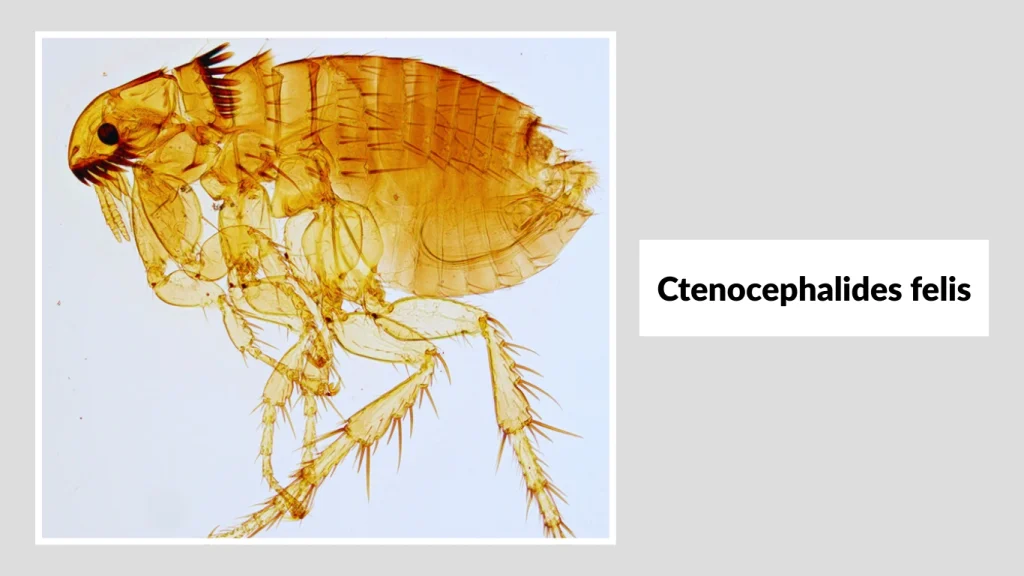
The cat flea (Ctenocephalides felis) is the most widespread flea species in the world. Despite its name, it infests not only cats but also dogs, humans, and other mammals. This species is more common than the dog flea and is responsible for the majority of flea infestations in household pets.
Identification
- Adult size: 1.5–3.2 mm long
- Body: Flattened sideways for easy movement through fur
- Color: Dark brown to reddish-brown
- Legs: Long hind legs specialized for jumping
- Key trait: Has genal and pronotal combs, but the head is longer compared to the dog flea
Habitat
Cat fleas thrive on their hosts but also inhabit bedding, carpets, upholstery, and cracks in floors. They prefer warm, humid environments and can easily spread indoors if not controlled.
Diet
Their main diet is the blood of cats and dogs. However, they opportunistically bite humans and other mammals when hosts are not available, often leaving itchy red bumps on the skin.
Behavior
Cat fleas are highly resilient and can infest multiple hosts in the same household. They jump quickly to latch onto passing animals and feed several times a day. They are more adaptable than dog fleas and can survive in indoor environments year-round, making them particularly difficult to eradicate.
3. Pulex irritans (Human Flea)
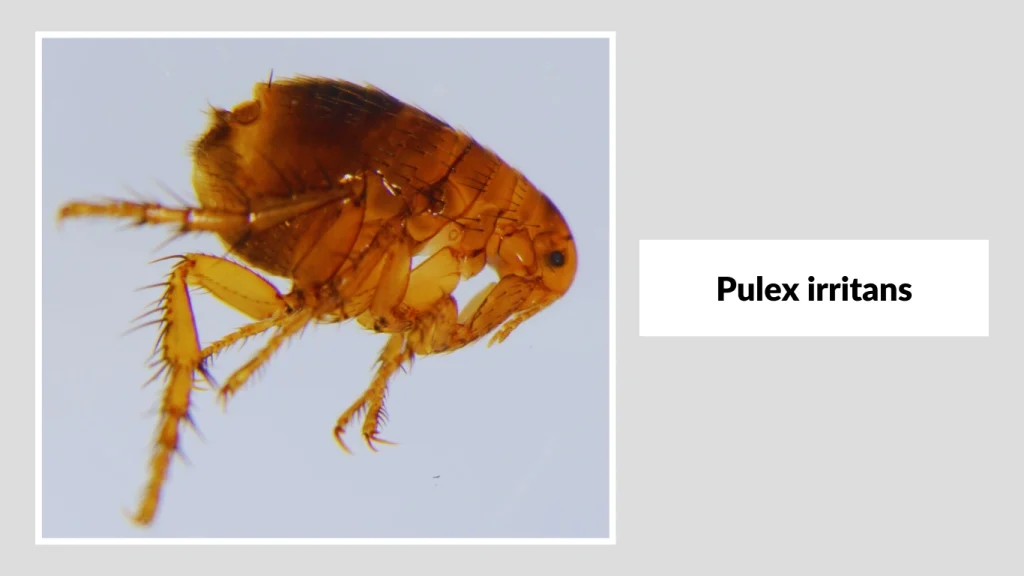
The human flea (Pulex irritans) is a flea species that commonly infests humans but can also live on dogs, pigs, cats, and other mammals. While less common today due to modern hygiene and pest control, it still appears in some rural and underdeveloped regions. It is also known as a potential carrier of disease-causing pathogens.
Identification
- Adult size: 2–3.5 mm long
- Body: Flattened sideways, smooth compared to dog or cat fleas
- Color: Dark brown to blackish-brown
- Key trait: Lacks both genal and pronotal combs (a distinguishing feature)
- Shape: Rounded head and simple structure compared to other fleas
Habitat
Human fleas are found in homes, animal shelters, rural environments, and livestock areas. They live in bedding, carpets, cracks in floors, and barns where animals and humans frequently interact.
Diet
Although called the “human flea,” this species is not host-specific. It feeds on human blood but also attacks dogs, cats, pigs, goats, and other warm-blooded mammals.
Behavior
Human fleas are opportunistic and adapt easily to new hosts. They jump from one host to another and can live for weeks without feeding. Their bites often cause painful itching and irritation, and in history, they have been linked with the spread of plague and typhus through transmission of infected blood.
4. Echidnophaga gallinacea (Sticktight Flea)
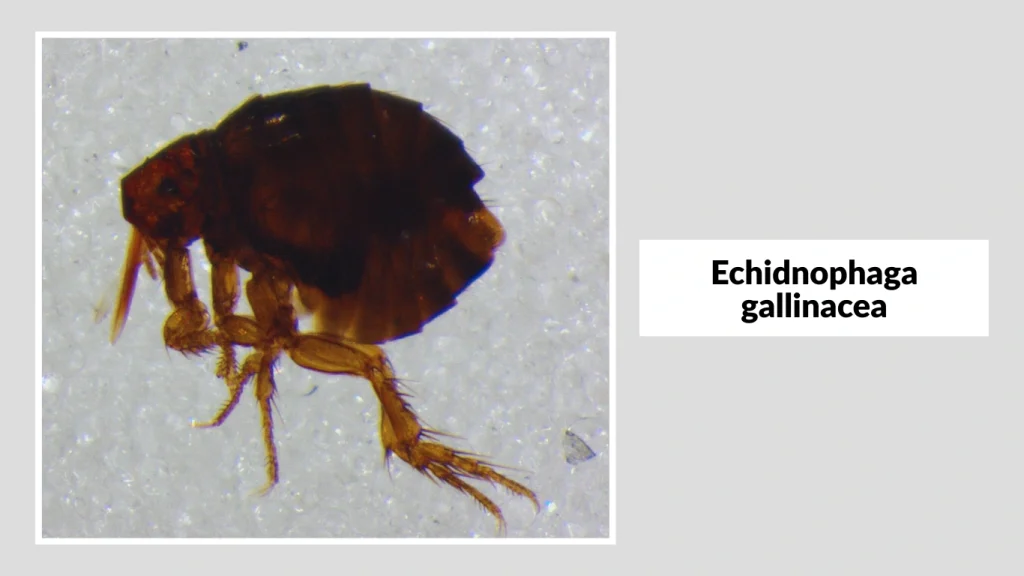
The sticktight flea (Echidnophaga gallinacea) is a small, burrowing flea that primarily infests poultry but can also attack dogs, cats, and humans. Unlike most fleas that move freely on the host, the sticktight flea firmly attaches itself to the skin, often around the eyes, ears, and thin-skinned areas of animals.
Identification
- Adult size: 1.5–2 mm long (smaller than cat and dog fleas)
- Body: Compact, dark brown, and flattened
- Key trait: Females embed their mouthparts deep into the host’s skin and remain fixed in place
- Appearance: Less active than other fleas, often seen clustered in groups on the host
Habitat
These fleas are common in warm, tropical, and subtropical regions. They are usually found in barns, poultry houses, and rural outdoor environments. On dogs, they attach around the eyes, ears, and muzzle, causing irritation and swelling.
Diet
Sticktight fleas feed exclusively on the blood of their host. Once attached, they remain fixed in one spot for days or weeks, continually drawing blood.
Behavior
Unlike the agile dog and cat fleas, sticktight fleas are sedentary. Females anchor themselves into the host’s skin, causing painful sores, swelling, and in severe infestations, secondary infections. Their immobility makes them harder to dislodge, and infestations can be especially dangerous for young or weak animals.
5. Spilopsyllus cuniculi (Rabbit Flea)

The rabbit flea (Spilopsyllus cuniculi) is primarily associated with wild and domestic rabbits but can also infest dogs, cats, and even humans if given the chance. It is particularly well known for its role in transmitting myxomatosis among rabbit populations, making it a significant veterinary concern.
Identification
- Adult size: Around 1.5–2.5 mm long
- Body: Narrow and flattened for easy movement through fur
- Color: Dark brown
- Key trait: Similar in appearance to cat fleas but smaller, with distinct head shape adapted to rabbits
Habitat
Rabbit fleas are most commonly found on rabbits, but in shared environments, they may jump onto dogs, especially in rural areas where dogs encounter wild rabbits. They can also live in rabbit hutches, burrows, and grassy areas where rabbits rest.
Diet
Their primary food source is the blood of rabbits, but when in contact with dogs or other mammals, they will readily feed on them as well.
Behavior
Rabbit fleas are opportunistic and often move between hosts. On dogs, infestations are usually temporary but can still cause itching, irritation, and discomfort. They also act as disease vectors, spreading viruses among rabbit populations, which indirectly affects other pets exposed to infected animals.
6. Archaeopsylla erinacei (Hedgehog Flea)

The hedgehog flea (Archaeopsylla erinacei) is a parasite primarily found on hedgehogs but can also bite dogs, cats, and humans when hedgehogs live nearby. In areas where hedgehogs and domestic pets share outdoor spaces, dogs may occasionally pick up these fleas.
Identification
- Adult size: 2–3.5 mm long
- Body: Flattened, reddish-brown
- Key trait: Very similar to the cat flea, but slightly larger and more robust
- Distinguishing feature: Commonly linked with hedgehogs, especially in rural or suburban gardens
Habitat
These fleas live mostly on hedgehogs, nesting in their bedding or dens. However, when hedgehogs move through gardens or sleep near dog kennels, the fleas can transfer to dogs. Indoors, they can survive for some time in pet bedding and carpets.
Diet
Their primary diet is hedgehog blood, but they opportunistically feed on dogs, cats, and humans if the chance arises.
Behavior
Hedgehog fleas are resilient and can jump from hedgehogs to dogs during encounters. While they do not establish long-term infestations on dogs as easily as cat or dog fleas, they still cause itching, discomfort, and skin irritation. In regions where hedgehogs are common, pet owners should be cautious about flea transmission.
7. Ceratophyllus gallinae (European Chicken Flea)

The European chicken flea (Ceratophyllus gallinae) is a parasite commonly found on poultry but can also infest dogs, cats, and humans, especially in rural areas. Dogs that live near chicken coops or farmyards are at risk of encountering this flea.
Identification
- Adult size: 2–2.5 mm long
- Body: Laterally flattened, dark brown
- Key trait: Lacks both genal and pronotal combs, which separates it from dog and cat fleas
- Commonly clustered in poultry houses but may jump onto passing mammals
Habitat
These fleas are most often found in chicken coops, bird nests, and animal shelters. When dogs explore or sleep near poultry areas, they may become temporary hosts. Indoors, they can survive in carpets, bedding, and cracks in wooden floors.
Diet
The primary diet is bird blood, but they will opportunistically bite dogs and other mammals. On dogs, bites can lead to skin irritation, itching, and allergic reactions.
Behavior
European chicken fleas are less host-specific than many other species. They frequently move between birds and mammals, biting whenever a blood meal is available. Their presence in poultry environments makes them a seasonal problem for dogs that share outdoor spaces with chickens.
8. Tunga penetrans (Jigger Flea / Sand Flea)
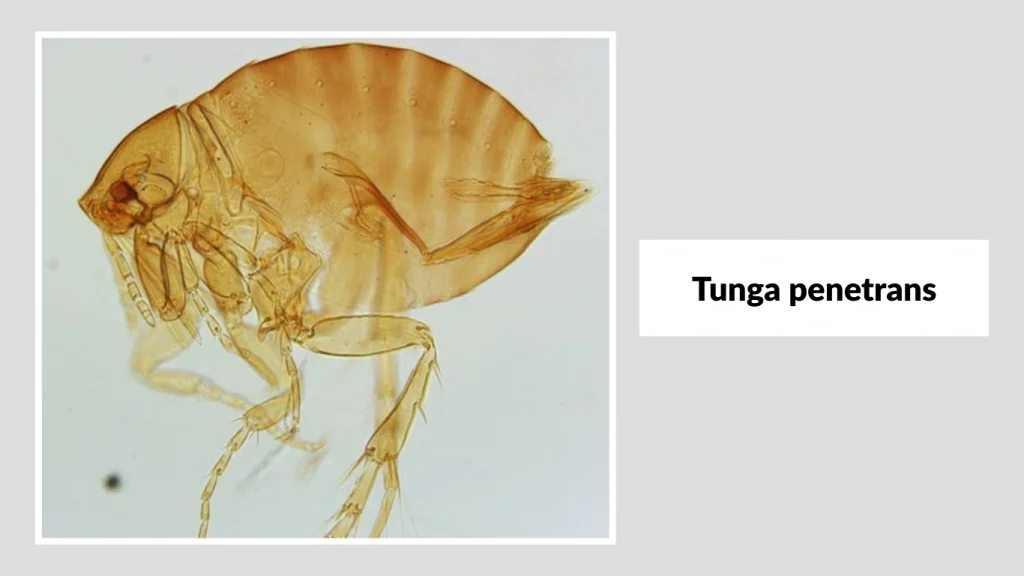
The jigger flea (Tunga penetrans), also known as the sand flea, is a burrowing parasite found in tropical and subtropical regions. Unlike other fleas that move freely on the host, the female jigger flea embeds itself into the skin of mammals, including dogs, causing painful sores and infections.
Identification
- Adult size: Extremely small, about 1 mm long
- Body: Pale brown and difficult to see with the naked eye
- Key trait: Females burrow into the skin, swelling as they feed and produce eggs
- Appearance: Swollen nodules on the skin indicate infestation
Habitat
Jigger fleas live in sandy soils, dusty floors, and dry environments in tropical regions of Africa, South America, and the Caribbean. Dogs are highly susceptible when they walk or rest on infested ground.
Diet
They feed on the blood of mammals. After burrowing, females remain fixed in the host’s skin, drawing blood continuously while releasing eggs into the environment.
Behavior
Unlike most fleas that stay mobile, jigger fleas burrow into the skin and remain embedded for weeks. On dogs, they commonly infest the paws, pads, belly, and ears. Their presence causes intense itching, inflammation, and sometimes secondary bacterial infections. Heavy infestations may lead to lameness and severe health issues if untreated.
9. Xenopsylla cheopis (Oriental Rat Flea)

The oriental rat flea (Xenopsylla cheopis) is one of the most notorious flea species in history, known as the primary vector of the bubonic plague. While its main host is the rat, it can also infest dogs, cats, and humans, particularly in areas where rats and domestic animals live in close proximity.
Identification
- Adult size: 1.5–2.5 mm long
- Body: Flattened, dark brown
- Key trait: Lacks both genal and pronotal combs
- Distinctive head shape and thorax help differentiate it from dog and cat fleas
Habitat
These fleas are found in rodent nests, barns, warehouses, and urban areas with rat populations. Dogs can pick them up when exploring infested areas or through indirect contact with rodents.
Diet
Their preferred host is the rat, but they will bite dogs, cats, and humans when needed. On dogs, bites lead to irritation, itching, and potential allergic reactions.
Behavior
Oriental rat fleas are opportunistic jumpers and move between rodents, dogs, and humans. Historically, they transmitted Yersinia pestis, the bacteria responsible for plague, showing their capacity as disease vectors. In modern times, they are still capable of carrying and spreading murine typhus and other pathogens. On dogs, they are less common than cat fleas but still pose health risks in rat-infested areas.
10. Nosopsyllus fasciatus (Northern Rat Flea)
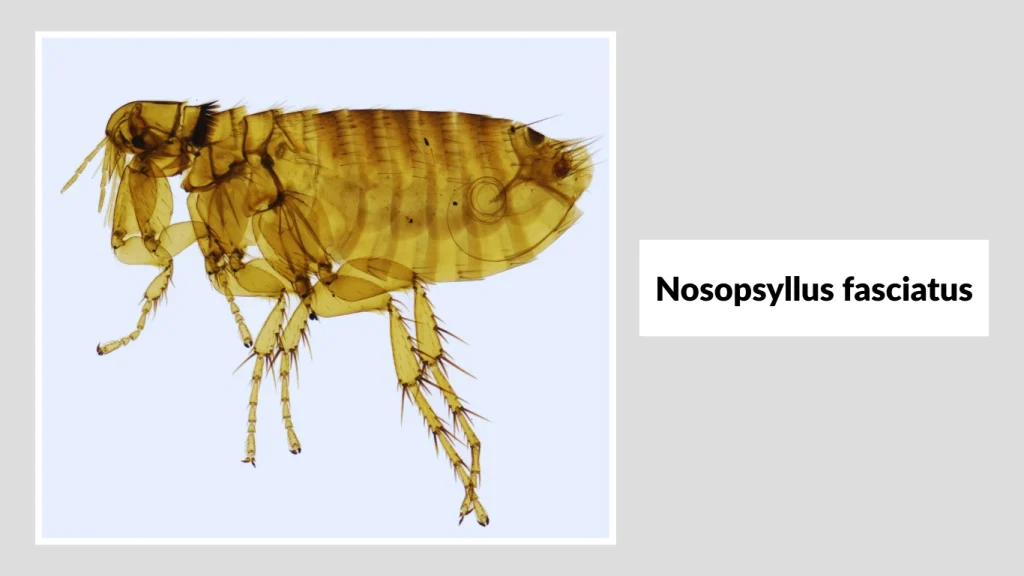
The northern rat flea (Nosopsyllus fasciatus) is another rodent-associated flea that can infest dogs when they come into contact with rats or rat-infested areas. It is common in temperate regions and is one of the most widespread rat fleas globally.
Identification
- Adult size: 2–4 mm long (slightly larger than many other fleas)
- Body: Flattened, dark brown
- Key trait: Lacks both genal and pronotal combs, like the oriental rat flea
- Distinctive feature: Longer spine-like bristles on the body compared to Xenopsylla cheopis
Habitat
This flea is most often found in rat burrows, barns, warehouses, and areas with poor sanitation. Dogs may pick them up outdoors in rodent-infested places or when resting near rat nests.
Diet
The primary host is the rat, but when rats are unavailable, the northern rat flea will readily feed on dogs, cats, and humans. Bites are irritating and may lead to secondary skin infections in dogs due to scratching.
Behavior
Northern rat fleas are opportunistic and move between rodent and non-rodent hosts. They jump effectively and can survive for weeks without feeding. Though less infamous than the oriental rat flea, they are also capable of transmitting pathogens, including Yersinia pestis and Rickettsia species. On dogs, they are usually temporary parasites but can still cause discomfort and health risks.
11. Ctenophthalmus agyrtes (Common European Flea)

The common European flea (Ctenophthalmus agyrtes) is mainly associated with wild rodents but can occasionally infest dogs, especially in rural or woodland areas. While not as widespread on pets as cat or dog fleas, it is still important because of its ability to switch hosts.
Identification
- Adult size: 2–3 mm long
- Body: Flattened and reddish-brown
- Key trait: Lacks both genal and pronotal combs
- Distinctive feature: Found mostly on wild rodents, but can transfer to dogs in shared environments
Habitat
This flea is most often found in rodent burrows, nests, and woodland environments. Dogs that hunt, roam, or explore outdoor rural areas are more likely to encounter them.
Diet
The preferred host is wild rodents, but in the absence of these, they will feed on dogs, cats, and other mammals.
Behavior
These fleas are opportunistic and move between rodents and larger animals when the chance arises. On dogs, they may not establish permanent infestations but still cause itching, irritation, and scratching. In some regions, they are known to carry and spread pathogens between wildlife and domestic pets.
12. Leptopsylla segnis (Mouse Flea)
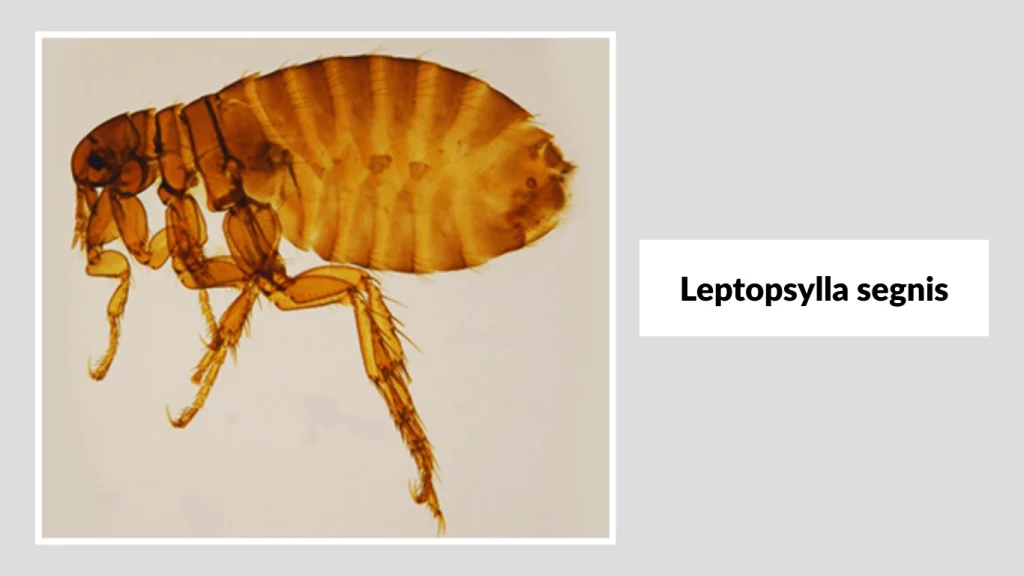
The mouse flea (Leptopsylla segnis) is primarily a parasite of house mice but can also infest dogs, cats, and humans when rodents are present in the same environment. It is considered a secondary flea species on pets but may still cause problems in homes with rodent activity.
Identification
- Adult size: 2–2.5 mm long
- Body: Flattened, light to dark brown
- Key trait: Lacks both genal and pronotal combs
- Distinctive feature: Most often found on mice, but will opportunistically infest other mammals
Habitat
Mouse fleas are common in rodent nests, houses, barns, and storage areas where mice live. Dogs that spend time in rodent-infested environments are at higher risk of temporary infestations.
Diet
Their main food source is mouse blood, but they will also bite dogs, cats, and humans if given the opportunity. On dogs, bites cause irritation and mild allergic reactions.
Behavior
Mouse fleas move quickly between mice and other mammals in shared spaces. They are opportunistic and can survive for days to weeks without feeding. While not a permanent parasite on dogs, they still contribute to discomfort and may play a role in transmitting diseases from rodents to pets.
13. Odontopsyllus multispinosus (Beaver Flea)

The beaver flea (Odontopsyllus multispinosus) is the largest flea species in North America and is primarily associated with beavers. Although it rarely infests dogs, it can occasionally bite them if they come into contact with beaver habitats such as rivers, ponds, or wetlands.
Identification
- Adult size: Up to 8 mm long (much larger than most flea species)
- Body: Flattened, reddish-brown
- Key trait: Noticeably larger than common dog or cat fleas
- Distinctive feature: Adapted to aquatic mammal hosts like beavers
Habitat
Beaver fleas live in and around beaver lodges and dams. Dogs that swim or explore near beaver habitats are at risk of encountering these fleas.
Diet
Their main host is the beaver, but they will bite dogs, humans, and other mammals if nearby. Bites on dogs can cause swelling, itching, and skin irritation.
Behavior
Unlike most fleas that infest household pets, beaver fleas are more host-specific. They rarely establish infestations on dogs but may transfer temporarily during outdoor exposure. Their large size makes them more visible on fur, and their bites are often more painful than those of smaller flea species.
14. Amphipsylla sibirica (Siberian Flea)
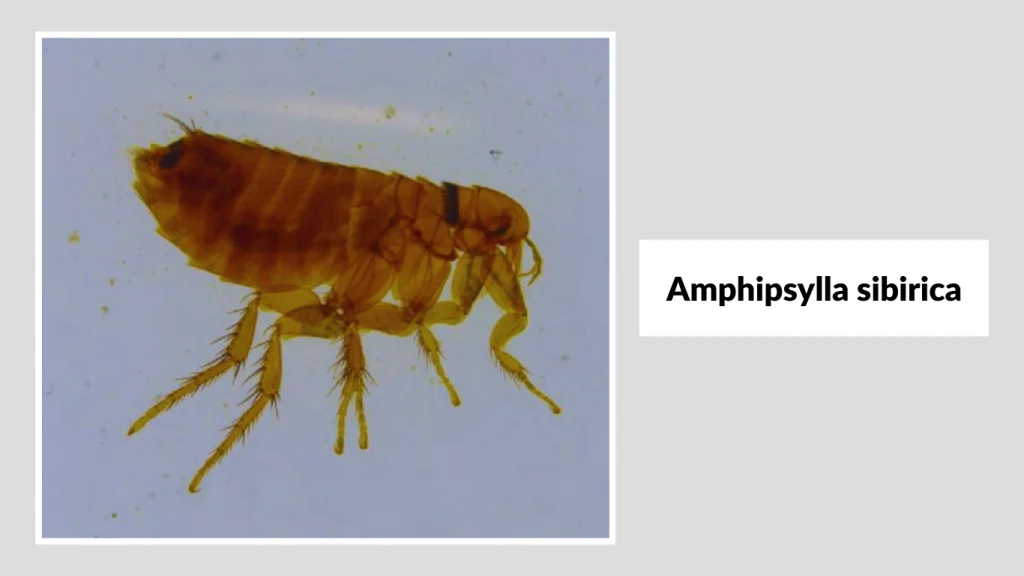
The Siberian flea (Amphipsylla sibirica) is mainly found on wild rodents in cold, northern regions but can occasionally infest dogs and other mammals. While not as common as cat or dog fleas, it is still relevant in rural and forested areas where dogs encounter wildlife.
Identification
- Adult size: 2–3 mm long
- Body: Flattened, reddish-brown
- Key trait: Lacks genal and pronotal combs
- Distinctive feature: Associated with rodents in colder climates, especially in Siberia and Northern Europe/Asia
Habitat
These fleas are found in rodent burrows, nests, and natural shelters in forested or steppe regions. Dogs roaming in such areas may carry them back into human dwellings or kennels.
Diet
The preferred host is wild rodents, but they will bite dogs, cats, and sometimes humans when in close contact. On dogs, bites usually cause itching and localized irritation.
Behavior
Siberian fleas are opportunistic parasites that jump from rodents to other mammals. While they do not typically form long-term infestations on dogs, they are capable of spreading pathogens between wildlife and domestic animals, making them a concern in rural settings.
15. Typhloceras poppei (Wild Rodent Flea)

The wild rodent flea (Typhloceras poppei) is a flea species primarily associated with small wild rodents. Though not a common parasite of dogs, it can infest them temporarily when they come into contact with rodent habitats in forests, fields, or rural areas.
Identification
- Adult size: 2–3 mm long
- Body: Flattened, brownish in color
- Key trait: Lacks both genal and pronotal combs
- Distinctive feature: Strongly linked with wild rodents rather than domestic animals
Habitat
This flea lives in rodent nests, burrows, and grassy outdoor environments. Dogs that roam freely in rural or wooded areas are most at risk of picking up these fleas.
Diet
Its preferred host is wild rodents, but it will opportunistically bite dogs, cats, and humans. On dogs, bites generally cause irritation and itching but are usually short-lived unless dogs remain in contact with infested rodent areas.
Behavior
Wild rodent fleas are opportunistic jumpers, moving between rodents and larger mammals when food sources are available. They are not well adapted to living permanently on dogs but still pose a risk as carriers of rodent-borne diseases.
