

Giant stick insects are some of the most extraordinary creatures in the insect world, known for their incredible size, camouflage, and unique defenses. From the record-breaking Chan’s Megastick to the heavily armored Giant Thorny Stick Insect, these fascinating species showcase nature’s mastery of mimicry and survival. In this article, we’ll explore 15 remarkable types of giant stick insects, their features, habitats, and ecological importance.
1. Giant Spiny Stick Insect

The Giant Spiny Stick Insect (Extatosoma tiaratum), also called the Macleay’s Spectre, is one of the most famous and widely recognized stick insects. Native to Australia, it is known for its incredible camouflage, mimicking both sticks and leaves with remarkable accuracy. Its large size and spiny body make it a fascinating species among insect enthusiasts.
Identification
- Females reach up to 20 cm (8 in), males around 12 cm (4.7 in)
- Females have broad, leaf-like bodies with spiny projections
- Males are slimmer with long wings and strong fliers
- Color varies from brown to green, resembling dry or fresh leaves
- Strong legs equipped with small spines for defense
Behavior
Giant Spiny Stick Insects are nocturnal and remain motionless during the day, blending into foliage to avoid predators. When threatened, females curl their abdomen over their body like a scorpion and display spines to deter attackers. Males, being lighter and winged, often escape by flying.
Habitat
They are native to Queensland and New South Wales in Australia, living in eucalyptus forests and woodland areas. They prefer trees and shrubs where their leaf-like camouflage is most effective.
Importance
This insect plays a role in maintaining plant balance by feeding on leaves. It is also popular in insect-keeping communities worldwide and serves as an educational species for teaching camouflage and adaptation in nature.
2. Jungle Nymph
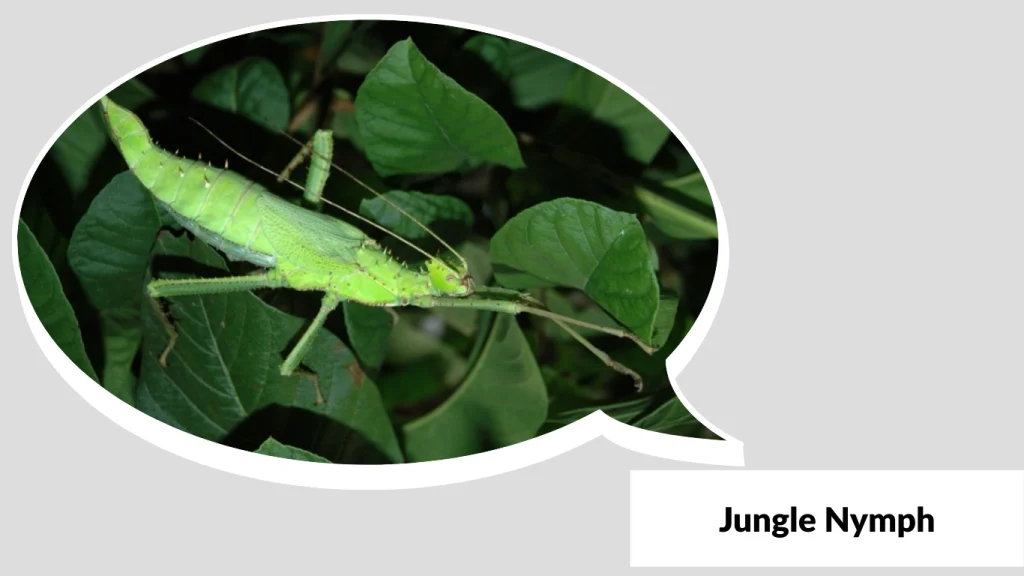
The Jungle Nymph (Heteropteryx dilatata) is considered one of the heaviest and most striking stick insects in the world. Native to Malaysia, this species is admired for its size, bright green coloration, and thorny body. It is one of the most iconic representatives of giant stick insects and is often showcased in insect collections and educational programs.
Identification
- Females are massive, reaching up to 25 cm (10 in) in length and very bulky
- Males are smaller, slimmer, and capable of flight
- Bright green coloration in females, aiding leaf camouflage
- Thorn-covered body, especially prominent on legs and thorax
- Very strong legs, capable of delivering a defensive pinch
Behavior
The Jungle Nymph is nocturnal and spends most of the day hiding motionless among leaves. At night, it feeds on a variety of plants, especially guava and bramble leaves. When threatened, it raises its spiny legs defensively and can give a painful pinch with its thorned limbs.
Habitat
This species inhabits the tropical rainforests of Malaysia, preferring dense vegetation where it can hide among foliage. It thrives in warm, humid environments.
Importance
Jungle Nymphs play a role in the forest ecosystem by consuming leaves and contributing to nutrient cycling. They are also a popular species in insect zoos and breeding programs due to their impressive size and unique appearance.
3. Macleay’s Spectre
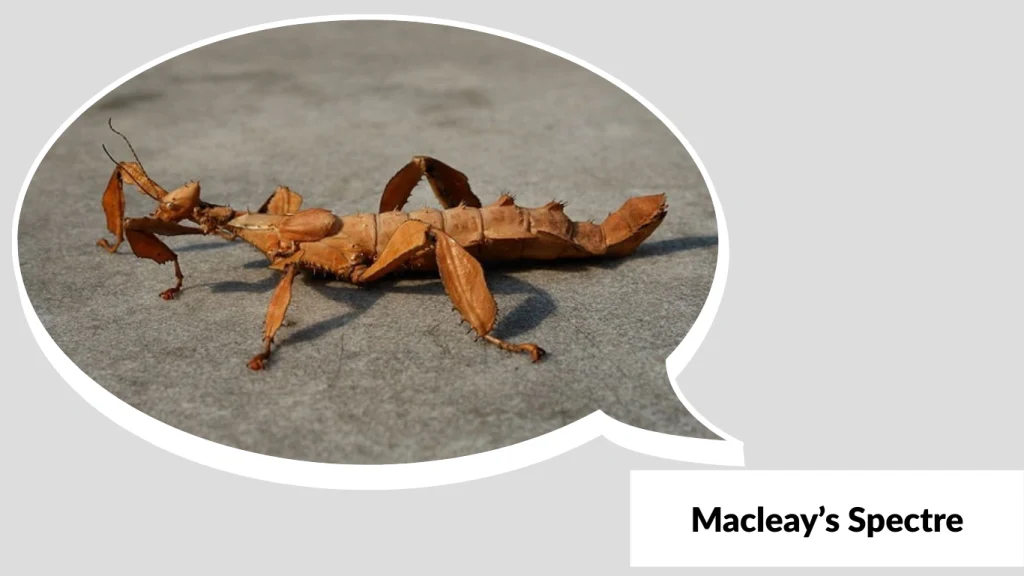
Macleay’s Spectre (Extatosoma sp.) is a remarkable stick insect known for its leaf-like body and superb mimicry. Often confused with the Giant Spiny Stick Insect since they belong to the same genus, it is also native to Australia and admired for its extraordinary camouflage abilities. Its curled abdomen and irregular edges make it look almost identical to a dried, crumpled leaf.
Identification
- Females grow up to 20 cm (8 in), males around 12 cm (4.7 in)
- Females are bulky with a curled abdomen resembling a scorpion’s tail
- Males are slender, winged, and capable of flight
- Colors vary from green to brown, mimicking fresh or dried leaves
- Body edges are uneven, enhancing camouflage as foliage
Behavior
Macleay’s Spectres are nocturnal feeders, staying motionless during the day to avoid predators. When threatened, females raise their spiny legs and curl their abdomen as a bluff display. Males rely more on flight to escape danger.
Habitat
They inhabit eucalyptus forests and woodlands in Australia, where their leaf-like bodies blend perfectly with surrounding vegetation.
Importance
These insects are essential for demonstrating natural camouflage and adaptation in education. They are also widely bred in captivity, making them one of the most popular stick insects among hobbyists worldwide.
4. Titan Stick Insect

The Titan Stick Insect (Acrophylla titan) is one of Australia’s largest stick insects, famous for its incredible length. Although it looks fragile, its slender body and long legs allow it to blend perfectly with tree branches. Despite its size, it relies heavily on camouflage rather than aggression for survival.
Identification
- One of the longest stick insects in Australia, reaching up to 30 cm (12 in)
- Slender, elongated body resembling a thin twig
- Brown or green coloration depending on habitat
- Long, delicate legs and antennae
- Females are larger and heavier, males slimmer with wings
Behavior
Titan Stick Insects are nocturnal, remaining still during daylight to avoid detection. They feed at night on eucalyptus and other native leaves. When disturbed, they sway gently, mimicking the motion of twigs in the wind for added camouflage.
Habitat
They are widely found in eastern Australia, especially in eucalyptus forests and bushlands. Their stick-like bodies make them nearly invisible among tree branches.
Importance
The Titan Stick Insect showcases one of the best examples of twig mimicry in nature. It also plays a role in the ecosystem by consuming leaves and contributing to plant cycle balance. Its impressive size makes it a highlight for insect enthusiasts and educational exhibits.
5. Goliath Stick Insect

The Goliath Stick Insect (Eurycnema goliath) is one of the largest stick insects in Australia and is famous for both its size and striking appearance. Unlike many stick insects that rely solely on twig mimicry, this species can also flash its wings as a defense display, making it one of the most dramatic phasmids to encounter.
Identification
- Grows up to 25 cm (10 in) in length
- Females are large and heavy-bodied, while males are slimmer and winged
- Green or brown body with long legs resembling branches
- Large hindwings with red and black markings used in defense
- Strong legs with spines for protection
Behavior
The Goliath Stick Insect is mostly nocturnal, feeding at night on eucalyptus and acacia leaves. When threatened, it spreads its colorful wings to startle predators, sometimes producing a hissing sound by rubbing its wings together. If attacked, it may kick with its spiny legs for defense.
Habitat
It inhabits forests and woodlands across eastern Australia, especially in areas with eucalyptus trees. Its camouflage is highly effective, allowing it to blend seamlessly with branches during the day.
Importance
The Goliath Stick Insect demonstrates both camouflage and startling defense tactics, making it a unique species among stick insects. It contributes to the natural balance by feeding on tree leaves and is a favorite species among insect collectors and educators.
6. Thorny Stick Insect

The Thorny Stick Insect (Aretaon asperrimus) is a rugged-looking phasmid covered with sharp spines that serve as natural protection against predators. Native to Borneo, it is not as long as some of the world’s largest stick insects but is one of the most heavily armored. Its thorny appearance makes it stand out among other species.
Identification
- Medium-sized, reaching about 12–15 cm (5–6 in) in length
- Body and legs covered with sharp spines
- Color ranges from brown to gray, blending with bark and branches
- Females are larger and more robust, males are slimmer
- Strong legs with thorny projections used in defense
Behavior
Thorny Stick Insects are mostly nocturnal, hiding during the day among branches and tree bark. When threatened, they raise their spiny legs in defense and may deliver a painful pinch if handled roughly. Their camouflage, combined with their thorny armor, makes them well-protected against predators.
Habitat
They inhabit tropical rainforests in Borneo, preferring dense vegetation and tree trunks where their bark-like appearance is most effective.
Importance
The Thorny Stick Insect is an excellent example of how physical defenses evolve alongside camouflage. It also plays an ecological role in leaf consumption and nutrient cycling within rainforest ecosystems. Its spiny body makes it popular in insect exhibits as a demonstration of natural armor.
7. Giant Malaysian Stick Insect

The Giant Malaysian Stick Insect (Phobaeticus serratipes) is one of the longest insects in the world, sometimes exceeding the length of a human forearm. Its slender, twig-like body makes it nearly invisible in its natural habitat, where it blends seamlessly among branches and stems.
Identification
- Extremely long body, females reaching up to 30 cm (12 in) or more
- Very slender build with twig-like legs and antennae
- Brown or green coloration for camouflage
- Females are wingless and heavier, males are slimmer with wings
- Considered one of the longest stick insect species on record
Behavior
The Giant Malaysian Stick Insect is nocturnal, feeding on leaves of forest plants under the cover of darkness. During the day, it remains motionless, its twig-like body making it almost indistinguishable from real branches. If disturbed, it may sway gently to mimic twigs moving in the wind.
Habitat
This species is found in tropical rainforests across Malaysia, Singapore, and parts of Indonesia. It prefers tall shrubs and trees where its camouflage is most effective.
Importance
As one of the longest insects in the world, this stick insect highlights the extreme adaptations of camouflage in nature. It also plays a role in rainforest ecosystems as a leaf consumer, contributing to the balance of vegetation growth.
8. Chan’s Megastick

Chan’s Megastick (Phobaeticus chani) is officially recognized as the longest insect species ever recorded, making it a true giant among stick insects. Discovered in Borneo, it is named after Malaysian naturalist Datuk Chan Chew Lun. Its astonishing length allows it to perfectly mimic twigs in its rainforest environment.
Identification
- Holds the record as the world’s longest insect, with specimens measuring over 56 cm (22 in) including legs
- Extremely slender, twig-like body
- Brown coloration resembling dry sticks
- Females are larger and bulkier, while males are slimmer
- Long, delicate legs and antennae enhance its camouflage
Behavior
Chan’s Megastick is strictly nocturnal, feeding on leaves at night. During the day, it clings motionless to branches, relying entirely on its twig mimicry for survival. Its swaying movements in the breeze make it almost indistinguishable from the real thing.
Habitat
It is native to the rainforests of Borneo, thriving in dense vegetation where its elongated body helps it blend with tall twigs and branches.
Importance
This species represents one of the greatest examples of evolutionary camouflage in the insect world. It is also highly significant in entomology as the largest known insect by length, making it a valuable species for scientific study and education.
9. White’s Stick Insect
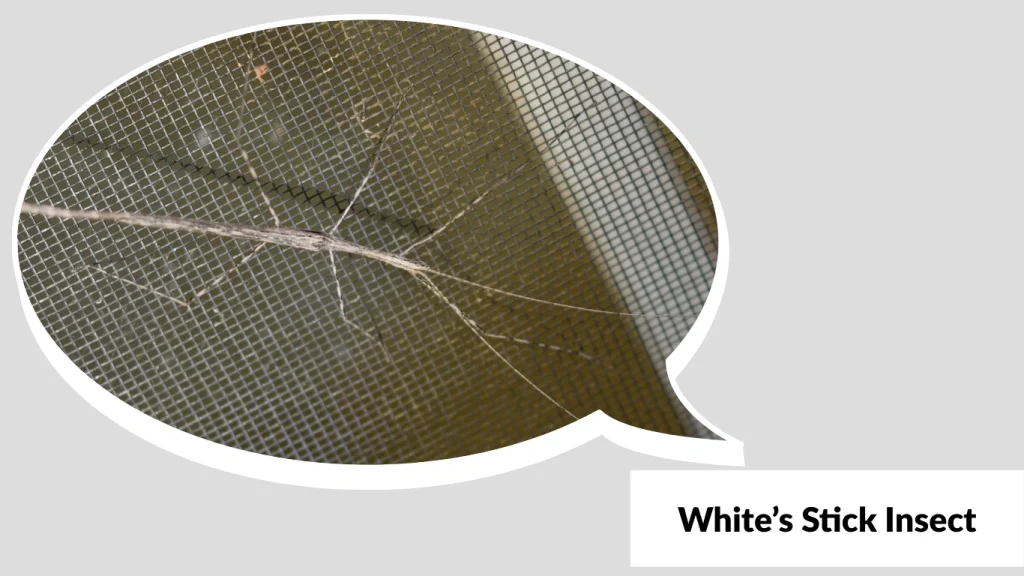
White’s Stick Insect (Tropidoderus childrenii), also known as the Children’s Stick Insect, is a striking species from Australia. Unlike most stick insects that are brown or green, this species displays bright green colors and sometimes even wing markings with splashes of pink or purple, making it more visually noticeable than many others.
Identification
- Medium-sized species, about 10–12 cm (4–5 in) long
- Bright green body, sometimes with hints of purple or pink on wings
- Leaf-like forewings in adults, used for camouflage
- Males are slimmer and capable of flight, while females are larger and heavier
- Distinctive triangular-shaped head compared to other phasmids
Behavior
White’s Stick Insects are nocturnal feeders, consuming eucalyptus and acacia leaves. During the day, they remain still, relying on their green coloration to blend into foliage. If disturbed, they may flash their brightly colored hindwings to startle predators.
Habitat
They are commonly found in eastern Australia, particularly in eucalyptus forests and woodlands. Their coloration allows them to hide among leaves effectively.
Importance
This species is often kept in captivity due to its manageable size and striking appearance. It plays an ecological role in leaf consumption and demonstrates both camouflage and defensive display strategies in insects.
10. Pink Winged Stick Insect

The Pink Winged Stick Insect (Sipyloidea sipylus) is one of the most widely distributed stick insects, often kept as a pet due to its adaptability and ease of care. Its delicate body and bright-colored wings make it stand out from many other stick insect species.
Identification
- Medium to large size, reaching up to 15 cm (6 in) long
- Slender, twig-like body, usually light green or brown
- Long, thin legs with excellent twig mimicry
- Adults have striking pink hindwings used in defense displays
- Females are wingless or short-winged, while males are fully winged and capable of flight
Behavior
Pink Winged Stick Insects are nocturnal and feed mainly on leaves such as bramble, rose, and guava. They rely heavily on camouflage but, when threatened, can flash their pink wings to surprise predators. Males may also fly short distances to escape danger.
Habitat
Native to Southeast Asia, they are also widely introduced elsewhere due to their popularity in breeding programs. They thrive in tropical forests, gardens, and areas with dense vegetation.
Importance
This species is one of the most commonly studied and kept in captivity, making it valuable for education about insect behavior and camouflage. It also contributes to leaf consumption and seed dispersal in its natural ecosystems.
11. Achrioptera manga
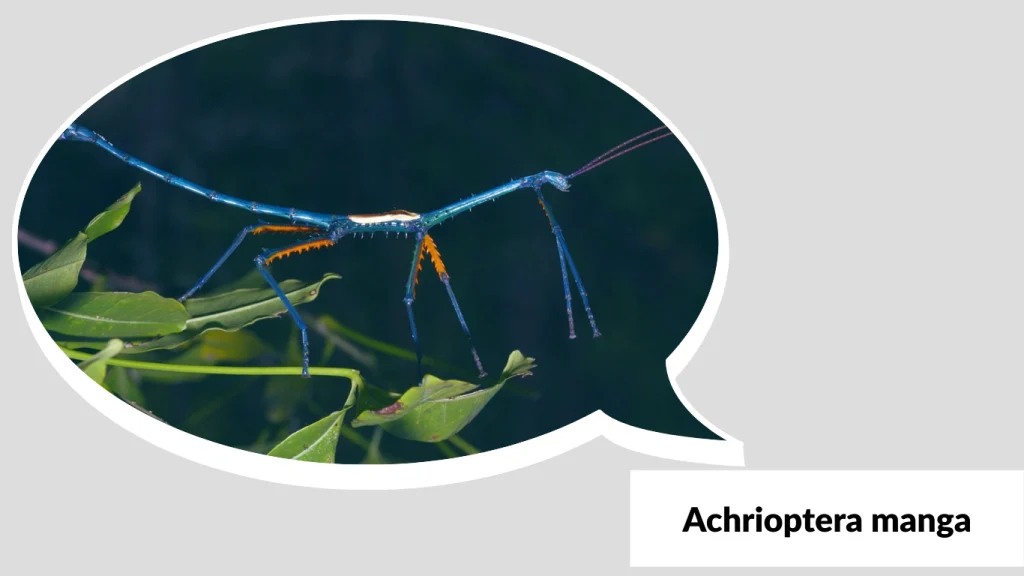
Achrioptera manga is one of the most colorful and visually striking giant stick insects, native to Madagascar. Unlike many stick insects that rely on dull brown camouflage, this species displays bright, metallic shades that make it one of the most unique members of its family.
Identification
- Large size, reaching about 20 cm (8 in) in length
- Males are brilliantly colored with metallic blue and green bodies, sometimes with red or orange markings
- Females are larger, heavier, and mostly brown for camouflage
- Slender body with long legs adapted for clinging to vegetation
- Strong contrast in sexual dimorphism (males flashy, females cryptic)
Behavior
This species is nocturnal, feeding on leaves at night. Males often rely on their coloration as a deterrent, while females depend more on camouflage. When threatened, they may sway like branches in the wind or drop to the ground to avoid predators.
Habitat
Achrioptera manga inhabits the forests of Madagascar, preferring dense foliage where it can feed on a variety of plants. The males’ colors stand out vividly in natural sunlight, while females remain concealed.
Importance
This species is highly valued in insect collections and breeding programs due to its unique colors. It also highlights the diversity of camouflage and display strategies in stick insects, from dull mimicry to bright warning-like colors.
12. Malayan Jungle Nymph
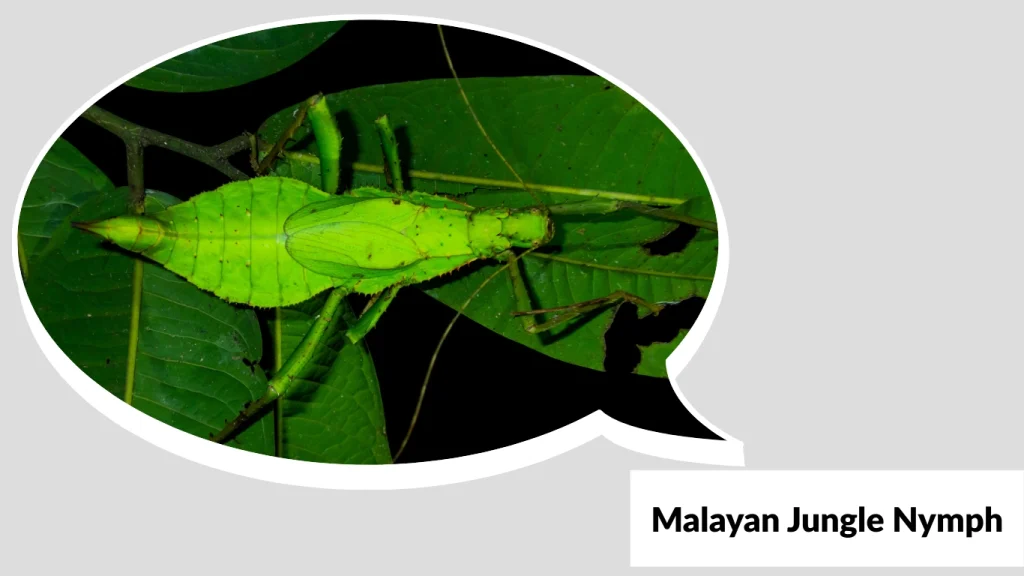
The Malayan Jungle Nymph (Heteropteryx dilatata) is often regarded as the heaviest stick insect in the world. Native to the rainforests of Malaysia, it is famous for its bulky size, bright green coloration, and thorn-covered body, which provide both camouflage and defense.
Identification
- Females are massive, reaching up to 25–26 cm (10 in) long and very heavy
- Males are smaller, slimmer, and capable of flight
- Females are bright green with broad, leaf-like wings that resemble foliage
- Males are brownish, blending in with branches
- Thorny legs and body, especially in females, act as a natural defense
Behavior
Malayan Jungle Nymphs are nocturnal, feeding on guava, bramble, and other rainforest leaves during the night. During the day, they rest motionless among leaves. When threatened, they raise their spiny legs in defense and can deliver a painful pinch to predators.
Habitat
They live in the dense tropical rainforests of Malaysia, where their coloration blends perfectly with green foliage. High humidity and lush vegetation are essential for their survival.
Importance
As the heaviest of all stick insects, this species demonstrates the extreme size diversity in phasmids. It also plays a vital role in rainforest ecosystems by feeding on plants and cycling nutrients. Its impressive appearance makes it popular in insect breeding and educational programs.
13. Phobaeticus kirbyi
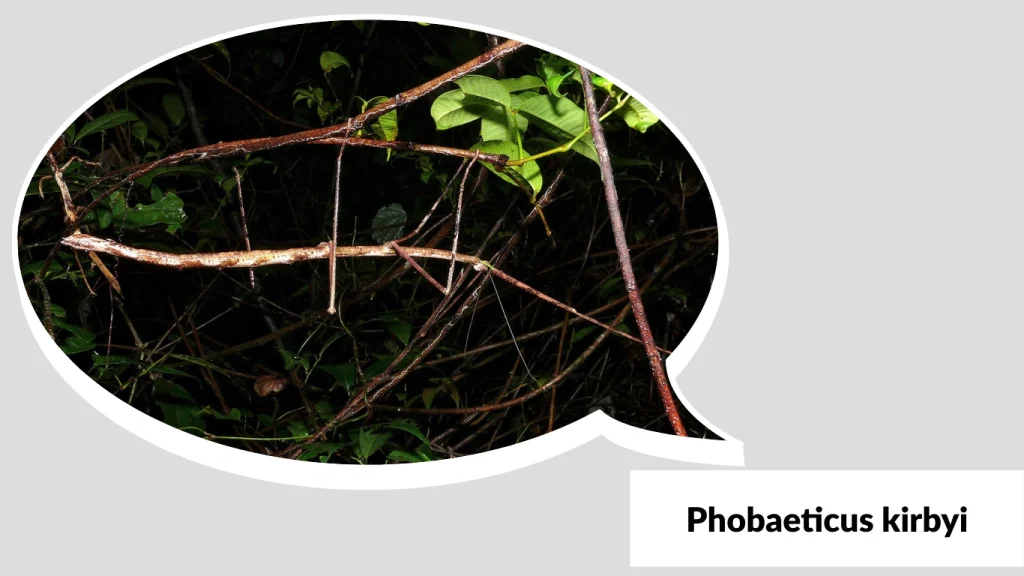
Phobaeticus kirbyi is one of the longest stick insects in the world, rivaling other record-holders like Phobaeticus chani. Native to Borneo, this species is famous for its extraordinary length and extreme twig mimicry, which makes it nearly impossible to spot in the wild.
Identification
- Females can reach up to 32 cm (12.6 in) in body length, with legs extending their total size even further
- Very slender, twig-like body perfectly adapted for camouflage
- Brown to grayish coloration, resembling dry branches
- Long, thin antennae and legs enhance twig mimicry
- Males are smaller and more delicate in structure
Behavior
This species is nocturnal, feeding on leaves at night while remaining still and camouflaged during the day. It avoids predators by swaying gently like twigs in the wind. Unlike some species, it relies entirely on mimicry rather than defensive spines or bright displays.
Habitat
Phobaeticus kirbyi inhabits the rainforests of Borneo, where dense vegetation and tall shrubs provide the perfect setting for its twig-like body.
Importance
As one of the longest insects on Earth, this species is of great interest to entomologists studying extreme adaptations in insect morphology. It also serves as a striking example of camouflage in educational contexts.
14. Pharnacia ponderosa
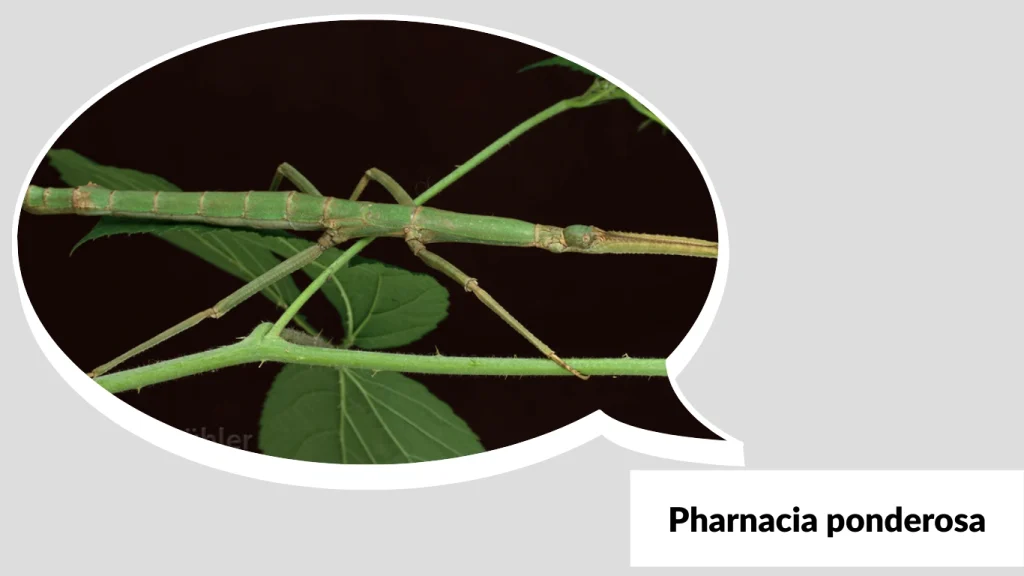
Pharnacia ponderosa is a giant stick insect species from Southeast Asia, recognized for its extreme length and delicate, branch-like appearance. Though not as famous as Phobaeticus chani or Phobaeticus kirbyi, it is still among the longest insects ever documented.
Identification
- Females can reach up to 30 cm (12 in) in length, with males being smaller
- Very slender body resembling a dry twig
- Brown to gray coloration for camouflage
- Long, thin legs and antennae that enhance twig mimicry
- Wingless in females, while males may have small functional wings
Behavior
Pharnacia ponderosa is nocturnal, staying still during the day and feeding on leaves at night. Its primary defense is perfect camouflage, swaying gently like twigs in the wind to avoid detection.
Habitat
This species inhabits tropical forests of Southeast Asia, especially in regions with dense vegetation that offers the best concealment.
Importance
Pharnacia ponderosa contributes to the diversity of record-length phasmids and is important in understanding insect adaptations for camouflage. Its remarkable twig mimicry demonstrates how evolution favors extreme morphology for survival in forest habitats.
15. Giant Thorny Stick Insect
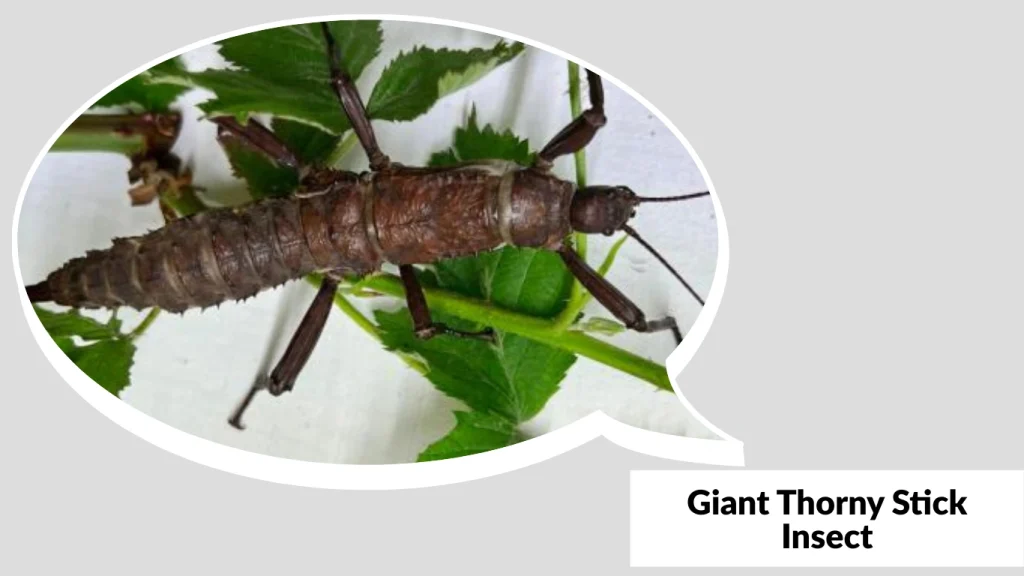
The Giant Thorny Stick Insect (Eurycantha calcarata) is a robust and heavily armored species native to Papua New Guinea. Unlike the slender twig-like stick insects, this species is stocky, spiny, and built for defense rather than delicate camouflage. Its thorny body and powerful legs make it one of the most intimidating members of the stick insect family.
Identification
- Medium to large size, reaching 13–15 cm (5–6 in) in length
- Dark brown to black body, resembling bark
- Covered with thorny spines across body and legs
- Females are larger and wingless, males slimmer with a large spine (calcar) on the hind legs
- Strong legs capable of delivering a painful defensive pinch
Behavior
This species is nocturnal, feeding on leaves such as bramble and guava at night. When threatened, it raises its spiny hind legs and can grasp predators with its thorny limbs, delivering a sharp pinch. It also releases a defensive odor to deter attackers.
Habitat
Giant Thorny Stick Insects inhabit tropical rainforests of Papua New Guinea, living in leaf litter, low shrubs, and tree trunks where their dark coloration helps them remain concealed.
Importance
This insect plays an ecological role in plant consumption and nutrient cycling. Its unusual body structure and strong defenses make it a popular species in insect collections and educational displays, demonstrating survival strategies beyond camouflage.
