

Odonata, the insect order that includes both dragonflies and damselflies, is full of fascinating species that vary in size, color, and behavior. From the powerful Darners to the delicate Jewel Damselflies, each type has its own charm. In this guide, I’ve shared all the major families of Odonata, breaking them down with simple descriptions to help you recognize and appreciate each one.
1. Aeshnidae (Darners)

Aeshnidae, commonly known as Darners, are among the largest and most powerful dragonflies in the world. Known for their swift flight and long bodies, they are often seen patrolling near water bodies, especially ponds and slow-moving streams. Darners are easily recognizable due to their size, striking coloration, and large, powerful wings.
Habitat
Darners are typically found near freshwater habitats such as lakes, marshes, ponds, and slow-flowing rivers. They prefer areas with abundant aquatic vegetation where they can lay eggs.
Behavior
They are strong fliers and are known to patrol territories aggressively. Males often guard their chosen area to mate with females and chase away rivals. These dragonflies are mostly active during the day and are excellent hunters, preying on smaller insects in flight.
Identification
- Large body size, often 6–8 cm or more in length
- Long, narrow abdomen, often with vivid blue or green markings
- Large, compound eyes that touch at the top of the head
- Clear wings with strong venation and a distinctive nodus (notch)
- Males have claspers at the end of their abdomen for mating
- Larvae are large with strong jaws, living underwater
Distribution
Darners are found on every continent except Antarctica. They are especially abundant in North America and Europe, with many species also thriving in Asia and parts of Africa.
2. Gomphidae (Clubtails)

Gomphidae, or Clubtails, are a distinct family of dragonflies named after the swollen segments at the end of their abdomens, which resemble a club. Unlike many other dragonflies, their eyes do not meet at the top of the head, giving them a unique appearance.
Habitat
Clubtails are commonly found along rivers, streams, and sometimes lakes with clean, flowing water. The larvae live buried in sandy or silty substrates.
Behavior
Clubtails are less conspicuous than other dragonflies and are often seen perching low on the ground or vegetation. They fly low and fast, hunting small insects with precision.
Identification
- Medium to large size
- Club-shaped tip of the abdomen in many species
- Widely spaced eyes (do not touch at the top)
- Usually dull-colored (brown, green, black) with pale markings
- Wings held flat when perched
- Larvae with flat bodies and short antennae
Distribution
Found worldwide, especially in temperate regions. They are well-represented in North America and Europe.
3. Libellulidae (Skimmers)
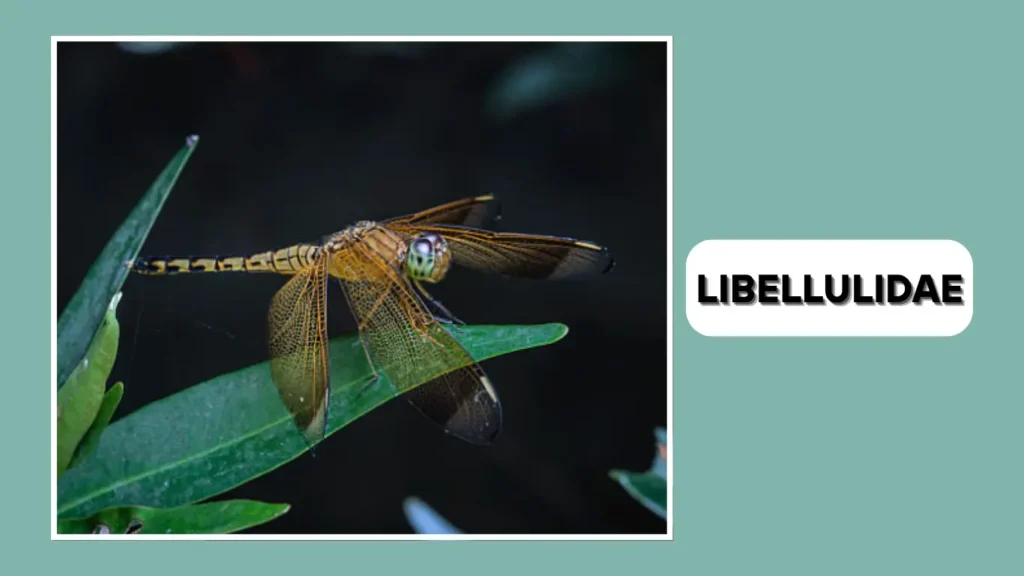
The Libellulidae family, commonly known as Skimmers, is the largest and most diverse dragonfly family. They are known for their bright colors, patterned wings, and widespread presence across various freshwater habitats.
Habitat
Skimmers inhabit a wide range of still or slow-moving water bodies including ponds, marshes, lakes, and ditches. Many species are tolerant of disturbed or artificial habitats.
Behavior
They are active fliers, often seen basking in the sun or darting over water. Males typically defend small territories, and mating occurs in flight followed by egg-laying in water.
Identification
- Medium to small body size
- Bright colors (red, blue, yellow, black)
- Wings may have distinctive spots or bands
- Eyes usually touch at the top
- Perch frequently on twigs, grass, or rocks
- Larvae are squat and adapted to muddy or still water
Distribution
Libellulidae are found on every continent except Antarctica, with especially high diversity in tropical and subtropical regions.
4. Corduliidae (Emeralds)

Corduliidae, commonly called Emeralds, are named for their metallic green or bronze sheen, especially noticeable on the thorax. They are graceful fliers and often found near clean, well-vegetated water bodies.
Habitat
Emeralds prefer habitats like bogs, forested swamps, ponds, and lakes with clear water. Their larvae typically develop in submerged vegetation or in bottom sediments.
Behavior
They are strong, fast fliers and often patrol sunny areas near water. Some species are crepuscular (active at dusk). Males tend to hover and patrol territories while females remain hidden until mating.
Identification
- Medium-sized with slender bodies
- Metallic green or bronze thorax and abdomen
- Clear wings with dark veins
- Bright green or blue eyes
- Wings held flat at rest
- Larvae with long legs and hairy bodies for camouflage
Distribution
Most common in North America and Europe, especially in cooler climates. A few species are also found in Asia and northern Africa.
5. Cordulegastridae (Spiketails)

Cordulegastridae, known as Spiketails, are large, striking dragonflies often seen flying near forested streams. They are named for the long, pointed ovipositors that females use to lay eggs into sand or mud.
Habitat
They inhabit fast-flowing, shaded streams and forested creeks. The larvae live buried in gravel or sandy substrates.
Behavior
Spiketails are powerful, swift fliers that often patrol long stretches of forested water. Females use their sharp ovipositor to insert eggs deep into streambeds. Adults are usually solitary and territorial.
Identification
- Large and robust body
- Distinctive black and yellow body patterns
- Long ovipositor in females
- Clear wings with strong veins
- Eyes touch at the top of the head
- Larvae with strong legs and burrowing adaptations
Distribution
Primarily found in North America, Europe, and parts of Asia. They favor cooler, forested regions with clean streams.
6. Macromiidae (Cruisers)

Macromiidae, commonly known as Cruisers, are sleek dragonflies named for their habit of cruising long distances along watercourses without resting. Their bodies are long and narrow, often with yellow and black stripes.
Habitat
Cruisers favor large rivers, streams, and lakes with clear water and moderate to fast flow. Larvae are typically found in sandy or silty substrates along river margins.
Behavior
These dragonflies are almost always in flight, rarely perching. They patrol long stretches of water and are excellent hunters. Males often patrol territories for mates, while females are more secretive.
Identification
- Long, slender body with yellow and black striping
- Bright green eyes that may just touch at the top
- Clear wings with strong venation
- Constant flyers; rarely seen perching
- Larvae are long-legged and burrow into sediment
Distribution
Mostly found in North America and Asia. Some species are also present in Europe. They prefer warm climates with abundant freshwater systems.
7. Synthemistidae (Tigertails)

Synthemistidae, known as Tigertails, are small to medium-sized dragonflies with bold, tiger-like patterns. They are mostly found in Australia and parts of Southeast Asia.
Habitat
Tigertails inhabit forest streams, alpine creeks, and temporary pools, depending on the species. They are adapted to a variety of freshwater habitats, often in hilly or mountainous areas.
Behavior
They are agile fliers and may perch frequently on rocks or vegetation. Males patrol territories in a fluttery, hovering style, and some species are active even in cooler temperatures.
Identification
- Medium-sized with bold black and yellow or orange markings
- Eyes may be separated or narrowly touching
- Wings usually clear but may have small dark patches
- Perch frequently and are easily observed
- Larvae have long spines and often cling to submerged surfaces
Distribution
Primarily in Australia, with a few species extending into New Guinea and Southeast Asia. They are most common in forested and upland areas.
8. Austropetaliidae (Stream Cruisers)
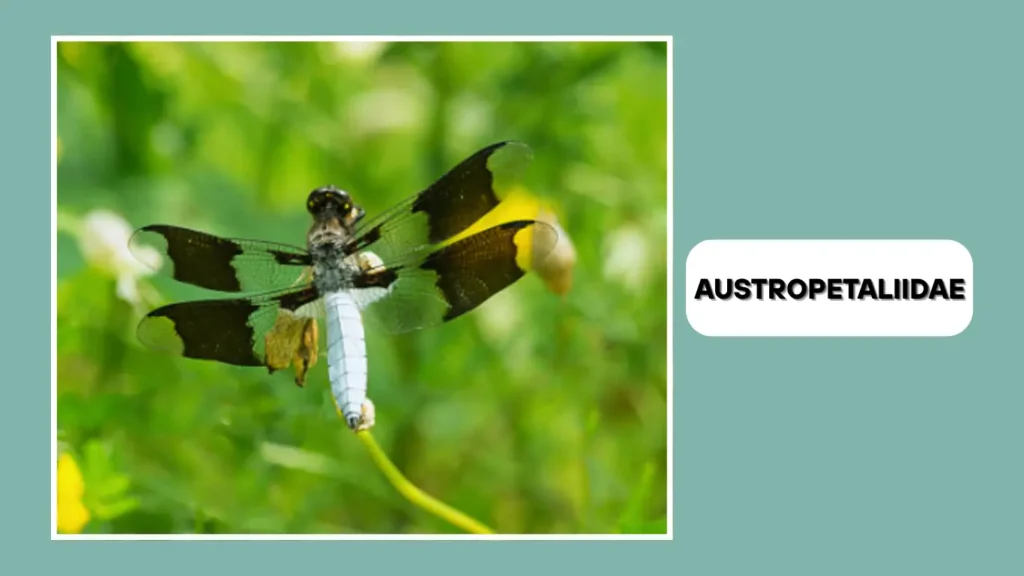
Austropetaliidae, commonly referred to as Stream Cruisers, are a small and rare family of dragonflies primarily found in the Southern Hemisphere. They are known for inhabiting high-altitude forest streams and cool, mountainous areas.
Habitat
They favor cold, clean, fast-flowing streams in mountainous or forested environments. The larvae are aquatic and develop in shallow riffles or pools along streambeds.
Behavior
Stream Cruisers are strong fliers that patrol along creeks and forest openings. Adults may rest on foliage or hover in sunny patches. They are elusive and not often seen in large numbers.
Identification
- Medium to large in size
- Brown to dark body coloration with pale markings
- Eyes often meet at the top of the head
- Clear wings with noticeable veins
- Larvae live under stones in cool, shallow streams
- Found at higher elevations and cooler habitats
Distribution
Primarily restricted to Australia, Chile, and Argentina. They are considered relict species, with very few representatives worldwide.
9. Petaluridae (Petaltails)

Petaluridae, or Petaltails, are among the most ancient lineages of dragonflies. They are large, slow-flying insects with a primitive appearance and are considered living fossils.
Habitat
Petaltails typically live near seeps, bogs, and small spring-fed streams. Their larvae often live in moist soil or moss rather than fully submerged aquatic environments.
Behavior
They fly slowly and deliberately, often close to the ground. Unlike most dragonflies, petaltails perch vertically on tree trunks or vegetation. Their behavior is more secretive, and they are rarely seen in large numbers.
Identification
- Very large size (some over 10 cm long)
- Dark body with pale striping
- Eyes widely separated on the head
- Wings clear with strong venation
- Larvae are semi-terrestrial, living in wet soil or moss
- One of the most primitive dragonfly families
Distribution
Found in North America, Japan, and eastern Australia. Each region typically has only one or two rare species, often with highly localized populations.
10. Calopterygidae (Broad-winged Damselflies)
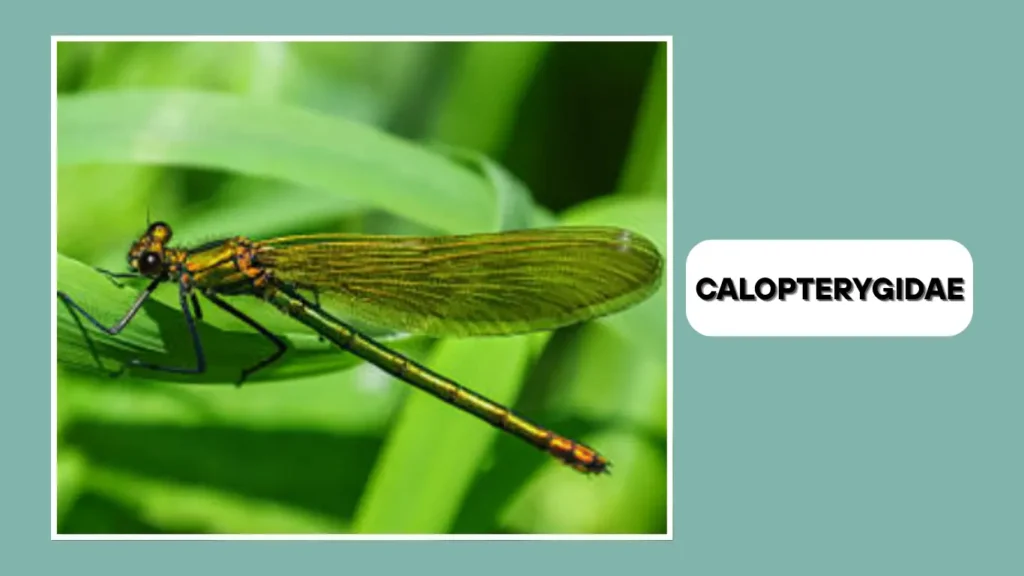
Calopterygidae, known as Broad-winged Damselflies, are some of the most visually striking damselflies. They are often metallic in color with broad, sometimes colored or patterned wings, giving them a butterfly-like appearance in flight.
Habitat
They prefer slow-moving or still waters such as streams, creeks, and shaded riverbanks, especially in forested areas. Larvae develop in clean, well-oxygenated water.
Behavior
Males are highly territorial and often perform fluttering, aerial displays to attract females. These damselflies frequently perch on leaves or rocks, wings spread, and are active during sunny hours.
Identification
- Medium to large size for a damselfly
- Metallic blue, green, or copper bodies
- Broad wings often colored or marked, held partially open when perched
- Eyes set apart on the sides of the head
- Larvae with long legs and three fan-like tail appendages
Distribution
Widespread across North America, Europe, Africa, and Asia, especially in wooded and temperate regions.
11. Coenagrionidae (Narrow-winged Damselflies)
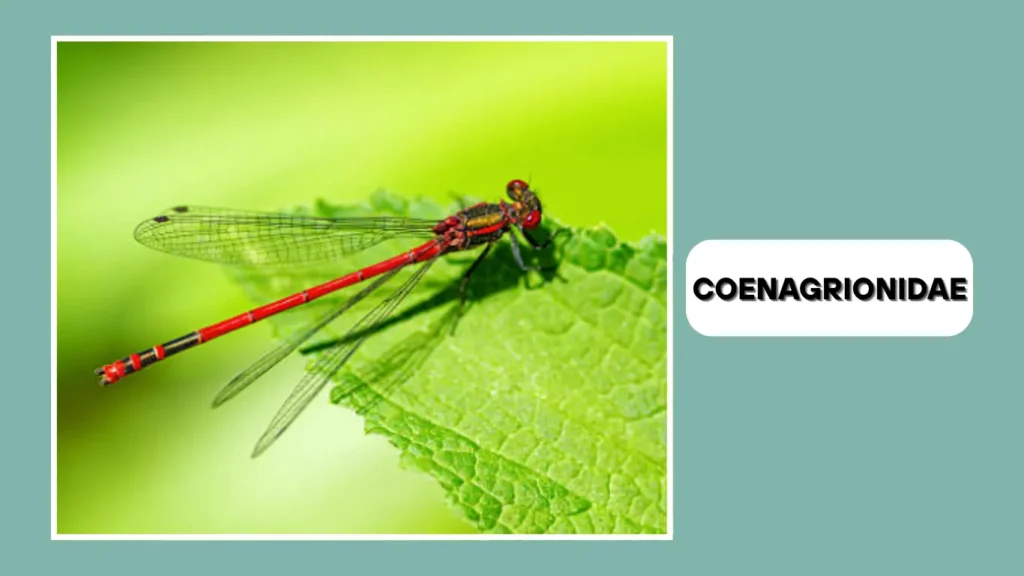
Coenagrionidae, commonly called Narrow-winged Damselflies, is the largest damselfly family. These damselflies are slender, often brightly colored, and can be found in a wide variety of habitats.
Habitat
They thrive in almost any still or slow-moving water body—ponds, lakes, marshes, ditches, and even artificial water sources. They are highly adaptable and common in both rural and urban environments.
Behavior
Coenagrionid damselflies are active fliers, often seen in large numbers. Males are territorial and may chase rivals. They typically perch with wings held close together above the abdomen.
Identification
- Small to medium size
- Slender, stick-like bodies
- Bright blue, red, green, or yellow markings (depending on species)
- Wings narrow and transparent, held above the body at rest
- Eyes widely spaced
- Larvae slim-bodied with three long gills at the end
Distribution
Found worldwide, from tropical rainforests to temperate ponds. Especially diverse in North America, Europe, and Asia.
12. Lestidae (Spreadwings)

Lestidae, commonly known as Spreadwings, are unique among damselflies for their habit of resting with their wings partially or fully open—unlike most damselflies, which hold wings closed above the body.
Habitat
They prefer still or slow-moving waters such as ponds, marshes, temporary pools, and ditches. Spreadwings often breed in shallow waters with emergent vegetation.
Behavior
Spreadwings are typically slower and more relaxed fliers. They often perch on reeds or grasses with wings spread. Mating and egg-laying take place in tandem, with eggs inserted into plant stems.
Identification
- Medium to large body size for a damselfly
- Slender body, usually bronze, metallic green, or brown
- Wings held partially open when perched
- Eyes spaced far apart
- Larvae are elongate with three broad gill appendages
Distribution
Found worldwide, especially common in North America and Europe. Many species are also found in Asia and Africa.
13. Platycnemididae (White-legged Damselflies)
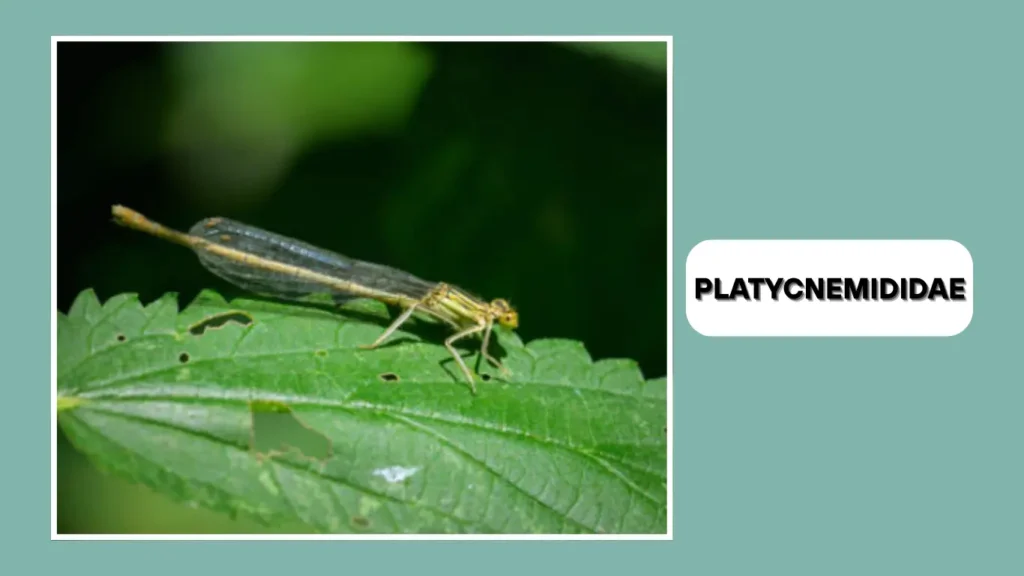
Platycnemididae, or White-legged Damselflies, are named for the widened, pale-colored tibiae (lower leg segments) of the males, which resemble paddles or flags used in display.
Habitat
They typically inhabit slow-flowing rivers, streams, and large ponds with abundant vegetation. They prefer clean, well-oxygenated water and are sensitive to pollution.
Behavior
Males display their enlarged legs during courtship to attract females. These damselflies perch often and are most active in warm, sunny weather. They may gather in loose groups along riverbanks.
Identification
- Medium-sized body
- Widened, pale or white-colored legs in males
- Generally pale blue, green, or tan body colors
- Wings held together above the abdomen when at rest
- Eyes well-separated
- Larvae are slender with long tail gills
Distribution
Found primarily in Europe, Africa, and parts of Asia. Some species are highly localized, making them important indicators of habitat quality.
14. Protoneuridae (Threadtails)

Protoneuridae, commonly known as Threadtails, are delicate damselflies with extremely slender bodies and long tails, giving them a needle-like appearance. They are often overlooked due to their small size and shy behavior.
Habitat
Threadtails prefer shaded, slow-moving forest streams and small creeks. They are sensitive to habitat changes and usually found in pristine, undisturbed environments.
Behavior
They are weak fliers and tend to stay close to the water or low vegetation. Males are often seen perching quietly, while females remain well-hidden until mating. Their subtle behavior makes them difficult to spot.
Identification
- Small and extremely slender body
- Mostly pale-colored or with light striping
- Narrow, clear wings held above the body at rest
- Eyes small and widely spaced
- Larvae are delicate with long, narrow gills
Distribution
Primarily found in tropical and subtropical regions of Asia, Africa, and Central and South America. Many species are endemic to small areas.
15. Megapodagrionidae (Flatwings)
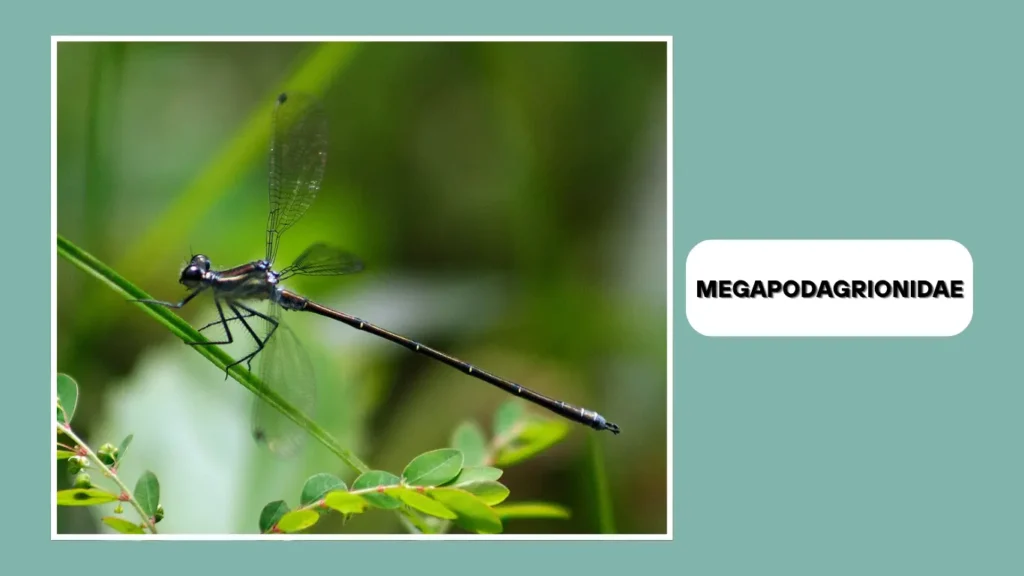
Megapodagrionidae, commonly called Flatwings, are a group of damselflies that rest with their wings fully spread out to the sides, much like dragonflies—a trait unusual for damselflies.
Habitat
Flatwings inhabit forest streams, mountain brooks, and shaded water bodies, particularly in humid, tropical environments. The larvae are aquatic and live among submerged vegetation or rocks.
Behavior
They are slow, deliberate fliers and often perch with wings outspread. Males and females may be seen basking in filtered sunlight, often in quiet, undisturbed areas.
Identification
- Medium to large damselflies
- Wings held flat and outstretched when resting
- Dark or metallic-colored bodies
- Broad thorax with long legs
- Larvae typically robust with large gill appendages
Distribution
Mainly found in Central and South America, Southeast Asia, and the Pacific islands. They are most diverse in rainforest regions.
16. Chlorocyphidae (Jewel Damselflies)
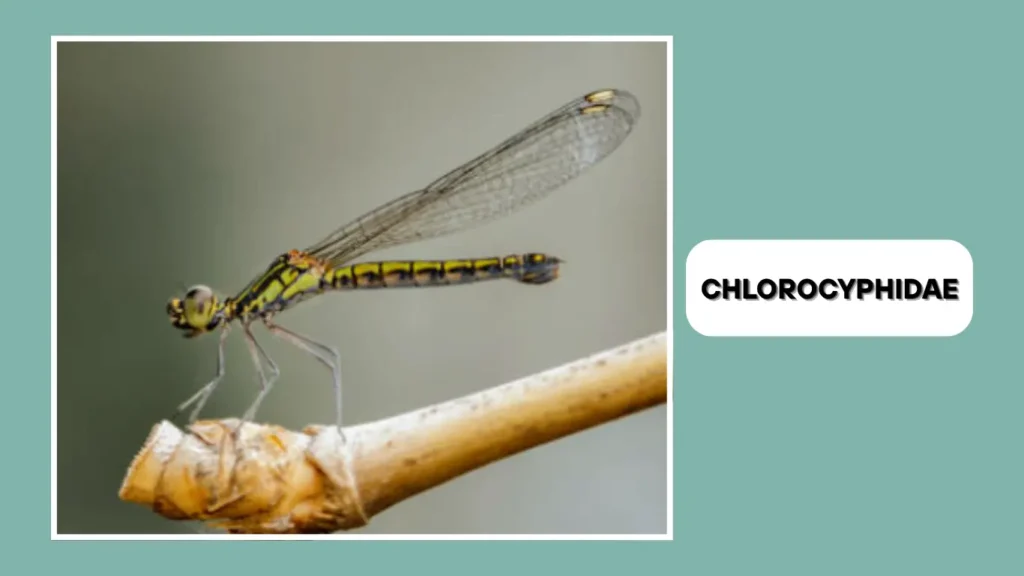
Chlorocyphidae, commonly known as Jewel Damselflies, are among the most colorful and visually stunning damselflies. Males often display brilliant metallic hues and engage in striking courtship displays.
Habitat
They are typically found along fast-flowing forest streams and rivers, especially in tropical rainforests. They favor sunny spots along shaded watercourses.
Behavior
Males perch on rocks, leaves, or twigs near water to guard territories and display to females. Their brilliant coloration and fluttering flight are part of complex mating rituals. They are often solitary or in small groups.
Identification
- Small to medium-sized
- Metallic blue, red, green, or gold body colors
- Often have boldly marked or darkened wings
- Wings held together when at rest
- Eyes are large and well-separated
- Larvae adapted to flowing water habitats
Distribution
Most common in Africa and Southeast Asia, especially in tropical rainforests. Some species are highly localized and sensitive to habitat disturbance.
17. Euphaeidae (Gossamerwings)
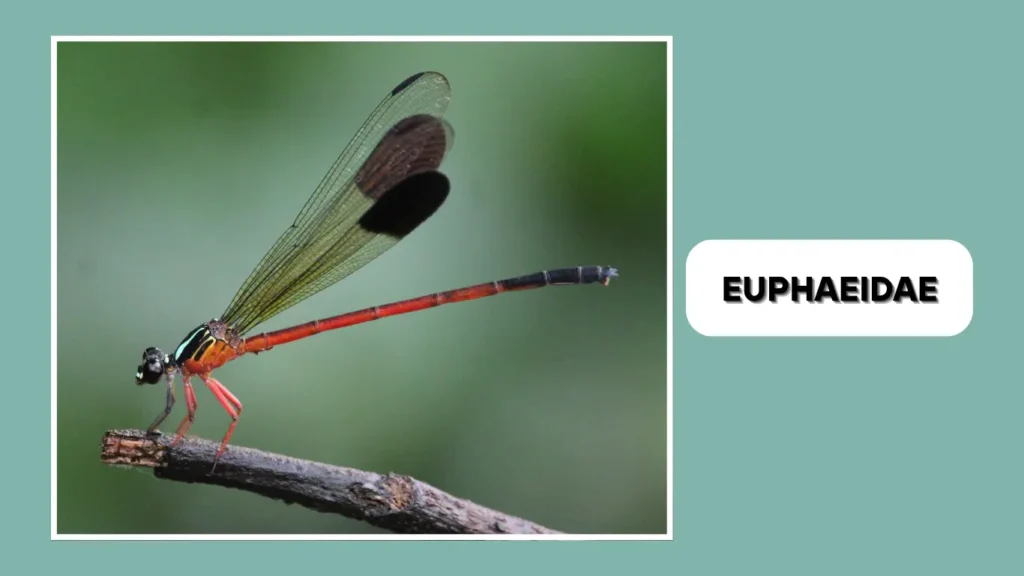
Euphaeidae, known as Gossamerwings, are elegant damselflies with soft, broad wings that often appear smoky or tinted. They are graceful in flight and often mistaken for butterflies at a distance.
Habitat
They prefer forested streams and rivers, often in hilly or mountainous terrain. Their presence is an indicator of good water quality and minimal habitat disruption.
Behavior
These damselflies are active during the day, often seen fluttering gently over water or perching in sunny gaps in the forest canopy. Males are territorial and perform courtship displays involving slow, floating flights.
Identification
- Medium to large body size
- Broad, tinted wings with a silky or smoky appearance
- Often metallic green, blue, or copper bodies
- Wings held above the body at rest
- Larvae are streamlined, well-adapted to clean, flowing water
Distribution
Found mainly in Asia, especially in India, Southeast Asia, and parts of China. Some species are also present in Central America and tropical Africa.
18. Amphipterygidae (Flatwings)
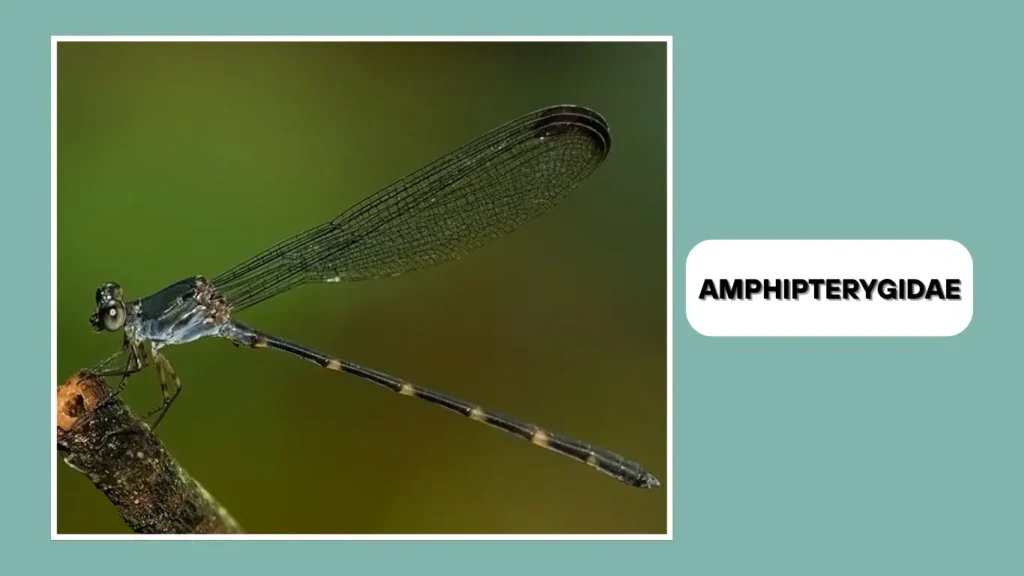
Amphipterygidae, often referred to simply as Flatwings, are primitive damselflies with a distinctive resting posture—holding their wings flat like dragonflies. Though sometimes confused with Megapodagrionidae, they are a separate and smaller family.
Habitat
They inhabit clear, shaded forest streams and seeps in tropical and subtropical regions. These damselflies are closely tied to pristine environments with high humidity and minimal disturbance.
Behavior
Flatwings are shy and inconspicuous. They tend to perch quietly on vegetation near water, holding their wings flat and motionless. Males may guard territories or hover near females during mating.
Identification
- Small to medium size
- Delicate body structure
- Wings held horizontally at rest
- Typically dull-colored with occasional metallic highlights
- Eyes widely spaced
- Larvae live in clean, shaded streams
Distribution
Primarily found in Central and South America and parts of southern Mexico. A few species also occur in Southeast Asia.
19. Synlestidae (Sylphs)

Synlestidae, commonly known as Sylphs, are graceful, long-bodied damselflies with a metallic sheen. Many species hold their wings partially open at rest, giving them a distinct look.
Habitat
They are found near forest streams, springs, and sometimes temporary pools in mountainous or hilly terrain. These habitats are often shaded and rich in plant life.
Behavior
Sylphs are agile fliers and frequently perch on twigs or leaves overhanging water. Some species are known to be more tolerant of slightly disturbed habitats, though many still prefer undisturbed areas.
Identification
- Medium to large, slender damselflies
- Often metallic green, blue, or bronze
- Wings usually held half-open at rest
- Long legs and elongated thorax
- Larvae inhabit clean, rocky-bottomed streams
Distribution
Mainly distributed in Africa, Australia, and Southeast Asia. Some species are also present in New Guinea and surrounding islands.
